High prevalence of somatic symptoms
and depression in women with disabling
chronic headache
G.E. Tietjen, MD; J.L. Brandes, MD; K.B. Digre, MD; S. Baggaley, MS, FNP; V. Martin, MD;
A. Recober, MD; L.O. Geweke, MD; F. Hafeez, MD; S.K. Aurora, MD; N.A. Herial, MD, MPH;
C. Utley, MSN, CNP; and S.A. Khuder, PhD
Abstract—Objective:To better define, in women with headache, the relationship of depression and somatic symptoms to headache, characterized by diagnoses, frequency, and disability.Methods: At six headache specialty clinics, women with headache were classified using ICHD-II criteria, and frequency was recorded. A questionnaire addressing demographics, age at onset of headache, headache-related disability, somatic symptom, and depression severity was completed. Logistic regression was performed to measure the associations of headache frequency and headache-related disability with somatic symptom and depression severity.Results:A total of 1,032 women with headache completed the survey, 593 with episodic (96% with migraine) and 439 with chronic headache (87% with migraine). Low education and household income was more common in chronic headache sufferers and in persons with severe headache disability. Somatic symptom prevalence and severity was greater in persons with chronic headache and with severe headache-related disability. Significant correlation was observed between PHQ-9 and PHQ-15 scores (r ⫽ 0.62). Chronic headache, severe disability, and high somatic symptom severity were associated with major depressive disorder (OR⫽25.1, 95% CI: 10.9 to 57.9), and this relationship was stronger in the subgroup with a diagnosis of migraine (OR⫽31.8, 95% CI: 12.9 to 78.5).Conclusions:High somatic symptom severity is prevalent in women with chronic and severely disabling headaches. Synergistic relationship to major depression exists for high somatic symptom severity, chronic headache, and disabling headache, suggesting a psychobio-logical underpinning of these associations.
NEUROLOGY 2007;68:134–140
The nature of the relationship of depression and
headache has been of great interest, given the high
prevalence
1,2and expense
3of both conditions, and
the increased frequency in which they co-occur.
4,5Painful symptoms may provoke
6or be a
manifesta-tion of major depression,
7and depression may
heighten pain perception.
8Findings of a bidirectional
influence between migraine and major depression
suggest a common neurobiology.
5Regardless of the
mechanism of migraine-depression relationship,
psy-chiatric disease complicates headache management
and portends a poorer prognosis for headache
treatment.
9,10Somatic symptoms in headache patients are less
well studied than psychological symptoms. Persons
with somatic symptoms account for a sizable portion
of patients presenting to primary care
11and
subspe-cialty practices.
12In some cases somatic symptoms
are due to underlying medical conditions, although
the pathophysiology of many of these syndromatic
disorders remains ill-defined. Although
controver-sial,
13,14idiopathic somatic symptoms have also been
recognized as a possible manifestation of psychiatric
disease, termed somatoform disorder.
15A recent
study in a referral headache population reported
so-matic symptoms to be significantly more common in
patients with chronic (as compared to episodic)
head-ache, and in those with associated depression.
16Lim-itations of this study include small sample size, lack
of use of standardized criteria to make psychiatric
diagnoses, and absence of data on income and
educa-tion, established confounding variables.
17The primary purpose of our study is to better
de-fine, within a population of women seeking
treat-ment
in
headache
subspecialty
clinics,
the
relationship of headache, characterized by type,
fre-quency, and disability, to current depression and
so-matic symptoms.
Methods. Patient selection. The recruiting phase of this cross sectional survey of headache clinic patients took place between June 2003 and December 2004 in six outpatient headache centers. A pilot study from the research consortium of the American Head-ache Society Women’s Issue’s Section on depression, somatic symptoms, and domestic violence in headache, this study’s
sam-From The University of Toledo (G.E.T., F.H., N.A.H., C.U., S.A.K.), OH; Nashville Neuroscience Group (J.L.B.), TN; The University of Utah (K.B.D., S.B.), Salt Lake City; The University of Cincinnati (V.M.), OH; The University of Iowa (A.R., L.O.G.), Iowa City; and Swedish Medical Center (S.K.A.), Seattle, WA. Funded in part by the American Headache Society.
Disclosure: The authors report no conflicts of interest.
Received June 1, 2006. Accepted in final form September 28, 2006.
pling frame was restricted to women. The reason was that women comprise about 85% of the clinics’ population, and the literature suggests that women are much more frequently victims of domes-tic violence. Pardomes-ticipants were examined by a headache specialist, who during the encounter determined the patient’s eligibility for the study and invited them to participate. Participation in the study was offered to consecutive women using the following inclu-sion criteria: women with primary headache disorder as defined by the International Classification of Headache Disorders (ICHD)-II18criteria, 18 years and older, willingness to complete a
self-administered electronic questionnaire on a Personal Digital Assistant (PDA), e.g., the Palm handheld device. Exclusion crite-ria included the following: not physically well enough to complete an electronic questionnaire on a PDA, not literate in English. Patients were provided with an IRB approved information sheet that described the purpose of the study, voluntary nature of the study, study aims, methods, and population, and were given op-portunity to ask questions. After consenting to participate in the study, the physician entered the primary headache diagnosis, based on the ICHD-II criteria, and the average monthly headache frequency over the prior 3 months,⬍15 days, orⱖ15 days. Per the instruction of the ICHD-II manual we had physicians diagnose antecedent migraine type in addition to other primary headache types. Given that the criteria for chronic migraine were under debate at the time of this study, we recorded the number of days of headache rather than use a complications of migraine diagno-sis. The physician or the study personnel provided the subjects with verbal instructions and a brief demonstration to complete the remainder of the survey. A written instruction sheet was also provided to the subjects.
Measures. In keeping with recent recommendation for re-search in headache and psychiatric comorbidity,19 we used
ICHD-II diagnostic headache criteria and reliable, validated ques-tionnaires with clinically relevant cut-off scores to classify headache-related disability (Headache Impact Test [HIT-6]),20
de-pression (Patient Health Questionnaire [PHQ]-9),21 and somatic
symptoms severity (PHQ-15).22
HIT-6. The HIT-6, a six-item scale, which correlates well with headache severity,23has been determined to be reliable and
valid in evaluating the impact of headache on health-related qual-ity of life in patients seeking primary and headache subspecialty care.24HIT-6 produces a score ranging from 36 to 78. Severity of
impact was graded as little or no impact for score ⱕ49, some impact for 50 to 55, substantial impact for 56to 59, and very severe impact for a scoreⱖ60.
PHQ-9. The PHQ-9 is a self-reported diagnostic and severity measure for current (in the prior 2 weeks) depression using crite-ria from the Diagnostic and Statistical Manual of Mental Disor-ders (DSM-IV). It has been demonstrated to have superior validity criterion for the diagnosis of major depressive disorder compared to two other established depression screening questionnaires,25
and it can detect changes over time,26 and detect subthreshold
depression.27The five levels of depression severity based on the
PHQ-9 scores were minimal for scores 0 to 4, mild for scores 5 to 9, moderate for scores 10 to 14, moderately severe for scores 15 to 19, and severe for scores 20 and above. A study has shown that PHQ-9 scores ofⱖ15 are associated with 68% sensitivity and 95% specificity in diagnosing major depressive disorder using DSM-IV criteria.21PHQ-9 scores between 10 and 14 were associated with
other depressive disorder and scoresⱕ10 represented no depres-sive disorder. Other depresdepres-sive disorder is defined as a depresdepres-sive disorder whose criteria encompass fewer symptoms than are re-quired for any specific DSM-IV diagnoses.21
PHQ-15. The PHQ-15 is a self-administered validated ques-tionnaire that measures somatic symptom type and severity over the prior 4 weeks. Each of 15 symptoms were graded by the patient as not bothered at all (scored as 0), bothered a little (scored as 1), or bothered a lot (scored as 2). The PHQ-15 is scored, with the total allowing ranking of somatic symptoms severity as minimal for 0 to 4, low for 5 to 9, medium for 10 to 14, and high for 15 to 30. Both the PHQ-9 and the PHQ-15 are derived from the self-administered Patient Health Questionnaire of the PRIME-MD (Pfizer Inc., New York, NY) used for making criteria-based diagnoses of mental disorders.28
Data collection. The electronic questionnaire was designed with Pendragon Forms 3.2 computer software (Pendragon Soft-ware Corporation, Libertyville, IL) and addressed the following
topics: age, race, household income, highest educational level at-tained, total number of people in the household, age at onset of headaches, impact of headaches on daily life, and severity of de-pression and somatic symptoms. There were no personal health identifiers in the questionnaire. The questions were formatted as forced-response items (each item requires a response in order to proceed to the next item) to minimize data entry errors and elim-inate missing items. For questions on race, education, and income, an option of “I choose not to answer” was provided for individuals who wanted to withhold this information. The average time taken for completion of the survey was 15 minutes. The physician or the study personnel entered a security code to indicate completion of the survey and for secure data transmission. Data were uploaded to secure central database by synchronizing the PDAs with an Internet-enabled computer using Pendragon SyncServer computer software (Pendragon Software Corporation). The database was maintained with technical support at the University of Toledo Health Science Campus, the primary site for the study. A total of 1,032 surveys were collected from all six centers, which recruited during periods ranging from 6 weeks to 9 months. Names of the individual centers and number of surveys contributed from each are as follows: University of Toledo, OH (189 surveys), Nashville Neuroscience Group, TN (424 surveys), University of Cincinnati, OH (92 surveys), University of Utah Medical Center, Salt Lake City (222 surveys), University of Iowa Hospitals, Iowa City (63 surveys), and Swedish Medical Center, Seattle, WA (42 surveys). Information on race was not available in 2 surveys, on education in 8 surveys, and on household income in 79 surveys as patients selected the “I choose not to answer” option for these survey items. Information on the primary headache diagnosis was missing in 8 surveys.
Statistical analysis. Analysis of categorical data was done us-ing 2 or Fisher exact test and evidence of trends in binomial
proportions was examined using Cochran-Armitage test statistic. For data with deviation from normality and for analysis of the HIT-6, PHQ-15, and PHQ-9 scores, nonparametric tests including Spearman rho correlation test to examine the relation between the scores were utilized. Multivariate logistic regression analysis adjusting for significant confounders was performed to measure the association of depression and somatic symptom severity with headache frequency and headache-related disability. OR and 95% CI were used to measure the strength of the associations between dependent and predictor variables. Significance of the ORs was examined using Wald’s 2 statistic and Hosmer and Lemeshow
test was used to assess the fit of the regression models.29 The
multicenter sampling frame of this study was taken into account in the analysis by including the centers as a categorical covariate in the estimations procedures. All statistical hypotheses were tested at 0.05 level of significance, and the analysis was per-formed using SAS version 9.1 (SAS Institute, Inc., Cary, NC).
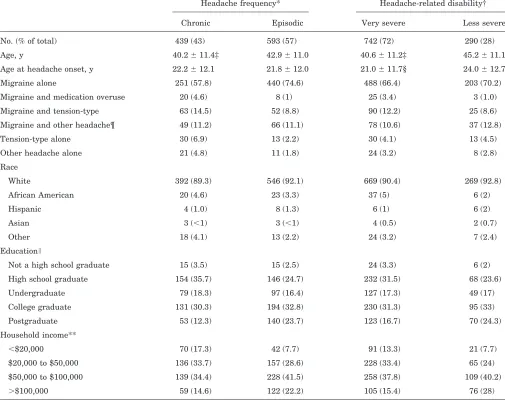
Results. A total of 1,032 women, aged 18 years and older (mean⫽42 years, SD⫽11.2), from six different headache clinics, completed the survey. Approximately 10% of those asked did not participate, usually because of acute head-ache or lack of time following the visit. Very few persons (⬍1%) who started the survey did not complete it. Every survey was included in the analysis as there were no miss-ing data in patient responses due to the forced-response design of the PDA program. Participants from one of the centers (University of Toledo Health Science Campus) were relatively younger (mean⫽38 years, SD⫽ 11), but all the other demographic information was similar across the centers. Migraine was diagnosed in over 90% of the participants. A quarter of the migraineurs also had a sec-ond headache diagnosis, usually tension-type headache (table 1).
educa-tion (p⬍ 0.001) and lower household income (p⬍ 0.001) compared to those with episodic headaches. Low education and income levels were associated with increased head-ache frequency and vice versa. These associations re-mained significant after adjusting for depression (as measured by PHQ-9) and also after adjusting for somatic symptom severity (as measured by PHQ-15).
Seventy-two percent (n ⫽ 742) of the women in this study reported having very severe headache impact (HIT-6 scoreⱖ60), with higher proportion in the chronic headache group (88% vs 60%, p ⬍ 0.001). Women reporting very severe impact were significantly younger at the time of enrollment and also reported onset of headaches at an earlier age. Women with very severe impact reported lower household income and lower education levels. The associa-tion of increased impact with low income levels remained significant after adjusting for either depression or somatic
symptom severity, whereas this was not true with education.
In separate analyses, women at lower education levels had higher scores on PHQ-9 (2⫽32.8,df⫽4,p⬍0.001) and PHQ-15 (2 ⫽ 29.9, df ⫽ 4, p ⬍ 0.001). Similarly, women at lower income levels revealed high PHQ-9 (2⫽ 57.6,df⫽3,p⬍0.001) and PHQ-15 (2⫽35.5,df⫽3,p⬍ 0.001) scores.
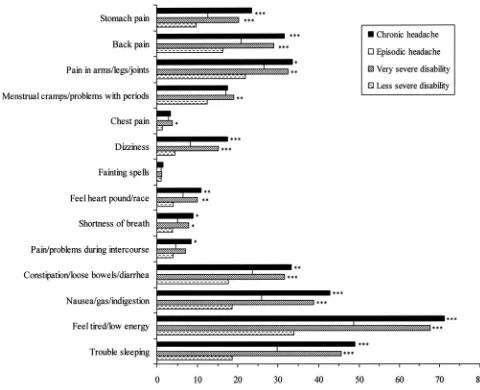
Somatic symptom severity as measured on the PHQ-15 was reported as high in 31%, medium in 39%, low in 27%, and minimal in 4% of the study population. Univariate analysis of each of the 14 non-headache symptoms in the PHQ-15 revealed that 11 items were more commonly en-dorsed (i.e., “bothered a lot”) by women with chronic head-ache compared to those with episodic headhead-ache (figure). Adjusting for age, education, and income in multivariate regression models, eight of these symptoms were
signifi-Table 1Study population characteristics (n⫽1,032)
Headache frequency* Headache-related disability† Chronic Episodic Very severe Less severe No. (% of total) 439 (43) 593 (57) 742 (72) 290 (28) Age, y 40.2⫾11.4‡ 42.9⫾11.0 40.6⫾11.2‡ 45.2⫾11.1 Age at headache onset, y 22.2⫾12.1 21.8⫾12.0 21.0⫾11.7§ 24.0⫾12.7 Migraine alone 251 (57.8) 440 (74.6) 488 (66.4) 203 (70.2) Migraine and medication overuse 20 (4.6) 8 (1) 25 (3.4) 3 (1.0) Migraine and tension-type 63 (14.5) 52 (8.8) 90 (12.2) 25 (8.6) Migraine and other headache¶ 49 (11.2) 66 (11.1) 78 (10.6) 37 (12.8) Tension-type alone 30 (6.9) 13 (2.2) 30 (4.1) 13 (4.5) Other headache alone 21 (4.8) 11 (1.8) 24 (3.2) 8 (2.8) Race
White 392 (89.3) 546 (92.1) 669 (90.4) 269 (92.8) African American 20 (4.6) 23 (3.3) 37 (5) 6 (2) Hispanic 4 (1.0) 8 (1.3) 6 (1) 6 (2) Asian 3 (⬍1) 3 (⬍1) 4 (0.5) 2 (0.7) Other 18 (4.1) 13 (2.2) 24 (3.2) 7 (2.4) Education
Not a high school graduate 15 (3.5) 15 (2.5) 24 (3.3) 6 (2) High school graduate 154 (35.7) 146 (24.7) 232 (31.5) 68 (23.6) Undergraduate 79 (18.3) 97 (16.4) 127 (17.3) 49 (17) College graduate 131 (30.3) 194 (32.8) 230 (31.3) 95 (33) Postgraduate 53 (12.3) 140 (23.7) 123 (16.7) 70 (24.3) Household income**
⬍$20,000 70 (17.3) 42 (7.7) 91 (13.3) 21 (7.7) $20,000 to $50,000 136 (33.7) 157 (28.6) 228 (33.4) 65 (24) $50,000 to $100,000 139 (34.4) 228 (41.5) 258 (37.8) 109 (40.2)
⬎$100,000 59 (14.6) 122 (22.2) 105 (15.4) 76 (28) Values are n (%) or mean⫾SD. Values may not add to the total due to missing or unavailable information (see Methods).
* Chronic headache (ⱖ15 headache days/month), episodic (⬍15 headache days/month). † Very severe disability defined as a HIT-6 score of 60 or higher.
‡p⬍0.001, §p⫽0.006.
¶ Migraine in addition to post-traumatic or cluster headache.
cantly associated with chronic headache, including stom-ach pain (OR ⫽1.8, 95% CI: 1.3 to 2.6); back pain (OR⫽ 1.7, 95% CI: 1.2 to 2.3); dizziness (OR⫽2.1, 95% CI: 1.4 to 3.2); pain or problems during intercourse (OR ⫽1.8, 95% CI: 1.0 to 3.0); constipation, loose bowels, or diarrhea (OR⫽1.6, 95% CI: 1.2 to 2.2); nausea, gas, or indigestion (OR⫽1.9, 95% CI: 1.4 to 2.5); feeling tired or having low energy (OR⫽2.5, 95% CI: 1.9 to 3.4); and trouble sleeping (OR⫽2.1, 95% CI: 1.6 to 2.7). Women with chronic head-ache were three times more likely than those with episodic headache to report a high degree of somatic symptom se-verity (OR ⫽ 3.4, 95% CI: 1.6 to 7.3). The association between chronic headache and high somatic symptom se-verity remained significant after controlling for depression (OR⫽1.7, 95% CI: 1.2 to 2.4).
Univariate analysis of each of the 14 non-headache symptoms in the PHQ-15 revealed that 12 items were more commonly endorsed (“bothered a lot”) by women with very severe impact compared to the less impacted group. The pattern of the symptoms frequency stratified by HIT-6 scores (ⱖ60 vs⬍60) was similar to that stratified by head-ache frequency (ⱖ15 days/month vs⬍15 days/month) (fig-ure). Examined in an adjusted multivariate analysis, women with very severe impact were nearly 5 times more likely to have high somatic symptoms severity (OR ⫽4.6, 95% CI: 3.0 to 6.9). This relationship was maintained after adjusting for coexistent depression, with an adjusted OR of 3.1 (95% CI: 1.9 to 4.9).
Based on the PHQ-9 scores, the prevalence rate of cur-rent major depressive disorder for the entire study popula-tion was 18%. Seventeen percent reported other depressive disorders. Analysis indicated a strong association between headache frequency and depression after adjustment for age, education, and income. Compared to those with epi-sodic headache, chronic headache sufferers were four times more likely to report symptoms of major depressive disor-der (OR⫽4.4, 95% CI: 2.9 to 6.5) and about twice as likely to present with symptoms of other depressive disorders (OR ⫽ 1.8, 95% CI: 1.3 to 2.7). The prevalence rate of major depressive disorder in patients with chronic head-ache was 29% (n ⫽ 129). Women reporting very severe
headache impact were six times more likely to endorse symptoms of major depressive disorder (OR⫽6.2, 95% CI: 3.3 to 11.4) and about three times more likely to endorse symptoms of other depressive disorder (OR⫽2.7, 95% CI: 1.7 to 4.3).
Increase in the PHQ-9 scores was associated with an increase in the PHQ-15 scores (r⫽0.62,p⬍0.001). Strat-ifying by headache frequency, this association between de-pression and somatic symptoms remained, and was slightly stronger in chronic headache sufferers (r ⫽ 0.63, p ⬍ 0.001) than those with episodic headache (r ⫽ 0.57, p ⬍0.001). The difference in the strength of the relation was also apparent between women with very severe head-ache impact (r⫽0.58,p⬍0.001) compared to those with less severe headache impact (r⫽0.54,p⬍0.001).
Table 2 shows the relationship of headache frequency and headache impact to high somatic symptom severity in a stratified analysis. Both chronic headache and very se-vere headache impact were independently associated with high somatic symptom severity, and combined (headache frequency ⱖ15 days/month and HIT-6 ⱖ 60) the OR for high somatic symptom severity was additive (OR ⫽ 8.6, 95% CI: 4.9 to 14.7). This relationship remained significant after adjusting for major depression (OR⫽5.8, 95% CI: 3.3 to 10.1). Subgroup analysis of migraine patients (n⫽949) did not alter the association between these variables.
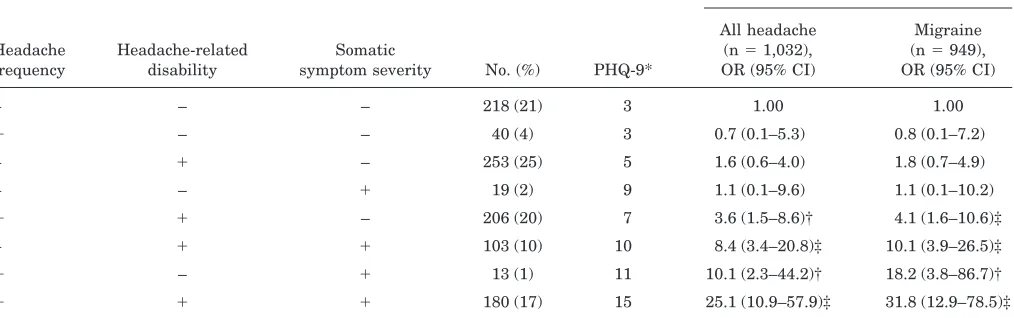
Table 3 illustrates the relationship of headache fre-quency, headache impact, and somatic symptom severity in determining the risk for major depressive disorder. None of these variables was independently associated with major depressive disorder, but with two variables in com-bination, the ORs for a significant association with major depressive disorder ranged from 4 to 10. It can be noted that presence of high somatic symptom severity largely determined the overall strength of association with major depressive disorder, followed by headache frequency and, finally, by headache-related disability (as measured by HIT-6). Women with chronic headache, very severe headache-related disability, and high somatic symptom se-verity were 25 times more likely to have major depressive disorder compared to those without any of these condi-tions. Analysis of data restricted to patients with migraine (n ⫽ 949) indicated a stronger relationship of headache frequency, disability, and somatic symptom severity with major depressive disorder. The risk of major depressive disorder in persons with frequent, disabling migraines in Figure. Prevalence (in percentage) of somatic symptoms in
women by headache frequency and headache-related dis-ability. *p⬍0.05; **p⬍0.01; ***p⬍0.001.
Table 2Effect of headache frequency and headache-related disability on the risk for high somatic symptom severity
Headache frequency
Headache-related
disability No. (%)
High somatic symptom severity,
OR (95% CI) – ⫺ 237 (23) 1.00
⫹ – 53 (5) 3.3 (1.5–7.6)* – ⫹ 356 (35) 4.7 (2.7–8.0)*
⫹ ⫹ 386 (37) 8.6 (4.9–14.7)* Headache frequency: chronic headache (⫹) and episodic headache (⫺). Headache disability: very severe disability (⫹) and less se-vere disability (⫺).
addition to severe somatic symptoms increases by 32-fold (table 3).
Discussion.
In our study of female headache clinic
patients, somatic symptoms and depression were
common. One-third of our study population had high
somatic symptom severity. Of the six symptoms
in-volving extra-cephalic pain, pain in extremities/
joints, back pain, and stomach pain were the most
prevalent. Somatic symptoms that overlapped with
those on the depression instrument (feeling tired/low
energy, and trouble sleeping) were nearly twice as
common as the pain symptoms. One fifth of our
study population endorsed symptoms on the PHQ-9
suggesting current major depressive disorder, and
this is in keeping with other studies of migraine
patients.
30Furthermore, based on the increase in
PHQ-9 scores with increasing PHQ-15 scores, our
data suggest that an increase in somatic symptom
severity is associated with increased depression.
There is a growing literature on the overlap of
de-pression and somatic symptoms.
31In one primary
care center study, half the depressed patients
re-ported multiple unexplained somatic symptoms,
32whereas in another primary care study, 35% of
pa-tients with somatization also had major depression.
33Somatic symptoms may be a manifestation of
psychi-atric disease, and the question arises as to whether
the PHQ9 and PHQ 15 instruments are measuring
the same entity, referred to as transdiagnostic
con-founding effects.
34Our finding that the association of
somatic symptom severity with headache frequency,
as well as with headache impact, remained
signifi-cant after controlling for major depression suggests
that somatic symptom severity and major depression
are distinct variables. Of note is a recent study in a
non-clinical population, which demonstrated that
so-matic symptoms predict major depression for the
fol-lowing year.
35When patients were stratified by headache
fre-quency, chronic headache was associated with
higher somatic symptoms severity and greater
fre-quency of major depressive disorder than episodic
headache. Other studies have similarly
high-lighted the increased frequency of somatic
com-plaints,
36,37particularly painful symptoms,
38-40in
persons with chronic headache. The pattern of
in-dividual somatic symptom prevalence stratified by
headache frequency was comparable to that found
in a recent study.
16Although somatic symptoms
were highly prevalent in our study, the PHQ-15 is
not a diagnostic instrument for somatoform
disor-ders,
22a category within the DSM-IV which is
hotly debated because of highly divergent potential
influences.
13Our finding of 29% prevalence of
ma-jor depression in the cohort with chronic headache
is in keeping with the prevalence rates of major
depression (23% to 57%) reported with chronic
headache in other clinic-based studies.
41,42There
remains some controversy in the literature as to
the association of headache frequency with
depres-sion, with one recent study demonstrating
increas-ing headache frequency with increasincreas-ing depression
scores,
43and another study reporting no influence
of depression on headache attack frequency.
44In
this headache clinic population, we found income
and education to be important covariates. In
keep-ing with other studies, income and education levels
diminished with increasing severity of the
follow-ing: headache frequency,
17,40,45headache impact,
somatic symptoms, and depression.
32,46-48Table 3Effect of headache frequency, headache-related disability, and somatic symptom severity on the risk for major depressive disorder
Risk for major depressive disorder
Headache frequency
Headache-related disability
Somatic
symptom severity No. (%) PHQ-9*
All headache (n⫽1,032), OR (95% CI)
Migraine (n⫽949), OR (95% CI) – – – 218 (21) 3 1.00 1.00
⫹ – – 40 (4) 3 0.7 (0.1–5.3) 0.8 (0.1–7.2) – ⫹ – 253 (25) 5 1.6 (0.6–4.0) 1.8 (0.7–4.9) – – ⫹ 19 (2) 9 1.1 (0.1–9.6) 1.1 (0.1–10.2)
⫹ ⫹ – 206 (20) 7 3.6 (1.5–8.6)† 4.1 (1.6–10.6)‡ – ⫹ ⫹ 103 (10) 10 8.4 (3.4–20.8)‡ 10.1 (3.9–26.5)‡
⫹ – ⫹ 13 (1) 11 10.1 (2.3–44.2)† 18.2 (3.8–86.7)†
⫹ ⫹ ⫹ 180 (17) 15 25.1 (10.9–57.9)‡ 31.8 (12.9–78.5)‡ Headache frequency: chronic headache (⫹) and episodic headache (–). Headache disability: very severe disability (⫹) and less severe disability (–). Somatic symptom severity: high severity (⫹) and medium to minimal severity (–).
* Median PHQ-9 score. †p⬍0.01, ‡p⬍0.001.
A novel finding from our analysis is the utility of
this particular headache-related disability
measure-ment (HIT-6) in predicting headache frequency,
somatic symptoms severity, and depression.
Impor-tantly, persons with frequent headache, severe
headache-related disability, and multiple physical
symptoms have a very high likelihood of having
cur-rent major depressive disorder. Analysis suggests a
synergistic relationship of these variables. We
hy-pothesize that severe headache, severe somatic
symptoms, and major depression may be linked
through dysfunction of the serotonergic system and
studies are under way to test this theory.
Strengths of this study include the large sample
size, geographically distinct locations of the
partici-pating clinics, and the methodology we employed.
Diagnosis of the headache type and frequency were
determined by a headache specialist using the
ICHD-II criteria. Evaluation of depression and
so-matic symptom severity was performed using
instru-ments which, although novel in headache research,
have well-documented validity and reliability. The
PDA technology, which patients found very easy to
use, had the advantage of ensuring that there are no
missing data fields. The rapid paperless transfer of
data to a central database eliminated errors in data
entry.
Weaknesses of this study include the omission of a
number of variables that may have positively
con-tributed to the analysis. These include noting the
presence of aura, the presence of medication uses
and overuse, and the exact frequency of headache.
Use of antidepressants, for example, may have
mod-ulated (likely minimized) the association of headache
and depression found in the study. Since the
instru-ments we used measured only current depression
and somatic symptoms severity, our data do not
al-low us to establish a temporal sequence for onset
headache and comorbid conditions. The
cross-sectional nature of the study does not allow for
spec-ulation on causality. The inclusion of only female
patients in this study limits the generalizability of
the findings to other populations.
Acknowledgment
The authors thank Brian Szabo, in the Center for Creative In-struction, the University of Toledo Health Science Campus, for technical support and database management.
References
1. Lipton RB, Stewart WF, Diamond S, Diamond ML, Reed M. Prevalence and burden of migraine in the United States: data from the American Migraine Study II. Headache 2001;41:646–657.
2. Scher AI, Lipton RB, Stewart W. Risk factors for chronic daily head-ache. Curr Pain Headache Rep 2002;6:486–491.
3. Edmeads J, Mackell JA. The economic impact of migraine: an analysis of direct and indirect costs. Headache 2002;42:501–509.
4. Breslau N, Merikangas K, Bowden CL. Comorbidity of migraine and major affective disorders. Neurology 1994;44(10 suppl 7):S17–S22. 5. Breslau N, Schultz LR, Stewart WF, Lipton RB, Lucia VC, Welch KM.
Headache and major depression: is the association specific to migraine? Neurology 2000;54:308–313.
6. Rudy TE, Kerns RD, Turk DC. Chronic pain and depression: toward a cognitive-behavioral mediation model. Pain 1988;35:129–140. 7. Stahl SM. Does depression hurt? J Clin Psychiatry 2002;63:273–274.
8. Croyle RT, Uretsky MB. Effects of mood on self-appraisal of health status. Health Psychol 1987;6:239–253.
9. Guidetti V, Galli F, Fabrizi P, et al. Headache and psychiatric comor-bidity: clinical aspects and outcome in an 8-year follow-up study. Ceph-alalgia 1998;18:455–462.
10. Puca F, Genco S, Prudenzano MP, et al. Psychiatric comorbidity and psychosocial stress in patients with tension-type headache from head-ache centers in Italy. The Italian Collaborative Group for the Study of Psychopathological Factors in Primary Headaches. Cephalalgia 1999; 19:159–164.
11. Escobar JI, Waitzkin H, Silver RC, Gara M, Holman A. Abridged som-atization: a study in primary care. Psychosom Med 1998;60:466–472. 12. Katon WJ. The development of a randomized trial of
consultation-liaison psychiatry trial in distressed high utilizers of primary care. Psychiatr Med 1991;9:577–591.
13. Martin RD. The somatoform conundrum: a question of nosological val-ues. Gen Hosp Psychiatry 1999;21:177–186.
14. Sharpe M, Mayou R. Somatoform disorders: a help or hindrance to good patient care? Br J Psychiatry 2004;184:465–467.
15. Kroenke K. Patients presenting with somatic complaints: epidemiology, psychiatric comorbidity and management. Int J Methods Psychiatr Res 2003;12:34–43.
16. Maizels M, Burchette R. Somatic symptoms in headache patients: the influence of headache diagnosis, frequency, and comorbidity. Headache 2004;44:983–993.
17. Hagen K, Vatten L, Stovner LJ, Zwart JA, Krokstad S, Bovim G. Low socio-economic status is associated with increased risk of frequent headache: a prospective study of 22718 adults in Norway. Cephalalgia 2002;22:672–679.
18. The International Classification of Headache Disorders: 2nd edition. Cephalalgia 2004;24 Suppl 1:9–160.
19. Lake AE, III, Rains JC, Penzien DB, Lipchik GL. Headache and psychi-atric comorbidity: historical context, clinical implications, and research relevance. Headache 2005;45:493–506.
20. Kosinski M, Bayliss MS, Bjorner JB, et al. A six-item short-form survey for measuring headache impact: the HIT-6. Qual Life Res 2003;12:963– 974.
21. Kroenke K, Spitzer RL, Williams JB. The PHQ-9: validity of a brief depression severity measure. J Gen Intern Med 2001;16:606–613. 22. Kroenke K, Spitzer RL, Williams JB. The PHQ-15: validity of a new
measure for evaluating the severity of somatic symptoms. Psychosom Med 2002;64:258–266.
23. Nachit-Ouinekh F, Dartigues JF, Henry P, et al. Use of the headache impact test (HIT-6) in general practice: relationship with quality of life and severity. Eur J Neurol 2005;12:189–193.
24. Kawata AK, Coeytaux RR, Devellis RF, Finkel AG, Mann JD, Kahn K. Psychometric properties of the HIT-6 among patients in a headache-specialty practice. Headache 2005;45:638–643.
25. Lowe B, Grafe K, Zipfel S, Witte S, Loerch B, Herzog W. Diagnosing ICD-10 depressive episodes: superior criterion validity of the Patient Health Questionnaire. Psychother Psychosom 2004;73:386–390. 26. Lowe B, Kroenke K, Herzog W, Grafe K. Measuring depression outcome
with a brief self-report instrument: sensitivity to change of the Patient Health Questionnaire (PHQ-9). J Affect Disord 2004;81:61–66. 27. Martin A, Rief W, Klaiberg A, Braehler E. Validity of the Brief Patient
Health Questionnaire Mood Scale (PHQ-9) in the general population. Gen Hosp Psychiatry 2006;28:71–77.
28. Spitzer RL, Kroenke K, Williams JB. Validation and utility of a self-report version of PRIME-MD: the PHQ primary care study. Primary Care Evaluation of Mental Disorders. Patient Health Questionnaire. JAMA 1999;282:1737–1744.
29. Hosmer Jr DW, Lemeshow S. Applied logistic regression. New York: John Wiley & Sons, 1989.
30. Patel NV, Bigal ME, Kolodner KB, Leotta C, Lafata JE, Lipton RB. Prevalence and impact of migraine and probable migraine in a health plan. Neurology 2004;63:1432–1438.
31. Henningsen P, Lowe B. Depression, pain, and somatoform disorders. Curr Opin Psychiatry 2006;19:19–24.
32. Simon G, Gater R, Kisely S, Piccinelli M. Somatic symptoms of distress: an international primary care study. Psychosom Med 1996;58:481–488. 33. Allen LA, Gara MA, Escobar JI, Waitzkin H, Silver RC. Somatization: a debilitating syndrome in primary care. Psychosomatics 2001;42:63–67. 34. Holm JE, Penzien DB, Holroyd KA, Brown TA. Headache and
depres-sion: confounding effects of transdiagnostic symptoms. Headache 1994; 34:418–423.
35. Nakao M, Yano E. Somatic symptoms for predicting depression: one-year follow-up study in annual health examinations. Psychiatry Clin Neurosci 2006;60:219–225.
36. Kroenke K, Spitzer RL, Williams JB, et al. Physical symptoms in pri-mary care. Predictors of psychiatric disorders and functional impair-ment. Arch Fam Med 1994;3:774–779.
37. Russo J, Katon W, Sullivan M, Clark M, Buchwald D. Severity of somatization and its relationship to psychiatric disorders and personal-ity. Psychosomatics 1994;35:546–556.
39. Hagen K, Einarsen C, Zwart JA, Svebak S, Bovim G. The co-occurrence of headache and musculoskeletal symptoms amongst 51 050 adults in Norway. Eur J Neurol 2002;9:527–533.
40. Scher AI, Stewart WF, Ricci JA, Lipton RB. Factors associated with the onset and remission of chronic daily headache in a population-based study. Pain 2003;106:81–89.
41. Verri AP, Proietti CA, Galli C, Granella F, Sandrini G, Nappi G. Psy-chiatric comorbidity in chronic daily headache. Cephalalgia 1998;18 suppl 21:45–49.
42. Juang KD, Wang SJ, Fuh JL, Lu SR, Su TP. Comorbidity of depressive and anxiety disorders in chronic daily headache and its subtypes. Head-ache 2000;40:818–823.
43. Zwart JA, Dyb G, Hagen K, et al. Depression and anxiety disorders associated with headache frequency. The Nord-Trondelag Health Study. Eur J Neurol 2003;10:147–152.
44. Breslau N, Lipton RB, Stewart WF, Schultz LR, Welch KM. Comorbid-ity of migraine and depression: investigating potential etiology and prognosis. Neurology 2003;60:1308–1312.
45. Atasoy HT, Unal AE, Atasoy N, Emre U, Sumer M. Low income and education levels may cause medication overuse and chronicity in mi-graine patients. Headache 2005;45:25–31.
46. Stewart WF, Lipton RB, Simon D. Work-related disability: results from the American migraine study. Cephalalgia 1996;16:231–238.
47. Bingefors K, Isacson D. Epidemiology, co-morbidity, and impact on health-related quality of life of self-reported headache and musculoskel-etal pain—a gender perspective. Eur J Pain 2004;8:435–450.
48. Gilmer WS, Trivedi MH, Rush AJ, et al. Factors associated with chronic depressive episodes: a preliminary report from the STAR-D project. Acta Psychiatr Scand 2005;112:425–433.
Neuro
Images
Swiss cheese brain
Thomas I. Cochrane, MD, MBA; and
Thanh N. Nguyen, MD, FRCPc, Boston, MA (T.I.C.); and Montreal, Quebec (T.N.N.)
A 66-year-old woman with hypertension and hypercholesterol-emia presented with 2 days of cough, low-grade fever, and severe encephalopathy. Nasal influenza A antigen was detected. As her fever resolved, her mental status returned to normal. Brain MRI revealed extensive non-enhancing T2 hyperintensities (figure 1).
This swiss cheese appearance is caused by unusually large Virchow-Robin spaces (VRS), normal perivascular extensions of the subarachnoid space. Large VRS can be a phenomenon of aging or cerebral atrophy, particularly over the hemispheric convexity.1
VRS 2 cm in diameter have been described in normal patients.2
VRS are FLAIR and T1 hypointense, and T2 hyperintense. Left temporal lobe biopsy was performed during unrelated elective aneurysm clipping, to exclude neurodegenerative diseases that might cause ex vacuo enlargement of VRS or cystic condi-tions— e.g., infectious or post-infarction cysts, cerebral lacunes, ependymal, neuroepithelial, or arachnoid cysts.2 The biopsy
re-vealed dilated perivascular spaces (figure 2), confirming the diagnosis.
Copyright © 2007 by AAN Enterprises, Inc.
1. Heier LA, Bauer CJ, Schwartz L, Zimmerman RD, Morgello S, Deck MDF. Large Virchow-Robin s: MR-clinical correlation. AJNR Am J Neu-roradiol 1989;10:929–936.
2. Ogawa T, Okudera T, Fukusawa H, et al. Unusual widening of Virchow-Robin s: MR appearance. AJNR Am J Neuroradiol 1995;16:1238–1242. Disclosure: The authors report no conflicts of interest.
Address correspondence and reprint requests to Dr. Thomas I. Cochrane, Department of Neurology, Brigham and Women’s Hospital, 75 Francis Street, Boston, MA; e-mail: [email protected]
Figure 1. Axial T2 (A) and FLAIR (B) weighted MRI dem-onstrating dramatically enlarged Virchow Robin spaces.