Practical Cryptanalysis of a Pulblic-key Encryption Scheme
Based on Non-linear Indeterminate Equations at SAC 2017
Keita Xagawa
3-9-11, Midori-cho Musashino-shi, Tokyo 180-8585 Japan [email protected]
Abstract. We investigate the security of a public-key encryption scheme, the Indeterminate Equation Cryp-tosystem (IEC), introduced by Akiyama, Goto, Okumura, Takagi, Nuida, and Hanaoka at SAC 2017 as post-quantum cryptography. They gave two parameter sets PS1(n,p,degX,q)=(80,3,1,921601)and PS2(n,p,degX,q)= (80,3,2,58982400019).
The paper gives practical key-recovery and message-recovery attacks against those parameter sets of IEC through lattice basis-reduction algorithms. We exploit the fact thatn=80 is composite and adopt the idea of Gentry’s attack against NTRU-Composite (EUROCRYPT2001) to this setting. The summary of our attacks follows:
– On PS1, we recover 84 private keys from 100 public keys in 30–40 seconds per key.
– On PS1, we recover partial information of all message from 100 ciphertexts in a second per ciphertext. – On PS2, we recover partial information of all message from 100 ciphertexts in 30 seconds per ciphertext. Moreover, we also give message-recovery and distinguishing attacks against the parameter sets with prime n, say,n=83. We exploit another subring to reduce the dimension of lattices in our lattice-based attacks and our attack succeeds in the case of degX=2.
– For PS2’(n,p,degX,q) = (83,3,2,68339982247), we recover 7 messages from 10 random ciphertexts within 61,000 seconds≈17 hours per ciphertext.
– Even for largern, we can find short vector from lattices to break the underlying assumption of IEC. In our experiment, we can found such vector within 330,000 seconds≈4 days forn=113.
keywords:Public-Key Encryption, Indeterminate Equations Cryptosystem, Post-quantum cryptography.
1
Introduction
Algebraic-Surface Cryptosystem (ASC) is a public-key cryptosystem based on the section-finding problem. Let Rn,q :=Zq[t]/(tn−1)and considerRn,q[x,y]. The section-finding problem overRn,q[x,y]is, given an algebraic surfaceX(x,y) =0, finding the sectionu =(ux,uy) ∈ R2n,q such thatX(ux,uy) =0 [AG06,AGM09]. Recently, the new version of ASC, the IEC encryption scheme, was proposed by Akiyama, Goto, Okumura, Takagi, Nuida, and Hanaoka at SAC 2017 [AGO+18], where IEC stands for Indeterminate Equation Cryptosystem. The authors investigate the security of IECs by considering the lattice-based attacks and define two sets of parameter values, PS1(n,p,degX,q)=(80,3,1,921601)and PS2(n,p,degX,q)=(80,3,2,58982400019).
1.1 Our Contribution
We give practical-time lattice-based attacks against the IECs.
Our first attack is combining the original lattice-based attack with Gentry’s attack [Gen01] against NTRU Composite [Sil01]. Letd be a non-trivial divisor ofn, say, 40. We can consider the subringRd,q[x,y]instead of Rn,q[x,y]. This modification allows us to employ a smaller lattice than that in the original lattice-based attacks. Our attack succeeds as follows:
– On PS1, we mount a key-recovery attack. Our attack finds 84 secret keys from 100 random keys. The attack took approximately 30 seconds per key.
– On PS1, we mound a partial-message-recovery attack. Our attack finds partial messages of all 100 pairs of random public key and ciphertext. The attack took approximately 0.5 seconds per try.
– On PS2, we mound a partial-message-recovery attack. Our attack finds partial messages of all 100 pairs of random public key and ciphertext. The attack took approximately 30 seconds per try.
– For(n,p,degX)=(83,3,2), we recover 7 messages out of 10 random ciphertexts in 61,000 seconds≈17 hours per ciphertext.
– Even for largern, we can find short vector which enables us to break the underlying assumption of IEC. We can find such vector forn=113 within 330,000 seconds≈4 days.
Responsible Disclosure Process: We already notified the authors of our attacks before making this paper public. We informed them by email on September 28th with key-recovery attack on PS1, October 2nd with partial-message-recovery attack on PS1 and PS2, October 17th with message-partial-message-recovery attack on(n,p,degX) = (83,3,2), and November 2nd with distinguishing attack on variant of PS2 withn ≥ 83. The authors reported that they have changed parameter values and they run their experiments further. We publish this paper after Akiyama et al. pub-lished their revised paper and their NIST PQC submission [AGO+17b,AGO+17a].
1.2 Organization
We define notations and review lattices insection 2. We review the IEC scheme insection 3and the original lattice-based attacks insection 4. We recall Gentry’s attack insection 5. We combine them insection 6and give new attacks insection 7. The experimental results are reported insection 8.
2
Preliminaries
Notations: The security parameter is denoted byκ.
For a positive integerq, we defineZq := Z/(qZ)andZq+ := {0,1, . . . ,q −1}. For a positive integern, we defineRn :=Z[t]/(tn−1). For two positive integersnandq, we defineRn,q :=Zq[t]/(tn−1). We also define a subsetRn,q,pofRn,qas a set of allZp-coefficient polynomials inRn,q, that is,
Rn,q,p:=
(
f = n−1
Õ
i=0
fiti ∈Rn,q
fi ∈ {0,1, . . . ,p−1} ⊂Zq
)
.
LetRbe a ring and considerR[x,y]. ForRand a set of indicesΓ⊆Z2≥0, we define
F(Γ,R):=f ∈R[x,y] | f =Í
(i,j)∈Γai jxiyj ,
a set of all polynomials inR[x,y]which only consists ofxiyj terms for(i,j) ∈Γ. We will referΓas the term set. (Those notations are borrowed from [AGO+18].) We definethe total degreeof f(x,y) ∈ R[x,y]as the maximum of the sums of the exponents of the variables in the termai jxiyj.
Polynomials: We review the notations which bridge polynomials inRnandn-dimensional vectors (and matrices). For integersnandq, let us define two functions:
vecn:Rn,q →Zn: f = f0+f1t+· · ·+ fn−1tn−1 7→ (f0,f1, . . . , fn−1)
Rotn:Rn,q →Zn×n: f 7→={fj−imodn}i,j=0,...,n−1=
©
«
vecn(f) vecn(t f) vecn(t2f)
.. . vecn(tn−1f)
ª ® ® ® ® ® ®
¬
.
We have
vecn(f) ·Rotn(g)=vecn(f ·g)and Rotn(f) ·Rotn(g)=Rotn(f ·g)
Lattices: Givenn-linearly independent vectorsB={b0, . . . ,bn−1} ⊂Rm, the lattice generated by them is the set of vectors
L(B)=Zn·B={
n−1
Õ
i=0
xibi |xi ∈Z}.
The determinant or volume vol(Λ)of a full-rank latticeΛis the absolute value of the determinant of any given basisBofΛ, that is, vol(Λ)=|det(B)|. The dual of a latticeΛ, denoted byΛ∗, is the lattice consisting of the set of all vectorsz∈Rmorthogonal to any vectorsv∈Λ, that is,Λ∗={z∈
Rm | hz,yi=0 for ally∈Λ}. We also defineq-ary lattices. ForA∈Zqn×m,
Λq(A):={z∈Zm| z=s A (modq)for somes∈Zn}
Λ⊥q(A):={e∈Zm |e A>≡0 (modq)}.
We have
Λ⊥q(A)=q·Λq(A)∗andΛq(A)=q·Λ⊥q(A)∗.
See e.g., [GPV08, Section 5].
The basis ofΛqis easily obtained. For example, we obtain the basis by considering a matrixqImA
and taking the row echelon form of the matrix.
SVP and CVP: Finally we define shortest-vector problem and closest-vector problem. The shortest-vector prob-lem (SVP) is, given a latticeΛ, finding a non-zero vectorv∈Λ\ {0}such thatkvk ≤ kxkfor any non-zero lattice vectorx ∈Λ\ {0}. The closet-vector problem (CVP) is, given a latticeΛand a target vectort, finding a lattice vectorw∈Λsuch thatkw−tk ≤ kx−tkfor any lattice vectorx∈Λ.
The Gaussian heuristic says that the m-dimensional full-rank lattice contains a short vector of length ap-proximately
γ=
r
m 2πedet(L)
1/m.
If our target vectorvis sufficiently smaller thanγ, then we expect the LLL or BKZ algorithm find the short vector
v.
3
IEC Scheme
Parameters: In the IEC scheme, we will employX ∈R[x,y]as a public key,r,e∈R[x,y]as a random polynomials in ciphertexts. The IEC involves several parameters,(p,q,n)and(ΓX,Γr,ΓXr):
1. p,q: primes andpq
2. n: the degree ofRn,q=Zq[t]/(tn−1) 3. ΓX: The term set ofX(x,y)
4. wX: The total degree ofX
5. Γr: The term set of the random polynomialr(x,y)
6. wr : The total degree ofr
7. ΓXr: The term set of the random polynomiale(x,y)
Akiyama et al. defined
ΓXr :={(i,j)+(k,l) | (i,j) ∈ΓX,(k,l) ∈Γr}
in order to avoid the linear algebraic attacks against the previous cryptosystems [AGO+18, Section 2.2]. They also require largeqas
q >#ΓXr·p(p−1) · (n(p−1))wX+wr (1)
to make the scheme perfectly correct. They implicitly defined
ΓX={(i,j) ∈Z2≥0 |i+j ≤wX}andΓr ={(i,j) ∈Z2≥0|i+j ≤wr}.
AlthoughΓXandΓr can be different, they always takeΓX=Γr. Hence, they just parameterize degXinstead of
Table 1: Proposed sets of parameter values [AGO+18, Table 3]. PS2’ is obtained by settingn=83 in PS2 n p qdegX degr #ΓXr |sk|(bits)|pk|(bits)|ct|(bits)
PS1 80 3 921601 1 1 6 256 4755 9510
PS2 80 3 58982400019 2 2 15 256 17174 42935 PS2’ 83 3 68339982247 2 2 15 264 17928 44820
Key Generation: The secret key is asmall solution of the indeterminate equationX(x,y)=0. We denote the solution by
u:(x,y)=(ux(t),uy(t)) ∈R2n,q,p.
The public key is the indeterminate equationX(x,y)=0 that has a small solutionu. We denote it by
X(x,y)= Õ
(i,j)∈ΓX
ai jxiyj, whereai j ∈Rn,q.
Akiyama et al. recommend to chooseai jexcepta00uniformly at random and seta00:=−Í(i,j)∈ΓX\{(0,0)}ai ju i xu
j y.
Encryption: A plaintext is treated asm(t) ∈Rn,q,p. The ciphertext is
c(x,y):=m(t)+X(x,y) ·r(x,y)+p·e(x,y) ∈F(ΓXr,Rn,q),
where we chooser(x,y) ←F(Γr,Rn,q)ande(x,y) ←F(ΓXr,Rn,q,p).
Decryption: Given a ciphertextc(x,y) ∈F(ΓXr,Rn,q), 1. Computec(ux,uy) ∈ Rn,q
2. regardc(ux,uy)as a polynomial inRn(=Z[t]/(tn−1)), computem0(t):=c(ux,uy) mod p, and outputm0(t)
Notice that c(ux,uy) = m(t)+p ·e(ux,uy) ∈ Rn,q because X(ux,uy) = 0 ∈ Rn,q. By the condition on q and p, if cis a valid ciphertext, then c(ux,uy)modq = m(t)+p ·e(ux,uy) ∈ Rn. Thus, we havem(t) =
(c(ux,uy)modq)modp.
See our implementation inListing 1.1.
3.1 Security Assumption
LetX(ΓX,Rn,q,p)be the set ofX(x,y)which has a small solutionu, that is,
X(ΓX,Rn,q,p):={X ∈F(ΓX,Rn,q) |∃ux,uy∈Rn,q,p:X(ux,uy)=0}.
Akiyama et al. defined the following decision problem:
Definition 3.1 (IE-LWE Problem).For parametersn,p,q,ΓX,Γr, andΓXr, we define two sets
U:=X(ΓX,Rn,q,p) ×F(ΓXr,Rn,q)
T :={(X,Xr+e) | X∈X(ΓX,Rn,q,p),r∈F(Γr,Rn,q),e∈F(ΓXr,Rn,q,p)}.
The IE-LWE problem is distinguishing the multivariate polynomials chosen from a ‘noisy’ setTof polynomials from a ‘uniform’ setU.
The IE-LWE assumption states that it is infeasible to solve the IE-LWE problem, where X is chosen by the key-generation algorithmGen.
Definition 3.2 (IE-LWE Assumption).For parametersn,p,q,ΓX,Γr, andΓXr, a key-generation algorithmGen, and an adversaryA, we defineA’s advantage as
Advie-lweGen,A(κ):=
Pr
X ←Gen(1κ);r←F(Γr,Rn,q);e←F(ΓXr,Rn,q,p);Y :=Xr+e;A(X,Y) →1
−Pr
X ←Gen(1κ);Y ←F(ΓXr,Rn,q);A(X,Y) →1
.
We say that the IE-LWE assumption onGenholds if for any PPT adversaryA, its advantageAdvie−lweGen,A(κ)is negli-gible inκ.
4
Review of Linear-Algebraic Attacks
We review the linear-algebraic attacks in [AGO+18]. In the following, we omit the subscriptn from Rotnand vecn.
4.1 Key-Recovery Attack
We review the example in the case degX=1.
We are givenX(x,y)=a00+a10x+a01yand want to find asmallsolution(ux,uy) ∈ Rn2,qsatisfying
a10·ux+a01·uy+a00=0 (inRn,q).
This implies
vec(ux) ·Rot(a10)+vec(uy) ·Rot(a01) ≡vec(−a00) (modq),
that is,
vec(ux),vec(uy)·
Rot(a10) Rot(a01)
≡vec(−a00) (modq).
Therefore, we let
Akr1=[Rot(a10)> |Rot(a01)>] ∈Zn×2nq
and consider the lattice
Λ⊥(Akr1)={v∈Z2n |v·A>kr1≡0 (modq)}
={(vx,vy) ∈Z2n |vx·Rot(a10)+vy·Rot(a01) ≡0 (modq)}.
Now, we consider a target vectort∈Z2n, an arbitrary solution oft·A>
kr1≡vec(−a00) (modq). Solving the CVP instance(Λ⊥(Akr1),t), we obtain a vectorw∈Λ⊥(Akr1). We let ¯u=(vec(ux),vec(uy)):=t−w.
We have ¯u·A>kr1≡vec(−a00) (modq)because ¯u=t−w. In addition, we expect that the norm of ¯uis small, sincewis the close vector totand ¯uis the difference.
Remark 4.1. In the case of degX=degr=2, we haveX(x,y)=a00+a10x+a01y+a20x2+a11xy+a02y2and consider a matrix
Akr2=[Rot(a10)> |Rot(a01)>|Rot(a20)>|Rot(a11)>|Rot(a02)>] ∈Zn×5nq .
4.2 Message-Recovery Attack
We again review the example in the case degX=1 and degr=1.
Let us consider f(x,y)=p·e(x,y)+m∈F(ΓXr,Rn,q). The ciphertextcofmhas the relation
Õ
(i,j)∈ΓX r
ci jxiyj =©
« Õ
(i,j)∈ΓX
ai jxiyjª®
¬ ·©
« Õ
(i,j)∈Γr
ri jxiyjª®
¬
+©
« Õ
(i,j)∈ΓX r
fi jxiyjª®
¬
. (2)
Let us consider the following matrix
Amr1= ©
«
1 x y x2 xy y2
1 A00 A10 A01
x A00 A10 A01
y A00 A10 A01
ª ®
¬
∈Z3n×6n,
whereAi j:=Rot(ai j) ∈Zn×n. Let
¯
r:= vec(r00),vec(r10),vec(r01) ∈Z3n, ¯
f := vec(f00),vec(f10),vec(f10),vec(f20),vec(f11),vec(f02) ∈Z6n, ¯
According toEquation 2, we have
¯
c≡r¯·Amr1+f¯ (modq).
Now, we consider a lattice
Λq(Amr1)={z∈Z6n |z≡s Amr1 (modq)for somes∈Z3n}
and a target vector ¯c∈Z6n. Solving the CVP instance(Λq(Amr1),c¯), we obtainw∈Λq(Amr1). We let ¯v:=c¯−w. Now, we have ¯c≡s A+v¯ (modq)for somes∈Z3nand expect that ¯vis small. If we obtain ¯v= f¯, we finally obtainmby taking it modulop.
Remark 4.2. In the case of degX=degr=2, we will consider a matrix
Amr2=
©
«
1 x y . . . x4 x3y x2y2 xy3 y4
1 A00 A10 A01
x A00
y A00
x2 A20 A11 A02
xy A20 A11 A02
y2 A20 A11 A02
ª ® ® ® ® ® ® ®
¬
∈Z6n×15n,
and solve the CVP instance with 15n-dimensional lattice.
Experimental Results: Akiyama et al. estimate IEC’s security by mounting these attacks against the small param-eter setsn=10,20, . . . ,60 for degX =1 andn=10,20,30,40 for degX=2. Their environment is
– CPU: AMD Opteron(TM) Processor 848 – Memory: 64 GB
– OS: Linux version 2.6.18-406.el5.centos.plus – Software: Magma Ver2.21-5
They also defineqas small as possible.
They mount a key-recovery attack, which succeeds if and only if(ux,uy) ∈ Rn,q,psatisfyingX(ux,uy)=0 is found. In their experiments, the key-recovery attack for degX =1 failed forn≥50 and that for degX=2 failed even forn≥10.
They also mount a message-recovery attack, which, givenXandXr+e, succeeds if and only ife=(e1, . . . ,e6n) withei ∈ [0,p−1]is found. The message-recovery attack for degX=1 failed forn ≥50. Curiously, the attack for degX=2 succeed to find shorteeven forn=40. (They seem stop their experiment due to time constraint. Their experiment took about 230000 seconds≈2.7 days to process a 600-dimensional lattice.)
5
Review of Gentry’s Attack
We review Gentry’s attack against NTRU-Composite [Sil01]. Let us consider NTRU’s key generation and en-cryption: Roughly speaking, we choose a secret key(f,g) ∈Rn2,q,pand compute a public key ash=g/f ∈Rn,q. The ciphertext of plaintextm∈Rn,q,pwith randomnessr∈Rn,q,pisc=phr+m∈Rn,q.
Lattice Attack: Coppersmith and Shamir [CS97] pointed out that a short vector(vecn(f),vecn(g)) ∈Z2nis in a lattice spanned by a matrix
LCS:=
Rotn(1)Rotn(h) Rotn(0)Rotn(q)
∈Z2n×2n.
We have h = g/f modq and this implies f h+kq = g for some k ∈ Rn. Therefore, (vecn(f),vecn(k)) · LCS = (vecn(f),vecn(g))as we wanted. Hence, we solve the SVP problem on the lattice and expect to find
Gentry’s Attack: Gentry pointed out that there is a ring homomorphismθ:Rn→Rd, whered |nis a non-trivial divisor.
Theorem 5.1 ([Gen01, Theorem 1]).Letnbe a composite, anddbe a non-trivial divisor ofn. The mapping
θ:Rn→ Rd: f = n−1
Õ
i=0 fiti 7→
d−1
Õ
i=0 n/d−1
Õ
j=0 fj d+i
!
ti
is a ring-homomorphism.
Gentry considered the 2d-dimensional lattice analogue ofΛ(LCS), the lattice spanned by a matrix
Ld =
Rotd(1)Rotd(θ(h)) Rotd(0) Rotd(q)
∈Z2d×2d.
The latticeΛ(Ld)contains a short vector vecd(θ(f)),vecd(θ(g)), whose norm is approximately equals to that of vecn(f),vecn(g)(see [Gen01, Appendix A.2]). Therefore, we expect the basis-reduction algorithm, say, LLL or BKZ, findsθ(f)andθ(g). We can exploit this partial informationθ(f)as follows:
1. Message-Recovery Attack: We haveθ(f) ·θ(c) = θ(f) · θ(m)+pθ(r) ·θ(g)modq. Thus, the expected magnitudes of coefficients ofθ(f) ·θ(m)+pθ(r) ·θ(g)are small, then we can recoverθ(m).
2. Secret-Key Recover Attack: Usingθ(f)andθ(g)as hint, we again solve the SVP problem and find(f,g). Indeed, Gentry succeeds to find f in the case of(n,q,p)=(256,127,2)in his experiment.
6
Attacks against Composite
n
We employ Gentry’s idea. Let us expand the range of the homomorphismθ:Rn→Rdto
θ:Rn,q[x,y] →Rd,q[x,y].
6.1 Key-Recovery Attack for degX =1
We are givenX(x,y)=a01x+a01y+a00and want to find asmallsolution(ux,uy) ∈R2n,q satisfying
a10·ux+a01·uy+a00=0 (inRn,q).
Applying the homomorphismθ, we have
θ(a10) ·θ(ux)+θ(a01) ·θ(uy)+θ(a00)=0 (inRd,q).
Thus, we can try to find(θ(ux), θ(uy))by using the lattice-basis reduction algorithms on the lattice of dimension 2d(<2n).
The concrete attack consists of two sub-attacks, findingθ(ux)andθ(uy)and findinguxanduyby using those hints. The details follow.
Findingθ(ux)andθ(uy): We set
Akr1,d=[Rotd(θ(a10))>|Rotd(θ(a01))>] ∈Zd×2dq
and want to find a short vectorvdsatisfying
vd·A>kr1,d≡vecd(−θ(a00)) (modq). (3)
We consider a latticeΛ⊥q(Akr1,d). Lett ∈Z2d be an arbitrary solution ofEquation 3. We solve the CVP instance
(Λ⊥q(Akr1,d),t)and obtainw∈Λ⊥q(Akr1,d).
Now, we have “short” ¯vd :=t−wsatisfyingEquation 3. Let us interpret the vector ¯vdas the pair of polynomials
(v(d)x ,v(d)y ) ∈ R2d,q. and assume thatvx(d)=θ(ux)andvy(d)=θ(uy).
We have vol(Λ⊥q(Akr1,d) =qd,γ≈
p
2d/(2πe) ·vol(Λ⊥q(Akr1,d) 1/2d
=p
d/πe·q1/2, andkvdk ≤2p
√
Findingux and uy: We already have a hint(θ(ux), θ(uy)). In this paper, we consider a simpler method than Gentry’s one: We set
Akr1,hint=
Rotn(a10)>Rotn(a01)> Id · · · Id
| {z }
n/d Id · · · Id
| {z }
n/d
∈Z(qn+2d)×2n
and try to find a short vectorvsatisfying
v·A>kr1,hint ≡ vecn(−a00),vecd(θ(ux)),vecd(θ(uy)) (mod q). (4)
We again consider a latticeΛ⊥q(Akr1,hint). Lett ∈Z2nbe an arbitrary solution ofEquation 4. We solve the CVP instance(Λ⊥q(Akr1,hint),t)and obtainw. Now, we have a short vector ¯v:=t−wsatisfyingEquation 4.
Interpreting the vector ¯vas the pair of polynomials(ux,uy) ∈ Rn2,q, we havea10·ux+a01·uy+a00 =0 in Rn,qas we wanted.
We have vol(Λ⊥q(Akr1,hint) = qn+d.γ ≈
p
2n/(2πe) ·vol(Λ⊥q(Ad) 1/2n
=p
d/πe·q1+d/n, andkv¯k ≤ p√2n. Sinceγ kv¯k, we expect that the LLL/BKZ algorithm can find the target vector ¯v.
6.2 Partial-Message-Recovery Attack for degX =1
We try to findθ(m)modpfrom a ciphertextcofm. If so, it easily breaks the IND-CPA security of the IEC scheme. For simplicity, we define f(x,y) = pe(x,y)+m, which results inθ(f) = pθ(e)+θ(m). Sinceθ is a ring homomorphism fromRn[x,y] → Rd[x,y], we have
θ(c)=θ(r) ·θ(X)+θ(f).
Let us consider the following matrix:
Apmr1,d := ©
«
1 x y x2 xy y2
1 A000 A100 A001
x A000 A010 A001
y A000 A010 A010
ª ®
¬
∈Z3d×6d,
whereA0i j:=Rotd(θ(ai j)) ∈Zd×d. Let
¯
rd := vecd(θ(r00)),vecd(θ(r10)),vecd(θ(r01)) ∈Z3d, ¯
cd := vecd(θ(c00)),vecd(θ(c10)),vecd(θ(c01)),vecd(θ(c20)),vecd(θ(c11)),vecd(θ(c02)) ∈Z6d, ¯
fd := vecd(θ(f00)),vecd(θ(f10)),vecd(θ(f01)),vecd(θ(f20)),vecd(θ(f11)),vecd(θ(f02)) ∈Z6d.
We have
¯
cd≡r¯d·Apmr1,d+f¯d (modq).
Now, we consider a latticeΛq(Apmr1,d)and solve the CVP instance(Λq(Apmr1,d),c¯d)and obtain ¯vd. Let us interpret the vector ¯vdas a tuple of polynomials(v00,v10,v01,v20,v11,v02) ∈ R6d,q. Suppose that we have ¯vd = f¯d, if so, we havev00=θ(f00)and, thus,
v00≡θ(f00) ≡pθ(e00)+θ(m) ≡θ(m) (mod p).
We have vol(Λ⊥q(Apmr1,d)=q3d,γ≈
p
6d/(2πe) ·vol(Λ⊥q(Ad)1/6d =
p
3d/πe·q1/2, andkv¯dk ≤ (n/d)p2
√
6d. We expect that the LLL/BKZ algorithm can find ¯vd, becauseγ kv¯dk.
6.3 Partial-Message-Recovery Attack for degX =2
In the case of degX=degr=2, we consider a matrix
Apmr2,d=
© «
1 x y . . . x4 x3y x2y2 xy3 y4
1 A000 A100 A001
x A000
y A000
x2 A200 A011 A002
xy A020 A011 A020
y2 A020 A110 A002
ª ® ® ® ® ® ® ® ¬
whereAi j0 :=Rotd(θ(ai j)) ∈Zd×d. By the similar way, we solve the CVP instance(Λq(Apmr2,d),c¯d)and obtain ¯
vd, which corresponding to a tuple of polynomials(v00,v10, . . . ,v04) ∈ R15d,q. We outputv00modpasθ(m)modp.
We have vol(Λ⊥q(Apmr2,d) = q9d, γ ≈
p
15d/(2πe) ·vol(Λ⊥q(Ad)1
/15d = p
15d/2πe·q3/5, and kv¯dk ≤
(n/d)p2√15d. We expect that the LLL/BKZ algorithm can find ¯vdbecauseγ kv¯dk.
7
Attacks against Prime
n
After reporting the previous attacks to the authors of [AGO+18], they setn as a prime, say,n = 83 (andq = 68339982247) [Aki17]. In this section, we propose a sub-ring attack, which is applicable to the case thatnis a prime.
(Non-trivial) subring: Notice thatRn,q[x]is a subring ofRn,q[x,y]. We consider a ring homomorphism
π:Rn,q[x,y] 7→ Rn,q[x]: f(x,y) 7→ f(x,0).
We have the relationc(x,y) = r(x,y) ·X(x,y)+ f(x,y), where f(x,y) = pe(x,y)+m. Applying the ring homomorphismπ, we obtain
π(c) ≡π(r) ·π(X)+π(f) ≡π(r) ·π(X)+p·π(e)+m (modq) (5)
and notice that the max norm ofπ(f)is at most that of f =p·e+m.
7.1 Message-Recovery Attack against degX=1
Let us recall the message-recovery attack against degX=2 insubsection 4.2. We consider
Amr1:=
©
«
1 x y x2 xy y2
1 A00 A10 A01
x A00 A10 A01
y A00 A10 A01
ª ® ®
¬
∈Z3n×6n,
¯
c:=(vecn(c00),vecn(c10),vecn(c01),vecn(c20),vecn(c11),vecn(c02)) ∈Z6n,
whereAi j:=Rotn(ai j) ∈Zn×n, and try to solve the CVP instance(Λq(Amr1),c¯)to find ¯f.
In the lattice-based attacks, we often shorten the basis of the lattice and the target vector to reduce the dimension. Here, we give another approach to shorten them.
Concrete Attack: Deleting the rows and columns whose indices containyfromAand ¯c, we obtain
Amr10 :=
1 x x2
1 A00 A10
x A00 A10
!
∈Z2n×3n,
¯
c0:= vecn(c00),vecn(c10),vecn(c20) ∈Z5n.
Letting
¯
r0=(vecn(r00),vecn(r10)) ∈Z2n, ¯
f0=(vecn(f00),vecn(f10),vecn(f20)) ∈Z3n,
we have
¯
c0≡r¯0·Amr10 +f¯0 (modq),
Gaussian Heuristic: This shortening reduces the dimension of the lattice from 5n =415 to 3n =249. We have vol(Λq(Amr20 ) =qnandγ≈
p
3n/(2πe) ·vol(Λq(A0)1/3n=
p
3n/2πe·q1/3andkf¯0k ≤p2√3n. In our parameter setting, we haveγ≈380.81 andkf¯0k ≤142.02 and the gap betweenγandkf¯0kis not so large. Thus it seems hard to find ¯f0in this setting.
7.2 Message-Recovery Attack against degX=2
Let us recall the message-recovery attack against degX =2 insubsection 4.2. We considerAmr2∈Z6n×15nand ¯
c:=(vecn(c00),vecn(c10),vecn(c01), . . . ,vecn(c04)) ∈Z15n, and try to solve the CVP instance(Λq(Amr2),c¯)to find ¯
f.
Concrete Attack: Deleting the rows and columns whose indices containyfromAand ¯c, we obtain
Amr20 := ©
«
1 x x2 x3 x4
1 A00 A10 A20
x A00 A10 A20
x2 A00 A10 A20
ª ® ®
¬
∈Z3n×5n,
¯
c0:=(vecn(c00),vecn(c10),vecn(c20),vecn(c30),vecn(c40)) ∈Z5n.
Letting
¯
r0=(vecn(r00),vecn(r10),vecn(r20)) ∈Z3n, ¯
f0=(vecn(f00),vecn(f10),vecn(f20),vecn(f30),vecn(f40)) ∈Z5n,
we have
¯
c0≡r¯0·Amr20 +f¯0 (modq),
which corresponds toEquation 5. Thus, solving the CVP instance(Λq(Amr20 ),c¯0), we expect to find ¯f0and obtain m:=vecn(f00)modp.
Gaussian Heuristic: We note that this shortening reduces the dimension of the lattice from 15n =1243 to 5n= 415. We have vol(Λq(Amr20 ) =
q2nandγ ≈p5n/(2πe) ·vol(Λq(A0)1/5n =p
5n/2πe·q2/5and kf¯0k ≤ p2√5n. In our parameter setting,γ≈106330.25 andkf¯0k ≤183.35. We expect that the LLL/BKZ algorithm can find a short vector ¯f0because of this large gap.
7.3 Distinguishing Attack for degX=1 and degX =2
Further, we try to falsify the IE-LWE assumption, that is to distinguish(X,c)=(X,Xr+e)from(X,u). In order to do so, we try to find a short vector ¯v0fromΛq(A0mr1). IfcisXr+e, then we havehc¯0,v¯0i modqis “short,” while ifcis chosen uniformly at random, thenhc¯0,v¯0imodqis distributed according to the uniform distribution overZq.
This can also be applied to the case of degX=2.
8
Experiments
We run our experiment on a virtual machine on our company’s internal private cloud. Our environment is
– CPU: QEMU Virtual CPU version 2.5+ – Memory: 32GB
8.1 Key-Recovery Attack for degX =1
We mount our attack insubsection 6.1with n = 80 and d = 40. We employ the default BKZ algorithm in SageMath 8.0 as the lattice-basis reduction algorithm and the rounding algorithm to solve the CVP instance. We generate 100 key pairs and try to find a pair(ux,uy) ∈ R2n,q,p satisfyingX(ux,uy) = 0. In our experiment, 84 secret keys are found from 100 public keys. The attack used an average CPU time of 32.68 seconds per key on a single core of our server. (min: 29.16, avg: 32.68, med: 32.54, max: 39.11)
The script is inListing 1.2. We did not check the other settings, say,d=20 ord =16.
8.2 Partial-Message-Recovery Attack for degX =1
We mount our attack insubsection 6.2withn = 80 andd =10. We employ the default BKZ algorithm with block size 10 as the lattice-basis reduction algorithm and the embedding algorithm to solve the CVP instance. We generate 100 pairs of a public key and a random ciphertext on a random plaintext. In our experiment, all partial messageθ(m)modpare recovered. The attack used an average CPU time of 0.47 seconds per key on a single core of our server. (min: 0.29, avg: 0.47, med: 0.46, max: 0.73)
8.3 Partial-Message-Recovery Attack for degX =2
We mount our attack insubsection 6.3withn = 80 andd =10. We employ the default BKZ algorithm as the lattice-basis reduction algorithm and the embedding algorithm to solve the CVP instance. We generate 100 pairs of a public key and a random ciphertext on a random plaintext. In our experiment, all partial messageθ(m)modp are recovered. The attack used an average CPU time of 33.40 seconds per key on a single core of our server. (min: 20.95, avg: 33.40, med: 32.41, max: 84.77)
8.4 Message-Recovery Subring Attack for degX=2
We mount our attack insubsection 7.2withn=83 (andq=68339982247). We employ the BKZ algorithm with optionsblock_size=10,fp="rr",precision=150as the lattice-basis reduction algorithm and the embedding algorithm to solve the CVP instance. We generate 10 pairs of a public key and a random ciphertext on a random plaintext. In our experiment, all messagemare recovered. The attack used an average CPU time of 54842.55 sec-onds per key on a single core of our server. (min: 51481.51, avg: 54842.55, med: 54127.69, max: 61770.88)
8.5 Distinguishing Subring Attack for degX=2
We mount our attack insubsection 7.3 with various primen with p = 3 and a smallest prime q satisfying Equation 1. We generate 10 public keys on eachn∈ {83,89,97,101,103,107,109,113,127,131,137,139,149}and try to find a short vector ¯v0in the latticeΛq(Amr20 ). We employ the BKZ algorithm with optionsblock_size=10,
fp="rr", precision=150up to n = 113 andblock_size=10, fp="rr", precision=200forn ≥ 127 as the lattice-basis reduction algorithm.
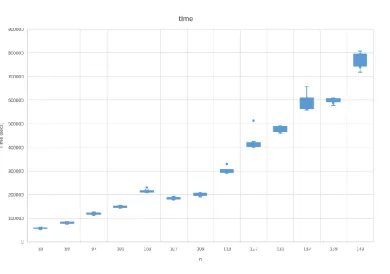
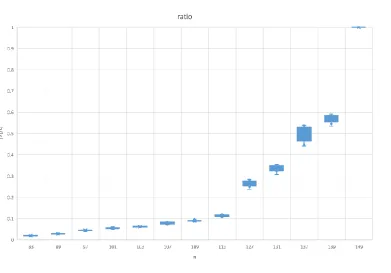
The timing results are summarized inFigure 1and the qualities of ¯v0are summarized inFigure 2. The attack onn=83,113,149 used an average CPU time of 57471.10, 309815.82, 762618.22 seconds per key. The attack on n=83,113 found short vectors ¯v0such that the average of ratiok¯v0k/qis 0.021, and 0.11. In the case ofn=149, we fail to find short vectors ¯v0.
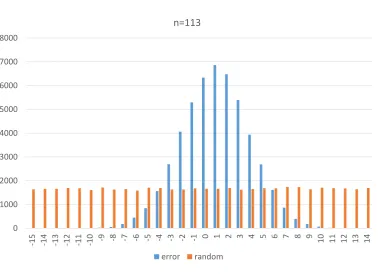
We check the quality of ¯v0as follows. We generate 50000 random errorsei(x,y) ∈F(ΓXr,Rn,q,p)and 50000 random polynomialsui(x,y) ∈F(ΓXr,Rn,q). We then compute computeδi :=v¯0·e¯imodcqandξi :=¯v0·u¯imodcq, where we denote by modcthe centered modulo operator. We check how they vary.
For example, in the case ofn = 113, we take the worst vector ¯v0withkv¯0k/q = 0.12. Although this is the worst vector, it is enough to distinguish the errors from uniform as the histogram inFigure 3shows.
9
Conclusion
Fig. 1: Summary of Running Time
attacks. The second one is for primenand exploits another class of subringRn,q[x]ofRn,q[x,y]to reduce the dimension. The message-recovery attack succeeds in the case degX = 2 but fails in the case degX =1. The distinguishing attack also succeeds in largern, say,n=113.
We finally note that we have already reported our attacks to Akiyama et al. and the parameter settings in their paper on Cryptology ePrint Archive [AGO+17b] and NIST PQC submission [AGO+17a] reflected our attacks. They further investigated lattice-based attacks and estimated the security by following the security-estimation methods of the LWE problems [AGVW17,ADPS16,BDGL15,Che13]. See their paper for details.
Acknowledgment
The author would like to thank Akiyama, Goto, Okumura, Takagi, Nuida, and Hanaoka for their kindness and fruitful discussions. The author would like to thank anonymous reviewers of PQCrypto 2018 for their valuable comments. The author finally would like to thank the XFARM Team for providing their could.
References
ADPS16. Erdem Alkim, Léo Ducas, Thomas Pöppelmann, and Peter Schwabe. Post-quantum key exchange - A new hope. In Thorsten Holz and Stefan Savage, editors,USENIX Security Symposium 2016, pages 327–343. USENIX Association, 2016. See alsohttps://eprint.iacr.org/2015/1092.12
AG06. Koichiro Akiyama and Yasuhiro Goto. A public-key cryptosystem using algebraic surfaces. InPQCrypto 2006, pages 119–138, 2006. Available athttp://postquantum.cr.yp.to/.1
AGM09. Koichiro Akiyama, Yasuhiro Goto, and Hideyuki Miyake. An algebraic surface cryptosystem. In Stanisław Jarecki and Gene Tsudik, editors,PKC 2009, volume 5443 ofLNCS, pages 425–442. Springer, Heidelberg, 2009. 1
Fig. 2: Summary of Ratiok¯v0k/q
AGO+17b. Koichiro Akiyama, Yasuhiro Goto, Shinya Okumura, Tsuyoshi Takagi, Koji Nuida, Goichiro Hanaoka, Hideo Shimizu, and Yasuhiko Ikematsu. A public-key encryption scheme based on non-linear indeterminate equations (Giophantus). Cryptology ePrint Archive, Report 2017/1241, 2017. Available athttps://eprint.iacr.org/2017/1241.
2,12
AGO+18. Koichiro Akiyama, Yasuhiro Goto, Shinya Okumura, Tsuyoshi Takagi, Koji Nuida, and Goichiro Hanaoka. A public-key encryption scheme based on non-linear indeterminate equations. InSAC 2017 – Proceedings of the
24th Annual Conference on Selected Areas in Cryptography, volume 10719 ofLecture Notes in Computer Science,
pages 199–218. Springer, Heidelberg, 2018. To appear.1,2,3,4,5,9
AGVW17. Martin R. Albrecht, Florian Göpfert, Fernando Virdia, and Thomas Wunderer. Revisiting the expected cost of solving usvp and applications to LWE. In Tsuyoshi Takagi and Thomas Peyrin, editors,Advances in Cryptology - ASIACRYPT 2017 - 23rd International Conference on the Theory and Applications of Cryptology and Information
Security, Hong Kong, China, December 3-7, 2017, Proceedings, Part I, volume 10624 ofLecture Notes in Computer
Science, pages 297–322. Springer, 2017.12
Aki17. Koichiro Akiyama. Private communication, October 2017. 2017-10-04.9
BDGL15. Anja Becker, Léo Ducas, Nicolas Gama, and Thijs Laarhoven. New directions in nearest neighbor searching with applications to lattice sieving.IACR Cryptology ePrint Archive, 2015:1128, 2015.12
Che13. Yuanmi Chen.Réduction de réseau et sécurité concrète du chiffrement complètement homomorphe. PhD thesis, 2013. Informatique Paris 7 2013.12
CS97. Don Coppersmith and Adi Shamir. Lattice attacks on NTRU. In Walter Fumy, editor,EUROCRYPT ’97, volume 1233 ofLNCS, pages 52–61. Springer, Heidelberg, 1997.6
Gen01. Craig Gentry. Key recovery and message attacks on NTRU-composite. In Birgit Pfitzmann, editor,EUROCRYPT 2001, volume 2045 ofLNCS, pages 182–194. Springer, Heidelberg, 2001.1,7,11
GPV08. Craig Gentry, Chris Peikert, and Vinod Vaikuntanathan. Trapdoors for hard lattices and new cryptographic constructions. In Cynthia Dwork, editor,STOC 2008, pages 197–206. ACM, 2008. see alsohttps://eprint.iacr.org/ 2007/432.3
0 1000 2000 3000 4000 5000 6000 7000 8000
-15 -14 -13 -12 -11 -10 -9 -8 -7 -6 -5 -4 -3 -2 -1 0 1 2 3 4 5 6 7 8 9 10 11 12 13 14
n=113
error random
Fig. 3: Histogram ofδi(blue lines) andξi(orange lines). We countq/30
A
Implementation
Listing 1.1: ref.sage
# Reference Implementation of IEC # Load this file
# n = 80; p=3; wx =1; wr =1; # load('ref.sage ')
# Parameters ====================
def gen_G ( upper_bound , lower_bound ):
# compare with total deg. if equal , (1 ,0) < (0 ,1)
def my_key (a):
return (a[0] + a[1] , a[1] , a[0])
# i for index of x, j for index of y
l = [(i,j) for j in range( upper_bound +1) \ for i in range( upper_bound +1) \
if ( lower_bound <= i+j) and (i+j <= upper_bound )] return sorted(l, key= my_key )
GX = gen_G (wx ,0); Gr = gen_G (wr ,0) GXr = gen_G (wx+wr ,0); GXp = gen_G (wx ,1)
def bd(n,p):
return len(GXr) * p * (p -1) * (n * (p -1))^( wx+wr)
q = next_prime (bd(n,p))
Zq = Integers (q) R.<t> = Zq []
Rq = R. quotient (t^n -1) F.<x,y> = Rq []
# Random polys ====================
def random_tpoly (p): return R([ randint (0,p -1) for _ in range(n)])
def random_template (p, indices ): a = 0
for (i,j) in indices :
a += Rq( random_tpoly (p)) * x^i * y^j return a
def random_r (): return random_template (q,Gr) def random_e (): return random_template (p,GXr)
# Cryptosystem ====================
def skgen ():
return random_tpoly (p), random_tpoly (p)
def pkgen (ux ,uy ):
X = random_template (q,GXp) X -= X(ux ,uy)
return X
def encrypt (X,m):
return Rq(m)+ X * random_r () +p * random_e ()
def decrypt (ux ,uy ,c): cu = c(ux ,uy)
mt = cu.lift (). change_ring (ZZ ). change_ring ( Integers (p))
# output mt in Rq
return mt. change_ring ( Integers (q))
Listing 1.2: KRA-PS1.sage
# key - recovery attack for PS1
# Make the experiment reproducible
# (at least on given platform /Sage version )
set_random_seed (0)
n = 80; p=3; wx =1; wr =1; d=int(n/2)
load('ref.sage ')
# Rings ====================
Rqd = R. quotient (t^d -1) Fd = F. change_ring (Rqd)
# ====================
def circulant_matrix (b,n):
# Input : b in Zq[t] (not Zq[t]/(t^n -1) !!!) # Output : circlant b
return matrix (ZZ ,n,n,lambda i,j: b. monomial_coefficient (t^((j-i) % n)))
def vectorize (b,n):
return circulant_matrix (b,n)[0]
l = v * L. inverse ()
lround = vector (map(lambda x: round(x), l)) w = lround * L
return w
def recover_folded_sk_roundingCVP ( folded_X ): Alist = []
for (i,j) in GXp:
a = folded_X . monomial_coefficient (Fd(x^i*y^j))
Alist . append ( circulant_matrix (a.lift (),d). transpose ()) A_kr = block_matrix (ZZ ,1,len(GXp), Alist )
Z = block_matrix (ZZ ,[[ A_kr], [q * identity_matrix (d*len(GXp ))]]) Z = Z. echelon_form ( include_zero_rows = false )
L = (q * Z. transpose (). inverse ()). change_ring (ZZ) L = L.BKZ ()
# solve CVP by rounding
a00 = folded_X . monomial_coefficient (Fd (1)). lift () target_vector = vector (Zq ,list( vectorize (-a00 ,d))) Aq = A_kr. change_ring (Zq)
target_t = Aq. solve_right ( target_vector ). change_ring (ZZ) w = roundingCVP (target_t ,L)
v = target_t - w
return v, R(list(v[0:d])) , R(list(v[d:2*d]))
def recover_sk_from_folded_sk (X,vv ): def f(i,j):
return 1 if int(n/d) * i <= j and j < int(n/d) * (i+1) else 0
Alist = []
for (i,j) in GXp:
a = X. monomial_coefficient (F(x^i*y^j))
Alist . append ( circulant_matrix (a.lift (),n). transpose ()) A_kr = block_matrix (ZZ ,1,len(GXp), Alist )
Tp = matrix (ZZ ,len(GXp),len(GXp )*int(n/d),lambda i,j: f(i,j)) T = Tp. tensor_product ( identity_matrix (d))
A_kr_hint = block_matrix (ZZ ,[[ A_kr ],[T]])
Z = block_matrix (ZZ ,[[ A_kr_hint ], [q * identity_matrix (len(GXp )*n )]]) Z = Z. echelon_form ( include_zero_rows = false )
L = (q * Z. transpose (). inverse ()). change_ring (ZZ) L = L.BKZ ()
# solve CVP by rounding
a00 = X. monomial_coefficient (F (1)). lift ()
target_vector = vector (Zq ,list( vectorize (-a00 ,n)) + list(vv )) Aq = A_kr_hint . change_ring (Zq)
target_t = Aq. solve_right ( target_vector ). change_ring (ZZ) w = roundingCVP (target_t ,L)
v = target_t - w
return v, R(list(v[0:n])) , R(list(v[n:2*n]))
def test( pairs =10 , debug =true ): succ = 0
tottime = 0.0
for npair in range( pairs ): ux ,uy = skgen ()
print " --- Key pair %d ---" % ( npair )
tm = cputime ( subprocesses =True) folded_X = X. change_ring (Rqd)
folded_v , folded_ux , folded_uy = recover_folded_sk_roundingCVP ( folded_X ) if debug :
print "X", X
print " folded X", folded_X print " folded v", folded_v print " folded ux", folded_ux print " folded uy", folded_uy
v, ux_cand , uy_cand = recover_sk_from_folded_sk (X, folded_v ) tottime += float( cputime (tm ))
if debug :
print "v", v
print " ux_cand ", ux_cand print " uy_cand ", uy_cand
if ux == ux_cand and uy == uy_cand : succ += 1
print " ===== Results ===== "
print " Total time for extraction : %f seconds ." % ( tottime )
print " Average time for extraction : %f seconds ." % ( tottime / pairs ) print " Successful recoveries : %d/%d (%f)." % \
(succ ,pairs ,RR (100* succ/ pairs ))
![Table 1: Proposed sets of parameter values [AGO+18, Table 3]. PS2’ is obtained by setting n = 83 in PS2](https://thumb-us.123doks.com/thumbv2/123dok_us/7954775.1319953/4.595.160.434.96.154/table-proposed-sets-parameter-values-table-obtained-setting.webp)