Planning for Multiple Task Work - an Analysis of a
Medical Reception Worksystem
Becky Hill, John Long, Walter Smith and Andy Whitefield
Ergonomics Unit, University College London 26 Bedford Way, London
WC1H 0AP U.K. Tel: +44-71-387-7050 Fax: +44-71-580-1100 E-mail: [email protected]
primary contact: Becky Hill
ABSTRACT
This paper presents an investigation of interactive worksystem planning in the multiple task work domain of medical reception. In an observational study of a medical reception worksystem, three different types of plan were identified: the task plan, the procedure plan and the activity plan. These three types of plan were required for effective working in the domain of medical reception, because of the nature of the multiple task work. It is proposed, therefore, that to design effective interactive human-computer worksystems for the domain of medical reception (and possibly for other work domains of a similar nature), the designer must specify the three different types of plan and the relationships between them.
Keywords: medical reception; planning and control; multiple tasks
type of submission: paper
type of paper: theoretical
number of colour illustrations: zero
machine-readable version not sent:
Planning for Multiple Task Work - an Analysis of a
Medical Reception Worksystem
Becky Hill, John Long, Walter Smith and Andy Whitefield
Ergonomics Unit, University College London 26 Bedford Way, London
WC1H 0AP Tel: +44 71 387 7050 E-mail: [email protected] ABSTRACT
This paper presents an investigation of interactive worksystem planning in the multiple task work domain of medical reception. In an observational study of a medical reception worksystem, three different types of plan were identified: the task plan, the procedure plan and the activity plan. These three types of plan were required for effective working in the domain of medical reception, because of the many similar concurrent tasks, the frequency of behaviour switching between tasks and the need for consistency within the worksystem. It is proposed, therefore, that to design effective interactive human-computer worksystems for the domain of medical reception (and possibly for other work domains of a similar nature), the designer must specify the three different types of plan and the relationships between them. The three types of plan in medical reception are discussed in the context of design issues such as the allocation of planning structures.
KEYWORDS
medical reception; planning and control; multiple tasks.
1 INTRODUCTION
This paper presents an observational study of the plans and planning behaviour of a medical reception worksystem. The study was carried out to develop further an existing design-oriented framework of the planning and control of multiple task work (PCMT) (Smith, Hill, Long and Whitefield, 1993 [5]). Section 1 provides some background information about medical reception (MR), and identifies it as a 'PCMT design problem'. Section 2 describes the particular medical reception worksystem studied and how the observational data were collected and analysed. Section 3 contains the resulting model of PCMT in medical reception, while Section 4 presents more detailed accounts of the three different types of plan used by the medical reception worksystem. The model is intended to have appropriate content to aid in reasoning about design, but is not yet in a suitable form for use within an existing design methodology. Section 5 identifies design issues addressed by the model.
1.1 Medical Reception (in the UK)
Informally, we can identify medical reception worksystems as those interactive systems, comprising combinations of people and office devices, which support the effective interaction between medical practitioners and their patients in medical general practices.
Jeffreys and Sachs (1983) [1] have described the emergence of medical reception worksystems in the UK. In 1966, there was a boost to the employment of receptionists and secretaries, because the Family Doctors Charter was implemented, which gave provision for GPs to reclaim 70% of the salaries paid to their staff. Closely related to the increasing employment of receptionists was the growth in the use of appointment systems in general practice, as an appointment system could not be implemented without the employment of receptionist staff. General practices have begun in the last few years to be computerised, however the number has been small. The British government has more recently introduced a scheme of partial reimbursement of computer costs to increase computerisation.
Medical reception, therefore, presents an example of what might be described as an emerging Human Computer Interaction (HCI) design problem. Following the approach of Dowell and Long (1989) [2], the medical reception HCI design problem might be stated as: to specify the structures and behaviours of a human-computer interactive medical reception worksystem which will carry out work in the domain of medical reception to a desired level of performance.
1.2 Medical Reception as an Instance of the Planning and Control of Multiple Task Work
There are many different issues to be addressed in the design of medical reception worksystems. The set of issues addressed in this paper are those concerning PCMT. The general aim of the present research is to construct an appropriate model to aid designers reasoning about alternative solutions to this medical reception-PCMT design problem. The aim of the observational study reported here was to investigate the types of planning and plans used by medical reception worksystems to carry out work effectively.
behaviours is particularly important where the worksystem carries out several ongoing tasks concurrently.
1.3 A Design-Oriented Framework of PCMT-MR The notions of multiple task work and planning and control used in this paper are based on a previously constructed PCMT framework (Smith, Hill, Long and Whitefield, 1992a [3]; 1993 [5]). This section briefly outlines a PCMT-MR framework, the application of the PCMT framework to medical reception, in sufficient detail to understand the resulting model presented in Section 3.
The 'PCMT-MR' framework is based on Dowell and Long's (1989) conception for an engineering discipline of HCI which expresses the HCI general design problem. The conception makes a fundamental distinction between an interactive worksystem, comprising one or more users and computers, and its domain of application, comprising the transformations carried out by the worksystem which constitute its work. The effectiveness with which work is carried out is expressed by the concept of performance which can be defined as a function of two factors: the quality of the product (i.e. how well the desired state of the domain is achieved compared with the state specified in the goal); and the incurred resource costs (i.e. the resources required by the worksystem in accomplishing the work).
The interactive worksystem, its domain of application and performance. In medical reception, the worksystem is the receptionist plus devices such as an appointment book, telephone and prescription filing system, a wider notion of worksystem used in order to analyse to-be-computerised systems. The medical reception domain is conceptualised as the provision of support for medical cases, i.e. patients consulting with medical practitioners. Medical reception performance concerns the effectiveness with which support is provided for the medical cases.
Multiple task work. The medical reception domain is an instance of multiple task work since support is given concurrently for multiple ongoing and temporally overlapping medical cases. A single medical reception task is the transformation of a single medical case object, comprising a patient object, medical practitioner object(s), diagnosis object(s) and treatment object(s). This task might require a diverse range of behaviours spread over a long period of time, for example: arranging a suitable appointment for patient P, notifying patient P of test results.
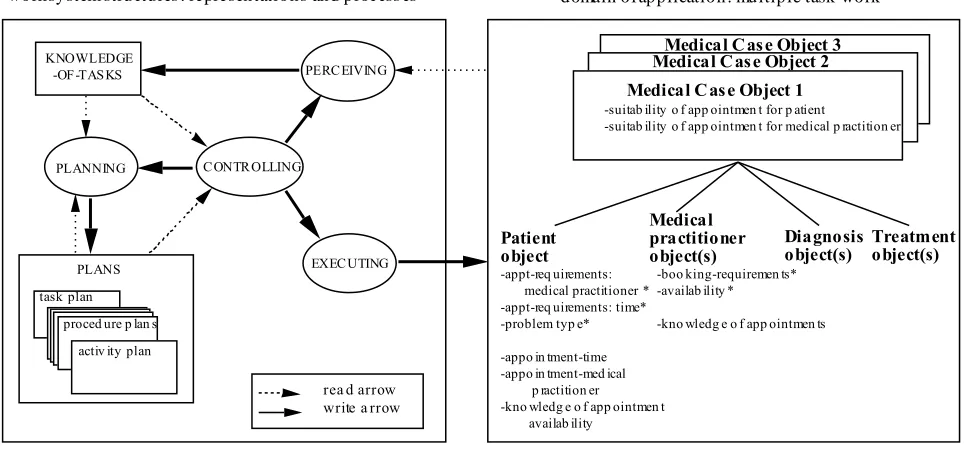
Planning and control behaviour. It has been argued elsewhere (Smith et al, 1992b, [4]) that for an adequate characterisation of the planning and control structures of worksystems which carry out work in complex and dynamic domains, it is necessary to make explicit the relationship between planning, control, perception and execution behaviours. Planning, in medical reception, entails specifying how medical case objects are to be
supported by specifying either required transformations of medical case objects and/or required behaviours. Control entails deciding which behaviour to carry out next, such as arranging an appointment for patient P1 or preparing notes for P2. Perception and execution behaviours are, respectively, those whereby the medical reception worksystem acquires information about the medical case objects and those whereby it provides the required support.
Cognitive structures and allocation of function. The PCMT-MR framework expresses the worksystem at two levels of description. Firstly, the framework describes the cognitive structures of the worksystem, expressed as four processes - perceiving, planning, controlling and executing - and two representations - knowledge-of-the-tasks and plans. This relationship is illustrated in more detail in the description of the PCMT-MR model (Section 3). Secondly, the framework describes the distribution of these cognitive structures across the physically separate user and devices of particular worksystems. The framework therefore allows the construction of alternative models of the distribution of cognitive structures across the user and devices, and thus, it supports reasoning about allocation of function.
2 AN OBSERVATIONAL STUDY OF MEDICAL RECEPTION
This Section describes an observational study of a medical reception worksystem. The aim of the observational study was to investigate the types of planning and plans used by medical reception worksystems to carry out work effectively.
2.1 The Medical Reception Worksystem
The medical reception worksystem chosen for the study supported the provision of medical care in a general practice with four doctors and two nurses. This worksystem was physically divided into two different workstations, with two receptionists working from a 'front desk' and a 'back desk'. The front desk workstation comprised a receptionist and devices, such as a telephone, and an appointments book. The back desk workstation comprised a second receptionist and devices, such as a prescription book, telephone and a computerised database. The front desk was positioned in front of a hatch through which the receptionist interacted with patients arriving at the surgery Under guidance of the receptionist, patients passed from the hatch to a waiting room before seeing a medical practitioner.
2.2 The Nature of the Medical Reception Domain As described in Section 1.3, the medical reception domain involves multiple task work. These tasks are characterised by:
(i) well-defined, routine sub-tasks;
Figure 1 The Model of PCMT-MR
KNOWLEDGE -OF-TASKS
PLANNING CONTROLLING
PERCEIVING
EXECUTING
task plan proced ure p lan s
activ ity plan PLANS
worksystem structures : representations and process es
Patient object
Medical practitioner
object(s) Diagnosis object(s) Treatment object(s) -appt-req uirements:
medical practitioner * -appt-req uirements: time* -problem typ e*
-appo in tment-time -appo in tment-med ical p ractition er
-kno wledg e o f app ointmen t availab ility
-boo king-requiremen ts* -availab ility *
-kno wledg e o f app ointmen ts Medical Case Object 3 Medical Case Object 2 Medical Case Object 1 -suitab ility o f app ointmen t for p atient
-suitab ility o f app ointmen t for medical p ractition er
domain of application: multiple task work
rea d arrow write a rrow
(iii) a high frequency of autonomous events; that is, task-relevant events which occur independently of any worksystem behaviour, for example: the arrival of a patient at the hatch or an incoming telephone call.
2.3 Data Collection
Video-recordings were taken of the two workstations. Two video cameras were used simultaneously, one camera focused on the appointment-booking system of the front desk, while the other camera recorded the interactions within the whole reception area including both desks. Video-recordings were taken, both during and outside surgery hours, for one morning and afternoon in which time one pair of receptionists was relieved by another. At a later date, after initial analysis, an interview was carried out with one receptionist, to obtain clarification of selected details concerning the work. Only the analysis of video-recordings is reported here, although this analysis was assisted by the interview.
2.4 Data Analysis
Only the two videos recorded in the morning were analysed, because sufficient data were gathered from these two videos. The following analysis was carried out on both videos. From the 240 minutes of video-recording a sequence of between 30 - 90 minutes was selected for analysis. This selection was based mainly on the criteria that (i) the observed behaviours were interpretable, and (ii) the analysed period appeared to be busy in support of medical cases (and so was presumed to include behaviours of interest).
The first stage of the analysis was the documentation of behaviours and task-related events to a level of description considered to be at, or below, that necessary for the identification of planning and control behaviours. This first description allowed the identification of: (i) a
low-level description of the physical domain objects (e.g., prescription); (ii) a low-level description of the physical worksystem devices (e.g., ). Behaviours and events were documented in chronological sequence in a manner illustrated as follows:
BUZZ pick up pick up select-LINE
(over telephone): Hello can I help
event: P put prescription in
(over ): Dr S?
From this first analysis, it was possible to identify sequences of behaviours which were generic to particular activities carried out by the receptionist worksystem, for example appointment-booking.
3 A MODEL OF PCMT-MR
Section 1.3 described the conceptual framework of PCMT-MR constructed prior to carrying out the observational study outlined in Section 2. Sections 3 and 4 now describe the model of PCMT-MR constructed by using the observations of medical reception tasks and behaviours to instantiate the concepts of the framework.
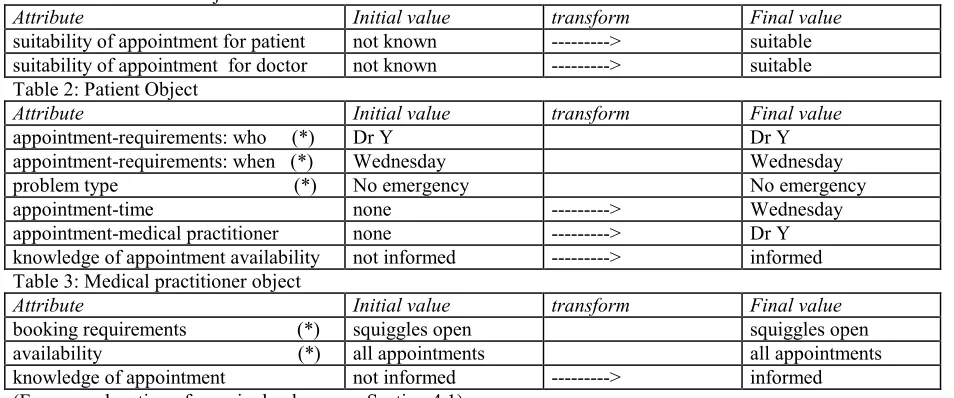
Table 1: Medical case object
Attribute Initial value transform Final value
suitability of appointment for patient not known ---> suitable suitability of appointment for doctor not known ---> suitable Table 2: Patient Object
Attribute Initial value transform Final value
appointment-requirements: who (*) Dr Y Dr Y
appointment-requirements: when (*) Wednesday Wednesday problem type (*) No emergency No emergency
appointment-time none ---> Wednesday
appointment-medical practitioner none ---> Dr Y knowledge of appointment availability not informed ---> informed Table 3: Medical practitioner object
Attribute Initial value transform Final value
booking requirements (*) squiggles open squiggles open availability (*) all appointments all appointments knowledge of appointment not informed ---> informed (For an explanation of a squiggle please see Section 4.1)
3.1 The Medical Reception Worksystem
The expression of the medical reception worksystem in Figure 1 shows cognitive structures taken from the PCMT-MR framework (described in Section 1.3). These cognitive structures are expressed at a generic level; that is, they depict the cognition of the medical reception worksystem prior to any allocation of function between the receptionist and devices. The relationships between the cognitive structures in Figure 1 embody the definitions of the planning and control behaviours described in Section 1.3. (For more detail see Smith et al, 1992b [4]). The plan representation structure in Figure 1 has been 'opened-up' to show the different types of plan identified in the study which are described in detail in Section 4.
3.2 The Medical Reception Domain
Following the PCMT-MR framework, the medical reception domain is expressed as those objects whose transformation constitutes the work of medical reception. Thus, the domain contains multiple medical case objects, each medical case object comprising a patient object, medical practitioner object(s), diagnosis object(s) and treatment object(s). Each task constitutes the transformation of a single medical case object with respect to the values of a number of attributes. In order to transform the medical case object attributes, the attributes of the medical case sub-objects (which are in a part-whole relationship with the medical case object), must be transformed. Tables 1-3 describe the transformation of the objects associated with the sub-task of appointment-booking. One of the attributes of a medical case object which must be transformed is appointment suitability for the patient. To transform the value of this attribute, the values of some of the attributes of the patient sub-object must be transformed.
The study revealed that the required transformation of each medical case object could be divided into a number of sub-transformations concerning particular sets of attributes. The division of the tasks into
sub-transformations was consistent across all the tasks, and therefore the sub-transformations could be labelled generic sub-tasks. The generic sub-tasks identified in this study of medical reception were: appointment-booking, preparation of repeat prescriptions, registration of new patients, preparation (and updating) of medical notes for medical practitioners, and notification of patients test results.
Associated with the set of identified generic sub-tasks there were a corresponding set of activities. An activity is that set of behaviours which carry out a generic sub-task.
The activities identified in medical reception were: booking of appointments, preparing repeat prescriptions, registering new patients, preparing (and updating) medical notes for medical practitioners, and notifying patients of test results. Due to limitation of space, only appointment-booking will be described in detail.
Figure 1 shows only those attributes which apply to the generic sub-task of appointment-booking. Attributes may be affordant or dispositional. Affordant attributes are transformed by the worksystem; their transformation constitutes the work done. Dispositional attributes are relevant to the work but their transformation does not itself constitute work (often dispositional attributes do not change their values). The attributes marked with an asterisk (*) in Figure 1 and Tables 1-3 are dispositional, for appointment-booking.
4 PLANS AND PLANNING IN THE MEDICAL RECEPTION WORKSYSTEM
interpreted as instances of three general types of plan: a task plan, an activity plan and a procedure plan.
4.1 The Task Plan
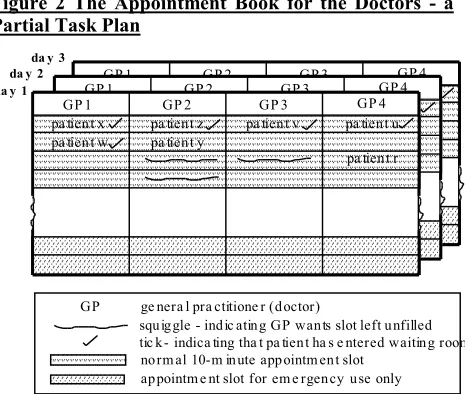
The receptionists used two appointment books (one for doctors and one for nurses) to represent and record details of patient appointments with the medical practitioners. Figure 2 schematically depicts the information represented in the appointment book for doctors: names of patients occupying particular appointment slots; whether or not the patient had entered the waiting room; slots which were still available; slots which the medical practitioners wanted to be left open; slots which could be used in emergencies. The receptionists also used what can be called 'mental markers'; that is, they made mental notes of temporarily significant appointment slots, such as the next available appointment of a particular medical practitioner or a slot which was in the process of being offered to a patient but not yet accepted.
Figure 2 The Appointment Book for the Doctors - a Partial Task Plan
GP 1 GP 2 GP 3 GP 4
pa tient x
pa tient y pa tient w
pa tient z pa tient v pa tient u
pa tient r
GP 1 GP 2 GP 3 GP 4
pa tient x
pa tient y pa tient w
pa tient z pa tient v pa tient u
pa tient r
da y 1 da y 2
da y 3
squiggle - indic ating GP wants slot left unfilled tic k - indica ting tha t pa tient ha s e ntered waiting room norm al 10-m inute appointm ent slot
appointm e nt slot for em e rgency use only
GP 1 GP 2 GP 3 GP 4
pa tient x
pa tient y pa tient w
pa tient z pa tient v pa tient u
pa tient r
GP ge nera l pra ctitione r (doctor)
From other perspectives, the appointment books might be regarded as plans for the whole practice. In the present analysis, the appointment books plus the associated mental markers were regarded as plans of the medical reception worksystem because they guided its behaviour; for example, they represented the patients whose medical notes needed to be prepared for the doctor, and the patients who should be let into the waiting-room. In terms of the PCMT-MR framework, the appointment books were plans which represented information about domain object attribute values. Specifically, they represented information about the patient object attributes of appointment-time and appointment-practitioner, and medical practitioner object attributes of availability (see Figure 1).
The information represented in the appointment books was specific to particular objects, i.e. patients and medical practitioners, in the medical reception domain and was therefore specific to particular tasks, i.e. transformations of medical cases. The appointment books, with associated mental markers, were therefore
identified as instances of a generic type of plan - the task plan. In general, task plans are specifications of either behaviours or domain object transformations relating to specific task instances. The appointment books were therefore partial task plans.
4.2 The Activity Plan
As described in Section 3.2, the medical reception worksystem carried out a number of different activities, e.g. appointment-booking, preparing medical notes. From the video-recording and interview, it was possible to identify that the receptionists had a shared daily schedule of activities, mentally represented, to be carried out by the front and back desk receptionists. Figure 3 shows the activity schedule of the observed medical reception worksystem on the day of recording. This schedule was not rigidly adhered to as many activities, such as notifying of test results, were carried out in direct response to autonomous events such as patients telephoning the surgery.
Figure 3 The Activity Plan BACK DESK
morning dealing with mail updating medical record envelopes
preparing repeat prescriptions
afternoon dealing with mail updating medical record envelopes
preparing repeat prescriptions
FRONT DESK morning
booking of appointments preparing repeat pr escriptions (requests, >10.00am)
afternoon
booking of appointments
The information represented in the activity schedule was specific to the carrying out of particular activities, as opposed to particular tasks. The activity schedule was therefore identified as an instance of a generic type of plan - the activity plan. In general, activity plans are specifications of sequences of activities to be carried out; where each activity is a set of behaviours relating to a particular generic sub-task of the domain (see Section 3.2).
4.3 The Procedure Plan
Through analysis of the video-recordings, supported by interviews, it was possible to identify that the receptionist went through well-established sequences of behaviours when carrying out a particular activity. Thus the receptionists had mental routines, with in-built conditionals, for carrying out each activity, such as preparing medical notes, booking of appointments, preparing repeat prescriptions, etc.
relates to a generic sub-task of the domain (see Section 3.2).
C ONDITIONAL ON PATIENT- R EQUIR EMENTS C ONDITIONAL ON DOCTOR
AVAILABILITY B EHAVIOUR
OFFER APPT TODAY OWN DR
YES NO
IF ALT APPT AVAILABLE
TODAY OWN
DR
NO
C ONFIR M APP OINTMENT IF R EQUIR E APPOINTMENT
TODAY
YES NO
IF R EQUIR E
OWN DR
YES
NO
INF OR M CALLER NO APPT TODAY
OWN DR
YES IF STILL R EQUIR E OWN DR
NO
OFFER NEXT AP PT WITH OW N DR
YES IF
ACC EP T NO
TAKE NAME
B OOK APP OINTMENT IF
ACC EP T YES
YES
NO IF APPT AVAILABLE
TODAY OWN DR
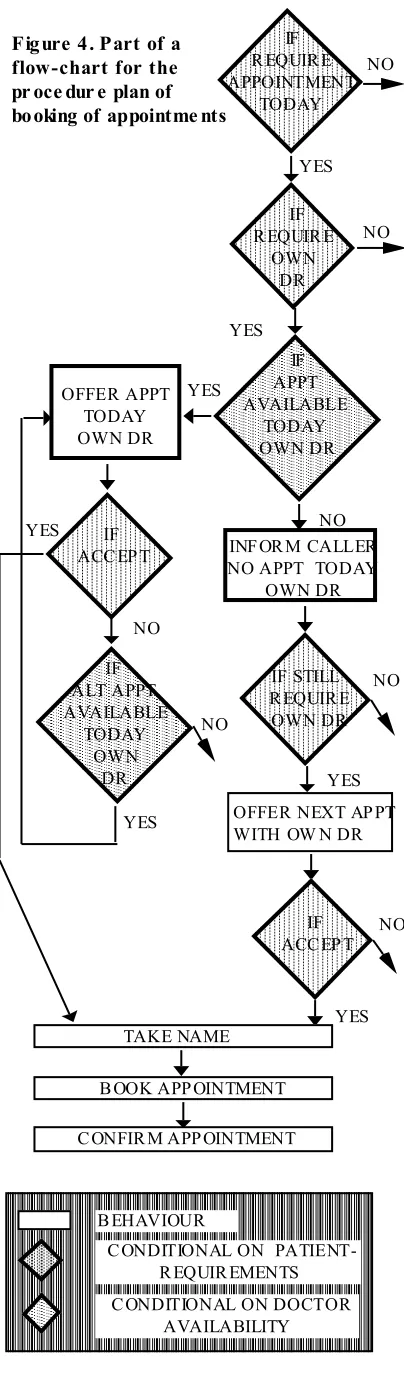
As an illustration, the procedure plan for booking of appointments is now described in detail. Figure 4 shows a flow diagram of behaviours, with associated conditionals, carried out in the activity of booking of appointments. The conditionals imply other behaviours; for example, the first conditional in Figure 4 implies that the controlling process must initiate the behaviour of reading the contents of Knowledge of tasks and, if necessary, to perceive the patient's requirement for appointment time (see Figure 1). Thus this procedure plan for booking of appointments describes the behaviours of the worksystem in terms of both the planning, control, perception and execution behaviours and the transformation of the medical case objects that constitute the generic sub-task of appointment-booking (see Section 4.4).
4.4 The Relationship between the Different Plans The following scenario of an appointment being booked illustrates the relationship between the three plans shown in Figure 1, and shows how they operated in combination to guide the worksystem's behaviour.
At the beginning of the day, the controlling process reads the activity plan - which specifies that receptionist R should carry out booking of appointments from the front-desk during the morning (Figure 3) - and sets the parameters of the perceiving, executing and planning processes appropriately.
Later, an autonomous event occurs associated with the domain: patient P telephones the surgery requiring an appointment. The controlling process then reads from the procedure plan for booking of appointments (Figure 4) which guides control decisions to activate the following sequence of behaviours:
• perception: perceiving the values of patient P's attributes and updating knowledge-of-tasks: with the following attribute values:
appointment-requirements-who: own Dr (Dr X) appointment-requirements-when: today problem type: not emergency
• planning: selecting and (mentally) marking a possible appointment slot in the task plan (i.e. the appointment book): Dr X, time t
• execution: offering the selected appointment to patient P, i.e., attempt to transform P's attribute values to: appointment-practitioner: Dr X
appointment-time: time t
• perception: updating knowledge-of-tasks to register the acceptance of the appointment and patient P's name. • planning: adding a representation of the agreed appointment to the task plan
• perception: confirming the appointment details with patient P.
5 THE ROLE OF THE MODEL IN SUPPORTING THE DESIGN OF MEDICAL RECEPTION WORKSYSTEMS The study of medical reception showed how the worksystem used three types of plan to carry out its work effectively. The relationship between the use of these different plan types and performance, i.e. the
effectiveness with which the multiple task work was carried out will now be described along with their implications for the design of interactive worksystems.
• The task plan, observed in the form of patient appointment books, supported the effective carrying out of the many ongoing tasks by:
1) giving guidance for the carrying out of behaviours relating to specific tasks, e.g. whether to admit patient P1 to the waiting room, preparing medical notes for P2; 2) co-ordinating different tasks e.g. ensuring that appointments were unique for each task.
• The activity plan, observed in the form of a (mentally represented) daily schedule of activities, supported the effective carrying out of tasks by:
1) supporting large-scale sharing of effort across separate tasks; e.g., when carrying out the activity of preparing repeat prescriptions, all of the medical notes for the patients requiring repeat prescriptions would be collected together at one time, thus reducing the behavioural costs to the worksystem;
2) co-ordinating the activities with the task-relevant changes in the domain; e.g., the activity of preparing repeat prescriptions was carried out during surgery hours, so that the prescriptions were ready for the doctors to verify and sign when the surgeries finished.
• Procedure plans, observed in the form of mental routines, supported the effective carrying out of repetitive sub-tasks which were generic across tasks (such as booking of appointments) by:
1) providing quick responses in a domain where there was a very high frequency of autonomous events (patients arriving, incoming telephone calls);
2) maintaining consistency which supported the rotation of the four receptionists around the two medical reception workstations;
3) supporting shared user behaviour, such that if one workstation was left unattended because a receptionist was busy the other receptionist on that shift could take over at the unattended workstation.
In computerising, and therefore redesigning, the medical reception worksystem described in this paper, a designer should specify how the identified plans will be supported in the new design. For example it may be advisable to re-allocate some of the mental plans to computerised devices, by:
i) having a partial procedure plan for booking of appointments device-based
ii) incorporating the currently used mental markers into a device-based appointment book. These two examples would enhance the effectiveness of the worksystem by aiding in the training of new receptionists and reducing their mental workload.
Therefore, in general, designs for medical reception worksystems should specify:
(ii) the relationship between the different plans
(iii) the allocation of the plans across the receptionist and the physically separate devices of the worksystem.
The generality of the plan types identified in the study reported here is uncertain at present. However, it might be suggested that the same issues will arise in the design of worksystems which carry out work in multiple task domains which are similar in nature to that of medical reception.
ACKNOWLEDGEMENT
The work reported herein was supported by the Joint Councils Initiative in Cognitive Science/HCI, grant no: SPG 8825634.
REFERENCES
[1] Jefferys, M. and Sachs, H. Rethinking General Practice: Dilemmas in Primary Health Care. London Tavistock,1983.
[2] Dowell, J. and Long, J. Towards a conception for an engineering discipline of human factors. Ergonomics, 32, (1989), 1513-1536.
[3] Smith, M.W., Hill, B., Long, J.B. and Whitefield, A.D. The Planning and Control of Multiple Task Work: a Study of Secretarial Office Administration. In Proceedings of the Second Interdisciplinary Workshop on Mental Models, Cambridge, (1992a), 74-83, in press.
[4] Smith, M.W., Hill, B., Long, J.B. and Whitefield, A.D. Modelling the Relationship Between Planning, Control, Perception and Execution Behaviours in Interactive Worksystems. In D.Diaper, M.Harrison and A.Monk (Eds) People and Computers VII; Proceedings of HCI '92. Cambridge University Press, 1992b.