New Techniques for Obfuscating Conjunctions
James Bartusek∗
Princeton
Tancr`ede Lepoint†
SRI International
Fermi Ma‡
Princeton
Mark Zhandry§
Princeton
March 5, 2019
Abstract
A conjunction is a function f(x1, . . . , xn) =Vi∈Sli where S ⊆[n] and each li isxi or¬xi.
Bishop et al. (CRYPTO 2018) recently proposed obfuscating conjunctions by embedding them in the error positions of a noisy Reed-Solomon codeword and placing the codeword in a group exponent. They prove distributional virtual black box (VBB) security in the generic group model for random conjunctions where |S| ≥0.226n. While conjunction obfuscation is known from LWE [WZ17,GKW17], these constructions rely on substantial technical machinery. In this work, we conduct an extensive study ofsimple conjunction obfuscation techniques.
• We abstract the Bishop et al. scheme to obtain an equivalent yet more efficient “dual” scheme that can handle conjunctions over exponential size alphabets. This scheme ad-mits a straightforward proof of generic group security, which we combine with a novel combinatorial argument to obtain distributional VBB security for|S|ofany size.
• If we replace the Reed-Solomon code with a random binary linear code, we can prove security from standard LPN and avoid encoding in a group. This addresses an open problem posed by Bishop et al. to prove security of this simple approach in the standard model.
• We give a new construction that achievesinformation theoreticdistributional VBB security and weak functionality preservation for |S| ≥ n−nδ and δ <1. Assuming discrete log
andδ <1/2, we satisfy a stronger notion of functionality preservation for computationally bounded adversaries while still achieving information theoretic security.
∗
[email protected]. This work was done while the author was an intern at SRI International.
†
[email protected]. Now at Google.
‡
[email protected]. This work was done while the author was an intern at SRI International.
§
Contents
1 Introduction 3
1.1 This Work: Conjunction Obfuscation . . . 3
1.1.1 Our Results. . . 4
1.2 Technical Overview . . . 5
1.2.1 Interpretation 1: The Primal . . . 6
1.2.2 Interpretation 2: The Dual . . . 7
1.2.3 Moving Out of the Exponent . . . 9
1.2.4 The Reduction to Structured Error. . . 11
1.2.5 Information Theoretic Security . . . 12
1.2.6 Computational Preservation Preservation . . . 13
1.3 Related Work . . . 14
2 Preliminaries 15 2.1 Security Notions for Evasive Circuit Obfuscation . . . 16
2.2 The Generic Group Model . . . 17
2.3 Learning Parity with Noise . . . 18
3 Obfuscating Conjunctions in the Generic Group Model 18 3.1 Generic Group Construction. . . 18
3.2 General Min-Entropy Distributions . . . 22
3.3 Extension to Larger Alphabets . . . 23
3.4 Efficiency Improvements . . . 25
4 Obfuscating Conjunctions from Constant-Noise LPN 26 4.1 Exact Structured Learning Parity with Noise . . . 27
4.2 Construction . . . 28
4.3 Security . . . 29
4.4 Multi-Bit Output . . . 30
5 Information-Theoretic Security 32 5.1 Construction . . . 33
5.2 Security . . . 34
5.3 Computational Functionality Preservation . . . 38
A Reduction for Structured Error LPN/RLC 48 A.1 Random Linear Code Problems . . . 48
A.2 Preliminary Lemmas . . . 49
A.3 Proof of Theorem 8. . . 53
B Efficient Evaluation in [BKM+18] and Our Generic Construction 55
C Strong Functionality Preservation 56
1
Introduction
Program obfuscation [BGI+01] scrambles a program in order to hide its implementation details, while still preserving its functionality. Program obfuscation has recently received considerable attention, yielding new constructions [SW14,BZ14,CLTV15,BP15,DGL+16,MPs16] and demon-strating many applications throughout cryptography [MO14,BFM15,GPS16,CCC+16].
Much of the recent attention on obfuscation focuses on obfuscating general programs. Such obfuscation is naturally the most useful, but currently the only known constructions are ex-tremely inefficient and rely on new uncertain complexity assumptions about cryptographic mul-tilinear maps [GGH13, CLT13,GGH15]. Despite advances in terms of efficiency [AGIS14,AB15,
Zim15,BISW17] and security [AJ15,MSZ16,LV16,GMM+16,Lin16,AS17,LT17,FRS17,MZ18,
BGMZ18], obfuscating general programs remains far from usable.
For some specific functionalities, it is possible to avoid multilinear maps. A series of works have shown how to obfuscate point functions (i.e., boolean functions that output 1 on a single input) and hyperplanes [Can97,LPS04,Wee05,CD08,DKL09,GKPV10,CRV10,YZ16,BS16,KY18]. Brak-erski, Vaikuntanathan, Wee, and Wichs [BVWW16] showed how to obfuscate conjunctions under a variant of the Learning with Errors (LWE) assumption. More recently it has been shown how to ob-fuscate a very general class of evasive functions including conjunctions under LWE [GKW17,WZ17].
1.1 This Work: Conjunction Obfuscation
In this work, we primarily consider obfuscating conjunctions. This class of programs has also been called pattern matching with wildcards [BKM+18], and in related contexts is known as bit-fixing [BW13].
A conjunction is any boolean function f(x1, . . . , xn) = Vi∈Sli for some S ⊆ [n], where each literal li is either xi or ¬xi. This functionality can be viewed as pattern-matching for a pattern
pat∈ {0,1,*}n, where the* character denotes a wildcard. An input string x∈ {0,1}n matches a pattern pat if and only if x matches pat at all non-wildcard positions. So for example x = 0100 matchespat=*10* but notpat=1**0.
We are interested in obfuscating the boolean functionsfpat:{0,1}n→ {0,1}which output 1 if
and only if x matches pat. We additionally give obfuscation constructions for two generalizations of the pattern matching functionality: multi-bit conjunction programsfpat,m which output a secret message m∈ {0,1}` on an accepting input, and conjunctions over arbitrary size alphabets.1
In particular, we consider the notion of distributional virtual black-box obfuscation (VBB), which guarantees that the obfuscation of a pattern drawn from some distribution can be simulated efficiently, given only oracle access to the truth table of the function defined by the pattern. We consider this notion of obfuscation in the evasive setting, where given oracle access to a pattern drawn from the distribution, the polynomial time simulator cannot find an accepting input except with negligible probability. Thus our goal will be to produce obfuscations that are easily simulatable without any information about the sampled pattern other than its distribution.
Recently, Bishop, Kowalczyk, Malkin, Pastro, Raykova, and Shi [BKM+18] gave a simple and elegant obfuscation scheme for conjunctions, which they prove secure in the generic group model [Sho97]. Unfortunately, they did not prove security relative to any concrete (efficiently fal-sifiable [Nao03, GW11]) assumption on cryptographic groups. Before their work, obfuscation for
1
Conjunctions over boolean/binary inputs naturally generalize to alphabets [`] for `≥2. In this setting, each
conjunctions was already known from LWE as a consequence of lockable obfuscation (also known as obfuscation for compute-and-compare programs) [WZ17, GKW17]. However, for the restricted setting of conjunctions, the Bishop et al. [BKM+18] construction is significantly simpler and more efficient.
1.1.1 Our Results.
In this work, we show how to alter the Bishop et al. construction in various ways, obtaining the following results.
• A New Generic Group Construction. We give a new group-based construction that can be viewed as “dual” to the construction of Bishop et al [BKM+18]. Our construction offers significant efficiency improvements by removing the dependence on alphabet size from the construction.
We also improve upon the generic group security analysis of Bishop et al. [BKM+18] by sim-plifying the proof steps and extending the argument to handle a larger class of distributions.
• Security from LPN.We show that a few modifications to the group-based construction allows us to remove groups from the scheme entirely. We prove security of the resulting construction under the (constant-rate) Learning Parity with Noise (LPN) assumption. Along the way, we give a reduction from standard LPN to a specific, structured-error version of LPN, which we believe may be of independent interest.
• Information-Theoretic Security. Finally, we show how to extend our techniques to the information-theoretic setting if the number of wildcards is sub-linear. We stress that this requires considering a weaker notion of functionality preservation. We also give an alterna-tive information theoretic scheme that achieves an intermediate “computational” notion of functionality preservation assuming discrete log.
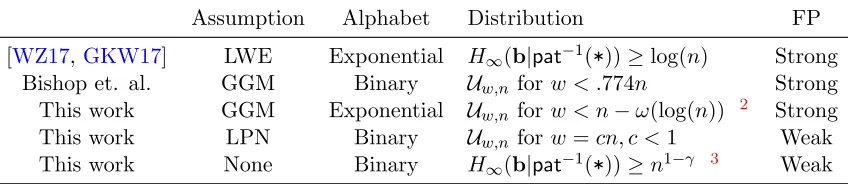
In Table 1, we compare our results with prior works on conjunction obfuscation achieving distributional-VBB security (we omit the [BVWW16] and [BR17] constructions from entropic-ring-LWE and multilinear maps).
Assumption Alphabet Distribution FP
[WZ17,GKW17] LWE Exponential H∞(b|pat−1(*))≥log(n) Strong
Bishop et. al. GGM Binary Uw,n forw < .774n Strong
This work GGM Exponential Uw,n forw < n−ω(log(n)) 2 Strong
This work LPN Binary Uw,n forw=cn, c <1 Weak
This work None Binary H∞(b|pat−1(*))≥n1−γ 3 Weak
1.2 Technical Overview
Review of the [BKM+18] Construction. We first recall the [BKM+18] scheme for obfuscating a patternpat ∈ {0,1,*}n. Begin by fixing a fieldFq for a prime q exponential inn. Then sample uniformly random s1, . . . , sn−1 ← Fq and define the polynomial s(t) := Pnk=1−1sktk ∈ Fq[t]. Note thats(t) is a uniformly random degree n−1 polynomial conditioned ons(0) = 0.
Visualize a 2 ×n grid with columns indexed as i = 1, . . . , n and rows indexed as j = 0,1. Correspond theith character inpat with theith grid column as follows: pati=0points to the top cell, pati =1to the bottom cell, and pati=*to both cells. For example, whenn= 5 the pattern
pat=0*01*naturally corresponds to the gray cells in the 2×5 grid below:
Next, we evaluate the polynomial s(t) at 2i+j for each gray cell (i, j). For each white cell, we sample a uniformly random elementr2i+j ←Fq. So for pat=0*01*, the resulting grid would be
s(2) s(4) s(6) r8 s(10)
r3 s(5) r7 s(9) s(11)
If we stop here and simply output these 2nfield elements in the clear, we already have a functional (although insecure) construction. To evaluate whether or not an input x ∈ {0,1}n matches the pattern, we read the nfield elements corresponding to the bits ofx. In our example, ifx=00011 (an accepting input for pat = 0*01*), we read row j = 0 in columns 1,2,3, and row j = 1 in columns 4 and 5:
s(2) s(4) s(6)
s(9) s(11)
An input is accepting precisely when all n = 5 selected elements are evaluations of the random degree n−1 = 4 polynomial s(t). Thus, we can evaluate by simply performing a Lagrange in-terpolation and evaluating the polynomial at s(0), i.e., we generate reconstruction coefficients L2, L4, L6, L9, L11∈Fq that satisfy
L2p(2) +L4s(4) +L6s(6) +L9s(9) +L11s(11) =s(0)
for any degree 4 polynomial s(t). When we perform this reconstruction for an accepting input, we recover s(0) = 0. If the input is not accepting, say x = 10010 in our example, then at least one of thenreconstruction points will be a random field element instead of the correct polynomial evaluation. With overwhelming probability, the reconstructed field element will not be 0, indicating x did not match pat.
Bishop et al. [BKM+18] observe that these 2n field elements are essentially a noisy Reed-Solomon codeword with the white grid cells representing error positions. If the number of error
2
In a concurrent work [BW19], Beullens and Wee achieved the same improvement in parameters and show how to base security on a new knowledge assumption secure in the generic group model. Also, note that we actually obtain security for more general distributions.
3
positions is small enough, an attacker can run any Reed-Solomon error correction algorithm to recover s(t) and learn pat. The key observation of [BKM+18] is that honest functionality only
requires linear operations on the field elements, whereas all known error-correction algorithms for Reed-Solomon codes are non-linear. Thus, the final step of their construction is to place the 2n field elements in the exponent of a groupG=hgiof orderq. Evaluation is done by performing the reconstruction in the exponent and accepting if and only if Lagrange reconstruction yields g0. For security, they prove the following:
Theorem ([BKM+18]). Let Un,w be the uniform distribution over all patterns in {0,1,*}n with
exactly w wildcards. For any w <0.774n, this construction attains distributional virtual black box security in the generic group model.
The proof in [BKM+18] is fairly technical and spans over 10 pages. Bishop et al. do not address whether the scheme actually becomes insecure for 0.774n < w < n−ω(logn), or if the bound is a limitation of their analysis.4
This Work. We provide several new interpretations of the [BKM+18] scheme. Through these interpretations, we are able to obtain improved security, efficiency, and generality, as well as novel constructions secure under standard cryptographic assumptions. We summarize the properties of these new constructions in Table 1
1.2.1 Interpretation 1: The Primal
Our first observation is that the 2n field elements generated by the [BKM+18] construction can be rewritten as a product of a Vandermonde-style matrix (henceforth the “Vandermonde matrix”) and a random vector, plus a certain “error vector.” So if the pattern is pat = 11*0, instead of writing the elements in grid form as
r2 r4 s(6) s(8)
s(3) s(5) s(7) r9
we can stack them in a column as
r2 s(3) r4 s(5) s(6) s(7) s(8) r9 =
21 22 23 31 32 33 41 42 43 51 52 53 61 62 63 71 72 73 81 82 83 91 92 93
· s1 s2 s3 +
r02 0 r04 0 0 0 0 r09
.
If s1, s2, s3, r20, r40, r90 are chosen uniformly at random from Fq, the resulting column vector has the same distribution as the 2ngroup exponents in the [BKM+18] construction. The product of the
4
Vandermonde matrix and the random vectors>:= s1 s2 s3
>
is simply s(2) s(3) · · · s(9)>
for the polynomials(t) :=s3t3+s2t2+s1t. Sincer02, r04, r90 are uniformly random, adding the “error vector” with these entries is equivalent to replacing the corresponding polynomial evaluations with random field elements as in the [BKM+18] scheme. For sake of clarity, we useA·s+eto denote this
view of the scheme, and we write the 2ngroup elements that result from encoding in the exponent asgA·s+e∈G2n.
So far, nothing has changed — the [BKM+18] obfuscation scheme is preciselygA·s+e. But if we revisit the evaluation procedure in theA·s+eformat, a possible improvement to the construction becomes apparent. Recall that evaluation is simply polynomial interpolation: on inputx∈ {0,1}n, the evaluator generates a vector v ∈ Z2n
q where v2i+xi−1 = 0 for all i ∈ [n], and the n non-zero elements ofvare Lagrange coefficients. For any input x(even ones not corresponding to accepting inputs), the Lagrange coefficients ensure v satisfies v>·A= 0∈Z2n
q and the corresponding scalar equation v>·A·s = 0. This means an input x is only accepted if v>·(A·s+e) = v>·e= 0. Indeed, we can verify that if there exists a positioni∈[n] wherexi 6=pati(note that ifpati =*we take this to mean xi =pati), this corresponds to an entry where v is non-zero and e is uniformly random, makingv>·enon-zero with overwhelming probability.
1.2.2 Interpretation 2: The Dual
Observe that evaluation only required the A matrix and e vector. The random degree n−1 polynomial s(t) generated in the [BKM+18] scheme, whose coefficients form the randoms vector, does not play a role in functionality. This suggests performing the following “dual” transformation to the A·s+e scheme. Let B be an (n+ 1)×2n dimensional matrix whose rows span the left kernel ofA. SinceB·A=0∈Zq(n+1)×(n−1), multiplyingB·(A·s+e) yields then+ 1 dimensional vectorB·e. We claim this dual gB·e scheme captures all the information needed for secure generic group obfuscation, but withn+ 1 group elements rather than 2n.
Evaluation in the Dual. A similar evaluation procedure works for the dual scheme. On input x, the evaluator solves for a vectork∈Fnq+1so that the 2n-dimensional vectork>·Bis 0 at position 2i+xi−1 for each i∈ [n]. Note that such a k exists since we only place n constraints on n+ 1 variables. k>·B will play exactly the same role as the v> vector from the A·s+e evaluation. On accepting input,k>·B will be 0 in all the positions wheree is non-zero, sok>·B·e= 0. On rejecting inputs, (k>·B) will have a non-zero entry where the corresponding entry ofeis uniformly random, so k>·B·e6= 0 with overwhelming probability.
Solving for k to ensure k>·B is zero in n positions gives an evaluation procedure that in general requires more than O(n2) time, making it slower to evaluate than the [BKM+18] scheme. However, we can choose B to enable fast evaluation. In particular, if we simply choose B to be a Vandermonde matrix whose (i, j)th entry is ji, solving fork becomes the problem of computing the coefficients of a polynomial given specified roots. In AppendixB, we show that this scheme, as well as the [BKM+18] scheme, can be optimized toO(nlog2n) evaluation. Most importantly, our security analysis will only require thatB ∈F(qn+1)×2nsatisfies the property that every (n+1)×(n+1) submatrix is full rank. The above choice ofB guarantees this for sufficiently largeq.
briefly sketch an intuitive security argument for the following theorem, which extends the [BKM+18] result.
Theorem 1. Let Un,w be the uniform distribution over all patterns in {0,1,*}n with exactly w
wildcards. For any w≤n−ω(logn), our dual construction attains distributional virtual black box security in the generic group model.
Roughly speaking, a generic group model adversary can only learn information about the ob-fuscatedpat by taking linear combinations of the encoded elements and testing whether the result is g0. In the dual scheme, this means that the adversary can learn whether or not gk>·(B·e) = g0 for arbitrary k∈Fnq+1.
We argue that for any k the adversary tries, it will fail to getk>·(B·e) = 0. Intuitively, this means the model leaks no information; with a bit more generic group formalism, we can show this implies distributional VBB security. To show this, we note that if there exists a position j ∈[2n] where (k>·B)j 6= 0 andej 6= 0, the scalar k>·(B·e) = 0 is a sum containing a uniformly random element and will be non-zero with overwhelming probability.
Since the adversary does not know where the non-zero entries of e∈F2n
q are, a natural attack strategy would be to findksuch that k>·B has many zeros. However, any choice ofn+ 1 columns of B are linearly independent, and so for anyk,k>·B ∈F2qnhas at least nnon-zero elements.
The remainder of the proof is a purely combinatorial argument. A uniformly random pattern withc(n) :=n−w non-wildcard bits will produce anewith c(n) random non-zero elements. The only requirement on the positions of these non-zero elements is that in any index pair (2i−1,2i) for i∈[n], at most one of {e2i−1, e2i} can be non-zero (if both are non-zero, the pattern will not match either of xi = 0 or xi= 1).
Thennon-zero positions ofk>·B must inhabit at leastn/2 of these index pairs. In expectation, at least c(n)/2 of these n/2 index pairs (2i−1,2i) also correspond to indices where either e2i−1 ore2i is a random non-zero value. A Chernoff bound argument proves this value must be close to its expectation; concretely, with overwhelming probability at least c(n)/8 index pairs correspond to both a non-zero position of k>·B and a non-zero position of e.5
In each of these c(n)/8 pairs, we know at least one of (k>·B)2i−1 or (k>·B)2i is non-zero, and at least one ofe2i−1 ore2i is uniformly random. Since the bits of the pattern are picked uniformly at random, with probability at least 1/2 a non-zero position of (k>·B) and a uniformly random position of e coincide. To have any non-negligible chance of getting 0, the adversary must avoid this scenario in each of these c(n)/8 pairs, which happens with probability at most 1/2c(n)/8. For c(n) =ω(logn), this is negligible.
We can also use similar arguments (minus the Chernoff bound analysis) to obtain security for distributions satisfying a more general min-entropy requirement. In particular, we consider distributions over patterns with some fixed number of wildcardsw. For anyw, our argument gives a lower boundbw such that obfuscation for a pattern drawn from any distribution over patterns with w wildcards and min-entropy at leastbw is secure in the generic group model. For any w≤0.75n, the boundbw is less than the min-entropy of the uniform distribution withw wildcards. However, when wgets too large this is no longer the case and the bound becomes meaningless.
5
Conjunctions over Large Alphabets. If we go beyond binary alphabets, the dual scheme actually reduces the obfuscation size by far more than a factor of 2. Suppose the alphabet is [`] for some integer `, so a conjunction is specified by a lengthn pattern pat∈ {[`]∪ {*}}n. f
pat(x) = 1
only if xi =pati on all non-wildcard positions.
We can give a natural generalization of the A·s+e/Bishop et al. [BKM+18] scheme to handle larger alphabets. For an alphabet of size `, we use an error vector e ∈ Zn`q , which we imagine partitioning intonblocks of length`. Theith block ofecorresponds with theith pattern position. As in the binary case, if pati = *, we set every entry of e in the ith block to 0. If pati = j for j ∈ [`], we set the jth position in the ith block of e to a uniformly random value in Fq, and set the remaining `−1 entries in the ith block to 0. A is now a transposed Vandermonde matrix of dimension n`×n`−n−1, and sis drawn as a random vector from Zn`p −n−1. To evaluate on x∈[`]n, we solve forv>·A= 0 wherev is restricted to be zero only atv
(i−1)`+xi for each i∈[n]. 6
However, this scheme is fundamentally stuck at polynomial-size alphabets, sinceA·s+econtains n`elements.
If we switch to the dual view, this same scheme can be implemented as gB·e where B ∈
Z(qn+1)×n`, e ∈ Zn`q . But the number of group elements in gB·e is simply n+ 1, which has no dependence on the alphabet size. Of courseB will have dimension (n+ 1)×n`, but if we choose B to be a Vandermonde matrix, we can demonstrate that neither the evaluator nor the obfuscator ever have to store B or e in their entirety, since e is sparse for large `. In particular, we set the (i, j)th entry ofB toji. We simply need q to grow with log`to ensure this implicit B satisfies the certain linear independence conditions that arise from our security analysis.
1.2.3 Moving Out of the Exponent
Returning to theA·s+eview of the scheme for a moment, we see that its form begs an interesting question:
Can the (transposed) Vandermonde matrixA be replaced with other matrices?
In [BKM+18], the transposed Vandermonde matrixA plays at least two crucial roles: it allows for evaluation by polynomial interpolation and at the same time is vital for their security analysis. However, the structure of the transposed Vandermonde matrix is what leads to Reed-Solomon decoding attacks on the plain scheme, necessitating encoding the values in a cryptographic group. Furthermore, observe that our abstract evaluation procedure described in Section 1.2.1 made no reference to the specificstructure ofA; in particular, it works forany public matrix A. In the case of the transposed Vandermonde matrix, applying this abstract procedure results in the Lagrange coefficients used in [BKM+18], but we can easily perform evaluation for other matrices.
Furthermore, the matrix form of the scheme is strongly reminiscent of the Learning Parity with Noise (LPN) problem and in particular its extension to Fq, known as the Random Linear Codes (RLC) problem [IPS09].
We recall the form of the RLC problem overFq for noise rateρand ncsamples. Here, we have a uniformly random matrix A← Fnc×n
q , a uniformly random column vector s∈ Fnq, and an error vectore∈Fnc
q generated as follows. For eachi∈[nc], setei = 0 with independent probability 1−ρ, and otherwise drawei←Fq uniformly at random. The search version of this problem is to recover the secret vectorsgiven (A, A·s+e), and the decision version is to is to distinguish (A, A·s+e) from
(A, v) for uniformly random v←Fnc
q . The standard search RLC and decisional RLC assumptions are that these problems are intractable for any computationally bounded adversary for constant noise rate 0< ρ <1.
This suggests the following approach to obtaining a secure obfuscation scheme from the original scheme: simply replace A with arandom matrix overFq. A would be publicly output along with A·s+e. The hope would be that we could invoke the RLC assumption to show that even given A, the obfuscation A·s+e is computationally indistinguishable from a vector v of 2n random elements. This would allow us to simultaneously avoid encoding in a group exponent and obtain security under a standard assumption.
Structured Error Distributions. At first glance, there are some difficulties with this approach. We can immediately see a mismatch between the error vector in the RLC problem and the error vector in our matrix scheme. To begin with, the entries of the RLC error vector e are chosen so that each entry is non-zero with independent random probability ρ. In our matrix view, the number of non-zero terms in the error vector is exactly equal to the number of fixed bits, which is n−w. Settingρ= (n−w)/ndoes not quite simulate the correct error distribution, since the actual number of non-zero terms in the error is unlikely to be exactlyn−w, as needed for our distribution. Fortunately, this issue can be resolved by considering a decisional “exact RLC” problem (decisional xRLC for short) in which the number of non-zero error terms is fixed to be ρn. This is completely analogous to the “decisional exact LPN” problem (decisional xLPN) considered by Jain, Krenn, Pietrzak and Tentes [JKPT12].
However, even this decisional xRLC problem is insufficient to argue security. The problem lies in the fact that the error vector in our setting is structured: for any pair of positions e2i−1, e2i for i∈[n], the construction ensures that at least one of e2i−1 ore2i is 0. Recall that if the ith bit of the pattern is b, then e2i−b = 0 while e2i−(1−b) is drawn randomly from Fq. If the ith bit of the pattern is *, then e2i−1 = e2i = 0. But if both e2i−1 and e2i are random elements from Fq, this corresponds to a position where the input string can be neither 0 nor 1, which can never arise in the obfuscation construction.
To the best of our knowledge, the only work that considers this particular structured error distribution is the work of Arora and Ge [AG11], which shows that this problem is actuallyinsecure
in the binary case (corresponding to a structured error version of LPN). Their attack uses re-linearization and it is easy to see that it extends to break the problem we would like to assume hard as long as A has Ω(n2) rows.
1.2.4 The Reduction to Structured Error
For our reduction, we return to the B·e view of the scheme and consider the equivalent “dual” version of the decisional RLC problem,7 where the goal is to distinguish (B, B·e) from (B, u) for B ← F(n
c−n)×nc
q , u ← Fn
c−n
q , and e as drawn previously. The advantage of considering the dual version is that the resulting technical steps of the reduction are slightly easier to see, and we stress that our proof implies the hardness of structured error RLC in its primal A·s+eform.
Note that the problem of distinguishing between (B, B·e) and (B, u) fornc−n samples and error vectoreof dimensionnc is equivalent to the setting where the number of samples isn−n1/c and the error vector is of dimension n. Since the standard RLC problem is conjectured hard for any constant c, we set =1/cand assume hardness for any 0< <1.
We show how to turn an instance of this problem into a structured error RLC instance, where the challenge is to distinguish between (B, B·e) and (B, u) for uniformly randomB ←F(qn+1)×2n, a structured error vector e∈F2n
q with noise rateρ, and uniformly randomu∈Fnq+1.
To perform this transformation, we need to somehow inject the necessary structure into the standard RLC error vector e, which means introducing a zero element in each pair. The most natural way to do this given the regular RLC instance (B, B ·e) is to draw n new uniformly random columns and insert them intoB in random locations to produce the structured matrixB0. NowB·e=B0·e0, wheree0 is a structured error vector with a 0 element in every (2i−1,2i) index pair. This immediately gives us a structured error RLC instance with a matrix B0 of dimension (n−n)×2n. However, we require B to haven+ 1 rows to enable evaluation of the corresponding obfuscation. We would like to simply extend the (n−n)×2n-dimensionalB0 to an (n+ 1)× 2n-dimensional B00 by appending n+ 1 newly generated uniformly random rows, but this appears impossible since we will be unable to fill in then+ 1 additional entries ofB00·e0without knowledge of e0.
As a first attempt, we can try to extendB0 toB00by appending random linear combinations of then−n rows ofB0. This would allow us to properly generateB00·e0 by extendingB0·e0 with the corresponding linear combinations. Unfortunately, this is not quite sufficient since the matrix B00 is distinguishable from random, since its bottomn+ 1 rows are in the row span of the firstn−n. We now appeal to the fact that the reduction algorithm itself chose the locations of the newly generated columns inB0, and thus it knows the location ofnelements ofe0 set to 0. The reduction can therefore introduce randomness into the last n+ 1 rows of B00 by modifying only the entries in these ncolumns, since any changes it makes will not affect the dot product with e0. After this process, the lastn+ 1 rows ofB00are no longer restricted to being in the row span of the topn−n rows. By appealing to leftover hash lemma arguments, we can prove the resulting (n+ 1)×2n dimensionalB00 matrix is statistically close uniform and that B00·e0 is correctly distributed.
A Note on Functionality Preservation. Some previous works on conjunction obfuscation [BKM+18,
BR17] explicitly prove a weak notion of functionality preservation, where on any given input the obfuscation is required to be correct with overwhelming probability. This is in contrast to strong functionality preservation, which requires simultaneous correctness on all inputs with overwhelming probability. Both [BKM+18] and [BR17] remark that if desired, their constructions can be boosted to achieve the stronger notion by scaling parameters until the error probability on any given input
7
can be union bounded over all inputs.8
A notable weakness of our analysis is that the above argument used for proving the B00 matrix is statistically close to uniform does not work for q as large as 2n. Further complications arise when we attempt to equip a search-to-decision reduction with a predicate (for more detail, see Section4), and thus we limitq = 2 for our formal obfuscation construction.9 Our reduction allows us to add slightly more than n+ 1 additional rows, and it turns out these rows can be used to boost correctness — to a point. On any input, our final construction has an error probability of 1/2nδ (for any δ <1/2), and therefore settles for weak functionality preservation.
In AppendixC, we describe a modification of our construction that achieves strong functionality preservation, but under a relaxed notion of “polynomial slowdown.” On any inputx, our evaluation procedure runs in polynomial time in expectation over the randomness of the obfuscation (but in the worst case takes exponential time). We do not find this resolution especially satisfying, and we leave it as an open problem to achieve strong functionality preserving conjunction obfuscation from constant-noise LPN satisfying standard obfuscation definitions.
1.2.5 Information Theoretic Security
Bishop et al. [BKM+18] motivate the design of their scheme by explaining how an even simpler idea seems to fail. They informally give the following scheme for point obfuscation. To accept on input x=0101, we simply draw uniformly random elements fromFq conditioned on the elements in grey cells corresponding to 0101 summing to 0.
r1 r3 r5 r7
r2 r4 r6 r8
This can easily be done by setting r7 = −r2 −r3 −r6. While [BKM+18] do not explore this idea further, distributional virtual black-box security of this scheme follows from the leftover hash lemma, and this scheme is actually statistically secure.10
However, [BKM+18] point out that the moment we have two gray cells in the same column, this fails. If we want to extend this idea to 01*1, we have no choice but to set r5 = r6 if we want to preserve functionality. Then the scheme is trivially insecure, since a wildcard position will correspond to a column with two repeated elements.
This barrier appears inherent if we are limited to summing a set of elements in Fqand checking if the result is 0. But what if we use matrices in Fq instead of scalar elements? Evaluation could now involve checking therank of the resulting matrix sum.
Our construction takes the following form. An obfuscation of a pattern pat∈ {0,1,*}nconsists of a single full rank matrix F ∈Fkq×k, andn rank 1 matrices A(i) ∈Fkq×k for i∈[n]. To evaluate on ann bit string x, we simply compute the sum
F+ X
i|xi=1 A(i).
We chooseF and A(i) so that if the determinant of this sum is 0, thenx must have matchedpat. 8
This holds for our generic group model constructions as well.
9
RLC for field sizeq= 2 is equivalent to LPN.
10We remark that this scheme does not actually satisfy strong functionality preservation, which may preclude its
Observe that ifF and{A(i)}i∈[n]were scalars, theA(i)terms corresponding to wildcard positions iwould have to be 0, since the sum must remain unchanged whether or not thoseA(i)are included. But since these are matrices, we can set theA(i) corresponding to wildcard positions to be in the
column span of the matrix
F + X
i|pati=1 A(i).
We prove security of this scheme by applying the leftover hash lemma (LHL), which shows that as long as the non-wildcard bits ofpathave sufficient min-entropy, the matrixF is statistically close to a uniformly random matrix. Then the rank deficient matrix B is statistically hidden from view, so if there are fewer thankwildcards, all of the A(i) matrices are distributed as uniformly random k×k rank 1 matrices. The number of wildcards this scheme can handle is k−1, but we cannot make the matrices arbitrarily large. The limitation arises from our statistical security arguments which only work for k as large as nδ (for anyδ < 1), so we obtain statistical distributional VBB security for patterns with a sublinear number of wildcards.
1.2.6 Computational Preservation Preservation
Although we obtain weak functionality preservation with the above construction, itnecessarilyfalls short of strong functionality preservation. Without relaxing correctness, statistical VBB security is impossible since a computationally unbounded adversary can recover patfrom the truth table of the obfuscated function.
A Motivating Scenario from [WZ17]. A natural question to ask is when weak functionality preservation is “good enough.” To shed light on this, we take a step back and recall a motivating example for general evasive circuit obfuscation. Even this might not be immediately obvious: what good is an obfuscated circuit if a user can never find an accepting input? Wichs and Zirdelis [WZ17] address precisely this question with the following scenario. Suppose we have a set of users where a subset of them has access to additional privileged information. If we publicly give out an obfuscated circuit containing this privileged information, then security assures us that the un-privileged users cannot find accepting inputs. For them, functionality preservation is unimportant since the circuit may as well be the all 0’s circuit.11 However, it does matter for the privileged users who may actually find accepting inputs (for these users, security does not hold).
In this example, a secure obfuscation that only achieves weak functionality preservation is good enough to ensure the un-privileged users never learn anything about the hidden circuit. However, it might not be enough for certain applications. Weak functionality preservation does not explicitly rule out the possibility that a user with privileged information can detect that the obfuscated circuit functionality differs from the intended circuit functionality.
An Intermediate Definition. To address this gap, we use a notion (between weak and strong) we refer to as computational functionality preservation. In the context of point obfuscation, this notion is essentially equivalent to the correctness definition for oracle hashing12 considered by Canetti [Can97] (also achieved by Canetti, Micciancio, and Reingold [CMR98] and Dodis and
11This is slightly informal, since it requires a notion of input-hiding obfuscation [BBC+14]. 12
Smith [DS05]), as observed by Wee [Wee05]. It is also roughly the same definition considered by Brakerski and Vaikuntanathan [BV15] for constrained PRFs. For us, computational functionality preservation guarantees that even a user who knows the real circuit (in this work, “real circuit” means the obfuscated pattern) cannot find a point x on which the obfuscated circuit and the real circuit differ, provided they are computationally bounded.
In Section 5.3, we describe a simple modification to our basic sum-of-matrices scheme that allows us to achieve computational functionality preservation from discrete log. We note that the resulting construction is still information theoretically secure. Mapping this to the above example, this means even computationally unbounded un-privileged users cannot learn any predicate on the hidden pattern. This is only possible because our obfuscated circuit computes thewrong output on exponentially many inputs. Despite this, a computationally bounded user (who might even know the hidden pattern) cannot even find one of these incorrect inputs, assuming discrete log.
1.3 Related Work
Conjunction Obfuscation. Previously, Brakerski and Rothblum had shown how to obfuscate conjunctions using multilinear maps [BR13]. This was followed by a work of Brakerski et al. which showed how to obfuscate conjunctions under entropic ring LWE [BVWW16]. More recently, Wichs and Zirdelis showed how to obfuscate compute-and-compare programs under LWE [WZ17]. Goyal, Koppula, and Waters concurrently and independently introduced lockable obfuscation and proved security under LWE [GKW17]. Both of these works easily imply secure obfuscation of conjunctions under LWE, though with a complicated construction that encodes branching programs in a manner reminiscent of the GGH15 multilinear map [GGH15]. The main contribution of [BKM+18] then was the simplicity and efficiency of their conjunction obfuscation scheme. In this work, we provide constructions and proofs that maintain these strengths while addressing the major weaknesses of the [BKM+18] construction — lack of generality (to more wildcards, more distributions, and more alphabet sizes) and lack of security based on a falsifiable assumption.
LWE vs LPN. Given the similarities between LPN and LWE (LWE can be framed as a general-ization of LPN), it might seem that our conjunction obfuscation result was essentially known as a consequence of lockable obfuscation [WZ17,GKW17]. To address this point, we briefly recall some of the deeper qualitative differences between LPN-based and LWE-based cryptography. Over the past decade, LWE has been shown to imply a rich class of powerful cryptographic tools such as fully homomorphic encryption [Gen09], inner-product encryption [AFV11], and private constrained PRFs [CC17,BTVW17,PS18], just to name a few. In comparison, the applications of LPN have been somewhat limited. Applebaum, Avron, and Brzuska [AAB15] investigate this discrepancy and observe that LPN-based constructions tend to admit natural “arithmetic” generalizations. They demonstrate that arithmetic constructions are provably limited in many settings where LWE is not, suggesting that the limitations of LPN-based cryptography might be inherent.
The current state of affairs in obfuscation is no exception. Prior to this work, extremely little was known from LPN; Yu and Zhang constructed a point obfuscator from sub-exponentially hard LPN [YZ16], but to the best of our knowledge this is the only obfuscation construction for any non-trivial functionality known directly from LPN.13 On the other hand, lockable obfuscation [WZ17,
13Yu and Zhang [YZ16] improve upon Dodis, Kalai, and Lovett [DKL09], who constructed a point obfuscator from
GKW17] allows us to obfuscate a large and expressive class of circuits under LWE.
In this work, we demonstrate that conjunction obfuscation is a problem where LPN-based obfuscation is not only possible, but actually provides a more natural and intuitive solution than the known LWE approach. The particular structure of our conjunction obfuscation schemes corresponds precisely to a structured LPN error vector, allowing us to avoid a construction relying on more technical machinery (such as branching programs and lattice trapdoors, as required in lockable obfuscation).
Reader’s Guide In Section 2, we briefly recall security notions for evasive circuit obfuscation, the definition of the generic group model, and the LPN problem. After that point, Section 3, Section 4, and Section 5 are self-contained and can be read in any order, though we recommend familiarity with the introduction. All of our generic group constructions and security arguments are confined to Section 3, Appendix B, and Appendix D. In Section 4, we formally define the LPN error distributions we consider, and proceed to prove security of our constructions assuming hardness of decisional “structured-error” exact LPN. We prove that computational intractibility of this problem follows from the standard constant-noise LPN assumption in AppendixA. This section is written more generally to handle RLC, as we believe the reduction might be of independent interest (restricting the field size to q = 2 gives the LPN result needed for our security proof in Section 4). Our sum-of-matrices construction achieving information theoretic VBB security is in Section5, plus an extension that achieves computational functionality preservation.
2
Preliminaries
Notation. LetZ,Nbe the set of integers and positive integers. For n∈N, we let [n] denote the set{1, . . . , n}. Forq ∈N, denoteZ/qZby Zq, and denote the finite field of order qby Fq. A vector v inFq (represented in column form by default) is written as a lower-case letter and its coefficients vi ∈Fq are indexed byi; a matrixAis written as a capital letter and its columns (A)j are indexed by j. We denote by 0n×m the (n, m)-dimensional matrix filled with zeros. For any matrix M, let colspan(M) denote the column span of M.
We use the usual Landau notations. A function f(n) is said to be negligible if it is n−ω(1) and we denote it by f(n) :=negl(n). A probabilityp(n) is said to be overwhelming if it is 1−n−ω(1).
If D is a distribution, we denote Supp(D) ={x :D(x) 6= 0} its support. For a set S of finite weight, we let U(S) denote the uniform distribution on S. The statistical distance between two distributions D1 andD2 over a countable supportS is ∆(D1, D2) := 21Px∈S|D1(x)−D2(x)|. We naturally extend those definitions to random variables. Let >0. We say that two distributionsD1 andD2 are-statistically close if ∆(D1, D2)≤. We say thatD1andD2are statistically close, and denote D1 ≈s D2, if there exists a negligible function such that D1 and D2 are (n)-statistically close.
The distinguishing advantage of an algorithmAbetween two distributionsD0 andD1 is defined as AdvA(D0, D1) := |Prx←D0[A(x) = 1]−Prx←D1[A(x) = 1]|, where the probabilities are taken over the randomness of the input x and the internal randomness of A. We say that D1 and D2 are computationally indistinguishable, and denote D1 ≈cD2, if for any non-uniform probabilistic polynomial-time (PPT) algorithm A, there exists a negligible functionsuch that AdvA=(n).
The min-entropy of a random variable X isH∞(X) :=−log(maxxPr[X =x]). The (average) conditional min-entropy of a random variable X conditioned on a correlated variable Y, denoted asH∞(X|Y), is defined by
H∞(X|Y) :=−log
Ey←Y
max
x Pr[X=x|Y =y]
.
We recall the leftover hash lemma below.
Lemma 1 (Leftover hash lemma). Let H ={h:X → Y} be a 2-universal hash function family. For any random variable X ∈ X and Z, for >0 such that log(|Y|)≤H∞(X|Z)−2 log(1/), the distributions (h, h(X), Z) and (h, U(Y), Z) are -statistically close.
2.1 Security Notions for Evasive Circuit Obfuscation
We recall the definition of a distributional virtual black-box (VBB) obfuscator. We roughly follow the definition of Brakerski and Rothblum [BR13], but we include a computational functionality preservation definition.
Definition 1 (Distributional VBB Obfuscation). Let C ={Cn}n∈N be a family of polynomial-size circuits, whereCn is a set of boolean circuits operating on inputs of lengthn, and let Obf be a PPT algorithm which takes as input an input length n∈N and a circuit C ∈ Cn and outputs a boolean circuit Obf(C)(not necessarily in C). Let D={Dn}n∈Nbe an ensemble of distribution families Dn where each D∈ Dn is a distribution over Cn.
Obf is a distributional VBB obfuscator for the distribution class D over the circuit family C if it has the following properties:
1. Functionality Preservation: We give three variants:
• (Weak) Functionality Preservation: For every n ∈ N, C ∈ Cn, and x ∈ {0,1}n, there
exists a negligible function µsuch that
Pr[Obf(C,1n)(x) =C(x)] = 1−µ(n).
• (Computational) Functionality Preservation: For every PPT adversary A, n∈ N, and
C∈ Cn, there exists a negligible function µ such that
Pr[x← A(C,Obf(C,1n)) :C(x)6=Obf(C,1n)(x)] =µ(n).
• (Strong) Functionality Preservation: For every n∈N, C ∈ Cn, there exists a negligible
functionµ such that
Pr[Obf(C,1n)(x) =C(x) ∀x∈ {0,1}n] = 1−µ(n).
2. Polynomial Slowdown: For every n ∈ N and C ∈ Cn, the evaluation of Obf(C,1n) can be performed in time poly(|C|, n).
3. Distributional Virtual Black-Box: For every PPT adversary A, there exists a (non-uniform) polynomial size simulator S such that for every n∈ N, every distribution D∈ Dn (a
distri-bution over Cn), and every predicateP:Cn→ {0,1}, there exists a negligible function µ such
that
Pr C←Dn
[A(Obf(C,1n)) =P(C)]− Pr C←Dn
[SC(1|C|,1n) =P(C)]
Both weak functionality preservation [GR07,BR17,BKM+18] and strong functionality preser-vation [BGI+01] have been considered numerous times before in the obfuscation literature.
We note that computational functionality preservation has appeared before in the obfuscation literature [Wee05,DS05], and our definition is also the same as the functionality preservation notion considered in Definition 3.1 of [BV15] in the context of constrained PRFs. We motivate and discuss this definition in Section1.2.6, and demonstrate an obfuscation scheme achieving it in Section5.3. We now extend the above definition to give the notion of statistical security in the context of average-case obfuscation.
Definition 2 ((n)-Statistical Distributional VBB Obfuscation). Let C, Obf, and D, be as in Definition 1. Obf is a (n)-statistical distributional VBB obfuscator if it satisfies the notions of Functionality Preservation and Polynomial Slowdown and a modified notion of Distributional Vir-tual Black-Box where for any unbounded adversaryA, the distinguishing advantage is bounded by
(n).
We recall the definition ofperfect-circuit hiding, introduced by Barak, Bitansky, Canetti, Kalai, Paneth, and Sahai [BBC+14].
Definition 3 (Perfect Circuit-Hiding [BBC+14]). Let C be a collection of circuits. An obfuscator
Obf for a circuit collection C is perfect circuit-hiding if for every PPT adversary A there exists a negligible function µ such that for every balanced predicate P, every n∈ N and every auxiliary
input z∈ {0,1}poly(n) to A:
Pr C←Cn
[A(z,Obf(C)) =P(C)]≤ 1
2 +µ(n),
where the probability is also over the randomness of Obf.
Barak et al. [BBC+14] prove that perfect-circuit hiding security is equivalent to distributional
virtual black-box security, i.e. property 3 in Definition 1 is equivalent to Definition3. We rely on this equivalence to simplify the proof of Theorem 5.
2.2 The Generic Group Model
Part of our analysis occurs in the generic group model [Sho97], which assumes that an adversary interacts with group elements in a generic way. To model this, it is common to associate each group element with an independent and uniformly random string (drawn from a sufficiently large space) with we refer to as a “handle.” The adversary has access to a generic group oracle which maintains the mapping between group elements and handles. The adversary is initialized with the handles corresponding to the group elements that comprise the scheme in question. It can query its generic group oracle with two handles, after which the oracle performs the group operation on the associated group elements and returns the handle associated with the resulting group element. It will be convenient to associate each of these group operation queries performed by the adver-sary to a linear combination over the initial handles that it receives. The adveradver-sary can also request a “ZeroTest” operation on a handle, to which the oracle replies with a bit indicating whether or not that handle is associated with the identity element of the group. See [BBG05] for examples and more details.
group oracleG. We refer to this definition asDistributional VBB Obfuscation in the Generic Group Model.
2.3 Learning Parity with Noise
We give the precise definition of the Learning Parity with Noise (LPN) problem in its dual formu-lation. Let ρ ∈(0,1) andm be an integer. LetBm
ρ denote the distribution on Fm2 for which each component of the output independently takes the value 1 with probabilityρand 0 with probability 1−ρ. (i.e., each component is sampled according to the Bernoulli distribution with parameterρ)
Definition 4. Let n, m be integers and ρ ∈ (0,1). The Decisional Learning Parity with Noise (DLPN) problem with parameters n, m, ρ, denoted DLPN(n, m, ρ), is hard if for every probabilistic polynomial-time (inn) algorithm A, there exists a negligible function µsuch that
Pr
B,e[A(B, B·e) = 1]−B,uPr[A(B, B·u) = 1
≤µ(n),
where B ←F2(m−n)×m, e← Bρm, andu←Fm
−n 2 .
Remark 1. The primal version of the above problem is, for A ← Fm2×n, s ← Fn2, e ← Bρm, and v←Fm
2 , to distinguish between (A, As+e) and(A, v). These problems are equivalent for anyerror
distribution whenm=n+ω(logn), as discussed for example in [MM11, Sec. 4.2].
3
Obfuscating Conjunctions in the Generic Group Model
In this section, we present our generalized dual scheme for obfuscating conjunctions in the generic group model. We then show a simple proof of security that applies to the uniform distribution over binary patterns withany fixed number of wildcards. In particular, our distributional VBB security result holds for up ton−ω(logn) wildcards, but distributional VBB security is vacuously satisfied forw > n−O(logn) wildcards. This extends the generic model analysis of [BKM+18] that proved security up tow < .774n. We note that the combinatorial argument we give can be used to show that the original [BKM+18] construction achieves security for all values ofwas well.
We then extend our security analysis to handle more general distributions with sufficient min-entropy (over a fixed number of wildcards), which had not been considered in [BKM+18]. Finally, we extend our scheme to handle exponential size alphabets, and demonstrate other efficiency im-provements resulting from our “dual” scheme.
Here and throughout the remainder of paper, the length n of the pattern will double as the security parameter.
3.1 Generic Group Construction
Throughout this section, we will refer to a fixed matrixB.
Definition 5. Let Bn+1,k,q∈Zq(n+1)×k be the matrix whose(i, j)th entry is ji:
Bn+1,k,q=
1 2 . . . k
1 22 . . . k2
..
. ... ... ...
1 2n+1 . . . kn+1
Construction.
• Setup(n). Let Gbe a group of prime order q > 2n with generator g. We let B := Bn+1,2n,q whereBn+1,2n,q is as in Definition 5.
• Obf(pat∈ {0,1,*}n). Set e∈
Z2qn×1 as follows. For eachi∈[n]:
– Ifpati =*, set e2i−1=e2i= 0.
– Ifpati=b, sample e2i−b ←Zq and sete2i−(1−b)= 0.
Output
gB·e∈Gn+1.
• Eval(v∈Gn+1, x∈ {0,1}n). Define Bx to be the (n+ 1)×nmatrix where columnj is set as (Bx)j := (B)2j−xj. Solve
14 tBx= 0 for a non-zerot∈
Z1q×(n+1). Compute
n+1
Y
i=1 vti
i
and accept if and only if the result is g0.
Alternative Setup. For concreteness (and efficiency), we define Obf andEval to use the matrix Bn+1,2n,q. However, Setup can be modified to output any B ∈ Zq(n+1)×2n with the property that anyn+ 1 columns ofB form a full rank matrix (with overwhelming probability), andObf andEval
will work as above with the matrix B (albeit, the efficiency gain in Appendix B may no longer apply). We note that if B is viewed as the generator matrix for a linear code (of length 2n and rank n+ 1), then this property is equivalent to the code having distance n. This requirement on B is sufficient to prove Theorem2 below.
Functionality Preservation. We first state a useful lemma.
Lemma 2. If k < q, any set of n+ 1 columns ofBn+1,k,q are linearly independent over Zq.
Proof. This follows from inspecting the form of the determinant of the Vandermonde matrix, and noting that none of the factors of the determinant will divideq as long ask < q.
Fix an x which matches pat and let t be the row vector computed in the Eval procedure. By construction, the vector tB is zero in all of the positions for which eis non-zero and thus
n+1
Y
i=1 vti
i =g
tBe=g0.
On the other hand, for an x which does not match pat, by construction there is at least one index i∈[2n] such that (B)i is not part of Bx and ei is a uniformly random field element. Then appealing to Lemma2,t(B)i 6= 0 since otherwise then+ 1 columnsBx and (B)i would be linearly dependent. Then the product t(B)iei is distributed as a uniformly random field element, which means that tBeis as well. Thusx is only accepted with probability 1/q =negl(n).15
14See AppendixBfor a description of how to do this inO(nlog2(n)) time 15
Security. We prove the distributional virtual black-box security of our construction.
Theorem 2. Fix any functionw(n)≤n. The above construction is a distributional VBB obfuscator in the generic group model for the distribution Un,w(n) over strings {0,1,*}n.
Proof. First we consider the case where w(n) =n−ω(log(n)). Letc(n) =n−w(n) =ω(log(n)). Let H be the space of handles used in the generic group instantiation of the obfuscation and let |H|>2nso that two uniformly drawn handles collide with negligible probability. For any adversary A, we consider the simulator S that acts as the generic group model oracle and initializes A with n+ 1 uniformly random handles. On a group operation query byA,S responds with a uniformly random handle unlessAhad previously requested the same linear combination of initial elements, in which case S responds with the same handle as before. S can easily implement this with a lookup table. We assume without loss of generality thatA only submits linear combinations over initial elements that are not identically zero. On any ZeroTest query by A, S will return “not zero”. Finally, S will output whatever A outputs after it has finished interacting with the generic group model simulation.
We show that with all but negligible probability, A’s view of the generic group model oracle that is honestly implementing the obfuscation isidentical to its view of the simulated oracle, which completes the proof of security. Observe that the only way that A’s view diverges is if when interacting with the honest oracle,Aeither gets a successful ZeroTest, or receives the same handle on two group operation queries corresponding to different linear combinations of the initial handles. If we subtract these two linear combinations, we see that in both casesAhas formed a non-trivial linear combination of the initial n+ 1 group elements that evaluates to zero. Consider the first time that this occurs and denote the vector of coefficients as k = (k1, . . . , kn+1) ∈ Z1q×(n+1). Let e∈Z2n×1
q be the vector drawn in the Obf procedure on input a patternpat drawn from Un,n−c(n), so the resulting evaluation is equal to kBe. We show that the probability that kBe= 0 over the randomness of the pattern and of the obfuscation is negligible.
Since the coefficients of k are specified by A before its view has diverged from the simulated view, we can treat k as completely independent of e. Now by Lemma 2, any n+ 1 columns of B form a full rank matrix, so the vector kB ∈ Z1q×2n is 0 in at most n positions. Now if there exists i ∈ [2n] for which (kB)i is non-zero and ei is uniformly random, then with overwhelming probability kBe6= 0 over the randomness of the obfuscation.
Partition e into then pairs {e2j−1, e2j}j∈[n]. Sampling pat from Un,n−c(n) corresponds to uni-formly randomly picking c(n) of the pairs to have one uniformly random e component, and then within each of thesec(n) sets, picking eithere2j−1 ore2j with probability 1/2 to be the uniformly random component.
LetS ⊂[2n] be any fixed set ofnindices. At leastn/2 of these pairs must contain at least one ei such thati∈S, and among them, an expectedc(n)/2 number of them have a uniformly random e component. This random variable is an instance of a hypergeometric random variable, and in Lemma 3 we use a Chernoff bound to show that it is greater than c(n)/8 except with negligible probability. Now for each of these n/2 pairs that contains a uniformly random componentei, we have thati∈S with probability 1/2. Then the probability that there does not exist anyi∈S such thatei is uniformly random is at most (1/2)c(n)/8+negl(n) which isnegl(n) for c(n) =ω(logn).
overwhelming probability. Then it simply varies the accepting input one bit at a time in queries to the function oracle, and recovers the pattern in full. At this point it can run the obfuscation itself and simulate Aon the honest obfuscation.
We now state Lemma 3. While tail bounds are known for hypergeometric random variables, we were unable to find bounds strong enough for our parameter settings. In particular, plugging in the bounds summarized by Skala [Ska13] into the proof of Theorem 2 imply security whenc(n) is as small as 1/n for <1/2. Using Lemma 3, we obtain c(n) =ω(logn). We note that our bound is specifically tailored for our application and should not be misinterpreted as a strengthening of known bounds on hypergeometric random variables.
Lemma 3. A bag initially contains nballs, of which c(n) are black and n−c(n) are white. Ifn/2
balls are randomly drawn without replacement, then
Prh# black balls drawn ≥ c(n) 8
i
≥1−e−c(n)/12.
Proof. Instead of considering randomly selected white and black balls, consider an alternative setup where white balls are randomly painted black. Starting from nwhite balls, draw n/2 of them and call this set of ballsD. Now consider two procedures to paint the balls:
• Procedure 1. Forc(n) iterations, pick a white ball at random and paint it black.
• Procedure 2. While the number of black balls in D is less than c(n)/8, pick a white ball at random and paint it black.
Pr[# black balls drawn ≥c(n)/8] is equivalent to the probability that at least c(n)/8 balls in D are colored black at the conclusion of Procedure 1. Observe that Procedure 1 and Procedure 2 are equivalent except for their stopping conditions. The probability that fewer than c(n)/8 balls in D are black at the conclusion of Procedure 1 is equal to the probability that fewer than c(n)/8 balls inDare black afterc(n) steps of the second procedure. In other words, the probability that fewer thanc(n)/8 balls inDare black is equal to the probability the second procedure requires more than c(n) steps.
For each i= 1, . . . , c(n), letBi be a binary random variable that equals 1 if on theith iteration of Procedure 2, a white ball in D is painted black. For the same range of i, let Ci be a binary random variable that equals 1 with probability3/8. Define the random variableC :=Pc(n)
i=1 Ci with expectationE[C] =3c(n)/8.
First we show that Pr[Bi = 1]≥Pr[Ci = 1]. To see this, note that at most c(n)/8 balls inDare black at any point during Procedure 2, so at least n/k−c(n)/8≥3n/8 balls in D are always white. Thus, the probability a ball inD is selected at any step in Procedure 2 is at least3/8.
Collecting all of the above claims, we have
Pr
# black balls drawn < c(n) 8
= Pr
c(n)
X
i=1 Bi <
c(n) 8
≤Pr
c(n)
X
i=1 Ci <
c(n) 8
= Pr
C <(1−2 3)E[C]
≤e−(1/2)(2/3)2E[C]=e−c(n)/12,
3.2 General Min-Entropy Distributions
The above proof shows security for a specific distributionUn,w, which has min-entropy log wn
+n− w. We show here (again considering distributions over patterns with a fixed number of wildcardsw), that we can obtain security for any distribution over {0,1,*}n that satisfies a certain min-entropy requirement. We then note that this bound gives an improvement overUn,w for any w≤cnwhere c is some constant in the range [0.75,0.821].
Lemma 4. The above construction is a distributional VBB obfuscator in the generic group model for any distributionD over strings{0,1,*}n with exactlyw wildcards such thatD has min-entropy
at least
• log wn+ω(log(n))if w≤n/2;
• log 2(nn−−ww)
+ 2w−n+ω(log(n))if 3n/4≥w > n/2;
• log wn/−n/22
+n/2 +ω(log(n)) if w >3n/4.
Proof. Fix a distributionDover patterns withw≤nwildcards that satisfies the above min-entropy requirement. Letebe as drawn inObf(pat) forpat← D. Assume towards contradiction that there exists some set S ⊂ [2n] of n indices such that ei = 0 for all i ∈ S with probability 1/p(n) for some polynomialp (where the probability is over pat← D). Note that if there does not exist such a set then we get security in the generic group model by the same arguments as in the proof of Theorem 2. Partition e into the n pairs {e2j−1, e2j}j∈[n]. Say that 2k of the n indices in S are in the same pair, for some k ∈ [0, ..., w]. We want to calculate the maximum number of possible patterns which satisfy ei = 0 for alli∈S. This fixes kindices of patto be *,n−2kindices to be either in the set {0,*} or the set {1,*}, and leaves k indices to be in the set{0,1,*}. So we can pick any w−k wildcard locations among n−k indices and then (overcounting slightly) pick any lengthkbinary string. So we want to find
max k∈[0,...,w]
n−k w−k
2k.
Just as in the analysis in [BKM+18, Lemma 14], since wn−−kk is monotonically decreasing in k, the quantity is maximized for the largest k such that wn−−kk ≥ 1/2. For w ≤ n/2, this maximum is attained at k = 0, for n/2 < w ≤3n/4, the maximum is attained at k= 2w−n≤ n/2, and for w >3n/4, the maximum is obtained at k=n/2.
For w≤n/2, this shows that the maximum number of matching patterns over all possible sets of n elements is wn
. By averaging, there must be some pattern that occurs with probability at least 1
p(n)(n w)
which implies the min-entropy of the distribution is log wn+O(log(n)). The same
averaging argument gives the results for the cases wherew > n/2.
Remark 2. The proof of [BKM+18, Lemma 14] shows that our min-entropy bound is an im-provement over the uniform distribution for fixed number of wildcards w = cn when c ≤ 3/4. Note that the bound improves (gets farther from the uniform distribution) as w decreases. Since
Remark 3. Forc≥0.821, the proposed bound becomes higher than the min-entropy of the uniform distribution. Indeed, it holds that
log
n/2 w−n/2
−log
n w
= log
w(w−1)· · ·(w−n/2 + 1) n(n−1)· · ·(n/2 + 1)
≥ n 2 log
w−n/2 n/2
= n
2 log(2c−1),
and for c≥0.821, it holds that log(2c−1)>(1−2c); hence we get
log
n/2 w−n/2
−log
n w
> n
2(1−2c) = (n−w)− n 2 .
Hence for that parameter regime, we need to appeal to the Chernoff bound analysis above to get security for the uniform distribution.
3.3 Extension to Larger Alphabets
We generalize the construction to obfuscate patterns over any alphabet Σ of size`. For a pattern length n, we choose the field size q to be a prime of size at least max{n`,2n}. Then the size of the obfuscation is O(nlog(q)) and the running time of Obf and Eval is O(n2log(q)). We let Σ∗:= Σ∪ {*}.
Construction.
• Setup(n,Σ). LetGbe a group of prime orderq >max{n|Σ|,2n} with generatorg.
• Obf(pat∈Σn∗): We associate the characters in Σ with the integers [`]. Letwbe the number of
wildcards inpat, and forj∈[n−w], letind(j) be the index of thejth non-wildcard element of
pat. Let the integerαj := (ind(j)−1)`+patind(j) forj∈[n−w]. DefineBpat∈Zq(n+1)×(n−w) as follows:
Bpat :=
α1 α2 . . . αn−w (α1)2 (α2)2 . . . (αn−w)2
..
. ... . . . ... (α1)n+1 (α2)n+1 . . . (αn−w)n+1
.
Draw e←Zn−w
q and output
gBpat·e ∈
Gn+1.
• Eval(v∈Gn+1, x∈Σn): Define Bx ∈
Z(qn+1)×n as follows:
Bx :=
x1 `+x2 . . . (n−1)`+xn (x1)2 (`+x2)2 . . . ((n−1)`+xn)2
..
. ... . . . ...
(x1)n+1 (`+x2)n+1 . . . ((n−1)`+xn)n+1
Solve for a non-zero t∈Z1q×(n+1) such thatt·Bx = 0. Compute
n+1
Y
i=1 vti
i
and accept if and only if the result is g0.
Functionality Preservation. Fix an x which matches pat, let Bpat and e be as computed in
theObf procedure, and let tand Bx be as computed in the Evalprocedure. By construction, each column of Bpat is a column ofBx, so sincet·Bx = 0,t·Bpat = 0 and thus gt·Bpat·e=g0.
Now fix an x which does not match pat. Then by construction there is a column (Bpat)i of Bpat such that (Bpat)i is not a column of Bx. Then t·(Bpat)i 6= 0, otherwise the n+ 1 columns
[Bx|(Bpat)i] would not be linearly independent and violate Lemma 2. Thus, t·(Bpat)i ·ei is a uniformly random field element, which implies that t·Bpat·e is as well, so Eval will only accept
with probability 1/q =negl(n).
Security. We first note that there is an equivalent (yet inefficient) representation of the Obf
procedure, and we use it to prove distributional virtual black-box security of our construction.
Remark 4. We can define an equivalent (inefficient) Obf procedure. On input a pat∈Σn∗, where |Σ|=`,Obf draws the error vector be∈Zn`
q as follows (again associating characters inΣ with[`]).
For each i∈[n]:
• If pati =*, setbe(i−1)`+1 =be(i−1)`+2 =· · ·=bei`= 0
• Otherwise, set be(i−1)`+pati ←Zq and be(i−1)`+a= 0 for a∈[`]\ {pati}.
The output of Obf will be g(Bn+1,n`,q)·be, where B
n+1,n`,q is the(n+ 1)×n`matrix defined at the
beginning of this section. Note that this procedure now has running time linear in the alphabet size rather than logarithmic. We will use the fact that this procedure produces an equivalent obfuscation as the procedure in the construction, namely, Bpat·e=Bn+1,n`,q·bewhere Bpat and eare as drawn in the Obf procedure above on input pat.
Theorem 3. Let Σbe an alphabet of arbitrary size and letUn,wΣ,α be the set of distributions over Σn∗ with the following properties:
• There are a fixed number of wildcard locationsw;
• Thew wildcard locations are uniformly distributed;
• Each non-wildcard character can be guessed independently with probability at most1−α.
Then the above construction is a distributional VBB obfuscator in the generic group model for any distribution D ∈ Un,wΣ,α(n) for anyw(n) =n−ω(log(n)) and constant α >0.
Proof. We follow the same argument as in the proof of Theorem 2 up until the point where the adversary A has specified n+ 1 coefficients k= (k1, . . . , kn+1) ∈Z1q×(n+1) (while interacting with the generic group oracle implementing the honest obfuscation). Following the remark above, we view the obfuscation as Bn+1,n`,q·be and again by Lemma2,k·Bn+1,n`,q ∈Z
1×n`