Identity-Based KEM/DEM
Kyu Young Choi1, Jihoon Cho1, Jung Yeon Hwang2, and Taekyoung Kwon3 1
Samsung SDS, Inc., Seoul, Korea
{ky12.choi,jihoon1.cho}@samsung.com 2
ETRI, Daejeon, Korea [email protected] 3
Yonsei University, Seoul, Korea [email protected]
Abstract. In this paper, we propose an efficient identity-based pass-word authenticated key exchange (IBPAKE) protocol using identity-based KEM/DEM. In IBPAKE, a client conducts authentication identity-based on a human-memorable password and a server’s identity. A distinctive feature of IBPAKE protocols, compared to the well-known EKE-type PAKE protocols, is that an adversary who even acquired a user’s pass-word cannot impersonate a server to further investigate user’s sensitive information.
We first construct the new IBPAKE protocol using the Boneh-Franklin Identity-based encryption (IBE) scheme, and then generalize the proto-col by presenting a generic method to yield an efficient IBPAKE protoproto-col from identity-based KEM/DEM. Our fine-grained approach has concrete advantages in terms of performance. First, unnecessary parameters can be removed easily. This allows a straightforward improvement on com-putational cost and communication bandwidth. In addition, using the essential feature of identity-based KEM/DEM, we can construct an IB-PAKE protocol which runs in a single pass. Our protocol gives better performance, compared to prior known IBPAKE protocols.
1
Introduction
active attacks, a KE protocol should achieve appropriate authentication, that is, some assurance to know each other’s true identities.
Among various factors of authentication, a password is commonly used be-cause it can be memorized by human without any specific device. In practice, most of IT services use ID/password as a log-in method. A lot of password-authenticated KE (PAKE) protocols have been suggested extending the Diffie-Hellman protocol in a client-server model. In principle, due to low entropy of a password, PAKE can be easily vulnerable to dictionary attacks in which an adversary tries a word from a dictionary exhaustively. On-line dictionary attacks can be simply prevented by applying a limit on the number of an on-line au-thentication trial. One of the main challenges for PAKE is to design a protocol which is immune to off-line dictionary attacks. In a PAKE protocol, a client and a server transmit transcripts containing a password. An off-line dictionary attack can be mounted when some information to verify a true password, called
password verifier, is revealed from the transcripts.
For a PAKE protocol, so-called ‘Encrypted Key Exchange (EKE)’ is pre-sented in [5]. Also, various PAKE protocols extending EKE have been con-structed. The essential idea of EKE is to encrypt ephemeral DH keys by a password. Since ephemeral DH keys are generated from a random distribution, decryption by a guessed password does not reveal meaningful information about the original one. Off-line dictionary attacks can be prevented effectively in EKE. However there are various situations where a password can be leaked; for ex-ample, by a malware, hacking, shoulder surfing attacks and information leakage from lost/stolen portable devices. When a password of a client is revealed, it is inevitable that an adversary can impersonate the client. It will be also quite dangerous if an adversary is able to impersonate a server to the client, using a password stolen from a client. A server may provide a client with useful services and important information, e.g., financial service, healthcare information, etc. In EKE, a client and a server authenticate each other by a shared password (or a password verifier). Therefore it is vulnerable to server impersonation attacks when a password is revealed.
As an approach to resolve the problem, we can apply a hybrid method com-bining password authentication and asymmetric cryptographic schemes. For ex-ample, [15] and [17] use a public key encryption scheme in conjunction with password authentication. It uses a password for a client and a public key en-cryption scheme for a server. In a usual client-server model, a client is a human who can memorize a password and a server is a powerful machine which can store a high-entropy secret key. The hybrid structure fits for such unbalanced computational environments. A public key is set to be a random string for secu-rity. A client must check if the random public key is corresponding to a specific server by a certificate [18]. The maintenance of certificates entails additional computation and communication costs.4To simplify the certificate-based public key management, one can build an identity-based cryptosystem [23, 4]. Here, a
4
public key can be replaced with an arbitrary public string that a user chooses, such as an e-mail address or IP address.
Recently, an identity-based password authenticated key exchange (IBPAKE) protocol is introduced in a client-server model [26]. In the protocol, a server’s public identity is additionally used to encrypt a password. Since the server’s public identity such as a company or brand name is typically well remembered, a client can perform a convenient authentication. However, the IBPAKE pro-tocol of [26] is generically constructed from an identity-based encryption (IBE) scheme. Though it gives a conceptually simple design principle, efficiency is fur-ther studied.
Our Results. In this paper, we propose an efficient IBPAKE protocol using identity-based key encapsulation mechanism (KEM) and data encapsulation mechanism (DEM) [2]. Basically, based KEM/DEM works in identity-based cryptosystem, that is, a public key is defined as an arbitrary string. Thus a client can do an easy authentication based on a human-memorable password and server’s identity.
In contrast to the approach of [26], our approach has various advantages in terms of the performance. Intuitively, we can control a keying material from identity-based KEM/DEM more precisely and remove unnecessary parameters. This gives straightforward improvement on computational cost and communica-tion bandwidth. By a fine-grained design based on identity-based KEM/DEM, we can construct an IBPAKE protocol which runs in a single pass. With respects to the performance of a PAKE protocol, reducing the number of communication passes(or rounds) is an important issue because it fundamentally affects com-munication latency. Note that this is impossible in [26] because of structural limitation of the approach.
Our first IBPAKE protocol is constructed by using the well-known Boneh-Franklin IBE scheme [4]. Next, generalizing our first protocol, we presents a generic method to yield an efficient IBPAKE protocol using identity-based KEM/ DEM. Our idea is to combine an identity-based KEM/DEM and a DH KE pro-tocol. We formally prove its security. Using the generic method, we can flexibly and independently construct an IBPAKE protocol by combining any pair of identity-based KEM/DEM and KE protocols irrespective of their underlying structures or hardness assumptions. For example, an integer factorization-based identity-based KEM and a pairing-based IBKS can be combined together.
As shown in our performance analysis, our IBPAKE protocol gives better performance, compared to [26].
Related Work.Since Diffie-Hellman key agreement protocol [13], KE protocols have been proposed to achieve various authentication goals [7, 8, 6, 20]. Authenti-cated KE protocols have been developed largely according to two authentication types, i.e., symmetric and asymmetric.
features, e.g. resilience to server compromise [16], construction under standard assumption [21], and multi-party PAKE [1]. Recent research on PAKE protocols [9] focuses on meeting highly theoretical security requirement such as UC model [11] and the protocols are known to be relatively inefficient.
Asymmetric authentication type assumes that a participant has a secret key and its corresponding public key. The secret key is kept secret by the partici-pant while the public key is set to be public and so anyone can access it. By construction, no information about the secret key should be extracted from the public key. For example, we can consider a standard public key based KE and identity-based KE [12].
Organization.The remainder of this paper is organized as follows. In Section 2, we briefly review some preliminaries. In Section 3 we give a security model for IBPAKE. In Section 4 we present an IBPAKE protocol over gap Diffie-Hellman groups and prove its security. In Section 5 we present a generalization of the IBPAKE protocol, i.e., a generic method to generate an IBPAKE protocol and its security. Finally we conclude in Section 6.
2
Preliminaries
In this section, we review bilinear maps and some assumptions related to our protocol. LetG1 andG2 are two (multiplicative) cyclic group of prime orderp. We assume that the discrete logarithm problems (DLP) in bothG1 andG2 are intractable.
Admissible Bilinear Map.We calle:G1×G1→G2anadmissible bilinear map if it satisfies the following properties:
- Bilinearity:e(ga, hb) =e(g, h)abfor allg, h∈
G1 anda, b∈Z∗p.
- Non-degenerancy: There existsP ∈G1 such thate(g, g)6= 1.
- Computability: There exists an efficient algorithm to computee(g, h) for all g, h∈G1.
The modified Weil and Tate pairings in elliptic curve are examples of the admis-sible bilinear maps.
Computational Diffie-Hellman (CDH) problem. A CDH problem in G1 is to compute gab when given g, ga and gb for some a, b ∈
Z∗p. More formally, the
advantage ofAis defined to be:
AdvCDHA,G1(λ) = PrA(g, ga, gb) =gab|a, b←
Z∗p;g←G1
.
Bilinear Diffie-Hellman (BDH) problem. A BDH problem in [G1,G2, e] is to compute e(g, g)abc when given g, ga, gb, and gc for some a, b, c ∈
Z∗p. More
formally, the advantage ofAis defined to be: AdvBDHA,[G1,G2,e](λ) = Pr
A(g, ga, gb, gc) =e(g, g)abc|a, b, c←
We assume that the above CDH and BDH problems are intractable. That is, there is no PPT algorithm that solves these problems with non-negligible probability.
3
Security Model
We extend the security model of Bellare et al. [6], which is formal security of PAKE protocols in the realistic setting of concurrent sessions, to define a secu-rity model for our identity-based PAKE protocol.
Initialization. We assume that client C and server S have unique identities IDC and IDS from {0,1}`, respectively. In the model, we allow client C to
execute a protocol repeatedly with serverS. An instance ofC(resp.S) is repre-sented by an oracleΠs
C (resp.ΠSs) for anys∈N. The clientCholds a password
spacePasswordof sizePW. The serverS holds a vector (the so-called a verifier) f(pwC) and a secret key corresponding toIDS from IBE, wheref is a one-way
function. The public parameters pand identitiesIDi(i∈ {C, S}) are known to
client and server (and also to an adversary).
Partnering.LetsidsCbe the concatenation of all messages sent and received by
an oracle ΠCs during the execution. For the concatenation the messages are or-dered according to the sender’s identity. Let partner identifierpidsC for instance
Πs
C be a set of the identities of the users with whomΠ s
C intends to establish a
session key. The oraclesΠs CandΠ
t
S arepartnered if and only ifpid s C=pid
t S and
sidsC =sidtS.
Adversarial model. An adversary A is a PPT algorithm that controls all the communications. The types of attacks thatAcan make are modelled in the following queries.
- Extract(IDi): This query allowsAto obtain the long-term secret key ofIDi
wherei /∈ {C, S}.
- Execute(IDC,IDS): This query models passive attacks, whereAeavesdrops
an execution of the protocol.Aretrieves the complete transcripts of an hon-est execution betweenC andS.
- Send(Πs
i, m): This query is used to send a messagemto instanceΠis (this
models active attack on the part of the adversary). WhenΠs
i receivesm, it
responds according to key agreement protocol. - Reveal(Πs
i): This query models known key attacks in the real system.A is
- Corrupt(IDi): This query models exposure of the long-term secret key held
byIDi where i /∈ {C, S}.Ais assumed to be able to obtain the full private
key, but cannot control the behaviour ofIDidirectly (of course, onceAhas
asked a query Corrupt(IDi), the adversary may impersonate IDi in
subse-quentSendqueries.)
- Test(Πis): This query is used to define the advantage of A. When A asks this query to an instance Πis, a random bit b is chosen; if b = 1 then the session key is returned. Otherwise a random string is returned.Ais allowed to make a singleTestquery, at any time during the game.
In the model, we consider two types of adversaries according to their attack types. The attack types are simulated by the queries issued by an adversary. Apassive adversaryis allowed to issueExecute,Reveal,Corrupt, andTestqueries, while an
active adversary is additionally allowed to issueSendandExtractqueries. Even thoughExecutequery can be usingSendqueries repeatedly, we useExecutequery for more concrete analysis.
Freshness.An oracleΠisis saidfresh(or holds afreshkeyssk) if the following
conditions hold:
1. Corrupt(IDj) is not asked for allj∈pidsi,
2. a session secret key sskofΠs
i is not revealed, and
3. ifΠisandΠjtare partnered,ssk ofΠjt is not revealed.
IBPAKE Security.Aasks the allowed queries to the oracles in order to defeat the security of an identity-based PAKE protocolP, and receives the responses. At some point during the game a Testquery is asked to a fresh oracle, and A may continue to make other queries. Finally A outputs its guess b0 for the bit b used by the Test oracle, and terminates. We define Succ to be an event that Acorrectly guesses the bitb. The advantages of adversary must be measured in terms of the security parameterλand are defined asAdvP,A(λ) = 2·Pr[Succ]−1. The advantage function is defined asAdvP(λ, t) = maxA{AdvP,A(λ)}, where A is any adversary with time complexityt which is a polynomial inλ.
Definition 1.We say a protocol P is asecure identity-based password authen-ticated key exchange (IBPAKE) protocol if the following two properties are sat-isfied:
- Validity: if all oracles in a session are partnered, the session keys of all oracles are same.
4
Proposed IBPAKE Protocol and Security Analysis
In this section, we propose an IBPAKE protocol, callediPAKEusing the Boneh-Franklin IBE (BF-IBE) scheme [4]. The protocol makes an asymmetric key set-ting for a client and a server. That is, the server S has a long-term secret key generated from an IBE scheme, while the client C has no long-term secret key of high-entropy but only uses a human-memorizable password. In the following description, we denote byx←RX the operation that picks an elementxof set
X uniformly at random.
4.1 Protocol Description
Our protocol,iPAKEconsists of two phases, initialization and key establishment. In the initialization phase, system parameters and keys of iPAKEare generated. We assume that there exists a trusted key generation system (KGS) to generate a secret key for a given server’s identity. In the key establishment phase, a client and a server execute a key exchange process using a password and the BF-IBE scheme.
Initialization Phase. A server, S obtains a secret key corresponding to its identity. A client,C registers a password as its authentication key.
- Setup: To generate IBE system parameters, the KGS chooses a randomκ∈
Zq and a generator g in G1 and sets gpub = gκ. KGC also chooses four
cryptographic hash functions H1 : {0,1}∗ −→ G1, H2 : G2 −→ {0,1}t, H3 : {0,1}∗ −→ {0,1}t, and H4 : {0,1}∗ −→ {0,1}l where t is a security parameter andl is the bit length of a session key. The system parametersp and the master secret keymskare given by
msk=κ, p= (λ, p, e,G1,G2, g, gpub, H1, H2, H3, H4).
- Extract: To generate a private key for a server S with identity IDS, using
the master key msk, KGS computes qS = H1(IDS) and the private key
kS = (qS)κ. KGS finally sendskS toS over a secure channel.
- Registration: A client C chooses a password pwC ∈ Password and sends
H3(pwC) toS over a secure channel.
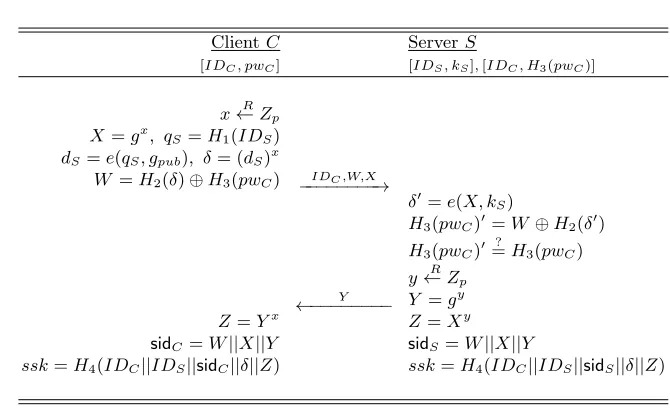
Key Establishment Phase. WhenC and S want to establish a session key, they execute the following protocol (See Fig. 1).
1. The client C picks a random number x in Zp. C computesX =gx, qS =
H1(IDS),dS =e(qS, ppub), andδ= (dS)x. Also,C computesW =H2(δ)⊕ H3(pwC) by using his/her own password.C then sendshIDC, W, Xito the
ClientC ServerS
[IDC, pwC] [IDS, kS],[IDC, H3(pwC)]
x←RZp
X=gx, qS=H1(IDS)
dS=e(qS, gpub), δ= (dS)x
W =H2(δ)⊕H3(pwC) IDC,W,X
−−−−−−−−→
δ0=e(X, kS)
H3(pwC)0=W⊕H2(δ0)
H3(pwC)0
?
=H3(pwC)
y←RZp Y
←−−−−−−−− Y =gy
Z =Yx Z=Xy
sidC=W||X||Y sidS=W||X||Y
ssk=H4(IDC||IDS||sidC||δ||Z) ssk=H4(IDC||IDS||sidS||δ||Z)
Fig. 1.OuriPAKEprotocol
2. The server S computesδ0 = e(X, kS) and H3(pwC)0 = W ⊕H2(δ0) by us-ing received messages and its secret keykS. S then checks if H3(pwC)0 =
H3(pwC). If it is not true,Soutputs FAIL and aborts. Otherwise,Spicks a
random numberyinZ∗
N.Scomputes (Y =g
y,Z=Xy), and sendsY to the
clientC. Finally,Scomputes the session secret keyssk=H4(IDC||IDS||sidS
||δ||Z), wheresidS =W||X||Y.
3. The clientCcomputes the session secret keyssk=H4(IDC||IDS||sidC||δ||Z),
wheresidC=W||X||Y andZ =Yx.
In the above protocol, the transcript (W, X) is a ciphertext which is the result of encryption performed on the plaintext H3(pwC) using BF-IBE scheme, i.e,
CT = (W, X)←BF-IBE.Enc(IDS, H3(pwC)) and
H3(pwC)←BF-IBE.Dec(kS, CT).
We focus on IBPAKE with implicit authentication. A KE protocol is said to achieve implicit key authentication if an entity (client or server) is assured that no other entities except partners can possibly learn the valuesδandZ of particular secret keys. Note that implicit key authentication does not necessarily mean that partners have actually obtained the key. For explicit key authentication, we can easily apply the known techniques [20].
4.2 Security Analysis
Theorem 1. Let A be an adversary for given IDC and IDS attack to iPAKE
to the H4,Execute, andSandoracle, respectively. Then,
AdvIBPAKEA,iPAKE(t)≤qEAdvABDH,[G1,G2,e](t) +
1 2qH4Adv
CDH
A,G1(t) +qSAdvA,BF-IBE(t) +
qS
PW
wheret is the adversary’s running time andAdvA,BF-IBE(t)is the maximum
ad-vantage ofA against the BF-IBE scheme.
Proof. LetAbe an active adversary that gets an advantage in attackingiPAKE. The adversaryAcan get the advantage by following cases:
- Case 1.Finding the password, namely impersonating the client.
- Case 2.Computing a server’s secret value, namely impersonating the server. - Case 3.Breaking the protocol without altering transcripts.
InCase 1, the adversary A can get information about a particular session key by finding the password pwC. There are two ways A can get information
about the password; either A executes on-line dictionary attacks using Sand queries or Abreaks a ciphertext (W, X) of the BF-IBE scheme. Let Succpw be
the event thatAsucceeds inCase 1, and we assume that passwords are uniformly distributed. We then may obtain the probability of Succpw as follows:
PrA[Succpw]≤qSAdvA,BF-IBE(t) +
qS
PW.
InCase 2, to impersonate the server or to get information about a session key,Amay try to computeδ=e(qS, gpub)xfrom the transcriptXand the public
values (qS, gpub) of the protocol from Executequeries. It is the same as solving
the BDH problem. Therefore, the upper bound about the advantage ofA from Case 2isqEAdvBDHA,[G1,G2,e](t).
Next, we consider the advantage fromCase 3. Note that, to get any infor-mation of a session secret key ssk in the random oracle model, A has to ask hIDC||IDS|| sid||δ||Zi to the hash oracle H4. We can construct B which suc-ceeds in solving the CDH problem using Aas a subroutine. B receives a CDH instance (G, N, g, U =gu, V =gv).Bchooses two identities (ID
C, IDS), a
mas-ter secret key κ∈ Z∗p, and a passwordpwC ∈ Password of the client’s identity
IDC. B sets gpub =gκ, and gives (IDC, IDS) and system parameters to A. B
then runs A, answering its oracle queries as follows:
- For queries H1(IDi) proceed as follows: if [IDi, qi] exist in a list h1-tuples,
returnqi. Otherwise, return a randomqi∈G1and store [IDi, qi] inh1-tuples.
(IfIDi =IDS, we denoteqi=qS.)
- For queriesH2(δi) proceed as follows: if [δi, αi] exist in a listh2-tuples, return
αi. Otherwise, return a randomαi∈ {0,1}t and store [δi, αi] inh2-tuples.
- For queries H3(pwi) proceed as follows: if [pwi, βi] exist in a list h3-tuples,
return βi. Otherwise, return a random βi ∈ {0,1}t and store [pwi, βi] in
- For queries H4(IDC||IDS||sidi||δi||Zi), return a random γi ∈ {0,1}l. Store
[sidi,γi] in a listh4-tuples.
- For queries Extract(IDi) proceed as follows: find [IDi, qi] in h1-tuples and
returnki=qκi. (We assumeExtractqueries are preceded byH1queries.) - For queriesExecute(IDC, IDS) proceed as follows: choose randoma, b∈Z∗p
and α, β ∈ {0,1}t. Compute X = U ga, δ = e(X, k
S), W = α⊕β, and
Y =V gb. ReturnhIDC, W, X, Yiand store [δ, α] and [pwC, β] in h2-tuples
andh3-tuples, respectively. (We assumeExecutequeries are not preceded by
H2, H3queries.)
- Send, Corrupt, Reveal, and Testqueries are answered honestly.
The success probability ofBdepends on the eventquerythatAissuesH4oracle query onIDC||IDS||sid||δ||Z, wheresid is a return value of Executequery and
Z =g(u+a)(v+b). (Note that,guv =Z/UbVagab.) If the advantage ofAinCase 3
is, thenAissues a query forH4(IDC||IDS||sid||δ||Z) with probability at least
2, i.e., PrA[query] ≤ 2. (The details are in [4].) Thus, the provability that B outputsguvfrom the listh
4-tuplesis at least 2/qH4. Therefore, the upper bound
about the advantage ofAfromCase 3is 12qH4Adv BDH
A,[G1,G2,e](t). Finally, we have
AdvIBPAKEA,iPAKE(t)≤qEAdvABDH,[G1,G2,e](t) +
1 2qH4Adv
CDH
A,G1(t) +qSAdvA,BF-IBE(t) +
qS
PW.
5
Generic Construction
In this section, we present a generic method to construct an IBPAKE protocol from an identity-based KEM/DEM scheme. Before describing our construction in detail, we present an identity-based KEM/DEM scheme which extends the identity-based KEM scheme [2].
5.1 Identity-based KEM/DEM scheme
An identity-based KEM/DEM scheme is specified by six polynomial time algo-rithms,Setup,Extract,IBKEM.Enc,IBDEM.Enc,IBKEM.Dec, andIBDEM.Dec.
- Setup(λ). This algorithm takes a security parameterλas input and returns a master secret key,mskand its corresponding public parameter,p.KP is a
plaintext space associated withp.
- Extract(msk,p, ID). This algorithm takes the master secret key,msk, public parameter,p, and an identity,IDas input. It returns a secret key,skID.
- IBKEM.Enc(p, ID). This algorithm takes pand an identity,ID as input. It returns a randomone-time key,kp∈ KP and its ciphertext,∆KEM.
- IBDEM.Enc(kp,p, m). This algorithm takesp, a keykp, and a message,mas
- IBKEM.Dec(skID,p, ∆KEM). This algorithm takesp, a private keyskID, and
a ciphertext∆KEM as input. It returns a key,kp.
- IBDEM.Dec(kp,p, ∆DEM). This algorithm takesp, a keykp, and a ciphertext
∆DEM as input. It returns a messagem.
In the above identity-based KEM/DEM scheme, the full ciphertext for m is (∆KEM, ∆DEM). Several IBE schemes [4, 24, 3, 25, 14] can be represented in the
identity-based KEM/DEM framework [2].
5.2 Our Generic Construction for IBPAKE
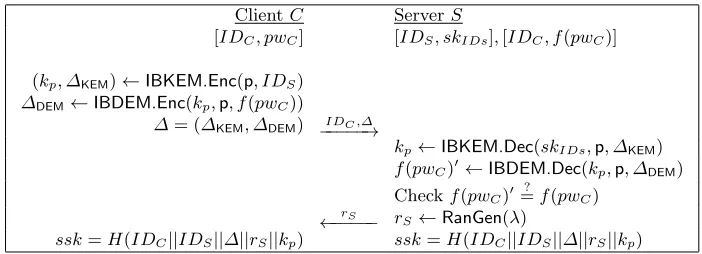
The generic method to construct an IBPAKE protocol from an identity-based KEM/DEM scheme is described as follows:
1. C runsIBKEM.Enc(p, IDS) to obtain a random one-time key kp and its
ci-phertext∆KEM.Calso runsIBDEM.Enc(kp,p, f(pwC)) to obtain a ciphertext
∆DEM for a message f(pwC), wheref is a one-way function. C then sends
IDC and∆= (∆KEM, ∆DEM) to S.
2. S runs IBKEM.Dec(skIDs,p, ∆KEM) to obtain the one-time key kp, where
skIDs is a server’s secret key generated by Extract(msk,p, IDS). S obtains
f(pwC)0 by runningIBDEM.Dec(kp,p, ∆DEM) and then checks iff(pwC)0=
f(pwC). If it is not true,Soutputs FAIL and aborts. Otherwise,Sgenerates
a random numberrS from a random number generator, and sendsrS toC.
Finally,S computes a session secret keyssk=H(IDC||IDS||∆||rS||kp).
3. Ccomputes a session secret key,ssk=H(IDC||IDS||∆||rS||kp).
ClientC ServerS
[IDC, pwC] [IDS, skIDs],[IDC, f(pwC)]
(kp, ∆KEM)←IBKEM.Enc(p, IDS)
∆DEM←IBDEM.Enc(kp,p, f(pwC))
∆= (∆KEM, ∆DEM) −−−−−IDC,∆→
kp←IBKEM.Dec(skIDs,p, ∆KEM)
f(pwC)0←IBDEM.Dec(kp,p, ∆DEM)
Checkf(pwC)0
?
=f(pwC) rS
←−−−−− rS←RanGen(λ)
ssk=H(IDC||IDS||∆||rS||kp) ssk=H(IDC||IDS||∆||rS||kp)
Fig. 2.Generic construction for IBPAKE
information about previous session keys. In practice, it is reasonable to assume that low-power devices held by clients are vulnerable to attacks, while a server is powerful and so more secure.
However, our generic construction can be modified to provideforward secrecy
by using additional ephemeral DH KE. In fact,iPAKEcan be viewed as a specific version of our generic protocol, in which BF-IBE is used as an identity-based KEM/DEM scheme. Note that BF-IBE can be represented as a identity-based KEM/DEM scheme as follows:
IBE-Enc
(kp=e(qS,gpub)x,∆KEM=gx)←IBKEM.Enc(p, ID)
∆DEM =m⊕H2(kp)←IBDEM.Enc(kp,p, m) IBE-Dec
kp=e(∆KEM,skID)←IBKEM.Dec(skID,p, ∆KEM)
m=∆DEM⊕H2(kp)←IBDEM.Dec(kp,p, ∆DEM).
The ciphertext element X(=∆KEM=gx) of BF-IBE is a public ephemeral DH
value. OuriPAKE performs DH KE to computegxy by using gy, instead of use
of the random valuerS. It is known that the ephemeral key,gxy is sufficient for
perfect forward secrecy [20]. Similarly, by using such identity-based KEM/DEM schemes [24, 3, 25, 14] that have public DH values in ciphertexts, we can also construct an IBPAKE protocol with perfect forward secrecy.
Considering only half forward secrecy, we can construct one-pass IBPAKE protocol by omitting the second pass. A client does not receive a server response, rS and thus a session key is defined asssk=H(IDC||IDS||∆||kp). We can show
that this one-pass protocol provideskey indistinguishability (KI). A brief proof sketch is given as follows (For more details, refer to the full version of this paper). Assume thatB is an IND-ID-CPA adversary to an identity-based KEM/DEM scheme. Also,Ais a probabilistic polynomial time adversary attacking the one-pass IBPAKE protocol:
Initially,Bsets up system parameter and gives it with identities (IDC, IDS)
toA.Bsimulates an attack environment for the one-pass IBPAKE by provid-ingExtract,Execute,Send,Reveal,Corruptand hash queries.Aget transcripts of an honest execution of the protocol or a common key computed from an execution of the protocol according to queries. When A makes Testquery for a fresh oracle described in Section 3, B gives a session key sskb after
selecting a bitb∈ {0,1}, wheressk0is an honest session key of the protocol and ssk1 is a random element from a key space. If A succeeds the attack thenA issued hash oracle query on H(IDC||IDS||∆||kp). (The details are
in [4].) Therefore, if a KI adversary exists then an IND-ID-CPA adversary exists.
5.3 Comparison
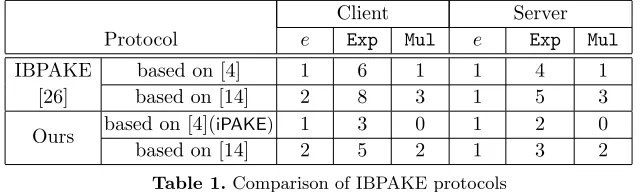
We now compare performance between our IBPAKE protocol and the previous IBPAKE protocol [26]5. To be fair, we assume that the IBPAKE protocols are constructed by using the BF-IBE [4] and Gentry IBE [14], respectively. The following table summarizes the results.
Client Server
Protocol e Exp Mul e Exp Mul
IBPAKE based on [4] 1 6 1 1 4 1
[26] based on [14] 2 8 3 1 5 3
Ours based on [4](iPAKE) 1 3 0 1 2 0
based on [14] 2 5 2 1 3 2
Table 1.Comparison of IBPAKE protocols
(e: pairing operation, Exp: modular exponentiation, Mul: modular multiplication, w.l.o.g,ExpandMulcontain the multiplication and the addition in a gap
Diffie-Hellman group, respectively.)
As shown in Table 1, although the IBPAKE protocol [26] can be constructed by using the IBE schemes [4, 14], our protocols are more efficient.
6
Conclusion
We have proposed efficient IBPAKE protocols using identity-based KEM/DEM. A client can do an easy authentication based on only a human-memorable pass-word and server’s public identity. Our protocols give resistance to server imper-sonation attacks. That is, even if a password is revealed from a client, a server impersonation attack can be prevented effectively. The proposed protocols out-perform the best-known IBPAKE protocol.
References
1. M. Abdalla and D. Pointcheval. A scalable password-based group key exchange protocol in the standard model, Asicrypt’06, LNCS 4284, pp 332-347, Springer, 2006.
2. X. Boyen, A Tapestry of Identity-based Encryption: Practical Frameworks Com-pared, J. Applied Cryptography, Vol 1, No. 1, pp.3-21, Inderscience, 2008. 3. D. Boneh and X. Boyen, Efficient Selective-ID Secure Identity-Based Encryption
Without Random Oracles, Eurocrypt??4, LNCS 3027, pp.223-238, Springer, 2004. 4. D. Boneh and M. Franklin, Identity-based encryption from the Weil pairing,
Crypto??1, LNCS 2139, pp.213-229, Springer, 2001.
5. S. M. Bellovin and M. Merritt, Encrypted key exchange: Password-based protocol secure against dictionary attack, 1992 IEEE Symposium on Research in Security and Privacy, pp.72-84, 1992.
5
6. M. Bellare, D. Pointcheval and P. Rogaway, Authenticated key exchange secure against dictionary attack, Eurocrypt’00, LNCS 1807, pp.139-155, Springer, 2000. 7. M. Bellare and P. Rogaway, Entity authentication and key distribution, Crypto’93,
LNCS 773, pp.232-249, Springer, 1994.
8. M. Bellare and P. Rogaway, Provably-Secure Session Key Distribution : The Three Party Case, STOC’95, pp.57-66, 1995.
9. F. Benhamouda, O. Blazy, C. Chevalier, D. Pointcheval1, and D. Vergnaud, New Techniques for SPHFs and Efficient One-Round PAKE Protocols, Crypto’13, LNCS 8042, pp.449-475, Springer, 2013.
10. V. Boyko, P. D. MacKenzie, and S. Patel. Provably secure password-authenticated key exchange using Diffie-Hellman. Eurocrypt’00, LNCS 1807, pp.156-171. Springer, 2000.
11. R. Canetti, S. Halevi, J. Katz, Y. Lindell, and P. D. MacKenzie. Universally composable password-based key exchange. Eurocrypt’05, LNCS 3494, pp.404-421. Springer, 2005.
12. K. Y. Choi, J. Y. Hwang and D. H. Lee, Efficient ID-based group key agreement with bilinear maps, PKC’04, LNCS 2947, pp.130-144, Springer, 2004.
13. W. Diffie and M. Hellman, New directions in cryptography, IEEE Transactions on Information Theory 22(6), pp.644-654, 1976.
14. C. Gentry, Practical identity-based encryption without random oracles, Euro-crypt’06, LNCS 4004, pp.445-464, Springer, 2006.
15. L. A. Gong, T. M. Lomas, R. Needham, and J. Saltzwe, Protecting poorly chosen secrets from guessing attacks. IEEE J. Sel. Areas Commun., 11 (5), pp. 648-656, 1993.
16. C. Gentry, P. MacKenzie, and Z. Ramzan, A Method for Making Password-Based Key Exchange Resilient to Server Compromise, Crypto’06, LNCS 4117, pp.142-159, Springer, 2006.
17. S. Halevi and H. Krawczyk. Public-key cryptography and password protocols. ACM Trans. Information and System Security, 2(3), pp.230-268, 1999.
18. R. Housley and T. Polk, Planning for PKI: Best Practices Guide for Deploying Public Key Infrastructure, WILEY, 2001.
19. S. Haber and W. Stornetta, How to Time-Stamp a Digital Document, Crypto’90, LNCS 537, pp.437-455, Springer, 1991.
20. J. Katz and M. Yung, Scalable protocols for authenticated group key exchange, Crypto’03, LNCS 2729, pp.85-113, Springer, 2003.
21. J. Katz, R. Ostrovsky, and M. Yung. Efficient password-authenticated key ex-change using human-memorable passwords. Eurocrypt’01, LNCS 2045, pp.475-494, Springer, 2001.
22. D. Pointcheval, Password-Based Authenticated Key Exchange, PKC 2012, LNCS 7293, pp. 390-397, Springer, 2012.
23. A. Shamir, Identity based cryptosystems and signature schemes, Crypto’84, LNCS 196, pp. 47-53, Springer, 1984.
24. R. Sakai, and M. Kasahara, ID based cryptosystems with pairing over elliptic curve, Cryptology ePrint Archive, Report 2003/054. http://eprint.iacr.org/2003/054. 25. B. Waters, Efficient Identity-Based Encryption Without Random Oracles,
Euro-crypt’05, LNCS 3494, pp.114-127, Springer, 2005.