A Formal Analysis of Prefetching in Profiled
Cache-Timing Attacks on Block Ciphers
Chester Rebeiro and Debdeep Mukhopadhyay
Department of Computer Science and Engineering Indian Institute of Technology Kharagpur 721302, India
{chester,debdeep}@cse.iitkgp.ernet.in
Abstract. Formally bounding side-channel leakage is important to bridge the gap between the theory and practice in cryptography. However, bounding side-channel leakages is difficult because leakage in a crypto-system could be from several sources. Moreover the amount of leakage from a source may vary depending on the implementation of the cipher and the form of attack. To formally analyze the security of a crypto-system against a form of attack, it is therefore essential to consider each source of leakage independently. This paper considers data prefetching, which is used in most modern day cache memories to reduce the miss penalty. To the best of our knowledge, we show for the first time that micro-architectural features like prefetching is a major source of leakage in profiled cache-timing attacks. We further quantify the leakage due to important data prefetching algorithms, namely sequential and arbitrary-stride prefetching. The analytical results, with supported experimenta-tion, brings out interesting facts like the effect of placement of tables in memory and the cipher’s implementation on the leakage in profiled cache-timing attacks.
Keywords. quantifying information leakage, formal modeling, cache memories, data prefetching, profiled cache-timing attacks
1
Introduction
A cache memory is a small high-speed memory that stores recently used data and instructions. The time required to access data present in the cache (acache hit) is much lesser than when the data is not present in cache (acache miss). In modern systems, the number of cache misses is reduced byprefetchingdata into the cache memory. However, not all cache misses are prevented and misses still occur. The differential behavior between a hit and a miss is manifested through side-channels such as timing, power, and electro-magnetic radiation.
In [21], it was prophesied that this non-uniform memory access behavior can be used to attack crypto-systems that are implemented with look-up tables stored in memory. The attack, which came to be known ascache attacks, was first formulated and simulated in [27]. Subsequently the attack was demonstrated on MISTY1 in [40] and extended to DES and 3-DES in [39]. AES was the next target with attacks in [6], [7], and [26]. Subsequently there have been several works that have analyzed, enhanced, and provided countermeasures for cache attacks.
measurements and require sophisticated measuring equipment.Access driven at-tacks [25, 26, 28, 38] rely on spy processes to gain information about the cache access patterns of the cipher. Timing attacks such as [6, 8, 10, 30, 39, 40], on the other hand just require knowledge of the overall execution time of the cipher. Compared to trace attacks, timing measurements can easily be made. Moreover, unlike access attacks that are restricted to multi-user environments, timing at-tacks can target a wide range of platforms. These reasons, along with the threat that timing attacks may be mounted over the network [4, 9, 12], make timing attacks an important security concern.
Of all timing attacks, profiled cache-timing attacks are the most portable. These attacks do not require prior knowledge about the device architecture, however they assume a powerful adversary, who is capable of loading a key into the cryptographic device. Profiled attacks have two stages : a learning phase followed by an attack phase. In the learning phase, a template timing profile is generated for a known key. During the attack phase, a timing profile for the unknown key is generated. The two profiles are statistically correlated to yield a small set of candidate keys. Profiled cache-timing attacks were demonstrated on AES in [6] and CLEFIA in [30]. The reason for profiled cache-timing attacks to work is the variations in the encryption time [6, 10, 24]. These variations lead to information leakage that depends on the microprocessor architecture, operating system, and the cipher’s implementation.
– We consider the leakage due to data prefetching in profiled cache-timing at-tacks. We show that the information leaked due to prefetching depends on several factors such as the size and number of look-up tables used in the cipher’s implementation. We analyze the leakage of two prefetching algo-rithms : sequential and arbitrary-stride prefetching [42]. These algoalgo-rithms or their variants are used in most modern day microprocessors.
– Unlike [37], where the mathematical models developed for cache misses were for classical cache memories, our models also consider data prefetching. We formally analyze the number of cache misses during an encryption in presence of the aforementioned prefetching algorithms.
– We propose a mathematical model to analyze the information leakage in a profiled cache-timing attack. The leakage, denotedD, is derived using the
Kullback-Leibler divergence [22]. We useD to study the effect of sequential
and arbitrary-stride prefetching algorithms with different implementations of the cipher. To the best of our knowledge this is the first work which quan-titatively analyzes the effect on security of a micro-architectural component of a computer.
The paper is organized as follows: Section 2 has the preliminaries about cache memories, block ciphers, and profiled cache-timing attacks. Section 3 lays the foundations and assumptions for the formal analysis. This section shows why en-cryption time can be analyzed in terms of the number of cache misses. Section 4 presents the mathematical models for the number of cache misses in presence of the two considered prefetching styles. Section 5 presents the model for ana-lyzing profiled cache-timing attacks by using cache misses. The section also has empirical validations of the cache models developed. A formal model for profiled timing attacks is presented in Section 6. An analysis of profiled cache-timing attacks for different implementation strategies is explained in Section 7 using the previously developed model. Other aspects influencing cache-timing attacks such as noise in measurements and leakages other than prefetching is presented in Section 8. The final section summarizes the work and presents po-tential future directions.
2
Preliminaries
In this section we first give a brief introduction about cache memories and prefetching. Then we describe a block cipher’s structure from the cache attack point of view. We then describe formally the profiled cache-timing attack.
2.1 Cache Memories
Caches are high-speed memories, which are incorporated in computer architec-ture to reduce the memory access time. In systems that use cache memories, the main memory is divided into blocks referred to asmemory blocks, while the cache is organized as cache lines. When acache miss occurs, a block of memory gets loaded into a cache line. Unless evicted, all subsequent accesses to that memory block results in cache hits.
Algorithm 1:SP : Sequential Prefetching Algorithm
Input: The access to memory block at addressti
begin 1
if(tinot in cache) or (ti was prefetched and this is the first access toti)then
2
if ti+1not present in the cachethen
3
prefetch ti+1
4
end 5
end 6
end 7
Algorithm 2:AP : Arbitrary-stride Prefetching Algorithm
Input: Address of instruction (IA), Address of memory block accessed (ti)
begin 1
pref etch f lag←false
2
iffirst access toIAthen
3
stride(IA)←0 ; state(IA)←1
4
else 5
switchstate(IA)do
6
case 1 7
state(IA)←2
8
stride(IA)←ti−lastaccess(IA)
9
end 10
case 2 11
ifstride(IA) =ti−lastaccess(IA)then
12
pref etch f lag←true
13
else 14
stride(IA)←ti−lastaccess(IA)
15
end 16
end 17
end 18
if pref etch f lag=trueandti+stride(IA) is not present in cachethen
19
prefetch ti+stride(IA)
20
end 21
lastaccess(IA)←ti
22 end 23
end 24
early restart, and prefetching [19, 20]. Of all micro-optimizations, only prefetch-ing works to reduce the number of cache misses. All other techniques reduce the overhead of the cache miss on the application’s performance.
Prefetching : A prefetcher anticipates cache misses and fetches data from the memory before the processor requests for it. The prefetch is either invoked by the program (software prefetching) through explicit microprocessor instructions or gets triggered automatically (hardware prefetching). With respect to cache-attacks, software prefetching is of less concern as block cipher implementations do not generally use explicit prefetching instructions.
There are several techniques to decide ‘when’ and ‘how’ a hardware prefetch happens. Each technique has its own set of advantages and disadvantages and is generally suited to a particular class of applications. Broadly, the techniques are classified into two :sequential prefetch andarbitrary-stride prefetch [41, 42].
– Sequential Prefetch (SP) : A popular sequential prefetch algorithm is the tagged prefetchalgorithm [41, 42]. The algorithm (described in Algorithm 1) triggers the prefetch for the adjacent memory block whenever it detects a cache miss or when a prefetch block is accessed for the first time. A variant of this algorithm, known asprefetch-on-miss, is used on some Intel platforms [18].
p1 p2 p3
k1 k2 k3
S1 S2 S3
a1 a2 a3
S1 S2 S3
Key Whitening
I Round
II Round
Sr ar
pr
kr
Sr ps−pt
Round Key Addition Diffusion Layer
Round Key Addition Diffusion Layer
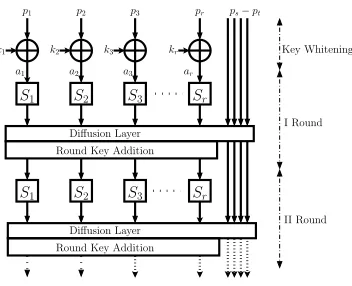
Fig. 1.Iterative Block Cipher Structure
[18] and are applicable to programs that use loops. In this prefetching algo-rithm, if a stride in the sequence of accesses from an instruction is detected, then a prefetch to the next memory address gets triggered. Although there are several forms of arbitrary-stride prefetching algorithms, we consider the constant stride variant [5] described in Algorithm 2. In this algorithm, if a stride is detected for accesses to memory locationsti, ti+d, andti+2d from the same instruction (IA), then the memory blockti+3d gets prefetched. The locationsti,ti+d, andti+2d form avalid sequence, while thestride,d, is the constant difference between the sequence. The stride can be either positive or negative, while the length of the sequence (denotedλ) is at-least 2.
2.2 Block Cipher Implementations
Figure 1 shows a typical structure of an iterated block cipher. The input (Λ) to each round of the cipher can be partitioned into two sets : inputs which undergo substitution (ΛS) and those that don’t (ΛN). For SPN networks such as the AES specified in [13], ΛN = φ, while balanced and unbalanced Feistel networks have |ΛS| =|ΛN| and |ΛS| 6=|ΛN|respectively [32]. In all cases, the substitution transformations (S1, S2,· · ·, Sr) is preceded by a round key addition
and followed by a diffusion layer.
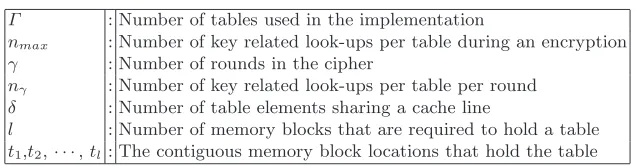
Generalization of the Block Cipher Structure for Cache Attacks : Substitution is normally implemented by s-box look-up tables. These s-box accesses are key-dependent and are the main source of information leakage in cache attacks. The number of tables, size of tables (in terms of memory blocks), and number of accesses to a table vary from cipher to cipher and may also depend on the platform of implementation. This paper quantifies the effects of these parameters on the information leaked in profiled cache-timing attacks. Table 1 lists various parameters which can be used to characterize the memory accesses of a cipher. We definecipher model as a function of these parameters.
Table 2 gives the memory access characteristics for the block ciphers at-tacked by profiled cache-timing attacks. The AES implementation atat-tacked in [6] considered the standard used in OpenSSL1 library distributions. Although
Table 1.Memory Access Parameters of a Block Cipher
Γ : Number of tables used in the implementation
nmax : Number of key related look-ups per table during an encryption
γ : Number of rounds in the cipher
nγ : Number of key related look-ups per table per round
δ : Number of table elements sharing a cache line
l : Number of memory blocks that are required to hold a table
t1,t2,· · ·,tl: The contiguous memory block locations that hold the table
Table 2.Memory Access Model of Ciphers Attacked using the Profiled Cache Timing Attack
Γ nmax γ nγ l δ
AES 4 36 9 4 16 16 CLEFIA 2 72 18 4 4 64
the number of rounds for AES is 10, the last round is not considered in the table as it uses a different look-up table. The implementation of CLEFIA [33] attacked in [30] was the reference implementation2. The attack on both AES and
CLEFIA had a similar procedure. In the next part of this section we formally present the steps involved in a profiled cache-timing attack.
2.3 Profiled Cache-Timing Attacks
Consider an SPN cipher, EK, having a secret key K and a structure similar to
Figure 1. The memory access parameters for EK are as shown in Table 1. The
secret key is chosen uniformly from the key set Kr and is split into r equal parts as K = (k1|k2|k3| · · ·kr). The block cipher function isEK :Pr → Cr. The
plaintext P∈ Pr and ciphertext C∈ Crare also split into rparts (for example P = (p1|p2|p3| · · · |pr) as seen in Figure 1). Each part ofki,pi, andciare chosen
from the set K,P, andC respectively and assumed to be ofmbits each.
Let a physical realization [23] ofEK, denoted asEfK, be on a computer with
cache memory. The side channel leakage ofEfKis in the form of timing information
(t). The goal of the side-channel adversary is to predict the key partsk1,k2,· · ·,
kr, from the timing information. We present the strategy for the profiled cache-timing attack on the key partk1. The strategy described can be adopted for any
of the other key parts.
To findk1, the attack uses three phases : learning, attack, and finally analysis.
In the learning phase a known key K∗ = (k∗
1|k∗2| · · · |k∗r) is considered and the timing profile for k∗
1 is constructed as shown in Algorithm 3. The inner loop in
the algorithm is generally executed around 216times.
For a given value of p∗
1, the algorithm invokes EK^∗(P∗) several times and obtains the average encryption time (t) from the timing. The timing profile returned consists of 2m
average encryption times, which form thetiming profile for k∗
1 for the known key denoted TP(k∗1).
During the attack phase, the key K#= (k#
1|k
#
2| · · ·k#r) is unknown. A tim-ing profile (TP(k#
1)) for k #
1 is constructed in a similar manner. Since the first
Algorithm 3: Timing Profile fork∗
1
Output: The timing profile fork∗
1
begin
1
forallp∗
1∈ {0,1,· · ·,2 m
−1}do
2
forLarge number of times do
3
p∗
j
R ←−[0,2m
), where 2≤j≤r;
4
P∗ = (p∗
1|p
∗
2|p
∗
3| · · · |p
∗
r) ;
5
(C∗
,t)←EK^∗(P∗)
6
end
7
ComputeAvgEncryptionT imek∗
1[p
∗
1] from the timing obtained
8
end
9
returnAvgEncryptionT ime
10
end
11
operation between p1 and k1 is ex-or (Figure 1), the average encryption times
satisfy the EIS (equal images under different sub keys) property [31]. This means that for every p∗
1 there exists a p #
1 such that AvgEncryptionT imek∗
1[p
∗
1] ≈
AvgEncryptionT imek# 1[p
#
1 ⊕(k1∗⊕k#1)]. Thus theTP(k #
1) is a shifted version
of TP(k∗
1) and the amount of shift is equal to (k1∗⊕k #
1). During the analysis
phase of the attack, this shift is extracted from the two timing profiles to reveal the unknown key part k1#. The aim of this paper is to estimate the amount of
information leaked in the timing profiles due to prefetching in cache memories.
3
Foundations and Assumptions
Profiled cache-timing attacks rely on the differences in encryption time of a ci-pher’s execution. This paper analyzes these differences in terms of the number of cache misses that occur during the encryption. In this section we first empir-ically justify the fact that encryption time can in fact be analyzed from cache misses for various cipher models. Further, the section also states our assumptions about profiled cache-timing attacks. These assumptions are required in order to formally model the attack.
2000 3000 4000 5000 6000 7000
20 40 60 80 100 120 140
Encryption Time (clock cycles)
Number of L1-Data Cache Misses l=4
l=8 l=16 l=32
(a) Encryption Time
20 40 60 80 100 120 140
Frequency of Occurance
Number of L1-Data Cache Misses l=4 l=8 l=16 l=32
(b) Distribution of Cache Misses
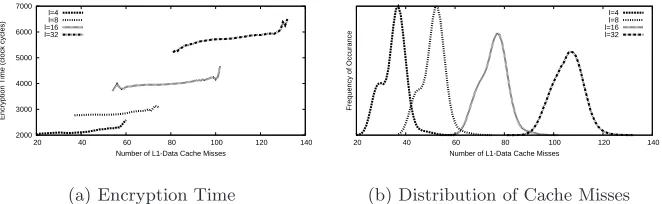
Relating Cache Misses and Timing : Figure 2(a) shows the variation in the en-cryption time with the number of cache misses3 for SPN cipher models (Figure
1) with different table sizes. All other parameters of the cipher models are identi-cal with valuesnmax= 36,Γ = 4,γ= 9,nγ = 4,δ= 16. From the figure, there is a linear relation between the execution time and the number of cache misses for all cipher models. Therefore the cipher’s encryption time can be analyzed by the number of cache misses. Figure 2(b) shows the frequency distribution of the number of cache misses. The distribution is Gaussian irrespective of the table size.
Assumptions about the Platform and the Attack : The formal models developed in this work relies on the following assumptions on the attack and the attack platform.
– The cache does not contain any information about the program at the start of encryption. This assumption is valid as operations done after an encryption, such as transmission or storage of the ciphertext is highly likely to overwrite the cache contents. Thus each new encryption would start with a clean cache [6, 24].
– We assume thatduring an encryption, data loaded into the cache is never flushed out. This means that the execution of the cipher is independent of other processes running concurrently in the system. Also, there are no con-flicts for the cache from within the encryption process. While this assumption holds for cipher models with tables much smaller than the size of the cache, for larger tables there would be noise added to the timing due to conflict misses. This noise makes it more difficult to attack.
– The s-box accesses that occur during the execution of a cipher are at ran-dom locations and are independent of each other. This assumption is a basic requirement of block ciphers.
– In profiled cache-timing attacks, the difference in cache misses between en-cryptions is of concern. We assume thatthis difference in cache misses is only due to the accesses to the s-box tables used in the implementation. Also, we assume that the table accesses are not influenced by any other part of the cipher’s execution.
For caches that support prefetching, the effectiveness of prefetching depends on several system parameters such as the number of processing cores in the system, system load, etc. In order to formally analyze the profiled cache-timing attacks with prefetching we make a few assumptions. These assumptions are optimistic, that is, in reality, systems incorporating the described prefetching schemes would be less effective. The assumptions made are as follows:
– In practice, a trigger by the prefetcher does not imply that the memory block wouldalways get loaded into cache. The actual availability of the prefetched block depends on several other factors such as the availability of system’s resources, work-load of the processor etc. For example, in multi-core systems,
3The experiments were done on a 2.8GHzIntel Core 2 Duo machine with 32 KByte
the L2 cache is a shared resource, therefore prefetching will not occur unless the L2 cache is available. In the model of the attack developed, however, it is assumed thata prefetch trigger would always fetch a block of memory into cache.
– In practice, the number of instructions the prefetcher can track is limited by the size of the table [5] which tracks memory access streams. However we assume that there is no such limit, and the prefetcher is able to track access patterns in infinitely many streams.
It may be noted that the assumptions made are realistic, as later we show that the theory developed based on them match the experimental results.
4
Mathematical Models for Cache Memory Accesses
In this section we develop mathematical models for the number of cache misses that occur during the execution of a cipher. The cipher is viewed as having Γ tables occupying l blocks each. Each table is accessed randomly nmax times during the execution. Various cache models are considered, starting from the classical cache memories to models which support sequential and arbitrary-stride prefetching.
Probability of a Cache Miss in a Classical Cache : In the architecture of a classical cache, a cache-miss results in a single block of data getting loaded into the cache. All subsequent accesses to any location within that memory block results in cache hits (ie. collisions). Consider a tableT1, of sizel, present at the
contiguous memory locationst1totland is accessed atnmaxrandom locations.
We determine the probability that thenth access to the table results in a cache hit, where 1 ≤ n ≤ nmax. Let AC
l,n be a random variable which denotes the outcome of the nth memory access. AC
l,n takes the value H when a cache hit occurs andMwhen a cache miss occurs.
Theorem 1. The probability that thenth random access to tableT
1 results in a
cache hit is given by
P r[ACl,n=H] = 1 ln−1
n−X2
i=0
n−1 i
(l−1)i (1)
Proof. Let thenth access be to the memory locationtb (where 1≤b≤l). For AC
l,nto be a cache hit,tb should have been accessed at-least once in the previous n−1 memory accesses. There areln−1different ways in which the previousn−1 memory accesses can be done. Out of these, the number of ways in which tb gets accessed exactlyj times is n−j1(l−1)n−1−j, andj varies from 1 ton−1.
Theorem 1 follows. ⊓⊔
Corollary 1. The probability that thenth access to table T
1 results in a cache
miss is given by:
4.1 Probabilistic Models for Cache Memories with Prefetching
In a cache memory that supports prefetching, a cache hit can occur either if the memory block being accessed collides with a previous access (the classical case) or has been prefetched earlier (the prefetching case). Consider a cache having some prefetching strategyP. Let the random variableAC,Pl,n denote the result of thenth access to tableT
1. Then,
P r[AC,Pl,n =H] =P r[AC,Pl,n =H|collision]·P r[collision]
+P r[AC,Pl,n =H|collision]·(1−P r[collision]) (2)
The probability of a collision is given by Equation 1 and would certainly result in a cache hit. The probabilityP r[AC,Pl,n =H|collision] in Equation 2 depends completely on the prefetching strategy used. LetAP
l,n denote a random variable which takes the value H if and only if a cache hit in the nth access occurs exclusively due to prefetching. Equation 2 can be rewritten as
P r[AC,Pl,n =H] =P r[ACl,n=H] +P r[Al,nP =H]·(1−P r[ACl,n=H]) (3)
In this section we analyze the probabilities of a cache hit with two prefetch-ing strategies : sequential prefetchprefetch-ing and arbitrary-stride prefetchprefetch-ing [5]. These prefetching styles are common in modern processors.
Probability of a Cache Miss with Sequential Prefetching : For the prefetching al-gorithm described in Alal-gorithm 1 and under the assumptions made in Section 3, the following observations can be made.
1. The first memory block in the table cannot be prefetched.
2. The last memory block in the table prefetches a block outside the boundary of the table.
These observations have an effect on the cache miss probabilities as will be seen in this section. Let AS
l,n be the random variable which takes the value H if and only if a cache hit in the nth access to TableT
1 occurs exclusively due to
sequential prefetching. In Equation 3,P is replaced withS.
Theorem 2. For the tableT1, in a cache supporting sequential prefetching,
P r[ASl,n=H] = l−1
l · 1 (l−1)n−1
n−2 X
i=0
n−1 i
(l−2)i (4)
Proof. If T1 is the only table used in the cipher, then all blocks in the table
are prefetchable except the first block (ie.t1). Thus the fraction of prefetchable
blocks is (l−1)/l.
Assumenth access is to memory blocktb. Since a collision is not allowed, tb cannot occur in the previous n−1 memory accesses. Therefore, the only way to obtain a hit is when the previous block, ie. tb−1, gets accessed at-least once.
Theorem 2 follows by counting in a similar manner as in Theorem 1. ⊓⊔
Probability of a Cache Miss with Arbitrary-Stride Prefetching : Let AA l,n be a random variable, which takes the value H if and only if a cache hit in the nth access to tableT
1 occurs exclusively due to the arbitrary-stride prefetching
We see that the probability with whichAA
l,n takes the value H depends on the number of valid sequences occurring in the previousn−1 memory accesses. The valid sequences can have a positive or negative stride, which we respectively callincreasing sequence anddecreasing sequence. The following lemmas present different properties of the sequences.
Lemma 1. Let λ ≥2 be the minimum length of a valid sequence and tb (1 ≤
b ≤ l) be the memory block in table T1 that gets accessed in the nth memory
access (where n > λ). The number of valid increasing sequences for tb is
Sb+=⌈(b−λ)/λ⌉
Proof. Assuming that only increasing sequences are possible, a prefetch of tb requires a sequence of at-least λ accesses that have a constant stride. This se-quence can take values from t1 to tb−1. The maximum stride possible is thus
dmax=⌈(b−λ)/λ⌉. All strides between 1 todmax(both inclusive) form exactly one increasing sequence fortb. ThusSb+=dmax. ⊓⊔
As an example, considerb= 10 andλ= 3, then the valid increasing sequences that can prefetcht10are (t7, t8, t9), (t4, t6, t8), and (t1, t4, t7), thusSb+= 3.
Lemma 2. For thel sized tableT1, the number of decreasing sequences for the
memory block tb isS−b =S(+l−b+1).
Proof. For every valid decreasing sequence for tb of the form tb1, tb2, · · ·, tbλ,
there exists an increasing sequencetl−b1+1,tl−b2+1,· · ·,tl−bλ+1for the memory
blocktl−b+1. ⊓⊔
Continuing the previous example, if l = 16, then there are 3 valid decreasing sequences fort7becauseS7−=S
+
10. These sequences are (t10, t9, t8), (t13, t11, t9),
and (t16, t13, t10).
Lemma 3. If tbi (1 ≤ i ≤ λ) is the i
th element of a valid sequence for tb,
then for the pair tb and tbi at most one sequence is possible. Moreover, tb =
tbi mod(λ+ 1−i).
Proof. First Part : Assume, that two sequences are possible with tbi having
stridesd1andd2respectively. Then,tb= (λ+ 1−i)d1+tbi = (λ+ 1−i)d2+tbi
Thusd1=d2, and the two sequences are equal.
Second Part : If d is the stride of the sequence for tb containingtbi, then |tb−tbi|=d(λ+ 1−i). Thustb=tbi mod (λ+ 1−i). ⊓⊔
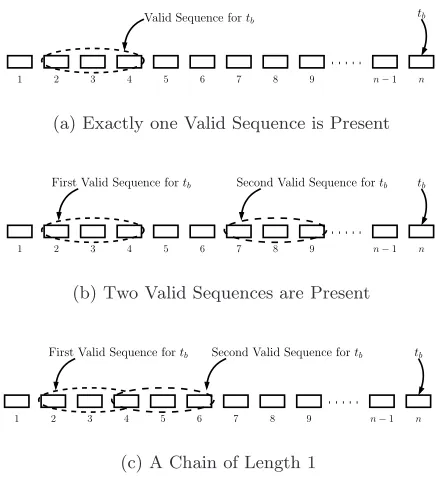
In order to prefetchtb a valid sequence (either increasing or decreasing) for tb should appear at-least once in (n−1) memory accesses. Figure 3(a) shows a valid sequence appearing in the 2nd, 3rd, and 4thmemory accesses, which would prefetch tb. Multiple valid sequences for tb can also appear as shown in Figure 3(b). The sequences may also overlap as seen in Figure 3(c) forming achain of sequences. For example, fort10 andλ= 3, a chain of length 1 is possible by the
cascade of the sequences (t1, t4, t7) and (t7, t8, t9). This is a chain of length 1
1 2 3 4 5 6 7 8 9 n−1 n
Valid Sequence fortb tb
(a) Exactly one Valid Sequence is Present
1 2 3 4 5 6 7 8 9 n−1 n
tb
Second Valid Sequence fortb
First Valid Sequence fortb
(b) Two Valid Sequences are Present
1 2 3 4 5 6 7 8 9 n−1 n
tb
First Valid Sequence fortb Second Valid Sequence fortb
(c) A Chain of Length 1
Fig. 3.Arbitrary Stride Prefetch oftbBefore thenthMemory Access to TableT1 (for
λ= 3)
Lemma 4. For tb, the number of chains of length ithat are possible is
chain(b, λ, i, n) =
(
0 ifn < λ+ (λ−1)i
S+b
λi
+Sb−
λi
otherwise
Also,i < max(⌊logλS+⌋,⌊logλS−⌋).
Proof. A chain of length i will have λ+ (λ−i) elements. If the number of accesses made, n, is less thanλ+ (λ−i), then no chains are possible. For any two overlapping sequences (t(1)b1 , t(1)b2 ,· · · , t(1)bλ) and (t(2)b1 , t(2)b2 ,· · ·, t(2)bλ), without loss of generality t(1)b1 = t(2)bλ and no other elements are common. This means that an overlap can occur in exactly one location. This follows because if two sequences overlap in more than one location then the strides would be equal. If the strides of the cascaded sequences ared1 andd2respectively,
t(1)b1 =t(2)bλ
tb−d1(λ) =tb−d2
d1λ=d2
If a third sequence of strided3 is to be added; making a chain of length 2, then
d2λ=d3, thusd1λ2=d3. In a similar manner fori cascades,
d1λi=di+1 (5)
Since a stride can take values between 1 anddmax(both inclusive), for the chain of length i, Equation 5 would hold for ⌊dmax/λi⌋times. Moreoverdmax=S+
therefore there are ⌊Sb+/λi⌋possible chains of lengthicomprising of increasing sequences and the maximum value ofiis⌊logλSb+⌋.
An increasing sequence can never overlap with a decreasing sequence because all elements in an increasing sequence are less thantb while all elements in a de-creasing sequence are greater thantb. Thus increasing and decreasing sequences have to be considered independently. The lemma follows. ⊓⊔
The number of ways to prefetch tb before the nth memory access can be determined by counting the number possiblen−1 memory accesses without a valid sequence for tb. If Vb,n−1 is the number ofn−1 memory accesses which
have at-least one valid sequence fortbandIb,n−1is the number ofn−1 memory
accesses which have no valid sequence fortb then
Vb,n−1= (l−1)n−1−Ib,n−1
Lemma 5. For λ= 2 and the (n+ 1)th memory access is totb, the following recurrence computes the value of Ib,n: Ib,0 = 1,Ib,1 = (l−1),Ib,2 = (l−1)2−
(Sb++Sb−), and for n >2,
Ib,n = (l−1)Ib,n−1−(Sb++Sb−)Ib,n−2
+
max(⌊log2S+b⌋,
⌊logX2S−b⌋)
i=1
(−1)i+1·Ib,n−
2−i·chain(b,2, i, n)
Proof. Ifn= 0 implies the first access is totb, thereforeIb,0= 1. For n= 1, all
memory accesses to tableT1are possible except the one which causes a collision.
ThereforeIb,1= (l−1). Forn= 2, there are (l−1) possible first memory accesses
and another (l−1) possible second memory accesses.Ib,2comprises of all those
pairs of accesses, which does not prefetchtb. That is, the first and second memory accesses do not form a sequence which leads to tb. There are (Sb++Sb−) ways such sequences can be formed, these are eliminated from (l−1)2.
Forn >2,Ib,nis computed applying inclusion-exclusion. First, we include all possible memory access sequences till (n−1) which does not prefetchtb, namely Ib,n−1, along with all possible ways to access the nth memory access, namely
(l−1). However, here we have included all possible memory accesses till (n−2) which does not prefetchtb, and the (n−1)th and thenth memory access could form a sequence. Hence the total number of cases which needs to be excluded is Ib,n−1(Sb++Sb−). But, while excluding this we have considered accesses, which,
till (n−3)rd memory access did not prefetch tb, and the (n−2)nd, (n−1)st, and nth memory access may form a chain which prefetches tb. This counts to Ib,n−3chain(b,2,1, n). Likewise we continue till the maximum possible length of
chain. ⊓⊔
In a similar manner Ib,n, when λ = 3, can be obtained as shown in the following recurrence: Ib,0 = 1, Ib,1 = (l−1), Ib,2 = (l−1)2, Ib,3 = (l−1)3−
(Sb++Sb−) and
Ib,n= (l−1)Ib,n−1−(Sb++Sb−)Ib,n−3
+Pmax(⌊log3Sb+⌋,⌊log3S−b⌋)
Theorem 3. The probability that the random variableAA
l,ntakes the valueHin the nth access is given by
P r[AAl,n=H] = 1 l(l−1)n−1
l
X
b=1
Vb,n−1 (6)
Proof. Thenthmemory access could be tolmemory blocks. Each of these mem-ory blocks can be prefetched in Vb,n−1 ways. Since, prefetching requires no
col-lision, therefore there are (l−1)n−1possible ways to do the firstn−1 memory
accesses. ⊓⊔
4.2 Conditional Probability Models for Cache Accesses
The probability of a cache miss in the nth memory access is altered if one of the previous accesses is known. Let Tm be a random variable that denotes the memory block that gets accessed in themth access.Tmcan take valuest
1to tl.
In this part of the section we develop models to determine the probability of a cache miss in thenth memory access givenTm.
In the classical model of the cache, the probability of having a cache hit in thenth access is independent of the conditionTm(m < n). Therefore
P r[AC l,n=H
Tm] =P r[AC l,n=H]
Thus, for cache memories with some prefetching policyP, the conditional prob-ability for a hit in the nth access can be represented in a similar way as in Equation 3.
P r[AC,Pl,n =HTm] =P r[AC,Pl,n =H|collision, Tm]·P r[collision|Tm]
+P r[AC,Pl,n =H|collision, Tm]·(1−P r[collision|Tm])
=P r[ACl,n=H] +P r[APl,n=H
Tm]·(1−P r[ACl,n=H]) (7)
As in the previous part of this section, we consider the sequential prefetching and arbitrary-stride prefetching algorithms to determine P r[AP
l,n =H
Tm] for the l sized table T1. Our equations are for m = 1. Similar techniques can be
adopted form >1.
Conditional Probability of a Cache Miss with Sequential Prefetching : LetSP be a function which returns the prefetched memory block (ie.SP(tb) =tb+1 for
1≤b≤l). For sequential prefetching P r[AS l,n=H
T1] varies depending on the
value ofT1. The following discussion explain this phenomenon.
WhenT1=tl,
P r[AS l,n=H
T1=tl] =
(l−2) (l−1)n−1
nX−2
i=1
n−2 i
(l−2)n−2−i (8)
For SP(tl), the block prefetched is outside the boundary of the table and has no effect on the probability. Therefore, AS
Tn 6=tl (as this would cause a collision with T1) and Tn 6=t1 (ast1 cannot be
prefetched). WhenT16=tl,
P r[ASl,n=H
T16=tl] =P r[ASl,n=H|Tn=SP(T1)]·P r[Tn=SP(T1)]
+P r[ASl,n=H|Tn6=SP(T1)]·P r[Tn6=SP(T1)]
(9)
There are two components in Equation 9.
– When Tn = SP(T1), it would certainly cause a cache hit. Also, since Tn
cannot have a collision with T1, it can only take l−1 different values and
notl. Thus,
P r[Tl,n=SP(T1)] = 1
l−1
– WhenTn 6=SP(T1). This happens with probability 1−1/(l−1). A hit in
thenth access occurs if and only ifTn =SP(Ti) and 2 ≤ i ≤n−1. The probability with which this happens is given by the following Equation.
P r[AS n=H
Tn6=SP(T1), T16=tl] =
α (l−2)(l−1)n−2
nX−2
i=1
n−2 i
(l−2)n−2−i
,whereαis the number of prefetchable blocks.
◦ IfT1=t1thenTn6=t1andTn6=t2. Thus,α=l−2.
◦ IfT16=t1thenTn6=T1,Tn6=SP(T1), andTn 6=t1. Thus, α=l−3.
Conditional Probability of a Cache Miss with Arbitrary-Stride Prefetching : In a cache supporting arbitrary-stride prefetching, a known value of Tm restricts the number of valid sequences, thus altering the probability of a cache miss in thenth memory access (m < n). For example ifλ= 2 and T
3 =t10, then from
lemmas 1 and 2, the number of valid increasing sequences fort10 is 4. They are
(t2, t6), (t4, t7), (t6, t8), and (t8, t9). However, ifT1is fixed tot2then only one of
these sequences is possible thus reducing the probability thatt10gets prefetched.
We now determine the probability of a hit due to prefetching whenm= 1. This is given by,
P r[AAl,n=H|T1] =
1 l−1
X
b∈{1,2,3,···,l}andtb6=T1
P r[AAl,n=H|T1 andTn=tb]
Depending on the value taken byT1, the probability of prefetchingtbin thenth
memory access would vary.
– If T1 =ta and ta 6=tb modλ then by Lemma 3 no valid sequence can be
present atT1. Thus,tbcan be prefetched only due to a valid sequence present
in the remainingn−2 memory accesses. Therefore,
P r[AA
l,n=H|T1=ta, Tn=tb andta 6=tbmodλ] =
Vb,n−2
(l−1)n−2
– IfT1=taandta=tb modλthen at-most one valid sequence may be present
atT1(by Lemma 3). Consequently, the number of chains that can be formed
forbis reduced. For example, forλ= 2 andT4=t10, the number of chains
and (t8, t9)). If T1 =t2, then only one of these chains is possible. For the
conditional case, we call the number of chains forb as chain′. The number of chains of lengthiis given in the following equation,
chain′(b, a, λ, i, n) =
chain(b, λ, i, n) ifn > λ+ (λ−1)i
1 ifn=λ+ (λ−1)iandd|λi
0 otherwise
In the equation,dis the stride for the sequence atT1; (d= (b−a)/λ). The
equation uses the property that a chain of lengthi is only possible ifd|λi. The chain would have a lengthλ+ (λ−1)i. From the equation forchain′, we see thatnplays a crucial role in determining the number of chains of length i. Specifically, ifn=λ+ (λ−1)i, then the number of elements in the chain is equal to the number of memory accesses made, therefore the first element of the chain must coincide withT1, which is fixed atta. Thus only one chain
is possible. Forn > λ+ (λ−1)i, the chain does not have to coincide withT1,
thus all possible chains forbare applicable. This is given bychain(b, λ, i, n). Let I′
b,a,n be the number of ways memory accesses can be done in which T1=ta,Tn+1=tb, and there are no valid sequences fortb in the preceding
nmemory accesses, ie.tb is not prefetched. Forλ= 2,I′
b,a,n is given by the following recurrence:I′
b,a,0= 1,Ib,a,′ 1= 1,Ib,a,′ 2= (l−2), and
I′
b,a,n= (l−1)Ib,a,n′ −1−(S +
b +Sb−)Ib,a,n′ −2
+P
max(⌊log2S + b⌋,
⌊log2Sb−⌋)
i=1 (−1)i+1·Ib,a,n′ −2−i·chain′(b, a,2, i, n) whenn >2
Similarly forλ= 3, the recurrence forI′
b,a,n isIb,a,′ 0= 1,Ib,a,′ 1= 1,Ib,a,′ 2=
(l−1), I′
b,a,3= (l−1)2−1, and,
I′
b,a,n= (l−1)Ib,a,n′ −1−(S +
b +Sb−)Ib,a,n′ −3
+P
max(⌊log3Sb+⌋,
⌊log3Sb−⌋)
i=1 (−1)i+1·Ib,a,n−′ 4−i·chain′(b, a,3, i, n) whenn >3
The probability of a cache hit in the nth access due to prefetching in this case is
P r[AA
l,n=H|T1=ta, Tn=tb andta =tbmodλ] = 1−
I′ b,a,n−1
(l−1)n−2
4.3 Effect of Table Placement in Memory
The placement of tables in memory has an effect on the probability of obtaining a cache hit. There are two factors in the table’s placement that influences the cache hit probability.
– The boundaries of prefetching – The relative placement of the tables
00 00 00 00 00 00 00 00 00 00 00 00 00 00 00 00 00 00 00 00 00 00 00 11 11 11 11 11 11 11 11 11 11 11 11 11 11 11 11 11 11 11 11 11 11 11 00 00 00 00 00 00 00 00 00 00 00 00 00 00 00 00 11 11 11 11 11 11 11 11 11 11 11 11 11 11 11 11 Prefetch Visibility ofl′blocks
Prefetch Visibility ofl−l′blocks
l′
l
l−l′
(a) Table Spread Across Bound-ary 0 0 0 0 0 0 0 0 0 0 0 0 0 0 0 0 1 1 1 1 1 1 1 1 1 1 1 1 1 1 1 1 0 0 0 0 0 0 0 0 0 0 0 0 0 0 0 1 1 1 1 1 1 1 1 1 1 1 1 1 1 1 0 0 0 0 0 0 0 0 0 0 0 0 0 0 0 1 1 1 1 1 1 1 1 1 1 1 1 1 1 1 0 0 0 0 0 0 0 0 0 0 0 0 0 0 0 0 0 0 0 0 1 1 1 1 1 1 1 1 1 1 1 1 1 1 1 1 1 1 1 1 0 0 0 0 0 0 0 0 0 0 0 0 0 0 0 0 0 0 0 1 1 1 1 1 1 1 1 1 1 1 1 1 1 1 1 1 1 1 0 0 0 0 0 0 0 0 0 0 0 0 0 0 0 1 1 1 1 1 1 1 1 1 1 1 1 1 1 1 0 0 0 0 0 0 0 0 0 0 0 0 0 0 0 0 0 0 0 0 0 0 0 0 0 0 0 0 0 0 0 0 0 0 0 0 0 0 0 0 0 0 0 0 0 0 1 1 1 1 1 1 1 1 1 1 1 1 1 1 1 1 1 1 1 1 1 1 1 1 1 1 1 1 1 1 1 1 1 1 1 1 1 1 1 1 1 1 1 1 1 1 T1 T2 T3 V is ib il it y o f C la ss ica l C a ch e V is ib il it y o f S eq u en ti a l P ref et ch V is ib il it y o f A rb it ra ry -S tr id e P ref et ch
(b) Tables Placed Side-by-Side
Fig. 4.Prefetch Visibility for Look-up Tables
prefetching will not occur if the memory block to be prefetched is in another page.
In order to determine the effect of prefetching in a table split between two memory pages, the part of the table in each page can be considered as an inde-pendent entity. Figure 4(a) shows a table ofl memory blocks spread across two memory pages withl′ memory blocks in one page and l−l′ blocks in another. Since accesses to a table in a cipher is uniformly random, each part of the table gets a fraction of the accesses that is proportional to its size. For some prefetch-ing schemeP, the probability that thenth memory access results in a cache hit due to a prefetched data is given by
P r[APl,n=H]≈ l′
lP r[A P l′,⌊nl′
l ⌋
=H] +
1−l
′
l
P r[AP(l
−l′),n−⌊nl′
l ⌋
=H]
,where Al′,⌊nl′
l ⌋ andA(l−l′),⌊n(l−l
′) l ⌋
are the random variables denoting the out-come of the prefetching in each part of the table.
Relative Placement of Tables If a cipher is implemented with multiple tables and executed on a system with a classical cache architecture, an access to one table does not affect the probability of a hit in another table. However in cache architectures supporting prefetching, it is possible for memory accesses in one table to prefetch blocks of memory in another.
Figure 4(b) shows the ability (visibility) of a cache strategy to load blocks from other tables. TablesT1,T2, andT3, are assumed to be placed side-by-side
in memory. For sequential prefetching, an access to the last memory block of one table may prefetch the first memory block of an adjacent table. Similarly, with the arbitrary-stride scheme, sequences may occur which would prefetch a memory block from any of the other tables. As seen in Figure 4(b) arbitrary-stride prefetching has the maximum visibility, however its effect on information leakage is less compared to sequential prefetching (as will be seen in Section 7). Therefore in this section we restrict discussion to sequential prefetching in multiple tables.
followed by an access to the tableT2and thenT3. The random variableA[l,nj],C,S
denotes the outcome of thenth memory access to tableT
j for a cache with se-quential prefetching policy. The random variableTn[j]denotes the memory block accessed in thenthmemory access of tableT
j. This can take valuest[1j], t
[j]
2 ,· · ·t
[j]
l . Since probability of a collision is independent of the number of tables used we obtain the following relation, which is similar to Equation 3.
P r[A[l,nj],C,S =H] =P r[ACl,n=H] +P r[A
[j],S
l,n =H]·(1−P r[A C
l,n=H]) (10)
P r[A[l,nj],S =H] is the probability of a cache hit in thenth access due to prefetch-ing. For sequential prefetching this is given by the following lemma.
Lemma 6. For j >1,
P r[A[l,nj],S =H] =P r[ASl,n=H] + 1
l ·P r[t
[j−1]
l gets accessed]) (11)
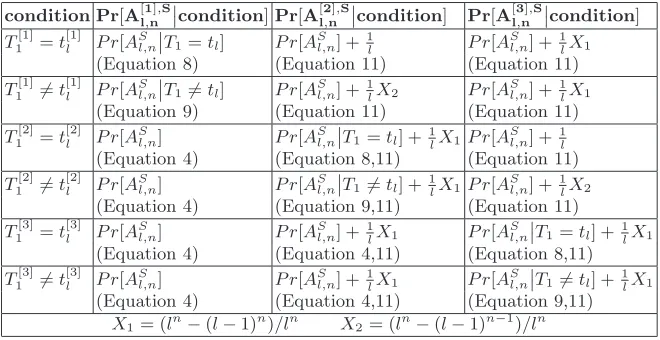
If all accesses toTj−1are random thenP r[t[lj−1] gets accessed] = 1−((l−1)n/ln)
and if T1[j−1] = tl[j−1] then this probability is 1. For j = 1, P r[A[1]l,n,S = H] = P r[AS
l,n=H]
Proof. ForT1, just as in a single table, the first memory block cannot be prefetched
(from the first observation Section 4.1). For tablesTj (j >1), which are placed after another table, the first memory block t[1j], can be prefetched by the last
memory block of the previous table (ie. t[lj−1]). The probability of t[1j] getting accessed in thenthmemory access oftjis 1/land the probability that this access results in a cache hit is equal to the probability with whicht[lj−1] gets accessed
at-least once innmemory accesses. ⊓⊔
When a condition is applied to one of the tables, it affects the outcome of the neighboring table’s memory accesses. Table 3 summarizes the conditional probabilities for thenth access in the three tables. To simplify notations in the table,P r[X=H] is simply represented asP r[X].
Table 3.Conditional Probabilities for Sequential Prefetching in Three Tables (T1,T2
T3) Placed Side-by-Side
condition Pr[A[l1,n],S
condition]Pr[A
[2],S
l,n
condition] Pr[A
[3],S
l,n
condition]
T1[1]=t [1] l P r[A
S l,n
T1=tl] P r[ASl,n] +1l P r[A
S
l,n] +1lX1
(Equation 8) (Equation 11) (Equation 11)
T1[1]6=t[1]l P r[AS l,n
T16=tl] P r[ASl,n] +1lX2 P r[A S
l,n] +1lX1
(Equation 9) (Equation 11) (Equation 11)
T1[2]=t[2]l P r[A S
l,n] P r[ASl,n
T1=tl] +1lX1P r[ASl,n] +1l
(Equation 4) (Equation 8,11) (Equation 11)
T1[2]6=t[2]l P r[AS
l,n] P r[A S l,n
T16=tl] +1lX1P r[ASl,n] +1lX2
(Equation 4) (Equation 9,11) (Equation 11)
T1[3]=t[3]l P r[AS
l,n] P r[ASl,n] +1lX1 P r[A S l,n
T1=tl] +1lX1
(Equation 4) (Equation 4,11) (Equation 8,11)
T1[3]6=t[3]l P r[AS
l,n] P r[A S
l,n] +1lX1 P r[A S l,n
T16=tl] +1lX1
(Equation 4) (Equation 4,11) (Equation 9,11)
X1 = (ln−(l−1)n)/ln X2= (ln−(l−1)n
4.4 Estimating the Cache Miss Distribution
When a cipher is executed several times, the number of cache misses form a distribution as seen in Figure 2(b). This distribution is normal and can be defined by its expected value and variance. Further we see that the random variables AC
l,n (for the classical cache) and A C,P
l,n (for caches with prefetching) form a distribution of the number of cache misses in thenth access. For this section, we generalize the notationsAC
l,n andA C,P
l,n byAl,n. The expected number of cache misses in thenth access is,
E(Al,n) = 0·(P r[Al,n=H]) + 1·(P r[Al,n=M]) = 1−P r[Al,n=H]
and the variance of cache misses in thenth access is
V(Al,n) = (1−P r[Al,n=H])−(1−P r[Al,n=H])2 =P r[Al,n=H]2+P r[Al,n=H]
LetMn be a random variable denoting the number of cache misses after n memory accesses. Let the expectation and variance of Mn be denoted E(Mn) andV(Mn). These are given by the recurrences,
E(Mn) =E(Mn−1) +E(Al,n)
and
V(Mn) =V(Mn−1) +V(Al,n) + 2·Cov(Mn−1, Al,n)
While the variance for the classical cache can be correctly predicted, the variance for the prefetching caches is approximated from that of the classical case. The expectation can be correctly predicted in all cases.
If the cipher uses more than 1 table then the expected number of cache misses in the cipher is simply the sum of each table’s corresponding expectation. If the tables are placed so that accessing one table is independent of the others (for example, the tables are placed in different memory pages), then the variance of the number of cache misses is the sum of each table’s corresponding variance. On the other hand if the accesses to the tables are not independent (example, the tables are placed side-by-side) then the covariance between the cache miss distributions of each table has to be considered.
5
Building Cache Profiles of a Block Cipher
In a profiled cache-timing attack, prediction ofki requires the timing profile for kito be built (Algorithm 3). From the discussion in Section 3, timing information from a block cipher can be analyzed in terms of the number of cache misses during the cipher’s execution. We therefore introduce the notion of a cache profile for ki.
Definition 1. The cache profile for ki is the variations in the cache miss distribution with respect to the value ofpi when Algorithm 3 is computed.
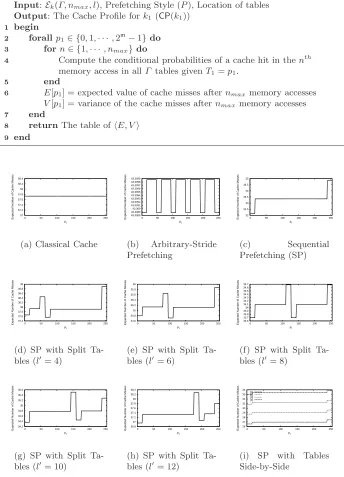
Algorithm 4 shows the estimation of the cache profile for k1 and can be
Algorithm 4: Cache Profile fork1
Input:Ek(Γ, nmax, l), Prefetching Style (P), Location of tables
Output: The Cache Profile fork1(CP(k1))
begin
1
forallp1∈ {0,1,· · ·,2 m
−1}do
2
forn∈ {1,· · ·, nmax}do
3
Compute the conditional probabilities of a cache hit in thenth
4
memory access in allΓ tables givenT1=p1.
end
5
E[p1] = expected value of cache misses afternmax memory accesses
6
V[p1] = variance of the cache misses afternmaxmemory accesses
end
7
returnThe table ofhE, Vi
8 end 9 57 57.2 57.4 57.6 57.8 58 58.2 58.4
0 50 100 150 200 250
Expected Number of Cache Misses
p1
(a) Classical Cache
43.3088 43.3089 43.309 43.3091 43.3092 43.3093 43.3094 43.3095 43.3096 43.3097 43.3098 43.3099
0 50 100 150 200 250
Expected Number of Cache Misses
p1 (b) Arbitrary-Stride Prefetching 32 32.5 33 33.5 34 34.5 35
0 50 100 150 200 250
Expected Number of Cache Misses
p1 (c) Sequential Prefetching (SP) 37.4 37.6 37.8 38 38.2 38.4 38.6 38.8 39
0 50 100 150 200 250
Expected Number of Cache Misses
p1
(d) SP with Split Ta-bles (l′
= 4) 34.6 34.8 35 35.2 35.4 35.6 35.8 36
0 50 100 150 200 250
Expected Number of Cache Misses
p1
(e) SP with Split Ta-bles (l′
= 6) 33.6 33.7 33.8 33.9 34 34.1 34.2 34.3 34.4 34.5 34.6 34.7
0 50 100 150 200 250
Expected Number of Cache Misses
p1
(f) SP with Split Ta-bles (l′
= 8) 34.2 34.4 34.6 34.8 35 35.2 35.4 35.6
0 50 100 150 200 250
Expected Number of Cache Misses
p1
(g) SP with Split Ta-bles (l′
= 10) 36.8 37 37.2 37.4 37.6 37.8 38 38.2 38.4
0 50 100 150 200 250
Expected Number of Cache Misses
p1
(h) SP with Split Ta-bles (l′
= 12) 26 27 28 29 30 31 32 33 34
0 50 100 150 200 250
Expected Number of Cache Misses
p1
[1] [2] [3] [4]
(i) SP with Tables Side-by-Side
Fig. 5. Cache Profiles for k1 with Different Prefetching Styles and Γ = 4, l =
16, nmax= 36, δ= 16
(l) for the cipher EK. The algorithm also takes the prefetching styleP used in
the cache memory, and the locations of theΓ tables in memory.
The cache profile returned by the algorithm comprises of a table with 2m
rows with each row consisting of a value ofp1and the corresponding distribution of the
Table 4.Comparison of Predicted and Empirical Distributions for the Cipher Model,
Γ = 1,l= 8,nmax= 36
Prefetching Style Predicted Distribution Empirical Distribution
Expectation Variance Expectation Variance
Classical Cache 7.934 0.0629 7.938 0.0591
Sequential Prefetching 4.492 0.6695 4.463 0.7302 Arbitrary-Stride Prefetching 7.734 0.2454 7.734 0.2622
is Gaussian (as seen in Figure 2(b)), therefore the table records the mean and variance of the distribution.
Depending on the type of prefetching, the cache profile would vary for the same cipher parameters. Figure 5 plots the cache profiles fork1= 0 with various
prefetching styles and locations of the tables. The x−axis has the values of p1 while the y−axis has the expected number of cache misses. Except for the
classical cache (Figure 5(a)), all other prefetching styles show a variation in the expected number of cache misses during the encryption. In the arbitrary-stride prefetching, the variations in the cache profile is very less, while the variations are much more significant in the case of the sequential prefetching schemes. Figures 5(d), 5(e), 5(f), 5(g), and 5(h) show how the cache profile with sequential prefetching (5(c)) gets affected due to the tables placed across a prefetching boundary. All cache profiles except (5(i)) assume that each table is not affected by accesses to a neighboring table. Figure 5(i) shows cache profiles for each table when the tables are placed side-by-side withT1 placed first followed by T2, T3,
and thenT4. These variations in the cache profile aid an adversary in a profiled
cache-timing attack.
5.1 Validation of the Cache Models
To check the correctness of the mathematical models developed in this section, we used the cache profiling toolCachegrind4. Cachegrind provides an ideal platform
for verification as most of the assumptions made in Section 3 are met. The source code of Cachegrind was patched to support the prefetching algorithms described in Algorithms (1) and (2). The predicted cache miss distribution was compared with empirical results obtained from Cachegrind for various cipher (Figure 1) and cache models. Table 4 shows a comparison of the distributions for various prefetching styles. The cipher model used in the table has parameters Γ = 1, l= 8,nmax= 36 with the accesses to the table at randomly chosen locations. The cache modeled is direct mapped with δ= 32 and of size 16KB. The empirical distributions were obtained after sampling 10,000 executions of the cipher. Figure 6 shows the cache profiles for key bytek1obtained from Cachegrind and
the prediction for the same cipher and cache model. Both the table and the cache profile show that the predicted distributions closely match empirical results. It was also found that for reasonably large cache memories (>4KB), the size of the cache and the associativity have little impact on the distribution obtained.
3.8 4 4.2 4.4 4.6 4.8 5 5.2 5.4
0 50 100 150 200 250
Expected Number of Cache Misses
p1 Predicted Cache Profile Empirical Cache Profile
Fig. 6.Predicted and Empirical Cache Profiles fork1 for Cipher Model Γ = 1,l= 8,
nmax= 36
6
Formal Model for the Profiled Cache Timing Attack
Just as in the case of timing profiles used in a profiled cache-timing attack (Section 2.3), the distribution of the cache misses for p1 also satisfies the EIS
property. Therefore for the known (K∗) and unknown (K#) keys,
CacheM issDistributionk∗
1(p
∗
1) =CacheM issDistributionk1#(p
#
1 ⊕(k∗1⊕k
#
1))
This means that the cache profile for the unknown key (CP(k#1)) is a shifted
version of the cache profile of the known key (CP(k1∗)). It is this shift that leaks
information about the secret key from the cache profile. The cache profileCP(k1) comprises of 2m
distributions corresponding to each value ofp1. Let theith distribution be calledFk1,i for (0 ≤i≤2
m
−1). In the cache profile with a classical cache (Figure 5(a)), all 2m
distributions are equal, therefore a shift between the profilesCP(k#
1) andCP(k∗1) is not observable and
no information is leaked.
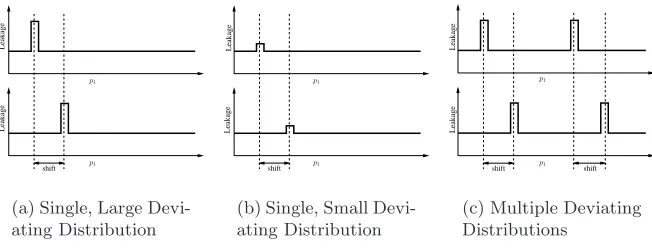
Consider the cache profile in Figure 7(a) in which all 2m
distributions are the same except for one. The deviating distribution being Fk1,µ. The shift in
the profile is observable with an error whose standard deviation is say e. The magnitude of the error depends on the amount of deviation ofFk1,µcompared to
the other distributions. For example, the measurement of shift in the cache profile in Figure 7(b) would have higher error than that of Figure 7(a). If there are more
Leakage
Leakage
shift p1
p1
(a) Single, Large Devi-ating Distribution
shift
Leakage
Leakage
p1
p1
(b) Single, Small Devi-ating Distribution
shift shift
Leakage
Leakage
p1
p1
(c) Multiple Deviating Distributions
variations in the distributions such as in Figure 7(c), then the error in deducing the shift would reduce. In general, if there areN variations in a cache profile then the standard deviation of the mean measurement would approximately reduce to √e
N [36]. Thus, the uncertainty of the keyk
#
1 can be analyzed in terms of the
variations in a cache profile.
Quantifying Information Leakage : The variations in the cache profile is mea-sured by the distances between the distributions. The symmetric version of the Kullback-Leibler (KL) divergence [22] is used for this purpose. Equation 12 com-putes the symmetric KL divergence between two distributionFk1,i andFk1,i′.
D(Fk1,i, Fk1,i′) =D(Fk1,i||Fk1,i′) +D(Fk1,i′||Fk1,i) (12)
, where
D(Fx||Fy) =X j
Fx(j) log Fx(j) Fy(j)
The index of the summation, j, ranges from the minimum to the maximum number of cache misses. The minimum number of cache misses is 1 corresponding to the first compulsory miss in the table. The maximum number of cache misses is either n (the number of table accesses) or l (the number of memory blocks required by the table), whichever is greater.
To compute the total information leakage (D(CP(k1)) for the cache profile for
k1, the value ofD(Fk1,i, Fk1,i′) is added for every possible pair of distributions. Therefore,
D(CP(k1)) = X
∀pairs of i and i′,i6=i′
D(Fk1,i, Fk1,i′) (13)
7
Analysis of Information Leakage
There are two parts in Equation 13:(a)the Kullback Leibler divergence and(b) the summation over all pairs of distributions in the cache profile. The Kullback Leibler divergence is zero when i and i′ fall in the same cache line, leading to an uncertainty in detection of shifts in the cache profile. For information to be leaked, at-least one pair ofi andi′ from different cache lines should have a non-zero divergence. Higher the value of the divergence implies more information getting leaked. The summation in Equation 13 quantifies the case when the cache profile has more variations in the distributions. This leads to more information leakage.
1e-05 0.0001 0.001 0.01 0.1 1
0 10 20 30 40 50 60 70
Leakage
Size of Table (l) λ = 2
λ = 3
(a) Arbitrary-Stride Prefetching (Γ = 1)
1 10 100 1000
0 10 20 30 40 50 60 70
Leakage
Size of Table (l) Γ = 1
Γ = 2
(b) Sequential Prefetching (SP)
0.001 0.01 0.1 1 10 100 1000
0 10 20 30 40 50 60 70
Leakage
Size of Table (l)
Tables Side by Side Tables Placed Independent
(c) SP with Relative Positions of Ta-bles (Γ = 2)
10 100 1000
20 30 40 50 60 70 80
Leakage
Table Split Percentage Γ=2 Split
Γ=2 Not Split
(d) SP with Split Tables (l = 16,
Γ = 1)
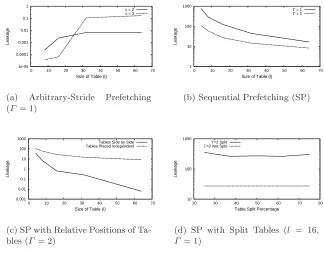
Fig. 8.Leakage fork1with Various Configurations as the Table Size Increases (nmax=
36)
Figure 8(b) shows that the leakage reduces as the number of tables (Γ) increase. Moreover, if the tables are placed side-by-side (Figure 8(c)), there is a further reduction in leakage. Figure 8(d) shows an increase in leakage when the table is split between prefetching boundaries.
We summarize the results as follows:
– For sequential prefetching, large tables have less leakage due to prefetching compared to small tables.
– For the arbitrary-stride prefetching, large tables leak more than small tables. However the magnitude of leakage is several times smaller compared to the sequential prefetching scheme.
– Larger number of tables in the cipher would result in lesser information leakage in profiled cache-timing attacks.
– Tables in which accesses are dependent on other tables have less leakage compared to tables in which the accesses are independent of other tables. – Split tables have a higher leakage, and the more unequal the split, the larger
the leakage.
8
Practical Aspects in Timing Profiles
In this section we discuss variations in timing profiles obtained during the exe-cution of Algorithm 3. The differencetdbetween any pair of distributions in the
resulting timing profile can be represented by the equation,
0.1 1 10 100
0 5 10 15 20 25 30 35
Variations in Timing Profile
Size of Table (l)
Fig. 9.Variations inDfor Timing Profiles aslincreases on an Intel Core 2 Duo with
Γ = 4,nmax= 36
There are three contributing components in td. The component tc denotes the
variation due to cache misses between the distributions. This is the variation formally analyzed in the previous sections. Besides cache misses, other factors could also cause differences in the timing. This is represented by to. Some of
these factors have been discussed in [6]. These contributory factors include, for example, memory reads taking longer time under certain conditions. The com-ponentstc+tointd result in information leakage, while the third componenttn
is due to noise, which makes attacking the system more difficult.
The noise can be categorized into two: frequently occurring (tnf) and
spo-radic (tns). Therefore tn = tnf +tns. Reasons for frequently occurring noise
in the measurements could be several such as stalls in the processor owing to pipelines or buffers getting full. Generally these events affect all distributions in the timing profile to an equal extent therefore their effect gets canceled out when the difference between distributions is taken (so, tnf = 0). Sporadic noise
occur rarely during the execution but are of much larger magnitude. Examples of sporadic noise are due to TLB misses or page faults. Since this noise is sporadic, they affect distributions by an unequal extent and their effect on the difference of distributions cannot be canceled out (ie. tns > 0). Also, as the size of the
tables increase, tns (hence tn) also increases. For example, with an increase in
table size, TLB misses and pages faults are more likely.
To quantify the amount of variations in the timing profile, we use the same metric as in Equation 13 but the distributions Fk1,i andFk1,i′ in the equation are timing and not cache misses.
D(TP(k1)) = X
∀pairs of i and i′,i6=i′
D(Fk1,i, Fk1,i′) (14)
Figure 9 show the variations in this metric as the size of the tables used increases. Assuming that to is a constant with respect to the table size, the
analysis in Section 7 shows a decrease intc aslincreases. Alsotn increases with
that in 85% of cases the attack on CLEFIA gave the correct key, while only 60% of the cases the right AES key was obtained in the same attack environment.
9
Summary and Future Directions
This paper is the first reported attempt to quantify leakages due to a micro-architectural component in the system. The paper considers data prefetching; an important feature in most modern day cache memories. Two data prefetch-ing algorithms, namely sequential prefetchprefetch-ing and arbitrary-stride prefetchprefetch-ing are analyzed. The results can be used as a guide to implementing ciphers with minimal leakage due to prefetching. The analysis shows that ciphers implemented with small tables leak more information due to prefetching compared to those with large tables. This leakage can be reduced by using several tables in the implementation. Further reduction in leakage can be obtained by placing tables side-by-side in memory. Finally, tables should not be split across prefetching boundaries as this would increase leakage.
There are several architecture and micro-architecture components in the sys-tem capable of leaking information. This paper has considered one such com-ponent. A future direction is to pin-point and quantify the leakage from other components in the system, thus leading to a complete analysis of leakage in the entire system. Since disabling prefetching may have an averse effect on the per-formance of other applications, another direction could be in the design of new prefetching strategies which either reduces or completely eliminates information leakage.
References
1. Abe, M. (ed.): Topics in Cryptology - CT-RSA 2007, The Cryptographers’ Track at the RSA Conference 2007, San Francisco, CA, USA, February 5-9, 2007, Pro-ceedings, Lecture Notes in Computer Science, vol. 4377. Springer (2006)
2. Acii¸cmez, O., C¸ etin Kaya Ko¸c: Trace-Driven Cache Attacks on AES (Short Paper). In: Ning, P., Qing, S., Li, N. (eds.) ICICS. Lecture Notes in Computer Science, vol. 4307, pp. 112–121. Springer (2006)
3. Acii¸cmez, O., C¸ etin Kaya Ko¸c, Seifert, J.P.: Predicting secret keys via branch prediction. In: Abe [1], pp. 225–242
4. Acii¸cmez, O., Schindler, W., C¸ etin Kaya Ko¸c: Cache Based Remote Timing Attack on the AES. In: Abe [1], pp. 271–286
5. Baer, J.L.: Microprocessor Architecture: From Simple Pipelines to Chip Multipro-cessors. Cambridge University Press (2010)
6. Bernstein, D.J.: Cache-timing Attacks on AES. Tech. rep. (2005)
7. Bertoni, G., Zaccaria, V., Breveglieri, L., Monchiero, M., Palermo, G.: AES Power Attack Based on Induced Cache Miss and Countermeasure. In: ITCC (1). pp. 586–591. IEEE Computer Society (2005)
8. Bonneau, J., Mironov, I.: Cache-Collision Timing Attacks Against AES. In: Goubin, L., Matsui, M. (eds.) CHES. Lecture Notes in Computer Science, vol. 4249, pp. 201–215. Springer (2006)
9. Brumley, D., Boneh, D.: Remote Timing Attacks are Practical. Computer Networks 48(5), 701–716 (2005)
10. Canteaut, A., Lauradoux, C., Seznec, A.: Understanding Cache Attacks. Research Report RR-5881, INRIA (2006), http://hal.inria.fr/inria-00071387/en/
12. Crosby, S.A., Wallach, D.S., Riedi, R.H.: Opportunities and Limits of Remote Timing Attacks. ACM Trans. Inf. Syst. Secur. 12(3) (2009)
13. Federal Information Processing Standards Publication 197: Announcing the Ad-vanced Encryption Standard (AES) (2001)
14. Fournier, J.J.A., Tunstall, M.: Cache Based Power Analysis Attacks on AES. In: Batten, L.M., Safavi-Naini, R. (eds.) ACISP. Lecture Notes in Computer Science, vol. 4058, pp. 17–28. Springer (2006)
15. Gallais, J.F., Kizhvatov, I., Tunstall, M.: Improved Trace-Driven Cache-Collision Attacks against Embedded AES Implementations. In: Chung, Y., Yung, M. (eds.) WISA. Lecture Notes in Computer Science, vol. 6513, pp. 243–257. Springer (2010) 16. Gierlichs, B., Batina, L., Tuyls, P., Preneel, B.: Mutual Information Analysis. In: Oswald, E., Rohatgi, P. (eds.) CHES. Lecture Notes in Computer Science, vol. 5154, pp. 426–442. Springer (2008)
17. Halderman, J.A., Schoen, S.D., Heninger, N., Clarkson, W., Paul, W., Calandrino, J.A., Feldman, A.J., Appelbaum, J., Felten, E.W.: Lest We Remember: Cold Boot Attacks on Encryption Keys. In: van Oorschot, P.C. (ed.) USENIX Security Sym-posium. pp. 45–60. USENIX Association (2008)
18. Hegde, R.: Optimizing Application Performance on Intel Core Microarchi-tecture Using Hardware-Implemented Prefetchers. Intel Software Network, http://software.intel.com/en-us/articles/optimizing-application-perfor mance-on-intel-coret-microarchitecture-using-hardware-implemented-pref etchers/(2008)
19. Hennessy, J.L., Patterson, D.A.: Computer Architecture: A Quantitative Ap-proach, 4th Edition. Morgan Kaufmann (2006)
20. Intel Corporation: Intel 64 and IA-32 Architectures Optimization Reference Man-ual (2009)
21. Kelsey, J., Schneier, B., Wagner, D., Hall, C.: Side Channel Cryptanalysis of Prod-uct Ciphers. J. Comput. Secur. 8(2,3), 141–158 (2000)
22. Kullback, S., Leibler, R.A.: On Information and Sufficiency. Annals of Mathemat-ical Statistics 22, 49–86 (1951)
23. Micali, S., Reyzin, L.: Physically observable cryptography (extended abstract). In: Naor, M. (ed.) TCC. Lecture Notes in Computer Science, vol. 2951, pp. 278–296. Springer (2004)
24. Neve, M.: Cache-based Vulnerabilities and SPAM Analysis. Ph.D. thesis, Thesis in Applied Science, UCL (2006)
25. Neve, M., Seifert, J.P.: Advances on Access-Driven Cache Attacks on AES. In: Biham, E., Youssef, A.M. (eds.) Selected Areas in Cryptography. Lecture Notes in Computer Science, vol. 4356, pp. 147–162. Springer (2006)
26. Osvik, D.A., Shamir, A., Tromer, E.: Cache Attacks and Countermeasures: The Case of AES. In: Pointcheval, D. (ed.) CT-RSA. Lecture Notes in Computer Sci-ence, vol. 3860, pp. 1–20. Springer (2006)
27. Page, D.: Theoretical Use of Cache Memory as a Cryptanalytic Side-Channel (2002)
28. Percival, C.: Cache Missing for Fun and Profit. In: Proc. of BSDCan 2005 (2005) 29. Rebeiro, C., Mukhopadhyay, D.: Cryptanalysis of CLEFIA Using Differential
Methods with Cache Trace Patterns. In: Kiayias, A. (ed.) CT-RSA. Lecture Notes in Computer Science, vol. 6558, pp. 89–103. Springer (2011)
30. Rebeiro, C., Mukhopadhyay, D., Takahashi, J., Fukunaga, T.: Cache Timing At-tacks on CLEFIA. In: Roy, B., Sendrier, N. (eds.) INDOCRYPT. Lecture Notes in Computer Science, vol. 5922, pp. 104–118. Springer (2009)
31. Schindler, W., Lemke, K., Paar, C.: A Stochastic Model for Differential Side Chan-nel Cryptanalysis. In: Rao, J.R., Sunar, B. (eds.) CHES. Lecture Notes in Com-puter Science, vol. 3659, pp. 30–46. Springer (2005)