Point-to-Pose Voting based Hand Pose Estimation using Residual Permutation
Equivariant Layer
Shile Li
Technical University of Munich
[email protected]Dongheui Lee
Technical University of Munich, German Aerospace Center
[email protected]Abstract
Recently, 3D input data based hand pose estimation methods have shown state-of-the-art performance, because 3D data capture more spatial information than the depth image. Whereas 3D voxel-based methods need a large amount of memory, PointNet based methods need tedious preprocessing steps such as K-nearest neighbour search for each point. In this paper, we present a novel deep learning hand pose estimation method for an unordered point cloud. Our method takes 1024 3D points as input and does not re-quire additional information. We use Permutation Equivari-ant Layer (PEL) as the basic element, where a residual net-work version of PEL is proposed for the hand pose estima-tion task. Furthermore, we propose a voting-based scheme to merge information from individual points to the final pose output. In addition to the pose estimation task, the voting-based scheme can also provide point cloud segmentation re-sult without ground-truth for segmentation. We evaluate our method on both NYU dataset and the Hands2017Challenge dataset, where our method outperforms recent state-of-the-art methods.
1. Introduction
Hand pose estimation plays an important role in human-robot interaction tasks, such as gesture recognition and learning grasping capability by human demonstration. Since the emergence of consumer level depth sensing de-vices, a lot of depth image based hand pose estimation methods appeared. Many state-of-the-art methods use depth image as input, which provides the conveniences to use the well developed convolutional neural networks or residual networks. However, methods using 2D images as input can-not fully utilize 3D spatial information in the depth image. Furthermore, the appearance of the depth image is depen-dent on the camera parameters, such that the trained model using one camera’s image cannot generalize well to another camera’s image. On the other hand, 3D data is more
”di-input points point-wise
pose predictions
point-to-pose importance weight
hand pose
segmentation
weighted fusion
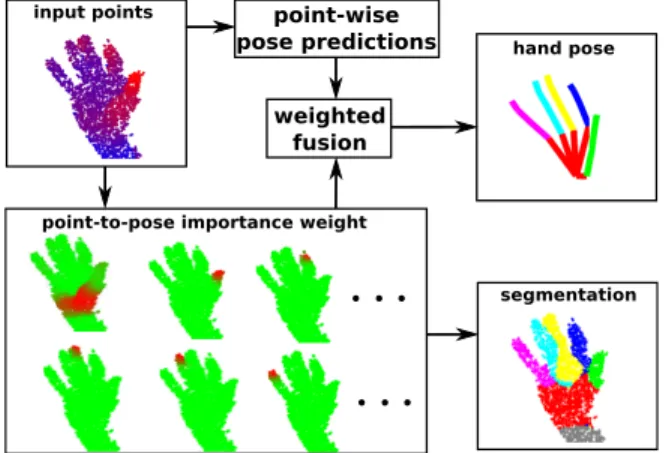
Figure 1. Our method takes point cloud as input. Then each point predicts the hand pose and its importance weights for different pose dimensions. The final pose is obtained through weighted fusion from each point’s pose prediction. Using the importance weight, the hand can be clearly segmented into different parts, al-though no segmentation ground-truth was used during training.
rect” and ”distinctive” than depth image because the appear-ance of 3D data is unique and invariant to camera parame-ters.
Recently, methods using 3D data as input have shown the outperformance over depth image based methods [36]. One way to use 3D input data is to convert 2D depth image to volumetric representation, such as 3D voxels [15] [4], where occupied 3D voxel is set to 1 and voxels with empty space is set to 0. Using the voxelized data brings the con-venience to directly use 3-dimensional CNN learning struc-ture. However, the voxelization requires large amount of memory to represent the input and output data, which pre-vents the deployment of a very deep structure.
Another way to use 3D input data is to use unordered point cloud as input [6][9][3]. Recently, PointNet, a deep learning structure for point cloud, has shown its success in different tasks. The PointNet estimates point-wise features for individual points and extract global feature from indi-vidual points using a max-pooling layer, such that the net-work is invariant to the order of points. Ge et al. use
Point-Net [20][22] as backbone to estimate hand pose from point cloud [6]. However, tedious pre-processing steps such as surface normal estimation and k-nearest-neighours search are required for [6]. Moreover, the final max-pooling layer in the PointNet neglects many informations that might be crucial for pose estimation.
In this work, we explore a more flexible learning struc-ture for unordered point sets, the permutation equivariant layer (PEL) [24] [39]. The PEL is a deep learning structure that can be applied for unordered points. In PEL, point-wise features are computed, where each point’s feature does not only depend on its own input, but also the global max-imum value. Using PEL as the basic element, we propose a residual network version of PEL to construct a deep net-work for hand pose estimation task. Moreover, we propose a point-to-pose voting scheme to obtain hand pose, which eliminates the use of max-pooling layer to extract global feature, thus avoiding the loss of information. Furthermore, the generated point-to-pose importance weights can be also used for the hand segmentation task (Fig. 1), where clear segmentation result can be obtained even without the seg-mentation ground-truth.
The contributions of this work are:
• We propose a novel deep learning based hand pose estimation method for unordered point cloud. Using Permuation Equivariant Layer as the basic element, a residual network version of PEL is used to solve the hand pose estimation task. Compared to PointNet [22] based methods, our method doesn’t require tedious steps such as normal estimation, nearest neighbour es-timation.
• We propose a point-to-pose voting scheme to merge the information from point-wise local features, which also genearates weakly-supervised segmenation re-sults without the need of segmentation ground-truth. • We evaluate our method on Hands2017 Challenge
dataset and NYU dataset, where state-of-the-art per-formance is shown. The proposed method achieves the lowest pose error on the Hands2017 Challenge dataset at the time of submission.
2. Related work
A lot of research about hand pose estimation has been done in the last decade, which can be categorized to generative, discriminative and hybrid methods. Gener-ative methods rely on a hand model and an optimiza-tion method to fit the hand model to the observaoptimiza-tions [25][29][23][19]. Discriminative methods use learning data to learn a mapping between observation and the hand pose [17][30][15][4][3][16][26][28]. Hybrid methods use a com-bination of the generative and discriminative methods [18]
[27][34]. Our method is a learning based method thus falls into the second category.
Deep learning for hand pose estimation
With the success of deep learning methods for 2D com-puter vision, depth image based deep learning methods also showed good performance in hand pose estimation task. Tompson et al. use 2D CNN to predict heatmaps of each joint and then rely on PSO optimization to estimate the hand pose [30]. Oberweger et al. [17] uses 2D CNN to directly regress the hand pose out of the image features, where a bottleneck layer was used to force the predicted pose obey certain prior distribution. In a later work, Oberweger [16] replaced CNN to a more sophisticated learning structure, ResidualNet50, to improve the performance of feature ex-traction. Zhou et al. [40] regress a set of hand joint angles and feed the joint angles into an embedded kinematic layer to obtain the final pose. Ye et al. [33] use a hierarchical mix-ture density network to handle the multi-modal distribution of occluded hand joints.
Recently, 3D deep learning has been also applied for the hand pose estimation task. Moon et al. use883
voxels to represent hand’s 3D geometry and use 3D CNN to estimate hand pose [15]. Their method achieved very accurate result, however, 3D voxelization of the input and output data re-quires large memory size, such that their method only runs at 3.5 FPS. Ge et al. [6][9] use 1024 3D points as input, and rely on PointNet [22] structure to regress the hand pose. Their method achieved satisfying performance, but tedious pre-processing steps are required, which includes oriented bounding box (OBB) calculation, surface normal estima-tion and k-nearest-neighbours search for all points. Chen et al. improves Ge’s method by using a spatial transformer network to replace the OBB and furthermore added a aux-iliary hand segmentation task to improve the performance [3]. Their method can be trained end-to-end without OBB, but the segmentation ground-truth data require a extra pre-computation step from the pose data.
3D Deep learning
Since 3D data cannot be directly fed into a conventional 2D CNN, some methods project the 3D data onto different views to obtain multiple depth images and perform CNN on all images [7] [21] [10] [35]. Another way to process the 3D data is to use volumetric representation and process the data with 3D CNN [8] [32] [14] [15]. These methods can capture the feature of input data more effective, but they require large memory size. Qi et al. developed PointNet to handle unordered point cloud [20]. The PointNet estimates point-wise local features and obtains global features with a max-pooling layer. Later on, PointNet++ extends PointNet by hierarchically upsampling the local features into higher levels [22].
J
pose
residual PEL network
Nx
3
Nx
1024
input points point-wise features
point-to-pose voting
point-to-pose voting: detection version
NxJ Nx (J x B) NxJxB weighted fusion JxB pose estimation from distribution point-to-pose importance term point-to-pose distributions estimates dimensional pose distributions point-wise fully-connect point-wise fully-connect
point-to-pose voting: regression version
NxJ NxJ weighted fusion point-to-pose importance term point-to-pose estimates point-wise fully-connect point-wise fully-connect
Figure 2. Overview of our method.
Other recent methods taking 3D points as input in-clude point-wise CNN [11], Deep kd-Networks [12], Self-Organizing Net [13] and Dynamic Graph CNN [31]. De-spite their good performance for different tasks, they all re-quire extra steps to estimate k-nearest neighbours or con-struct kd-tree, which are not required in our proposed resid-ual PEL network.
3. Methodology
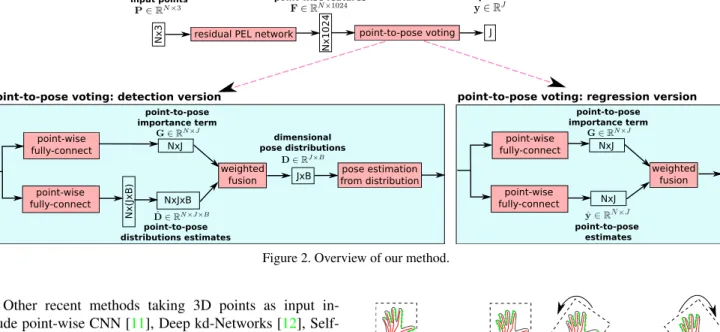
The overview of our method is illustrated in Fig. 2. Our method takesN 3D pointsP ∈ RN×3
with arbitrary order as input, and outputs the vectorized 3D hand pose
y ∈RJ in the end, whereJ = 3×#joints. To estimate the hand pose, the residual permutation equivariant layers (PEL) (Fig.4) first extract features from each point (Section
3.2). Using the point-wise local features, we use point-to-pose voting to estimate the final point-to-pose output (Section3.3), where two versions for point-to-pose voting are developed, which are the detection version and the regression version.
3.1. Pre-processing with view normalization
For pprocessing, first, the depth pixels in the hand re-gion are converted to 3D points. The next step is to cre-ate a 3D bounding box for the hand points to obtain nor-malized coordinate of these points. A usual pre-processing method will simply create a bounding box aligned with the camera coordinate system (Fig3a). However, because of self-occlusion of the hand, this will result in different set of observation points for the exact same pose label, which creates one-to-many mapping of the input-output pairs.
To maintain the one-to-one mapping relation of the input-output pairs, we propose to use view normalization to align the bounding box’s z-axis[0,0,1]T with the view
direction towards the hand centroid point c ∈ R3
. The alignment is performed by rotating the hand points with a
camera camera
a) w/o view normalization b) with view normalization sample 1 sample 2 sample 1 sample 2
Figure 3. View normalization as pre-processing step. Red skele-tons indicate ground-truth pose, green points indicate observed points of the camera. a) The same hand pose result in different ob-servations due to different view directions, thus the resulted train-ing samples will contain one-to-many mapptrain-ings. b) With view normalization, the different observations will also have different pose labels, thus the input-output pairs will have a one-to-one map-ping.
rotation matrixRcam:
αy =atan2(cx,cz), ec=Ry(−αy)·c,
αx=atan2(ecy,ecz), Rcam =Ry(−αy)·Rx(αx).
(1)
After rotating the observation points and ground truth pose withRcam, the hand is rotated such that it appears right in
front of the camera, As illustrated in Fig. 3b, the one-to-many mapping problem is then avoided.
3.2. Residual Permutation Equivariant Layers
The feature extraction module in our method is called Residual Permutation Equivariant Layers. The basic ele-ment is the permutation equviariant layer (PEL), which fol-lows the design from [24]. A PEL takes a set of unordered
points as input and computes separate features for each in-dividual input point.
Assuming that the input for a PEL isx∈ RN×Kin and the output isx′
∈ RN×Kout
, where N is the number of points andKin, Koutare the size of input and output feature
dimensions. The outputx′
of the PEL is:
x′
=σ(1NβT+(xdiag(λ)+1NxTmaxdiag(γ))W), (2)
whereλ ∈ RKin,γ ∈ RKin
are weighting terms for the point’s own feature and the global maximum value respec-tively, andxmax∈RKinis a vector representing maximum
values for each column ofx.W∈RKin×Kout
is the weight term andβ∈RKout
is the bias term and1N ∈RNis a
vec-tor full of ones. Furthermore, an activation functionσ(·)is applied to provide non-linearity, where a sigmoid function is used in our method.
This layer is invariant to input order because the output value of each individual point only depends on its own in-put feature and the global maximum values in each feature dimension, whereas the global maximum values are also invariant to the order of input points.1 In this way, each point’s feature does not only computed based on its own input feature, each point also exchanges information with other points through the weighted summation ofxmax.
For the practical side, four elements need to be trained, which areβ,λ,γandW. In total, the number of parame-ters needed for one layer isKout+ (Kout+ 2)Kin, which
is only slightly more than a fully-connected layer, thus it is feasible for training in practice.
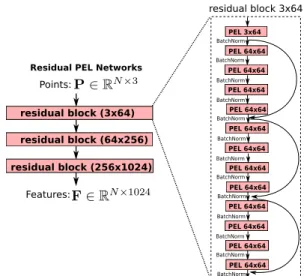
In order to extract very complex features, we construct a residual network with 39 PEL layers. As illustrated in Fig. 4, we use three residual blocks, whereas each residual block consists of 13 PELs and four short-cut connections. Furthermore, after each PEL, a batch normalization is per-formed.
3.3. Point-to-pose voting
With the residual PEL module, featuresFof points are computed, where each row ofFrepresents local feature for one point. Using these local point-wise features, the hand posey ∈ RJ will be estimated using a point-to-pose vot-ing scheme. Two versions for point-to-pose votvot-ing are ex-plored, which are the detection based version and the regres-sion based verregres-sion. The performance of these two verregres-sions will be compared in the experiment section.
Detection version
In the detection version (Fig. 2 left), probability distri-butions of each pose dimension is firstly detected and the pose is then integrated from the distributions. We use two
1The detailed proof of the invariance for PEL can be found in [24].
PEL 3x64 PEL 64x64
residual block 3x64
Residual PEL Networks
residual block (3x64) residual block (64x256) residual block (256x1024) BatchNorm BatchNorm BatchNorm PEL 64x64 BatchNorm PEL 64x64 PEL 64x64 BatchNorm BatchNorm PEL 64x64 BatchNorm PEL 64x64 BatchNorm Points:
Features: BatchNormPEL 64x64 PEL 64x64 BatchNorm PEL 64x64 BatchNorm PEL 64x64 BatchNorm PEL 64x64 BatchNorm PEL 64x64
Figure 4. Residual network of permutation equivariant layer
separate fully connected modules to estimate two matri-ces: an importance termG ∈ RN×J and a distributions
ˆ
D∈RN×J×B. An element of importance matrixGnj
rep-resents the confidence level ofnth input point to predict the jth output pose dimension. In other words, each of theN points predictsJ B-dimensional distributions andJ corre-sponding importance weights. Notice that the final layer of the two fully connected modules are sigmoid functions, such that all elements ofGandDˆ are in the range of[0,1].
ˆ
D represents the output pose distributions, where each point makes its own predictions to J output dimensions. Each of the output pose dimension is represented as discrete distribution using aBbins, representing the value range in
[−r,+r]with the resolution per bin∆d = 2r/B. For the jth dimension of the output poseyj, the corresponding bin
index for itself is then: indexgtj =⌈(y
gt
j +r)/∆d⌉,
and the ground truth distribution is defined as:
Dgtjb= ( 1, ifb∈[indexgtj −1, index gt j + 1] 0, otherwise (3)
whereas the three bins around ground truth pose are set to one and all other bins are set to zero.
The final distribution for theJ-dimensional outputD∈
RJ×Bis then obtained by merging the predictions of allN
points: Djb= PN n=1(GnjDˆnjb) PN n=1Gnj . (4)
And the final poseyis estimated with integration over the distribution: yj= PB b=1(b−0.5)Djb PB b=1Djb , (5)
whereb−0.5represents the bin center position.
Regression version
In the regression version (Fig. 2right), each point will di-rectly predict the pose without the intermediate distribution detection. Similarly to the detection version, two separate fully connected modules are used to estimate the impor-tance term G ∈ RN×J and the point-to-pose estimates
ˆ
y ∈ RN×J. Then the final pose output is merged as the weighted average over all points’ predictions:
yj= PN n=1(Gnjˆynj) PN n=1Gnj . (6)
3.4. Segmentation using importance term
The importance termG∈RN×Jis estimated automati-cally without the ground-truth information. However, it still provides vital information of each point’s importance to the pose output. Therefore, the obtained importance term can be also used for the hand segmentation task based on the most contributed pose dimension. For then-th point having the importance termsg=Gn, the point’s most contributed
pose dimension is:
jmax= argmax
j gj,
where the pose dimensionjmaxcan be categorized to a
spe-cific hand part. In this work, we categorized the J pose dimensions to palm, thumb, index, ring and pinky fingers.
3.5. Training Loss
The only training loss for the detection version is the log-arithm loss of the pose distributions:
Ldet =− J X j=1 B X b=1 Dgtjblog(Djb+ǫ) +(1−Dgtjb)(1−log(Djb+ǫ)), (7) whereǫ = 10−7
is a small offset to avoid feeding zero to the logarithm operator.
The only training loss used for the regression version is the L2 loss between predicted pose and ground-truth pose:
Lreg = 1 2 J X j=1 (ygtj −yj) 2 . (8)
For both detection and regression versions, the impor-tance termG∈ RN×J is estimated automatically without
the ground-truth information.
4. Experiment and result
Our hand pose estimation method is evaluated on the Hands2017Challenge dataset [37] and the NYU [30] dataset. The Hands2017Challenge is composed from parts of the Big Hand 2.2M dataset [38] and the First-person Hand Action Dataset (FHAD) [5], it is currently the largest dataset available. Its training set contains 957032 depth im-ages of five different hands. The test set consists of 295510 depth images of ten different hand shapes, of which five are the same as in the training set and five are entirely new. The NYU dataset contains 72757 training images of a single subject’s hand and 8252 test images that include a second hand shape besides the one from the training set. The NYU dataset provides depth images from three different views, we trained our method both using only frontal view data and using all three views. And we test only using the frontal view.
Our method is implemented using TensorFlow [1]. The networks are trained on a PC with an AMD FX-4300/Intel Core i7-860 CPU and an nVidia GeForce GTX1060 6GB GPU. We train 100 epochs for the NYU dataset and train only 20 epochs for the Hands 2017 challenge dataset since the challenge dataset has a large size. For both datasets, the first 50% of the epochs are trained with smaller number of points (N = 256) to boost the training speed. The remain-ing epochs are trained with a point size of N = 512. We used Adam optimizer for training with an initial learning rate of10−3
and we decrease the learning rate to10−4
for the last 10% of the epochs. For the detection version, we set r = 15mm andB = 60. Online augmentation was performed with random translation in all three dimensions within [−15,15]mm, random scaling within [0.85,1.15]
and random rotation around z-axis within[−π, π].
4.1. Evaluation metrics
For the NYU dataset, two standard metrics are used to evaluated the performance. The first metric is the mean joint error, which measures the average Euclidean distance error for all joints across the whole test set. The second metric is correct frame proportion, which indicates the proportion of frames that have all joints within a certain distance to ground truth. The second metric is considered as more dif-ficult since single joint violation will cause an unqualified frame. For the Hands2017Challenge dataset, only the mean joint error is used since the ground-truth data of test set is not publicly available and the official test website only pro-vides the mean joint error result.
4.2. Self-comparison
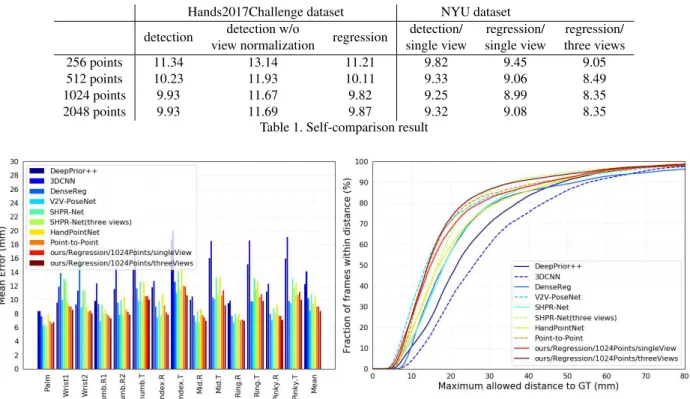
In this subsection, we perform self-comparison to show the effects of different components in our method. The de-tailed comparison can be found in Table 1.
Hands2017Challenge dataset NYU dataset detection detection w/o
view normalization regression
detection/ single view regression/ single view regression/ three views 256 points 11.34 13.14 11.21 9.82 9.45 9.05 512 points 10.23 11.93 10.11 9.33 9.06 8.49 1024 points 9.93 11.67 9.82 9.25 8.99 8.35 2048 points 9.93 11.69 9.87 9.32 9.08 8.35
Table 1. Self-comparison result
Figure 5. Comparison with state-of-the-arts on NYU [30] dataset. Left: mean errors of different joints. Right: proportion of correct frames based on different error thresholds.
method avg test seen test unseen test Ours/regression 9.82 7.15 12.04 Ours/detection 9.93 7.18 12.22 V2V-PoseNet [15] 9.95 6.97 12.43 RCN-3D [36] 9.97 7.55 12.00 oasis [6] 11.30 8.86 13.33 THU VCLab [2] 11.70 9.15 13.83 Vanora [36] 11.91 9.55 13.89 Table 2. Comparison of our method with state-of-the-art methods on the Hands2017Challenge dataset
method mean joint error (mm) Ours/regression/singleView 8.99 Ours/regression/threeViews 8.35 Ours/detection 9.25 DeepPrior++ [16] 12.23 3DCNN 14.11 DenseReg [4] 10.21 V2V-PoseNet [15] 8.42 SHPR-Net [3] 10.77
SHPR-Net (three views) [3] 9.37 HandPointNet [6] 10.54 Point-to-Point [9] 9.04
Table 3. Comparison of our method with state-of-the-art methods on the NYU dataset
View normalization. To validate the necessity of view normalization, we trained our method using both view nor-malized data and original data for the detection version. It is evident from Table 1 that view normalization
de-creases the pose estimation error by about 1.5 mm for the Hands2017Challenge dataset.
Detection vs. regression. Yuan et.al. indicates that detection based methods work in general better than regression-based methods [36], therefore we implemented both detection-based (ours/distribution) and regression-based (ours/regression) variations. As seen from Table 1, in both datasets, both variations show similar performance, where regression-based variation slightly outperforms the detection-based counterpart. Possible reasons for this can be quantization effect of the binary distribution and the sim-plification of 1-dimensional heat vectors compared to 2D or 3D heat maps used in previous works. However, the 1D heat vector representation is much more efficient than the 3D heatmap representation. For the heat vectors, we needB×Jvalues to represent the pose output, whereas 3D heatmaps requireJ×B3
values [15]. In future work, it is worth to investigate more different loss types and heat map representations.
Number of points. Taking advantage of the PEL struc-ture and voting-based scheme, our method is very flexible to the input point cloud size. Although the network was trained with 512 points, arbitrary number of points can be used at the testing stage. For an online application, this property can be beneficial to choose an arbitrary number of points based on the computational resources available. As seen from Table 1, different number of points were tested
P o in ts S eg men ta ti o n P o in ts S eg men ta ti o n P o in ts S eg men ta ti o n
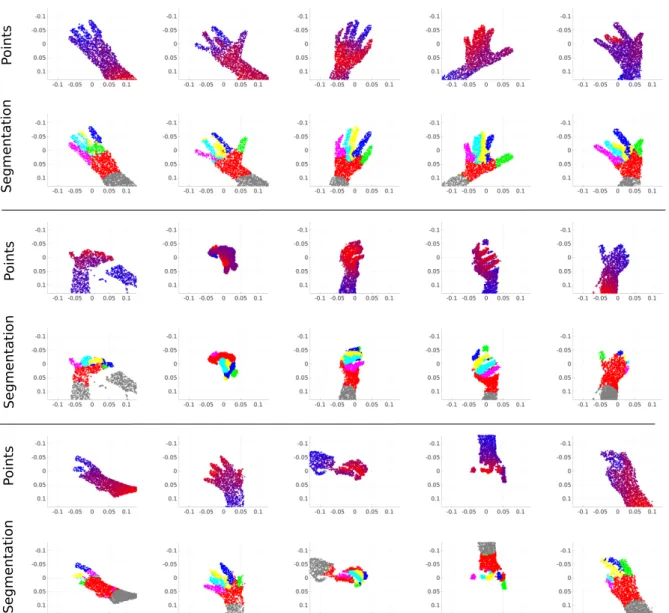
Figure 6. Segmentation results based on importance weights (best viewed in color). Points: input point cloud, color indicates depth value, blue points are more distanced and red points are more closer to the camera. Segmentation: each part of the hand is indicated with an different color, palm (red), thumb (green), index (blue), middle (yellow), ring (cyan), pinky (pink) and irrelevant points with low importance weight for all parts (gray).
for both datasets. Our method can achieve good perfor-mance with only 256 points, the mean joint error only in-creased by 0.11 mm compared to 512 points. In general, more points provides better performance, but it doesn’t im-prove any more after 1024 points. Therefore, we choose 1024 points for testing to compare our method with other state-of-the-art methods.
4.3. Comparison to state-of-the-art methods
Hands2017Challenge dataset. Since the ground-truth data for the testing set publicly available, some previous pa-pers divide the training set on their own to create their own testing set. Therefore, for fair comparison, we only compare
to those methods, who have also tested on the official test-ing website2. In Table 2, we compare our method with five
other top performing methods on the Hands2017Challenge dataset, which include both methods using 3D input data and methods using 2D depth image. RCN-3D [36], THU VCLab [2] and Vanora [36] use depth image as input data. V2V-PoseNet [15] uses voxel representation for both input data and output heatmaps. Oasis [6] also uses 3D point cloud as input and their method is constructed based on PointNet [20]. Three different errors are used for compar-ison: 1) the average across the complete test set (avg test), 2) the average across the test set of seen subjects’ hand
our method V2V-PoseNet [15] Hand3D [4] P2P-Regression [9]
GPU GTX1060 Titan X Titan X Titan Xp
time detection regression 285.7 ms 33.3 ms 23.9 ms 256 points 3.5 ms 2.9 ms 512 points 6.9 ms 5.5 ms 1024 points 12.5 ms 10.7 ms
Table 4. Comparison of runtime and hardware
ing training (seen test), and 3) the average across the test set images of unseen subjects’ hand (unseen test). Currently, our method achieves the lowest overall mean joint error on the test dataset of 9.82 mm. For seen subjects’ hand and un-seen subjects’ hand, the mean joint errors are 7.15 mm and 12.04 mm respectively, which shows the generalizability of the proposed method even without regularization on the pa-rameters. In comparison to other 3D data based methods, our method is slightly better than V2V-PoseNet, whereas V2V-PoseNet requires 10 good GPUs to run realtime and our method requires only one moderate GPU. Compared to oasis, which also uses 1024 3D points as input, our method is 1.48 mm better, where oasis requires more input informa-tion like surface normal and k-nearest neighbours.
NYU dataset. For the NYU dataset, we only compared to recent state-of-the-art methods after 2017. For testing the performance, only the frontal view was used. Follow-ing previous works [17][30][9], only 14 joints out of 36 joints provided were used for evaluation. For a fair com-parison, we only compared to the methods trained solely on the NYU dataset without additional data. The compared methods include depth image based methods (DeepPrior++ [16], DenseReg [4]), 3D voxel based methods (3DCNN [8], V2V-PoseNet [15]) and point cloud based methods (SHPR-Net [3], HandPointNet [6], Point-to-Point [9]). The comparison is shown in Figure5, where our method per-forms comparably good with V2V-PoseNet [15] and Point-to-Point [9], and outperforms all other methods. A closer comparison of the mean joint error value can be found in Table 3, where our method trained with single view is the second best, and our method trained with three views out-performs all recent state-of-the-art methods.
4.4. Segmentation using importance term
Besides showing the quantitative results relying on the ground-truth data, we also show some qualitative result of the segmentation using the automatically inferred impor-tance term. As seen from Figure 6, the segmentation re-sult is shown alongside the original point cloud. The sam-ples are taken from the Hands2017Challenge dataset. Both samples with all visible fingers and samples with different levels of self-occlusion are shown. In all cases, the fingers are clearly segmented with each other, even the fingers are twisted together. The points has no contribution to any joint has very small importance values and they are classified as
background. As Figure 6 shows, the arm and the back-ground points are clearly segmented in gray. Notice that the segmentation result is obtained without the ground-truth data for segmentation. This leads to a future research ques-tion about whether we can perform this method on hand-object interaction cases, where the influence of the hand-object can be automatically removed.
4.5. Runtime and model size
Compared to depth image based methods, our method requires more computation time and memory storage, this limits our training to use only 512 points (batch size=32) on our hardware setting. To store the learned models, the proposed method takes 38 MB for the regression version and 44 MB for the detection version. Compared to 420MB for a 3D CNN based method [4], our model size is much smaller. For the testing stage, the runtime of our method is 12.5 ms and 10.7 ms per frame for the detection and re-gression version respectively, where 1024 points are used as input. When less input points is used, the runtime can be further reduced with a small performance loss. Table 4 shows a comparison of runtime to other state-of-the-art 3D methods [15][4][9]. Although the other methods all used a more powerful GPU than ours, our method require the least processing time.
5. Conclusion
We propose to use a novel neural network archi-tecture, ResidualPEL, for hand pose estimation using unordered point cloud as input. The proposed method is invariant to input point order and can handle different numbers of points. Compared to previous 3D voxel based methods, our method requires less memory size. And compared to PointNet based methods, our method does not require surface normal and K-nearest-neighours information. A voting-based scheme was proposed to merge information from individual points to pose output, where the resulting importance term can be also used to segment the hand into different parts. The performance of our method is evaluated on two datasets, where our method outperforms the state-of-the-art methods on both datasets. In future work, the proposed ResidualPEL and voting scheme can be also applied to similar problem such as human pose estimation and object pose estimation.
References
[1] Mart´ın Abadi, Ashish Agarwal, Paul Barham, Eugene Brevdo, Zhifeng Chen, Craig Citro, Greg S Corrado, Andy Davis, Jeffrey Dean, Matthieu Devin, et al. Tensorflow: Large-scale machine learning on heterogeneous distributed systems.arXiv:1603.04467, 2016.5
[2] Xinghao Chen, Guijin Wang, Hengkai Guo, and Cairong Zhang. Pose guided structured region ensemble net-work for cascaded hand pose estimation. arXiv preprint arXiv:1708.03416, 2017.6,7
[3] Xinghao Chen, Guijin Wang, Cairong Zhang, Tae-Kyun Kim, and Xiangyang Ji. Shpr-net: Deep semantic hand pose regression from point clouds.IEEE Access, 6:43425–43439, 2018.1,2,6,8
[4] Xiaoming Deng, Shuo Yang, Yinda Zhang, Ping Tan, Liang Chang, and Hongan Wang. Hand3d: Hand pose estimation using 3d neural network.Proc. Computer Vision and Pattern Recognition (CVPR), IEEE, 2018.1,2,6,8
[5] Guillermo Garcia-Hernando, Shanxin Yuan, Seungryul Baek, and Tae-Kyun Kim. First-person hand action bench-mark with rgb-d videos and 3d hand pose annotations. arXiv:1704.02463, 2017.5
[6] Liuhao Ge, Yujun Cai, Junwu Weng, and Junsong Yuan. Hand pointnet: 3d hand pose estimation using point sets. InProceedings of the IEEE Conference on Computer Vision and Pattern Recognition, pages 8417–8426, 2018.1,2,6,7, 8
[7] Liuhao Ge, Hui Liang, Junsong Yuan, and Daniel Thalmann. Robust 3d hand pose estimation in single depth images: from single-view cnn to multi-view cnns. InProceedings of the IEEE conference on computer vision and pattern recogni-tion, pages 3593–3601, 2016.2
[8] Liuhao Ge, Hui Liang, Junsong Yuan, and Daniel Thalmann. 3d convolutional neural networks for efficient and robust hand pose estimation from single depth images. InIEEE con-ference on computer vision and pattern recognition, pages 1991–2000, 2017.2,8
[9] Liuhao Ge, Zhou Ren, and Junsong Yuan. Point-to-point regression pointnet for 3d hand pose estimation. ECCV, Springer, 1, 2018.1,2,6,8
[10] Xinwei He, Yang Zhou, Zhichao Zhou, Song Bai, and Xiang Bai. Triplet-center loss for multi-view 3d object retrieval. In The IEEE Conference on Computer Vision and Pattern Recognition (CVPR), June 2018.2
[11] Binh-Son Hua, Minh-Khoi Tran, and Sai-Kit Yeung. Point-wise convolutional neural networks. InThe IEEE Conference on Computer Vision and Pattern Recognition (CVPR), June 2018.3
[12] Roman Klokov and Victor Lempitsky. Escape from cells: Deep kd-networks for the recognition of 3d point cloud mod-els. InComputer Vision (ICCV), 2017 IEEE International Conference on, pages 863–872. IEEE, 2017.3
[13] Jiaxin Li, Ben M. Chen, and Gim Hee Lee. So-net: Self-organizing network for point cloud analysis. InThe IEEE Conference on Computer Vision and Pattern Recognition (CVPR), June 2018.3
[14] Daniel Maturana and Sebastian Scherer. Voxnet: A 3d con-volutional neural network for real-time object recognition. In Intelligent Robots and Systems (IROS), 2015 IEEE/RSJ International Conference on, pages 922–928. IEEE, 2015.2 [15] Gyeongsik Moon, Ju Yong Chang, and Kyoung Mu Lee. V2v-posenet: Voxel-to-voxel prediction network for accu-rate 3d hand and human pose estimation from a single depth map.arXiv:1711.07399, 2017.1,2,6,7,8
[16] Markus Oberweger and Vincent Lepetit. Deepprior++: Im-proving fast and accurate 3d hand pose estimation. InICCV workshop, volume 840, page 2, 2017.2,6,8
[17] Markus Oberweger, Paul Wohlhart, and Vincent Lepetit. Hands deep in deep learning for hand pose estimation. In Computer Vision Winter Workshop, pages 1–10, 2015.2,8 [18] Markus Oberweger, Paul Wohlhart, and Vincent Lepetit.
Training a feedback loop for hand pose estimation. InIEEE International Conference on Computer Vision, pages 3316– 3324, 2015.2
[19] Iason Oikonomidis, Nikolaos Kyriazis, and Antonis A Argy-ros. Efficient model-based 3d tracking of hand articulations using kinect. InBmVC, volume 1, page 3, 2011.2
[20] Charles R Qi, Hao Su, Kaichun Mo, and Leonidas J Guibas. Pointnet: Deep learning on point sets for 3d classifica-tion and segmentaclassifica-tion. Proc. Computer Vision and Pattern Recognition (CVPR), IEEE, 1(2):4, 2017.2,7
[21] Charles R Qi, Hao Su, Matthias Nießner, Angela Dai, Mengyuan Yan, and Leonidas J Guibas. Volumetric and multi-view cnns for object classification on 3d data. In Pro-ceedings of the IEEE conference on computer vision and pat-tern recognition, pages 5648–5656, 2016.2
[22] Charles Ruizhongtai Qi, Li Yi, Hao Su, and Leonidas J Guibas. Pointnet++: Deep hierarchical feature learning on point sets in a metric space. InAdvances in Neural Informa-tion Processing Systems, pages 5099–5108, 2017.2 [23] Chen Qian, Xiao Sun, Yichen Wei, Xiaoou Tang, and Jian
Sun. Realtime and robust hand tracking from depth. In Pro-ceedings of the IEEE conference on computer vision and pat-tern recognition, pages 1106–1113, 2014.2
[24] Siamak Ravanbakhsh, Jeff Schneider, and Barnabas Poczos. Deep learning with sets and point clouds. arXiv preprint arXiv:1611.04500, 2016.2,3,4
[25] Javier Romero, Dimitrios Tzionas, and Michael J Black. Em-bodied hands: Modeling and capturing hands and bodies to-gether. ACM Transactions on Graphics (TOG), 36(6):245, 2017.2
[26] Toby Sharp, Cem Keskin, Duncan Robertson, Jonathan Tay-lor, Jamie Shotton, David Kim, Christoph Rhemann, Ido Le-ichter, Alon Vinnikov, Yichen Wei, et al. Accurate, robust, and flexible real-time hand tracking. InProceedings of the 33rd Annual ACM Conference on Human Factors in Com-puting Systems, pages 3633–3642. ACM, 2015.2
[27] Toby Sharp, Cem Keskin, Duncan Robertson, Jonathan Tay-lor, Jamie Shotton, David Kim, Christoph Rhemann, Ido Le-ichter, Alon Vinnikov, Yichen Wei, et al. Accurate, robust, and flexible real-time hand tracking. In33rd ACM Confer-ence on Human Factors in Computing Systems, pages 3633– 3642. ACM, 2015.2
[28] Danhang Tang, Jonathan Taylor, Pushmeet Kohli, Cem Ke-skin, Tae-Kyun Kim, and Jamie Shotton. Opening the black box: Hierarchical sampling optimization for estimating hu-man hand pose. InProceedings of the IEEE international conference on computer vision, pages 3325–3333, 2015.2 [29] Anastasia Tkach, Andrea Tagliasacchi, Edoardo Remelli,
Mark Pauly, and Andrew Fitzgibbon. Online generative model personalization for hand tracking.ACM Transactions on Graphics (TOG), 36(6):243, 2017.2
[30] Jonathan Tompson, Murphy Stein, Yann Lecun, and Ken Perlin. Real-time continuous pose recovery of human hands using convolutional networks.ACM Transactions on Graph-ics, 33(5):169, 2014.2,5,6,8
[31] Yue Wang, Yongbin Sun, Ziwei Liu, Sanjay E Sarma, Michael M Bronstein, and Justin M Solomon. Dynamic graph cnn for learning on point clouds. arXiv preprint arXiv:1801.07829, 2018.3
[32] Zhirong Wu, Shuran Song, Aditya Khosla, Fisher Yu, Lin-guang Zhang, Xiaoou Tang, and Jianxiong Xiao. 3d shapenets: A deep representation for volumetric shapes. In Proceedings of the IEEE conference on computer vision and pattern recognition, pages 1912–1920, 2015.2
[33] Qi Ye and Tae-Kyun Kim. Occlusion-aware hand pose esti-mation using hierarchical mixture density network. ECCV, Springer, 2018.2
[34] Qi Ye, Shanxin Yuan, and Tae-Kyun Kim. Spatial atten-tion deep net with partial pso for hierarchical hybrid hand pose estimation. InEuropean conference on computer vi-sion, pages 346–361. Springer, 2016. 2
[35] Tan Yu, Jingjing Meng, and Junsong Yuan. Multi-view har-monized bilinear network for 3d object recognition. InThe IEEE Conference on Computer Vision and Pattern Recogni-tion (CVPR), June 2018.2
[36] Shanxin Yuan, Guillermo Garcia-Hernando, Bjrn Stenger, Gyeongsik Moon, Ju Yong Chang, Kyoung Mu Lee, Pavlo Molchanov, Jan Kautz, Sina Honari, Liuhao Ge, Junsong Yuan, Xinghao Chen, Guijin Wang, Fan Yang, Kai Akiyama, Yang Wu, Qingfu Wan, Meysam Madadi, Sergio Escalera, Shile Li, Dongheui Lee, Iason Oikonomidis, Antonis Ar-gyros, and Tae-Kyun Kim. Depth-based 3d hand pose es-timation: From current achievements to future goals. InThe IEEE Conference on Computer Vision and Pattern Recogni-tion (CVPR), June 2018.1,6,7
[37] Shanxin Yuan, Qi Ye, Guillermo Garcia-Hernando, and Tae-Kyun Kim. The 2017 hands in the million challenge on 3d hand pose estimation.arXiv:1707.02237, 2017.5
[38] Shanxin Yuan, Qi Ye, Bjorn Stenger, Siddhant Jain, and Tae-Kyun Kim. Bighand2. 2m benchmark: Hand pose dataset and state of the art analysis. InIEEE Conference on Com-puter Vision and Pattern Recognition, pages 2605–2613, 2017.5
[39] Manzil Zaheer, Satwik Kottur, Siamak Ravanbakhsh, Barn-abas Poczos, Ruslan R Salakhutdinov, and Alexander J Smola. Deep sets. InAdvances in Neural Information Pro-cessing Systems, pages 3391–3401, 2017.2
[40] Xingyi Zhou, Qingfu Wan, Wei Zhang, Xiangyang Xue, and Yichen Wei. Model-based deep hand pose estimation. In
Twenty-Fifth International Joint Conference on Artificial In-telligence, pages 2421–2427. AAAI Press, 2016.2