Reverse Firewalls for Actively Secure MPCs
Suvradip Chakraborty?, Stefan Dziembowski??, and Jesper Buus Nielsen? ? ?
Abstract. Reverse firewalls were introduced at Eurocrypt 2015 by Mironov and Stephens-Davidowitz, as a method for protecting cryptographic protocols against attacks on the devices of the honest parties. In a nutshell: a reverse firewall is placed outside of a device and its goal is to “sanitize” the messages sent by it, in such a way that a malicious device cannot leak its secrets to the outside world. It is typically assumed that the cryptographic devices are attacked in a “functionality-preserving way” (i.e. informally speaking, the func-tionality of the protocol remains unchanged under this attacks). In their paper, Mironov and Stephens-Davidowitz construct a protocol for passively-secure two-party computations with firewalls, leaving extension of this result to stronger models as an open question. In this paper, we address this problem by constructing a protocol for secure computation with firewalls that has two main advantages over the original protocol from Eurocrypt 2015. Firstly, it is amultipartycomputation protocol (i.e. it works for an arbitrary number n of the parties, and not just for 2). Secondly, it is secure in much stronger corruption settings, namely in theactively corruption model. More precisely: we consider an adversary that can fully corrupt up ton−1 parties, while the remaining parties are corrupt in a functionality-preserving way.
Our core techniques are: malleable commitments and malleable non-interactive zero-knowledge, which in particular allow us to create a novel protocol for multiparty augmented coin-tossing into the well with reverse firewalls (that is based on a protocol of Lindell from Crypto 2001).
1 Introduction
Traditional approach to cryptography is to design schemes in a black-box way, i.e, under assumption that the devices that execute cryptographic algorithms are fully trusted. The abstract, “black-box”, cryptography is currently well-understood, and there exist several algorithms that implement the basic cryptographic tasks in a way that is secure against a large class of attacks (under very plausible assumptions). Therefore, one can say that the cryptographic algorithms (if implemented correctly) are the most secure part of the digital systems.
Unfortunately, once we get closer to the real “physical world” the situation becomes much less satisfactory. This is because several real-life attacks on cryptographic devices are based on attacking the implementation, not the abstract mathematical algorithm. In particular, the adversary can exploit the so-called side-channels information emitted of a device, or tamper with it, by changing the way they behave. This can be achieved by attacking the cryptographic software by computer viruses or Trojan horses. What can be viewed as the extreme case of the tampering attacks are scenarios in which the
? Institute of Science and Technology Austria.[email protected] ??
device is produced by an adversarial manufacturer, who maliciously modifies its design. Such attacks are quite realistic, since, for the economical reasons, private companies and government agencies are often forced to use hardware that they did not produce themselves. Another source of such attacks are the insiders that originate from within a given company or organization. Last but not least, some attacks of this type can originate from the governments. The recent revelations of Edward Snowden disclosed a massive scale of the US government cyberattacks directed against the individuals (both within the US and abroad). It is generally believed that many other governments take similar actions, one recent example being the “Chinese hack chip” attack (revealed in October 2018) that reached almost 30 U.S. companies, including Amazon and Apple.
Countermeasures. Starting from 1990s there has been a significant effort in the cryp-tographic community to address this kind of “implementation attacks”, by extending the black-box model to cover also them (see, e.g., [17, 15]). An interesting alternative ap-proach has been recently proposed by Mironov and Stephens-Davidowitz [18] under the name “reverse firewalls”. On a high level (for a formal definition see Sect.2.1), this tech-nique addresses the problem of information leakage from cryptographic implementations that are malicious, either because they were produced by an adversarial manufacturer, or because they are were maliciously modified at a later stage. More concretely, reverse firewalls are used to protect against attacks in which a malicious implementation leaks some of its secrets via so-called “subliminal channels” [19], i.e, by encoding this secrets in innocently-looking protocol messages. In a nutshell, a reverse firewall is an external device that is put between a partyP and the external world in order to “sanitize” the messages that are sent and received byP. A reverse firewall isnot a trusted third party, and, in particular, it cannot be used to keepP’s secrets and to perform operations “in
P’s name”. Reverse firewalls come in different variants. The most popular one, that we also consider in this paper, is to require that the reverse firewalls provide protection only against the aforementioned “informational leakage” attack (and not against attacks that may influence the output of the computation). In particular, in this model, we are not
concerned with the correctness of the computation. More formally, we assume that all the adversarial tampering cannot change the functionality of the entire protocol. This type of attacks are called “functionality maintaining” corruptions [18]. The authors of this paper provide a construction of a two-party1 passively secure computation protocol with a reverse firewall, leaving the generalization of this construction to stronger security notions as an open problem.
Our contribution. We address the open problem of [18] by providing a construction of reverse firewalls for secure computation in a much stronger security model, and in a more general setting. More concretely, we show a solution to the problem by constructing
any actions of his choice. It is well-known [11,10] that such protocols can be constructed even if a majority of parties is corrupt (assuming that nofairness is guaranteed, i.e., the adversary can prevent the honest parties from learning their outputs, after she learns the outputs of corrupt parties). In this work, we show an MPC protocol (based on [11,10]), together with a reverse firewall for it, that provides security in a very strong sense: it can tolerate up to n−1 “standard” (active) corruptions (wheren is the number of parties) plus a corruption of the remaining parties, as long as it is “functionality maintaining” and this party is protected by a reverse firewall. The core technique that we use in this construction is a novel protocol for multiparty augmented parallel coin-tossing into the well with reverse firewalls (our starting point for this construction is a protocol of Lindell [16]).
Other related work. After the publication of [18] there has been some follow-up work on the reverse firewalls. In particular [8] constructed a firewalled protocol for CCA-secure message transmission, and [6] provide protocols for oblivious signature-based envelopes with firewalls, and oblivious transfer (this is done using a new technique called “mal-leable smooth projective hash function” that they develop in this paper). In [1] Ateniese et al. use reverse firewalls to construct signature schemes secure against arbitrary tam-pering. Reverse firewalls are also related to several earlier topics in cryptography such as the algorithm-substitution attacks, subliminal channels and divertible protocols, com-biners, kleptography, collusion-free protocols and mediated collusion-free protocols and more. Due to space constraints, we refer the reader to Sect. 1.1 of [18] for an overview of these topics and their relation to reverse firewalls.
1.1 Overview of our construction
firewalls can re-randomize a protocol transcript exploiting homomorphic properties of the commitment scheme, and controlled malleability property of the NIZK proofs (where the controlled malleability is “tied” to the appropriate mauling of the commitments). One of the key ingredients of our construction is a firewalled scheme for augmented coin tossing. This is built by combining the firewalled protocols for commitment and NIZKs with the coin-tossing protocol of Lindell [16].
Reverse Firewalls for multi-party (augmented) coin-tossing. Let us explain the
design principle of our reverse firewall for the multi-party augmented coin-tossing proto-col in more details. The starting point of our protoproto-col is the 2-party augmented parallel coin-tossing of Lindell [16]. The protocol of [16] uses a “commit-and-proof” technique, where one party (often called the initiating party) commits to a random bit-string and proves in zero-knowledge about the consistency of the committed value. The other party also sends a random bit-string to this party. The final string is the exclusive OR of both these strings and the initiating party commits to this final string. The protocol ends by outputting a random bit-string (which the initiating party gets), and the commitment value to the final bit-string (which the other party receives). First, we extend this pro-tocol to the multi-party setting, and finally design a reverse firewall for this propro-tocol. We assume that the honest parties are corrupted in a functionality-maintaining way. The first observation is that the corrupted parties may not necessarily commit to a ran-dom bit-string. Even if it does so, the commitment may also leak information about the committed value (say the randomness used to commit may leak additional information about the bit-string). Secondly, the bit-strings sent by the other parties to the initiating party may also act as a subliminal channel to leak secret information.
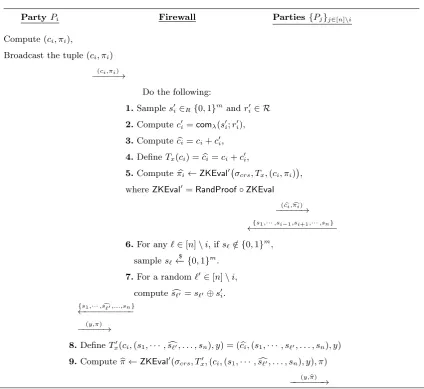
The main idea behind our firewall design is that it should somehow be possible to maul the commitment in such a way that the committed element is random (even if the initial bit-string is not chosen randomly) and the commitment is itself re-randomizable (so that the commitment appears to be “fresh”). For this, we assume the commitment scheme to be additively homomorphic (with respect to an appropriate relation), which suffices for our purpose. At this point, the original zero-knowledge proof (that conforms to the initial commitment) is no longervalid with respect to the mauled commitment. Hence, the firewall needs a way to appropriately maul the proof (so that the mauled proof is consistent with the mauled commitment), and also to re-randomize the proof (so that the randomness used to proof does not leak any information on the witness, which is the committed string). To this end, we use the controlled-malleable NIZK proof systems (cm-NIZK) introduced by Chase et al. [5]. We replace the (interactive) zero-knowledge proofs used in the protocol of [16] with cm-NIZK proofs (with a trusted setup procedure). The firewall then re-randomizes the shares (bit-strings) of the other parties in such a way that is consistent with the initial mauling of the commitment and the proof.
consistent, without compromising on the security of the protocol. We show that, indeed at the end the initiating party ends up with a random bit-string (as required by the functionality), even if its corrupted (in a functionality-maintaining way) and the other parties obtains a secure commitment to this bit-string. We show that the above firewall maintains functionality, preserves security for the honest parties, and also provide weak exfiltration-resistant3 against other parties. Finally, we stress that the above mauling operations, specially the mauling of the NIZK proofs, does not require the firewall to know the original witness (chosen by the initiating party), which makes it interesting and doable from the firewall perspective (since it shares no secret with any of the parties). We refer the reader to section 5.1for the details.
Reverse Firewalls for other protocols. We also present design of reverse firewalls for the multi-party input commitment protocol and the multi-party authenticated com-putation protocol, which are also used as key ingredients for our final actively-secure MPC protocol. The reverse firewalls for these protocols are relatively much simpler and involves only re-randomizing the commitment and the NIZK proof (in case of the input commitment protocol) and re-randomizing the proof (for the authenticated computation protocol). We show that both the firewalls corresponding to these two protocols preserve security and is exfiltration-resistant against other parties.
The final compiler. Finally, we show the construction of our actively-secure MPC
protocols in the presence of reverse firewalls. Our final compiler is similar to the compiler presented in [10], however, adapted to the setting of reverse firewalls. The compiler takes as input any semi-honest MPC protocol (without reverse firewalls) and runs the multi-party input commitment protocol, the multi-multi-party (augmented) coin-tossing protocol and the multi-party authenticated computation protocol in the reverse firewall setting (in sequential order) to obtain the final actively-secure MPC protocol. On a high level, after the input commitment and the coin-tossing protocol (in the presence of reverse firewalls) the inputs and the random pads of all the (honest) parties are fixed. Now, since the honest parties are corrupted in a functionality-maintaining way, the computation performed by the party in the authenticated computation protocol is determined, and the final zero-knowledge proofs conform to these computations. Hence, at this point, the security of the underlying semi-honest MPC protocol (without using reverse firewalls) can be invoked to argue security of our final actively-secure MPC protocol (in the presence of reverse firewalls).
Compiler for Reverse Firewalls for Broadcast model. As a contribution of
be a “unique message protocol”, so that, at any given point there is only one possible message that a party can send. We implement this by replacing the signatures in the Dolev-Strong protocol withunique signatures. Intuitively this works because: on any in-put in the Dolev-Strong protocol, the only allowed message consists of adding a signature on a well-defined message. The signature is either sent or added to a valid set. Since the signatures are unique and the parties are corrupted in a functionality-maintaining way, it is forced to send the unique message at that particular round. In general, the above idea also works if we replace the signatures in the Dolev-Strong protocol withre-randomizable
signatures [14,20]. Note that unique signatures are efficiently re-randomizable. We note that, our result also nicely complements the result of Ateniese et al. [1], who gave a neg-ative result for the construction of RF for arbitrary signature schemes. On the positive side, they show constructions of RF for the class of re-randomizable signature schemes (which includes unique signatures as well).
Organization of the paper. The basic definitions and notation are provided in Sect.2
(Sect. 2.1 contains the definitions related to the reverse firewalls). Our main technical contribution is presented in Sect.3, with Sections 4and 4.1describing the construction of broadcast channels in the reverse firewall setting, Sections 5—5.4 describing the in-gredients of our construction, and Sect.5.5putting them together into a single “protocol complier” algorithm. The security of our construction in stated and proven in Thm. 7.
2 Preliminaries
In this section we introduce some standard notation and terminology that will be used throughout the paper. For an integer n∈N, we denote by [n] the set {1,2,· · ·, n} and for any pair of integers 1 < i < j ≤ n, we denote by [i, j] the set {i, i+ 1,· · ·, j}. For a distribution or random variable X, we denote x ← X the action of sampling an element x according to X. For any integer m ∈ N, we write Um to denote the uniform distribution over all m-bit strings. A decision problem related to a language
L ⊆ {0,1}∗ requires to determine if a given string x is in L or not. In this paper, we consider N P language. Corresponding to each N P language L, we can associate a binary relation R ⊆ {0,1}∗× {0,1}∗ defining L such that: L={x:∃ωs.t.(x, ω) ∈R}
and |ω| ≤ poly(|x|). We callx the statement/theorem, and ω thewitness testifying the membership ofx in the language L, i.e., x∈L. Let T = (Tx, Tω) be a pair of efficiently computablen-ary functions,Tx :{{0,1}∗}n→ {0,1}∗. We call such a tupleT as ann-ary
transformation. Following [5], we define what it means for a transformationT = (Tx, Tw)
to beadmissible with respect to a NP relation R.
Definition 1. (Admissible transformations [5]). An n-ary transformation T =
(Tx, Tw) is said to admissible for an efficient relation R, if R is closed under T, i.e, for anyn-tuple
{(x1, ω1),· · ·,(xn, ωn)} ∈Rn, it holds that the pair Tx(x1,· · ·xn), Tω(ω1,· · ·, ωn)
(Homomorphic commitments.) A (non-interactive) commitment scheme consists of three polynomial time algorithms (G, K,com). The probabilistic setup algorithm G takes as input the security parameter λand outputs the setup parameterspar. The key generation algorithmK is a probabilistic algorithm that takes as inputparand generates a commitment keyck. We assume that the commitment keyck includes the description of the message space M, the randomness space R and the commitment space C to be used in the scheme. We also assume it is possible to efficiently sample elements from R. The algorithmcomtakes as input the commitment keyck, a messagemfrom the message space Mand “encodes”m to produce a commitment stringcin the commitment space C. Additionally, we also require the commitment scheme to behomomorphic [12,13], i.e, we assume that M,Rand C are groups with thehomomorphic property, and if we add any two commitments, the resulting commitment will encode the sum of the underlying messages. The formal definition follows.
Definition 2 (Homomorphic commitments [12]). A homomorphic trapdoor
com-mitment scheme consists of the tuple of algorithms (G, K,com) as described above, with the security properties as stated below:
– (Perfect hiding).The triple (G, K,com) is perfectly hiding if for all stateful adver-saries A, we have:
Pr "
b0 =b
par← G(1λ);ck←K(par); (m
0, m1,st)← A(par,ck);
b←− {0$ ,1};c←comck(mb);b0 ← A(c,st)
# ≤ 1
2 +negl(λ).
– (Computationally binding). The triple (G, K,com) is computationally binding if for all non-uniform polynomial time stateful adversaries A, we have:
Pr
m6=m0 ∧ par← G(1λ);ck←K(par); (m, m0, r, r0)← A(par,ck) : m, m0 6=⊥ comck(m;r) =comck(m0;r0)
≤negl(λ)
– (Homomorphic).The commitment scheme(G, K,com)is homomorphicifK always
outputsck describing groups M, R, C, which are written additively, such that for all m, m0∈ M, r, r0 ∈ R we have: comck(m;r) +comck(m0;r0) =comck(m+m0;r+r0).
(Controlled Malleable Non-Interactive Zero-Knowledge Proofs.) We recall
the definitions of controlled-malleable non-interactive proof systems from [5]. A non-interactive proof system for a N P language L associated with relation R consists of three (probabilistic) polynomial-time algorithm (CRSGen,P,V). The Common Refer-ence String (CRS) generation algorithm CRSGen takes as input the security parameter 1λ, and outputs CRS σcrs. The prover algorithm P takes as input σcrs, and a pair (x, ω) ∈ R, and outputs a proof π. The verifier algorithm V takes as input σcrs, a
areperfect completeness and adaptive soundness with respect to (possibly unbounded) cheating provers. Besides, we also want the NIZK proof systems for efficient relations
R that are (1) malleable with respect to an allowable set of transformations T, i.e., for any T ∈ T, given proofs π1,· · · , πn for statements x1,· · ·, xn ∈ L they can be
transformed into a proofπ for the statementTx(x1,· · ·, xn), and (2) derivation private,
i.e. the resultant proof π cannot be distinguished from a fresh proof computed by the prover on input Tx(x1,· · ·, xn), Tω(ω1,· · ·, ωn)
. We also want zero-knowledge property and simulation-sound extractability property to hold for the NIZK proof system under controlled malleability, as defined below.
Definition 3. (Controlled-malleable NIZK proof system [5]). A controlled
mal-leable non-interactive(cm-NIZK)proof systemfor a languageLassociated with aN P re-lationRconsists of four (probabilistic) polynomial-time algorithms (CRSGen,P,V,ZKEval) such that the following conditions hold:
• (Completeness). For allσcrs ←CRSGen(1λ), and (x, ω)∈R, it holds thatV(σcrs, x, π) =
1 for all proofs π←P(σcrs, x, ω).
• (Soundness). We say that (CRSGen,P,V) satisfiesadaptive soundness if for allP P T
(malicious) provers P∗ we have:
Prhσcrs ←CRSGen(1λ); (x, π)←P∗(σcrs) : V(σcrs, x, π) = 0 if x /∈R
i
>1−negl(κ).
for some negligible functionnegl(κ). Perfect soundness is achieved when this proba-bility is always 1.
• (Malleability). Let T be a set of allowable transformation for an efficient relation R. Then the proof system (CRSGen,P,V) is said to be malleable with respect to T, if there exists an efficient algorithm ZKEval that does the following: ZKEval takes as input σcrs, the description of a n-ary admissible transformation T ∈ T, statement-proof pairs (xi, πi), where 1 ≤ i ≤ n, such that V(σcrs, xi, πi) = 1 for all i, and
outputs a proof π for the statementx=T({xi}) such that V(σcrs, x, π) = 1.
• (Rerandomizability). We say that the NIZK proof system (CRSGen,P,V) for relation
Ris re-randomizable if there exists an additional algorithmRandProof, such that the probability of the event thatb0 = 0 in the following game is negligible:
– σcrs ←CRSGen(1λ).
– state, x, w, π)←− A($ σcrs).
– If V(σcrs, x, π) = 0, or (x, w)∈/ R, output ⊥. Otherwise form
π0← (
P σcrs, x, w ifb= 0 RandProof(σcrs, x, π) ifb= 1.
• (Derivation privacy). We say that the NIZK proof system (CRSGen,P,V,ZKEval) for relationR with respect to T is derivation-private, if for all adversariesA and bit b, the probabilitypAb (λ) that the event b0 = 0 in the following game is negligible:
– σcrs ←CRSGen(1λ).
– state,(x1, ω1, π1),· · ·,(xq, ωq, πq), T
← A(σcrs).
– If V(σcrs, xi, πi) = 0 for some i, (xi, ωi) ∈/ R for some i, or T /∈ T, abort and output ⊥. Otherwise compute,
π ← (
P σcrs, Tx(x1,· · · , xq), Tω(ω1,· · · , ωq)
ifb= 0 ZKEval(σcrs, T,{(xi, πi)}i∈[q]) ifb= 1.
– b0 ← A(state, π).
Theorem 1. [5] If a proof system is both malleable and randomizable and uses
ZKEval0 =RandProof◦ZKEval, then it is also derivation private.
• (Controlled-malleable simulation-sound extractability). Let (CRSGen,P,V) be a NIZK proof of knowledge (NIZKPoK) system for the relationR, with a simulator (S1,S2)
and an extractor (E1,E2). LetT be an allowable set of unary transformation for the
relationRsuch that membership inT is efficiently testable. LetSE1 be an algorithm, that on input 1λ outputs (σcrs, τs, τe) such that (σcrs, τs) is distributed identically to the output ofS1. Consider the following game with the adversaryA:
– (σcrs, τs, τe)← SE1(1λ).
– (x, π)← AS2(σcrs,τs,·)(σ
crs, τe).
– (ω, x0, T)← E2(σcrs, τe, x, π).
We say that the NIZKPoK satisfiescontrolled-malleable simulation-sound extractabil-ity (CMSSE) if for all P P T algorithmsAthere exists a negligible functionν(·) such that the probability that V(σcrs, x, π) = 1 and (x, π) ∈ Q/ (where Q is the set of
queried statements and their responses) but either (1) ω 6=⊥ and (x, ω) ∈/ R; (2) (x0, T) 6= (⊥,⊥) and either x0 ∈ Q/ x (the set of queried instances), x 6= Tx(x0), or T /∈ T; (3) (ω, x0, T) = (⊥,⊥,⊥) is at most ν(λ).
Secure computation We present the definition of general multi-party computation protocols (for an introduction to this topic see, e.g., [7]). We follow the definitions as presented in [10,16], which in turn follows the definitions of [4,2].
Multi-party protocols. Letndenote the number of parties involved in the protocol. We assume that n is fixed. A multi-party protocol problem is casted by specifying a random process which maps sequences of inputs (one input per each of the n parties) to sequences of outputs (one for each of the n parties). We refer to such a process as a n-ary functionality, denoted by f : ({0,1}∗)n → ({0,1}∗)n, where f = (f1,· · ·, fn).
For a input vector x={x1,· · · , xn} the output is a tuple of random variables denoted
by (f1(x),· · · , fn(x)). Theith party Pi initially holds the input xi and obtains the ith
element in f(x1,· · ·, xn), i.e. fi(x1,· · ·, xn). We also assume that all the parties hold
input of equal length, i.e.,|xi|=|xj|for alli, j ∈[n]. We will denote such a functionality
as (x1,· · ·, xn)7→(f1(x1,· · ·xn),· · · , fn(x1,· · ·xn)).
Adversarial behavior. For the analysis of our protocols we consider the malicious
adversarial model. A malicious adversary may corrupt a subset of parties and can com-pletely control these parties and deviate arbitrarily from the specified protocol. We assume a static corruption model, where the set of corrupted or dishonest parties are already specified before the execution of the protocol. A weaker model of security is the
semi-honest model, where the adversary has to follow the protocol as per its specifica-tion, but it may record the entire transcript of the protocol to infer something beyond the output of the protocol. We consider the definition of security in terms of a real-world and ideal-world simulation paradigm, as in [10]. In the ideal model, we assume the existence of an in-corruptible trusted third party (TTP). In the semi-honest model, all the parties send their local inputs to the TTP, who computes the desired functionality and send back the prescribed outputs to them. The honest parties then output their respective outputs, while the semi-honest parties output an arbitrary probabilistic polynomial-time function of their respective inputs and the outputs obtained from the TTP. In contrast, in the malicious model the malicious parties may substitute their local input and send it to the TTP in the first place. We assume that the TTP always answers the malicious parties first. The malicious parties may also abort the execution of the protocol by re-fraining from sending their own messages. Finally, as in the semi-honest model, each honest party outputs its output as received from the TTP, while the malicious parties may output an arbitrary probabilistic polynomial-time function of their initial inputs and the outputs obtained from the TTP.
Definition 4 (Malicious adversaries–the ideal model).Letf : ({0,1}∗)n→({0,1}∗)n
be an-ary functionality as defined above. LetI ={i1,· · · , iq} ⊂[n], and(x1,· · · , xn)I =
(xi1,· · · , xiq). A pair(I,C) where I ⊂[n]and C is a polynomial-size circuit family
rep-resents an adversary in the ideal model. The joint execution under (I,C) in the ideal model (on input sequence x = (x1,· · · , xn)), denoted by IDEALf,(I,C)(x) is defined as
(C(xI,⊥),⊥,· · · ,⊥) if C(xI) =⊥.
(C(xI, fI(C(xI),xI¯),⊥),⊥,· · · ,⊥) if C(xI)6=⊥ ,1∈ I and yI =⊥, where
yIdef= (C(xI, fI(C(xI),xI¯))
(C(xI, fI(C(xI),xI¯)), fI¯(C(xI),xI¯)) otherwise.
where I¯= [n]\I.
The first equation represents the case where the adversary makes some dishonest party to abort before invoking the trusted party. The second equation represents the case where the trusted is invoked with possibly substituted inputs C(xI) and is halted right
after supplying the adversary with the I-part of the output yI = fI(C(xI),xI¯)). This
case is allowed only when 1∈ I, i.e, the party P1 can only be blamed for early abort.
Finally, the third equation presents the case where the trusted is invoked with possibly substituted inputs C(xI), but is also allowed to answer to all the parties.
Definition 5 (Malicious adversaries–the real model).Letf : ({0,1}∗)n→({0,1}∗)n be an-ary functionality as defined above. LetΠ be a protocol for computingf. The joint execution under (I,C) in the real model (on input sequence x= (x1,· · · , xn)), denoted
by REALΠ,(I,C)(x) is defined as the output sequence resulting of the interaction between
the n parties where the messages of parties in I are computed according to C and the messages of parties not in I are computed according to Π.
Now that the ideal and real models are defined, we put forward the notion of security for a multi-party protocol. Informally, it says that a secure multi-party protocol in the real model emulates the ideal model.
Definition 6 (Security in the Malicious model). Let f and Π be as in Def. 5.
Protocol Π is said to securely compute f if there exists a polynomial-time computable transformation of polynomial-size circuit families A = {Aλ} for the real model (of
Def. 5) into polynomial-size circuit families B = {Bλ} for the ideal model (of Def. 4) such that for every subset I ⊂ [n] we have that {IDEALf,(I,B)(x)}λ∈N,x∈({0,1}λ)n ≡c
{REALΠ,(I,A)(x)}λ∈
N,x∈({0,1}λ)n.
2.1 Cryptographic Reverse Firewalls
input with party A nor does it get to know the output of party A. The firewall W is allowed to see only the public parameters of the system. Besides this, it can internally toss its own random coins and can also maintain state. We require the firewall W to preserve the functionality of the protocol (in case the parties are not corrupted), i.e., the composed partyW ◦A should not break the correctness of the protocol. Following [18,
8] we actually require the stronger property that the reverse firewalls be “stackable”, i.e, many firewalls can be composed in series W ◦ · · · ◦ W ◦A without breaking the functionality of the protocol. In addition, we would want the firewallW to preserve the security S of the underlying protocol, even in the case of compromise. The strongest notion of security requires the security of the protocol to be preserved even when a partyP is arbitrarily corrupted (denote as P). A weaker notion of security requires the security of the protocol to hold, even when the partyP is tampered in a functionality-maintainingway (denoted byPb), i.e., when the tampered implementation still maintains the functionalityF of the protocol. For a protocol Π with party P, we write ΠP→
b P to
represent the protocol in which the role of party A is replaced by partyPb. Further, we require exfiltration resistance from the reverse firewall, which informally says that “no corrupt implementation of partyA can leak any information through the firewall”. We generalize the definition of exfiltration-resistance, as defined in [18,8], to the multi-party setting. Finally, following [8], we will also need the notion of “detectable failure” from the reverse firewall. Informally, this notion stipulates that a protocol fails detectably if we can distinguish transcripts of valid runs of a protocol from invalid transcripts. This property will be used by the firewall of a large protocol to test whether some sub-protocol failed or not. We now formally define all these properties below.
Definition 7. (Functionality-maintaining CRF [18]). For any reverse firewallW
and a party P, let W1◦P =W ◦P, and Wk◦P =W ◦ · · · ◦ W
| {z }
k times
◦P. A reverse firewall
W maintains functionality F for a party P in protocol Π if Π satisfies F, the protocol ΠP→W◦P satisfies F, and the protocol ΠP→Wk◦P also satisfies F.
Definition 8. (Security-preserving CRF [18]). A reverse firewall strongly
pre-serves securitySfor a partyPin the protocolΠ if ΠsatisfiesS, and for any polynomial time algorithm P, the protocol ΠP→W◦P satisfiesS. (I.e., the firewall can guarantee se-curity even when the adversary has tampered with the implementation of P).
A reverse firewall preserves security S for a protocol P in the protocolΠ satisfying functionality F if Π satisfies S, and for any polynomial time algorithm Pb such that
ΠP→ b
P satisfies F, the protocol ΠP→W◦Pb satisfies S. (I.e., the firewall can guarantee security even when the adversary has tampered with the implementation of P, provided that the tampered implementation preserves the functionality of the protocol).
Definition 9. (Exfiltration-resistant CRF [18]). Let Π be a multi-party protocol run between the partiesP1,· · ·, Pnsatisfying functionalityF and having a reverse firewall
W. Then:
– We say that the firewallW is strongly exfiltration-resistant for partyPi against the
other parties (P1,· · ·, Pi−1, Pi+1,· · ·, Pn), if for any PPT adversaryE, the advantage
AdvLEAKE,W (λ) of E in the game LEAK as shown below is negligible in the security parameter λ, and
– We say that the firewall W is weakly exfiltration-resistant for party Pi against the
other parties (P1,· · ·, Pi−1, Pi+1,· · ·, Pn), if for any PPT adversary E, the
advan-tage AdvLEAKE,W (λ) of E in the game LEAK (see Figure 1)is negligible in the security parameter λ, provided that Pi maintains functionality F for Pi.
Proc.LEAK(Π, i,{P1,· · ·, Pn},Wi, λ)
(P1,· · ·, Pn, I)← E(1λ).
b←− {$ 0,1}.
IF b= 1,Pi∗← Wi◦Pi. ELSE,Pi∗← Wi◦Pi. T∗←
ΠP
i→Pi∗,{Pj→Pj}j∈[n\i](I).
b∗← E(T∗,{stPj}j∈[n\i]). OUTPUT (b=b∗)
Fig. 1.LEAK(Π, i,{P1,· · ·, Pn},Wi, λ) is the exfiltration-resistance security game for a reverse firewall Wfor a partyPiin protocolΠagainst the set of parties{Pj}j∈[n\i]with inputI.E is the adversary,λis the security parameter,{stPj}j∈[n\i]denote the states of the parties{Pj}j∈[n\i]after the run of the proto-col,Iis the valid input forΠ, andT∗is the transcript of running the protocolΠP
i→Pi∗,{Pj→Pj}j∈[n\i](I).
The advantage of any adversary E in the game LEAK is defined as:
AdvLEAKE,W (λ) =
Pr[LEAK(Π, i,{P1,· · ·, Pn},Wi, λ) = 1]− 1 2
Finally, we define another technical condition related todetectable failures of reverse firewalls, as presented in [8]. First, we recall the definition for what it means for a transcript to be valid, and then define detectable failures.
Definition 10 (Valid Transcripts [8]).A sequence of bits r and private inputI gen-erate transcript T in protocol Π if a run of the protocol Π with input I in which the parties’ coin flips are taken fromr results in the transcriptT . A transcriptT is a valid transcript for protocol Π if there is a sequence r and private input I generating T such that no party outputs ⊥ at the end of the run. A protocol has unambiguous transcripts
Definition 11 (Detectable failure). A reverse firewall W detects failure for party P in protocol Π if (a) ΠP→W◦P has unambiguous transcripts; (b) the firewall outputs a special symbol ⊥ when run on any transcript that is not valid for ΠP→W◦P, and (c) there is a polynomial-time deterministic algorithm that decides whether a transcript T
is valid for ΠP→W◦P.
3 Reverse Firewalls and Actively secure MPCs
In this section, we discuss the relationship between actively secure MPC protocols and reverse firewalls. In this work, we consider computationally-secure MPC protocols. For the protocol to be secure, we need to assume that atleast one of the parties participating in the MPC protocol is “honest”. However, in the setting of reverse firewalls, this as-sumption may not hold true, and in general, we cannot rely on trusted implementation of any of the parties to guarantee security of the resulting MPC protocol. In particular, in this setting, one may consider a scenario where all the parties may be arbitrarily corrupted. To provide any sort of meaningful security guarantees in such a strong cor-ruption model, we assume that each of the honest parties participating in the MPC protocol are equipped with a cryptographic reverse firewall. As mentioned earlier, none of the firewalls share any secrets with any of the parties, nor can it access the outputs of the corresponding parties. The firewall has access to only the public parameters used in the protocol. All the incoming and outgoing messages sent and received by the parties are modified by the firewall. The hope is that: even if the honest parties are corrupted, the firewall can somehow sanitize the outgoing and incoming messages in such a way that the security of the original MPC protocol (where there is at least one honest party) is preserved.
Ideally, we would like to build reverse firewalls for the MPC protocol, where all the
honest parties can be arbitrarily corrupted. However, in order to accomplish this goal, we will need to consider the following scenario: Suppose that one of the parties which was assumed to be honest in the original MPC protocol refuses to communicate (also called “attack by refusal” in [8]) in this new model of corruption. To guarantee security against this attack, clearly the firewall needs to produce a message which looks indistinguishable from the message the honest party would have sent in the original MPC protocol. In order words, the firewall needs to simulate the behavior of this (honest) party in our new corruption model, where the same party can be arbitrarily corrupted. Now suppose that, the party has a public-secret key pair and it uses the secret key to compute some message at some point in the protocol (say, a signature on the transcript so far). Clearly, this actioncannot be simulated by the firewall, since it does not have access to the secret key of the party. Hence, in this setting, where the parties have access to key pairs (which will indeed be the case for us), achieving security against strong or arbitrary corruption isimpossible.
in our model, up to n−1 parties can be arbitrarily corrupted, where n is the total number of parties participating in the protocol. The remaining honest parties can also be corrupted, albeit, in afunctionality-maintaining way. In a functionality-maintaining tampered implementation of a party, the adversary may deviate arbitrarily from the protocol, as long as it does not break its functionality. Intuitively, this models “more conspicuous” adversaries whose tampered circuit(s) will be noticed by honest parties participating in the protocol with non-negligible probability [18].
Ports: For each party Pi there is a protocol port Casti. There are also special ports Leak,
Replace, andDeliverconnected to the adversary.
Syntax: The inputs onCasti from partiesPi can be of the form (bid,Pi, m), where bidis a broadcast ID andmis a message. Furthermore, partiesPj6=Pican give inputs of the form (bid,Pi,?) indicating that they know thatPiis about to give an input. PartiesPj can give outputs of the form (bid,Pi, m) indicating that they thinkPi has broadcastm.
Input: On input (bid,Pi, m) onCastithe IF outputs (bid,Pi, m) onLeakand stores (bid,Pi, m). Replace: On input (bid,Pi, m) on Replace, where Pi is corrupted the IF stores (bid,Pi, m),
overwriting any previous value of form (bid,Pi,·).
User Contract: Honest parties must give input according to the following contract.
Synchrony: If in some round any honest party gives an input of the form (bid,Pi,·), then in that round all honest parties give an input of the form (bid,Pi,·).
Unique identifiers: If an honest party is honest then for each bidit gives at most one input of the form (bid,·,·).
Total Breakdown: On input ((bid,Pi, m),Pj) on Deliver at a point in time after the user contract was broken, output (bid,Pi, m) toPj.
Ideal Functionality Contract: If the inputs of the honest parties are according to the user contract, then the IF gives outputs according to the following rule.
Output: If an input of the form (bid,Pi,·) was input onCastkfor an honest Pkin round r, then in roundr+n+ 2 rounds, find the stored value (bid,Pi, m). If none is stored, usem=NoMsg. Then output (bid,Pi, m) onCastj for all honestPj.
Fig. 2.An ideal functionalityCastfor Broadcast.
4 Dolev-Strong Broadcast for Reverse Firewalls
the signatures are unique, this leaves only one possible message that a (even corrupted) party can send. The latter holds since we assume that the parties are corrupted in a functionality-maintaining way.
Here we present a version of the Dolev-Strong protocol suitable for reverse firewalls. The setup will be that each party gets a signing key. We phrase the protocols and ideal functionalities in terms of sending values on ports. Send a message m on a port Port and a party Pi just means sending (Port, m) to Pi. The protocol implements the ideal
functionality in Fig.2. This IF will broadcast a value inn+ 2 rounds. It requires that all honest users start the protocol in the same round. We model this by allowing the IF to behave arbitrarily when this user contract is broken. This makes it trivial to simulate the IF when the user contract is broken: simply ask the IF to output the same (faulty) messages as the protocol. Hence in the proof of security we can focus on just the case where the user contract is never broken.
Initialize Party Pi learns the private signing key ski and the public keys of all parties, (vk1, . . . ,vkn). Then it initializes a map Relayediwhich isRelayedi(bid, m) =⊥for all
pos-sible broadcast identifiersbidand messagesm.
Broadcast On input (bid,Pi, m) on Casti compute σi ← Sigski(bid, m), SigSet = {σi}, set
Relayedi(bid, m) =>, and send (bid,Pi, m,SigSet) to all parties.
Relay In roundr after input (bid,Pi,?), ifPj6=Pireceives a message of form (bid, m,SigSet), whereSigSetis a set of signatures, and ifRelayedi(m) =⊥, proceed as follows. CallSigSet
valid for (bid,Pi, m) in round r if it contains signatures σk from exactly r−1 distinct
partiesPk such thatVervkk(bid, m, σk) =>. Furthermore, one of these parties has to bePi
and none of them arePj. IfSigSetis valid, then computeσj←Sigskj(bid, m), letSigSet
0←
SigSet∪ {σj}and send (bid, m,SigSet0) to all parties. Then setRelayedi(bid, m) =>.
Output In roundn+ 2 after input (bid,Pi,?), partyPjcomputes its output as follows. If there is exactly one messagemsuch thatRelayedi(bid, m) =>, then output (bid,Pi, m) onCastj.
Otherwise, output (bid,Pi,NoMsg) onCastj.
Fig. 3.The Dolev-Strong Protocol,DolevStrong
The protocol is given in Fig.3. The analysis of Dolev-Strong is standard by now, but we sketch the proof for completeness. Assume that some honest party output (bid,Pi,·) in round r. Then by the user contract all honest parties got input (bid,Pi,·) in round r−n−2. Therefore they all output (bid,Pi,·) in round r. To see that they output the samemwe show that Relayedi(bid, m) =Relayedj(bid, m) for all honestPi and Pj when
they give output. Namely, if Relayedi(bid, m) = > then it was set to this after seeing a valid signature set in some round r after input (bid,Pi,·). Let I be the round where (bid,Pi,·) was input. The valid set had sizer−1 and was received in roundI+r. It had
r−1 signatures from distinct parties and none fromPi, so it had size at mostn−1. So r≤n. ThenPiadded its signature and relayed the set. Therefore it is received as a valid
set in the next round by all partiesPj who did not already setRelayedj(bid, m) =>. This
before round I +n+ 2. The honest parties give output in round I +n+ 2. Hence Relayedi(bid, m) =Relayedj(bid, m) for all honestPi and Pj when they give output.
In Fig.4 we present a wrapper for partyPi in Dolev-Strong with unique signatures.
We will only treat this case here. The case with randomizable signatures follows by letting the wrapper randomize the outgoing signatures.
Initialize The wrapper for partyPilearns the public keys of all parties, (vk1, . . . ,vkn). Then it initializes a mapRelayediwhich isRelayedi(bid, m) =⊥for all possible broadcast identifiers bidand messagesm.
Broadcast On input (bid,Pi, m) on Casti it expects Pi in the same round to send (bid,Pi, m,SigSet), where SigSet = {σi} and Vervki(bid, m, σi) = >. If so, then it lets (bid,Pi, m,SigSet) pass. Otherwise, outputRefusal.
Relay In roundrafter input (bid,Pi,?), ifPj6=Pireceives a message of form (bid, m,SigSet), whereSigSetis a set of signatures, and if Relayedi(m) =⊥, proceed as follows. CallSigSet
valid for (bid,Pi, m) in round r if it contains signatures σk from exactly r−1 distinct
partiesPk such that Vervkk(bid, m, σk) = >. Furthermore, one of these parties has to be
Pi and none of them arePj. If SigSetis valid, then expect Pj in the same round to send
SigSet0=SigSet∪ {σj}whereVervkj(bid, m, σj) =>. If so, let the message pass. Otherwise, outputRefusal.
Output In roundn+2 after input (bid,Pi,?), the allowed output ofPjis computed as follows. If there is exactly one messagemsuch thatRelayedi(bid, m) =>, then (bid,Pi, m) is expected. Otherwise, (bid,Pi,NoMsg) is expected. IfPj does not give the expected output onCastj, outputRefusal. If it gives another output, then drop it and outputDeviation.
Deviation If Pi outputs any value not explicitly expected in one of the above rules, drop it and outputDeviation.
Fig. 4.The Dolev-Strong WrapperWrapfor the case with unique signatures
For two programsA and B we use A≡B to mean that they give the same outputs on the same input sequences. The following lemma follows by construction.
Lemma 1. The wrapper Wrapis input-output preserving, i.e., Wrap(Pi)≡Pi.
Let P0i be a possibly corrupt implementation of Pi. We call it deviating if it makes
Wrap(P0i) outputDeviation. We call it refusing if it makesWrap(P0i) outputRefusal.
We call it covert if it does not makeWrap(P0i) output neitherDeviationnotRefusal.
The following lemma is also straight forward.
Lemma 2. Assume that DolevStrongis implemented using unique signatures. Let P0i be a possibly corrupt implementation of Pi. If P0i is covert, then on any input sequence to
Wrap(P0i) there is exactly one message that P0i can send, and it will always send this message.
leaves one possible message P0i can send. It will send it, as it is not refusing. It will not send other messages, as it is not deviating.
Putting the above together we get the following theorem.
Theorem 2. Assume that DolevStrong is implemented using unique signatures. Let P0i
be a possibly corrupt implementation of Pi. If P0i is covert, then Wrap(P 0 i)≡Pi.
Namely, by the second lemma we have thatWrap(P0i) ≡ Wrap(Pi). By the first lemma
we have thatWrap(Pi)≡Pi. And≡ is transitive.
4.1 A Compiler for Reverse Firewalls for the Broadcast Model
We now describe how to take a reverse firewall R for a protocol π for theCast-hybrid model and make it into a reverse firewall R0 for the protocol π0 = π[DolevStrong/Cast] which uses Dolev-Strong for broadcast. Let Qi be the i’th party in π. Let Pi be the i
party inDolevStrong. LetRi be thei’th party inπ0. ThenRi consists of Qi and Pi. The
reverse firewallR0 is composed ofR andWrap. We apply the reverse firewallR0 toRi as
follows. Apply R toQi. Whenever R lets Qi broadcast a message (bid,Pi, m), input it
toWrap(Pi) on Casti. Then send only message that are allowed by Wrap(Pi) and send
all in-coming trafic to Wrap(Pi). If Wrap(Pi) outputs (bid,Pi, m) on Castj then give it
toR(Qi).
5 Actively secure MPC protocols using Reverse Firewalls
In this section, we present a construction of multi-party computation (MPC) protocol secure against malicious adversaries in the setting of reverse firewalls. As mentioned above, we only consider computationally-secure MPC protocols. The starting point of our construction is the actively-secure MPC protocol of Goldreich, Micali and Wigderson [11,10] (henceforth referred to as the GMW protocol). Their methodology works by first presenting a MPC protocol secure against semi-honest adversaries, and then compiling it into a protocol secure against malicious adversaries. The resulting actively secure GMW protocol can tolerate a corruption of up to n−1 parties, where n is the number of parties participating in the protocol. We begin with an informal exposition of the GMW compiler.
Informal description of the GMW compiler. As mentioned before, the GMW
protocol [11,10] first constructs a semi-honest MPC protocol, and then compiles it to one which is secure against malicious adversaries. Recall that, in the semi-honest protocol all the parties follow the protocol specification exactly. However, in the malicious model, the parties may deviate arbitrarily from the protocol. The way that the GMW protocol achieves security against malicious adversaries is by somehow enforcing the parties to behave in a semi-honest manner. However, this only makes sense relative to a given input and a random tape. The GMW protocol achieves this in the following way:
given inputs with arbitrary bit strings. However, the security of this protocol guar-antees that, once they commit to their inputs, it cannot be changed afterwards during the course of execution of the protocol.
• The parties run an actively-securemulti-party (augmented) coin tossing protocol to fix their random tapes (to be used in the actual MPC protocol). This protocol ensures that all the parties have a uniformly random tape.
• After these first two steps, each party holds its own uniformly random tape, and the commitments to other party’s inputs and random tapes. Hence, the parties can now be forced to behave properly in the following way: the view of each party in the MPC protocol is simply a deterministic function of its own input, random tape and the (public/broadcast) messages received so far in the protocol. Hence, when a party sends a new message it also proves in zero-knowledge that the computation was correctly done, as per the protocol specification. The soundness of the proof system guarantees that even a malicious adversary cannot deviate from the protocol, while the zero-knowledge property ensures that nothing other than the validity of each computational step is revealed to the adversary. This phase is also called the
protocol emulation phase.
When we consider the actively-secure GMW protocol in the reverse firewall settings, we must ensure that the above-mentioned protocols remain functional and secure in the setting of reverse firewalls. Hence, we need to design reverse firewalls for each of the three main protocols (as discussed above) used in the GMW compiler. Finally, to enable the working of the compiler, we need to show that the reverse firewalls for each of these protocols compose together. To this end, we first propose a multi-party augmented coin-tossing protocol with reduced round-complexity (see section 5.1) by appropriately extending the two-party coin-tossing protocol of Lindell [16]. We then present a reverse firewall for this multi-party coin-tossing protocol in section 5.2. In sections5.3 and 5.4, we present reverse firewalls for the multi-party input commitment and the multi-party authenticated computation protocols.
5.1 Multi-party Augmented Coin-Tossing into the Well
Lindell [16] showed a constant round two-party protocol for augmented parallel coin-tossing into the well using a “commit-and-proof” framework. In Figure5, we extend the protocol of [16] in the multi-party setting with round-complexity only 34 and achieving a comparable level of security as in [16]. In section 5.2, we present a reverse firewall for our multiparty augmented coin-tossing protocol. This requires the commitment scheme com to be statistically/perfectly hiding (and computationally binding) and additively homomorphic, and also requires the NIZK argument system to be controlled-malleable
simulation-sound extractable with respect to the above homomorphic operation.
Definition 12 (Multi-party Augmented Parallel Coin-Tossing into the Well).
Ann-party augmented coin-tossing into the well is ann-party protocol for securely com-puting the following functionality with respect to a fixed commitment scheme{Gλ, Kλ,comλ}λ∈N,
(1λ,· · · ,1λ)→ (Ut, Ut·λ),comλ(Ut;Ut·λ),· · ·,comλ(Ut;Ut·λ)
(1)
where Um denotes the uniform distribution overm-bit strings, and we assume thatcom requires λrandom bits to commit to each bit.
Similar to [16], we will actually give a protocol with respect to the functionality (1λ,· · ·,1λ)→ U
m, F(Um),· · · , F(Um)
, where we can set m=t+t·λand F(Um) =
comλ(Ut;Ut·λ). Thus, all the parties other than the one who initiates the protocol receive
a commitment to a uniformly randomt bit string, and the committing/initiating party receives the random string and its decommitment. In the final compiler, thetbit strings will be used as random pads for the parties and the decommitment value is used to provide consistency checks for each step of the protocol (via (non-interactive) zero-knowledge proof).
Additional Notation. The coin-tossing protocol proceed in rounds and in every round each of the parties take turn to initialize the protocol. W.lo.g, we denote partyPi to be the initializing party, i.e, it receives the random pad and the decommitment value (to be used later in the protocol) and all the other parties Pj (where j ∈ [n]\i) receive a commitment to the random string ofPi. Specifically, in round 1, partyP1 takes the role
of partyPi and all other partiesPj (j∈[2,· · · , n]) receive the commitment to partyP1’s
random string. Similarly, in round 2, partyP2 pays the role ofPi, and so on.
Theorem 3. Let {Gλ, Kλ,comλ}λ∈N be a perfectly hiding and computationally binding
commitment scheme. Also, let(CRSGen,P,V,ZKEval) be a strong simulation-extractable non-interactive zero-knowledge argument system for the language defined in Figure 5. Then the protocol shown in Figure 5 is a secure protocol for multi-party augmented coin-tossing into the well.
4
Let {Gλ, Kλ,comλ}λ∈N be a statistically/perfectly hiding and computationally binding commitment
scheme. Also, let (CRSGen,P,V) be astrong simulation-extractable non-interactive zero-knowledge (SSE-NIZK) argument system for the following language:L={c,(x, y)|c=comλ(x;y)}.
Inputs:Each party gets as input the security parameter 1λ.
Convention: As mentioned above, we denote the initializing party in each round by party Pi. Any
deviation from the protocol, by a party other than PartyPi, will be interpreted as a canonical legitimate
message. In casePiaborts or is detected cheating, all honest parties halt outputting the special symbol ⊥.
(I) PartyPichooses a random stringsi∈R{0,1}m. It then computesci=comλ(si;r) for a randomr
us-ing a computationally bindus-ing commitment scheme.Pithen computes a proofπi←P(σcrs, ci,(si, r))
using the SSE-NIZK argument system. Pi then places the tuple (ci, πi) on the broadcast channel.
In case, the proofπi does not verify with respect toci, all the parties abort with output⊥.
(II) Forj∈[n]\i, partyPj selectssj∈R{0,1}mand placessj on the broadcast channel.
(III) PartyPisetss=si⊕j∈[n]\isj, and computesy=F(s).Pithen proves in zero-knowledge that there
exists a pair (si, r) such that ci =comλ(si;r) andy =F(si⊕j∈[n]\isj). It then places the tuple
(y, π) on the broadcast channel. As before, if the proof πdoes not verify with respect to (ci, y), all
the parties abort with output⊥.
Outputs:PartyPi sets its local output to s =si⊕j∈[n]\isj and all the other parties set their local
output to bey, provided they did not halt with output⊥before.
Fig. 5.Multi-party Augmented Parallel Coin-Tossing into the Well.
5.2 Multi-party Augmented Coin-Tossing using Reverse Firewalls.
In this section, we present a cryptographic reverse firewall (CRF) for the multi-party augmented parallel coin-tossing protocol, as shown in Figure 6. We present a single reverse firewall W1 for this protocol that happens to work for all the honest parties. However, each of the honest parties involved in the coin-tossing protocol should be equipped with their own CRF. It so happens that the “code” of the firewall is the same for all these parties.
Main Idea. The main idea underlying the multi-party coin-tossing protocol from Figure
5involves a “commit-and-proof” framework. Here, partyPiinitially commits to a random
m-bit string si and proves in zero-knowledge about the consistency of the committed
value. Each of the other parties Pj (j ∈ [n]\i) then sends a random m-bit string sj
to Pi, and the final m-bit string s is then set as the exclusive OR of all these strings. FinallyPi commits tosand proves in zero-knowledge about the consistency of both the
initial and this final commitment.
However, in reality a tampered implementation ofPimight use a commitment scheme that leaks some information about si to an eavesdropper. The committed value might
also act as a subliminal channel to leak some of its secrets (or inputs) to the other parties or to an eavesdropper. Similarly, a tampered implementation of a partyPj might also open up the possibility to leak m-bit of its input (or other secrets) to Pi or to the
Protocol:Multi-party Augmented Parallel Coin-Tossing into the Well using CRFW1.
Let (G, K,com) be a perfectly hiding and computationally binding commitment scheme (see Def.2), and (CRSGen,P,V,RandProof,ZKEval)) be a re-randomizable cm-NIZKargument system (see Def3). Assume thatPi is the initiating party.
PartyPi Firewall Parties{Pj}j∈[n]\i
Compute (ci, πi),
Broadcast the tuple (ci, πi)
(ci,πi)
−−−−−→
Do the following:
1.Samples0i∈R{0,1}mandri0∈ R
2.Computec0i=comλ(s
0
i;r
0
i),
3.Computecbi=ci+c0i,
4.DefineTx(ci) =cbi=ci+c
0
i,
5.Computeπbi←ZKEval
0
σcrs, Tx,(ci, πi),
whereZKEval0=RandProof◦ZKEval
(cbi,cπi)
−−−−−→
{s1,···,si−1,si+1,···,sn}
←−−−−−−−−−−−−−−−−
6.For any`∈[n]\i, ifs`∈ {/ 0,1}m,
samples`
$
←− {0,1}m
. 7.For a random`0∈[n]\i,
computesc`0=s`0⊕s
0
i.
{s1,···,sc`0,...,sn}
←−−−−−−−−−−
(y,π)
−−−−−→
8.DefineTx0(ci,(s1,· · ·,sc`0, . . . , sn), y) = (cbi,(s1,· · ·, s`0, . . . , sn), y) 9.Computeπb←ZKEval0(σcrs, Tx0,(ci,(s1,· · ·,sc`0, . . . , sn), y), π)
(y,bπ)
−−−−−−−→
Fig. 6.Reverse firewallW1 for the parties involved in the protocol from Fig.5.
of malleability and re-randomizability by assuming that the underlying commitment schemecom is homomorphic (with respect to an appropriate relation).
Our main idea is that the CRF mauls and re-randomizes the initial commitment it receives from Pi using the homomorphic properties of com. However, at this point the
proof πi given by Pi (that proves consistency of the initial commitment value) will no
longer be valid with respect to the mauled commitment. Hence, the CRF also needs to
maul the proof in such a way that the mauled proof is consistent with the mauled state-ment (i.,e the commitstate-ment). At first thought, it seems that the CRF cannot produce such a proof, since it does not know the witness corresponding to the original state-ment (i.e., the committed string and the randomness used for commitstate-ment) and hence, also has no knowledge of the mauled witness (witness resulting from mauling the state-ment/commitment). Fortunately, as we show, the CRF can still maul the proofπiwithout actually knowing the mauled witness, thanks to the availability of the public evaluation algorithm ZKEval of the underlying controlled-malleable simulation-extractable NIZK argument system. The mauled proof is then further re-randomized using the algorithm RandProof, so that the randomness used in the proof does not reveal any information about the witness. Finally, the resulting proof looks like a fresh proof corresponding to the mauled statement. The firewall then places the mauled commitment-proof pair on the broadcast channel. When any other party Pj sends a string sj, the CRF checks if the string is indeed a m-bit string. If not, it chooses a randomm-bit string on behalf of
Pj. It then modifies one of the stringssj it receives by adding the offsets0i chosen by the CRF at the beginning withsj, so that it is consistent with the mauled commitment. At this point, another technical difficulty arises: the views of partyPi and all other parties
in the protocol areinconsistent due to the above mauling by the CRF. However, as we show, the CRF can again appropriately maul the transcript (which will be treated as a statement in the final NIZK proof) so that at the end all the parties arrive at a consistent view of the protocol. The design of the reverse firewall (see Figure 6) is now described in details:
1. The CRFW1 receives a commitment-proof pair (ci, πi) from partyPi. Let us assume,
thatci is a commitment to some m-but stringsi (may not be random). It then does
the following:
• Sample another random m-bit string s0i ∈R {0,1}m and a randomizer ri0 ∈R R
for the commitment schemecom.
• Compute c0i=comλ(s0i, r0i) and then homomorphically compute the mauled
com-mitment cbi =ci+c0i.
• Define the transformationTx(ci) =cib =ci+c0i.
• Derive a proof for the transformed statement as: πib ← RandProof ◦ ZKEval
σcrs, Tx,(ci, πi)
. Note that, the proof πbi is consistent with the mauled
com-mitment cbi.
• The firewall then places the tuple (cbi,πbi) on the broadcast channel.
2. On receiving the stringssj from partyPj (j∈[n]\i), the CRF checks ifsj ∈ {0,1}m.
`0 ∈[n]\iand modifies the string s`0 to the related string
c
s`0 =s`0⊕s0i, and forwards
the tuple{s1,· · · ,sc`0,· · · , sn} to partyPi.
3. Receive the tuple (y, π) from Pi. Note that, the proofπ will not be consistent with
the view of the other parties {Pj}j∈[n]\i, since the common input (or statement) for Pj will be different from the input of party Pi. In particular, the (public) input for
Pi is the tuple (ci, s1,· · · ,sc`0,· · · , sn), while the (public) input for the parties Pj is the tuple (cbi, s1,· · · , s`0,· · ·, sn). The CRF then does the following:
• Define the following transformation:Tx0(ci,(s1,· · · ,sc`0,· · · , sn), y) =
(cbi,(s1,· · ·, s`0,· · · , sn), y). Note that, this is efficiently computable, given the
knowledge ofs0i.
• Compute the proofbπ←RandProof◦ZKEval σcrs, T
0
x,(ci,(s1,· · ·,sc`0,· · · , sn), y), π
. Broadcast the tuple (y,bπ) to all the parties Pj. Note that, the proof bπ is now consistent with the statement (cbi, s1,· · ·, s`0,· · ·, sn).
Theorem 4. The reverse firewall W1 for augmented multi-party coin-tossing shown
in Figure 6 is functionality-maintaining. If the commitment scheme com is compu-tationally binding and is homomorphic with respect to the (addition) operation defined over the underlying groups (i.e, the message space, randomness space and the commit-ment space of com) and the NIZK argument system is controlled-malleable simulation-sound extractable, then the firewall W1 preserves security for party Pj and is weakly
exfiltration-resistant against the other parties {Pj}j∈[n]\i. If the commitment scheme is
perfectly/statistically hidingand homomorphic as above and the NIZK argument system also satisfies the same property as above, W1 strongly preserves security for the parties
{Pj}j∈[n]\i and is strongly exfiltration-resistant againstPi. The firewallW1 also detects
failuresfor all the parties.
Proof. First, we will show that the reverse firewall shown in Figure 6 is functionality maintaining. If the parties are honest, the output view of all these parties areconsistent. In particular, the output of partyPi is:bs=si⊕(s1⊕· · ·⊕cs`0· · ·⊕sn) = (si⊕s
0
i)⊕j∈[n]\isj.
The output ofPi is a commitment yto them-bit stringbs. Even if all the stringssi and (s1,· · · , si−1, si+1,· · · , sn) are not random, the resultantm-bit stringbsis indeedrandom. Hence, at the end partyPi ends up with a random pad, while the other parties receives
a commitment to the string. This shows that the CRF isfunctionality-maintaining. We now proceed to show that the reverse firewall forPi preserves security and exfiltration-resistance against the other parties {Pj}j∈[n]\i. Note that, the homomorphically
eval-uated commitment cib is independent of the original commitment ci. This is because the firewall chooses an independentm-bit strings0i and randomnessri0 to homomorphi-cally evaluate the original (potentially malicious) commitment string ci. The proof πi
message is fixed, unless he can find an alternate opening for ci, which by definition of binding is computationally hard. Hence, it follows that the reverse firewall for party Pi
is weakly exfiltration-resistant for Pi against all the other parties Pj and also preserves
security for Pi. To prove strong exfiltration-resistance for any partyPj against partyPi
and strong security preservation forPj, one should note that the mauled commitment is a uniformly random commitment to a uniformly random m-bit string. Since, the com-mitment schemecomis perfectly (statistically) hiding, it is (statistically) independent of the stringsj chosen by the partyPj. The firewall mauls one of the stringss`0 by adding
the random offsets0i, and hence the finalm-bit string of partyPi israndom, irrespective
of how the strings sj were chosen.
5.3 Multi-party Input Commitment phase using Reverse Firewalls
In this step, each party commits to its input to be used in the protocol. In particular, the parties execute a secure protocol for the following functionality:
(x, r),1λ,· · · ,1λ→ λ,comλ(x;r),· · ·,comλ(x;r)
. (2)
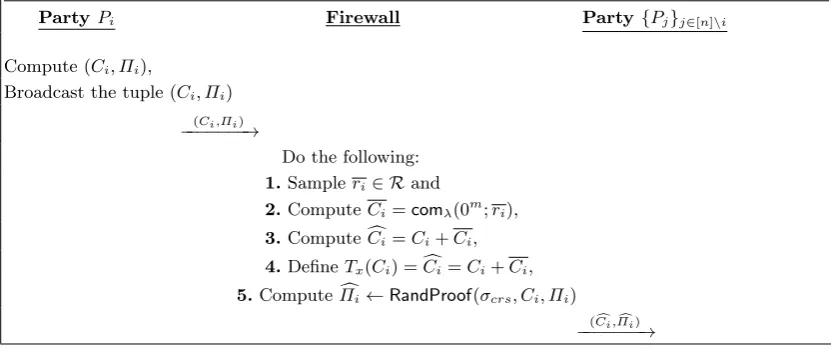
wherexis the input string of the party andris the randomness chosen by the committing party to commit to x. In the input commitment phase, each party P first chooses a random string x and commits tox using randomnessr to generate the commitment C. It also generates a proofπusing a simulation-extractable non-interactive zero-knowledge argument system that it knows a witness (i.,e, the tuple (x, r)) corresponding to the commitmentC. Finally, partyPi places the pair (C, π) on the broadcast channel. Next,
we present a reverse firewallW2 for the above protocol, as shown in Figure7. As before,
we assume thatPi is the initiating party.
The main idea of the working of the reverse firewallW2 is very simple (see Fig.6).
The CRF simply re-randomizes the commitmentCiand the proofΠireceived from party Pi. The way the CRF re-randomizes the commitmentCi is by homomorphically adding
to it a fresh commitment of the all zero string. It re-randomizes the proof Πi by using theRandProof algorithm of SSE-NIZK argument system. The CRF then broadcasts the re-randomized commitment-proof pair.
Theorem 5. Let {Gλ, Kλ,comλ}λ∈N be a perfectly hiding and computationally binding
commitment scheme. Also, let (CRSGen,P,V,ZKEval) be a simulation-extractable non-interactive zero-knowledge argument system for the language L={C|C=comλ(x;y)}. Then the protocol in Figure7securely computes the functionality presented inEq.2. The reverse firewall W2 shown in Figure 7 is functionality-maintaining and detects failure
for partyPi. If the commitment schemecomisperfectly hiding,computationally binding
and homomorphic with respect to the (addition) operation defined over the underlying groups (i.e, the message space, randomness space and the commitment space ofcom); the NIZK argument system is re-randomizable and simulation-sound extractable, then the reverse firewall W2 preserves security for party Pi and is exfiltration-resistant against
Protocol:Multi-party Input-commitment using CRFW2.
Let (G, K,com) be aperfectly hidingand computationally binding commitment scheme (see Def.2), and (CRSGen,P,V,RandProof,ZKEval)) be are-randomizable SSE-NIZK argument system (see Def3 and remark1) for the following language:L={C,(x, y)|C=comλ(x;y)}.
PartyPi Firewall Party{Pj}j∈[n]\i
Compute (Ci, Πi),
Broadcast the tuple (Ci, Πi)
(Ci,Πi)
−−−−−−−→
Do the following: 1.Sampleri∈ Rand
2.ComputeCi=comλ(0m;ri),
3.ComputeCci=Ci+Ci,
4.DefineTx(Ci) =Cci=Ci+Ci,
5.ComputeΠci←RandProof(σcrs, Ci, Πi)
(Cci,Πci)
−−−−−−−→
Fig. 7.Reverse FirewallW2 for the Multi-party Input commitment protocol
Proof. The proof that the underlying protocol is secure follows from the proof of the input commitment functionality, as presented in [10]. The only difference is that we use a SSE-NIZK instead of a strong NIZK proof of knowledge. However, this change is purely an efficiency concern and in no way impacts the security of the protocol. It is also clear that the firewall maintains functionality and fails detectably for party Pi. The re-randomizability property of the commitment schemecom guarantees that cCi is indistinguishable from a fresh commitment. Similarly, the re-randomizability of the SSE-NIZK argument system guarantees that the re-randomized proofΠic is indistinguishable from a fresh and honest proof on the statement Ci by the party Pi. Hence, the firewall
W2 preserves security for Pi and resists exfiltration for Pi against the other parties
{Pj}j∈[n]\i. ut
5.4 Multi-party Authenticated Computation Protocol using Reverse
Firewalls
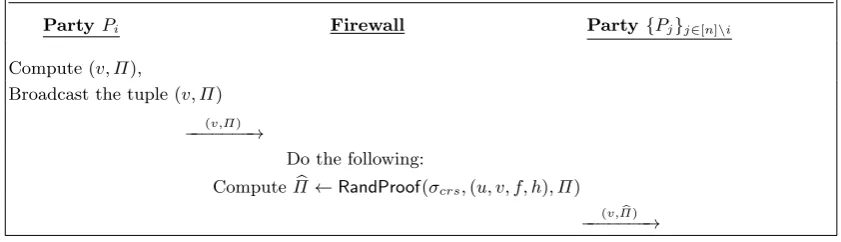
Let f, h :{0,1}∗× {0,1}∗ → {0,1}∗ be polynomial-time computable. The goal of this protocol is to force the initializing partyPi to computef(α, β), whereβ is known to all
the parties, α is known only toPi, andh(α) (where h is one-to-one function) is known to all the parties. Here f captures the desired computation. In particular, the parties execute this protocol for computing the following functionality:
(α, r, β),(h(α, r), β),· · · ,(h(α, r), β)
→ λ, f(α, β),· · ·, f(α, β)
![Fig. 1. LEAKWcol,(Π, i, {P1, · · · , Pn}, Wi, λ) is the exfiltration-resistance security game for a reverse firewall for a party Pi in protocol Π against the set of parties {Pj}j∈[n�i] with input I](https://thumb-us.123doks.com/thumbv2/123dok_us/7991739.1326520/13.595.147.411.297.400/leakwcol-exltration-resistance-security-reverse-rewall-protocol-parties.webp)