Available Online atwww.ijcsmc.com
International Journal of Computer Science and Mobile Computing
A Monthly Journal of Computer Science and Information Technology
ISSN 2320–088X
IJCSMC, Vol. 4, Issue. 8, August 2015, pg.426 – 430
RESEARCH ARTICLE
Supporting Document Notation
Using Content and Querying Value
P.Sumalatha
Department of IT, M.Tech, VNR VJIET, Hyderabad [email protected]
Abstract— Searching in the world wide internet is frustrating in today’s life. And also all assortment of textual information contains great amount of structured information that remains hide in unstructured format. Relevant information is usually tough to search out in these documents. You may notice huge amount of data, or we may not notice the forms of information we are looking for. Looking on-line can give us with a wealth of information, however not all of it’ll be helpful or of the highest quality. In this paper we tend to use an alternate approach for content and question looking supported Facilitating Document Annotation for the structured metadata by distinctive documents in overall system that contains data of internet and this information goes to be helpful for content of querying the information. Here publisher can doubtless to assign data, structured or unstructured associated with documents that they upload which can simply make possible the users in recovering the information.
Keywords— Document Annotation, CADS, information extraction
I. INTRODUCTION
Querying possible in many systems do not have the fundamental “attribute-value” annotation that might be created. Users to need a lot of Annotations in that usage “Quality rates” in their annotation efforts. User have sensible idea for applying the annotations or attributes, the system is permits to add the information to related documents. The users square measure typically reluctant to complete. Certain problems end up in basic comments that are typically restricted to straightforward words. Certain basic comments build survey and a question off the information is complicated.
Users have to access terribly basic comments, like “Formation date” and “Document size”. This project tends to learn and explore the interaction between document annotation exploitation content & querying worth. Annotation of documents area unit comments, notes, explanations, or different forms of external remarks that may be hooked up to an online document or to a particular a part of a document. As they’re external, it’s doable to edit any net document itself. Form a technical purpose of read, comments area unit typically seen as information, as they furnish additional information regarding an existing piece of information. The annotated document is that the adding information within the related documents that is helpful for extracting the information from the database. Annotated documents have become referred to as a singular stream in processing.
search. This methodology is useful for web document annotation process that is based on users need. Question price is additionally low compared to the other approach. The experimental analysis shows an improved performance whereas examination with different ways as a result of applied math provides a principled foundation for such reasoning below uncertainty. Annotation ways that use attribute-value day ds sq. measure sometimes extra bantu-speaking, as they’ll contain extra information than untyped approaches. The recent lines of labour towards utilizing extra queries that leverage basic comments, the “pay-as you-go” querying feasible in information areas: in knowledge areas, users provide information integration hints at period.
II. RELATED WORK
The system uses the collaboration objects of the annotation and use previous comments to create a new goal [1]. Their area unit important amounts of work in estimating the comments for various papers. Compared to associate ancient approach. Our approach is completely different. But by creating the annotations to documents can facilitate in improving quicker potency in looking out.
Information extraction algorithm is said that facilitates the extraction relations between the structure data; chiefly within the conditions of submission for determine the attributes. In this mainly two effort: closed information extraction and open information extraction. Closed information extraction needs a person to outline the method, so the process increases the methods and link high light from the documents. We have a tendency to determine what kinds of attributes are possible to seem inside a document.
The main contribution of this project
We gift associate degree adjusting manner of doing for mechanically manufacturing data for computes input forms, for expansion unstructured of, within the phraseology documented materials, such the use of the place in data for computers is formed the greatest quantity, given the user data needs[2].
We construct to get existence beside a way of right probabilistic strategies and algorithms to seamlessly get mixed with data from the question quantity of labor in to the facts note the process, so as to provide data that aren’t simply idea of the annotated documented material, however conjointly helpful to the users questioning the knowledge-base[2]. We present abundant investigation with existent facts and end users, viewing this system produces the correct intimation that measure significantly greater than the recommendation from that presumably taking place additionally moves close to [2].
III. TABLE(Notation)
A – Attributes used in the union of W and D Aj – Attribute in A
d – Document
dt – Document text for d
da -- Document annotations for d
D -- Repository
K -- Maximum number of suggetions for d Q = q1,q2..qm Query
daopt – complete and optimal annotations for d
W -- Worlkload
Annotated (d,Aj) -- Document d is annotated with Aj
Use(Aj,q) – Query q useas Aj P – System Prior
W – term
Score(Aj) – Ranking Function D – Database
DAj - Database Documents annotated with Aj
A. Framework and Problem Definition
In this project the theme is to suggest the annotations for a document based on user queries. We have a tendency to outline this pair (dt,da) is document d. collected of the matter content “dt” and therefore the
We use daopt to indicate the whole highest set of comments (annotation) for the document. the daopt is a
theoretical standard with good understanding of the document, naturally, da opt
is undisclosed to affecting method that’s difficult to evaluate however exactly as attainable the daopt .
Each annotation of attributes in the integration of the document that has the shape (Aj,Vi), wherever Aj and Vi is
the indication worth(value). The attribute pairs will have different worth and names. We are saying that an attribute Aj annotated to that document but responsible any worth v that (Aj,v)epsilon da. We have a tendency to
apply the comment (annotation) da and DV as the fields of quality name & quality worth, severally, D to indicate the all-annotated reports are saved in the directory.
Attributes Suggestion: This section is affection to study and submit explanation for suggestion the attributes problem. From the matter definition; this establishes to doubtless opposing, identifying the methods and suggesting the note for information.The attribute need to have high querying value (QV) and question work W. that is must suggest the several questions, as a result of the intermittent notes in W have to increase the clarity of documents.
The attributes need to have high content value (CV) with relevance dt. That is relevant to dt. If not, the users
dismiss the suggestions and document won’t be inclined commented.
During a high-respectable manner, using a probabilistic method. This abstract standard model is comparable to the language model [5], Abstract model except that characteristics measure achieved by two techniques, That is; 1) Selecting the number of quality information, succeeding a possibility of distribution given by Associate in nursing chance distribution.
2) By sophisticated the group of questions that users are generally provides to the information.
B. Flow of the System Architecture (implementation)
1. User initial choose the document to transfer it on the server. Before uploading the particular document our system analyze the document and find informative information from it.
2. To get information in annotation kind of key and value pair.
3. To analyze the information we tend to basic use noise removing the process. 4. After this process we tend to use to filter the data.
5. After we tend to calculate the frequency count.
6. Then we have a tendency to apply IE rule to recommend annotations from filtered knowledge.
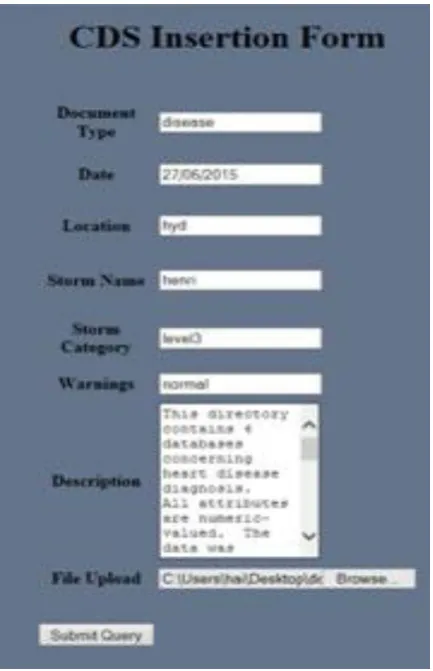
7. After this we generate a CADS insertion form (collaborative adaptive data sharing platform) that has annotations instructed by the system. At the side of the system suggestions users can post his comments to admin for explicit document before uploading. These annotations facilitate the United States to seek out the same document after we search it.
8. While looking, the user’s fireplace some queries, these search queries the square measure registered by our system and feed to QV and CV combing rule to querying value analysis. Later result of QV&CV rule is additionally won’t to counsel annotations.
9. Finally the user has to search any information in the Google, that queries split in to the database, search that queries in database, if that is matches it will be downloaded that related information(document), if that queries not matches it will be rejected(no results).
In this project we tend to propose CADS, that is “Create our own comments” structure that clarify the deployed information (comment)annotation, the main solution improvement of our method is that based on the user’s queries to direct creating the annotations for that related documents, toward qualifying to evaluate the information of content. In other words, we have a tendency to try position in this author creating the comments for user’s notes to generating the attribute values for information that are used by querying users.
Figure 1: System Architecture C. CADS Insertion Form
Figure 2: CADS insertion form
D. Experimental Results
To evaluate the recursive assess that privately contribute to introduce in this project, our own selves tend to match the logic by a spread like current standard:
Data frequency: recommend that foremost repeated attributes within the annotated document in database. QV: recommend attributes supported the querying worth component, that is analogous to ranking attributes supported their quality within the work.
CV: counsel attributes supported the content worth component.
Calais: we tend to use the open Calais ten data extraction method, as the recording machine. It can recognize the persons, locations, dates, as well as different organizations that area unit common in news articles. This operation bringing out the area unit fastened to a selected the method that we design to own attributes.
We tend to comment related information and think about total attributes to compare the associate operation. Privately tend to use the town connectedness results to high the attributes. If constant annotated with multiple values are to the attributes, we tend to use best importance price.
The problems in suggesting the attributes: we tend to study, however various ways to clear suggesting the attribute’s that is one drawback focus of our work. That technique is developed because attributes suggestion.
To obtain a sensible question distribution, we have a tendency to leverage the Google Trends. This performance concerning the notice of time variations in queries issued across the programmers. We can additionally compare two methods. The parallel increment because the question supported a appropriate time and placement. In this initial stage, separate the queries that conferred major improve in using timeframe of the information set, because the required location. Then Google having the comparative amount of questions that Google understanding befittingly the amount of work is done. Another drawback is the way to rework order queries. The users check queries in the search engine.
IV. CONCLUSIONS
Now a day’s data sharing is increases day by day and conjointly retrieving information from sources is an additionally vital issue, for that reason CADS add twin approach, rather than generating question forms and fault information, it produces the method and satisfied information through seeing content of the documents along with content of query work. Principally this project aim is to counsel annotation supported the user interest. The annotation is to satisfy the user expectation. Based on the user queries that will improve the correct results for users with elevation the advantages of distribute information. In this project the future enhancement is noise removing, frequency count of high querying key words (means repeated words) that will be important for the query based search. And also the users have to post and view the comments. Finally conclude that the planned document annotation methodology is economical and helpful in effective info retrieval and searching time is decreases.
REFERENCES [1] “Google,” Google Base, http://www.google.com/base, 2011.
[2] R. T. Clemen and R. L. Winkler, “Unanimity and compromise among probability forecasters,” Manage. Sci., vol. 36, pp. 767–779, July 1990. [Online]. Available: http://portal.acm.org/citation.cfm? id=81610.81609.
[3] C. D. Manning, P. Raghavan, and H. Sch¨utze, Introduction to Information Retrieval, 1st ed. Cambridge University Press,July 2008. [Online]. Available: http://www.amazon.com/exec/obidos/redirect?tag=citeulike07-20\&path=ASIN/0521865719
[4] P. G. Ipeirotis, F. Provost, and J. Wang, “Quality management on amazon mechanical turk,” in Proceedings of the ACM SIGKDD Workshop on Human Computation, ser. HCOMP ’10. New York, NY, USA: ACM, 2010, pp. 64–67. [Online].Available:
http://doi.acm.org/10.1145/1837885.1837906.
[5] G. Tsoumakas and I. Vlahavas, “Random k-labelsets: An ensemble method for multilabel classification,” in Proceedings of the 18th
European conference on Machine Learning, ser. ECML ’07. Berlin, Heidelberg: Springer-Verlag, 2007, pp. 406–417. [Online]. Available: http://dx.doi.org/10.1007/978-3-540-74958-5 38.
[6] M. Miah, G. Das, V. Hristidis, and H. Mannila, “Standing out in a crowd: Selecting attributes for maximum visibility,” ICDE, 2008. [7] P. Heymann, D. Ramage, and H. Garcia-Molina, “Social tag prediction,” in Proceedings of the 31st annual international ACMSIGIR
conference on Research and development in informationretrieval, ser. SIGIR ’08. New York, NY, USA: ACM, 2008, pp. 531–538. [Online]. Available: http://doi.acm.org/10.1145/1390334.1390425.
[8] S. R. Jeffery, M. J. Franklin, and A. Y. Halevy, “Pay-as-you-go user feedback for dataspace systems,” in ACM SIGMOD, 2008.FLEXChip Signal Processor (MC68175/D), Motorola, 1996.
[9] K. Saleem, S. Luis, Y. Deng, S.-C. Chen, V. Hristidis, and T. Li,“Towards a business continuity information network for rapid disaster recovery,” in International Conference on Digital GovernmentResearch, ser. dg.o ’08, 2008.
[10] M. J. Cafarella, J. Madhavan, and A. Halevy, “Web-scale extraction of structured data,” SIGMOD Rec., vol. 37, pp. 55–61, March 2009.[Online]. Available: http://doi.acm.org/10.1145/1519103.1519112.
[11] Eduardo J. Ruiz, Vagelis Hristidis and , Panagiotis G.Ipeirotis“Facilitating Document Annotation using Content and Querying Value”- IEEE TRANSACTIONS ON KNOWLEDGE AND DATA ENGINEERING, 2013.