Available Online atwww.ijcsmc.com
International Journal of Computer Science and Mobile Computing
A Monthly Journal of Computer Science and Information Technology
ISSN 2320–088X
IMPACT FACTOR: 6.017
IJCSMC, Vol. 6, Issue. 4, April 2017, pg.289 – 294
Live Migration using VM/TPM Protocol of
Virtual Machine on Private Cloud
Vaishakhi Maheshwari
1, Prof. Mohit Patel
2 1Department of Computer Engineering, Swaminarayan College of Engineering and Technology, Kalol, GTU, India
2
Department of Computer Engineering, Swaminarayan College of Engineering and Technology, Kalol, GTU, India
1
[email protected], 2 [email protected]
Abstract— Cloud computing means storing and accessing data and programs over the Internet instead of your computer's hard drive. The cloud is just a metaphor for the Internet. The on premises private cloud demands the security on data expansion. The concept of virtualization plays a vital role in providing secure cloud computing. The virtual machines which are emulation of a computer system over the cloud are combination of hardware and software. For achieving energy efficiency, load balancing and high availability of physical server in Cloud Data Center, the virtual machines should be migrated from one physical server to another. The migration process is not reliable until it provides security to the transferring data over the cloud. For this purpose VM-vTPM protocols can be used. vTPM should be migrated to the desired platform together with its corresponding virtual machine. Only vTPM are not secure enough so VM-vTPM comes forward to solve these issues. In this paper, we focus on the secure implementation of virtual machine migration from one platform to another platform in private cloud model. We propose a thorough and secure VM-vTPM migration scheme. In this scheme we first propose a vTPM key structure to make non-movable vTPM keys to be sent. Then we depend on this structure to construct a secure VM-vTPM migration protocol which includes three phases. The first phase is a dual authentication between source platform and destination platform, the second phase is the migration of vTPM, and the third phase is the migration of VM. Finally, we analyze the security of our protocol to make sure our proposed protocol can realize all the security goals such as confidentiality and integrity, authentication of source and destination platform, preserving the association between VM and vTPM, and atomicity of the transfer.
Keywords- ‘Cloud computing’, ‘Virtualization’, ‘Virtual machine’, ‘Live Migration’,’ 'vTPM Migration’.
I. INTRODUCTION
II. Virtualization
Virtualization is the abstraction and emulation of hardware resources to have better resource sharing. The server Virtualization is the ability to run multiple virtual machine, including their operating system called Guest operating system or existing real operating system called Host operating system.[2]
Many physical servers that connected by a physical switch, IT department get collected information about the traffic that transmit between servers from physical switch. That means it does not provided a virtual switch result lack of visibility into the traffic flows between among the VMs on the same physical level that impact security performances.
(A) Live Migration
Live VM migration is best characteristics of virtualization defined as process of dynamically transferring running VMs from one physical server to another with little or zero downtime and without interrupting services running in VM.[2] Live migration is the movement of virtual machine from one physical host to another while continues power up.
Live Migration process can be described below:[1]
Push phase: The source VM continues running while certain pages are pushed across the network to destination
Stop and copy phase: The source VM is stopped, pages are copied across to the destination VM, then the new VM is started downtime of a VM during a Live migration could be a few millisecond to seconds according to the size of memory and application running on the VM.
Pull phase: The new VM executes and, if it accesses a page that has not yet been copied, this page is pulled.
(B) Security Analysis
Different types of security described below:
Integrity Verification
Client’s platform integrity and to needs to be analyzed by remote host and to secure client’s platform integrity measurement from any illegitimate parties and this done by encrypting the measurement with session key (k). The integrity measurement value, attacker would need to capture (k) it is impossible as (k) has never been exchanged between clients and server. Therefore uses TPM as tamper proof hardware that protect all the measurements from manipulate of client’s side.
Impersonation Attack
As Implementations of SRP Protocols requires zero knowledge proof without session key (k) attacker would not able to compute evidence Mc or Ms, moreover session key is never passed over the network and this will make Impersonation attack almost Impossible.
Stolen Verifier Attack
The Strength of the proposed is that even though attacker manages to steal the verifies (v), the attacker would not able to continue with authentication process without client’s password as it requires expensive dictionary search to reveal it.
Insider Attack
The Strength of our proposed protocol is that it does not store any client’s password or server secret key in the server side. Therefore our scheme can prevent the insider from stealing sensitive authentication information.
Identity Protection
The proposed preserves user identity privacy by replacing user identity with pseudonym identity (u).which is a hashed value of user identity and selected platform PCR values. Pseudonym identity is important because in the event of server’s database has been compromised: user identity privacy is still protected due to the fact that attacker cannot manipulate the pseudonym identity or link it back to actual user.
III. LITERATURE SURVEY
Virtual trusted platform module (vTPM) provides trusted computing for multiple virtual machine (VM) running on single platform. Trust platform module provides hardware and software support for secure storage and software integrity protection .virtualized computing systems enables the hardware based protection of private information and the detection of malicious software that aims the break the operation of virtualization environment.
Requirements for secure VM-vTPM Migration Protocols[6] :-
The result for research with security as follows
:
A)Authentication of transfer platforms:An attacker must not be able to launch MITM (man in the middle) attacks or bait and switch attacks. The attacker must not be able to migrate a vTPM from a secure platform to his insecure platform or vice-versa.
B)Confidentiality and integrity of data transfer:An untrusted entity should not be able to learn any meaning full information about the VM-vTPM during the migration process and should not be able to modify the vTPM without the modification being detected.
C) Replay resistance:
An attacker should not able to reply an old communication sequence successfully without the reply being
detected.D) Source non-repudiation: It must not be possible for the source to deny the migration.
E) Atomicity of the transfer: Ensure deletion at the source in case of successful transfer and deletion at the destination in case of failure are required to ensure atomicity of the migration. It is critical for failure recovery and to prevent duplicate copy generation
.
Designs for vTPM Migration Protocol
Protocol outline:
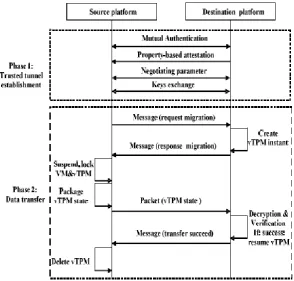
In this section, we describe the vTPM-VM live migration process authenticity, of the communication, credibility of partners and confidentiality of transfer data, at is important to establish an authenticated channel between the source and destination
.
Fig. A vTPM migration protocol outline
Our vTPM migration protocol is based on the vTPM architecture. The migration process is divided into two phases: establish of trusted channel and secure data transfer.fig shows the outline of vTPM-VM live migration process. The description of the two phases is summarized as follows:
Phase 2 Secure data transfer. The source forward request to migration message to destination. Next the destination creates an empty vTPM instance for the purpose of migrating state and responses request. The source then locks the VM and vTPM and transfer the state data of vTPM securely .Then after destination check the integrity of the received vTPM state packages. if no violation are detected, on the target the vTPM decrypts the state packages and activation and sends an acknowledgement to the source on success. Finally, the source deletes the migrated vTPM to prevent duplication.
IV. PROPOSED ALGORITHM AND IMPLEMENTATION STRATEGY
We are proposing verification based on integrity .here a new encryption scheme will be provided that enhances the security by prevention malicious virtual machine from damaging the live migration process. we assume that source and destination is on the same cloud and want to follow the secure channel provided by the platform far as attack. When VM talks to each other, it has possibility of attack in between and through message. Communication attacks between host/os and guest VM.
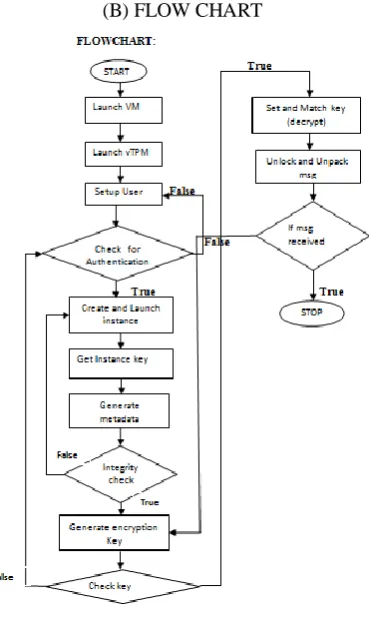
(A) PROPOSED ALGORITHM
Step 1: Start
Step 2: Launch VM
Step 3: Launch vTPM
Step 4: Setup USER
Step 5: Create & Launch instance
Step 6: Get Instance Key
Step 7: Generate metadata
Step 8: Integrity check (Hashing Technique)
Step 9: if checked set encryption
Step 10: Generate Encrypt Key
Step 11: Check Key
Step 11: Set and Match Key (decrypt)
Step 12: Unlock and Unpack message
Step 13: Message Received
(B) FLOW CHART
V. EXPECTED RESULTS D(SH, C) – m.
Decrypt cipher text message m.
Cipher text and public key alone revel nothing about message
Comparison of latency of migration over cloud.
10 20 30
T A T A T A
0.7 0.5 0.8 0.7 1.5 1
TABLE 1.Comparision Table
0 0.5 1 1.5 2 2.5 3
10 20 30
transfer
attestation
No. of properties
Fig. C graph
Here, latency means period of delay when one component of network is waiting for an action to be executed by another component.
Here, it’s the time required online or in a network for one way or round trip transfer of data between two nodes.
VI. CONCLUSION AND FUTURE WORK
Live VM migration is useful feature but it is not reliable until it provides security to the transferring data over the cloud. In this paper, we focus on the secure implementation of virtual machine migration from one platform to another platform in private cloud model. We propose a thorough and secure VM-vTPM migration scheme. In this scheme we first propose a vTPM key structure to make non-movable vTPM keys to be sent. My feature work is to implement the proposed vTPM migration process on simulator and check its efficiency and security. My feature work is to implement the proposed vTPM migration process on simulator and check its efficiency and security.
R
EFERENCES
[1] Xinlong Liang ,Rui Jiang, Huafeng Kong “ Secure and Reliable VM-vTPM Migration in Private Cloud.” IEEE2013.
[2] Ashima Agarwal, Shanguff Raina. “Live Migration of Virtual Machines In Cloud”, International Journal of Scientific and Research Publication, Volume2 Issue6, June 2012.
[3] Rajeshaheb R.Kadam1,Manoj Bangare2 “A Survey on Security Issues and Solutions in Live Virtual Machine Migration”, International Journal of Advance Foundation and Research in computer(JIAFRC) Volume1, Issues 12,December 2014,ISSn 2348-4853.
[4] Nelson Mimura Gonzalez, Marco Antonio Torrez Rojas, Marcos Vinicius Maciel da Silva,” A Framework for authentication and authorization credentials in cloud computing” IEEE 2013
[5] Arijit Ukil, Debasis Jana and Ajanta De Sarkar. “ A Security Framework in Cloud Computing Infrastructure”, Journal of Network Security &its Application (IJNSA) ,vol.5,NO.5,september2013.
[6] Xin Wan,XinFang Zhang,Liang Chen,JianXinZhu “An Improved vTPM Migration Protocol Based Trusted Channel”, 2012 International Conference on System and Informatics(ICSAI 212).
[7] Boris Danev, Ramya Jayaram Masti, Ghassan o,Karame and Srdjan Capkun ,”Enabling Secure VM-vTPM Migration in Private Cloud.”ACSAC December 2011
[8] Yuvapriya Ponnusamy,S Sasikumar” Application of Green Cloud Computing for Efficient Resource Energy Management in Data Centres” (IJCSIT) International Journal of Computer Science and Information Technologies, Vol. 3 (5) , 5101 - 5107, 2012 [9] Q. Zhang, L. Cheng, and R. Boutaba. “Cloud Computing: State-of-the-Art and Research Challenges,” J. Internet Services and Apps. Springer, 2010
[10] C. Metz, “AAA protocols: authentication, authorization, and accounting for the Internet,” Internet Computing, IEEE, vol. 3,no. 6, pp. 75 –79, Nov/Dec 1999.