Article
1
A Conceptual Model for Safety-Based Theory of Lean
2
Construction
3
Soheila Moaveni 1, Seyed Y. Banihashemi 2 and Mohammad Mojtahedi 3, *
4
1 MSc. Student, Civil Engineering Dept., Ferdowsi Univ. of Mashhad, Mashhad, Iran,
5
6
2 Assistant Professor, Civil Engineering Dept., Ferdowsi Univ. of Mashhad, Mashhad, Iran, +98 513 880 5437,
7
8
3 Senior Lecturer, Faculty of Built Environment, University of New South Wales (UNSW), Sydney, Australia,
9
+61 (2) 9385 5970, [email protected]
10
* Correspondence: [email protected]; Tel.: +61-450283994
11
12
Abstract: The construction industry is one of the most fatal industries, so it is important to pay more
13
attention to safety solutions. Even though work-related accidents are known as major waste in
14
construction projects, little attention has been paid so far to incorporating safety into the lean
15
construction framework. In this research, lean construction theory is reviewed through the lens of
16
safety. That being so, the identified challenges in previous research on improving safety in
17
construction projects are categorized and those related to the concept of lean project delivery are
18
introduced. Then, the principles of the lean construction framework are explained and the relevant
19
changes for incorporating safety into the framework are introduced and discussed. It is expected
20
that this hybrid model would further enrich the lean construction framework. The careful attention
21
of project executives to this model may improve the safety situation in construction projects.
22
23
Keywords: Prevention through Design; Safety Climate; Lean Construction;
Transformation-Flow-24
Value; Lean Project Delivery System.
25
26
1. Introduction
27
Despite extensive research on safety in the construction industry, the incidents are still one of
28
the main problems of the industry and the mortality rate is about 5 times the average of other
29
industries [1], causing about 8 to 15 percent increase in project cost in countries such as the United
30
States [2]. With regard to these consequences, some researchers have focused on proactive and
31
preventive approaches such as safety climate or Prevention through Design (PtD) that can prevent
32
the occurrence of about 40% of accidents [3]. On the other hand, in recent years, some studies have
33
studied the effects of lean construction techniques on safety performance of projects [4-6]; however,
34
there is lack of a comprehensive approach that explains the relationship between the lean
35
construction framework and safety improvements. Accordingly, this study attempts to introduce a
36
conceptual model by reviewing the theory of Transformation-Flow-Value (TFV) with a safety
37
approach for demonstrating the relationship between this theory and improving safety in the
38
construction process.
39
At first, the literature on safety issues, and more specifically the PtD approach, safety climate
40
and Cost of Safety (CoS) are investigated and barriers to PtD implementation and factors affecting
41
the positive safety climate are extracted. Then, the theory of TFV in lean construction is studied and
42
the Lean Project Delivery System (LPDS) and its benefits are reviewed. Finally, the relationship
43
between LPDS with PtD and the safety climate, and the TFV approach based on safety, will be
44
presented in the form of a conceptual model.
45
2. Safety in construction projects
46
Over the past decade, the focus for safety improvement has been changed from using passive to
47
active measures such as safety climate. This shift has happened by understanding that organizational,
48
managerial, and human factors are the main culprits of the construction industry's incidents rather
49
than purely technical factors [7]. Numerous studies have been done on the effects of safety culture
50
and safety climate on safety outcomes. Wiegmann et al. [8] described the climate of safety as a
51
psychological phenomenon, which includes the general understanding of team members of the safety
52
situation at a specific time in the workplace. Mohamed [9] identified ten potential factors that could
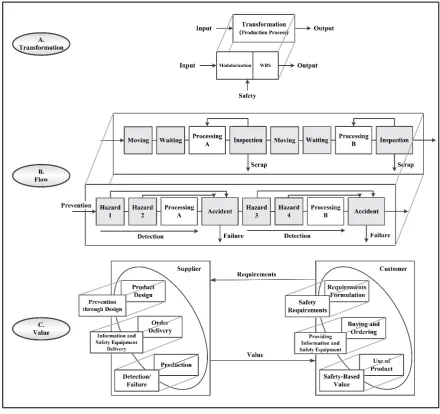
53
affect the safety climate of Australian construction projects; including: (1) management commitment;
54
(2) communication; (3) employee participation; (4) supportive environment; (5) personal awareness
55
of risks; (6) work pressures; (7) supervisory atmosphere; (8) risk assessment; (9) competency of
56
employees; and (10) safety rules and regulations. A positive and constructive safety climate is created
57
when appropriate interactions between project partners and project team members are created to
58
support safety at the front-end of the project.
59
On the other hand, according to Howell et al. [4], there are two basic ways to prevent injuries:
60
(1) prevention through design, and (2) prevention through task planning. In other words, improving
61
product design and construction planning can play a decisive role in preventing incidents in the
62
project. While a large percentage of safety research has focused on the construction phase of the
63
projects, much less attention has been paid to the early phases, including the planning and design
64
phases [e.g. 10, 11]. Research findings in this area indicate that safety planning and careful attention
65
at the pre-construction stages has significant impacts on safety in terms of reducing the incidents
66
throughout the life cycle of the project [3, 12, 13]. For example, Abdelhamid and Everett [14] proposed
67
a model for identifying the root causes of accidents which could provide a template for systematic
68
and rapid determination of areas requiring more investigations, so that labour and management may
69
put more effective measures in place for preventing probable accidents. Safety in Design (SiD) or
70
Prevention through Design (PtD) can be defined as “the integration of hazard analysis and risk
71
assessment methods early in the design and engineering stages, and taking the necessary actions to
72
keep risks of injury or damage at an acceptable level” [15]. Gambatese & Hinze [16] indicated that
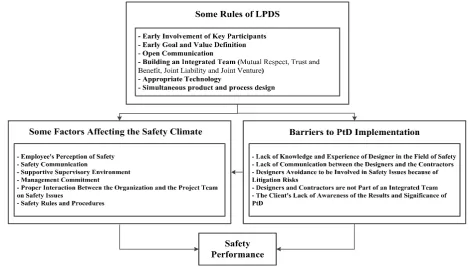
73
the use of knowledge of construction workers and designers in the early stages of a project can be a
74
positive step towards improving safety performance. Another problem is the designers' reluctance to
75
engage in safety due to the avoidance of litigation and claims [12]. Having this said, the clients can
76
play an active role in safety improvements by choosing an appropriate contract method, since the
77
emphasis on safety during contracting phase with a contractor or designer has a significant impact
78
on their safety performance [12, 17]. Some studies have also shown that contract type has an impact
79
on safety performance. For example, Huang [17] showed that Design-Build contracts have better
80
safety practices, since in these types of contracts the contractor and the designer play on the same
81
ground and the design team has more motivations to devise safe plans in the design phase.
82
The effective and optimal use of preventive approaches to achieve the best results can be
83
estimated through the concept of CoS. Most of clients believe that spending money on safety does
84
not create value for their business unless it is required by governmental regulations and standards
85
[18]. This view has made problems for safety managers to provide financial justification for the
86
investments. The most common and effective cost model that has been developed to describe the
87
cost-benefit concept of accident prevention is the CoS model [19]. Behm et al. [20] used Cost of Quality
88
(CoQ) classification for categorizing the safety cost into four categories of prevention and inspection
89
costs, and internal and external failure costs. They studied the CoS model in several case studies and
90
the results showed that the accident prevention strategy provides an optimum safety cost plan. As
91
shown in Figure 1, the cost of safety is equal to the total cost of prevention and inspection, and direct
92
and indirect costs of damage and the optimal point occurred at the intersection of two charts,
93
although the location of this point can vary in different projects [21].
95
Figure 1. Cost of Safety Model [19, 20]
96
3. Lean construction
97
In general, the purpose of a lean approach is to create the highest value for the customer and
98
reduce or eliminate the waste. Koskela [22] introduced a new theory of production in construction
99
context called TFV, which resulted in the integration of three theories of transformation, flow and
100
value creation. In this theory, transformation means the conversion of input into output in
101
production, and the management method is based on using hierarchical transformation of smaller
102
components (Figure 2-A). However, this method has limitations in recognizing the original source of
103
value in conversion process which is the extent to which the conversion is adapted to the customer's
104
needs and demand. Also, there is weakness in how to avoid loss and ensure customer satisfaction.
105
The flow view considers production as a stream of materials and a combination of
106
transformation, inspection, moving, and waiting (Figure 2-B). In this view, in order to achieve the
107
main goal of eliminating waste, some methods are used to reduce the production process time (lead
108
time), reduce variability, and increase simplification [22, 23].
109
Finally, in the value creation view, the creation of the highest possible value is measured by
110
taking into account the customer’s expectations (Figure 2-C).
111
112
Figure 2. Transformation, Flow and Value creation [22, 24]
113
In this perspective, the endeavour is to identify the customer's needs by adopting appropriate
114
methods and tools and to create the expected value for the customer by defining the appropriate
processes for designing, ordering and producing. The theory that integrates and combines the three
116
above-mentioned views is the TFV theory and any system in the field that pursues the TFV's goals is
117
approaching the lean system [22]. On the other hand, it is difficult to maximize value and reduce
118
waste at project level when the contractual structure impedes the coordination and creativity of
119
project team members. Therefore, choosing the right method of procurement can help overcome
120
many of the construction problems. In this regard, Integrated Project Delivery (IPD) and Lean Project
121
Delivery System (LPDS) have been defined as lean approaches to designing a delivery system. LPDS
122
which was presented by Ballard [25] aims to form an expert team in the early stages of the project,
123
driven by principles such as collaboration, trust, communication, transparency, and the use of the
124
best available technology for achieving optimal project success [26].
125
4. lean construction and safety performance
126
As explained, the adoption of preventive approaches to design and planning processes can play
127
a decisive role in improving safety in the construction and operation phases of the project. The
128
question now is how the barriers to implementing preventive approaches, including negative safety
129
climate, the knowledge gap between designers and contractors, the lack of interactions between
130
project participants in the early phases, and the litigation risks among key stakeholders can be
131
resolved.
132
Previous research showed that lean techniques and practices have the potential to improve
133
safety performance of projects and reduce accidents as noticeable sources of waste [10, 27]. For
134
example, Nahmens & Ikuma [5] showed that continuous improvement which is embedded in lean
135
approach can significantly reduce the rate of accidents in construction projects. Lean perspective can
136
also help manage safety, which is dependent on the management of uncertainty, as it contributes to
137
preventative planning and reducing work flow variability [27]. On the other hand, LPDS can prompt
138
all key stakeholders to participate actively in the risks and benefits of the project and consider
139
themselves part of a team and become sensitive to the performance of other members [28]. As a result,
140
LPDS, not only has the potential to promote the positive safety climate in the project, but also can
141
improve the PtD performance with providing the opportunity for two-way communications between
142
designers and contractors and transferring knowledge and experience between them (Figure 3).
143
144
Figure 3. Improving safety performance through LPDS
In addition, given the fact that one of the principles of LPDS is the simultaneous design of the
146
product and the process, adopting preventive approaches at the early stages of the project would be
147
more probable and safety risks can be identified and mitigated more effectively [23]. As mentioned
148
earlier, despite the studies on the effect of lean approach on improving safety performance, the effect
149
of incorporating safety in the principles of lean theory has not been studied. So, we will try to examine
150
the possible changes in any of the transformation, flow, and value approaches by examining the
151
theory of TFV from the perspective of safety and in the context of LPDS.
152
4.1. safety-based transformation
153
It is expected that by improving the quality of the production system, safety be significantly
154
improved [29]. By introducing the T-view on LPDS, it is possible to increase the clarity of conversions
155
in different phases of the project at the front-end of the project. For this purpose, it would be possible
156
to take advantage of the existing methods available in this field, such as Building Information
157
Modelling (BIM). The striking point here is how the transformation can be implemented at the safest
158
possible way. One of the possible solutions can be modularization and pre-fabrication, which can
159
reduce a significant portion of the site's risks and incidents. On the other hand, by defining the work
160
breakdown structure and determining different work packages during the life cycle of the project
-161
including the stages of construction, operation and recycling- we can estimate the probable risks of
162
accidents in each work package and provide an optimal safety strategy in accordance with each
163
package (Figure 4-A). For example, Aslesen et al. [30] developed a model for integrating safety
164
analyses with systematic planning of production progress. In this model, certain principles were
165
attached to each of the planning levels in the system of collaborative planning with respect to factors
166
such as an extra consideration towards WBS to avoid hidden hazards.
167
4.2. safety-based flow
168
In the flow view, it is desired to improve the flow process and developing a reliable workflow
169
which is dependent on waste (Muda), variability (Mura), and overburden to workers and machines
170
(Muri), and on the other hand, reliable workflow cannot be achieved without safe work practices [6].
171
For example, Abdelhamid and Everett [31] asserted that the successful implementation of lean
172
approach and developing a reliable workflow is dependent on the decrease in variability (Mura).
173
Accordingly, they studied the workers’ physical performance degradation as one of the most
174
important causes of variability.
175
Ohno [32] identified 7 waste items including: (1) rework, (2) overproduction, (3) inventory, (4)
176
overprocessing, (5) motion, (6) transportation, and (7) waiting, and the loss of employee’s potential
177
was later added to list by Womack & Jones [33]. According to Waehrer et al. [2], cost of injury was
178
about 15% of the total cost incurred in private industry in the US. Therefore, it is worthwhile to
179
consider accidents as one of the serious sources of waste in the construction industry.In this regard,
180
it is proposed to add accidents as the 9th source of waste. We contend that the evaluation of the eight
181
possible cases of waste cannot be accurate without considering safety and any attempt to reduce them
182
may result in damage to the safety performance of the project. That is, some of them may not be
183
considered as waste if we look at them through the lens of safety. For example, the route which is
184
designed for the movement of machinery at the site can be different in length if it is viewed through
185
the lens of safety or not. In this regard, safe planning may result in a longer route to mitigate the risk
186
of crash with other vehicles or site workers, however, without considering this risk of accident, the
187
shortest route may be preferred and any extra movements may consider as waste.
189
Figure 4. Safety-based theory of lean construction
190
Another point that can be taken into account in this view is CoS. As stated earlier, CoS considers
191
four sources of cost including cost of prevention and inspection, and internal and external failure
192
costs [20]. One of the points which is addressed in Figure 4-B is the possibility of preventing some of
193
the incidents that are predictable through preventative measures at the start of the process. When the
194
necessary measures to prevent accidents are not sufficient, it is more likely to have accidents. Safety
195
risks can be identified and eliminated through inspection and detection measures. However, if the
196
risks are not mitigated, they may eventually lead to an accident, in which case the project will bear
197
the direct and indirect costs of the incident or failure. The point here is to estimate the optimal point
198
in conformance and non-conformance costs of safety.
199
4.3. safety-based value creation
200
As discussed in the previous sections, if we can change the client's point of view on safety, we
201
can expect to improve safety performance. To this end, the concept of V can be used, because its main
202
purpose is to create value for the customer. The remarkable point here is the possibility for identifying
203
and extracting this value. In this regard, it is necessary to pay attention to a few points. Firstly, the
204
value should be defined in the long run, because in some cases, the short-term view for safety
205
performance improvement will be considered a costly activity. However, studies have shown that
206
with a long-term approach, incident costs are far higher than prevention costs. Therefore, finding the
optimal point in this regard is necessary. Secondly, in addition to paying attention to creating value
208
for the customer, the value required for stakeholders should also be considered. Finally, it should be
209
noted that the definition of value is long-term and can be integrated among all stakeholders when it
210
is possible to have all the stakeholders as an integrated team. To achieve this, LPDS approach can be
211
used. In order to examine the concept of V from the point of view of safety, the concept of CoS can
212
also be used. The CoS is equal to the total cost of prevention and inspection, and direct and indirect
213
costs of incidents. Each organization must determine its risk appetite and risk tolerance according to
214
its strategies and then find the optimum CoS in the organization [20]. For example, in some projects,
215
the achievement of zero-accident may even be desirable [21]. Therefore, in this context, it is important
216
to achieve customer requirements and create the highest value for the customer (Figure 4-C).
217
5. Conclusions
218
In this study, we reviewed the literature related to the challenges of implementation of safety in
219
construction projects and the principles related to lean construction, and then examined the
220
interaction effects of applying these two approaches to each other. In this regard, the effects of using
221
LPDS on PtD implementation and safety improvement of the project was studied. In addition, the
222
TFV theory was reviewed through the lens of safety. Studies have shown that key stakeholders can
223
be entered into the project through LPDS and as a result, they can create an integrated team with
224
effective communications in which all the key stakeholders are engaged in the risk-taking and
225
benefits of the project and feel themselves responsible for each other's performance. As a result, some
226
of the obstacles to implementing PtD, such as the knowledge gap between designers and contractors
227
on the design and construction of safe sites and workplaces and lack of motivation in designers for
228
getting involved in safety management process can be solved. In addition, the use of LPDS enables
229
the project participants to facilitate the creation of a positive safety climate in the project by creating
230
a collaborative environment between stakeholders and creating a long-term vision based on the life
231
cycle analysis of the project, including all stages of design, construction, operation and recycling.
232
Given the rapid growth of industries and the growing importance of resources, today, increasing
233
productivity of projects is more than ever necessary. With regard to the ability to influence the lean
234
principles and techniques in improving project performance, it is expected that using the approach
235
presented in this paper to combine the underlying principles of lean construction with safety
236
principles can be a positive step towards improving safety and, consequently, improve the
237
productivity of construction projects. It is also expected that the proposed model provides new
238
insights in the field of lean construction and safety. Future research may investigate the details of this
239
model and its practical implementation through empirical study.
240
241
Author Contributions: “Soheila Moaveni reviewed the relevant literature and developed the conceptual
242
framework; Seyed Y. Banihashemi adjusted the conceptual framework and Mohammad Mojtahedi contributed
243
to the discussion.”
244
Funding: This research received no external funding
245
Conflicts of Interest: The authors declare no conflict of interest.
References
248
1. Murie, F., Building Safety—An International Perspective. International Journal of Occupational and
249
Environmental Health2007. 13(1): p. 5-11.
250
2. Waehrer, G.M., et al., Costs of Occupational Injuries in Construction in the United States.Accident; Analysis and
251
Prevention2007. 39(6): p. 1258–1266.
252
3. Behm, M., Linking Construction Fatalities to the Design for Construction Safety Concept.Safety science2005.
253
43(8): p. 589-611.
254
4. Howell, G., G. Ballard, and S. Demirkesen, Why Lean Projects Are Safer, in 25th Annual Conference of the
255
International Group for Lean Construction. 2017: Herak-lion, Greece.
256
5. Nahmens, I. and L.H. Ikuma, An Empirical Examination of the Relationship between Lean Construction and
257
Safety in the Industrialized Housing Industry.Lean Construction Journal2009(2009): p. 1-12.
258
6. Schafer, D., et al., Resilience Engineering: A New Paradigm For Safety In Lean Construction Systems, in 16th
259
Annual Conference of the International Group for Lean Construction. 2008: Manchester, United Kingdom.
260
7. Langford, D., S. Rowlinson, and E. Sawacha, Safety Behaviour and Safety Management: Its Influence on the
261
Attitudes of Workers in the UK Construction Industry.Engineering, Construction and Architectural Management
262
2000. 7(2): p. 133-140.
263
8. Wiegmann, D.A., et al., Safety Culture: An Integrative Review.The International Journal of Aviation Psychology
264
2004. 14(2): p. 117-134.
265
9. Mohamed, S., Safety Climate in Construction Site Environments. Journal of Construction Engineering and
266
Management2002. 128(5): p. 375-384.
267
10. Martínez-Aires, M.D., M. López-Alonso, and M. Martínez-Rojas, Building Information Modeling and Safety
268
Management: A Systematic Review.Safety Science2018. 101(2018): p. 11-18.
269
11. Zhou, Z., Y.M. Goh, and Q. Li, Overview and Analysis of Safety Management Studies in the Construction
270
Industry.Safety Science2015. 72(2015): p. 337-350.
271
12. Hinze, J., Construction Safety. 2006: Prentice Hall.
272
13. Malekitabar, H., et al., Construction Safety Risk Drivers: A BIM Approach.Safety science2016. 82(2016): p.
273
445-455.
274
14. Abdelhamid, T.S. and J.G. Everett, Identifying Root Causes of Construction Accidents.Journal of Construction
275
Engineering and Management, ASCE2000. 126(1): p. 52-60.
276
15. Manuele, F.A., Prevention through Design (PtD): History and Future.Journal of Safety Research2008. 39(2): p.
277
127-130.
278
16. Gambatese, J. and J. Hinze, Addressing Construction Worker Safety in the Design Phase: Designing for
279
Construction Worker Safety.Automation in Construction1999. 8(6): p. 643-649.
280
17. Huang, X., The Owner's Role in Construction Safety. 2003, University of Florida.
281
18. Soyka, P.A. and S.J. Feldman, Capturing the Business Value of EH&S Excellence.Corporate Environmental
282
Strategy1998. 5(2): p. 6152-68.
283
19. Chalos, P., Managing Cost in Today's Manufacturing Environment. 1992: Prentice Hall.
284
20. Behm, M., A. Veltri, and I.K. Kleinsorge, The Cost of Safety: Cost Analysis Model Helps Build Business Case
285
for Safety.Professional Safety2004. 49(4): p. 22.
286
21. Panopoulos, G.D. and R.T. Booth, An Analysis of the Business Case for Safety: The Costs of Safety-Related
287
Failures and the Costs of their Prevention.Policy and Practice in Health and Safety2007. 5(1): p. 61-73.
288
22. Koskela, L., An Exploration Towards a Production Theory and Its Application to Construction. 2000, VTT
289
Technical Research Centre of Finland.
23. Koskela, L., et al., The Foundations of Lean Construction, in Design and Construction: Building in Value. 2002,
291
Butterworth Heinemann. p. 211-226.
292
24. Grubbström, R.W., Modelling Production Opportunities—An Historical Overview. International Journal of
293
Production Economics1995. 41(1-3): p. 1-14.
294
25. Ballard, G., Lean Project Delivery System.White Paper No. 8, Lean Construction Institute, California.2000.
295
26. American-Institute-of-Architects, Integrated Project Delivery: A Guide. 2007, Electronic, American Institute of
296
Architects Washington, DC. p. 62.
297
27. Antillon, E.I., et al., A Research Synthesis on the Interface Between Lean Construction and Safety Management,
298
in 19th Annual Conference of the International Group for Lean Construction. 2011: Lima, Peru.
299
28. Matthews, O. and G.A. Howell, Integrated Project Delivery an Example of Relational Contracting. Lean
300
Construction Journal2005. 2(1): p. 46-61.
301
29. Mitropoulos, P., Production control and safety management as project safety determinants, in 20th Annual
302
Conference of the International Group for Lean Construction. 2012: San Diego, California, USA.
303
30. Aslesen, S., et al., Integrating Safety Analyses in Production Planning and Control – A Proposal, in 21st Annual
304
Conference of the International Group for Lean Construction. 2013: Fortaleza, Brazil.
305
31. Abdelhamid, T.S. and J.G. Everett, Physical Demands of Construction Work: A Source of Workflow Unreliability,
306
in 10th Annual Conference of the International Group for Lean Construction. 2002: Gramado, Brazil.
307
32. Ohno, T., Toyota Production System: Beyond Large-Scale Production. 1988: crc Press.
308
33. Womack, J.P. and D.T. Jones, Lean Thinking—Banish Waste and Create Wealth in Your Corporation. 1996:
309
Simon and Schuster.
![Figure 1. Cost of Safety Model [19, 20]](https://thumb-us.123doks.com/thumbv2/123dok_us/7977496.1322894/3.595.69.519.443.723/figure-cost-safety-model.webp)