University of South Carolina
Scholar Commons
Theses and Dissertations
1-1-2013
Assessing the Effectiveness of Gordon Allport's
Contact Hypothesis Ability to Increase Cultural
Openness in First Year College Students
David Alan Kahn
University of South Carolina
Follow this and additional works at:https://scholarcommons.sc.edu/etd Part of theEducational Methods Commons
This Open Access Dissertation is brought to you by Scholar Commons. It has been accepted for inclusion in Theses and Dissertations by an authorized administrator of Scholar Commons. For more information, please [email protected].
Recommended Citation
i
ASSESSING THE EFFECTIVENESS OF GORDON ALLPORT’S CONTACT HYPOTHESIS ABILITY TO INCREASE CULTURAL OPENNESS IN FIRST YEAR COLLEGE STUDENTS
by
David A. Kahn, Sr.
B.S. Psychology
Western Carolina University, 1986
M. S. Counseling
North Carolina A&T State University, 1989
Submitted in Partial Fulfillment of the Requirements
For the Degree of Doctor of Philosophy in
Counselor Education and Supervision
Education
University of South Carolina
2013
Accepted by:
Kathy Evans, Major Professor
Johnnie McFadden, Committee Member
Joshua Gold, Committee Member
Rebecca Lawson, Committee Member
ii
© Copyright by David A. Kahn, Sr., 2013
iii
DEDICATION
I dedicate this work with love and affection to my wife and children who have
patiently waited for its final completion. After years of getting the answer “I’m almost
done” to the question “When are you going to finish?” they can finally hear “I’m done!”
iv
Abstract
The purpose of this study is to test Gordon Allport’s theory of Contact Hypothesis about
cultural attitude change in college students. Participants were college First year students
participating in First year seminar classes in a small southeastern liberal arts university.
The treatment group of randomly selected First year seminar classes was exposed to a
one-week seminar designed to address the issue of cultural diversity. A non-treatment
group received the standard instruction on this issue. The content of the seminar included
exposure to multicultural issues that include Allport’s most important tenants for
changing prejudicial attitudes. For this study components of Allport’s Contact Hypothesis
was measured using the Quick Discrimination Index designed to assess attitudinal shifts
towards racial equality. The QDI was administered early in the semester prior to the one
week seminar being introduced and again at the end of the semester. Scores on the QDI
are divided into three factors: 1) cognitive attitudes toward racial diversity, 2) affective
and personal attitudes as they relate to racial contact, and 3) general attitudes regarding
gender equity issues. Pre and post scores were compared and used to address the
following questions: 1) Will the one week workshop produce increased levels of cultural
openness in the direction predicted by four major tenants of Allport’s Contact
Hypothesis? 2) Do QDI factor scores differ for augmented treatment versus standard
treatment groups? 3) Does an interaction effect exist on post QDI factor scores for
v
of European descent and Students of color; and between genders? A dramatic result
occurred in which all female QDI affect factor scores decreased while all male QDI affect
factor scores increased. Only one of the QDI factor scores showed a significant decrease
in cultural openness. Females Students of European Descent living off campus
experiencing the augmented treatment had a significant decrease in cultural openness in
vi
TABLE OF CONTENTS
DEDICATION ... iii
ABSTRACT ... iv
LIST OF TABLES ... viii
CHAPTER 1: NATURE AND SIGNIFICANCE OF THE STUDY ... 8
CHAPTER 2: REVIEW OF THE LITERATURE... 21
Chapter 3: METHOD ... 43
Chapter 4: RESULTS ... 61
Chapter 5: DISCUSSION ... 74
REFERENCES ... 87
APPENDIX A - QUICK DISCRIMINATION INDEX ... 97
APPENDIX B - GENDER MEASURE RESULTS ... 100
APPENDIX C- SEMINAR DESCRIPTION ... 102
APPENDIX D - SKIN DEEP REACTION WORKSHEET ... 104
APPENDIX E- DIRECTIONS FOR BUILDING BRIDGES EXERCISE ... 106
vii LIST OF TABLES
3.1 INDEPENDENT AND DEPENDENT VARIABLES ... 47
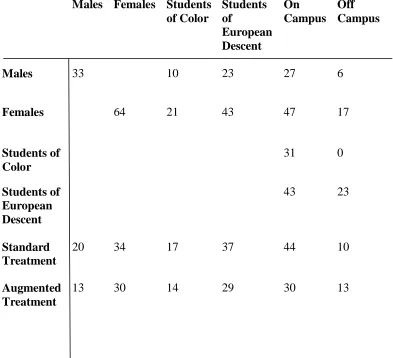
3.2 PARTICIPANT BREAKDOWN BY INDEPENDENT VARIABLE ... 58
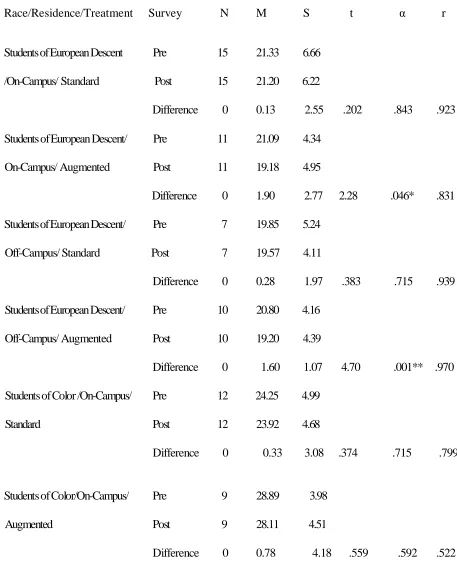
4.1 MEASURE: AFFECT ... 63
4.2 MEASURE: COGNITIVE ... 64
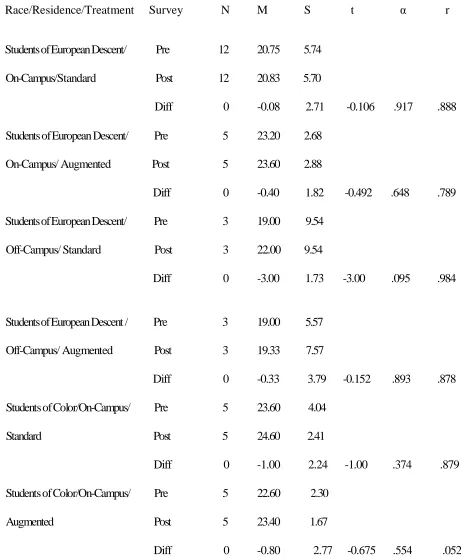
4.3 AFFECT MEASURE: FEMALE SAMPLE... 66
4.4 AFFECT MEASURE: MALE SAMPLE ... 67
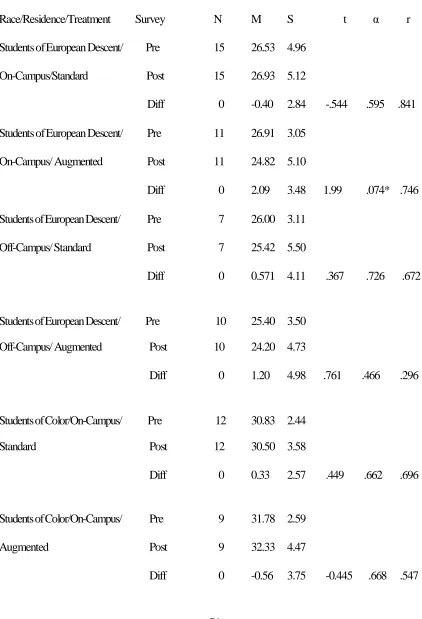
4.5 COGNITIVE MEASURE: FEMALE SAMPLE ... 71
8
CHAPTER 1
Nature and Significance of the Study
This study involves assessing the amount of change in cultural awareness and
cultural openness that the first semester of college provides to students attending an
institution of higher education. Several studies support the idea that the first year in
college provides an increased challenge to students’ value and belief systems in the realm
of cultural openness of cultural diversity issues. Factors that mediate change in student
value and belief systems are the amount and type of educational material a college
student experiences, the amount and type of exposure to people from differing cultural
backgrounds, exposure to students of equal status, and the perception about the
university's support for increased cultural openness. Finally, the question of whether
culture and racial heritage or the gender of a person influences willingness to change
early perceptions of racial and gender differences was assessed.
Gordon Allport (1954) developed the idea that, given the right conditions, people
can change their prejudicial attitudes. While there are 12 conditions that Allport outlines
as necessary for change in racial attitude; four stand out as the most important factors
necessary for promoting increased cultural openness and reduced prejudice (Brown,
1996; Pettigrew & Troop, 2006). The belief in institutional support for tolerant attitudes,
equal status of persons involved, the existence of cooperation between differing cultures,
and adequate time of exposure are the four most prominent factors needed to effect
9
incorporated these four factors into a three hour workshop, which was added to a
standard first year seminar course, and compared the possible effects it has on cultural
openness with first year college students who took a standard first year seminar course
without the added workshop .
Background and Rationale
As of the year 2050 nearly one half of the population in the United States is
estimated to be comprised of persons ofcolor (Mercer & Cunningham, 2003). This
number will only increase with timeand will logically result in increased minority
student enrollment in institutions of higher education (McClellan, Cogdal, Lease, and
Londono & McConnell, 1996). This increase requires that university administrators,
faculty and staff must help to create an environment where people of differing cultural
traditions and backgrounds can live, interact, and study comfortably (McClellan, et. al.,
1996, Blincoe & Harris, 2009). Without effective education towards life in a diverse
society, college campuses may continue to see issues of racial conflict that detract from their ability to educate students effectively. Multiculturalism and tension regarding
diversity have been cited as the most unresolved issue on college campuses today (Whitt,
Edison, Pascarella, Terenzini, & Nora, 2001). Much of the recent research on campus
climate and micro-aggression indicate that Students of color, women and homosexuals
experience both overt and subtle forms of bias which can negatively impact their
educational experience (Boysen, Vogel, Cope, & Hubbard, 2009). With the future
increase of minority student presence on college campuses the potential for increased
10
It has been argued that nowhere in United States society has the issue of racial
diversity been more apparent than in the realm of higher education (Fischer, 2011).
Minority issues are a substantial source of unrest on college campuses (Levine &
Cureton, 1998) and many campuses continue to experience increased levels of racial
unrest especially in the form of microaggressions (Engberg, 2004; Boysen, et al., 2009).
Student differences continue to be a source of focus with eight percent of Students of
European Descent respondents, 67% of Black respondents, 28% of Hispanic respondents,
and 53% of Asian respondents agreeing that racial discrimination will severely affect
their chances of obtaining a job after college (Levine & Cureton, 1998). In a pilot study
of tolerance on college campuses the Campus Tolerance Foundation (2008) found that
between 43 and 64% of students on three major college campuses report they have
experienced or witnessed bias or harassment in the forms of graffiti, verbal insult,
physical threat, or physical assault because of their group membership. As minority
student enrollment increases, the need to help students understand and address issues of
prejudice, stereotypes, racial and gender equality, discrimination and increase the
equality of college experiences for all students still exists. As students from differing
backgrounds begin to live in closer proximity, through exposure to higher education, they
will require the proper setting, information, potential for friendship, and opportunity to
cooperate in noncompetitive tasks to reduce the potential negative effects of stereotypes,
prejudice and racism.
Weingartner (1992) indicates that one of the goals of higher education is to help
students develop a sense of global awareness. The Association of American Colleges (as
11
learning especially for the undergraduate student. The world has literally become a
smaller market place where any country can compete or join together with other countries
to develop and sell goods to one another. This factor creates impetus for institutions of
higher education to help students recognize the need to learn about various cultures and
to gain a sense of increased cultural openness for those who originate from differing
cultures. Boyer (1992) calls for higher education to obtain a new level of cultural/ethnic
sophistication to meet the needs of the current diverse work force. Paceraella, Edison,
Nora, Hagedorn, and Terenzini (1996) find it reasonable to be concerned with the
methods that institutes of higher education "engender in students greater openness to
racial, cultural, and value diversity" (p.175). Higher education has been called upon to
help students gain values consistent with cultural openness and openness as a reflection
of society's need for greater cultural openness and acceptance (Taylor, 1998). The need
for institutions of higher education to address the issue of cultural diversity, cultural
openness and racial attitudes in students abounds, but the question of how to do so in an
effective and meaningful way remains (Herzog, 2012).
Most attempts to address the issue of teaching about diversity on college and
university campuses have seen mixed results (Bowman, 2009). Offering courses in
women’s studies, African-American Literature, or Hispanic studies do not provide a
comprehensive approach to helping students develop knowledge or awareness about
values and belief systems of other cultures. Taking one course does not assure students
will address the full measure of what is required under international and multicultural
education due to the quantity of varied concerns which need to be addressed
12
that do not focus explicitly on race or ethnicity makes a large assumption that students’
critical thinking ability will allow them to transfer understanding from the more general
to specific issues of cultural pluralism. Therefore, use of the academic curriculum and
specific courses should not be the only avenue by which universities and colleges attempt
to address the issue of racial attitude development. Bowman (2010) states that it takes
several types of diversity experiences such as interpersonal interactions, diversity
coursework and diversity workshops to increase the cognitive development of college
students. Institutions need to use an array of efforts on a variety of fronts including social
and academic in order to expose students to cultural diversity issues and enhance
curriculum efforts already in place.
Student development divisions in higher education have addressed the issue of
cultural awareness through a variety of means. The use of extra-curricular activities or
events to facilitate development of cultural awareness may include sponsoring speakers,
seminars, and various forms of entertainment. These approaches, while aimed at
promoting cultural awareness, often become barriers to developing awareness because
students may think of them as activitieswhich appeal exclusively to the cultural group
they represent and not as an activity them would enjoy themselves (McClellan, et. al.,
1996). Speakers or entertainers who appeal to African-American students will not be
highly attended by Caucasian students, thus negating prime opportunities for Caucasian
students to learn or experience differing cultural perspectives. Vasquez (1993) calls for a
blend of efforts to create a balance between expenditures on speakers and visiting
13
culturally diverse faculty and staff, and more academic programming aimed specifically
at multicultural issues.
Many college campuses have offered a varied number of programs or courses to
address multicultural awareness issues (Humphreys, 1998). Universities now structure
programs that address multiculturalism through formal instruction and the use of
diversity courses with emphasis on ethnic studies, women’s studies and social justice
(Bowman, 2010). Higher education has begun to look at issues of race, culture, class,
and gender as important aspects of developing a whole college experience for students.
Providing structured courses or multicultural components within a variety of courses is
more popular with academe and several studies have found that student satisfaction with
college increases with exposure to such information (Humphreys, 1998). In a report by
the American Association of Colleges and Universities indicate (as cited by Klak &
Martin, 2003) that universities have put effort into creating more inclusive and tolerant
campuses but these efforts are not reaching their potential.
McClellan et al. (1996) indicate that while college and universities promote
cultural awareness and acceptance through workshops, retreats, conferences, focus
groups and orientation activities, they do little to explore the perceptions and efficacy of
their programs. Providing seminars, speakers, and other avenues toward encouraging
awareness and education around cultural issues needs to be followed up with appropriate
assessment to determine the efficacy of such work in providing positive changes in
student’s knowledge, attitudes or behaviors (Muthuswamy, Levine & Gazel, 2006).
Evaluating a program based on the number of students who attended, or how much
14
understanding of diversity issues. Kulik and Roberson (2008) call for research efforts to
determine what actually works in diversity education. Much of the effort to increase such
understanding could begin in the first year of a student’s college life through such
targeted means as workshops, or first year seminar classes.
The first year of college is marked by many changes for students embarking on
their university experience. The university experience provides educational opportunities
beyond the classroom and addresses all areas of a person’s life. Pascerella and Tereazini's
(1991) in-depth and comprehensive work on how college affects students shows that
learning and attitude change occurs in the educational, social, personal, and career
development of the college student during the undergraduate experience. The first two
years, however, demand the most change of life and life-style with the first year being by
far the most significant (Loeb & Magee, 1992). This is often the time of life when a
person’s belief and value system is challenged by exposure to wide varieties of
information and experiences differing from those previously encountered in a student's
family life, educational experience or local community.
The first year experience is marked with many opportunities for growth and
change. Students arriving at college for their first year are full of excitement, fear,
anxiety, and wonder about the new worlds that lie before them. It is during this first year
of college that many First year’s early-defined values and beliefs are thoroughly
challenged to the point of genuine reflection and possible change (Bowman &
Brandenburger, 2012). Included among these challenges is their exposure to people, both
students and faculty, from differing cultural and ethnic backgrounds. The level of
15
experiences may have an effect upon the amount of cultural openness toward people from
different racial or ethnic heritages a college he or she might develop. Direct exposure,
combined with structured and cooperative learning exercises, a sense of institutional
support for cultural openness, and enough opportunity for acquaintance, may challenge
prior beliefs about people from differing cultural background to the point of increasing
some levels of cultural openness. The need to assess the effects these components have
on cultural openness building is required if higher education is going to invest significant
amounts of resources into helping to reduce prejudice and increase cultural openness
(Blincoe & Harris, 2009).
Purpose of the Study and Related Research Questions
Developing evidence to help determine what influences the amount of change
first year college students’experience in the area of cultural openness could help
counselor educators, especially those teaching in student affairs programs, recognize
developmental issues that need addressing on university campuses. The primary
psychological, sociological purpose of this inquiry is to assess the effectiveness of a
multicultural workshop, based on premises from Allport's Contact Hypothesis (Allport,
1954) is, potential for changing first year students’ attitudes toward cultural openness.
This endeavor starts as an effort to provide college counselors with effective outreach
programming in which to impact cultural openness and cultural attitude change that can
be measured.
Overview
Randomly sorted groups of female and male students both on-campus and
16
measured with an instrument that measures a cognitive, affective and gender equity
construct. The instrument was administered after the students participated in a first year
seminar class which either included a cultural diversity seminar, or did not include a
cultural diversity seminar.
Research Questions
The following research questions are of interest for this study. After participating
in either an augmented first year seminar course or a standard seminar course can pre
post uniformity of change across all intersections (treatment, gender, race, and housing)
of independent variables occur for either the cognitive or affective components of the
QDI? Specifically for any of the independent variables (Student of European descent,
Student of Color, Male, Female, living on campus, living off campus, standard treatment
or augmented treatment) can the means all increase or decrease across all intersections of
the other independent variables? For example is it possible for all of the students who live
on campus mean scores to increase or all decrease, regardless if they are male or female,
Student of European Descent, or Student of Color, or whether they received the
augmented or standard first year course? 2) Do pre and post mean score differences for
any intersection of independent variable show a significant magnitude of change
(increase or decrease) when measured either cognitively or affectively? Specifically, do
any of the independent variables show a significant increase or decrease in mean scores
post-test on the cognitive or affective measure of the QDI? 3) Within any specific
intersection of independent variable is there a high, medium, low or low low correlation
between the within intersections of independent variables pre-test post test score vectors
17
address the degree of change, the direction of change and the homogeneity of change
within each of the intersections of independent variables. The degree of change can be
measured by the size of the difference between pre and post means, the direction of
change can be measured by the sign of the difference between pre and post means, and
the coherence of change can be measured by the correlation between pre-test, post-test
score vectors (a directed line segment whose length represents the magnitude of change
and whose orientation in space represents the direction).
Delimitations of the Study
Limitations: Instructors for the first year seminar courses were different and,
while the course format was the same, instructors use a variety of different teaching
methods and emphasize different aspects of the course based on personal preference.
Students may respond to one instructor’s style more openly which could have an impact
on the student’s willingness to change ideas or beliefs.
Due to the nature of scheduling problems, it was necessary to use two different
instructors for the multifaceted multicultural training workshop provided in the
augmented first year courses, both were female, one was Caucasian while the other was
African American. This may have had some influence on how the course was taught and
the study could not effectively control for teaching style differences or issues based on
cultural background or heritage.
Experimenter bias was controlled for by using two qualified instructors for the
workshop. Both instructors have had prior experience dealing with diversity issues and
18
Statistical issues: Maturation: due to the passage of time first year students
begin to mature and this could not be controlled.
Definitions of Terms:
Affective construct or measure: The construct measured by the QDI which evaluates at
how people “feel” about race and diversity issues.
Augmented Treatment: The treatment in this study which added the Multifaceted
Multicultural Seminar, based on the four primary components of Allport’s contact
hypothesis, to the standard first year seminar class.
Cognitive construct or measure: The construct measured by the QDI which evaluates at
how people “think” about race and diversity issues.
Cultural Openness: The willingness of a person to be accepting of persons or ideas
originating from races or cultures other than their own.
Contact Hypothesis: the theory that states that under the appropriate conditions
interpersonal contact is the most effective way to reduce prejudice between groups of
people who differ in cultural background (Allport, 1954)
Micro-aggression: subtle insults in the form of verbal, nonverbal and visual cues directed
toward people of color in an automatic or unconscious way (Solorzano, Ceja, & Yosso,
2000).
On Campus: Students who live in any residence located on the Campus of Francis
Marion University and for which they pay housing fees to the university.
Off-Campus: Students who live in any residence not associated with Francis Marion
19
Standard Treatment: Standard first year seminar classes given by first year seminar
instructors without the added Multifaceted Multicultural Seminar included.
Students of European Descent: Students who identify themselves as White, Caucasian
and having the characteristics of a race originating from Europe, North Africa, and
southwest Asia with the physical characteristics of light skin pigmentation
(Merriam-Webster Online, 2013).
Students of Color: Any students who self-identify as non-European descent or whose
ancestors originate from Africa, Asia, North or South America prior to European arrival
and are of non-European descent and whose skin pigmentation is different from the
20
CHAPTER 2
Review of the Literature
The impact of college on college student’s racial cultural openness has been
studied in a variety of ways. Studies focus on how the universities provide diversity
programming, how universities incorporate multicultural education into the curriculum or
how well represented are faculty of color within the university. Many of the studies do
not however look at the impact of various types of programming for increasing racial
awareness on the actual ability to change the students’ cultural openness levels, nor do
the studies compare themselves with a standard curriculum. Stephan and Stephan (2001)
only found seven studies that looked at the impact of diversity trainings on students and
only three of these were judged to have been successful. Carol Kulk and Loriann
Roberson (2008) identified only 31 studies from 1970 to 2008 that evaluated diversity
education effects on attitudes and 14 studies that addressed increasing student knowledge
about diversity. The results of these studies indicate that diversity education results are
mixed in their ability to effect attitudes and good in their ability to increase knowledge
about diversity issues (Kulk & Roberson, 2008). The number of studies identified in the
pursuit of assessing diversity training’s ability to change undergraduate college students’
racial attitude and cognitive beliefs leaves room for more research in the effectiveness of
training courses, seminars or interventions with a need to look at the specific effects of
21
The issues of how people develop learn to cope with, or change racial attitudes
have only been researched in the recent past. Understanding how people develop their
racial attitudes is important to learning how to create attitude change. As people grow and
develop opportunities to change beliefs and attitudes present themselves through a variety
of experiences. It is through experience that belief systems develop and grow. One such
influential experience can be attending college.
A person’s life can be highly influenced by their participation in college. College
provides many people with a great opportunity to learn much about life and interpersonal
relationships (Beard, Elmore, & Lange, 1982). College has a unique role in affecting
students developmental growth as college students are in the developmental stage where
people develop their social and personal identities (Spanierman, Poteat, Oh, Hund,
McClair, Beer and Clarke, 2008; Bowman, 2010).The college environment is often the
first meaningful opportunity for students to interact with culturally diverse peers
(Spanierman, et. al. 2008; Bowman, 2010; Sanez, 2010,). As college has very influential
effects on students beyond just the academic it is a good environment to provide
opportunities to help students begin to develop more open attitudes and beliefs about
cultural diversity.
This review of the literature focuses on defining: what racial attitudes are, how
they are developed, what processes occur to create change or insight into racial attitude
development, the different racial attitudes of students of European descent and Students
of color, how gender effects racial attitudes, how racial attitudes affect college students,
how first year college students are affected by their racial attitudes, and how does choice
22
Racial Attitudes
Attitudes or beliefs about racial differences are primarily developed similarly to
attitudes or beliefs about any other subject. Rokeach (1971 p. 453) states that “... an
attitude represents an organization of interrelated beliefs that are all focused on a specific
object or situation…” Racial attitudes are just such a specific object or situation.
Attitudes consist of cognitive, affective and behavioral components (Weiten, 2001).
Attitudes are more than just a thought or belief because they combine our thoughts,
feelings and deeds and are often expressed through each of these realms of human
behavior. A person’s attitudes towards people of differing race or gender are just such a
combination of thoughts, feelings, and behaviors. These attitudes are centered in an often
strongly held or ingrained belief system. Racial attitudes can be expressed through
feelings of disdain, actions of discriminatory behavior, and stereotypical thoughts or
beliefs about persons from differing cultural or ethnic backgrounds (Hillis, 1996). How a
person develops his or her racial attitudes early in life can have a long-term effect on their
future interaction with people of differing cultural heritages or backgrounds.
Racial Attitudes of College Students
Simone Taylor (1998) says that college students bring a "composite self,
composed of levels of moral development, aptitudes and sets of experiences (e.g. family
education social network, religiosity) that contribute to their initial level of cultural
openness". The National Study of Student Learning found that pre-college openness was
a strong predictor of first year college students’ end of year openness to cultural openness
(Whitt, Edison, Pascarella, Terenzini, & Nora, 2001). Precollege exposure to diversity
23
engage in college diversity activities (Saenz, 2010). This initial level of cultural
openness will affect the way and amount a college student can change or grow in
openness to diversity issues. Addressing multicultural issues early in a college student’s
experience could help to generate more awareness and openness sooner in their lives.
Saenz (2010) found that prior to college 80% of Students of European Descent
students and 70% of African American students attend schools predominantly of their
own race. This re-segregation of K through 12 grades in the U. S. indicates that college
will be the first real meaningful opportunity for many students to interact with a more
racially diverse student population (Saenz, 2010). In studies on the racial attitudes of
college students the literature indicates that both Students of European Descent and
Students of color continue to perceive a need to enhance the multicultural climate
on-campus (Whitt, Edison, Pascarella, Terenzini & Nora, 2001; Fisher & Hartmann, 1995;
Brigham, 1993).
College students recognize the need for improved multicultural climates due to
existing attitudes that exist on university campuses. In a study on cultural attitudes and
climate at The University of Maryland, Sedlack and Bouis (1995), indicate that Students
of color perceive issues of academic performance, expectations about representing their
race in class discussions, and a lack of examples relevant to Students of color as
contributory to the need for continued and increased programs to address multicultural
issues. In the same study students of European descent indicated discomfort discussing
their beliefs or thoughts about ethnic/racial issues and felt that the university was
providing enough or too much effort on the issue of multicultural issues (Sedlack &
24
campus climates not as welcoming or accepting as Students of European Descent
students (Boysen, Bagel, Cope & Hubbard, 2009) and The difference of perspective of
how much multicultural issues are addressed is in itself and indication that college
students may benefit from early exposure and more in-depth discussion of these issue
early in their college experience.
Racial attitudes of Students of European Descent
Brigham (1993) indicates that racial attitudes of Students of European descent
have been broken down into a variety of categories. These categories include dominative
racism or old fashioned racism, symbolic or modern racism and aversive racism.
Dominative or overt racism is the type of attitude that is associated with people who
express their racist beliefs in the open. Dominative racial attitudes are those associated
with open criticism, hostility and derogatory beliefs toward minorities (Baldwin, Day &
Hecht, 2000). Modern racism is characterized by a deep moral feeling that minorities
violate traditional values of individualism and self-reliance. Modern racism is evident in
people who vote against a black political candidates, oppose affirmative action or express
concerns about welfare abuse or increase in urban crime (McConahay & Hough, 1976;
Sommers & Norton, 2006). Students of European descent who express their racial
attitudes in more subtle expressions including discomfort, uneasiness, fear, or avoidance
of minorities, or in terms of micro-aggressions are included in the aversive or subtle
racism category (Brigham, 1993; Sue, Capodilupo, Nadal, & Torino, 2008). Aversive
racists indicate that they believe in equality and deny being racist, however they express
racist behavior in subtle actions. It cannot to be assumed that all Students of European
25
necessarily totally racist, however it is argued that Students of European Descent
Americans do see the society as “open, fair, and color-blind” (McClelland & Linnander,
2006). The similarities within each of the different types of racism have been called
“contemporary racism” (McClelland & Linnander, 2006) which recognizes that at the
heart of each type of racism is the idea that Students of European Descent Americans
deny being overtly racist, support efforts to reduce racism, and are blind to the subtleties
of how racisms’ effects harm both People of Color and People of European descent.
Students of European descent express their racial cultural openness in a variety of
ways. Studies indicate that Students of European descent hold feelings of animosity
underneath a facade of anti-racist attitudes (Biasco, Goodwin and Vitale, 2001). In a
reverse of the predominate beliefs self-segregation has been found a greater problem for
students of European descent than Students of color (Matlock, 1998; Smith et. al. 1998)
and Students of European Descent students are less likely to be prepared to engage with
diversity in college settings (Saenz, 2010). Students of European descent tend to prefer
to sit in like groups and to room with other students of European descent. Students of
European descent indicate on written surveys that they approve of inter-racial marriages
but when interviewed personally they tended to deny such feelings (Bonilla-Silva, 1998).
These types of attitudes indicate that feelings about racial issues in students of European
descent tend not to be either totally positive or totally negative. Christopher Federico,
(2006) suggests that Students of European Descents’ racial perceptions may often deviate
from either positive or negative attitudes towards having both positive and negative racial
26
Reed and Radhakrishanan (2003) found that Students of European descent
perceive campus climates as non-racist or non-discriminatory. Students of European
descent in a study of attitudes toward racial discrimination did not perceive as much
discrimination as did Students of color ((Biasco, Goodwin and Vitale, 2001, Nora &
Cabrera, 1996). These attitudes may be indicative of Students of European descent
overall lack of experience of racism or prejudice directed at them. Students of European
descent may fail to recognize the subtle forms of racism that Students of color experience
and therefore fail to perceive racism as a major problem on-campus. The failure to
perceive racism as a major problem on-campus by students of European descent is a clear
indicator that the racial attitudes of Students of European Descents and Students of color
differ.
Students of European Descent students’ lack of understanding about the nuances
of racism and its effects, not only on those who are discriminated against but also upon
Students of European Descent students themselves (Todd, Spanierman & Poteat, 2011),
requires more than just increased contact with Students of color in order to effect racial
attitudes significantly (Ford, 2012). Rather than only relying on the potential for
increased contact with Students of color, within the increasingly diverse college campus,
it is imperative that Universities and Colleges provide creative ways of providing
opportunities for Students of European Descents to explore the issues of race (Ford,
2012). Because of Students of European Descent students lack of understanding of the
effects of racism, the first year of college is thought to be a crucial time in helping to
begin the process of developing awareness and beginning to change previously held
27
Racial Attitudes of College Students of color
Helen Neville and Roderick Lilly (2000) found that “few studies have attempted
to examine African Americans’ composite racial identity schemata or the underlying
dimensions of their racial identity patterns” (p. 195). I found that most studies about
racial attitudes of Students of color tend to focus on how they perceive their campus
climates or how much they feel discriminated against. Maramba and Velasquez (2012)
indicate that “we know relatively little about how college Students of color develop their
ethnic identity and how that identity impacts their perceptions and experiences in higher
education” (p. 297). Much of the literature about college Students of color attempts to
assess the impact of racial discrimination on their ability to perform in college or on their
self-perceptions rather than how they think or feel about students who differ from them in
culture or race.
In a study at five undergraduate colleges in California, Students of color indicate
that they experience more discrimination than Students of European Descents and
students who experience racism report lower levels of academic achievement and social
adjustment (LaSure, 1993). Reid and Radhakrishnan (2003) found through a review of
the literature that Students of color consistently find that the general campus climate
toward racial issues more negative than did students of European descent. Students of
color complain that they do not feel they are taken seriously as students, that they did not
get adequate advising or mentoring and reported being less self-confident than Students
of European descent (Reid & Radhakrishnan, 2003). In a study on attitudes toward racial
discrimination Biasco, Goodwin and Vitale (2001) found different perceptions among the
28
perceived higher levels of racial discrimination than did Students of European descent
(Biasco, Goodwin, & Vitale, 2001). Most of the research on students’ of color racial
attitudes do not focus on their own perceptions toward issues of race but rather on
whether or not they feel discriminated against in the higher education setting. More
focused research with Students of color on their personal perceptions of cultural openness
and on racial attitudes toward culturally different students is needed.
Racial Attitudes of Men and Women
Very few studies have looked at gender differences on racial attitudes (Hughes &
Tuch, 2003). Most of the studies on Students of European Descent racial attitude include
gender as a control but do not look at how gender itself affects racial attitudes. The author
found no studies that focused on how the Students of color gender effects their racial
attitudes. Gender differences can impact people’s racial attitudes in significant ways.
Men and women differ in their racial attitudes. Men and women are socialized
differently from birth as they are exposed to gender specific beliefs and behaviors which
help to create their sense of self and how to interact in the world around them (McCollum
& Kahn, 2006). Men have been found to pursue different goals in life when compared to
women. Men tend to pursue goals of superiority or social status when compared to
women in a study on social goals (McCollum & Kahn, 2006). Women tend to pursue
social responsibility and intimacy/relationship goals more often than men (McCollum &
Kahn, 2006). Women also have been found to enter college with higher levels of
motivation for social change and with greater levels of readiness to engage in social
action (Malaney & Berger, 2005). The pursuit of these differing social goals can have an
29
as cultural differences. Having a more pro-social orientation may lead to more inclined
support of interracial interaction and policies (Hughes & Tuch, 2003).
College can have an effect on male and female cultural openness levels. It had
been found that female students gain from two to three times the cultural openness
compared to males in their first two years of college (Bowman, 2010; Taylor 1998). This
gain has been linked to the females’ pre-college socialization experiences, the effects of
college experiences and the impact of the higher moral development of females (Taylor,
1998). Males on the other hand were found to have little to no change in cultural
openness levels in the first two years of college (Taylor, 1998). Katherine McClelland
and Erin Linnander, 2006, also found that women tend to have lower levels of
contemporary racism than men. These differences may be related to gender issues
including females likeliness to be more relational oriented than males, females
socialization toward more pro-social goals, females tendency toward nurturance, and
males tendency toward individual success and competition.
Campus Residence effect on Racial Attitude
The effects of living on or off-campus on racial attitudes have not been widely
studied. Research has looked at the effects of creating special housing for Students of
color and their academic success and the effects of living learning communities (Pike
2002), but little has been done to study the effects of traditional on or off-campus housing
on racial attitudes. The studies that have been conducted found that living on-campus
show positive influence on college student’s racial attitudes, however the strengths of this
influence was variable (Pike, 2002). Studies have found that Students of European
30
of color even if they had not previously known the minority roommate , however the
same is not true if they room with other Students of European Descent (Martin, Trego, &
Nakayama, 2010; Mark & Harris, 2012).
Korgen, Mahon and Wang (2003), looking at the effects of living on or
off-campus on students perceptions of racial tension, inter-racial friendships and dating
persons of the opposite race, found a possible tipping effect among on-campus residents
on a diverse college due to the higher number of minority, particularly African American,
students living on-campus. That is to say that the more African American students who
live on-campus the more negative students of European descent viewed campus race
relations and this decreased Students of European Descent student’s likelihood of having
friends of or dating another race (Korgen et al., 2003). This tipping effect could be
explained by the fact that having more Students of color on-campus increases the
availability for Students of color to interact more closely within their race thus reducing
the need for friendships or dating relationships outside of their own group. As Students
of color self-segregate, their openness to friendships outside of their own race may
diminish and therefore students of European descent might view them as more resistant
or less open to cross race interaction resulting in more negative perceptions of race
relations. This self-segregation may be more noticeable because of the larger numbers
being seen in the cafeteria, at sporting events, and in participation in African American
Fraternities and Sororities or Clubs and Organizations. Another reason for this tipping
effect may be that students of European descent are less likely to challenge their
preconceived or early beliefs about other races due to their own feelings of intimidation
31
could prevent a willingness to reach out to a member of a large group of people who are
different while it is easier to reach out to a member of a different race when the overall
numbers are lower and therefore not as intimidating.
The research on the effects of living off-campus on racial attitudes appears mixed.
Chickering (1975), as found in Korgen, et al. (2003), that Students of European Descent
commuter students attending a more diversely represented university were more likely to
view campus race relations positively and to date or develop friendships interracially than
on-campus students. Living campus may limit the exposure of racial friction as
off-campus students tend to attend class and visit the library but may not rely on on-off-campus
activities for their social interaction. Off-campus living may also reduce the social
network available to these students therefore encouraging more openness to social
interaction with students of a different race than their own. Off campus students are not
as exposed to the number of Students of color as on campus students and therefore may
not get as much exposure to the social activities of Students of color.
The effect of living on-campus on racial attitudes appears to also have mixed
results. Pascarella, Edison, Nora, Hagedorn and Terenzini (1996) found that first year
students of European descent who live on-campus were 20 times more likely to become
more open in racial attitudes than Students of color or commuting students. Meader
(1998) also found that living on-campus has a positive effect on students of European
descents’ support of diversity issues.
Students of European Descent students who live on campus at colleges that have a
higher representation of Students of color attending tend to experience more negative
32
that a possible tipping effect may occur when a higher proportion of Students of color, in
particular African American students, live on campus. This tipping effect indicates that
Students of European Descent on campus students are more likely to view race relations
negatively than on college campuses where the percent of Students of color living on
campus is lower.
There are few studies that look at the impact of racial attitude and on-campus
living with Students of color (Harwood, Huntt, Mendenhall & Lewis, 2012). The studies
that do exist find that Students of color perceive resident hall climates as being negative
and as having experiences of stereotyping and micro-aggressions, but living on campus
improved personal and social development compared to Students of color living off
campus. (Harwood, Huntt, Mendenhall, & Lewis, 2012).
Racial Attitudes of First Year College Students
Chan and Treacy (1996) state, that first year college students are often wary of
new perspectives such as the volatile issues of race and class. The concern arises from
the combining of cognitive and affective separation with those of the new physical
separation from their families to which they are just beginning to adjust (Chan & Treacy,
1996). Racial attitudes of new college students have been developed and formed from
their childhood. Both early education and indoctrination from family, peers, and the
educational system from which they enter college influence these attitudes. During the
course of college life students often move from a position of “differences do not matter”
to acknowledgment that “inequalities do exist based on differences” (Chan & Treacy,
1996). In a study on attitude change and self-perceptions Leob and Magee (1992) found
33
significant decreases reported in the initial year. In a study on first year students
openness to diversity and challenge, Pascerella, Edision, Nora, Hagedorn & Terenzini,
(1996) found that students who live on-campus, who spend more time studying, and who
are highly active with student peers tend to have higher levels of openness to diversity
and challenge. First year students who perceived their institution to have a
non-discriminatory racial environment, who attended a racial or cultural awareness workshop,
were involved with diverse student acquaintances and who had precollege openness to
diversity and challenge were associated with greater end of first year openness to
diversity (Whitt, Edison, Pascerella, et. al. 2001). First year students present as being
more ready to investigate or explore their previous racial attitudes given the proper
atmosphere for doing so.
First year college students are often exposed to a variety of different types of
kinds of people in their first year of school. Many first year college students experience
their first real exposure to students from another race as a function of attending college
(Shang, 2008).This exposure not only occurs in the classroom but also in the residence
halls and in various college activities or events. First year students who live on-campus
have a greater amount of exposure to persons of different cultural backgrounds than those
who live at home. Pascerella et. al. (1996) found evidence to support that one of the
highly influential factors for students developing openness to diversity or challenge is
whether or not they live on-campus or commute. Students living on-campus were found
to be more open to diversity issues in their first years of study (Whitt, Edision, Pascerella,
et.al, 2001). Commuting students do not participate in on-campus social activities as
34
more meaningful exposure to students who are culturally different than themselves.
Creating a variety of opportunities for both on-campus and commuting students to
interact in longer, more meaningful social or educational events could satisfy student’s
desires for higher levels of intergroup interaction.
The literature suggests that students seek and desire greater levels of intergroup
contact than they actually experience during their college life. Cole, (1991) indicates that
college students seek positive experiences with people whose racial backgrounds are
different from their own in order to develop the necessary skills and knowledge to
contribute to the multicultural world. When such interaction occurs students indicate
greater levels of understanding, decreases in prejudicial attitudes, greater institutional
satisfaction, more involvement and positive academic success (Humphreys, 1998; Smith,
Gerbrick, Figueroa, Watkins, Levitan, Moore, Merchant, Beliak, & Figueroa, 1998). The
more students interact with peers from differing racial backgrounds and the more they
engage in conversations around value-laden issues the greater openness is increased
(Pascerella et. al., 1996). Amy Lee, Rhiannon Williams and Rusudan Kilaberia (2012),
refer to several studies that indicate that engaging with diverse students has many
positive results including increases in cognitive, academic, social and prejudice reducing
skills. Spending time with peers of differing cultural backgrounds expose college students
to the kind of new and different ideas that challenge people to question existing racial
beliefs or attitudes thereby facilitating possible changes in these established perspectives.
Harvey, (1998) recognizes that as students enter college they bring with them the
racist attitudes that were instilled from their homes and neighborhoods, however he also
35
college life...” they bring with them the psychological openness to shed these views given
the proper opportunities to learn and grow. College is a place where students can
challenge their existing beliefs resulting in either a change or further entrenchment of
those beliefs. Factual information alone does little to create attitude and behavior change
(Pardeck, Fuge, Hess, McCoy, Tinney, 1997), therefore students must be afforded the
opportunities to analyze, discuss and experience new information first hand. The ultimate
determination of whether or not a student makes changes in a belief system relies highly
upon the discussion and analysis that occurs as part of the college experience (Harvey,
1998). The first year of college is a good place to start such discussions and analysis.
The time to help college students explore the effects that early attitudes and
beliefs about racial, gender, and socioeconomic differences is in their First year. It is in
this first year of college that students begin to test their independence, build new
academic and social structures, try on new identities, and practice new behaviors
(Pascerella & Terenzini, 1991). It is during this first year, or even first semester of
college, that students could become more ready to change previously held attitudes and
beliefs about family, peers, and life in general if given the proper educational,
environmental and social opportunities. These opportunities can be made available in
the classroom, through extracurricular activities, residence life experiences, and through
Student Development activities.
First year Seminar classes provide a unique opportunity to help students begin
thinking about the effects working and living with persons of differing backgrounds can
have upon them in the future. First year seminar is a class that has the flexibility to
36
world in general by providing a thorough socialization function that establishes the
behavioral norms expected of students attending college (Pascarella & Terenzini, 1991).
First year Seminar also provides the four most influential conditions for changing racial
attitudes in that the institution and social environment support contact between different
race and gender for the promotion of positive attitudes; the contact between students of
each first year seminar class lasts for a minimum of fifteen weeks; First year will have
equal status as they are at their starting point in their college career with the same
minimum requirements having been met to attend; and opportunities for cooperative
behavior can exist throughout the course curriculum. The four components of Gordon
Allport are necessary to help create true change in the racial attitudes of both students of
European descent and Students of color.
Changing Racial Attitudes
Allport's Contact Hypothesis
Gordon Allport (1954) developed the theory of contact hypothesis which states
that prejudice is reduced in direct relationship to the amount and type of contact that
occurs between differing groups or cultures. The type of contact that mediates prejudice
is the most influential aspect for initiating attitude and behavior change. Gaertner and
Dovidio (1986) list the features that Allport (1954) postulates as necessary to increase
intergroup cultural openness as:
“...cooperative rather than competitive interactions; cooperative interactions involving similar levels of competence between groups; cooperative tasks with
outcomes that are positive; interactions among members who do not possess qualities stereotypically associated with their group membership; situations that provide strong normative and institutional support for the contact;
37
period; contact that occurs in a variety of contexts with a variety of in-group and out-group members; and contact involving equal status both within and outside the initial contact situation.
(pp. 31-319)”.
While Allport endorsed eleven different postulates for the creation of racial attitude
change others who have studied Allport’s contact hypothesis have identified the four
most necessary postulates.
Brown (1996), points to four of these conditions as the most important for
successful contact that will influence change in attitude, belief, and behavior. Social
and institutional support of the measures employed to promote greater contact and
interaction must exist to help create a social climate ripe for tolerant norms to emerge.
Pettigrew and Tropp (2006), state that institutional support is a very significant
condition toward stereotype and prejudice reduction. Acquaintance potential is the
second condition Brown (1996) states are necessary for successful contact to occur.
The contact between groups must be long enough, often enough and in close enough
proximity to affect attitudinal change about different groups (Brown, 1996). The third
most important factor, according to Brown (1996) is that it should take place between
individuals who are viewed as having equal status. Equal status removes the ease of
which stereotypes that promote the ideas that persons from differing cultures are
inferior in their ability to perform various tasks. Finally, Brown (1996) emphasizes
the importance of cooperation. People who have to rely upon one another to obtain a
mutually beneficial goal have strong reasons to develop closer relationships with one
another. These four conditions, if present, are powerful enough to improve openness
38
Allport’s early studies and writings on the nature of prejudice continue to
influence current theory and perspectives on reducing prejudice and increasing cultural
openness between race, gender, and culture. Wittig and Grant-Thompson (1998) relate
that the Contact Hypothesis is one of the most researched principals for reducing
prejudice. The Contact Hypothesis emphasizes the importance of individual
prejudicial attitude change in relationship to social situations while identifying
conditions necessary for successful intergroup contact towards the reduction of
prejudice and increasing cultural openness (Wittig & Grant-Thompson, 1998). The
utility of the contact hypothesis has been well established in the literature.
Various studies have provided empirical support for use of Allport's key
conditions for change in prejudice. In a study about the utility of the contact
hypothesis Wittig and Grant Thompson (1998) found that teachers' theories of attitude
change are aligned with Allport's contact hypothesis. In a study on school interracial
climate, based on Allport's four criteria of the Contact Hypothesis and coping with
interracial stress, children’s' self-esteem and self-reported academic performance was
positively affected (Marcus-Newhall & Heindl, 1998). In another study using the
Jigsaw method, a classroom teaching method based on Allport's four key conditions,
Walker and Crogan (1998) found that increase in student academic performance,
increase of student liking of peers (both in-group and out-group), and decrease in
stereotypes of out-groups occurred. Gaertner, Dovidio & Bachman (1996) completed a
laboratory experiment, two survey studies and a field experiment to validate the ability
of the contact hypothesis to reduce bias primarily through the induction of a common
39
the framework for reducing intergroup bias (Gaertner, Dovidio & Bachman, 1996). In
another study of Allport's contact hypothesis Wright, Aron, Arthur,
McLaughlin-Volpe & Roop (1997) conducted two survey studies and two experimental studies on
effects of the knowledge of an in-group member's friendship with an out-group
member. Wright et. al. (1997) found that knowledge of cross-ethnic friendship had a
positive effect on racial attitudes of other in-group members and initially validated the
causal direction from knowledge of cross group friendship to positive intergroup
attitudes. Pettigrew (1998) reviews of various research supports Allport's contact
hypothesis in his review of intergroup contact theory. Studies range from school and
housing studies; to studies of Chinese, Americans, Australians, Germans, South
Africans, South East Asians; the mentally ill or disabled persons; victims of AIDS;
and computer programmers (Pettigrew, 1998). Research methods include field
studies, surveys, archival, and laboratory studies (Pettigrew, 1998). Pettigrew and
Tropp (2006) completed a meta-analysis of 515 studies of the contact hypothesis and
consistently found that intergroup contact reduces prejudice. Many of the effects of
contact often generalize beyond participants immediate contact situation to other
situations (Pettigrew & Tropp, 2006). Overall the majority of studies conducted on
Allport’s contact hypothesis supports its tenants and provides a strong source of
empirical support.
Studying the effects of Allport’s contact hypothesis in a college setting
perfectly support the four key conditions of institutional support, acquaintance
potential, equal status and cooperation. Fischer (2010), states that residential colleges
40
equal status in that they share the common goal of attaining a college degree, engage
in many activities that are similar to one another, are often given the chance to
participate in cooperative activities, experience institutional support for intergroup
interaction in classes and extra-curricular activities, and have many chances to interact
with students of differing cultural and racial backgrounds
Previous studies on the effect of contact and racial attitude change in college
students have found the importance that contact plays in reducing prejudicial attitudes.
The more contact students have with group members from other ethnic backgrounds
the greater the impact on reducing negative racial attitudes (McClelland &Linnander,
2000). In a study on the impact of contact with Asian students on Students of
European Descent students, Dinh, Wientstein, Nemon and Rondeau (2008), found that
Students of European Descent students who had more contact with Asian students
reported more positive attitudes and more awareness of racial discrimination.
Relevance to Counselor Education
Studying the effects that the first year of college has on racial attitudes and
awareness has much relevance to the field of counselor education. Counselor
Educators have taken a lead role in addressing the issue of race, gender, age, and
sexual preference in their field of study, professional realms of therapy and
educational outreach in higher education. The field of counseling has identified
specific skills needed to become culturally competent. Sue and Sue (1990) state that a
culturally competent counselor must be able to: (1) have an awareness of personal
assumptions, values, biases, limitations and world view; (2) understand the world view
41
and techniques for working with culturally different clients. The need to establish
similar competencies is essential for helping college students enhance their growth of
multicultural awareness and sensitivity (Howard-Hamilton, Richardson & Shuford,
1998).
College diversity issues often call for preventive-community or environmental
oriented work (Archer & Cooper, 1998). The outcomes of this study may identify
opportunities for counselor educators who are involved in higher education to develop
programming, outreach, or other services to students for developing cultural
awareness and cultural openness. Counselor educators often have positions in
university counseling centers and have some responsibility to help promote for the
care and equitable treatment of all students.
Archer & Cooper (1998) identify several programs run by college counseling
centers to address campus diversity and multiculturalism. Programs range from:
mini-conferences on awareness and prevention of sexual harassment; workshops on valuing
ethnic diversity; Gay and Lesbian programs offering closed or private groups, weekly
discussion groups and workshops on same sex attraction, and the emotional and
spiritual aspects of the Gay/Lesbian life-style; advising, consultation, and
recommendations to students and faculty concerning the academic, psychological, and
emotional issues of students with disabilities; minority retention programming; and
workshops for adult learners on a variety of topics including blood pressure
screenings, tax preparation, discussions groups, and cultural festivals (Archer &
42
staff in the provision of programs aimed at increasing cultural openness and awareness
of the impact of diversity issues.
Ponterotto and Pederson (1993) view the counselor's role as uniquely qualified to
help prevent prejudice development. Archer & Cooper (1998) state that college
counselors can use a model that adds the roles of "...change agent or consultant,
adviser, advocate, facilitator of within culture group support systems, and facilitator of
traditional healing methods, (p.95)" to their typical counseling responsibilities.
Counselors typically provide individual, family and group therapy opportunities for
college students. These opportunities may present the chance to address issues of
prejudice and racism through the dynamic process of therapy. Understanding the
developmental aspects and the necessary change agents for reducing or preventing
prejudice is the essential component for counselors to help create behavior change.
College counselors need to be aware of the many effects that racial issues on campus
may have on students they treat (Ancis, Sedlacek & Mohr, 2000). Finally, Ponterotto
and Pederson (1993) call for counselors to become activists by using the media,
multicultural education programs, and lobbying efforts of various counseling
associations for the support of civil and affirmative action rights of minorities and
women.
Studying the effects of current trends in developing cultural awareness on college
campus is needed to identify what actually works. Many colleges provide workshops,
seminars, speakers and a variety of opportunities for students to gain exposure and
understanding of the need for cultural awareness and openness yet do little to explore
43
to people of other races. This study will help to establish how effective the adding of a
specific cultural awareness workshop within the framework of a First year seminar
class against the standard First year seminar class has on students’ cognitive and
44
CHAPTER 3
Method
Purpose
The majority of university and colleges now have a course or specific programing
for first year students that deal with helping acclimate to college life (Messineo, 2012).
Within these courses the issue of racial and gender cultural awareness is often addressed.
Universities and colleges also offer various seminars, lectures, or even curriculum that
focus on diversity issues in order to help students address issues of cultural openness and
acceptance of differences. The question of whether or not attempts to impact college
students’ perceptions are effective has not been thoroughly explored.
Within the question of whether the various courses or seminars are effective in
changing attitudes or perceptions lies the question of which approach is best suited to
helping college students’ increase their openness to diversity issues. This study examined
the general question of effectiveness of how courses typically introduce the issue of
increasing cultural openness and a particularly promising augmented course with a
workshop that incorporates the four key components of institutional support,
acquaintance potential, equal status and cooperation based on Allport’s Contact
Hypothesis (Brown, 1996; Fischer, 2010)
Both questions represent categories of change that are of special interest: uniform
significant change measured across all intersections of independent variable levels and