A Lane consistent optical model potential for nucleon scattering
on actinide nuclei with extended coupling
José Manuel Quesada1,a, Roberto Capote2,b, Efrem S. Soukhovitski˜ı3,c, and Satoshi Chiba4,d 1Departamento de Física Atómica, Molecular y Nuclear, Universidad de Sevilla , Apartado 1065, 41080,
Sevilla, España
2NAPC–Nuclear Data Section, International Atomic Energy Agency, Vienna International Centre, A–1400,
Vienna, Austria
3Joint Institute for Energy and Nuclear Research 220109, Minsk-Sosny, Belarus
4Research Laboratory for Nuclear Reactors, Tokyo Institute of Technology 2-12-1-N1-9 Ookayama,
Meguro-ku, Tokyo 152–8550, Japan
Abstract.An extension for odd-A actinides of a previously derived dispersive coupled-channel optical model potential (OMP) for238U and232Th nuclei is presented. It is used to fit simultaneously all the available experimental databases including neutron strength functions for nucleon scattering on232Th ,233,235,238U and239Pu nuclei. Quasi-elastic (p,n) scattering data on232Th and238U to the isobaric analogue states of the target nucleus are also used to constrain the isovector part of the optical potential. For even-even (odd) actinides almost all low-lying collective levels below 1 MeV (0.5 MeV) of excitation energy are coupled. OMP parameters show a smooth energy dependence and energy independent geometry.
1 Introduction
The need of higher accuracy data for fast fission reactors ([1, 2]) requires improving the description of neutron induded reactions at energies from a few keV up to 6–7 MeV. While the ground-state band of even-even actinides below 500 keV is well described by a rigid rotor model, above 500 keV several vibrational bands are observed that need to be considered. The situation for odd actinides is even more complex, as no pairing gap exists, therefore low-lying excited states are dominated by single-particle (1QP) states. Rotational bands built on 1QP states are observed at very low excitation energies (e.g. K=1/2+,7/2- and 5/2+bands dominate the low lying excitation spectra for 235U and239Pu nuclei) and could be excited in neutron induced reactions. Therefore low-lying rotational bands, built on vibrational band-heads for even-even and on single-particle bandheads for odd nuclei, need to be taken into account to describe neutron inelastic scattering on actinides. Authors were not able to find published optical model potentials for neutron scattering on odd actinides, even if many publications described applications to even-even actinides [3–9]. The authors have derived a dispersive and isospin
ae-mail: [email protected]
be-mail: [email protected] ce-mail: [email protected]
dependent optical model potential for actinides [10–12] assuming a rigid rotor coupling of levels in the rotational ground state band. The coupling of vibrational bands improved the description of neutron scattering on even-even actinides in the energy region from 500 keV up to about 3 MeV, which is critical for fast neutron fission reactors, as was discussed at the WONDER 2012 workshop [13]. The main purpose of this contribution is to extend the previously derived isospin-dependent dispersive optical model potential for even-even actinides [13] to account for extended multiple-band couplings in odd-A actinides, while keeping the quality of the previously achieved description of scattering data. Preliminary findings for odd-nuclei were presented at ND2013 [14]. The work presented here for including the coupling of rotational bands built on single particle bandheads in odd nuclei is expected to reduce the observed discrepancies in neutron inelastic scattering on major fissile actinides233U, 235U and239Pu [2].
2 The formalism
The latest developments of the dispersive coupled-channel optical model potential with full coupling for even-even and odd actinides are reviewed in this section. The basic ingredients of our methodology were presented previously [13], therefore we briefly outline the extension of the coupling model. A full description with all technical details will be presented in a coming publication.
2.1 The target hamiltonian and nuclear wave-functions
The existence of the pairing gap in even-even actinides allows a clear separation between single par-ticle and collective excitations (rotational and vibrational). Therefore the low lying excited states can be described as members of rotational bands built on vibrational excitations. However, the nuclear structure description of odd actinides is particularly difficult due the coupling between the nuclear ro-tation with the unpaired nucleon [15–17], which does not permit the separation of the single-particle, rotational and vibrational degrees of freedom.
In the model, in even-even actinides, the nucleus comprises the even-even core where only paired nucleons are present. Additionally, for odd-mass nuclei, a single unpaired nucleon moves in the nuclear mean field created by the even-even core. We further assume that the nuclear ground state may be statically deformed, but it is axially symmetric. Dynamical deformations (including non-axial) are assumed to be small, and Erot(Ep) Evib, i.e. the adiabatic assumption holds for the
separation of the rotational (single-particle) and vibrational motion ([13]). Under those assumptions, the nuclear Hamiltonian can be written as,
H=Hrot+Hvib+Hp+Hint (1)
whereHrot is the rotational energy operator;Hvibis the vibrational energy operator;Hpis the energy
operator of the unpaired nucleon (single-particle operator); andHintis the interaction energy operator
of the unpaired nucleon with the nuclear even-even core field.
For even-even actinides the nuclear HamiltonianH≡Hrot+Hvibdescribes the collective motion
only, neglecting the interaction of vibrational and rotational states. Adiabatic approximation for the collective motion means that the even-even nuclear wave function can be factorized into a rotational and a vibrational partΨ = Φrot(Θ)nλph
, where the rotational wave functionΦrot(Θ) depends on the
Euler anglesΘ, and the vibrational wave function depends on the numbern of excited vibrational phonons of multipolarityλphconsidered. The phonon parity is given byπph=(−1)λph.
Ψ(I MτΘ)= I
K=0
AτK
2I+1 16π2(1+δ
K0)
1/2
DIMK(θ, ϕ)+(−1)I+λphDI
M−K(θ, ϕ) nKλph
(2)
being (−1)λphthe parity of the phonon. The coefficientsAτ
Kare theK-mixing coefficients that depend
on all deformation parameters.
For odd actinides we neglect vibrational excitations. Following refs.[19, 20], we assume the ex-treme extracore single-particle model for the HamiltonianHp describing the unpaired nucleon. The
nucleon single-particle wavefunctions, satisfyingHpχΩ=EpχΩ, beingEpthe single-particle energy,
are expanded in the spherical single-particle basis functions asχΩ= n jcΩn j |n j.
The nuclear wave function of odd-A actinides can be expressed in the extreme single-particle model:
Ψ(I MτΘ)= I
K=1/2
Ω
AτKΩ
2I+1 16π2
1/2
DIMK(θ, ϕ)χΩ+(−1)I−1/2DIM−K(θ, ϕ)πχχ−Ω (3)
beingπχthe parity of the intrinsic wave function.
It is worth mentioning that the odd-nucleus wave function given by eq.(3) has exactly the same collective angular operator structure (i.e. Wigner functions) that the even-nucleus wave function given by eq.(2). Such analogy allows using the same matrix element derived for the even-even nuclear wave function to obtain the odd-Amatrix element as will be shown below.
2.2 The reduced matrix elements of the couplings
According to ref.[13], a key ingredient in our approach is the assumption of static large axial defor-mations on which small dynamic defordefor-mations (δβ2, γ, β3, η), with axial and non-axial components, are built
R(θ, ϕ) = R0⎧⎪⎪⎨⎪⎪⎩1+ λ=2,4,6,8
βλ0Yλ0(θ)⎫⎪⎪⎬⎪⎪⎭+R0
δβ2−β20γ2 2
Y20(θ)+ (4)
R0β20γ√
2
Y22(θ, ϕ)+Y2−2(θ, ϕ)
+
R0β3cosηY30(θ)+
R0β3sin√η
2
Y32(θ, ϕ)+Y3−2(θ, ϕ)
Generalizing [13], the coupling matrix elements for even-even nuclei are given by
<IK||Dλ;μ+(−1)μDλ;−μ||IK>=
√
2I+1
√
(1+δK0)(1+δK0)×
[1+(−1)λ+μ+λph+λph]
2 × (5)
<IλKμ|IK>+(−1)I+λph <Iλ−Kμ|IK>+ (−1)I+λph <IλKμ|I−K>+(−1)I+I+λph+λph <Iλ−Kμ|I−K>
Generalizing [14] the reduced matrix elements for odd-Anuclei are given by
<IK||Dλ;μ+(−1)μDλ;−μ||IK>= √2I+1[1+(−1) λπ
χπχ]
2
n j cKn jcKn j
<
IλKμ|IK>+(−1)I−1/2πχ<Iλ−Kμ|IK >+ (6)
(−1)I−1/2πχ<IλKμ|I−K>+(−1)I+I−1πχπχ<Iλ−Kμ|I−K>
where the following selection rules are implicit:
- for intraband transitionsχK=χK, thereforeπχπχ = +1, λ=even.
- for inter-band transitions ifπχ =πχthenλ=even; ifπχπχthenλ=odd. In practice, these
se-lection rules forbid inter-band transitions in the cases under study as each inter-band matrix element will be proportional to the product of any two of the small dynamical deformations quantities.
2.3 Results and conclusions
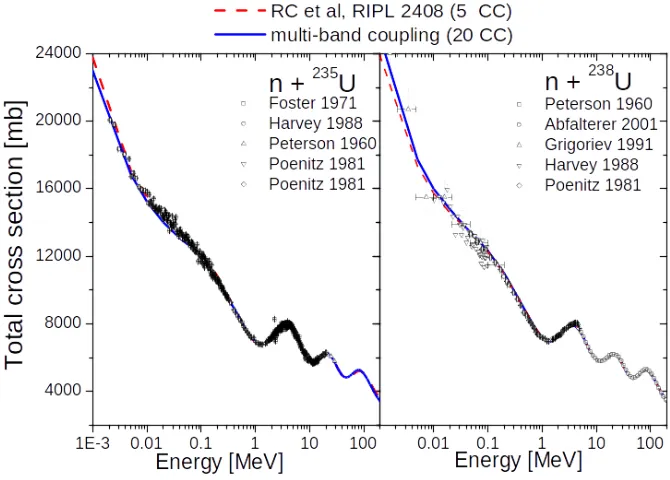
A dispersive and Lane consistent OMP with multiple-band coupling and energy independent geometry has been developed for nucleon scattering on odd actinides: 233,235,238U,239Pu, and 232Th. It’s has been optimized by a least-squares fit of a regional set of OMP parameters from (n,n),(p,p) & (p,n) reactions. It included couplings based on rigid rotor with dynamical corrections for rotational bands built on vibrational (even-even) or single-particle band-heads (odd nuclei). Fitted static deformations are in reasonable agreement with FRDM deformations theoretically derived by Moller and Nix [21]
References
[1] M. Salvatores et al., "Uncertainty and target accuracy assesment for innovative systems us-ing recent covariance data evaluations",International Evaluation Cooperation, Volume26, NEA no. 6410, Organization for Economic Cooperation and Development (OECD), Nuclear Energy Agency, Paris, France (2008).
[2] A.J. Plompen, T. Kawano, and R. Capote Noy, "Inelastic scattering and capture cross-section data of major actinides in the fast neutron region", Technical ReportINDC(NDS)-0597, International Atomic Energy Agency, Vienna, Austria (2012).
[3] D.W. Chanet al.,Phys. Rev.C26(1982) 841. [4] D.W. Chanet al.,Phys. Rev.C26(1982) 861.
[5] E. Sheldon. L.E. Beghian, D.W. Chanet al.,J.Phys.G:Nucl. Phys.12, 443 (1986).
[6] T. Kawano, N. Fujikawa, and Y. Kanda, "Evaluation of238U inelastic scattering cross section", Technical ReportJAERI-M-94-019,INDC(JPN)-169, Japan Atomic Energy Research Institute, Ibaraki-ken, Japan (1994).
[7] E. Sh. Sukhovitski˜ı and Yu.V. Porodzinski˜ı,Proc. of 9-th Int.Symposium on Capture Gamma-Ray Spectroscopy and Related Topics, Budapest , Hungary, Vol.1, p. 335 (1996).
[8] V.M. Maslov, Yu.V. Porodzinskij, N.A. Tetereva, M. Baba, and A. Hasegawa,Nucl. Phys.A764, 212–245 (2006).
[12] R. Capote, S. Chiba, E.Sh. Soukhovitski˜ı, J. M. Quesada, and E. Bauge,J. of Nucl. Sc. Tech.45, 333–340 (2008).
[13] J.M Quesada, E.S. Soukhovitski˜ı, R. Capote, and S. Chiba,EPJ Web of Conferences42, 02005 (2013).
[14] J.M. Quesada, R. Capote, E.Sh. Soukhovitskki˜ı, and S. Chiba,Nucl. Data Sheets118, 270–272 (2014).
[15] A.S. Davydov,Nucl. Phys.24, 682 (1961).
[16] A.S. Davydov and R.A. Sardaryan,Nucl. Phys.37, 106–118 (1962). [17] J.P. Davidson,Rev. Mod. Phys.37,105–158 (1965).
[18] A. Bohr,Mat. Fys. Medd. Dan. Vid. Selsk.26, No. 14 (1952).
[19] M. A. Preston and R. K. Bhaduri.Structure of the Nucleus,Addison-Wesley Publishing Com-pany, Inc. (1975).
[20] K. Hetch and G. R. Satchler,Nucl. Phys.32, 286–318 (1962).
[21] T. Belgya, O. Bersillon, R. Capote, T. Fukahori, G. Zhigang, S. Goriely, M. Herman, A. V. Ignatyuk, S. Kailas, A. Koning, P. Obložinský, V. Plujko, and P. Young, Handbook for calculations of nuclear reaction data, Reference Input Parameter Library-2. Technical Report
IAEA-TECDOC-1506, International Atomic Energy Agency, Vienna, Austria (2006).
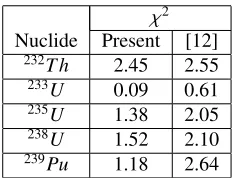
Table 1.Chi-square values of the optimum fit.
χ2 Nuclide Present [12]
232T h 2.45 2.55 233U 0.09 0.61
235U 1.38 2.05 238U 1.52 2.10