A Study of Pair Encodings:
Predicate Encryption in Prime Order Groups
Shashank Agrawal∗ Melissa Chase†
Abstract
Pair encodings and predicate encodings, recently introduced by Attrapadung (Eurocrypt 2014) and Wee (TCC 2014) respectively, greatly simplify the process of designing and analyzing pred-icate and attribute-based encryption schemes. However, they are still somewhat limited in that they are restricted to composite order groups, and the information theoretic properties are not sufficient to argue about many of the schemes. Here we focus on pair encodings, as the more general of the two. We first study the structure of these objects, then propose a new relaxed but still information theoretic security property. Next we show a generic construction for predicate encryption in prime order groups from our new property; it results in either semi-adaptive or full security depending on the encoding, and gives security under SXDH or DLIN. Finally, we demonstrate the range of our new property by using it to design the first semi-adaptively secure CP-ABE scheme with constant size ciphertexts.
Keywords.Predicate encryption, Attribute-based encryption, Pair encoding schemes, Dual sys-tem technique, Short ciphertexts
∗
University of Illinois Urbana-Champaign. Email:[email protected]. Part of this work was done when the author was at Microsoft Research.
†
1
Introduction
In traditional public key encryption systems, a message is encrypted under a particular public key, with the guarantee that it can only be decrypted by the party holding the corresponding secret key. Attribute based encryption (ABE), introduced in [SW05], instead allows us to use attributes to de-termine who has the power to decrypt. In these systems, there is a single entity which publishes system parameters and distributes the appropriate decryption keys to various parties. In key-policy ABE (KP-ABE) [GPSW06], a message is encrypted under a set of attributes describing that mes-sage, and each decryption key is associated with a policy describing which ciphertexts it can de-crypt. Conversely, in ciphertext-policy ABE (CP-ABE) [BSW07] each user is given a decryption key that depends on his attributes, and ciphertexts are encrypted with policies describing which users can decrypt them. ABE has been proposed for a variety of applications, from social net-work privacy to pay-per-view broadcasting to health record access-control to cloud security (see e.g. [PTMW06, TBEM08, BBS+09, APG+11, SRGS12]).
Recently there has been a lot of progress in terms of both security and functionality. Using the dual system framework introduced by Waters [Wat09], several works [LOS+10, LW12] have designed ABE schemes that satisfy the natural security definition, avoiding the restrictions of selective security1. Other works consider extra features like short ciphertexts whose length is independent of the size of the associated attribute set and policy [ALdP11, YAHK14], or “unbounded” schemes that place no bounds on the space of possible attributes or the number of attributes that can be tied to a ciphertext or key [LW11, OT12, RW13]. Predicate encryption [BSW11] generalizes the concept to require only that the ciphertext and key are associated with valuesx, y, and decryption succeeds iff some predicateP(x, y)holds. Note that in this work we assume that xand y are revealed by the ciphertext and key respectively; we do not consider attribute-hiding [BW07, KSW08] or predicate-hiding [SSW09, BRS13].
As these schemes have progressed, however, constructions and proofs have become increasingly complex. Many of the proposed schemes require composite order pairings, in which the order of the pairing groups is a product of two or more primes; since these schemes require that factoring the group order is hard, this in practice means that these groups must be at least an order of magnitude larger than prime order groups of comparable security level, and according to [Gui13] composite order pairing computations are at least 2 orders of magnitude slower. This has prompted efforts to design schemes in prime order groups [OT10, OT12, Fre10, Lew12, HHH+14], but many of these schemes still have fairly high cost as compared to their selectively secure counterparts, and designing and analyzing security of such schemes can be quite challenging.
Two very recent works, by Wee [Wee14] and Attrapadung [Att14] make significant progress in simplifying the design and analysis of new constructions. These works introduce simple new objects, called predicate encodings and pair encodings respectively in the two works, which can be used to construct ABE and other predicate encryption schemes. Essentially, they consider one decryption key and one ciphertext, and focus on what happens in the exponent space. Both formalisms introduce simple information theoretic properties on these objects and show that if these properties are met, they can be extended into fully secure ABE/predicate encryption schemes. The major advantage of this approach is that instead of having to design and prove security of a complex scheme, now all one has to do is design and analyze an appropriate encoding, which is a much simpler task. This vastly simplifies the design of new schemes, and in fact, both works resulted in new constructions and more efficient variants of previously known schemes.
1The original construction of Sahai and Waters [SW05], and much of the following work, considers what is referred to
Currently these works have two primary limitations. First, they both result in ABE schemes that rely on composite order pairings, which as explained above is very undesirable from an efficiency standpoint. The second drawback is that the strict information theoretic properties they require from the underlying objects mean that there are many constructions that they cannot capture in their model. Attrapadung [Att14] addresses this by introducing a computational security notion, which allows several more interesting constructions to be captured in the framework. However, this security notion is much harder to analyze - it involves not only the encodings in the exponent space, but also elements in the composite order group in which it is embedded, and the proofs that the encodings satisfy this notion are not only computational (rather than information theoretic) but are based on much stronger assumptions.
Still these encodings seem extremely promising as a way to simplify the design and analysis of predicate encryption schemes. In our work we further study these objects, with the aim of under-standing them better and beginning to address these limitations. In particular we focus on the pair encodings from [Att14], as they seem to be able to capture more constructions.
Our Contributions. First, we study thestructure of pair encodings. Attrapadung’s pair encodings have only limited structural requirements. This means that he is able to capture many existing con-structions in his framework, although as mentioned above, in many cases the information theoretic security property he defines does not hold for these schemes. A better understanding of the natural structure of these schemes may help to design new schemes, by providing better intuition for what is important and simply by limiting the search space.
Here we consider two structural properties. First we assume a simple property that describes where the public parameters appear in the key and ciphertext. This seems to reflect some basic structure, as all the pair encodings in [Att14] have this property. Looking ahead, this property allows us to instantiate these schemes efficiently in prime order groups. We then show that this implies a second, seemingly unrelated property involving the use of random variables in the key and ciphertexts. We can use this second property to simplify our security definitions and analyses.
Using this understanding, we propose arelaxation of the information theoretic security property
proposed in [Att14]. This property essentially allows us to consider the scheme at smaller granularity than an an entire key or ciphertext. It is still information theoretic, and it does not depend on the group in which it will be used; this means it is still easy to analyze whether a given encoding satisfies this property. We consider two flavors of this property and show that the stronger of the two is implied by the security properties in [Att14]. However, we will see that our new property is indeed a relaxation in that it allows us to consider encodings that did not satisfy the original property. Thus, we make a first step towards addressing the limitations of the strict information theoretic property of previous work.
Next we present ageneric construction of predicate encryptionfrom pair encodings. Here we make use of the dual system groups introduced by [CW13]; although we must modify their properties slightly, we show that their instantiations are still sufficient2. We show that pair encodings which satisfy the stronger flavor of our new property result in fully secure predicate encryption schemes, while pair encodings which satisfy the weaker flavor result in schemes which can still be shown to be semi-adaptively secure3. While full security is preferable, we will see that this second result allows us to design schemes in areas in which even selectively secure constructions are hard to construct.
This approach has two advantages. First, this means that we can transform any pair encoding
2
Since we use these groups in a black box way, any improvement in the underlying instantiation will translate directly into an improvement in our generic construction. In particular we believe that the simplified new dual system groups proposed in [CGW15] satisfy our modified definitions as well, so they could be used to simplify our construction.
3Unlike selective security, in semi-adaptive security an adversary is not forced to commit to the challenge before seeing
scheme which satisfies the information theoretic security properties in [Att14] into a fully secure ABE or predicate encryption scheme in a prime order group based only on the SXDH or DLIN assumption. This results in schemes which are of practical efficiency, with strong security guarantees based on mild assumptions. Moreover, the advantage of this approach is that while proof of our generic construction is fairly involved, analyzing a given pair encoding scheme to verify the necessary property is still quite straightforward.
Finally, to demonstrate how our relaxed security property allows us to consider additional func-tionalities, we present a new pair encoding forCP-ABE with constant-size ciphertext. When used in our generic construction, this results in a CP-ABE with constant size-ciphertext which is semi-adaptively secure and can be instantiated under eitherSXDHorDLIN. To the best of our knowledge, prior to our work there were no known schemes for constant-size CP-ABE, even considering only selectively security and allowing for very strong assumptions.4 This shows then that our new tech-niques allow us to consider a strictly greater range of schemes; we hope that they will continue to prove useful and lead to other interesting constructions.
Other related work. As mentioned above, the original works of [Wee14] and [Att14] gave con-structions only in composite order groups. In a recent work, however, Chen, Gay, and Wee [CGW15] proposed a transformation to go from pair encodings to prime order predicate encryption schemes, re-quiring the same strong information theoretic property on the underlying pair encoding as in [Wee14]. However, they also require strict restrictions on the structure of pair encodings, which are not satis-fied by most of the encodings which had previously been proposed; essentially this requires that there be only one unit of randomness in each ciphertext or key. They show that the previous encodings which satisfy the information theoretic property from [Att14] (the basic KP- and CP-ABE schemes) have counterparts which satisfy these stricter requirements. This results in the most efficient known constructions for a number of problems. As mentioned above, our generic construction can be ap-plied directly to the original pair encodings [Att14]; this will yield similar constructions, with slightly different tradeoffs (generally smaller public parameters but slower decryption). Interestingly, our re-laxed perfect security property is designed to leverage exactly the kind of structure they prohibit, so perhaps it suggests another way forward for predicates that cannot be addressed under their model.
In concurrent work, Attrapadung [Att15] proposed a generic construction that compiles any se-cure (computational or information-theoretic) pair encoding scheme for a predicateRto a fully secure FE scheme for the same predicate in prime-order groups under Matrix Diffie-Hellman assumption [EHK+13] (of whichDLINis a special case) with an additional q-type assumption in the case of pair encodings that only satisfy the computational security definition from [Att14]. This then also gives prime order group constructions for any predicate encoding scheme satisfying the strong information theoretic property under DLIN, and for KP-ABE with short ciphertext (as well as unbounded KP-ABE and ABE for regular languages) under a q-type assumption. However, as compared to this work, our results have the following advantages: First, we use dual system groups in a black box way, which simplifies the transformation, unifies prime and composite order group constructions, and means that any new construction of dual system groups directly gives new constructions for ABE. Moreover, our relaxed perfect security property allows us to show semi-adaptive security for the short ciphertext schemes based only on SXDH or DLIN, without any q-type assumptions; in addition to giving us the new results on CP-ABE, we can also give a much simpler proof of semi-adaptive security for Attrapadung’s KP-ABE with short ciphertexts, and this proof does not require q-type assumptions. (See Appendix E.)
Finally, we mention the concurrent work of Attrapadung, Hanaoka, and Yamada [AHY15]. This
4Here we discount threshold access policies because when only threshold policies are considered, CP-ABE and KP-ABE
work presents various conversions among pair encoding schemes. Among other things, they show that if one starts with the KP-ABE scheme with constant-size ciphertexts recently proposed by Takashima [Tak14], then by applying the conversion one gets a CP-ABE scheme with constant-size ciphertexts, which isselectively secure under theDLINassumption. On the other hand, we get a semi-adaptive
scheme secure under any assumption which can be used to construct dual system groups (which includes SXDH, DLIN, etc). Moreover, since Takashima’s construction does not use any abstractions, our construction is significantly more modular, easier to analyze and easier to extend. As we view the CP-ABE more as a test-case for the utility of our new definition and transformation, having an approach that can extend easily to other types of ABE schemes seems particularly valuable.
2
Preliminaries
We use∼=,≡and≈to denote statistical, perfect and computational indistinguishability respectively. Security parameter is denoted byλ, andnegl(λ)denotes a negligible function inλ.
We normally use lower case letters in bold to denote vectors; but if a vector’s elements are them-selves vectors, we use upper case. For two vectorsu = (u1, . . . , un) and v = (v1, . . . , vn), we useu ·v to denote the entry-wise product, i.e., (u1v1, . . . , unvn), and hu, vi to denote the inner-product, i.e., Pn
i=1uivi. The · operator naturally extends to vectors of vectors (or matrices): if
U= (u1, . . . ,um)andV= (v1, . . . ,vm), thenU·V= (u1·v1, . . . ,um·um).gushould be inter-preted as the vector(gu1, . . . , gun). gA, whereAis a matrix, should be interpreted in an analogous way.
We use u1, . . . ,um ← SampAlg(·) to denote that the algorithmSampAlg is runm times with independent coin tosses to generate samples u1, . . . ,um. Since the output of this algorithm is a vector, we also use (u1, . . . , un) ← SampAlg(·) to denote that a single sample with co-ordinates
u1, . . . , unis drawn fromSampAlg(this should not be confused with the previous notation). Finally,
a←RSdenotes drawing an elementauniformly at random from the setS.
Bilinear Pairings: LetG,HandGT be three multiplicative groups. A pairinge :G×H→ GT is bilinear if for allg∈G, h∈Handa, b∈Z,e(ga, hb) =e(g, h)ab. This pairing is non-degenerate if whenevere(g, h) = 1GT, then eitherg= 1G orh = 1H (where1G, for instance, denotes the identity element ofG.) We will only be interested in bilinear pairings that are efficiently computable.
The order of an elementgof a groupGis the smallest positive integerasuch thatga= 1G. The exponent of a group is defined as the least common multiple of the orders of all elements of the group. One can show that if a non-degenerate bilinear pairinge: G×H → GT can be defined over three groupsG,HandGT, then they all have the same exponent. We useexp(G)to denote the exponent of a groupG.
Homomorphism: A homomorphism from a grouphG,·ito a grouphH,⊕iis a functionψ:G→H
such that for allg1, g2 ∈ G, ψ(g1 ·g2) = ψ(g1)⊕ψ(g2). We define two sets with respect to a homomorphism:Image(ψ) ={ψ(g)|g∈G}andKernel(ψ) ={g∈G|ψ(g) = 1H}.
2.1 Predicate Encryption (PE)
An encryption scheme for a predicate familyP ={Pκ}κ∈Ncover a message spaceM={Mλ}λ∈N consists of fourPPTalgorithms which satisfy a correctness condition defined below.
MPK and a master secret keyMSK. The output of Setupdefines a number N ∈ N(perhaps
implicitly), andκis set to(N,par).
• Encrypt(MPK, x, m)→CT. The encryption algorithm takes public parametersMPK, anx∈ Xκ and anm∈ Mλas inputs, and outputs a ciphertextCT.
• KeyGen(MPK,MSK, y)→ SK. The key generation algorithm takes as input the public parame-tersMPK, the master secret keyMSKand ay∈ Yκ, and outputs a secret keySK.
• Decrypt(MPK,SK,CT) → m0. The decryption algorithm takes as input the public parameters
MPK, a secret keySKand a ciphertextCT, and outputs a messagem0 ∈ Mλ.
Correctness: For allpar, MPKandMSK output bySetup(1λ,par),m ∈ Mλ,x ∈ Xκ andy ∈ Yκ such thatPκ(x, y) = 1, if
CT←Encrypt(MPK, x, m) SK←KeyGen(MPK,MSK, y),
then
Pr[Decrypt(MPK,CT,SK)6=m]≤negl(λ),
where the probability is over the random coin tosses ofEncrypt,KeyGenandDecrypt.
Security: LetΠbe an encryption scheme for a predicate familyP ={Pκ}κ∈Ncover a message space
M={Mλ}λ∈N. Consider the following experimentExptA(b),Π(λ,par)between an adversaryAand a challengerChlforb∈ {0,1}when both are given input1λandpar:
1. Setup:ChlrunsSetup(1λ,par)to obtainMPKandMSK. It givesMPKtoA.
2. Query: A issues a key query by sendingy ∈ Yκ to Chl, and obtains SK ← KeyGen(MPK, MSK, y)in response. This step can be repeated any number of timesAdesires.
3. Challenge: A sends two messages m0, m1 ∈ Mλ and an x ∈ Xκ to Chl, and gets CT ← Encrypt(MPK, x, mb)as the challenge ciphertext.
4. Query: This step is identical to step2.
At the end of the experiment,Aoutputs a bit which is defined to be the output of the experiment. We call an adversary admissible if for everyy ∈ Yκ queried in steps2 and4,Pκ(x, y) = 0. This preventsAfrom succeeding in the experiment simply by decryptingCT.
Definition 1. An encryption scheme Π is adaptively or fully secure for a predicate family P =
{Pκ}κ∈Nc if for everyPPTadmissible adversaryAand everypar,
|Pr[Expt(0)A,Π(λ,par) = 1]−Pr[Expt(1)A,Π(λ,par) = 1]| ≤negl(λ),
where the probabilities are taken over the coin tosses ofAandChl. On the other hand,Πis semi-adaptively secure if the above condition is satisfied w.r.t. to a modified experiment whereAprovides x ∈ Xκ to Chl right after the setup phase (instead of the challenge phase), i.e., before it starts
3
Pair encoding schemes
The notion of pair encoding schemes (PES) was introduced by Attrapadung [Att14]. Our definition of this scheme is slightly different from the one given by [Att14] in that we place a restriction on the structure. Though the latter definition is more general, we believe that our formulation mirrors the concrete design of such schemes more closely. In particular, all the constructions of pair encoding schemes given in [Att14] fit into our framework without any changes.
We first present the definition given by Attrapadung and discuss the restrictions we impose af-terwards. A pair encoding scheme for a predicate family Pκ : Xκ × Yκ → {0,1} indexed by
κ = (N,par)consists of four polynomial-timedeterministic algorithms which satisfy a correctness condition as defined below.
• Param(par) → n. The Param algorithm takes the parameters par as input, and outputs a positive integern∈Nwhich specifies the number of common variables shared by the following
two algorithms. Letb:= (b1, b2, . . . , bn)denote the common variables.
• EncC(x, N) →(c:= (c1, c2, . . . , cw1);w2). TheEncCalgorithm takes anN ∈Nand anx∈ X(N,par)as inputs, and outputs a sequence ofw1polynomialsc1, c2, . . . , cw1 with coefficients
inZN and aw2 ∈ N. Every polynomialc`is a linear combination of monomials of the form
s, si, sbj, sibjin variabless, s1, s2, . . . , sw2 andb1, . . . , bn. More formally, for`∈[1, w1],
c` := ζ`s +
X
i∈[1,w2]
η`,isi +
X
j∈[1,n]
θ`,jsbj +
X
i∈[1,w2],j∈[1,n]
ϑ`,i,jsibj,
whereζ`, η`,i, θ`,j, ϑ`,i,j ∈ZN are constants which definec`.
• EncK(y, N)→(k:= (k1, k2, . . . , km1);m2). TheEncKalgorithm takes anN ∈Nand ay∈ Y(N,par)as inputs, and outputs a sequence ofm1polynomialsk1, k2, . . . , km1with coefficients
inZN and anm2 ∈N. Every polynomialktis a linear combination of monomials of the form
α, ri0, ri0bjin variablesα, r1, r2, . . . , rm
2 andb1, . . . , bn. More formally, fort∈[1, m1],
kt := τtα +
X
i0∈[1,m
2]
υt,i0ri0 +
X
i0∈[1,m
2],j∈[1,n]
φt,i0,jri0bj,
whereτt, υt,i0, φt,i0,j ∈ZN are constants which definekt.
• Pair(x, y, N)→ E. TheEncCalgorithm takes anN ∈N, anx∈ X(N,par)and ay ∈ Y(N,par)
as inputs, and outputs a matrixE∈ZmN1×w1.
Correctness: A pair encoding scheme is correct if for everyκ = (N,par),x∈ Xκandy∈ Yκsuch thatPκ(x, y) = 1, the following holds symbolically
kEcT = X
t∈[1,m1],
`∈[1,w1]
Et,`ktc` =αs.
Moreover, we can show that given the constraint onE, we can assume w.l.o.g. that the set of poly-nomials output byEncCandEncKhave a fairly restricted structure. In simple words, if a polynomial contains the monomialsibj (resp.ri0bj), then there must exist a polynomial whichonlycontains the monomialsi(resp.ri0). Further, there exists a polynomial with only the monomials.
In Appendix A, we formally show that for any pair encoding which satisfies the restriction onE, there is a corresponding one in which the polynomials output byEncCandEncKhave the additional structure described before, and this correspondence preserves all of the security properties defined in [Att14]. For the rest of this work then, we will assume that all pair encodings satisfy the properties listed above.
3.1 Security
Attrapadung provided two security notions for pair encoding schemes: perfect and computational. As discussed in Section 1, in this paper we focus on perfect security, which is the information theoretic property, for which we propose a relaxation. First, we restate here the original security definition given by Attrapadung (which is referred to asperfectly master-key hidingin his paper).
Definition 2(Perfect security [Att14]). A pair encoding scheme (Param,EncC, EncK,Pair) for a predicate familyPκ is perfectly secure if for every κ = (N,par), x ∈ Xκ andy ∈ Yκ such that
Pκ(x, y) = 0,
c(s,b),k(0,r,b)
≡ c(s,b),k(α,r,b)
, (1)
wheres←RZw2+1
N ,b←RZ n
N,r←RZmN2 andα←RZN.
We propose a new relaxed notion of perfect security that allows more flexibility in the design of pair encoding schemes. Very roughly, this property will allow us to add noise gradually to the param-eters used in the key, as long as this noise is not detectable given the relevant part of the key and the ciphertext. The goal is to eventually add sufficient noise to completely hide the master secret. Towards this, we define a newrandomized polynomial-time sampling algorithm for pair encoding schemes. While the algorithms above are used in the generic construction, theSampalgorithm described below will be used in the security proof.
• Samp(d, x, y, N) → (bd := (bd,1, bd,2, . . . , bd,n)). This algorithm takes a d ∈ [1, m2], an
N ∈N, anx∈ X(N,par), and ay∈ Y(N,par)as inputs, and outputs a sequence ofnnumbers in
ZN. We require that the probability of this algorithm producing(u·bd,1, u·bd,2, . . . , u·bd,n) as output is equal to the probability that it produces (bd,1, bd,2, . . . , bd,n) as output, for any
u∈Z∗ N.
Jumping ahead, the dependence of Samp on its inputs will play a crucial role in the proof of security of our generic construction. We will see that ifSampdoesn’t depend onx, then we can prove our construction to befullysecure. But in case it does, we can only provesemi-adaptivesecurity.
Recall thatEncKon inputy andN produces a sequence of polynomialsk(α,r,b)with coeffi-cients inZN, where every polynomial is a linear combination of monomials of the formα, ri0, ri0bj in variablesα, r1, r2, . . . , rm2 andb1, . . . , bn. In the following we usekd(α, rd,b), ford∈[1, m2],
to denote the polynomials inkobtained by setting all the variables in{r1, r2, . . . , rm2}exceptrdto 0. We are now ready to define our new notion of perfect security.
Definition 3(Relaxed perfect security). A pair encoding schemeΓ = (Param,EncC,EncK,Pair)for a predicate familyPκ is relaxed perfectly secure if there exists aPPT algorithmSamp (as defined
above) such that for everypar,x∈ Xκandy∈ Yκsuch thatPκ(x, y) = 0, and everyd∈[1, m2]:
wheres←RZw2+1
N ,b←RZnN,rd←RZN,bd←Samp(d, x, y, N). Furthermore,
c(s,b), X
d∈[1,m2]
kd(0, rd,b+bd)
N∈N
∼
=
c(s,b), X
d∈[1,m2]
kd(α, rd,b+bd)
N∈N
, (3)
wheres ←R Zw2+1
N ,b ←R ZnN, r1, r2, . . . , rm2 ←R ZN,α ←R ZN,bd ← Samp(d, x, y, N)for d∈[1, m2], and∼=denotes statistical indistinguishability. We sayΓsatisfiesstrongrelaxed perfect
security ifSampdoes not depend onx.
Note that in equations (2) and (3), we have distribution ensembles indexed by N, unlike the definition of perfect security where we are dealing with only one distribution. We require that the en-sembles are statistically indistinguishable from each other, which means that for large enough values ofN, the statistical distance between the distributions is negligible.
We now show that any pair encoding scheme that is perfectly secure under the original definition is also secure under the stronger flavor of the relaxed definition.
Lemma 1. LetΓ = (Param,EncC,EncK,Pair)be a pair encoding scheme. IfΓis prefectly secure (Definition 2), thenΓis also relaxed perfectly secure (Definition 3). Moreover, we can define aSamp
algorithm forΓthat does not depend on the inputx.
Proof. For any pair encoding schemeΓ, defineSampto output a vector of zeroes on any input. With this definition, (2) is trivially satisfied for everyd∈[1, m2], and the two distributions in (3) reduce to
c(s,b), X
d∈[1,m2]
kd(0, rd,b)
and
c(s,b), X
d∈[1,m2]
kd(α, rd,b)
. (4)
SinceΓis perfectly secure, we know that ifs ←R ZwN2+1, b ←R ZnN, r←R ZmN2 andα ←R ZN, then
{c(s,b),k(0,r,b)} ≡ {c(s,b),k(α,r,b)}.
We can replacek(α,r,b) with k(m2α,r,b) in the above without changing the joint distribution. Now, observe thatk(0,r,b) = P
d∈[1,m2]kd(0, rd,b)andk(m2α,r,b) =
P
d∈[1,m2]kd(α, rd,b)
symbolically. Therefore, the two distributions in (4) are identical.
4
Dual System Groups
Our construction of predicate encryption schemes from pair encodings is based on dual system groups (DSG), introduced by Chen and Wee [CW14a] in a recent work. Our formulation of DSG, given below, can be seen as a generalization of theirs. However, as we will show, both their instantiations satisfy the new properties without making any changes.
A dual system group is parameterized by a security parameterλand a numbern. It consists of sixPPTalgorithms as described below.
4.1 Syntax
– PPcontains a triple of groups(G,H,GT)and a non-degenerate bilinear mape:G×H→ GT, a homomorphism µ from H to GT, along with some additional parameters used bySampG, SampH. Given PP, we know the exponent of groupHand how to sample
uniformly from it. LetN = exp(H)(see Section 2). We require thatN is a product of
distinct primes ofΘ(λ)bits.
– SPcontains˜h∈H(whereh˜6= 1H) along with additional parameters used bySampGand SampH.
• SampGTtakes an element in the image ofµand outputs another element fromGT.
• SampG andSampH take PP as input and output a vector ofn+ 1elements from Gand H
respectively.
• SampGandSampHtake bothPPandSPas inputs and output a vector ofn+ 1elements from
GandHrespectively.
4.2 Properties
We require that all the properties below hold for every PP andSP output bySampP. LetSampG0
be the algorithm that outputs only the first element ofSampG. Analogously,SampH0,SampG0 and SampH0can be defined. A dual system group iscorrectif it satisfies the following two properties5:
Projective: For allh∈Hand coin tossesσ,SampGT(µ(h);σ) =e(SampG0(PP;σ), h).
Associative: If(g0, g1, . . . , gn)and(h0, h1, . . . , hn)are samples fromSampG(PP)andSampH(PP) respectively, then for alli∈[1, n],e(g0, hi) =e(gi, h0).
Forsecuritywe require the following three properties to hold:
Orthogonality:˜h∈Kernel(µ), i.e.,µ(˜h) = 1GT. Non-degeneracy:
1. SampH0(PP,SP)= ˜∼hδ, whereδ ←RZN.
2. ∃˜g∈Gs.t.SampG0(PP,SP)∼= ˜gα, whereα←RZN.
3. For allˆg0 ←SampG0(PP,SP),e(ˆg0,˜h)βis uniformly distributed overGT, whereβ ←RZN.
(Here∼=denotes statistical indistinguishability.)
Remark 1. In [CW14a], the non-degeneracy property is defined in a slightly different way. First, they require that for allˆh0 ← SampH0(PP,SP), ˜hlies in the group generated byˆh0, instead of the first point above. And secondly, they do not have any constraint on the output ofSampG0(PP,SP)like in the second point above. The third property, though, is also present in their definition6.
Indistinguishability.For two (positive) polynomialspoly1(·)andpoly2(·), defineG,H,Gˆ,Hˆ,Gˆ0,Hˆ0
as follows:
(PP,SP)←SampP(1λ,1n); γ1, γ2, . . . , γn←RZN;
g1,g2, . . . ,gpoly1(λ)←SampG(PP);G:= (g1,g2, . . . ,gpoly1(λ));
5Note that we have omitted the
H-subgroup property. It is required to construct encryption schemes with key delegation like HIBE. We do not use this property in our constructions.
6
h1,h2, . . . ,hpoly2(λ) ←SampH(PP);H:= (h1,h2, . . . ,hpoly2(λ));
∀i∈[1,poly1(λ)], ˆgi := (ˆgi,0, . . .)←SampG(PP,SP); gˆ0i := (1,gˆ γ1
i,0,gˆ γ2
i,0, . . . ,gˆ γn
i,0)
∀j∈[1,poly2(λ)], ˆhj := (ˆhj,0, . . .)←SampH(PP,SP); ˆh0j := (1,ˆh γ1
j,0,hˆ γ2
j,0, . . . ,ˆh γn
j,0)
ˆ
G:= (ˆg1,ˆg2, . . . ,ˆgpoly1(λ)); ˆ
H:= (hˆ1,hˆ2, . . . ,hˆpoly2(λ));
ˆ
G0:= (ˆg01,ˆg02, . . . ,ˆg0poly 1(λ));
ˆ
H0:= (hˆ01,hˆ02, . . . ,hˆ0poly 2(λ)).
We call a dual system groupLeft Subgroup Indistinguishable(LSI),Right Subgroup Indistinguishable
(RSI) andParameter hiding(PH) if for all polynomialspoly1(·)andpoly2(·),
{PP,G} ≈ {PP,G·G}ˆ , (5)
{PP,˜h,G·Gˆ,H} ≈ {PP,˜h,G·Gˆ,H·H}ˆ ,and (6)
{PP,˜h,Gˆ,H} ≡ {ˆ PP,˜h,Gˆ ·Gˆ0,Hˆ ·Hˆ0} (7)
hold respectively. Observe that the two distributions in (5) and (6) are computationally indistinguish-able, while the two distributions in (7) are identical.
Instantiations ofDSG.The three indistinguishability properties defined above are generalizations of the corresponding ones in Chen and Wee[CW14a]. In Appendix B, we show that the two instantia-tions ofDSG– in composite-order groups under the subgroup decision assumption and in prime-order groups under the decisional linear assumption (d-LIN) – given by [CW14a] satisfy our generalized indistinguishability properties as well as our new definition of non-degeneracy.
Remark 2. In the prime-order instantiation of dual system groups under thed-LINassumption given by [CW14a], an element from groupsGorHis represented byd+ 1elements from a source
prime-order group (an element fromGT is mapped to just one element of a target prime-order group). Now, suppose we have an encryption scheme in dual system groups where the ciphertext/key consists of elements fromGorH(and possibly an element fromGT). Then, a concrete instantiation in prime-order groups would only double the size of ciphertext/key, if we make theSXDHassumption (special case ofd-LINwithd= 1), and only triple it if we make theDLINassumption (special case ofd-LIN withd= 2).
5
Predicate encryption from pair encodings
In this section, we show how to construct a predicate encryption schemeΠP = (Setup,Encrypt, KeyGen,Decrypt)for any predicate familyP ={Pκ}κ∈Ncfor which we have a pair encoding scheme
ΓP = (Param,EncC,EncK,Pair), using dual system groups. The message space for ΠP would be the target group inDSG. Recall thatκspecifies a numberN ∈ Nand some additional parameters par.
• Setup(1λ,par): First runParam(par)to obtain n, then runSampP(1λ,1n) to obtain PP and
SP. Recall that givenPP, we know the exponent of groupHand can sample uniformly from it.
Output
MSK←RH MPK:= (PP, µ(MSK)).
• Encrypt(MPK, x, m): On input an x ∈ Xκ and an m ∈ GT, run EncC(x, N) to obtain a sequence ofw1 polynomials (c1, c2, . . . , cw1) and a w2 ∈ N. Draw w2 + 1 samples from
SampG:
(g0,0, . . . , g0,n)←SampG(PP;σ)
(g1,0, . . . , g1,n)←SampG(PP), . . . ,(gw2,0, . . . , gw2,n)←SampG(PP),
whereσdenotes the coin tosses used in drawing the first sample fromSampG.
Recall that the polynomialc`is given by
ζ`s +
X
i∈[1,w2]
η`,isi +
X
j∈[1,n]
θ`,jsbj +
X
i∈[1,w2],j∈[1,n]
ϑ`,i,jsibj,
whereζ`, η`,i, θ`,j, ϑ`,i,j ∈ ZN are constants. Output CT := (CT1, . . . ,CTw1,CTw1+1) as the
encryption ofmunderxwhere
CT` := gζ` 0,0 ·
Y
i∈[1,w2] gη`,i
i,0 · Y
j∈[1,n]
gθ`,j 0,j ·
Y
i∈[1,w2],j∈[1,n] gϑ`,i,j
i,j
for`∈[1, w1]andCTw1+1:=m·SampGT(µ(MSK);σ).Notice that the monomialss,si,sbj,
andsibj aremappedto group elementsg0,0,gi,0,g0,j, andgi,j, respectively.
• KeyGen(MPK,MSK, y): On input ay∈ Yκ, runEncK(y, N)to obtain a sequence ofm1 poly-nomials(k1, k2, . . . , km1)and anm2 ∈N. Drawm2samples fromSampH:
(h1,0, . . . , h1,n)←SampH(PP), . . . ,(hm2,0, . . . , hm2,n)←SampH(PP).
Output the key asSK:= (SK1,SK2, . . . ,SKm1)where fort∈[1, m1]
SKt := MSKτt ·
Y
i0∈[1,m
2] hυt,i0
i0,0 ·
Y
i0∈[1,m
2],j∈[1,n] hφt,i0,j
i0,j .
In this case, the variablesα,ri0, andri0bjare mapped toMSK,hi0,0, andhi0,j, respectively.
• Decrypt(MPK,SKy,CTx): On inputSKy := (SK1,SK2, . . . ,SKm1)andCTx:= (CT1, . . . ,CTw1+1),
runPair(x, y, N)to obtain anm1×w1matrixE. Output
CTw1+1·
Y
t∈[1,m1],`∈[1,w1]
e(CT`,SK Et,`
t )
−1
.
Correctness (Sketch). We know that ifPκ(x, y) = 1, thenPt∈[1,m1],`∈[1,w1]Et,`ktc` =αs.
Con-sider two polynomialsktandc`. When these polynomials are multiplied together, no two monomials – one fromktand one fromc`– combine to give the same monomial in the product polynomialktc`, except when
• sis multiplied withri0bj andsbj is multiplied withri0, or
because of the restriction on the form ofE. Now,sis mapped tog0,0,ri0bj is mapped to hi0,j,sbj is mapped tog0,j andri0 is mapped tohi0,0. By the associativity property of dual system groups, we know thate(g0,0, hi0,j) =e(g0,j, hi0,0).Further, we mappedsitogi,0andsibjtogi,j, and associativity guarantees thate(gi,0, hi0,j) =e(gi,j, hi0,0).Therefore, from the observations above, it follows that
Y
t∈[1,m1],`∈[1,w1]
e(CT`,SKEtt,`) =e(g0,0,MSK).
Finally, by projective property we know thate(g0,0,MSK) =SampGT(µ(MSK);σ).
Remark 3(Preserving size). Observe that the output of Encryptconsists of w1+ 1elements, w1 fromGand1fromGT, where w1 is the number of polynomials output byEncC. Further, any key has the same number of elements fromHas the number of polynomials output byEncK. Hence, in
particular, ifw1 (resp. m1) is a constant then ciphertexts (resp. keys) are also of constant size, in terms of dual system group elements. Further, if we instantiate dual system groups in prime-order groups underSXDHorDLINassumption, then the ciphertexts (resp. keys) would still be of constant size (see Remark 2.)
6
Proof of security
In this section, we show that the encryption scheme ΠP constructed for a predicate family P =
{Pκ}κ∈Nc in the previous section is secure using the properties of dual system groups and relaxed perfect security of pair encoding schemes. More formally, we prove the following theorem.
Theorem 1. For any predicate familyP = {Pκ}κ∈Nc, if ΓP = (Param,EncC,EncK,Pair) is a
relaxed perfectly securepair encoding scheme, then the encryption schemeΠP = (Setup,Encrypt, KeyGen,Decrypt)constructed in Section 5 (usingΓP) issemi-adaptivelysecure. Furthermore, if the
algorithmSampdoes not depend on inputx, thenΠP isfullysecure (see Definition 1).
Using Lemma 1, a corollary of the above theorem is that:
Corollary 2. For any predicate familyP ={Pκ}κ∈Nc, ifΓP = (Param,EncC,EncK,Pair,Samp)
is a perfectly secure pair encoding scheme, then the encryption scheme ΠP = (Setup,Encrypt, KeyGen,Decrypt)constructed in Section 5 (usingΓP) isfullysecure.
Recall that dual system groups can be instantiated in prime-order groups under thed-LIN assump-tion. Together with the above corollary, this gives a useful and interesting result:
Corollary 3. Every perfectly secure pair encoding scheme proposed by Attrapadung [Att14] has a fully secure predicate encryption scheme in prime order groups under thed-LINassumption.
The rest of this section is devoted to the proof of Theorem 1. We first define auxiliary algorithms for encryption and key generation.
• Encrypt(PP, x, m; (g00,g10, . . . ,g0w2),MSK): This algorithm is the same asEncryptexcept that it uses the inputg0i ∈Gn+1 instead of choosing samplesg
i fromSampGfori ∈[0, w2], and setsCTw1+1:=m·e(g
0
0,0,MSK), whereg00,0 if the first element of the vectorg00.
• KeyGen(PP,MSK, y; (h10, . . . ,h0m2)): This algorithm is the same asKeyGenexcept that it uses h0iinstead of the sampleshifromSampHfori∈[1, m2].
Table 1: Various types of keys
Type of key Inputs toKeyGen(besidesPPandy)
Normal MSK; (h1, . . . ,hm2)
ρ-Intermediate-1 MSK; (h1·˜hz1, . . . ,hρ−1·˜hzρ−1,hρ·ˆhρ,hρ+1, . . . ,hm2) ρ-Intermediate-2 MSK; (h1·˜hz1, . . . ,hρ−1·˜hzρ−1, hρ·hˆρ·˜hzρ ,hρ+1, . . . ,hm2) ρ-Intermediate-3 MSK; (h1·˜hz1, . . . ,hρ−1·˜hzρ−1, hρ·˜hzρ ,hρ+1, . . . ,hm2)
Pseudo-normal noisy MSK; (h1·ˆh1·˜hz1, . . . ,hm2 ·ˆhm2·h˜ zm2)
Pseudo-SF noisy MSK; (h1·hˆ1·h˜z1, . . . ,hm2 ·hˆm2·˜h zm2)
SF noisy MSK; (h1·˜hz1, . . . ,hm2·˜h zm2)
ρ-SF-intermediate-1 MSK; (h1, . . . ,hρ−1,hρ·hˆρ·h˜zρ,hρ+1·˜hzρ+1, . . . ,hm2 ·˜h zm2)
ρ-SF-intermediate-2 MSK; (h1, . . . ,hρ−1, hρ·hˆρ,hρ+1·˜hzρ+1, . . . ,hm2 ·˜h zm2)
ρ-SF-intermediate-3 MSK; (h1, . . . ,hρ−1, hρ,hρ+1·h˜zρ+1, . . . ,hm2·h˜ zm2)
SF MSK; (h1, . . . ,hm2)
• Semi-functional master secret keyis defined to beMSK:=MSK·h˜β whereβ ←RZN.
• Semi-functional ciphertextis given byEncrypt(PP, x, m;G·Gˆ,MSK)whereg1,g2, . . . ,gw2 ←
SampG(PP),ˆg1,ˆg2, . . . ,ˆgw2 ← SampG(PP,SP),G := (g1,g2, . . . ,gw2), andGˆ := (ˆg1,ˆg2, . . . ,ˆgw2). Observe thatEncrypt(PP, x, m;G,MSK)is identically distributed toEncrypt(MPK, x, m)– the normal ciphertext – by the projective property of dual system groups.
Table 1 defines various forms of keys forρ ∈ [1, m2]and the inputs that need to be passed to KeyGen(besidesPPandy) in order to generate them. Intermediate-3 and SF-intermediate-3 keys are
also defined forρ = 0(SF stands for semi-functional). In the table, h1, . . . ,hm2 ← SampH(PP), ˆ
h1, . . . ,ˆhm2 ←SampH(PP,SP), andzd := (1, zd,1, . . . , zd,n), where(zd,1, . . . , zd,n) ←Samp(d, x, y, N) for alld ∈ [1, m2]. For convenience in the following, we define a slightly modified form of Samp, called Samp, which just prepends 1 to the output of Samp. Note that 0-Intermediate-3 is distributed identically to a normal key and0-SF-intermediate-3 is distributed identically to a SF noisy key. Since we have many forms of keys, (where appropriate) we use a box to highlight the part of a key which is different from the previous key.
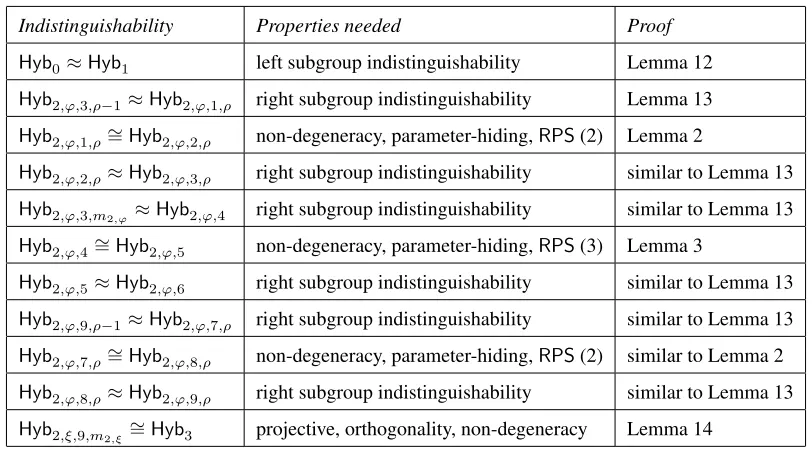
Proof structure: The novelty in our proof is that instead of working at the level of a key, we work at the level of samples that form the key. Letξdenote the number of queries made by the adversary, and letyϕ denote theϕth query forϕ∈ [1, ξ]. Further, letm2,ϕ be the second output ofEncK(yϕ, N). We define the following hybrids forϕ∈[1, ξ]andρ∈[1, m2,ϕ](fix anyb∈ {0,1}).
• Hyb0: This is the real security gameExpt(Ab),Π
P(λ,par)described in Section 2.1.
• Hyb1: This game is same as the above except that the ciphertext is semi-functional.
Indistinguishability Properties needed Proof
Hyb0≈Hyb1 left subgroup indistinguishability Lemma 12
Hyb2,ϕ,3,ρ−1≈Hyb2,ϕ,1,ρ right subgroup indistinguishability Lemma 13
Hyb2,ϕ,1,ρ∼=Hyb2,ϕ,2,ρ non-degeneracy, parameter-hiding,RPS(2) Lemma 2
Hyb2,ϕ,2,ρ≈Hyb2,ϕ,3,ρ right subgroup indistinguishability similar to Lemma 13
Hyb2,ϕ,3,m2,ϕ ≈Hyb2,ϕ,4 right subgroup indistinguishability similar to Lemma 13
Hyb2,ϕ,4∼=Hyb2,ϕ,5 non-degeneracy, parameter-hiding,RPS(3) Lemma 3
Hyb2,ϕ,5≈Hyb2,ϕ,6 right subgroup indistinguishability similar to Lemma 13
Hyb2,ϕ,9,ρ−1≈Hyb2,ϕ,7,ρ right subgroup indistinguishability similar to Lemma 13
Hyb2,ϕ,7,ρ∼=Hyb2,ϕ,8,ρ non-degeneracy, parameter-hiding,RPS(2) similar to Lemma 2
Hyb2,ϕ,8,ρ≈Hyb2,ϕ,9,ρ right subgroup indistinguishability similar to Lemma 13
Hyb2,ξ,9,m2,ξ ∼
=Hyb3 projective, orthogonality, non-degeneracy Lemma 14
Table 2: An outline of the proof structure. After proving a lemma for a certain pair of hybrids, we discuss how the proof can be modified to show indistinguishability of other related pairs. In the above, RPSis a shorthand for relaxed perfect security.
• Hyb2,ϕ,4: This game is same as the above except that theϕth key is Pseudo-normal noisy.
• Hyb2,ϕ,5: This game is same as the above except that theϕth key is Pseudo-SF noisy.
• Hyb2,ϕ,6: This game is same as the above except that theϕth key is SF noisy.
• Hyb2,ϕ,i,ρ fori ∈ {7,8,9}: This game is same as the above except that theϕth key is of the formρ-SF-intermediate-(i−6).
• Hyb3: This game is same asHyb2,ξ,9,m
2,ξ except that the ciphertext is a semi-functional en-cryption of a random message inGT.
Our goal is to show thatHyb0 andHyb3 are computationally indistinguishable from each other, for both values of the bitbused byChlin the security gameExpt(Ab),Π
P(λ,par). SinceChlencrypts a random message inHyb3, there would be no way for aPPTadversary to tell whetherm0 orm1was encrypted. This would imply thatΠP is a secure encryption scheme.
We formally prove the indistinguishability of hybrids that require relaxed perfect security, our new information-theoretic notion of security, in Lemma 2 and 3 below, but defer the proof of Lemma 12, 13, and 14 to Appendix C because they follow directly from the properties of dual system groups in a manner similar to Chen and Wee’s security proof for HIBE [CW14a]. Though Lemma 13 shows thatHyb2,ϕ,3,ρ−1 andHyb2,ϕ,1,ρ are computationally indistinguishable, we discuss immediately af-terwards how the proof can be modified to show indistinguishability of other related pairs of hybrids. We do the same with other lemmas too.
Remark 4(Full vs. semi-adaptive security.). In transitioning fromHyb2,ϕ,1,ρtoHyb2,ϕ,2,ρin Lemma 2, we add randomness using the algorithmSampto theρ-th sample of theϕ-th key. Observe that if Sampdepends on inputx, then this transition can only take place ifxis knownbeforeany key queries are issued. Therefore, in this case, we can prove semi-adaptive security. On the other hand, ifSamp does not depend onx, then we get full security (and as shown in Lemma 1, this is the case for all of the perfectly secure pair encoding schemes of [Att14]).
Remark 5(Perfectly secure encodings). Recall from the proof of Lemma 1 that for any perfectly secure pair encoding scheme, we can define a dummy sampling algorithm that always outputs a vector of 0s. When this is the case, the security proof can be considerably simplified: we could directly go from Hyb1 to Hyb2,ϕ,4 and also from Hyb2,ϕ,5 to Hyb2,ϕ,9,m2,ϕ using right subgroup indistinguishability.
Remark 6(Cost of our reduction). There are many complex predicates for which we do not know any perfectly secure pair encoding schemes. But if one can design a scheme that is relaxed per-fectly secure, then we show that an encryption scheme can be derived from it, which is secure under standard assumptions. The reduction cost of our security proof, however, is higher than usual: if an adversary makesξ queries andm2 is the maximum number of samples used in any key, then the cost isO(ξ·m2). For instance, this cost only depends on the number of pre-challenge queries in the case of Attrapadung’s computationally secure encodings (Theorem 1 in [Att14]). Note, however, that computational security of the encoding itself is proved underq-type assumptions.
Lemma 2. For everyϕ∈[1, ξ]andρ∈[1, m2,ϕ],Hyb2,ϕ,1,ρ ∼=Hyb2,ϕ,2,ρ.
Proof. GivenPP,MSKandh˜, one can generateMPKand every key except theϕth (because in order to generate this key and the ciphertext, we need to be able to sample fromSampHandSampG, for which secret parametersSPare required). Hence, it suffices to show that the following two distributions are statistically close (for clarity, we omitϕin the following):
{PP,MSK,˜h,Encrypt(PP, x, m;G·Gˆ,MSK),
KeyGen(PP,MSK, y; (h1·h˜z1, . . . ,hρ−1·˜hzρ−1,hρ·hˆρ,hρ+1, . . . ,hm2))},
{PP,MSK,˜h,Encrypt(PP, x, m;G·Gˆ,MSK),
KeyGen(PP,MSK, y; (h1·˜hz1, . . . ,hρ−1·˜hzρ−1,hρ·hˆρ·˜hzρ,hρ+1, . . . ,hm2))}.
But observe that:
Encrypt(PP, x, m;G·Gˆ,MSK) =Encrypt(PP, x, m;G,MSK)·Encrypt(PP, x,1;Gˆ,MSK),
KeyGen(PP,MSK, y; (h1·h˜z1, . . . ,hρ−1·˜hzρ−1,hρ·ˆhρ,hρ+1, . . . ,hm2))
=KeyGen(PP,MSK, y; (h1·˜hz1, . . . ,hρ−1·˜hzρ−1,hρ,hρ+1, . . . ,hm2))·
KeyGen(PP,MSK, y; (h1·˜hz1, . . . ,hρ−1·˜hzρ−1,hρ·ˆhρ·h˜zρ,hρ+1, . . . ,hm2)) =KeyGen(PP,MSK, y; (h1·˜hz1, . . . ,hρ−1·˜hzρ−1,hρ,hρ+1, . . . ,hm2))·
KeyGen(PP,1, y; (1, . . . ,1,hˆρ·˜hzρ,1, . . . ,1)),
because of the wayEncrypt and KeyGen are defined and bilinearity of e(see the construction in Section 5). The first component on the right hand side of each of the above equations can be generated givenPP,MSKandh˜. Hence, we only need to focus on the second components, i.e., it is enough to
show that the following two distributions are statistically close:
{PP,MSK,˜h,Encrypt(PP, x,1;Gˆ,MSK),KeyGen(PP,1, y; (1, . . . ,1,hˆρ,1, . . . ,1))}, (8)
{PP,MSK,˜h,Encrypt(PP, x,1;Gˆ,MSK),KeyGen(PP,1, y; (1, . . . ,1,hˆρ·h˜zρ,1, . . . ,1))}. (9)
Let us focus on the first distribution between the two above. By the parameter-hiding property of dual system groups we know that{PP,˜h,Gˆ,hˆρ}and{PP,h,˜ G·ˆ Gˆ0,hˆρ·hˆ0ρ}are identically distributed. Hence (8) is identically distributed to
{PP,MSK,˜h,Encrypt(PP, x,1;Gˆ ·Gˆ0,MSK),KeyGen(PP,1, y; (1, . . . ,1,hˆρ·hˆ0ρ,1, . . . ,1))}. (10)
LetCTˆ := ( ˆCT1, . . . ,CTˆ w1+1)andSKˆ := ( ˆSK1, . . . ,SKˆm1)denote the output ofEncryptandKeyGen
respectively. We know that for`∈[1, w1],
ˆ
CT` = gˆ0ζ`,0 ·
Y
i∈[1,w2] ˆ gη`,i
i,0 · Y
j∈[1,n]
(ˆg0,j·ˆg γj
0,0)θ`,j ·
Y
i∈[1,w2],j∈[1,n] (ˆgi,j·gˆ
γj
i,0)ϑ`,i,j,
where(ˆgi,0, . . . ,gˆi,n) ← SampG(PP,SP)fori ∈ [0, w2]andγ1, . . . , γn ←R ZN. Also,CTˆw1+1 = e(ˆg0,0,MSK). Using the non-degeneracy property of dual system groups, we can writeˆg0,0 andˆgi,0 as˜gδandg˜δi respectively, fori∈[1, w
2], whereδ, δ1, . . . , δw2 ←RZN. Then we considerˆg0,j(and ˆ
gi,j) forj= 1, . . . , nto be values sampled fromSampGconditioned on the value ofgˆ0,0(resp.gˆi,0). (These values may not be efficiently sampleable.) Therefore, we have
ˆ
CT` = g˜ζ`δ+
P
i∈[1,w2]η`,iδi+Pj∈[1,n]θ`,jδγj+Pi∈[1,w2],j∈[1,n]ϑ`,i,jδiγj·
Y
j∈[1,n]
ˆ gθ`,j
0,j ·
Y
i∈[1,w2],j∈[1,n] ˆ gϑ`,i,j
i,j (11)
Shifting our focus to the key, we know that itstth component is given by
ˆ
SKt = hˆυρ,t,ρ0 · Y
j∈[1,n]
(ˆhρ,j·hˆ γj
ρ,0)φt,ρ,j,
fort ∈ [1, m1], where (ˆhρ,0, . . . ,ˆhρ,n) ← SampH(PP,SP). Using non-degeneracy once again, we can writehˆρ,0as˜hωfor anω←RZN, and considerˆhρ,j forj= 1, . . . , nto be sampled fromSampH conditioned on the value ofhˆρ,0. Hence,
ˆ
SKt = ˜hυt,ρω+
P
j∈[1,n]φt,ρ,jωγj · Y
j∈[1,n]
ˆ hφt,ρ,j
ρ,j . (12)
Now, observe the superscripts of g˜ and ˜h in (11) and (12) respectively (over ` ∈ [1, w1] and
we can use the first property (2) of relaxed perfect security to add noise to theρ-th sample used in the key. But the problem is that in any sample drawn fromSampGandSampH, elements of the sample may depend on each other. In particulargˆ0,jmay reveal some information aboutδ, and similarly for
ˆ
gi,j and forˆhρ,j, so we must ensure that (2) applies even given this information. Recall the discussion onstructural restrictionsafter the definition of pair encoding schemes. We know that ifϑ`,i,j 6= 0for any` ∈ [1, w1]andj ∈ [1, n](otherwise, we don’t need to worry aboutˆgi,j), thenδi is an explicit part of the encoding output byEncC. Similarly, ifφt,ρ,j 6= 0for anyt∈[1, m1]andj∈[1, n], then
ωis an explicit part of the encoding output byEncK. Further,δis always explicit. Therefore, given a sample from either of the distributions in (2), one can compute the first element of the samples from SampGandSampH, and then draw rest of the elements conditioned on the first ones.
In a nutshell, we can apply (2) to conclude that the distribution
{PP,MSK,˜h,( ˆCT1, . . . ,CTˆw1+1),( ˆSK1, . . . ,SKˆm1)}
is statistically close to
{PP,MSK,h,˜ ( ˆCT1, . . . ,CTˆ w1+1),( ˜SK1, . . . ,SK˜m1)},
where
˜
SKt := ˜hυt,ρω+
P
j∈[1,n]φt,ρ,jω(γj+zj) · Y
j∈[1,n]
ˆ hφt,ρ,j
ρ,j
= ˜hυt,ρω+Pj∈[1,n]φt,ρ,jωγj · Y
j∈[1,n]
(ˆhρ,j·˜hωzj)φt,ρ,j,
fort∈[1, m1], andzρ= (z1, . . . , zn)← Samp(ρ, x, y, N). We use the fact thatδis always explicit to generate thew1+ 1th component of the ciphertext.
Observe that the only difference betweenSKˆtandSK˜ tis that an extra˜hωzjis multiplied withhˆρ,j in the latter case. Hence, the key( ˜SK1, . . . ,SK˜ m1)can be generated by giving ˆhρ·hˆ
0
ρ·˜hzρ as the
ρ-th sample toKeyGen(zρhas the same distribution asω·zρsinceω ∈Z∗N with high probability). Therefore, (10) is statistically close to
{PP,MSK,˜h,Encrypt(PP, x,1;Gˆ ·Gˆ0,MSK),KeyGen(PP,1, y; (1, . . . ,1,hˆρ·ˆh0ρ·h˜zρ,
1, . . . ,1)).
Using parameter-hiding once again, we can show that the above distribution is identical to
{PP,MSK,˜h,Encrypt(PP, x,1;Gˆ,MSK),KeyGen(PP,1, y; (1, . . . ,1,hˆρ·˜hzρ,1, . . . ,1)),
which completes the proof.
The above proof can be easily adapted to show thatHyb2,ϕ,7,ρ ∼=Hyb2,ϕ,8,ρ. In this case, we want that the two distributions
{PP,MSK,˜h,Encrypt(PP, x, m;G·Gˆ,MSK),
KeyGen(PP,MSK, y; (h1, . . . ,hρ−1,hρ·ˆhρ·h˜zρ,hρ+1·˜hzρ+1, . . . ,hm2·˜h zm2))},
{PP,MSK,˜h,Encrypt(PP, x, m;G·Gˆ,MSK),
are indistinguishable from each other. Observe that the only difference now is that we have MSK
instead ofMSK, and noise is present in the samplesρ+ 1, . . . , ninstead of1, . . . , ρ−1. So, we can splitEncryptandKeyGenin a way similar to the above proof, and once again it suffices to show that exactly the distributions in (8) and (9) are indistinguishable.
Lemma 3. For everyϕ∈[1, ξ],Hyb2,ϕ,4 ∼=Hyb2,ϕ,5.
Proof. This proof proceeds in a manner similar to the proof of Lemma 2. To begin with, we observe as before that givenPP,MSKand˜h, one can generateMPKand every key except theϕth (for clarity, we omitϕbelow). Hence, it suffices to show that the distribution
{PP,MSK,˜h,Encrypt(PP, x, m;G·Gˆ,MSK),KeyGen(PP,MSK, y; (h1·hˆ1·˜hz1, . . . ,
hm2 ·hˆm2·˜h zm2))},
is statistically close to a distribution whereMSKis replaced byMSK, the semi-functional master secret
key. Further,
Encrypt(PP, x, m;G·Gˆ,MSK) =Encrypt(PP, x, m;G,MSK)·Encrypt(PP, x,1;Gˆ,MSK),
KeyGen(PP,MSK, y; (h1·ˆh1·h˜z1, . . . ,hm2 ·hˆm2·h˜ zm2))
=KeyGen(PP,MSK, y; (h1, . . . ,hm2))·KeyGen(PP,1, y; (ˆh1·˜h
z1, . . . ,hˆ
m2 ·˜h zm2)),
KeyGen(PP,MSK, y; (h1·ˆh1·h˜z1, . . . ,hm2 ·hˆm2·h˜ zm2))
=KeyGen(PP,MSK, y; (h1, . . . ,hm2))·KeyGen(PP,˜h
β, y; (ˆh
1·˜hz1, . . . ,hˆm2 ·˜h zm2)),
whereβ ←R ZN. The first component on the right hand side of each of the above equations can be generated givenPP,MSKand˜h. Hence, it is enough to show that the following two distributions are statistically close:
{PP,MSK,˜h,Encrypt(PP, x,1;Gˆ,MSK),KeyGen(PP,1, y; (hˆ1·˜hz1, . . . ,hˆm2·˜h
zm2))}, (13)
{PP,MSK,˜h,Encrypt(PP, x,1;Gˆ,MSK),KeyGen(PP,˜hβ, y; (hˆ1·˜hz1, . . . ,ˆhm2·h˜
zm2))}. (14)
Let us focus on the first distribution between the two above. By the parameter-hiding property of dual system groups, it is identically distributed to
{PP,MSK,˜h,Encrypt(PP, x,1;Gˆ ·Gˆ0,MSK),KeyGen(PP,1, y; (hˆ1·ˆh01·˜hz1, . . . ,
ˆ hm2 ·ˆh
0 m2 ·˜h
zm2))}. (15)
LetCTˆ := ( ˆCT1, . . . ,CTˆ w1+1)andSKˆ := ( ˆSK1, . . . ,SKˆm1)denote the output ofEncryptandKeyGen
respectively. We know that for`∈[1, w1],
ˆ
CT` = gˆ0ζ`,0 ·
Y
i∈[1,w2] ˆ
gi,η`,i0 · Y
j∈[1,n]
(ˆg0,j·ˆg γj
0,0)θ`,j ·
Y
i∈[1,w2],j∈[1,n] (ˆgi,j·gˆ
γj
i,0) ϑ`,i,j,
where (ˆgi,0, . . . ,ˆgi,n) ← SampG(PP,SP) for i ∈ [0, w2] and γ1, . . . , γn ←R ZN. Using non-degeneracy property of dual system groups, we can writegˆ0,0 andgˆi,0 asg˜δ and ˜gδi respectively, fori∈[1, w2], whereδ, δ1, . . . , δw2 ←RZN. Therefore, we have
ˆ
CT` = g˜ζ`δ+
P
i∈[1,w2]η`,iδi+Pj∈[1,n]θ`,jδγj+Pi∈[1,w2],j∈[1,n]ϑ`,i,jδiγj·
Y
j∈[1,n]
ˆ gθ`,j
0,j ·
Y
i∈[1,w2],j∈[1,n] ˆ gϑ`,i,j
Shifting our focus to the key, we know that itstth component is given by
ˆ
SKt =
Y
i0∈[1,m
2] ˆ
hυi0t,i,00 ·
Y
i0∈[1,m
2],j∈[1,n]
(ˆhi0,j·ˆhγj
i0,0·h˜zi0,j)φt,i0,j,
fort∈[1, m1], where(ˆhi0,0, . . . ,ˆhi0,n)←SampH(PP,SP)and(zi0,1, . . . , zi0,n)←Samp(i0, x, y, N) fori0 ∈ [1, m2]. Using non-degeneracy once again, we can writehˆi0,0 as˜hωi0 for anωi0 ←R ZN. Hence,
ˆ
SKt = h˜
P
i0∈[1,m2][υt,i0ωi0+
P
j∈[1,n](φt,i0,jωi0γj+φt,i0,jzi0,j)] · Y
i0∈[1,m
2],j∈[1,n] ˆ hφt,i0,j
i0,j
= h˜
P
i0∈[1,m2][υt,i0ωi0+
P
j∈[1,n](φt,i0,jωi0(γj+zi0,j))] · Y
i0∈[1,m
2],j∈[1,n] ˆ hφt,i0,j
i0,j , (17)
since the distribution of(zi0,1, . . . , zi0,n)is statistically close to(ωi0zi0,1, . . . , ωi0zi0,n)(with high prob-abilityωi0 ∈Z∗
N) for alli0∈[1, m2].
Now, observe the superscripts of g˜ and ˜h in (16) and (17) respectively (over ` ∈ [1, w1] and
t ∈ [1, m1]). We know that δ, δ1, . . . , δw2,γ1, . . . , γn andω1, . . . , ωm2 are randomly chosen from
ZN. Hence, we can use the second property (3) of relaxed perfect security to add noise to the master secret key. (The dependencies between the elements of the samples drawn fromSampGandSampH can be handled as in the previous proof.) Therefore, we have that the distribution
{PP,MSK,˜h,( ˆCT1, . . . ,CTˆw1+1),( ˆSK1, . . . ,SKˆm1)}
is statistically close to
{PP,MSK,h,˜ ( ˆCT1, . . . ,CTˆ w1+1),( ˜SK1, . . . ,SK˜m1)},
where
˜
SKt := ˜hτtβ+
P
i0∈[1,m2][υt,i0ωi0+
P
j∈[1,n](φt,i0,jωi0(γj+zi0,j))] · Y
i0∈[1,m
2],j∈[1,n] ˆ hφt,i0,j
i0,j ,
fort∈[1, m1], andβ ←RZN. Observe that the only difference betweenSKˆ tandSK˜tis that an extra
τtβ is begin added to the exponent of˜h in the latter case. Hence, the key( ˜SK1, . . . ,SK˜m1) can be
generated by providing˜hβas master secret key toKeyGen. Therefore, (15) is statistically close to
{PP,MSK,˜h,Encrypt(PP, x,1;Gˆ ·Gˆ0,MSK),KeyGen(PP,˜hβ, y; (hˆ1·ˆh01·˜hz1, . . . ,
ˆ hm2 ·hˆ
0 m2·˜h
zm2))}.
Using parameter-hiding once again, we can show that the above distribution is identical to
{PP,MSK,˜h,Encrypt(PP, x,1;Gˆ,MSK),KeyGen(PP,h˜β, y; (ˆh1·˜hz1, . . . ,ˆhm2 ·˜h zm2))},
7
Ciphertext-Policy ABE
In this section, we design a relaxed perfectly secure pair encoding scheme for Ciphertext-Policy Attribute Based Encryption (CP-ABE). The access policy is represented by a linear secret sharing (LSS) scheme(A, π), whereA is a matrix of sizen1 ×n2 with entries inZN andπ is a mapping from[1, n1]to a universe of attributesU. Letaidenote theith row ofAfori∈[1, n1]. LetS⊆ Ube a set of attributes andΥ ={i|i∈[1, n1], π(i)∈S}be the indices of rows inAassociated withS.
We say that the LSS scheme (A, π) accepts S if e = (1,0, . . . ,0) lies in the span of rows associated withS (otherwise the scheme rejectsS). In other words, ifS is acceptable, there exists constants{εi}i∈Υsuch thatPi∈Υεiai =e. (This set of constants can be easily computed givenS.) An interesting property of LSS schemes that will be useful to us later in the proofs is that if(A, π)
rejectsS, then there must exist a vectorw= (w1, . . . , wn2)such thathw,aii = 0for alli∈ Υbut hw,ei = 1. This, in particular, implies thatw1 = 1. (See [Bei11], Claim2, for a proof of this and other properties below about secret sharing schemes.)
In order to share a secrets∈ ZN, one picksv2, v3, . . . , vn1 ←R ZN, and outputshai,vias the ith share for i ∈ [1, n1], wherev = (s, v2, v3, . . . , vn1). This way of sharing a secret leads to two
useful properties:
• Correctness: For everySaccepted by(A, π), every secrets∈ZN and anyv2, v3, . . . , vn1 ∈
ZN, P
i∈Υεihai,vi=hv,
P
i∈Υεiaii=s.
• Privacy: For everySrejected by(A, π), the distribution of{hai,vi}i∈Υis independent of the secretsbeing shared.
The predicate family for CP-ABE is indexed byκ = (N, n1, n2,U, T). Xκ is the set of all LSS schemes where the matrix is of sizen1×n2with entries inZN and the mapping is from[1, n1]toU.
Yκis given by the set{S |S ⊆ U,|S| ≤ T}. For allx ∈ Xκandy ∈ Yκ,Pκ(x, y) = 1if and only ifxacceptsy. It is clear from our definition of predicate family that there is a bound on the size of matrices and the number of attributes associated with a key. But there are no other restrictions: the size of attribute universeU could be arbitrary andπneed not be injective. Without loss of generality, we assumeU to beZN.
We are now ready to design a relaxed perfectly secure pair encoding schemeΦcp-abe = (Param,
EncC,EncK,Pair)for the CP-ABE predicate family.
7.1 Pair Encoding Scheme
• Param(par)→n1(n2+T + 1). Letb= ({bi,j}i∈[1,n1],j∈[1,n2],{b
0
i,t}i∈[1,n1],t∈[0,T]). • EncC((A, π), N)→c(s,b) := (c1, c2)where
c1 =s c2 =s
X
i∈[1,n1]
j∈[1,n2]
ai,jbi,j+ X
i∈[1,n1]
t∈[0,T]
π(i)tb0i,t
,
ands= (s), andai,j denotes the entry in theith row andjth column ofA.
• EncK(S, N)→k(α,r,b) := ({k1,i, k2,i,jk3,i,`,j, k4,i,yk5,i,`,t}i,`∈[1,n1],i6=`,j∈[1,n2],y∈S,t∈[0,T])
where
k4,i,y=ri X
t∈[0,T]
ytb0i,t k5,i,`,t=rib0`,t
andr= (r1, r2, . . . , rn1, v2, . . . , vn2)andv1 =α.
We informally discuss how to recover αs by combining the polynomials generated by EncC andEncK, with an intent to provide some intuition about the scheme, and defer a formal proof to Appendix D. We can think ofv2, v3, . . . , vn1 as the randomness picked in order to share v1 = α
according to the scheme(A, π). Hence, if we findhai,vi for alli ∈ Υ, we can recoverα (ignore
sfor now). One could start out by multiplying ai,j by k2,i,j and summing over j, for an i ∈ Υ. This does giveP
jai,jvjbut also produces an extra termriPjai,jbi,j (ignorerifor now). We could try to get rid of this term by usingc2 but the product ai,jbi,j there is also summed overi(since we wantEncCto produce a constant number of polynomials, we are forced to pack as much into one polynomial as possible). Fortunately, we have the polynomialsk3,i,`,j for ` 6= i. We can multiply these bya`,jand remove the unwantedai,jbi,j terms. But we are not done yet: we must also remove the termP
i,tπ(i)tb 0
i,t left in the mix because we usedc2. Ifπ(i)∈S, then this is easy: usek4,i,π(i) to removeP
tπ(i)tb 0
i,t, andk5,i,`,t·π(`)tto remove the rest. However, ifπ(i) ∈/ S, there is no way to do this.
7.2 Relaxed Perfect Security
We now prove that the pair encoding scheme Φcp-abe designed above is relaxed perfectly secure
(Definition 3). Towards this, we first define a sampling algorithm Samp as follows. On input an
i∈[1, n1],(A, π) ∈ Xκ,S ∈ YκandN,Sampchecks whetherπ(i) ∈/ S. If yes, it picks elements
ˆbi,1,ˆbi,2, . . . ,ˆbi,n
2 independently and uniformly fromZN; otherwise it picks them uniformly but with
the constraint thatP
j∈[1,n2]ai,j
ˆbi,j = 0. Sampoutputs
b
bi:= (0, . . . , . . . , . . . ,0 | {z }
(i−1)n2
,ˆbi,1,ˆbi,2, . . . ,ˆbi,n2,0, . . . , . . . , . . . , . . . ,0
| {z }
(n1−i)n2+n1(T+ 1)
). (18)
Observe that the output ofSampdepends on(A, π), the input toEncC. Hence, this sampling algo-rithm would lead to a semi-adaptively secure scheme.
We consider only thoseN ∈Nwhich are a product of distinct primes ofΘ(λ)bits. This is suf-ficient for our purposes because theSetupalgorithm of the generic construction in Section 5 defines
N of exactly this form. We first show that for alli∈[1, n1]andN ∈N,
c(s,b),ki(0, ri,b)
≡ c(s,b),ki(0, ri,b+bbi)
, (19)
wheres ←R Z1
N,b ←R ZnN,ri ←R ZN,bbi ← Samp(i,(A, π), S, N). Recall thatki denotes the polynomials in k obtained by setting all the variables inr = (r1, r2, . . . , rn1, v2, . . . , vn2) except
the ith to 0. For i ∈ [n1 + 1, n1 + n2 −1], the only polynomial in ki is −vi−n1+1, or, more
importantly, there is no monomial with anyb. Hence, the equation above trivially holds foriin this range irrespective of whatSampoutputs. (That is why we don’t care about definingSamp’s behavior on such inputs.)
Let us refer to the left and right distributions in Equation (19) as∆Land∆Rrespectively. Fix an arbitraryi∗∈[1, n1]. By the definition ofki∗, we know that in these two distributions only those com-ponents of the key survive which have subscripti∗. Further, in the componentsk2,i∗,1, . . . , k2,i∗,n
2,
the variablesv1, . . . , vn2 are all set to0. Now, focus on the distribution∆R. It is clear from Equation