Round and Communication Efficient Unconditionally-secure
MPC with
t < n/
3
in Partially Synchronous Network
Ashish Choudhury∗ Arpita Patra† Divya Ravi‡
Abstract
In this work, we study unconditionally-secure multi-party computation (MPC) toleratingt < n/3 corrupti-ons, wherenis the total number of parties involved. In this setting, it is well known that if the underlying network iscompletely asynchronous, then one can achieve onlystatisticalsecurity; moreover it is impos-sibleto ensureinput provisionand consider inputs of all the honest parties. The best known statistically-secure asynchronous MPC (AMPC) witht < n/3requires a communication ofΩ(n5)field elements per multiplication. We consider apartially synchronoussetting, where the parties are assumed to be globally synchronized initially for few rounds and then the network becomes completely asynchronous. In such a setting, we present a MPC protocol, which requiresO(n2)communication per multiplication while ensuring input provision. Our MPC protocol relies on a new four round, communication efficient statistical verifia-ble secret-sharing(VSS) protocol with broadcast communication complexityindependentof the number of secret-shared values.
1
Introduction
Threshold unconditionally-secure multiparty computation (MPC) is a fundamental problem in secure distribu-ted computing [40,26,8,12,38,2]. Informally, an MPC protocol enables a set ofnmutually distrusting parties to jointly and securely compute a publicly known function f of their private inputs over some finite field F, even in the presence of acomputationally unbounded active adversaryAdv, who can corrupt anytout of the
nparties. Let the parties be connected by pair-wise secure (private and authentic) channels. Then in the syn-chronouscommunication setting, where the parties are assumed to be synchronized through a global clock, it is known thatperfectly-secureMPC is possible if and only ift < n/3[8]. If a common broadcast channel is also available to the parties in addition to the pair-wise secure channels, then one can tolerate uptot < n/2 corrupti-ons, albeit withstatistical security1[38]. The resilience bounds become different if one considers a completely
asynchronoussetting, where parties are not synchronized and messages can be arbitrarily delayed. Specifically, perfectly-secure asynchronous MPC (AMPC) is possible if and only ift < n/4[7], while statistically-secure AMPC is possible if and only ift < n/3[9].
Feasibility Results for Unconditionally-secure MPC: In any general MPC protocol [8,12,38,2,27,3,20, 4,5,10,15], the functionf is usually expressed as an arithmetic circuit (consisting of addition and multipli-cation gates) overFand then the protocol “securely" evaluates each gate in the circuit in a shared/distributed fashion. More specifically, each party secret-shares its inputs among the parties using a linear secret-sharing
∗
International Institute of Information Technology Bangalore, India. Email: [email protected]. Financial support from Infosys Foundation acknowledged.
†
Indian Institute of Science, India. Email: [email protected]. Work partially supported by INSPIRE Faculty Fellowship (DST/INSPIRE/04/2014/015727) from Department of Science & Technology, India.
‡
Indian Institute of Science, India. Email:[email protected]. 1
scheme (LSS) [17], say Shamir [39], with threshold2 t. The parties then interact to maintain the following invariant for each gate:given the gate inputs in a shared fashion, the gate output is computed in a secret-shared fashion. Finally the (shared) circuit output is publicly reconstructed. Intuitively, the privacy follows since each intermediate value in the above process remains secret-shared with thresholdt. Due to thelinearity
of the LSS, the addition (linear) gates are evaluated locallyby the parties. However, maintaining the above invariant for the multiplication (non-linear) gates requires interaction among the parties. The focus therefore is rightfully placed on measuring the communication complexity (namely the totalnumber of field elements communicated) required to evaluate the multiplication gates in the circuit. In the recent past, a lot of work has been done to design communication-efficient MPC protocols; we summarize the relevant works here.
Witht < n/3, [5] presents a perfectly-secure MPC protocol withO(n)amortized communication complex-ity3per multiplication, while [10] presents a statistically-secure MPC protocol witht < n/2with almostO(n)
communication complexity per multiplication. Both these results are in the synchronous setting and require
non-constantnumber of rounds of interaction among the parties. While the protocol of [5] requiresΘ(n+D)
rounds, the protocol of [10] requiresΘ(n2+D)rounds, whereDdenotes themultiplicative depthof the circuit.
A major drawback of the synchronous setting is that it does not model real life networks like the Internet accurately where it is very hard to ensure that the users are synchronized through a global clock and that there exists a strict a priori known upper bound on the message delivery. Real life networks can be modelled more appropriately by the asynchronous setting, where there are no known upper bounds and messages are delivered arbitrarily (the only guarantee given in this model is that the messages sent by the honest parties will reach to their desitination eventually). Hence designing AMPC protocols is practically motivated. However, an inherent challenge in designing protocols in a completely asynchronous setting is that it is impossible to distinguish between aslow, but honest party (whose messages are delayed arbitrarily) and a corrupt party (who do not send any message at all). Hence in a completely asynchronous protocol, no party can afford to receive messages from all thenparties, as the wait may turn out to be an endless wait. So as soon a party receives messages fromn−t
parties, it has to proceed to the next “step" of the protocol. However, in this process, messages fromtpotentially honest, but slow parties may get ignored. Due to this inherent phenomena, designing efficient AMPC protocols is a challenging task, as evident from the known feasibility results for AMPC protocols summarized below.
In a completely asynchronous setting, [36] presents a perfectly-secure AMPC protocol witht < n/4and
O(n2)communication per multiplication, while [34] presents a statistically-secure AMPC witht < n/3and
O(n5)communication per multiplication. As it is clear, there is a significant gap in the communication com-plexity of MPC and AMPC protocols. In addition, any AMPC protocol cannot ensureinput provision, namely the inputs ofallthe honest parties may not be considered for the circuit evaluation, as this may turn out to be an endless wait and so inputs of uptotpotentially honest parties may get ignored. With an aim to bridge the gap in the communication complexity of synchronous and asynchronous MPC and to enforce input provision, the works of [4, 14] motivate and considerhybridasynchronous setting, where the network is assumed to be synchronized for few initial rounds and then it becomes completely asynchronous. This is a practically moti-vated communication setting, which has been well considered in the recent past for bridging the efficiency gap between synchronous and asynchronous protocols for various distributed computing tasks [30,4,23,6,14].
Witht < n/4, a perfectly-secure hybrid MPC protocol with one synchronous round is presented in [14], withO(n)amortized communication complexity per multiplication. In [15], four MPC protocols in the hybrid setting are proposed with t < n/3; while two of these protocols are perfectly-secure, the remaining two are statistically-secure. These protocols are obtained by instantiating the efficient framework for unconditionally-secure MPC proposed in [15] with existing VSS schemes with t < n/3 (more on this later). Among the
2
Informally such a scheme ensures that the shared value remains information-theoretically secure even if uptotshares are revealed. Shamir sharing of a secret with thresholdtis done by selecting a random polynomial of degree at mosttwith the secret as the constant term and defining the individual shares as distinct evaluations of the polynomial.
3
perfectly-secure protocols, the first one requires less number of synchronous rounds, namely4(12,3), but requi-res a higher communication ofO(n5)per multiplication. The second perfectly-secure protocol requires more number of synchronous rounds, namely (21,7), but provides a better communication complexity of O(n4)
per multiplication. So a tradeoff is attained between the amount of synchrony required and communication achieved per multiplication. The statistically-secure hybrid protocols of [15] with t < n/3 retain the same communication complexity as their perfect counterparts, but reduces the number of synchronous rounds. Na-mely the first statistically-secure protocol requires(7,2)rounds andO(n5)communication per multiplication, the second statistically-secure protocol requires (16,6)rounds andO(n4)communication per multiplication. As it is clear from these results, witht < n/3, significant improvement in the communication complexity is not achieved, even if partial synchrony is provided in the network. Our goal is to design more efficient hybrid MPC protocol witht < n/3using minimal level of synchrony.
Our Results. We present a hybrid MPC protocol witht < n/3. Our protocol isstatistically-secure, requires
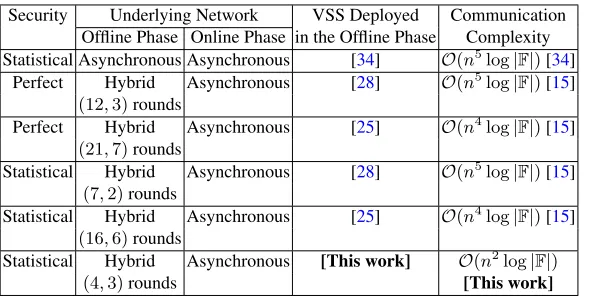
(4,3)synchronous rounds andO(n2)communication per multiplication. Moreover, our protocol also ensures input provision. Our protocol outperforms the existing hybrid MPC protocols witht < n/3, both in terms of communication complexity as well as in terms of the number of synchronous rounds required in the protocol.
To design our protocol, we follow the standard offline-online paradigm, based on Beaver’s circuit rando-mization technique [2] and which is now the de facto style of designing efficient MPC protocols [3,4,5,10, 14,15]. In this paradigm, an MPC protocol is divided into two phases, a circuit-independentoffline phase and acircuit-dependentonline phase. While the offline phase generates “raw data", independent of the circuit and actual inputs for the computation, the online phase utilizes this raw data for the circuit evaluation. In a more detail, the offline phase generates randommultiplication triplesof the form(a, b, c), Shamir-shared with thresholdt; herea, bare random and private andc= abholds. Later, using such triples, multiplication gates are evaluated in a shared fashion. For each multiplication gate, one multiplication triple from the offline phase is utilized and the multiplication gate is evaluated at the cost of publicly reconstructing two Shamir-shared va-lues. Reconstructing a Shamir-shared valued (with thresholdt) can be done efficiently witht < n/3using the standard Reed-Solomon (RS) error correction [31], even in acompletely asynchronoussetting [11,7]. Hence we shift the focus to design an efficient offline phase in the hybrid setting for generating multiplication triples. For this we follow the recent framework of [15], which shows how to efficiently generate Shamir-shared multi-plication triples in offline phase, usingany(polynomial based)verifiable secret-sharing(VSS) protocol [13] as a black-box. Informally, a VSS protocol allows a designated party calleddealer(D) toverifiablyShamir-share a secret with thresholdt. Thus at the end of the VSS protocol it is ensured that there exists some polynomial of degree at mosttwith the secret as the constant term and every share-holder has a distinct evaluation of this polynomial. Moreover this is ensured irrespective of whether the dealer is under the influence of the adversary or not. In addition, if the dealer ishonestthen it is ensured that the secret remains information-theoretically secure fromtcorrupted share-holders.
In this work, our proposed VSS protocol in the setting oft < n/3is plugged into the framework of [15] and the result is a more efficient hybrid MPC protocol. Communication-wise, our VSS protocol stands out with an amortized overhead ofO(n2)per secret-shared value, whereas the best known bound is only O(n3)
[25, 28]. The improvement comes from the fact that our VSS protocol requires a broadcast complexity that
is independent of the number of secrets shared, a property that is not achieved by the known constructions
[25, 28]. To induce a better complexity over point-to-point channels, we use the best knownbroadcast am-plification protocols (aka multi-valued broadcast protocols) [22] to simulate the broadcast invocations in the VSS protocols of [25,28]. Informally, in a multi-valued protocol, broadcasting a “sufficiently large" message of size`has communication complexity ofO(n`)over point-to-point channels and a broadcast complexity of poly(n). Witht < n/3, the most efficient multi-valued broadcast protocol is due to [37]. The protocol requires
4
a communication complexity ofO(n`)over point-to-point channels and broadcast ofn2bits for broadcasting an`-bit message. Detailed analysis and comparison of our VSS with existing ones is deferred later in the paper (see section4.4). In Table1, we compare our MPC and VSS protocols with their previous best counter parts.
Figure 1
(a) Communication complexity (in bits) per multiplication of various AMPC and hybrid MPC protocols witht < n/3
Security Underlying Network VSS Deployed Communication Offline Phase Online Phase in the Offline Phase Complexity Statistical Asynchronous Asynchronous [34] O(n5log|F|)[34]
Perfect Hybrid Asynchronous [28] O(n5log|F|)[15] (12,3)rounds
Perfect Hybrid Asynchronous [25] O(n4log| F|)[15] (21,7)rounds
Statistical Hybrid Asynchronous [28] O(n5log|F|)[15] (7,2)rounds
Statistical Hybrid Asynchronous [25] O(n4log| F|)[15] (16,6)rounds
Statistical Hybrid Asynchronous [This work] O(n2log|F|) (4,3)rounds [This work]
(b)Amortized communication complexity per shared-secret of the underlying VSS de-ployed in the offline phase.
Security Network Type Overhead Statistical Asynchronous O(n4)[34] Perfect Synchronous O(n4)[28]
(7,2)rounds Perfect Synchronous O(n3)
[25]
(16,6)rounds
Statistical Synchronous O(n2) (4,3)rounds [This work]
Other Related Work. In thesynchronoussetting, MPC protocols withO(n)communication per multiplica-tion has been reported in [5] with perfect security andt < n/3and in [10] with statistical security andt < n/2. These protocols deploynon-robustsecret-sharing protocols in the player-elimination and dispute-control fra-mework. The non-robustness of the underlying primitives inflates the round complexity of their offline phase toO(n)andO(n2)respectively. The naive approach of adopting these protocols in hybrid setting will lead to protocols withO(n)orO(n2)synchronous (broadcast) rounds to execute the offline phase. The online phase of these protocols can be executed asynchronously. Our hybrid MPC protocol on the other hand requires only a constant number of synchronous broadcast rounds.
The reported works [19,18] in the synchronous setting with polylogarithmic (inn) communication per gate (denoted asOe(n))5are onlynon-optimallyresilient. While [19] works witht <(1
2−)nand provides statistical
security, [18] works witht <(13−)nand provides perfect security, where >0. These protocols also evaluate the underlying circuit in a secret-shared fashion. However, instead of Shamir secret-sharing, they use packed secret-sharing [24] taking advantage of the presence of larger subset of honest parties (due to the non-optimal resilience). Due to the use of packed secret-sharing, “multiple" gates can be evaluated simultaneously by doing a fixed set of operations on the shares. However, this requires “special" structure from the underlying circuit being available at each layer, maintaining which, demands additional circuitry to be incorporated between different layers of the circuit. Evaluating the overall circuit using packed secret-sharing makes these protocols highly non-trivial and complex. It is not known how to adapt these protocols in a completely asynchronous or a partially synchronous setting. Specifically, it is not clear whether these protocols can be executed in a hybrid setting, with aconstantnumber of synchronous rounds. Therefore, while treating VSS as an MPC functionality and evaluating the resultant “VSS circuit" using the MPC protocols of [19,18] may lead to sublinear (namely
e
O(n)) overhead per secret-shared value, it is not clear if the resultant protocols runs with aconstantnumber of synchronous rounds in hybrid setting.
5
New Techniques. Our VSS protocol is built upon a new primitive calledinformation checking with succinct
proof of possession (ICPoP) that takes motivation from information checking protocol (ICP) introduced in
[38,16,35]. An ICP allows a Dto privately authenticate some data for an intermediaryINT, who can later publicly reveal this data and prove that it originated fromD. On the other hand, in an ICPoP protocolINTgives a proof of possession publicly of the data originated fromD, instead of publicly revealing the data. The proof preserves data privacy and is “succinct" i.e. its size isindependentof the size of the data. The succinctness of the proof makes the broadcast complexity of our VSS protocol independent of the number of shared secrets. Our ICPoP also offerstransferabilitythat allows any designated party to take possession ofINT’s authenticated (by D) data and to be able to give a proof of possession on the “behalf" ofINT. The existing ICPs do not support transferability.
We next give a high level overview of our VSS. To share a secrets, we embedsin the constant term of a random bivariate polynomialF(x, y)of degreetinxandy. Every partyPithen obtains a row polynomial
fi(x) = F(x, αi). The parties then publicly verify whether the row polynomials of at least n−t parties
calledVCOREdefine a unique bivariate polynomial. The standard way to do this is to perform the “pair-wise checking", where every pair of parties(Pi, Pj)is asked to verify the consistency of the common values on their
respective polynomials and publicly complain if there is any inconsistency, in which caseDpublicly resolves the complaint by making the common value public [25,21,28]. This approach will lead to a broadcast complexity ofO(n2)per secret-shared value; instead we use a statistical protocol calledPoly-Check(section4.1), adapted from [36], which performs the same task in parallel for ` secrets (and hence ` bivariate polynomials), but keeping the broadcast complexity independent of`. OnceVCOREis found, it is ensured thatDhas committed a uniqueF(x, y)and the secretF(0,0)to the parties inVCORE. To enable the parties to obtain their shares, the goal will be to enable each partyPj to compute itscolumn polynomial gj(y) = F(αj, y). For this each
partyPi ∈VCOREtransfers its common value ongj(y)(namelyfi(αj)) toPj. To ensure that correct values
are transferred,Pj publicly gives a proof of possession of all the transferred values originated fromDvia the
intermediary parties inVCORE. This is done in parallel for`secrets (and hence`bivariate polynomials); the succinctness of the proof ensures that this step has broadcast complexity, independent of`.
2
Network Model, Definitions and Existing Tools
We consider a set P = {P1, . . . , Pn} of n parties, connected by pair-wise private and authentic channels.
For simplicity we assume n = 3t+ 1, sot = Θ(n). There exists a computationally unbounded adversary
Advwho can maliciously corrupt anytparties and may force them to behave in any arbitrary fashion during the execution of a protocol. We assume the adversary to be static, who decides the set of corrupted parties at the beginning of the protocol execution. We assume a partially synchronous network, where the first four rounds are synchronous, after which the entire communication is doneasynchronously. Moreover, we assume that the parties have access to a broadcast channel during the second, third and fourth synchronous round. Our protocols operate over a finite field F, where |F| > 2n. We assume that there exists 2n distinct non-zero elements α1, . . . , αn, β1, . . . , βn in F. Each element of F can be represented by O(log|F|) bits. The communication complexity of any protocol is defined to be the total number of field elements communicated by the honestparties in that protocol. We denote the point-to-point communication complexity byPC()and the broadcast communication complexity asBC().
Without loss of generality, we assume that the parties want to securely compute the functionf : Fn → F via an MPC protocol, wheref(x1, . . . , xn) =y, such thatxi ∈Fis the input ofPiand every party is supposed
to receive the outputy∈F. The functionfis assumed to be represented by a publicly known arithmetic circuit
C overF. The circuitCconsists of ninput gates, two-input addition (linear) and multiplication (non-linear) gates, zero-input random gates (for generating random values during the computation) and one output gate. We denote bycM andcRthe number of multiplication and random gates inC respectively. By[X]and[X, Y]for
can take a value from the set{1,2. . . k}. We will also require that|F|> 4n4(cM +cR)(3t+ 1)2κ to ensure
that the error-probability of our MPC protocol is at most2−κ, for a given error parameterκ.
2.1 Definitions
Definition 2.1(d-sharing [3,20,5]). A values∈Fis said to bed-shared if there exists a polynomial overF,
sayf(·), of degree at mostd, such thatf(0) =sand every (honest) partyPi∈ P holds a sharesiofs, where
si=f(αi). We denote by[s]d, the vector of shares ofscorresponding to the (honest) parties inP.
A vectorS~ = (s(1), . . . , s(`))∈
F`is said to bed-shared ifeachs(i)isd-shared. Note thatd-sharings arelinear: given[a]dand[b]d, then[a+b]d= [a]d+ [b]dand[c·a]d=c·[a]dholds, for a public constantc. In general,
given ` sharings [x(1)]d, . . . ,[x(`)]d and a public linear function g : F` → Fm, where g(x(1), . . . , x(`)) =
(y(1), . . . , y(m)), then g([x(1)]
d, . . . ,[x(`)]d) = ([y(1)]d, . . . ,[y(m)]d). We say that the partieslocally compute
([y(1)]d, . . . ,[y(m)]d) = g([x(1)]d, . . . ,[x(`)]d) to mean that every Pi (locally) computes (yi(1), . . . , yi(m)) =
g(x(1)i , . . . , x(i`)), whereyi(l)andxi(l)denotes theithshare ofy(l)andx(l)respectively.
Definition 2.2((Polynomial-based) Verifiable Secret Sharing (VSS) [3,4,5]). LetS~ = (s(1), . . . , s(L))∈FL
be a set ofLvalues that a dealerD ∈ P wants tot-share amongP. LetShbe a protocol for thenparties, whereDhas the inputS~. ThenShis a VSS scheme if the following holds for every possibleAdv, on all possible inputs: (1) Correctness: IfDis honest then S~ ist-shared amongP at the end ofSh. Moreover even ifD
is corrupted there exists a set of Lvalues, say(s(1), . . . , s(L)), which is t-shared among P at the end ofSh. (2) Privacy: IfDis honest thenShreveals no information aboutS~toAdvin the information-theoretic sense; i.e.Adv’s view is identically distributed for all possibleS~.
IfShsatisfies all its properties without any error then it is called perfectly-secure. If the correctness is satisfied with probability at least1−, for a given error parameter, then it is called statistically-secure.
Unconditionally-secure MPC: Recent papers on efficient unconditionally-secure MPC follow a simpler “pro-perty based” security definition of secure MPC [3,20,5,10], instead of the more rigorous “real-world/ideal-world” paradigm based definition [29,1]. As our main goal is to provide an efficient VSS and MPC, to avoid blurring the main focus of the paper and to avoid additional technicalities, we also use the property based se-curity definition. However, we confirm that using standard techniques, like the above efficient protocols, our MPC protocol can be also proved secure according to the simulation based definition.
Letf : Fn → Fbe a publicly known function and party Pi has inputxi ∈ F. In any
(unconditionally-secure) multiparty computation, each partyPit-shares its input. Letxibe the value shared byPi. IfPiis honest
thenxi =xi. The parties then computef asy=f(x1, . . . ,xn)and everyone receivesy.
Definition 2.3(Unconditionally-secure MPC). A protocolΠamong the nparties securely computesf, if it satisfies the following for every possibleAdv, on all possible inputs:(1) Correctness: All honest parties obtain y at the end ofΠ. (2) Privacy: Advobtains no additional information about the inputs of the honest parties, other than what is inferred from the inputs of the corrupted parties andy.
ProtocolΠis called perfectly-secure if it satisfies all its properties without any error. If the correctness is satisfied with probability at least1−2−κ, for a given error parameterκ, thenΠis called statistically-secure. Information Checking with Succinct Proof of Possession (ICPoP): An ICPoP protocol involves three enti-ties: a designated dealerD∈ P who holds a set ofLprivate valuesS ={s(1), . . . , s(L)}, an intermediaryINT
∈ P and the set of parties P acting as verifiers (note thatDandINTwill also play the role of verifiers, apart from their designated role of dealer and intermediary respectively). The protocol proceeds in three phases, each of which is implemented by a dedicated sub-protocol: (1) Distribution Phase: HereD, sendsS toINTalong with someauxiliary information. For the purpose of verification, someverification informationis additionally sent to each individual verifier. (2) Authentication Phase: This phase is initiated byINTwho interacts withD
distributed to the individual verifiers. IfDwants it can publicly abort this phase, which is interpreted as ifDis accusingINTof malicious behaviour.(3) Revelation Phase: This phase is carried out byINTand the verifiers inPonly ifDhas not aborted the previous phase. HereINTreveals a proof of possession of the values received fromD. The verifiers inP check this proof with respect to their verification information. Then based on cer-tain criteria, each verifier either outputsAcceptProof(indicating that it accepts the proof) orRejectProof (indicating that it rejects the proof).
Definition 2.4 (ICPoP). A triplet of protocols (Distr,AuthVal,RevealPoP) (implementing the distribution, authentication and revelation phase respectively) is a (1 - )-secureICPoP, for an error parameter, if the following holds: (1)ICPoP-Correctness1: IfDandINTare honest, then each honest verifierPi ∈ P outputs
AcceptProofat the end ofRevealPoP. (2)ICPoP-Correctness2: IfDis corrupted andINTis honest and if
ICPoPproceeds toRevealPoP, then except with probability at most, all honest verifiers outputAcceptProof
at the end of RevealPoP. (3) ICPoP-Correctness3: If D is honest, INT is corrupted, ICPoP proceeds to
RevealPoPand if the honest verifiers outputAcceptProof, then except with probability at most, the proof produced byINTcorresponds6to the values inS. (4)ICPoP-Privacy: IfDandINTare honest, then informa-tion obtained byAdvduringICPoPis independent ofS.(5)ICPoP-Succinctness of the Proof: The size of the
proof produced byINTduringRevealPoPis independent ofL.
Properties of Polynomials: A bivariate polynomial F(x, y) of degree at most t is of the formF(x, y) =
Pi,j=t
i,j=0rijxiyj, whererij ∈F. Letfi(x)
def
= F(x, αi), gi(y)def= F(αi, y)fori∈[n]. We callfi(x)andgi(y)
asithrow polynomialandcolumn polynomialrespectively ofF(x, y). We say that a row polynomialfi(x)lies
on a bivariate polynomialF(x, y)of degree at mosttifF(x, αi) =fi(x)holds. Similarly we will say that a
column polynomialgi(y) lieson F(x, y) ifF(αi, y) = gi(y)holds. We will use some well known standard
properties of bivariate and univariate polynomials, which are stated in AppendixA.
3
Efficient ICPoP
We present a(1−)-secureICPoPprotocol, where|S|=L =`×pack, with`≥1and1 ≤pack≤n−t; moreover= max{|n`
F|−1,
n(n−1)
|F|−pack}. The protocol has communication complexityPC(O(n`))andBC(O(n)).
Hence the broadcast complexity isindependentof`. Our ICPoP is similar to the asynchronous ICP of [35], adapted to the synchronous setting with the following differences: in ICP the wholeS is revealed during the revelation phase, as only its authenticity is required during the revelation phase. We requireINTto be able to publicly prove the possession ofSwhile maintaining its privacy. Hence the auxiliary information distributed in our ICPoP differs and also used differently; the details follow.
LetS = {(s(1,1), . . . , s(1,pack)), . . . ,(s(`,1), . . . , s(`,pack))}. During the distribution phase,Dembeds the
values (s(k,1), . . . , s(k,pack)) for k ∈ [`] in a random degree d secret-encoding polynomialG(k)(x) at x = β1, . . . , βpack, whered=pack+t−1. In addition,Dpicks amasking setM, consisting of2·packrandom values
{(m(1,1), . . . , m(1,pack)),(m(2,1), . . . , m(2,pack))}, which are embedded in two random degree d polynomials H(1)(x) andH(2)(x) respectively atx = β1, . . . , βpack; we call these polynomials asmasking polynomials.
The polynomials are sent to INT, while each verifier Pi receives the valuesv1,i, . . . , v`,i, m1,i, m2,i of these
polynomials at a secret evaluation pointγi. This distribution achievesICPoP-Privacy, as each secret-encoding
polynomial has degree d and adversary may get at most tvalues on these polynomials; so it will lackpack
values on each polynomial to uniquely interpolate them.
During revelation phase, to give a proof of possession ofS,INTproduces a random linear combination of
the values inS ∪ Mby making public a random linear combiner, say eand a linear combinationC(x) def= eH(1)(x) +e2H(2)(x) +e3G(1)(x) +. . .+e`+2G(`)(x). The valuesC(β1), . . . , C(βpack)definepacklinear
combinations ofS ∪ Mwith respect toe. The pair(e, C(x))is considered as aproof of possessionofS(union
6
M) and verified as follows: each verifier locally verifies if the corresponding linear combination em1,i +
e2m2,i+e3v1,i+. . .+e`+2v`,i satisfiesC(x)atx = γi and accordingly broadcast anAcceptor aReject
message. If more thantverifiers broadcastAcceptthen the proof(e, C(x))is said to be accepted, otherwise it is rejected. The proof will always be accepted for an honestD andINT, implying ICPoP-Correctness1. The size of the proof isO(n)(asd=O(n)), which is independent of`, implyingICPoP-Succinctness of the Proof. No additional information about the secret-encoding polynomials is revealed fromC(x), thanks to the masking polynomials. IfDishonestandINTiscorruptedthen the evaluation points of the honest verifiers will be private. So ifINTgives a proof of possession ofS?∪ M? 6=S ∪ Mby revealing a linear combination of
S?∪ M?through(e, C?(x))whereC?(x)6=C(x), then with high probability, every honest verifier will reject
the proof. This is because the corresponding linear combination of the values possessed by the honest verifiers will fail to satisfyC?(x); this impliesICPoP-Correctness 3.
The above mechanism, however, fails to achieve ICPoP-Correctness 2, as acorruptedD can distribute “inconsistent" polynomials and values to an honestINT and honest verifiers respectively; later on the proof produced byINTwill be rejected by every honest verifier. To verify the consistency of the distributed informa-tion, during the authentication phase,INT“challenges"Dby making public a random linear combinationA(x)
of the received polynomials. In response, Deither instructs to abort the protocol or continue, after verifying whether theA(x)polynomial satisfies the corresponding random linear combination of the values held by each verifier. The idea here is that if Ddistributed inconsistent data, then with very high probability, any random linear combination of the distributed polynomials would fail to satisfy the corresponding linear combination of the values given to the honest verifiers. And this will be locally learned by the honest verifiers afterA(x) is made public. So ifDstill instructs to continue the protocol, then clearlyDis corrupted; so later even if the proof produced in the revelation phase turns out to be inconsistent with the information held by the honest verifiers, the proof is accepted by adding an additional acceptance condition to deal with this particular case. We stress that the additional acceptance condition never gets satisfied for anhonestDand acorruptedINT. The privacy of the secret-encoding polynomials is still preserved during the authentication phase (for an honest INTand
D), thanks to the masking polynomials7. The formal steps of ICPoP are given in Fig.3. In the protocol, if the output isAcceptProofthen we additionally let the parties outputpacklinear combinations of the values in
S ∪ Mpossessed byINT; looking ahead this will be useful in our VSS.
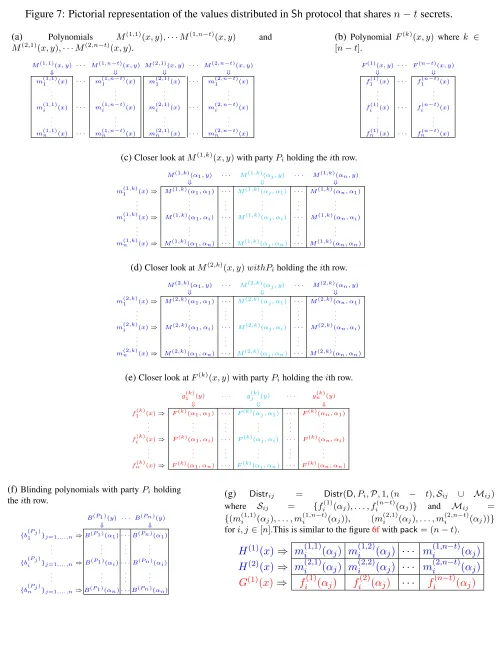
In Fig.2we present a pictorial representation of the values distributed and revealed in ICPoP.
In ICPoP, thecorrespondencebetween a proof and a set of values is defined as follows: LetS ={(s(1,1), . . . , s(1,pack)), . . . ,(s(`,1), . . . , s(`,pack))}andM= {(m(1,1), . . . , m(1,pack)),(m(2,1), . . . , m(2,pack))}. We say that a proof(e, C(x))corresponds toS ∪ Mif C(x) embeds linear combination ofS ∪ Mwith respect toeat
x=β1, . . . , βpack; i.e. ifC(βi) =em(1,i)+e2m(2,i)+e3s(1,i)+. . .+e(`+2)s(`,i)holds fori∈[pack].
We now prove the properties of our ICPoP.
Lemma 3.1 (ICPoP-Correctness1). If D and INT are honest then each honest verifier Pi ∈ P outputs
AcceptProofalong with(C(β1), . . . , C(βpack))at the end ofRevealPoP.
Proof. IfD is honest, then for each honest verifierPi ∈ P, the relationship G(k)(γi) = vk,iholds for each
k ∈ [`]and also H(1)(γi) = m1,i andH(2)(γi) = m2,i holds. Moreover if INT is honest then it correctly
broadcasts the C(x) polynomial duringRevealPoPand each honest verifierPi finds that the condition C1 is
true. Hence each honest verifier broadcastsAccept. As there are more than thonest verifiers who broadcast Acceptmessages, each honest verifier see more thantAcceptmessages and hence outputsAcceptProof.
Lemma 3.2(ICPoP-Correctness2). IfDis corrupt andINTis honest, and ifICPoPproceeds toRevealPoP, then all honest verifiers outputAcceptProof, except with probability at most|n`
F|−1.
Proof. We claim that ifINTishonestandICPoPproceeds toRevealPoP, then anhonestverifierPibroadcasts
Accept, except with probability at most | `
F|−1. Assuming that the claim is true, from the union bound it follows
Figure 2: Pictorial representation of the information generated and communicated duringICPoPprotocol.
(a) The values communicated during
Distr. The two masking polynomials of degree d are H(1)(x) and H(2)(x)
(shown in blue) which embeds the mas-king values {m(1,1)
. . . m(1,pack)} and
{m(2,1). . . m(2,pack)}
respectively. The`
secret-encoding polynomials of degree d
are G(1)(x) · · ·G(`)(x) (shown in red) where G(k)(x) embeds pack secrets i.e
{s(k,1)
. . . s(k,pack)}. All embeddings are done atx=β1, . . . , βpack.
H(1)(x) ⇒ m(1,1) · · · m(1,pack) H(2)(x) ⇒ m(2,1) · · · m(2,pack)
G(1)(x) ⇒ s(1,1) · · · s(1,pack)
..
. ... ... ...
G(`)(x) ⇒ s(`,1) · · · s(`,pack)
(b) The output vector (comb1, . . . ,combpack) = (C(β1), . . . , C(βpack))that
is revealed by INT during RevealPoP (shown in blue color) via the proof
(e, C(x)). We note thatcombk is a linear combination of thekth value
em-bedded inH(1)(x), H(2)(x), G(1)(x), . . . , G(`)(x)with respect to the combiner
e, fork = 1, . . . ,pack. This is represented as thekth column in the matrix representation (shown in green color).
H(1)(x) ⇒ m(1,1) · · · m(1,k) · · · m(1,pack) H(2)(x) ⇒ m(2,1) · · · m(2,k) · · · m(2,pack) G(1)(x) ⇒ s(1,1) · · · s(1,k) · · · s(1,pack)
..
. ... ... ... ... ... ...
G(`)(x) ⇒ s(`,1) · · · s(`,k) · · · s(`,pack)
⇓ ⇓ ⇓
comb1 combk combpack
combk=em(1,k)+e2m(2,k)+e3s(1,k)+· · ·+e`+2s(`,k)
=eH(1)(βk) +e2H(2)(βk) +e3G(1)(βk) +· · ·+e`+2G(`)(βk) =C(βk),where
C(x) =eH(1)(x) +e2H(2)(x) +e3G(1)(x) +. . .+e`+2G(`)(x)
that the probability any honest verifier fails to broadcast anAcceptmessage is at most |n`
F|−1, as the number of
honest parties is upper bounded byn. This ensures that there will be more thantAcceptmessages broadcasted by honest verifiers implying that each honest verifier outputsAcceptProofat the end ofRevealPoP.
We next proceed to prove our claim. For this we focus on a designated honestverifier Pi and consider
the relationship that holds between the polynomials G(1)(x), . . . , G(`)(x), H(1)(x), H(2)(x) distributed by a
corruptedDtoINTand the tuple(γi, v1,i, v2,i, . . . v`,i, m1,i, m2,i)distributed byDtoPi. We have two cases:
• vk,i =G
(k)
(γi) for eachk ∈[`]andm1,i = H
(1)
(γi), m2,i =H
(2)
(γi): In this case, the claim is true without any error asPiwill find that condition C1 is true for theC(x)polynomial duringRevealPoP.
• At least one of the following holds — eithervk,i 6= G
(k)
(γi)for somek ∈ [`]orm1,i 6= H
(1) (γi)or
m2,i6=H
(2)
(γi): In this case,A(γi)6=dm1,i+d2m2,i+d3v1,i+d4v2,i+. . . d`+2v`,iholds, except with
probability at most | `
F|−1 (follows from LemmaA.3by substitutingL=`+ 2). So clearly the verifierPi
will find that condition C2 is true duringRevealPoP
Lemma 3.3(ICPoP-Correctness3). IfDis honest,INTis corrupted,ICPoPproceeds toRevealPoPand if the honest verifiers outputAcceptProof, then except with probability at most | nd
F|−pack, the proof produced byINT corresponds to the values inS ∪ M.
Proof. IfICPoPproceeds toRevealPoPthen it implies thatDbroadcastedOKmessage duringAuthValwhich
implies that INTbroadcasted the correct A(x) polynomial duringAuthVal. More specifically, the condition
A(γi) =dm1,i+d2m2,i+d3v1,i+d4v2,i. . . d`+2v`,iholds for every verifierPi ∈ P. This further implies that
duringRevealPoP, the condition C2 is never satisfied for any honest verifierPi. To prove the lemma statement,
Figure 3: Efficient ICPoP protocol where`≥1and1≤pack≤n−t.
ICPoP(D,INT,P, `,pack,S) :S={(s(1,1), . . . , s(1,pack)), . . . ,(s(`,1), . . . , s(`,pack))}
Distr(D,INT,P, `,pack,S ∪ M)
Round 1:
• Ddefines amasking setMdef= {(m(1,1), . . . , m(1,pack)),(m(2,1), . . . , m(2,pack))}consisting of2·packrandom elements from
F. Letddef= pack+t−1. DealerDselects`randomsecret-encoding polynomialsG(1)(x), G(2)(x), . . . G(`)(x)of degree at mostd, such thatG(k)(β
1) = s(k,1), . . . , G(k)(βpack) =s(k,pack)fork ∈[`]. In addition,Dselects two randommasking
polynomialsH(1)(x), H(2)(x)of degreed, such thatH(k)(β1) =m(k,1), . . . , H(k)(βpack) =m(k,pack)fork∈[2]. For each
verifierPi∈ P, dealerDselects a randomevaluation pointγisuch thatγi∈F\ {β1, . . . , βpack}.
• DgivesS ∪ MtoINTby sendingG(1)(x), . . . G(`)(x), H(1)(x)
andH(2)(x)
toINT. To each verifierPi∈ P, dealerDsends
(γi, v1,i, v2,i, . . . v`,i, m1,i, m2,i), wherevk,idef= G(k)(γi)fork∈[`]andmk,idef= H(k)(γi)fork∈[2].
Local Computation byINT: LetG(1)(x), . . . G(`)(x), H(1)(x)andH(2)(x) be the polynomials received fromD(ifDis honest then these will be the same polynomials as selected byD). INTsetsS = {(s(1,1), . . . , s(1,pack)), . . . ,(s(`,1), . . . , s(`,pack))}and
M = {(m(1,1), . . . , m(1,pack)),(m(2,1), . . . , m(2,pack))}, wheres(k,1) = G(k)(β1), . . . , s(k,pack) = G (k)
(βpack) fork ∈ [`]and
m(k,1)=H(k)(β1), . . . , m(k,pack)=H (k)
(βpack)fork∈[2];S ∪ Mare considered to bereceivedbyINTfromD.
Local Computation Each Verifier Pi: Let (γi, v1,i, v2,i, . . . v`,i, m1,i, m2,i) be the tuple received from D (if D is honest
then this will be the same tuple as computed byD).
AuthVal(D,INT,P, `,pack,S ∪ M)
Round 1:INTselects a random elementd∈F\{0}and broadcasts(d, A(x)), whereA(x)def= dH(1)(x)+d2H(2)(x)+d3G(1)(x)+
d4G(2)(x) +. . . d`+2G(`)(x).
Round 2: Upon receiving(d, A(x))from the broadcast ofINT,Dchecks ifA(γi) =dm1,i+d2m2,i+d3v1,i+d4v2,i. . . d`+2v`,i
holds for everyPi∈ P. If not then it broadcasts anAbortmessages, else it broadcasts anOKmessage.
RevealPoP(D,INT,P, `,pack,S ∪ M) : Executed only ifDbroadcastedOKduringAuthVal.
Round 1: INT chooses a random element e ∈ F\ {0}and broadcasts(e, C(x))as aproof of possession ofS ∪ M, where
C(x)def= eH(1)(x) +e2H(2)(x) +e3G(1)(x) +e4G(2)(x). . . e`+2G(`)(x) .
Round 2: Upon receiving the broadcast of(e, C(x))fromINT, every verifierPi∈ Plocally verifies the following conditions:
• C(γi)
?
=em1,i+e2m2,i+e3v1,i+. . . e`+2v`,i— we call this conditionC1.
• A(γi)6=dm1,i+d2m2,i+d3v1,i+d4v2,i+. . . d`+2v`,iholds duringAuthVal— we call this conditionC2.
VerifierPibroadcastsAcceptif conditionC1orC2is true forPi, else it broadcastsReject.
Output Determination: If more thantverifiers broadcastAcceptthen each verifierPioutputsAcceptProofalong with the vector
(comb1, . . . ,combpack)def= (C(β1), . . . , C(βpack)), else each verifierPioutputsRejectProof.
claim is true, it follows via the union bound that the probability that any honest verifier broadcasts Accept message corresponding toC?(x)is at most | nd
F|−pack, as the number of honest verifiers is upper bounded byn.
This implies that there can be at mosttAcceptmessages corresponding toC?(x), broadcasted bytpotentially corrupted verifiers, implying that each honest verifier outputsRejectProof.
We next prove our claim. For this we focus on a designated honest verifierPi. As discussed above, the
condition C2 never happens for Pi. So Pi broadcasts Acceptmessage only if condition C1 holds for Pi.
In order that C1 is satisfied for Pi, it should hold that C?(γi) = C(γi). However since D is honest, the
adversary will have no information about the secret evaluation point γi. So the only way a corrupted INT
can ensure that C?(γi) = C(γi) holds is by correctly guessing γi, which it can do with probability at most
d
Lemma 3.4(ICPoP-Privacy). IfDandINTare honest, then the information obtained byAdvduringICPoP
is independent of the values inS.
Proof. Without loss of generality, let us assume thatP1, P2. . . Ptare under the control ofAdv. We claim that
adversary learns nothing aboutG(1)(x), . . . , G(`)(x) beyondtdistinct values on these polynomials, different fromx=β1, . . . , βpack. As each of these polynomials are of degree at mostd=t+pack−1, this implies that
Advlearns nothing about the value of these polynomials atβ1, . . . , βpack, which are nothing but elements ofS.
We next proceed to prove our claim.
DuringDistr, adversary obtains the tuple(γi, v1,i, v2,i, . . . v`,i, m1,i, m2,i)corresponding to eachPi ∈ {P1, . . . , Pt}via which it obtainstdistinct values ofG(1)(x), . . . , G(`)(x), H(1)(x), H(2)(x). DuringAuthVal,
ad-versary obtainsd, A(x). In addition, duringRevealPoP, adversary obtainse, C(x). However even after seeing
A(x)andC(x), the privacy ofG(k)(β1), . . . , G(k)(βpack)is preserved for eachk∈[`]. This is because the
po-lynomialsG(1)(x), . . . , G(`)(x)are masked withH(1)(x)andH(2)(x)in theA(x)andC(x)polynomials and adversary will lackpackvalues ofH(1)(x)andH(2)(x)to uniquely interpolate them. More specifically, from the view point of the adversary, for every choiceS ={(s(1,1), . . . , s(1,pack)), . . . ,(s(`,1), . . . , s(`,pack))}of the secret values, there exists corresponding secret-encoding polynomialsG(1)(x), . . . , G(`)(x)of degreed, with
G(k)(β1) =s(k,1), . . . , G (k)
(βpack) =s(k,pack)for eachk∈[`], such thatG (k)
(γi) =vk,iholds corresponding
to eachPi ∈ {P1, . . . , Pt}. Moreover corresponding toG
(1)
(x), . . . , G(`)(x)and the polynomialsA(x), C(x), there exists a corresponding masking set of values M = {(m(1,1), . . . , m(1,pack)),(m(2,1), . . . , m(2,pack))}
and corresponding masking polynomials H(1)(x) and H(2)(x) each of degree at most d, such that A(x) = dH(1)(x) +d2H(2)(x) +d3G(1)(x) +d4G(2)(x) +. . .+d`+2G(`)(x)andC(x) =eH(1)(x) +e2H(2)(x) + e3G(1)(x) +e4G(2)(x) +. . .+e`+2G(`)(x) holds, whereH(1)(β1) = m(1,1), . . . , H(1)(βpack) = m(1,pack)
andH(2)(β1) =m(2,1), . . . , H(2)(βpack) =m(2,pack)withH (1)
(γi) =m1,i,H
(2)
(γi) =m2,iholding for each
Pi∈ {P1, . . . , Pt+1}.
Theorem 3.5. Protocols(Distr,AuthVal,RevealPoP) constitute a (1−)-secureICPoP forL = `×pack
values with`≥1and1≤pack≤n−t, where= max{ n`
|F|−1,
nd
|F|−pack}andd=pack+t−1. The protocol has communication complexityPC(O(n`))andBC(O(n)).
Proof. The properties ofICPoPfollow from Lemma3.1-3.4. We next prove the communication complexity.
During Distr, Dsends `+ 2polynomials of degreed toINT and a tuple of`+ 3values to each individual verifier. During AuthVala polynomial of degree d is broadcasted by INT andDbroadcasts either anOK or Abort message. During RevealPoP, INT broadcasts a polynomial of degree d and each individual verifier broadcasts either an Acceptor a Rejectmessage. So overall the protocol has communication complexity
PC(O(n`))andBC(O(n)), asd =O(n). This also proves theICPoP-Succinctness of the Proofproperty, as the size of the proof is independent of`.
Transferability of ICPoP: In our VSS protocol we will use ICPoP as follows: after receivingS ∪ Mfrom
Dvia the secret-encoding and masking polynomials,INTwill send these polynomials (and henceS ∪ M) to another designated party, sayPR∈ P(ifINTis corrupted then it can send incorrect polynomials toPR). Later
on, partyPRwill act as anINTand produce a proof of possession ofS ∪ M, which got “transferred" toPR
fromINT; the proof gets verified with respect to the verification information held by the verifiers. This transfer ofS ∪ Mwill satisfy all the properties of ICPoP, imagining PR as the newINT. Specifically ifDishonest
and bothINTandPR arehonest, then the privacy will hold. Moreover ifPR produces a proof of possession
of incorrect sets (this can be the case if eitherINT orPR is corrupted), then the proof gets rejected. IfDis
4
Statistical VSS with a Quadratic Overhead
We present a 4-round VSS protocolShtot-share`×(n−t) = Θ(n`)values with communication complexity
PC(O(n3`))andBC(O(n3)). So for sufficiently large`, the broadcast complexity will beindependentof`. For simplicity, we will present a 5-round statistical VSS protocolSh-Singlefor sharing a single secret. We will then explain how to reduce the number of rounds ofSh-Singlefrom five to four. Finally we extend this four roundSh-Singleto getSh. We first discuss a protocolPoly-Checkadapted from [36], used in our VSS.
4.1 Verifiably Distributing Values on Bivariate Polynomials of Degree at mostt
In our VSS protocol we will come across the following situation: D will select L bivariate polynomials
F(1)(x, y), . . . , F(L)(x, y), each of degree at most tand send the ith row polynomialsfi(1)(x), . . . , fi(L)(x)
ofF(1)(x, y), . . . , F(L)(x, y)respectively to eachPi; we stress that the corresponding column polynomials are
retained by D. The parties now want to publicly verify if there is a set of at leastt+ 1 honestparties, who received row polynomials, lying onLunique bivariate polynomials of degree at mosttwithout revealing any additional information about the polynomials. For this we use a two round protocol Poly-Check (see Fig4), which is adapted from an asynchronous protocol for the same purpose, presented in [36].
In the protocol Poly-Check, there is a designated verifier V, who challenges D to broadcast a random linear combination of the ncolumn polynomials of all the bivariate polynomials selected byD. Specifically
V provides a challenge combiner, say r and in responseDmakes public a linear combination of its column polynomials with respect to r; to maintain the privacy of the column polynomials, this linear combination is blinded by a random degreetblinding polynomialB(y), selected byD, with each partyPi having a value on
this polynomial. Corresponding to the linear combination of the column polynomials produced by D, each partyPimakes public a linear combination ofnvalues of all its row polynomials, with respect to the combiner
r, which is blinded by the value ofB(y)possessed by it. The idea here is the following: if indeed there exists a set oft+ 1honest parties that we are looking for, then the values of the row polynomials possessed by these parties will define degree tcolumn polynomials. And these column and row polynomials will be "pair-wise consistent". Based on this idea we check if the blinded linear combination of the column polynomials produced by Dis of degreet. Moreover it is also checked if there exists a witness setW(V) of at least2t+ 1parties,
such that their blinded linear combination of row polynomial values satisfies the linear combination produced byD. If any one of the above conditions is not satisfied the parties output⊥, otherwise they outputW(V). It
is ensured that ifVishonest, then except with probability nL|
F|, the honest parties inW
(V)constitute the desired
set of row polynomial holders.
The properties ofPoly-Checkare stated in Lemma4.1; we refer to [36] for the complete proof.
Lemma 4.1(Properties of ProtocolPoly-Check[36]). In protocolPoly-Check, the following holds:
• IfDis honest then every honest party outputs aW(V)set which includes all the honest parties. Moreover the row polynomials of the honest parties inW(V)will lie on F(1)(x, y), . . . , F(L)(x, y). Furthermore
Advgets no additional information aboutF(1)(x, y), . . . , F(L)(x, y)in the protocol.
• IfDis corrupted andVis honest and if the parties output aW(V), then except with probability at most
nL
|F|, there existsLbivariate polynomials, say F (1)
(x, y), . . . , F(L)(x, y), of degree at mostt, such that the row polynomials of the honest parties inW(V)lie onF(1)(x, y), . . . , F(L)(x, y).
• The protocol requires two rounds and has communication complexityBC(O(n)).
4.2 Five Round Statistical VSS for a Single Secret
To t-share s,D selects a randomsecret-carrying bivariate polynomial F(x, y) of degree at mostt such that
Figure 4: Checking the consistency of row polynomials distributed byDunder the supervision of a designated verifierV. The inputs for (an honest)DareLsecret bivariate polynomialsF(1)(x, y), . . . , F(L)(x, y)of degree
at mosttand a secret blinding polynomialB(y)of degree at mostt. The inputs for (an honest) partyPiareL
row polynomialsf(1)i (x), . . . , f(iL)(x)of degree at mosttand a sharebi of blinding polynomial. IfDandPi
are honest then these values are private andf(ik)(x) =F(k)(x, αi)andbi =B(αi)will hold for eachk∈[L].
Poly-Check(D,V,P, L,{F(1)(x, y), . . . , F(L)(x, y), B(y)},{f(1)
i (x), . . . , f
(L)
i (x), bi}i∈[n])
Round 1: VerifierVselects a random combinerr∈F\ {0}and broadcastsr.
Round 2: The parties on receivingrfrom the broadcast ofVdo the following:
• Dbroadcasts the polynomialE(y)def= B(y)+rg1(1)(y)+r 2
g2(1)(y)+. . .+r
n
gn(1)(y)+r(n+1)g
(2) 1 (y)+r
(n+2)
g(2)2 (y)+
. . .+r2ng(2)
n (y) +. . .+r(L−1)n+1g(1L)(y) +r
(L−1)n+2g(L)
2 (y) +. . .+r
Lng(L)
n (y). Hereg(ik)(y) =F
(k)(αi, y) for
k∈[L]andi∈[n].
• Each partyPi ∈ P (includingD) broadcasts the linear combination ei def= bi+rf(1)i (α1) +r2f (1)
i (α2) +. . .+
rnf(1)i (αn)+r(n+1)f(2)i (α1)+r(n+2)f (2)
i (α2)+. . .+r2nf (2)
i (αn)+. . .+r
(L−1)n+1
f(iL)(α1)+r(L−1)n+2f (L)
i (α2)+
. . .+rLnf(L) i (αn)
Output determination: IfE(y)has degree more thantthen each partyPj∈ Poutputs⊥and terminate. Else each partyPj∈ P
creates awitness setW(V)
, initialized to∅and then does the following:
• Include partyPitoW(V)if the relationE(αi) ?
=eiis true.
• If|W(V)| ≥
2t+ 1thenPjoutputsW(V)
, elsePjoutputs⊥.
polynomials are distributed. The parties then verify the consistency of the distributed polynomials by publicly verifying the existence of a setVCOREof at least2t+ 1parties, such that the row polynomials of thehonest
parties inVCORElie on a unique bivariate polynomial, sayF(x, y), of degree at mostt. For this,ninstances of
Poly-Checkare executed (one on the behalf of each party playing the role of the designated verifierV) and it is verified if there is common subset of at least2t+1parties, present across all the generated witness sets. As there will be at least one instance ofPoly-Checkexecuted on the behalf of an honest verifier, clearly the common subset of 2t+ 1parties satisfies the properties of VCORE. To maintain the privacy of the row polynomials during thePoly-Checkinstances,nindependentblinding polynomialsare used byD, one for each instance. If a
VCOREis found, then we say thatDhas “committed" the secrets=F(0,0)to the parties inVCOREvia their row polynomials and the next goal will be to ensure that each partyPjobtains its column polynomialgj(y)of
F(x, y); partyPj can then output its share sj = gj(0)ofsand henceswill bet-shared viaF(x,0). IfDis
honestthenF(x, y) =F(x, y)will hold (and hences=s), asVCOREwill include all the honest parties. To enablePj obtaingj(y), eachPi ∈ VCOREcan send the common pointfi(αj)on gj(y)toPj, where
fi(αj) denotes thejth value on theith row polynomial received byPi (ifDis honest thenfi(αj) = fi(αj)
holds). The honest parties inVCOREwill always send the correct values; however the corrupted parties may send incorrect values. Due to insufficient redundancy in the received fi(αj) values, party Pj cannot
error-correct them (for this we require|VCORE|to be of size at least3t+ 1). The way out is thatPj gives aproof
of possession of thefi(αj) values received from the parties Pi in VCORE. Namely the values on the row
polynomials are initially distributed byDby executing instances ofDistr. There will ben2 such instances and instanceDistrij is executed to distributefi(αj)toPi, consideringPi as anINT; the corresponding instances
AuthValij are also executed and it is ensured that theAuthValinstances, involving any party fromVCOREas
anINT, is not aborted byD. Now when a partyPi inVCOREsendsfi(αj)toPj, partyPjacts as anINTand
publicly gives a proof of possession offi(αj)by executing an instanceRevealPoPjiofRevealPoP. The idea is
and an incorrectfi(αj)is transferred toPj, then the corresponding proof gets rejected duringRevealPoPjiand
Pjdiscard such values.
Unfortunately, ifD iscorruptedthen the above mechanism alone is not sufficient for Pj to robustly
re-constructgj(y). Because acorruptedPi inVCORE can then transfer an incorrectfi(αj) toPj and still the
proof will get accepted; this is because ifbothDandINTare corrupted, thenINTwill know the full auxili-ary and verification information involved in ICPoP. As a result,Pj will end up not reconstructing a degreet
column polynomial from the receivedfi(αj)values. To deal with this particular case, we ensure that theM
sets used byDin the ICPoP instances have a similar “structure" as the correspondingS sets. Specifically,D
selects two randommaskingbivariate polynomialsM(1)(x, y) andM(2)(x, y)each of degree at mostt. Let
m(1)i (x), m(2)i (x) denote the corresponding row polynomials. The instances Distrij are executed by setting
Sij = {fi(αj)} andMij = {m
(1)
i (αj), m
(2)
i (αj)}(thus` = 1andpack = 1in these instances). The
cor-respondingAuthValij instances are executed withSij = {fi(αj)}andMij ={m
(1)
i (αj), m
(2)
i (αj)}, which
denotes theSandMsets respectively received byPiduringDistrij (ifDis honest then these will be the same
asSij andMij). The existence ofVCOREwill now imply thatDhas committed a secret-carrying polynomial,
sayF(x, y)and two masking bivariate polynomials, sayM(1)(x, y), M(2)(x, y)to the parties inVCORE, where all these polynomials have degree at mostt. It follows that any linear combination of the column polynomials
F(αj, y), M
(1)
(αj, y)andM
(2)
(αj, y)will be a degreetunivariate polynomial. And this property is used by
Pj to identify the correctly transferredSij ∪ Mij sets. Namely the values in the transferredSij ∪ Mij sets
should lie on degree tunivariate polynomials and hence any random linear combination of these sets should also lie on a degreetpolynomial. Based on this observation, partyPj selects acommonrandom combiner, say
ej, for allthe transferred Sij ∪ Mij sets and publicly reveals a linear combination of these Sij ∪ Mij sets
via theRevealPoPji instances. It is then publicly verified if these linearly combined values lie on a degree t
polynomial. If not then it implies thatDis corrupted and it is discarded; see Fig.5for the formal details. For the ease of understanding, a pictorial representation of the information distributed inSh-Singleis given in Fig.6. We now proceed to prove the properties ofSh-Single.
Lemma 4.2. IfDis honest then except with probability at most |n3t
F|−1, it is not discarded duringSh-Single.
Proof. IfDis honest then no honestPi broadcasts(Abort, ?) message as the received row polynomials will
be of degree at mostt. More specifically,fi(x) =fi(x) =F(x, αi), m(1)i (x) =m
(1)
i (x) =M(1)(x, αi)and
m(2)i (x) =m(2)i (x) =M(2)(x, αi)holds forPi. So there can be at mostt(Abort, ?)messages corresponding
totpotentially corrupted parties. SinceDwill distribute consistent row polynomials to all the parties, it follows from Lemma4.1and protocol steps ofPoly-Checkthat all honest parties will be present inW(P1), . . . ,W(Pn)
and so clearly|VCORE| ≥ 2t+ 1will hold. Now consider a pair of partiesPi, Pj, with at least one of them
beingcorrupted, such that in theRevealPoPjiinstance the revealed proof does not correspond toSij ∪ Mij8.
It follows via Lemma3.3(by substitutingpack= 1andd=t+pack−1 =t) that except with probability at most |nt
F|−1, the proof will be rejected. As there can be at mostn
2such pairs of(P
i, Pj), from the union bound
it follows that except with probability at most |n3t
F|−1, the values which are finally considered for reconstructing
the column polynomials for the parties will be correct and lie on polynomials of degree at mostt. So except with probability at most |n3t
F|−1, the conditions which lead to an honestDbeing discarded never occur.
Lemma 4.3(Correctness for an honestD). IfDis honest then except with probability at most|n3t
F|−1, the value sist-shared at the end ofSh-Single.
Proof. IfDis honest then from Lemma4.2it follows that except with probability at most |n3t
F|−1, any incorrect
linear combination of values revealed in any of the RevealPoPinstances is rejected. More specifically, ifPj
8
Figure 5: VSS for sharing a single secret
Sh-Single(D,P, s)
Round 1: DealerDdoes the following:
• Select a randomsecret-carrying bivariate polynomialF(x, y)of degree at mosttwithF(0,0) =s. Select two randommasking bivariate polynomialsM(1)(x, y)andM(2)(x, y), each of degree at mostt. In addition selectnrandomblinding univariate polynomialsB(P1)(y), . . . , B(Pn)(y), each of degree at mostt, whereB(Pi)isassociatedwith partyPi∈ P. Corresponding
to eachPi ∈ P, compute row polynomialsfi(x) def= F(x, αi), m(1)i (x)
def
= M(1)(x, αi), m(2)i (x)
def
= M(2)(x, αi)and
share-vector(b(P1)
i , . . . , b
(Pn)
i )of blinding polynomials, whereb
(Pj) i
def
= B(Pj)(αi)forj ∈ [n]. LetSij def= {fi(αj)}and
Mijdef= {m(1)i (αj), m
(2)
i (αj)}fori, j∈[n]. • To eachPi∈ P, send(b(P1)
i , . . . , b
(Pn)
i ). In addition, forj∈[n], execute an instanceDistr(D, Pi,P,1,1,Sij∪ Mij)ofDistr
to giveSij∪ MijtoPi, consideringPias anINT. LetDistrijdenote the corresponding instance ofDistr.
Round 2: EachPi ∈ P(includingD) does the following: letSij ={fij}andMij ={m
(1)
ij , m
(2)
ij }be the secret and masking set
respectively received fromDinDistrij. In addition, let(b
(P1)
i , . . . , b
(Pn)
i )denote the vector receivedafromD. Letfi(x), m
(1)
i (x)
andm(2)i (x)be the polynomials defined by the points{(αj, fij)}j∈[n],{(αj, m (1)
ij )}j∈[n]and{(αj, m (2)
ij)}j∈[n]respectively. If these polynomials are not of degreetthenPibroadcasts(Abort, Pi), else it does the following:
• TransferSij∪ MijtoPjby sending all the information received fromDin the instanceDistrij.
• As anINT, execute the steps of Round 1 of an instanceAuthVal(D, Pi,P,1,1,Sij∪ Mij)ofAuthVal, corresponding to the
instanceDistrij, forj∈[n]. Let this instance ofAuthValbe denoted asAuthValij.
• As a verifier V, execute the steps of Round 1 of an instance Poly-Check(D, Pi,P,3,{M(1)
(x, y), M(2)(x, y), F(x, y), B(Pi)(y)},{m(1)
j (x), m
(2)
j (x), fj(x), b
(Pi)
j }j∈[n])ofPoly-Check; denote this instance asPoly-Check(Pi).
Round 3: EachPi∈ P(includingD) does the following: If(Abort, ?)message is received from the broadcast of more thantparties then discardDand abortSh-Single. ElsePidoes the following:
• Corresponding to eachj, k∈[n], participate as a verifier during Round 2 ofAuthVal, in the instancesAuthValjk
• Execute the steps of Round 2 ofPoly-Check, corresponding to the instancesPoly-Check(P1), . . . ,Poly
-Check(Pn) .
• [Additional steps, IfPi=D]— In addition to the above steps,Piexecutes the following steps ifPiisD:
– As aD, execute the steps of Round 2 ofAuthVal, corresponding to the instancesAuthValjkfor eachj, k∈[n].
– As aD, execute the steps of Round 2 ofPoly-Check, corresponding toPoly-Check(P1), . . . ,Poly
-Check(Pn) .
Computation ofVCORE— Every partyPi∈ P(includingD) executes the following steps:
• If in any of the instancesPoly-Check(P1), . . . ,Poly-Check(Pn)the output is⊥, then discardDand abortSh-Single.
• LetW(P1), . . . ,W(Pn)denote the witness sets obtained inPoly-Check(P1), . . . ,Poly-Check(Pn) respectively. If|W(P1)∩
W(P2)∩. . .∩ W(Pn)|<2t+ 1, then discardDand abortSh-Single. Else setVCOREdef= W(P1)∩ W(P2)∩. . .∩ W(Pn).
• If there exists anyPj∈VCORE, such thatDbroadcastedAbortmessage in some instanceAuthValjkinvolvingPjas anINT,
wherek∈[n], then removePjfromVCORE. If finally|VCORE|<2t+ 1then discardDand abortSh-Single.
Round 4: Each partyPj∈ Pexecutes the following steps:
• Corresponding to eachPi ∈VCORE, act as anINTand execute the steps of Round 1 of an instanceRevealPoP(D, Pj,P,
1,1,Sij∪ Mij)ofRevealPoP, to reveal a random linear combination of the values inSij∪ Mij, which were transferred from PitoPjduring Round 2 ofSh-Single. In all these instances ofRevealPoP, partyPjuses the same random combiner, sayej. Let these instances ofRevealPoPbe denoted byRevealPoPji.
Round 5: Every partyPk∈ P(includingD) acts as a verifier and executes the steps of Round 2 ofRevealPoP, corresponding to the instancesRevealPoPji, wherej∈[n]andPi∈VCORE.
Consistency checking of the values transferred by the parties inVCORE: EachPk∈ Pverifies the following for eachPj∈ P:
• Letsupjdenote the set of allPi∈VCORE, such that in the correspondingRevealPoPjiinstances, the output isAcceptProof,
along with a linear combination of values, saycombji.
• DiscardDand abortSh-Singleif{(αi,combji)}Pi∈supj lie on a polynomial of degree more thant.
Share determination— EachPj ∈ Pinterpolates a polynomialgj(y)through{(αi, fij)}Pi∈supj, whereSij ={fij}denotes the
secret set transferred toPjfromPiduring Round 2 ofSh-Single. PartyPjoutputssj=gj(0)as its share and terminates.
a IfDis honest thenSij=Sij,Mij=Mijand(b(P1)
i , . . . , b
(Pn)
i ) = (b
(P1)
i , . . . , b
Figure 6: Pictorial representation of the values distributed inSh-Singleprotocol.
(a)M(1)(x, y)withith row being possessed byPi.
M(1)(α
1, y) · · · M(1)(αn, y)
⇓ ⇓
m(1)1 (x)⇒ M(1)(α1, α1) · · · M(1)(αn, α1)
. . . . . . . . . . . .
m(1)i (x)⇒ M(1)(α1, αi) · · · M(1)(αn, αi)
. . . . . . . . . . . .
m(1)n (x)⇒ M(1)(α1, αn) · · · M(1)(αn, αn)
(b)M(2)(x, y)withith row being possessed byPi.
M(2)(α
1, y) · · · M(2)(αn, y)
⇓ ⇓
m(2)1 (x)⇒ M(2)(α1, α1) · · · M(2)(αn, α1)
. . . . . . . . . . . .
m(2)i (x)⇒ M(2)(α1, αi) · · · M(2)(αn, αi)
. . . . . . . . . . . .
m(2)n (x)⇒ M(2)(α1, αn) · · · M(2)(αn, αn)
(c)F(x, y)with theith row being possessed byPi.
g1(y) · · · gj(y) · · · gn(y)
⇓ ⇓ ⇓
f1(x)⇒ F(α1, α1) · · · F(αj, α1) · · · F(αn, α1)
. . . . . . . . . . . . . . . . . .
fi(x)⇒ F(α1, αi) · · · F(αj, αi) · · · F(αn, αi)
. . . . . . . . . . . . . . . . . .
fn(x)⇒ F(α1, αn) · · · F(αj, αn) · · · F(αn, αn)
(d)Blinding polynomials withith row being posses-sed byPi.
B(P1 )(y) · · · B(Pn)(y)
⇓ ⇓
{b(1Pj)}j=1,...,n⇒ B(P1 )(α1) · · · B(Pn)(α1)
. . . . . . . . . . . .
{b(iPj)}j=1,...,n⇒ B(P1 )(αi) · · · B(Pn)(αi)
. . . . . . . . . . . .
{b(nPj)}j=1,...,n⇒B(P1 )(αn) · · · B(Pn)(αn)
(e)Linear combination of the polynomials that are revealed duringPoly-Check(Pi).
B(Pi)(y) M(1)(α1, y) · · · M(1)(αn, y) M(2)(α1, y) · · · M(2)(αn, y) g1(y) g2(y) · · · gn(y)
(f) Distrij = Distr(D, Pi,P,1,1,Sij∪ Mij)whereSij ={fi(αj)}andMij =
{m(1)i (αj), m
(2)
i (αj)}fori, j ∈[n].
Re-fer to the corresponding figure 2a which shows the distribution of values during
Distr. We observe that forDistrij,`= 1
pack= 1.
H(1)(x)⇒ m(1)
i (αj) H(2)(x)⇒ m(2)i (αj)
G(1)(x)⇒ fi(αj)
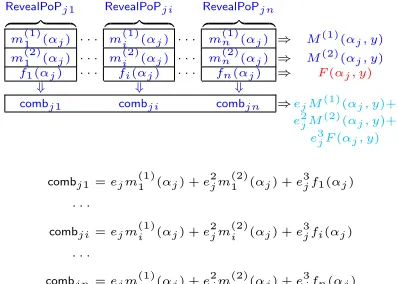
(g) RevealPoPji instances executed by PartyPj corresponding to the parties Pi ∈ VCORE. The same random combinerej is used in all these instances.
combjidenotes the linear combination of values output duringRevealPoPji.
This is analogous to figure2bwith`= 1,pack= 1.
RevealPoPj1 RevealPoPji RevealPoPjn
z }| { z }| { z }| {
m(1)1 (αj) · · · m(1)i (αj) · · · m(1)n (αj) ⇒ M(1)(αj, y)
m(2)1 (αj) · · · m(2)i (αj) · · · m(2)n (αj) ⇒ M(2)(αj, y)
f1(αj) · · · fi(αj) · · · fn(αj) ⇒ F(αj, y)
⇓ ⇓ ⇓
combj1 combji combjn ⇒ejM(1)(αj, y)+
e2
jM(2)(αj, y)+
e3 jF(αj, y)
combj1=ejm1(1)(αj) +e2jm
(2)
1 (αj) +e3jf1(αj) · · ·
combji=ejm(1)i (αj) +e2jm
(2)
i (αj) +e3jfi(αj) · · ·
combjn=ejm(1)n (αj) +e2jm
(2)
n (αj) +e3jfn(αj)
{m(1)1 (αj)· · ·m (1)
n (αj)}definesM(1)(αj, y)(refer fig6a). Similarly {m(2)1 (αj)· · ·m(2)n (αj)}definesM(2)(αj, y)(refer fig6b). {f1(αj), f2(αj)· · ·fn(αj)}definesF(αj, y)(refer fig6c). Therefore
ejM(1)(αj, y) +e2jM
(2)
(αj, y) +e3jF(αj, y)is atdegree polynomial defined