Executive Function and Theory of Mind
in Borderline Personality Disorder.
Nicholas Stokes
Submitted in partial fulfilment for the requirements of the degree of
D.CIIn.Psy
University College London, 2001
ProQuest Number: 10013822
All rights reserved
INFORMATION TO ALL USERS
The quality of this reproduction is dependent upon the quality of the copy submitted.
In the unlikely event that the author did not send a complete manuscript and there are missing pages, these will be noted. Also, if material had to be removed,
a note will indicate the deletion.
uest.
ProQuest 10013822
Published by ProQuest LLC(2016). Copyright of the Dissertation is held by the Author.
All rights reserved.
This work is protected against unauthorized copying under Title 17, United States Code. Microform Edition © ProQuest LLC.
ProQuest LLC
789 East Eisenhower Parkway P.O. Box 1346
Table of Contents
Page
(i) Acknowledgements (iii)
(ii) Abstract (iv)
Chapter 1 : Introduction 1
1.1 The nature of Borderline Personality Disorder 1 1.1.1 Description of Borderline Personality Disorder.
1.1.2 Epidemiology and natural course. 1.1.3 Treatment issues.
1.1.4 Validity of the Borderline Personality Disorder diagnosis. 1.1.5 Models of the aetiology and symptoms of BPD.
1.2 Evidence for brain abnormality in BPD 9
1.2.1 General neurological abnormalities 1.2.2 Frontal lobe abnormalities
1.2.3 Abnormalities of the hippocampus and amygdala 1.2.4 Neurochemical abnormalities
1.3 Possible relation between BPD symptoms 18
and brain abnormaiities 1.3.1 Interpersonal difficulties
1.3.2 Poor affect regulation and inappropriate anger 1.3.3 Impulsivity
1.3.4 Dissociation
1.3.5 Identity disturbance and emptiness 1.3.6 Summary
1.4 Possible explanations for the presence of 23
brain abnormalities in BPD 1.4.1 Childhood abuse and neglect 1.4.2 Genetic inheritance
1.4.3 Head injury 1.4.4 Summary
1.5 Review of relevant literature relating to 27
executive functioning
1.5.1 Definitions of executive functioning 1.5.2 Models of executive functioning
1.5.3 Special difficulties in the study of executive functioning
1.5.4 Implications for the assessment of executive functioning in BPD.
1.6 Review of relevant literature relating to theory of mind 33 1.6.1 Evidence for theory of mind as a discrete cognitive module
1.6.2 Doubts over the independence of theory of mind from executive functioning.
1.6.3 Implications for the study of BPD
1.7 Hypotheses of the study 40
Chapter 2: Methods 42
2.3 Measures
2.4 Testing procedure 2.5 Ethical permission
Chapter 3: Results 55
3.1 Participants 3.2 General measures 3.3 Theory of mind measures
3.4 Executive function measures (excluding Predicaments test) 3.4.1 Measure entered into the analysis
3.4.2 Statistical comparisons between groups 3.5 Predicaments test
Chapter 4: Discussion 68
4.1 Restatement of hypotheses, previous evidence, 68 and main statistical results
4.2 Theory of mind measures 69
4.2.1 Interpretation of theory of mind results
4.2.2 Possible influence of depression upon theory of mind result. 4.2.3 Relationship between theory of mind and BPD symptoms. 4.2.4 Wider discussion of theory of mind and BPD.
4.2.5 Summary
4.3 Executive function measures 79
4.3.1 Interpretation of executive function results.
4.3.2 Possible influence of depression upon executive function result. 4.3.3 Relationship between executive functioning and BPD symptoms. 4.3.4 Wider discussion of executive function in BPD.
4.3.5 Summary.
4.4 Concluding comments 85
4.4.1 Limitations of study
4.4.2 Clinical implications of study 4.4.3 Suggestions for future research 4.4.4 Conclusion
References 92
Acknowledgements
I would like to thank Dr. Janet Feigenbaum for her support and advice throughout this project, Dr. Shelly Channon for advice on the use of her measures, and Dr. Pascoe Fearon for statistical advice.
I would also like to acknowledge my debt to all of the participants, and to the countless mental health professionals with whom I liased about the study, without whom it would not have been possible.
Abstract
Recent years have seen an increasing interest in the question of whether there may be organic as well as psychosocial factors that are important in accounting for the aetiology and symptoms of Borderline Personality Disorder (BPD). Various brain abnormalities have been reported or proposed in the disorder, particularly involving the frontal lobes, the hippocampus and the amygdala. However, the overall body of previous research has shown only mixed evidence of neuropsychological impairments associated with these brain regions in individuals with BPD. The present study investigates two cognitive functions that have been linked to the frontal lobes: executive functioning and theory of mind. Theoretical and empirical evidence from a number of sources suggests that deficits in these functions may help to account for some of the symptoms of BPD, including interpersonal difficulties, poor affect regulation, dissociation, and impulsivity.
In the present study, a group of participants diagnosed with BPD (n=17) was compared to healthy controls (n=13) on a variety of executive function and theory of mind measures. These included two executive function tasks which were designed to be open-ended and to mimic real-life situations (Predicaments test, Channon and Crawford, 1999; Modified Six Elements test, Wilson et al., 1996). Such tasks may have better ecological validity than the more abstract measures of executive function which have previously been used in studies with the BPD population. The theory of mind tasks were chosen to be developmentally advanced, to enable subtle deficits in theory of mind ability to be detected (Story Comprehension test, Channon and Crawford, 2000; Nappe Strange Stories test. Nappe, 1994).
this probably applies only to a proportion of individuals with the diagnosis. However further analysis underlined the possibility that this poorer theory of mind performance may be attributable to co-morbId depression rather than BPD diagnosis, and further research with a depressed control group is needed to investigate this issue properly. The theory of mind findings of the study are discussed in relation to the reflective function hypothesis of BPD. In particular, the reflective function hypothesis suggests that a deficit in theory of mind should be largely restricted to contexts which are relevant to that person's attachment history, but this study raises the possibility that the deficit may also apply to more neutral contexts.
Chapter 1: Introduction
1.1 The nature of Borderline Personality Disorder
1.1.1 Description ofBorderiine Personaiity Disorder.
Stern (1938) used the term “borderline” to describe a particular group of patients who, amongst other characteristics, were prone to narcissism, psychological rigidity, hypersensitivity, negative therapeutic reactions, deep insecurity, and difficulties with reality testing in interpersonal contexts. Many of these characteristics seem to map on to the modern concept of Borderline Personality Disorder, but it was not until the introduction of the multiaxial classification system of DSM-III (American Psychiatric Association, 1980) that the term gained formal nosological recognition along with the other personality disorders and learning disabilities in Axis-ll.
Although DSM-III was ostensibly atheoretical, some (e.g. Silk, 2000) have argued that the split between Axis I and II disorders involved a tacit assumption that, while Axis I disorders were coming increasingly under the realm of biological psychiatry. Axis II could remain the territory of the psychoanalytic community, with psychosocial causation being seen as primary. This assumption has started to be questioned in recent years, with research increasingly addressing the question of whether there may be organic as well as psychosocial factors in the aetiology of personality disorders. The present study can be seen as part of this trend, with its hypotheses drawn from both psychosocial and organic models of Borderline Personality Disorder.
time, and leads to distress or impairment."
With respect to Borderline Personality Disorder, DSM-IV provides the following diagnostic criteria:
"A pervasive pattern of instability of interpersonal relationships, self image, and affects, and marked impulsivity beginning by early adulthood and present in a variety of contexts, as indicated by at least five of the following:
(i) Frantic efforts to avoid real or imagined abandonment
(ii) A pattern of unstable and intense interpersonal relationships characterised by alternating extremes of idealisation and devaluation.
(iii) Identity disturbance: markedly and persistently unstable self-image or sense of self.
(iv) Impulsivity in at least two areas that are potentially self-damaging.
(v) Recurrent suicidal behaviour, gestures, threats or self-mutilating behaviour.
(vi) Affective instability due to a marked reactivity of mood (e.g. intense episodic dysphoria, irritability, or anxiety usually lasting a few hours and only rarely more than a few days).
(vii) Chronic feelings of emptiness.
(viii) Inappropriate, intense anger, or difficulty controlling anger (e.g. frequent displays of temper, constant anger, recurrent physical fights).
1.1.2 Epidemiology and natural course (figures from DSM-IV, APA, 1994)
The prevalence of BPD is estimated at 2% of the general population, 10% among outpatient mental health patients, and 20% in psychiatric inpatients. It is one of the most common personality disorders, with prevalence in specialist personality disorder clinics of 30 to 60%. It Is thought that around 75% of those diagnosed with BPD are female. Physical and sexual abuse, neglect, conflict, and early parental loss or separation are common in the childhood histories of those with BPD. Although there is considerable variability in the course of BPD, the most typical pattern is of chronic instability in early adulthood, with the level of impairment and disruption gradually reducing as individuals reach their 30s and 40s, and beyond.
1.1.3 Treatment issues.
Individuals with BPD can be amongst the most challenging groups for mental health professionals to work with, with evidence that patients with BPD are more likely to be “dreaded” by clinicians than patients with other diagnoses (Bongar et al., 1991). Indeed, some have argued that the diagnosis of BPD has acquired a stigma within the mental health system (Nehls, 1998), and that clinicians are less likely to respond empathically to individuals if they have a diagnosis of BPD (Fraser and Gallop, 1993).
manifest itself in cruelty to others or violence.
Several approaches for the treatment of BPD have been developed specifically for the disorder, two of which have been subjected to randomised control trials: Dialectical Behaviour Therapy (Linehan, 1993; Shearin and Linehan, 1994), and Psychoanalytically Oriented Partial Hospitalisation (Bateman and Fonagy, 1999). Dialectical Behaviour Therapy is a manualised treatment in which patients receive individual psychotherapy and group-based skills training. The overall aim of the treatment is to enable patients to learn skills that help them to manage the emotional dysregulation which is characteristic of BPD. Psychoanalytically Oriented Partial Hospitalisation, described by Bateman and Fonagy (1999), is an approach which conceives of BPD as a disorder of attachment, separation tolerance and reflective functioning (the capacity to understand one’s own and others’ behaviour in mental state terms: Fonagy, 1999). Treatment consists of individual and group psychoanalytic psychotherapy, and group expressive therapy. Both treatment approaches were found to produce good outcomes on a number of measures, including frequency of suicidal behaviour, number of days in hospital and social adjustment.
1.1.4 Validity o f the Borderline Personality Disorder diagnosis.
that individuals with BPD should be considered to be suffering from some form of primary affective disorder.
Against these arguments, Gunderson (1994) asserts that there are significant phenomenological differences between the affective experiences of individuals with BPD and those with a primary affective disorder (for example emptiness and anger are more typical of BPD than unipolar depression, whereas guilt and a preoccupation with failure are more typical of unipolar depression than BPD). Gunderson (1994) notes that studies of the responsiveness of BPD to pharmacological treatment do not show any consistent pattern of response to anti-depressants and mood stabilisers, and argues that this counts against suggestions of a strong link with affective disorders. Also Maffei and Fossati (1999) conducted a study in which structured interviews were administered to a large sample of patients with a variety of diagnoses, from which they concluded that DSM-IV criteria for BPD generally had good sensitivity and specificity, and correlated better with each other than with diagnostic criteria of other personality disorders.
In summary, the validity of the BPD diagnosis remains a contested issue. Arguments against its current status as a personality disorder include its relatively good long-term prognosis and the high levels of comorbidity with mood disorders. However, there are also arguments in favour of BPD's diagnostic validity, such as phenomenological differences in affective experience between BPD and primary mood disorders, and its response to pharmacological treatment.
1.1.5 Models o f the aetiology and symptoms o f BPD.
(i) Psychodynamic models.
A number of models of BPD have been proposed within the psychodynamic field. These include suggestions that a derailment in the separation-individuation process is important (e.g. Maher and Kaplan, 1966), or that the borderline condition is a defence against powerful and unacceptable aggressive drives (Kernberg, 1976). One of these psychodynamic models, the reflective functioning model of BPD, will be described here in more detail as it is particularly relevant to the theory of mind hypothesis of this study. Fonagy et al. (2000) propose that poor reflective functioning is a core deficit in BPD, which can help to explain many of the symptoms of the disorder, including unstable sense of self, impulsivity, emotional instability, suicidality, and chronic feelings of emptiness. It is proposed that poor reflective functioning in BPD is a result of an ingrained defensive inhibition of mentalising, which develops as a result of childhood maltreatment or neglect occurring the absence of a secure attachment relationship. This defense originally occurs as a way of protecting the child from conceiving of the content of the abusive or neglectful caregiver's mind, and is a pattern which persists into adult life. However Fonagy et al. (2000) proposes a key qualification of this model: that poor reflective capacity in BPD is restricted to certain problematic internal working models and attachment contexts, and that reflective capacity is retained in some form at other times. This suggestion helps to account for anecdotal evidence that individuals with BPD at times appear to have an acute awareness of the mental states of others and can sometimes display a high level of apparent competence.
(ii) Cognitive-behavioural models.
affective regulation, and cognitive functioning seen in BPD patients. Layden et al. (1993) comment that individuals with BPD can be especially difficult to treat as they tend to hold numerous, often contradictory, schemas. For example, a patient might simultaneously hold schemas of dependence and mistrust, resulting in a continual dilemma about whether to seek closeness with others (thus putting themselves in a position where they could be vulnerable to maltreatment), or whether to withdraw from interpersonal contact (and risk feeling unable to cope alone).
(iii) Family based aetiologies.
Several researchers have proposed that a pathogenic family background may be important in the development of BPD. For example, Golomb et al. (1994) suggests that a families of BPD patients are typically chaotic, and that mothers of individuals with BPD tend to treat their offspring as a means of satisfying their own needs. Berzirganian et al. (1993) reports that a combination of maternal inconsistency and over-involvement predicted the development of BPD in a community sample of 776 adolescents. Also Linehan (1993) (in the context of the Biosocial model: see below) proposes that individuals with BPD often come from “invalidating” family environments, where the developing child's emotional reactions are labelled as wrong or invalid in some way.
(iv) Genetic predisposition.
(v) Brain abnormality models.
There is a growing body of evidence from physiological and neuropsychological studies indicating that there may be brain abnormalities in BPD which might be linked to the clinical presentation of the disorder. For example Lyoo et al. (1998) report evidence that individuals with BPD have smaller frontal lobes compared to matched controls, and Judd and Ruff (1993) report that verbal and non-verbal memory are impaired in BPD. There have also been suggestions that neuro-chemical abnormalities may underlie some symptoms in BPD: for example Gurvits et al., (2000) hypothesise that impairment of seratonergic function may be linked to impulsivity in the disorder, and that acetylcholine abnormalities may relate to affective instability.
(vi) Biosocial model
Linehan’s (1993) Biosocial model is an attempt to bring together biological and psycho social factors into a coherent integrative account of BPD. The model proposes that BPD is a disorder of emotional dysregulation, the aetiology of which is influenced by the combination of a biological vulnerability to emotional reactivity and an early environment which does not allow the child to learn skills to regulate affect. As mentioned above, Linehan proposes that the family environments of individuals who develop BPD are typically invalidating. Many of the symptoms of BPD (such as suicidal and self-harming behaviour) are seen as maladaptive ways of coping with emotional dysregulation.
Summary
the major research questions of the study are derived. The issue of brain abnormality in BPD will now be considered in more detail.
1.2 Evidence for brain abnormality in BPD
As outlined above, some researchers have proposed that there may be brain abnormalities in individuals with BPD which go some way towards accounting for the clinical presentation of the disorder. Many of these proposed brain abnormalities are within the limbic system (which includes the hippocampus and the amygdala) and the frontal cortex; areas that have been strongly implicated in the regulation of emotion and personality (Teicher et al., 1994). The possibility of abnormalities in these structures therefore links in well with the affective and interpersonal abnormalities seen in the clinical syndrome of BPD.
1.2.1 General neurological abnormalities.
It is thought that “neurological soft signs” (e.g. involuntary movements, apraxias, difficulty with rapid movements) can be associated with general neurological damage when there is no specific neurological disease (e.g. Shaffer et al., 1985). Stein et al., (1993) reported that a sample of 28 patients with BPD had increased left-sided neurological soft signs compared to control subjects, suggesting non-specific neurological abnormalities in the disorder. Other studies have similarly found an increase in neurological soft-signs in BPD (e.g. Gardener et al., 1987).
In summary, a number of neurological and EEG studies have suggested that there may be underlying organic abnormalities in BPD, and this has prompted research into whether there may be more specific brain regions and functions which are impaired in the disorder.
1.2.2 Frontal lobe abnormalities.
The frontal lobes are large and complex structures, which have been associated with a great variety of cognitive, motor and affective processes. The most posterior parts of this region are the sensory, motor and pre-motor cortices, which are involved in sensation, execution of movement, and the integration of motor skills into complex sequences. The more anterior section is the pre-frontal cortex. Lesions in this area may affect attention, working memory, the ability to inhibit pre-potent responses, the regulation of emotions and social behaviour, and the ability to appropriately initiate and terminate behaviours (Lezak, 1995). Other functions, such as the retrieval of autobiographical memories (Conway et al., 1999), and theory of mind (Stone et al., 1998) have also been associated with pre-frontal areas.
The pre-frontal region is of particular interest in the search for an organic basis for BPD, as lesions in this region have been known to produce personality and emotional changes. For example, Blair and Cipolotti (2000) report a single case of acquired anti social personality disorder following right frontal lobe damage. Changes in subjective emotional experience and emotional expression following frontal lobe damage have also been well documented (Stuss et al., 1992).
et al., 1983; Lucas et al., 1989). However, these used computerised tomography (CT) scans which are less likely to detect abnormalities than MRI scans (Na et al., 1991). In addition, the study by Lyoo et al. (1998) employed stricter criteria for diagnosis of the BPD subjects and exclusion of co-morbid diagnoses, so it remains the most reliable structural brain scanning study to date.
There have also been studies employing positron emission tomography (PET) scans, which have also produced evidence of frontal lobe abnormalities in BPD. PET scans measure the rate of metabolism (and thus brain activity) in different regions of the brain. Goyer et al. (1994) reported that a sample of 17 BPD subjects showed a significant decrease in metabolism in their frontal lobes when compared to controls. Also De La Fuente et al. (1994) found that BPD subjects (n=10) displayed a decrease in metabolism in the prefrontal and pre-motor areas.
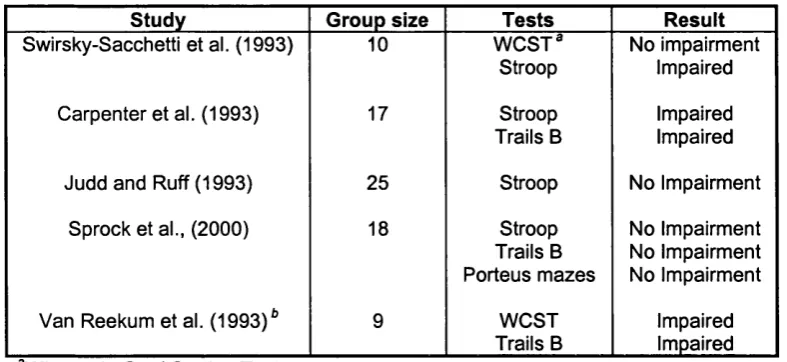
These findings of structural and metabolic abnormalities in the frontal lobes in BPD patients would suggest that one may find corresponding impairments in cognitive functions that are associated with the frontal lobes. A number of studies have investigated executive functioning^ in BPD, with mixed results. Table 1 summarises the results of these studies.
All of the studies used healthy volunteer control groups, except van Reekum et al. (1993) who compared the results to normative data. Tests used include the Wisconsin Card Sorting Test (Grant and Berg, 1948), the Stroop colour-word test (Stroop, 1935) the Trail-making test (Reitan, 1958) and the Porteus mazes (Porteus, 1955).
Table 1. Summary of studies Investigating executive function in BPD
Study Group size Tests Result
Swirsky-Sacchetti et al. (1993) 10 WGST® Stroop
No impairment Impaired Carpenter et al. (1993) 17 Stroop
Trails B
Impaired Impaired Judd and Ruff (1993) 25 Stroop No Impairment
Sprock et al., (2000) 18 Stroop Trails B Porteus mazes
No Impairment No Impairment No Impairment Van Reekum et al. (1993)* 9 WCST
Trails B
Impaired Impaired Wisconsin Card Sorting Test
^ Comparison made with normative data.
As can be seen from Table 1, studies investigating executive functioning in BPD have not produced consistent evidence of impairments, despite brain-scanning evidence of frontal lobe abnormalities in the disorder. There are a number of reasons why this may be. Firstly, sample sizes in most of the studies are small, and this obviously reduces the ability of studies to detect between group differences. The studies also vary in their sample characteristics, due to differing exclusion criteria, gender balance, type of referring institution (e.g. inpatient versus outpatient), which may account for some of the heterogeneity of the results.
It is worth also noting that some researchers have reported that poor performance on executive function tests has been associated with depression (e.g. Channon, 1996). This raises the possibility that executive function impairments, if found in BPD, are due to co-morbid affective disorders such as depression, rather than personality disorder. Sprock (2000) directly addressed this issue with the inclusion of a depressive disorder control group, but in the end did not find any significant difference between the groups on executive function measures.
Theory of mind (the ability to attribute mental states to others: e.g. Premack and Woodruff, 1978) has also been linked to the frontal lobes. For example Stone et al., 1998 reported that patients with orbito-frontal lesions were impaired compared to controls on a theory of mind task. Also Flecher et al., (1995) found that the comprehension of stories which required mental state attribution activated an area of the medial frontal cortex which was not active during comprehension of control stories which did not involve mental states. There have as yet been no published studies investigating theory of mind in BPD, but there have been studies which have looked at closely related constructs, the results of which indicate that this may be a fruitful area of cognition to study in the disorder. Firstly, Levine et al., (1997) reported that BPD patients were impaired on an emotional processing test which required the attribution of emotions to characters in stories: a task which closely resembles some theory of mind tests such as the Happe Strange Stories test (Nappe, 1994). Secondly, Fonagy et al. (1996) reported that patients with BPD had significantly lower scores on a measure of reflective functioning compared to patients of other diagnoses in a therapeutic community. Reflective functioning is defined as the capacity to understand ones own and others' behaviour in mental state terms (e.g. Fonagy, 1999) and thus appears to be a broader, but related construct to theory of mind, which focuses just upon the understanding of others’ mental worlds.
of mind and reflective functioning is that the latter is generally assessed in the context of an individual’s close attachment relationships. Formal assessments of reflective capacity are generally conducted by rating responses given in the Adult Attachment Interview (George et al., 1985), a structured interview which elicits narratives about childhood attachment relationships. By contrast, theory of mind measures employ hypothetical situations which are not designed to be relevant to a particular individual’s own relationships.
Finally, autobiographical memory has also been investigated in BPD. This function has been associated with the frontal lobes, through PET scanning studies (e.g. Conway et al., 1999). Conway et al. suggest that the role of the frontal lobes may be to regulate the construction of autobiographical memories from more posterior regions. Jones et al., (1999) found that 28 patients with BPD were impaired in comparison to controls on a test of autobiographical memory (Autobiographical Memory Test; Williams and Broadbent, 1986). The borderline group found it harder than the control group to access specific memories in response to cue words. Jones et al., (1999) argue that this deficit may link with dissociation in the disorder (see section 1.3.4 for a further discussion of this point). It is worth noting that autobiographical memory impairments have also been reported in patients suffering from depression, (e.g. Williams and Scott, 1988) which raises the possibility that the deficits reported by Jones et al., (1999) were due to co- morbid depression rather than personality disorder.
research. Finally, there have been studies suggesting that individuals with BPD have autobiographical memory deficits.
1.2.3 Abnormalities o f the hippocampus and amygdala
The hippocampus and the amygdala are adjacent sub-cortical structures, located just beneath the temporal lobes, which have been shown to be important in memory and emotional processing. Hippocampal lesions tend to produce anterograde memory deficits, and it appears that the major role of the hippocampus may be in the initial encoding of memory traces, which are later stored in other cortical areas (Lezak, 1995). The amygdala has been implicated in providing emotional “tags” to memories (e.g. Rolls, 1990), and may be involved in the processing of emotional elements of stimuli, including facial expressions (Young et al., 1996).
There is some indirect evidence from structural brain scanning that individuals with BPD may have hippocampal abnormalities. Stein et al. (1997) found that the average hippocampal volume (as measured by MRI) of 21 women reporting childhood sexual abuse was significantly smaller than that of matched controls. Other types of traumatic experience have also been linked to smaller hippocampal volume (e.g. combat trauma: Bremner et al., 1995). The significance of these findings for BPD is that childhood sexual abuse and other early traumatic experiences are a common feature of the histories of individuals with BPD (e.g. Zanarini et al., 1997, found that 91% of a sample of patients with BPD reported some sort of childhood abuse or neglect). Given this, one might therefore hypothesise that similar results in terms of hippocampal volume in BPD may be found in future studies.
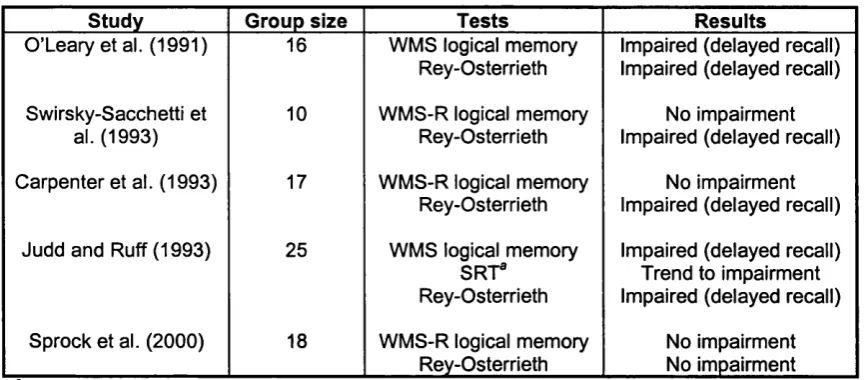
For verbal memory, all of the studies used the original or revised version of the Wechsler Memory Scale (WMS) logical memory sub-test (Wechsler, 1945, 1987), and one study also used the Selective Reminding Test (Buschke and Fuld, 1974). For non-verbal memory, all of the studies used the Rey-Osterrieth figure recall test (Osterrieth, 1944) These tasks have been shown to be sensitive to the effects of hippocampal damage (e.g. Miller et al., 1998, Sass et al., 1990).
Table 2. Summary of studies investigating memory function in BPD
Study Group size Tests Results
O’Leary et al. (1991) 16 WMS logical memory Rey-Osterrieth
Impaired (delayed recall) Impaired (delayed recall) Swirsky-Sacchetti et
al. (1993)
10 WMS-R logical memory Rey-Osterrieth
No impairment Impaired (delayed recall) Carpenter et al. (1993) 17 WMS-R logical memory
Rey-Osterrieth
No impairment Impaired (delayed recall) Judd and Ruff (1993) 25 WMS logical memory
S R T Rey-Osterrieth
Impaired (delayed recall) Trend to impairment Impaired (delayed recall) Sprock et al. (2000) 18 WMS-R logical memory
Rey-Osterrieth
No impairment No impairment Selective Reminding Test
Two studies have investigated cognitive functions associated with the amygdala in BPD. The first is Levine et al., (1997), who reported that a group of 30 individuals diagnosed with BPD performed poorly compared to controls on a test involving identifying emotional expressions of faces. This is an impairment which has been associated with patients who have had amygdalectomies (e.g. Young et al., 1996). However, Wagner and Linehan (1999) reported that a group of 21 women with BPD were unimpaired on a test of facial expression identification, and displayed heightened sensitivity to the recognition of fear. Wagner and Linehan suggest that one possible reason for the discrepancy between the two studies is that while Levine et al. (1997) used a multiple choice design, Wagner and Linehan used a free response format with answers coded by raters, which they argue is a more accurate assessment of facial emotion expression identification. In all, evidence of cognitive impairments associated with the amygdala in BPD is at best mixed.
In summary, there is indirect evidence from brain-scanning studies of trauma victims that individuals with BPD may have structural abnormalities of the hippocampus. Studies investigating memory function in BPD have produced mixed results, and this variability may be due to small sample sizes and varying exclusion criteria. There have also been mixed results in studies investigating facial emotion perception in BPD, a function associated with the amygdala .
1.2.4 Neuro-chemical abnormalities
al., 1994). There have been suggestions that deficient serotonergic modulation of the limbic system (which has a central role in the regulation of action) may underlie impulsive aggression in BPD (Gurvits et al., 2000). Gurvits et al. also hypothesise that levels of the neurotransmitter norepinepherine (which regulates levels of arousal and engagement with the environment) may determine whether impulsive aggression is directed outwards (i.e. at others) or inwards (i.e. self harm, suicidal behaviour).
With regard to affective instability, abnormalities in the function of the neurotransmitter acetylcholine have been related to mood disorders (e.g. Risch et al., 1983). Studies have indicated that BPD patients have a more intense depressive response compared to healthy controls following administrations of substances which mimic acetylcholine (e.g. Steinberg et al., 1997). In this last study, it was found that the magnitude of depressive response correlated with the number of affective instability traits in the patients.
In summary, it appears that several neurotransmitter abnormalities may be important in influencing impulsive aggression and affective lability in BPD, and that a combination of these abnormalities may be important (alongside psychosocial stressors) as predisposing factors for the development of the disorder (Gurvits et al., 2000).
1.3 Possible relation between BPD symptoms and brain abnormalities.
The following sections will consider how the physiological, cognitive and affective elements of the brain abnormality model of BPD may be helpful in accounting for some of the symptoms of the disorder.
1.3.1 Interpersonal difficulties.
retrieving autobiographical memories (e.g. Jones et al., 1999), possibly due to hippocampal and frontal lobe abnormalities, could result in a reduced ability to learn from and integrate information relating to interpersonal experiences, thus hampering the possibility of future social behaviour being guided in an adaptive way.
Hypothesised executive dysfunction in BPD could also relate to interpersonal difficulties. It could be argued that many interpersonal situations impose executive demands, as they may, for example, require the individual to inhibit their immediate response to a situation and weigh up the consequences of different courses of action before acting (e.g. Channon and Crawford, 1999).Therefore dysexecutive difficulties may make it hard to negotiate interpersonal relationships with sufficient social judgement, thus making relationships vulnerable to instability.
As mentioned above, there have so far been no studies directly investigating theory of mind in BPD, but if a subtle deficit in this function were to be found in this population, one could speculate that this could also contribute to interpersonal difficulties. For example, it could help to explain the dramatic shifts between idealisation and denigration characteristic of the disorder. When a significant other is unable to immediately gratify the patient’s needs, a theory of mind deficit may make it harder to understand the other’s behaviour as an expression of legitimate needs and concerns which differ from the patient’s.
1.3.2 Poor affect regulation and inappropriate anger.
be seen in some patients with frontal lobe injuries (e.g. Stuss et al., 1992). Therefore in BPD, one might speculate that frontal lobe abnormalities which have been reported (e.g. Lyoo et al., 1998) may contribute to the poor affect regulation and inappropriate anger seen in the disorder. In addition, abnormalities in neurotransmitter systems, particularly acetylcholine (e.g. Steinberg et al., 1997), may also have a role in affective instability and anger in BPD.
A hypothesised deficit in theory of mind may also contribute to these affective symptoms. For example, poor understanding of the motivation behind another’s behaviour may lead to a mis-construal of a situation involving a perceived violation of personal rights, to which the individual with BPD may react with understandable anger. A deficit in theory of mind may render interpersonal relationships baffling for much of the time, and this reduced ability to predict and understand the likely behaviour of others would leave the individual particularly vulnerable to emotional instability triggered by interpersonal events (e.g. a temporary separation).
1.3.3 Impulsivity.
1.3.4 Dissociation.
Dissociative experiences can involve drastic failures of autobiographical memory (e.g. Schacter et al., 1982), a function has been linked to the frontal lobes (e.g. Conway et al., 1999). Jones et al. (1999) report that individuals with BPD are impaired in their ability to retrieve specific autobiographical memories. In this study there was also a significant negative correlation between autobiographical memory performance and the Dissociative Experiences Scale (Carlson and Putnam, 1993), Indicating that poor autobiographical memory (when not dissociating) may relate to the likelihood of having dissociative experiences. Thus, one might hypothesise that frontal lobe abnormalities in BPD may be linked (through abnormal autobiographical memory function) to a tendency to dissociate in the disorder (Jones et al., 1999). The proposal that abnormal autobiographical memory may be linked to dissociation ties in with suggestions that the function of dissociation may be to avoid the emotional consequences of recalling past trauma (e.g. van den Hout et al., 1996). There have also been suggestions that hippocampal abnormalities may relate to dissociative amnesia, as the hippocampus may have a role in bringing together memory traces from disparate areas of the cortex (Bremner et al., 1996).
1.3.5 Identity disturbance and emptiness.
There have been suggestions that pre-frontal cortex activity may be important in meta cognition and providing a sense of self (e.g. Stuss, 1991). The pre-frontal cortex has been proposed as the site of the executive functions, which have a role in co-ordinating cognitive activity (e.g. Shallice, 1988). Meares et al., (1999) suggests that this co ordination of cognition enables a coherent stream of consciousness and a sense of self to emerge. It has also been suggested that disruptions in one’s sense of self may be related to autobiographical memory disturbance (Klein, 2001), a function which has been related to the frontal lobes (e.g. Conway et al., 1999). Therefore, a disruption of executive function and autobiographical memory, both due to frontal lobe abnormalities, may help to produce the unstable sense of identity which is characteristic of BPD.
There is also some evidence that identity disturbance and emptiness may be related to neurotransmitter dysfunction in BPD: Steinberg et al. (1997) reported that affective instability traits (including identity disturbance and chronic feelings of emptiness) correlated significantly with a measure of acetylcholine dysfunction those with the disorder (i.e. depressive response to physostigmine).
1.3.6 Summary.
1.4 Possible explanations for the presence of brain abnormalities in BPD.
The previous section reviewed how brain abnormalities in BPD may relate to the symptoms of the disorder. The question of how such abnormalities may have been acquired in BPD has recently been the subject of increasing theoretical and empirical work (e.g.. Meares et al., 1999). At least three types of explanation for the existence of brain abnormalities in BPD have been proposed, and these will now be considered.
1.4.1 Childhood abuse and neglect.
Childhood abuse and neglect is a common feature of the histories of individuals with BPD (e.g. Zanarini et al., 1997), and several researchers have suggested that brain abnormalities in BPD may develop as a result of such traumatic experiences (e.g. Meares et al., 1999).
The pre-frontal cortex, the hippocampus and the amygdala are amongst the most plastic of brain regions, and pre-frontal areas are the latest developing part of the cortex, with significant changes continuing into adolescence (Teicher et al., 1994). The plasticity and late development of these areas (some of which have been proposed as sites for brain abnormalities in BPD) makes them plausible candidates for being adversely affected by childhood trauma.
associated with stress (Uno et a!., 1989).
Some studies have produced support for the suggestion that childhood trauma in particular may be linked to brain changes. For example, Green et al., (1981) reported that in a sample of abused children, there was a raised prevalence of neurological soft signs and EEG abnormalities. Also, Stein et al., (1997) found that adult female survivors of sexual abuse had reduced hippocampal volume compared to controls (measured by MRI). Finally, Teicher et al. (1994) reported that in a large sample of out-patients, a history of childhood abuse was associated with higher scores on the Limbic System Checklist (Teicher et al., 1993), a self report questionnaire of symptoms indicative of limbic system dysfunction (e.g. dissociative experiences).
Although these studies were not conducted on BPD samples, they provide some support for the hypothesis that there may be link between childhood trauma and brain abnormalities in BPD. However Teicher et al. (1994) caution that the direction of causation is as yet unestablished. For example some have suggested that neurological and neuropsychiatrie abnormalities (such as seizures, impulsivity and depersonalisation) may put a child at increased risk of abuse as they are less able to resist the abuser (Davies 1978-1979), or that smaller hippocampal volume may be a risk factor for the development of the psychological sequelae of trauma (Stein et al., 1997).
1.4.2 Genetic inheritance.
did not find significant evidence of heritability. However Torgersen (2000) reports preliminary results of a larger twin study, which hints at a greater genetic role in the development of BPD.
Some have suggested that it may be more fruitful to consider whether the underlying dimensions of BPD are heritable (such as impulsivity and emotional lability), rather than trying to establish that BPD is heritable in itself (Gurvits et al., 2000). For example, Gurvits et al. argue that there is evidence that serotonergic abnormalities may by partially inherited, and in view of the fact that serotonergic abnormalities have been reported in BPD (De Vegvar et al., 1994), they propose that this may provide a genetic basis for impulsive aggression in the disorder. Torgersen (2000) argues that there are many personality traits associated with BPD which display a significant degree of heritability (possibly through variations in neurotransmitter function) including neuroticism, negative affectivity, affective lability, and identity problems.
In summary, although at present the evidence of the heritability of BPD itself is sparse, there are indications that underlying traits associated with BPD, such as impulsive aggression, may have a genetic basis. A genetic component may help to explain the presence of brain abnormalities which have been reported in BPD, particularly those involving neurotransmitter systems.
1.4.3 H ea d injury.
which amount to acquired personality disorder (e.g. Blair and CIpolottI 2000, Franullc et al., 2000). This raises the possibility that (at least for some Individuals with BPD) a head Injury may be a significant aetlologlcal factor In the development of the disorder, and that some of the brain abnormalities which have been reported In BPD may be related to prior head Injury.
Against this suggestion. It Is plausible to suggest that the diagnosis of BPD may itself be a risk factor for head Injury (e.g. through Impulsivity). However Streeter et al. (1995) report that In all but one of the cases In the BPD group, the head Injury was sustained before the development of the full clinical symptoms of the disorder. Streeter et al., argue that this finding supports the hypothesis that head Injury can be a contributory factor to the development of BPD. Regardless of whether head trauma precedes the development of BPD, one could argue that the presence of head Injury In such a large proportion of those diagnosed with the disorder means that It may be an important contributory factor to the cognitive, behavioural and emotional symptoms of many Individuals with BPD.
1.4.4 Sum m ary
head injury may be a cause of some of the brain abnormalities reported in BPD, and that it may be an significant aetiological factor for a proportion of individuals with the disorder.
1.5 Review of relevant literature relating to executive functioning.
Before formally presenting the hypotheses of this study, a brief review of relevant literature and current debates relating to executive functioning (this section) and theory of mind (section 1.6) will be presented, along with implications for the study of these functions in BPD.
1.5.1 Definitions o f executive functioning
Shallice (1988) notes that from the early 19th century onwards, many considered the frontal lobes to be the seat of higher order control of thought and action, observing that patients who had suffered frontal lesions showed deficits in planning, responding appropriately and adapting to new situations. Such cognitive abilities have become known as the executive functions, and there is a current consensus that these can be broadly defined as a set of processes which facilitate adaptation to novel situations (Burgess, 1997).
Numerous attempts have been made to provide a detailed functional definition of executive processes. Just one of these is provided by Norman and Shallice (1986), who argue that there are five types of situation where executive functions are required for optimum performance:
(1 ) Those that involve planning or decision making (2) Those involving error correction or trouble shooting
actions.
(4) Dangerous or technically difficult situations.
(5) Situations which require the overcoming of a strong habitual response or resisting temptation.
Rabbitt (1997) collected together a selection of recent attempts to distinguish between executive and non-executive functioning, and produced an extensive list which includes: dealing with novelty where planning and goal identification are required, initiating new sequences of behaviours, preventing inappropriate responses, carrying out novel dual task combinations, monitoring performance to correct errors, enabling sustained goal- directed attention, and searching for specific autobiographical memories.
The extensiveness of Rabbitt’s list illustrates the difficulty of providing a definitive functional definition of executive processes, and Burgess (1997) proposes that this difficulty stems primarily from the fact that executive processes are involved in the co ordination of lower-order functions. This means that executive functioning can potentially be required in any novel situation requiring the regulation of these lower-order processes, with the result there is no clear association between executive functioning and any particular type of behaviour. Indeed, Rabbitt (1997) argues that the degree of involvement of executive processes in any one task is a function of its novelty for that particular individual, rather than being due to any intrinsic property of the task. This is in contrast to other cognitive functions, where a particular underlying cognitive processes (e.g. face recognition) will contribute to performance on a well defined set of tasks. Therefore, while it is clear that in order to investigate whether a patient suffers from dyscalculia one should ask them to complete some sums, it is less clear what a definitive operationalisation of executive dysfunction should be.
function, such as memory, where deficits are defined in functional rather than anatomical terms.
1.5.2 Models o f executive functioning.
There have been many models of executive functioning, and one of the most influential was developed by Norman and Shallice (1986). In common with most other models, it relies on the distinction between automatic and controlled processing, proposing that habitual and novel actions are handled in different ways.
Under the model, routine processing is carried out by thought and action schemas, which contain the cognitive and motor programming for carrying out particular tasks, and are triggered by internal or external stimuli. Each schema will have acquired associations with particular triggers over time (e.g. for example, the sight of a glass of water will be associated with a schema containing the cognitive and motor programming required for picking up the a glass and drinking from it). Schemas that require the same information processing resource compete for dominance by inhibiting one another when activated; a process known as contention scheduling. However, for novel situations, the supervisory attention system becomes active, which selects or overrides schemas in order to enable the individual respond in a flexible manner.
could be argued that utilisation behaviour (where patients automatically begin using an object that is put in front of them: Lhermitte, 1983) is an example of such a process. More recent extensions of this model have included attempts to fractionate the supervisory system into constituent processes (e.g. Burgess, 1997). In this paper, Burgess reports data which suggests that response initiation and response suppression, both considered to be aspects of executive functioning, may be damaged independently by brain injury.
Another influential model of executive processes is Baddeley’s (1986) central executive component of working memory. In this, the central executive co-ordinates the activities of two slave working memory processes: the phonological loop and the visuo-spatial sketchpad. Under this model, tasks which require the simultaneous storage and manipulation of material would be sensitive to deficits in central executive ability (which, it is argued, explains poor dual task performance in Alzheimer’s disease). Baddeley conceives of the central executive as being similar to Norman and Shallice’s Supervisory Attention System. Other models include the one proposed by Stuss (1991), which again is broadly similar to the Norman and Shallice model, except that an additional level of self-reflectiveness/meta-cognition is proposed. This level is placed above the supervisory system, and its function is to enable the individual to reflect on thinking and action. It is proposed that the self-reflectiveness/meta-cognition level may also be damaged by injuries to the frontal lobe.
1.5.3 Special difficulties In the study o f Executive Functioning
(i) Issues of task purity.
Any task designed to measure a particular cognitive function is likely to suffer from additional variance due to the involvement of processes other than the one of interest (e.g. a deficit in visual processing ability may affect performance in a recognition memory task). However, Burgess (1997) argues that measures of executive function are especially prone to this source of error, as they necessarily involve the regulation and control of lower-order functions. This means that it is generally more difficult to rule out the effects of other functions in executive tasks than for measures of lower-order abilities. Certain executive function tasks, such as the Wisconsin Card Sorting Test (Grant and Berg, 1948) have been particularly singled out for criticism of task impurity, with some arguing that the involvement of lower-order processes (such as memory) is so great that the task can sometimes present greater difficulties for patients with lesions outside the frontal lobes than patients with frontal abnormalities (e.g. Corcoran and Upton, 1993). However, Rabbitt (1997) points out that too zealous an effort to control performance variables may result in a reduction in the “executive” nature of a task, as executive functioning involves the simultaneous management of different functional processes.
(ii) Test-retest reliability.
Rabbitt (1997) notes that tests of executive function generally have poor test-retest reliability, and that this problematic psychometric feature increases measurement error. Rabbitt argues that poor test-retest reliability is due to the fact that executive functions rely on novelty for their validity, as the more times a task is repeated, the more routine (and non-executive) its execution becomes.
(iii) Ecological validity
testing situation must necessarily impose a degree of structure upon the behaviour of the patient, executive difficulties tend to manifest themselves in situations where there are fewest environmental constraints on behaviour (e.g. Lezak 1995). Many tests of executive function have been criticised for being too structured and too explicitly defined when compared to the open ended tasks of daily living which present such difficulties for many patients with dysexecutive syndrome (e.g. Shallice and Burgess, 1991; Wilson et al., 1996).
To illustrate this point, Shallice and Burgess (1991) reported three case studies of patients with frontal lobe damage, whose IQs were in the superior range but who had severe impairments in activities of daily living due to executive difficulties. Two of the patients were unimpaired on 13 tests thought to be associated with frontal lobe damage, and the third was impaired on just three of these. However, all three patients were impaired on tests designed to simulate the type of open-ended activity the patients had difficulty with in everyday life (a shopping errand task and a version of the Modified Six Elements Test used in this study). Other studies have also found that traditional tests of executive functioning are poor at picking out the sorts of difficulties experienced by patients with frontal lobe damage: for example Anderson et al., (1996) reported that the Wisconsin Card Sorting Test (Grant and Berg, 1948) and the Halstead Category Test (Halstead, 1947) were unable to distinguish patients with frontal versus posterior lesions.
1.5.4 Implications for the assessment o f executive functioning in BPD.
It may also be useful to use a range of different executive measures, given evidence that executive processes may be frationable into relatively independent sub-components (e.g. Burgess, 1997).
It was mentioned above that some have claimed that many commonly used tests of executive function have poor ecological validity, and that open-ended tasks may be better at detecting dysexecutive problems (e.g. Shallice and Burgess, 1991, Wilson et al., 1996). It is notable that to date, no studies of executive functioning in BPD have used open-ended tasks such as those described by Shallice and Burgess (1991), and it could be argued that this may be one reason for the inconsistency of findings with regard to executive functioning impairment in BPD (see section 1.2.2). With this in mind, two of the executive function tasks chosen in this study have been explicitly designed to be open-ended: the first is the Modified Six Elements Test (Wilson et al., 1996) in which the subject must organise attempting six tasks in ten minutes whilst obeying a rule, a variant of a task used by Shallice and Burgess (1991). The second is the Predicaments test (Channon and Crawford, 1999) in which the subject must suggest solutions to awkward social situations. This would appear to be particularly suitable for use with the BPD population given the interpersonal nature of many of the difficulties seen in the disorder. These tasks are described in more detail in chapter 2.
1.6 Review of relevant literature relating to theory of mind
The term “theory of mind" refers to the ability to attribute mental states to others (Premack and Woodruff, 1978). Deficits in theory of mind have been proposed as important in expiaining the social impairments seen in autism (e.g. Baron-Cohen, 1985) and, more recently, schizophrenia (Frith, 1992). As yet, there have been no studies empirically testing theory of mind ability in BPD.
modular function in the same sense that language ability is: it may be selectively impaired or spared (however see section 1.6.2), it is culturally universal, and it emerges according to a particular developmental sequence. Others have argued for alternative viewpoints, such as the suggestion that theory of mind skills can simply be seen as a form of executive functioning (e.g. Russell, 1997). The following sections will briefly review this debate, and will then consider the implications for the present study.
1.6.1 Evidence for Theory o f Mind as a discrete cognitive module.
(i) Graded developmental emergence of theory of mind skills.
It appears that theory of mind skills develop amongst normal children according to a consistent developmental timetable. At around four years, children begin to understand first order false belief (Wimmer and Perner 1983). The classic version of the first order belief task is the Sally-Ann task (Baron-Cohen et al., 1985). In the test, a child sees Sally (a doll) hiding a marble in one basket, before leaving the room. Whilst out of the room, another doll moves the marble to a different basket. Upon Sally’s return, the child is asked where Sally will look for the marble; a question which requires the child to be able to ascribe a mental state to another (false belief) which is different to the child’s own.
This paradigm was extended by Baron-Cohen (1989) with the second order false belief task, which is passed by normally developing children at around seven years of age. Passing a second order false belief task requires the subject to be able to ascribe to someone a belief about another’s belief. At between nine and eleven years old children begin to pass faux-pas detection tasks, in which the subject must decide whether or not a character in a story has said something they shouldn’t have (Stone et al., 1998).
(e.g. Bach et al., 2000). However it could be argued that this developmental pattern is also consistent with alternative viewpoints, such as the proposal that theory of mind is an aspect of executive functioning (e.g. Russell, 1997).
(ii) Selective impairment/sparing of theory of mind skills in developmental disorders.
Many have argued that the core cognitive deficit in autism is a selective theory of mind impairment, and empirical studies of cognitive functioning in autism have provided some of the key pieces of evidence supporting the notion of a theory of mind module. The hypothesis of a selective theory of mind deficit is supported by the fact that autistic children perform poorly on theory of mind tasks compared to controls matched for IQ (e.g. Baron-Cohen et al.,1985) and autistic individuals show preserved abilities in non social cognitive areas, such as non-mental analogues of theory of mind tasks which require the representation of physical rather than mental states (e.g. the false photograph task, Leekam and Perner, 1991). Preserved abilities have also been reported on certain visuo-spatial tasks such as the block design sub-test of the Wechsler Intelligence scales (Shah and Frith, 1993), or the Children’s Embedded Figures Test (Shah and Frith, 1983).
The cognitive pattern seen in autism has been contrasted to that found in Williams’ syndrome. Individuals with this condition show poor verbal IQ, but are often affectionate and have good social skills, performing well on theory of mind tasks (Karmiloff-Smith et al., 1995). This suggests that theory of mind skills can be preserved against a background of other cognitive impairments. (However, Tager-Flusberg et al., 2000, challenge the notion that all aspects of theory of mind are spared in Williams syndrome).
(iii) Neuroimaging studies and brain damaged patients
A number of recent neuroimaging studies have suggested that theory of mind may be localised to regions within the frontal lobes. For example, Fletcher et al. (1995) reported that an area within the left frontal lobe showed greater activity when subjects were engaged in a task which involved mental state attribution, compared to non-mental control task.
This link between theory of mind and the frontal lobes is also suggested by studies of patients with frontal lobe damage. Happe, Malhi and Checkley (2000), and Channon and Crawford (2000) report results of testing with brain damaged patients which suggest that damage to locations within the frontal lobe may produce an acquired theory of mind deficit.
As well as localising evidence, studies of brain damaged patients have to some extent supported the notion that theory of mind skills may be independent of executive functioning: Nappe, Brownell and Winner (1999) reported that right hemisphere stroke patients were less impaired on control non-mental tasks than the theory of mind tasks, suggesting that general reasoning skills were left relatively intact (in this study, more precise localisation of damage was unavailable). Also, Bach et al., (2000) describes the case of a man with orbito-frontal brain damage who was impaired upon tests of executive functioning, but performed normally on advanced theory of mind tasks. Together these results tentatively suggest a double dissociation between theory of mind and executive functioning.
1.6.2 Doubts over the independence of theory of mind from executive functioning.
It has been suggested that the false belief task, upon which much of the empirical research into theory of mind rests, imposes significant executive function demands. Russell et al. (1999) argue that in order to pass a false belief task, the child must suppress a pre-potent response (their own belief) and select a less salient response (the other’s false belief) which has been held in working memory, and they argue that this gives the task a definite executive structure. This leaves open the possibility that autistic children fail the false belief task because of a deficit in executive functioning.
The standard argument used by theory of mind advocates against such a line of attack is to point out that autistic individuals are not impaired upon non-mental comparison tasks with the same executive structure, such as the false photograph task (Leekam and Perner, 1991). In the false photograph task, (Zaitchick, 1990) the child sees a Polaroid photograph being taken with a particular object in front of the camera. While the photograph is developing, the object in front of the camera is changed, and the child must predict what will appear in the photograph.
are less obviously executive in nature, such as faux pas detection (Stone et al., 1998).
Whether or not theory of mind tasks impose executive demands, studies of the relation between theory of mind and executive dysfunction in autism raise doubts about the selectivity and primacy of the theory of mind deficit in the disorder, which is one of the key pieces of evidence that has supported the notion of a theory of mind module. For example, Ozonoff et al., (1991) reported that executive dysfunction is more prevalent in individuals with autism than impaired theory of mind, which fits with the hypothesis that impaired executive function is a more primary deficit. Their study also found that poor theory of mind was significantly correlated with executive dysfunction, which calls into question the selectivity of poor theory of mind in the disorder.
In summary, it appears that many theory of mind tasks, especially false belief tasks, could also be viewed as tests of executive function, which calls into question whether theory of mind and executive function are separate constructs. This raises the possibility that autistic individuals fail theory of mind tasks because of executive problems, a proposal which is supported by studies which suggest that individuals with autism are
impaired on non-mental analogues of theory of mind tasks if the executive demands of the task are of an equivalent level. In addition, the primacy and selectivity of theory of mind impairments in autism is called into question, as executive dysfunction may be more prevalent in the disorder than impaired theory of mind, and as there is evidence that impairments in theory of mind and executive function are strongly correlated in the disorder.
1.6.3 Implications for the study of theory o f mind in BPD.