373
Abstract
We introduce a concept of a virtual discourse tree to improve question answering (Q/A) recall for complex, multi-sentence questions. Augmenting the discourse tree of an answer with tree fragments obtained from text corpora playing the role of ontology, we obtain on the fly a canonical discourse representation of this answer that is independent of the thought structure of a given author. This mechanism is critical for finding an answer that is not only relevant in terms of questions entities but also in terms of inter-relations between these entities in an answer and its style. We evaluate the Q/A system enabled with virtual discourse trees and observe a substantial increase of performance answering complex questions such as Yahoo! Answers and www.2carpros.com.
1
Introduction
In spite of the great success of search technologies, the problem of leveraging background knowledge is still on the agenda of search engineering, for both conventional and learning-based systems. Background knowledge ontologies are difficult and expensive to build, and knowledge graphs – based approaches usually have a limited expressiveness and coverage. In this study we explore how a
discourse analysis (which is
domain-independent) can substitute certain features of ontology-based search. There are few popular discourse theories describing how Discourse Trees (DT) can be constructed from the text. In our work we used Rhetorical Structure Theory
(RST, Mann and Thompson, 1988).
Ontologies are in great demand for answering complex, multi-sentence questions with a precise answer in such domain as
finance, legal, and health. In the educational domain this type of questions is referred to as convergent: answers to these types of questions are usually within a very limited range of acceptable accuracy. These may be at several
different levels of cognition including
comprehension, application, analysis, or ones where the answerer makes inferences or conjectures based on material read, presented or known. Answering convergent questions is an underexplored Q/A domain that can
leverage discourse analysis (Kuyten et al,
2015).
Discourse trees have became a standard for representing how thoughts are organized in text, in particular in a paragraph of text, such as an answer. Discourse-level analysis has been shown to assist in a number of NLP tasks where learning linguistic structures is essential (Louis et al., 2010; Lioma et al., 2012). DTs outline the relationship in between entities being introduced by an author. Obviously, there are multiple ways the same entities and their attributes are introduced, and not all rhetoric relations that hold between these entities occur in a DT for a given paragraph.
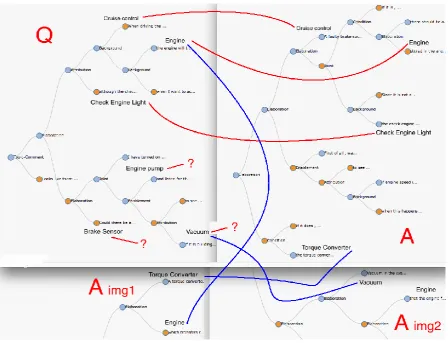
When DTs are used to coordinate questions and answers, we would want to obtain an “ideal” DT for an answer, where all rhetoric relations between involved entities occur. To do that, we need to augment an actual (available) DT of answer instance with a certain rhetorical relations which are missing in the given answer instance but can be mined from text corpora or from the web. Hence to
verify that an answer A is good for a given
question Q, we first verify that their DTs (
DT-A and DT-Q) agree and after that we usually
need to augment the DT-A with fragments of
other DTs to make sure all entities in Q are
Discourse-Based Approach to Involvement of Background Knowledge
for Question Answering
Boris Galitsky
1and Dmitry Ilvovsky
2 1Oracle Inc. Redwood Shores CA
2
National Research University Higher School of Economics
376
Figure 1: DTs of Q, A and imaginary DT-Aimg1 and DT-A img2
381
Confidential Review Copy. DO NOT DISTRIBUTE.
Christina Lioma, Birger Larsen, and Wei Lu. 2012. Rhetorical relations for information retrieval. SIGIR, Portland, OR, pp. 931-940.
D. T. Nguyen and S. Joty. A Neural Local Coherence Model. 2017. ACL. pp. 1320-1330.
Gardner, M., Grus, J., Neumann, M., Tafjord, O., Dasigi, P., Liu, N.H., Peters, M., Schmitz, M., & Zettlemoyer, L.S. A Deep Semantic Natural Language Processing Platform. arXiv:1803.07640. Jansen, P., M. Surdeanu, and Clark P. 2014. Discourse
Complements Lexical Semantics for Nonfactoid Answer Reranking. ACL.
Joty, Shafiq R and A. Moschitti. Discriminative Reranking of Discourse Parses Using Tree Kernels. EMNLP 2014.
Joty, Shafiq R, Giuseppe Carenini, Raymond T Ng, and Yashar Mehdad. 2013. Combining intra-and multi- sentential rhetorical parsing for document-level discourse analysis. In ACL (1), pages 486– 496.
M. Burtsev, A. Seliverstov, R. Airapetyan, M. Arkhipov, D. Baymurzina, N. Bushkov, O. Gureenkova, T. Khakhulin, Y. Kuratov, D. Kuznetsov, A. Litinsky, V. Logacheva, A. Lymar, V. Malykh, M. Petrov, V. Polulyakh, L. Pugachev, A. Sorokin, M. Vikhreva, M. Zaynutdinov. 2018. DeepPavlov: Open-Source Library for Dialogue Systems. ACL-System Demonstrations, p. 122– 127. 2018.
M. Sun and J. Y. Chai. 2017. Discourse processing for context question answering based on linguistic knowledge. Know.-Based Syst., 20:511–526, August 2007.
Marir F. and K. Haouam. 2004. Rhetorical structure theory for content-based indexing and retrieval of Web documents, ITRE 2004, pp. 160-164.
Minghao Hu, Furu Wei, Yuxing Peng, Zhen Huang, Nan Yang, Dongsheng Li. 2018. Read + Verify: Machine Reading Comprehension with Unanswerable Questions. arXiv:1808.05759 P. Kuyten, D. Bollegala, B. Hollerit, H. Prendinger
and K. Aizawa. 2015. A Discourse Search Engine Based on Rhetorical Structure Theory. Advances in Information Retrieva (ECIR). pp 80--91.
Poesio, M., R. Stevenson, B. Di Eugenio, and J. Hitzeman. 2004. Centering: A parametric theory and its instantiations. Computational Linguistics, 30(3):309–363.
Pranav Rajpurkar, Robin Jia, Percy Liang. Know What You Don't Know: Unanswerable Questions for SQuAD. arxiv.org/abs/1806.03822
Pranav Rajpurkar, Zhang, Jian; Lopyrev, Konstantin; Liang, Percy. 2016. SQuAD: 100,000+ Questions for Machine Comprehension of Text. in EMNLP 2016.
Regina Barzilay and Mirella Lapata. Modeling local coherence: An entity-based approach. Comput. Linguist. 34, 1 (March 2008), 1-34.
S. Teufel and M. Moens. Summarizing scientific articles: Experiments with relevance and rhetorical status. Computational Linguistics, 28(4):409–445. 2002.
Surdeanu, Mihai, Thomas Hicks, and Marco A. Valenzuela-Escarcega. 2015. Two Practical Rhetorical Structure Theory Parsers. NAACL HLT. Suwandaratna, N. and U. Perera. 2010. Discourse marker based topic identification and search results refining. In Information and Automation for Sustainability (ICIAFs), 2010 5th International Conference on, pages 119–125.
Wang, W., Su, J., Tan, C.L. 2010. Kernel Based Discourse Rela-tion Recognition with Temporal Ordering Information. ACL.
William Mann and Sandra Thompson. 1988. Rhetorical Structure Theory: Toward a functional theory of text organization. Text 8(3):243–281. Yangfeng Ji and Noah Smith. 2017. A Neural