1012
Analysing the Impact of Supervised Machine Learning on Automatic
Term Extraction: HAMLET vs TermoStat
Ayla Rigouts Terryn*, Patrick Drouin**, Veronique Hoste* and Els Lefever*
*LT3 Language and Translation Technology Team, Ghent University
Groot-Brittanni¨elaan 45, 9000 Gent;[email protected] **Observatoire de Linguistique Sens-Texte, Universit´e de Montr´eal
Succ. Centre-ville, Montr´eal, QC, H3C 3J7;[email protected]
Abstract
Traditional approaches to automatic term extraction do not rely on machine learn-ing (ML) and select the top n ranked can-didate terms or cancan-didate terms above a certain predefined cut-off point, based on a limited number of linguistic and statis-tical clues. However, supervised ML ap-proaches are gaining interest. Relatively little is known about the impact of these supervised methodologies; evaluations are often limited to precision, and sometimes recall and f1-scores, without information about the nature of the extracted candi-date terms. Therefore, the current paper presents a detailed and elaborate analysis and comparison of a traditional, state-of-the-art system (TermoStat) and a new, su-pervised ML approach (HAMLET), using the results obtained for the same, manually annotated, Dutch corpus about dressage.
1 Introduction
Automatic term extraction (ATE), also known as automatic term recognition (ATR), has long been an established task within the field of natural lan-guage processing. It can be used both in its own right, to automatically obtain a list of candidate terms (cts) from a specialised corpus, or as a pre-processing step for other tasks, such as machine translation (Wolf et al., 2011). The traditional method for ATE is a hybrid approach, combining both linguistic and statistical information. In a first step, linguistic preprocessing is performed and a preliminary list of cts is produced based on part-of-speech (POS) patterns. Next, statistical met-rics are applied to measure termhood (to what de-gree a term is related to the domain) and unithood for multi-word terms (whether the individual to-kens combine to form a lexical unit) (Kageura and
Umino,1996). These metrics are used to sort the cts based on their likelihood to be actual terms. To filter the list, one can either determine a cut-off value or select the top n or top n percent of terms. As a final step, manual validation is required.
This has been a standard methodology for some time (Daille, 1994) and is still used by state-of-the-art systems such as TermoStat (Drouin,2003) and TExSIS (Macken et al.,2013). However, the problem with these methodologies is determining the cut-off point (Lopes and Vieira, 2015) and combining multiple features (e.g., separate mea-sures for termhood and unithood). It has become clear that multiple evidence (i.e. combining multi-ple features) is highly beneficial for ATE (Dobrov and Loukachevitch, 2011; Loukachevitch, 2012). Supervised machine learning (ML) methodologies are now being used in answer to these problems. By automatically learning an optimal combination of features and cut-off points, many features can be efficiently combined.
pro-vided an opportunity to (1) develop a supervised ML approach for ATE (HAMLET) and (2) per-form a detailed evaluation of this system com-pared to a traditional tool without ML: TermoStat (Drouin,2003). These specific systems were cho-sen because they both allow extraction of single-and multi-word terms (swts single-and mwts) single-and are not restricted to only nouns and noun phrases, but in-stead also allow verbs, adjectives and adverbs to be extracted. Moreover, their methodology is sim-ilar, so the research can focus on one main differ-ence: the fact that HAMLET uses supervised ML to combine different features, rather than relying on manually set filters and thresholds like Termo-Stat. This is important to better understand the impact of the methodology. Are the same terms found with both methodologies? Do they make similar mistakes? Is it possible to see the impact of the training data? The analysis is performed by a terminologist, in her native language (Dutch) and on a subject for which she is a domain specialist (equitation - dressage).
2 Related Research
Some of the original supervised approaches to ATE start appearing in the early 2000s. Vivaldi and Rodr´ıguez (2001) claim to be the first to com-bine different methodologies for term extraction into a single system. Based on two manually anno-tated Spanish corpora in the medical domain, four different strategies are combined. The first strat-egy is to use EuroWordNet (EWN) (Vossen,1998) to determine whether a word belongs to the medi-cal domain. Next, Greek and Latin word forms are detected. Context is analysed as well, focusing on prime term candidates, i.e. those that are validated with EWN as medical terms. Finally, three unit-hood measures help to find relevant multi-word terms. Combining these four techniques leads to better results than using any one of them sepa-rately. The system is only tested on the Spanish medical domain; performance may vary signifi-cantly depending on EWN coverage of the cor-pus and relevance of the Latin and Greek words. Later research does test on multiple domains, for instance, an evolutionary algorithm based on the optimisation of the Receiver Operating Character-istics curve for the extraction of mwts (Az´e et al.,
2005), tested on the domains of biology and HR; or a system for both swts and mwts (Yuan et al.,
2017), elaborately evaluated with different
algo-rithms, using undersampling to obtain more bal-anced data, and cross-domain training/testing on four domains.
In 2016, neural network word embeddings are applied to ATE for the first time (Amjadian et al.,
2016), first as a filter on an existing tool (Termo-Stat), later on also as a full ATE pipeline ( Amja-dian et al., 2018). The success of multiple fea-tures for ATE has been proven repeatedly (Dobrov and Loukachevitch, 2011; Loukachevitch, 2012;
Nokel, Michael et al., 2012) and aside from the original binary classification approach of cts, se-quence labelling approaches are also gaining in-terest (Judea et al.,2014;Kucza et al.,2018). Ad-ditionally, There has been an increased interest in more nuanced term labels (Ljubei et al.,2019;
H¨atty and Schulte im Walde,2018), even though binary classification is still the norm.
con-sidering that these make up 75% of the terms in their test corpus.
Despite the increasing research interest, re-search on the impact of ML approaches on ATE is limited (Amjadian et al.,2018;Nokel, Michael et al.,2012). Comparative evaluations are highly problematic for several reasons. First, estab-lished benchmarks such as the GENIA corpus (Kim et al.,2003) and the ACL RD-TEC ( Qasem-izadeh and Schumann, 2016) are rare and often only available in a single language and domain. Second, reported evaluation scores (usually preci-sion, recall and f1-score) differ greatly depending on the strictness of the evaluation (e.g., whether or not partial matches are approved). Third, the difficulty of the task varies considerably depend-ing on the ct selection. For instance, limitdepend-ing POS patterns and frequency thresholds can result in a more balanced data set and narrower search space. Finally, results are rarely discussed beyond report-ing the scores, which may result in a distorted image, given the ambiguous nature of terms, as will be discussed further on. Therefore, while re-searchers regularly mention the suspected impact of methodology, term definitions, language and domain, little is known about how these factors in-fluence the actual results. The research presented in this paper presents an elaborate and qualitative evaluation and comparison of two tools and will focus on the difference between a supervised ML approach and a traditional approach.
3 Data and Tools
3.1 Data
The dataset is described in detail in (Rigouts Ter-ryn et al., 2019). The Dutch corpus on dressage was chosen as the evaluation corpus. The annotation scheme is based on lexicon-specificity (whether a term belongs to general language or only the vocabulary of experts) and domain-specificity (how relevant the term is to the given domain). Terms are annotated with three different labels: Specific Terms (which are both domain-specific and lexicon-specific), Common Terms (which are domain-specific but not lexicon-specific) and Out-Of-Domain (OOD) Terms (which are not domain specific but are lexicon-specific). Named Entities are annotated as well. In this corpus of around 55k tokens (64 documents), this resulted in 1326 different manual annotations (excluding Split Terms).
3.2 TermoStat
TermoStat is a hybrid term extractor developed by Drouin (2003) which is still continuously updated. It is currently available in French, English, Span-ish, Italian, and Portuguese, with beta versions for German, Catalan, Korean, Chinese and Dutch. It is customisable in the sense that users can choose to extract swts, mwts, or both and can also se-lect which POS (nouns, adjectives, adverbs and/or verbs) should be extracted. TermoStat selects cts based on their POS pattern and filters and sorts these cts with the Specificity score, a measure that takes into account the relative frequency of a ct in the specialised corpus, compared to that in a gen-eral reference corpus to calculate termhood.
3.3 HAMLET
HAMLET stands for Hybrid Adaptable Machine Learning approach to Extract Terminology and is a supervised methodology for ATE based on the data described in (Rigouts Terryn et al., 2019). HAMLET’s architecture is inspired by traditional hybrid systems such as TermoStat. First, cts are extracted based on their POS pattern. However, rather than a predefined list, the patterns are ob-tained from the annotated training corpus. Since there were no restrictions on which POS could be annotated, this results in an extensive list. More-over, incorrect patterns due to POS-tagging errors are included as well. This may result in a lot of noise but could also increase recall if similar tag-ging mistakes are made on terms in the test corpus. Next, a series of features are calculated for each ct. There are six different feature groups: mor-phological/shape (e.g., term length, capitalisation, special characters), frequency (e.g., relative fre-quencies in specialised corpus, newspaper cor-pus and Wikipedia corcor-pus), statistical (e.g., vari-ous termhood and unithood measures), related cts (e.g., information about terms with same lemma or normalised form), linguistic (e.g., POS pattern) and corpus features (e.g., domain of corpus of ori-gin). There are 152 distinct features in total. In contrast to most other term extractors, no restric-tions are placed on term length or frequency.
contribu-tion, HAMLET was trained on the Dutch corpora about heart failure and wind energy and tested on the Dutch corpus about dressage. Irrelevant fea-tures (with the same value for all instances) are discarded, leaving 136 features in this case. The data is highly imbalanced, with fewer than 10% positive instances (similar distribution in train and test sets). While other algorithms were able to reach better scores (e.g., a random forest classifier obtained an f1-score of 61% on the same dataset), only the decision tree model is discussed, because it offers both decent performance and is easy to in-terpret. Future research will devote more attention to the differences between algorithms for this task.
4 Experiments and Comparisons
4.1 Candidate Terms and Part-of-Speech Patterns
The gold standard data (test data) contains 1326 unique annotations: 985 Specific Terms, 190 Common Terms, 45 OOD Terms and 106 Named Entities. For this experiment, HAMLET was trained to find all annotation types, which is the configuration that lead to the best results for Ter-moStat. However, HAMLET could also be trained on specific combinations of these labels to cus-tomise the results for different applications. Out of the 1326 annotations which were considered true terms, only two could not be found because the an-notations were made below token-level and were therefore never selected as a ct by either extrac-tor: promotie(promotion, i.e. moving to a higher level of competition) andk(one of the letters indi-cating a certain position in the riding arena). An-other portion could not be found due to their POS pattern. This is always a problem for non-ML ex-tractors, since it is nearly impossible to manually define all possible patterns, especially consider-ing that POS taggers can make mistakes. How-ever, the supervised system has similar troubles. HAMLET’s preprocessing can only select terms for which the POS pattern occurred in the train-ing corpora (the two Dutch corpora on heart fail-ure and wind energy). In this case, there are 216 different patterns in the training data, but the test corpus still contains terms with 63 patterns that are not in the training data. This illustrates how domain-specific terminology can be. Dressage ter-minology contains many terms that start with a preposition. For instance, there are 85 annotations of the preposition+determiner+noun pattern, e.g.,
aan het been(responsive to a rider’s leg aids). Pat-terns including verbs are common in dressage as well, e.g.,vierkant halthouden(stopping the horse so all four hoofs form a rectangle). Due to the absence of such patterns in the training data, 104 terms were not extracted by HAMLET, while 11 of these were found by TermoStat.
Across all 3 languages and 4 domains in the complete dataset, a total of 1345 distinct POS patterns are identified (419 in Dutch in all four domains), meaning that these types of errors are greatly reduced when HAMLET is trained on a larger portion of the data, though that also leads to more noise. This emphasises the importance of diverse datasets to train robust term extractors and to evaluate extractors in multiple domains.
4.2 Decision Tree
The decision tree (of depth 8) that was created based on the training data of Dutch corpora on heart failure and wind energy uses 64 out of the 152 distinct features. All feature categories are represented, except corpus features. In other ex-periments involving more domains and languages, corpus features are regularly used, but in this set-ting, with only two different domains in the train-ing data, they did not appear to be informative. Statistical features are used most often (66 nodes, using 17 distinct features), followed by linguistic features (35 nodes, 16 features), related ct features (28 nodes, 9 features), morphological/shape tures (25 nodes, 9 features), and frequency fea-tures (16 nodes, 11 feafea-tures).
fre-quency features are strongly correlated.
A feature indicating presence in a list of stop-words is not used, even though lists of stopstop-words are generally very useful for ATE. This may be re-lated to the limited list used for Dutch (414 tokens) or the way it is currently implemented (only com-plete matches are counted). This analysis shows how the statistical termhood and unithood features are indeed most useful for ATE, but that there are many other informative features as well, in a range of different categories.
4.3 Precision, Recall and F1-scores
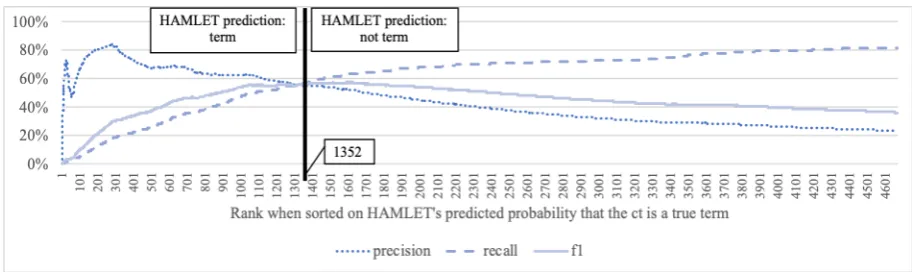
HAMLET extracts 1352 cts with a precision of 55.03%, a recall of 56.11% and an f1-score of 55.56%. TermoStat extracts many more cts (4671) and has a much lower precision of only 18.18% but a higher recall at 64.03%, resulting in an f1-score of 28.31%. This is where the supervised ML component becomes immediately apparent: HAMLET is trained to optimise f1-score, whereas the cut-off point for TermoStat had to be set man-ually based on a limited set of experiments. Fig-ures 1 and 2 show the precision, recall and f1-score curves for HAMLET and TermoStat. In this case, HAMLET did not print the predicted label of the classifier, but the predicted probability of label 1, i.e. the predicted probability that the ct is a true term. In Figure 1, only terms with a prob-ability higher than 50% (up until rank 1352) were labelled as terms by HAMLET. However, for the sake of comparison with TermoStat, the graph was calculated supposing that all 4671 highest ranked cts were predicted as terms. As can be seen in the graph, the decision boundary is very close to the highest possible f1-score. According to this rank-ing, that would have been 57.05%, if HAMLET had extracted the highest ranked 1619 cts instead of the first 1352. The TermoStat results in Fig-ure 2 show a different trend. Here, the ideal cut-off point would have been after the 1307thhighest ranked term (Specificity of 16.06), which would have resulted in an f1-score of 42.61%. Instead, 3362 more terms were extracted, causing a large drop in f1-score.
Another notable peculiarity in these curves is that the TermoStat curves are smoother and follow a more predictable pattern: precision starts high and decreases gradually, recall increases but starts to slowly flatten out. The recall curve for HAM-LET follows this pattern and even reaches over
80% at rank 4671, where TermoStat’s recall is still only at 64%. However, HAMLET’s precision curve is far from smooth in the beginning, with the highest precision only around rank 285. These fluctuations are due to two factors. First, preci-sion curves are very susceptible to small changes at the start, when it is calculated for few exam-ples. Second, surprisingly, HAMLET’s predicted probability that a ct is a true term does not always correspond with the reality. For instance, 13 cts were given a 100% probability and only 7 of these were actual terms. So, while the predicted true term probability for these cts was 100%, the ac-tual precision was only 54%. One of the false pos-itives should have been in the gold standard and was missed by the annotators. Two were parts of terms and the remaining three were very com-mon words: bovenstaande(above),moet(has to), andwerd(became). Further research is needed to explain this behaviour and compare results with other algorithms and corpora.
4.4 Term Labels
Figure 1: Precision, recall and f1-curves of HAMLET, including the 4671 highest ranked cts based on predicted probability that the ct is a true term; black line indicates boundary between cts that were predicted to be terms and those that were predicted not to be terms.
Figure 2: Precision, recall and f1-score curves of TermoStat for all 4669 extracted terms, ranked based on specificity score
in part, to the annotation. Since the corpus sub-ject was dressage (a subdomain of equitation), rather than equitation as a whole, many terms that are specific to other branches of equitation were annotated as OOD Terms. These are nearly all terms related to other equitation disciplines, such asgymkhana(same in English) orvoltige (eques-trian vaulting). Had the annotation been slightly less strict about the domain-specificity, at least 27 of the 34 OOD Term annotations would have been Specific Terms. This illustrates how a subjective decision about whether or not to include a certain group of terms, can have a large impact on the re-sults.
The second hypothesis concerns Specific Terms: we expect HAMLET to outperform TermoStat for Specific Terms. TermoStat relies heavily on a single termhood measure, which means it has the typical drawback of being very sensitive to frequency, leading to low recall on rare terms. HAMLET combines many more features, which may mean that it is less sensitive to frequency. This is important for Specific Terms,
since they are often rare. The average relative frequency of Specific Terms versus Common Terms in the domain-specific corpus, calculated by HAMLET is 0.0001268 versus 0.0003642 (similar for document frequency). Again, the hypothesis could only partially be confirmed. HAMLET extracts fewer Specific terms than TermoStat (540 versus 626), though this is similar when considering the comparative difference in total number of extracted terms. However, HAMLET does extract more hapax terms (291 versus 241 by TermoStat), despite extracting fewer terms in total, confirming the part of the hypothesis about HAMLET’s improved ability to extract rare terms.
4.5 Agreement between HAMLET and
TermoStat
slightly more elevated (0.28). These numbers in-dicate that the two tools have different strengths and weaknesses. In previous sections, two main strengths of the supervised approach were already discussed: it is better at optimising for f1-score and it is better at extracting rare terms. The variety of features also visibly results in other improve-ments. For instance, there is a feature indicating the presence of a dash at the end of a ct. HAM-LET has incorporated this feature into the deci-sion tree and extracts only 3 wrong cts that begin or end with a dash. This is not included in Termo-Stat’s preprocessing, resulting in 43 wrong extrac-tions. This does not always explain the results, as illustrated by the fact that the feature indicating the presence of digits in a ct is never used, but HAM-LET still correctly extracts 10 out of 21 gold stan-dard terms with digits, whereas TermoStat does not recognise any. Another notable result is that TermoStat extracts 90 cts that begin or end with an article (compared to only 5 such error extracted by HAMLET). These types of mistakes were ac-tually expected from HAMLET, rather than Ter-moStat, since HAMLET selects cts based on a list of POS patterns that is not manually validated and includes wrong patterns. The fact that only Ter-moStat makes this error, indicates that the former may have learnt to exclude such cts, while the lat-ter may include wrong patlat-terns, due to its suscep-tibility to human error. Another possibility is that the POS tagger used by TermoStat is less accurate, resulting in more such errors.
There are also disadvantages to the supervised method, specifically due to the differences be-tween training and test data. For instance, single letters, indicating certain positions in a dressage arena, can be terms. This is not be the case in most other domains, so a supervised system may learn rules that obstruct the extraction of single-character terms. HAMLET only extracts 3 out of 10 single-character terms in the gold standard, while TermoStat extracts 6. This is an illustration of how domain-dependent term characteristics can
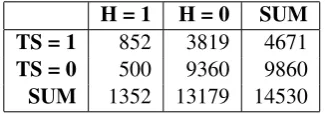
H = 1 H = 0 SUM
TS = 1 852 3819 4671
TS = 0 500 9360 9860
SUM 1352 13179 14530
Table 1: Agreement between TermoStat (TS) and HAMLET (H); =0.162
be and how this could impact supervised systems. Furthermore, HAMLET’s lower sensitivity to fre-quency is not only an advantage but can also back-fire. A few seemingly obvious terms with very high frequencies are not extracted, e.g., hulpen
(aids) andhand(meaning both literally hand, but also the direction the horse is going in the arena). Even paarden(horses) received a 0% probability of being a term by HAMLET. A final category of terms both extractors struggle with, are those that are also part of general language and only become terms in this context. An example ispijp, which usually means pipe, but, in the context of dressage, refers to a part of a horse’s leg. At least half of the terms that were not found by either tool concern terms that are also part of general language.
The described differences illustrate various strengths and weaknesses of both approaches and inspires a few suggestions for improvement. Ter-moStat’s approach could benefit from more elab-orate preprocessing (e.g., removing cts ending in a dash) and an evaluation of the POS pat-terns. The supervised approach is clearly influ-enced by the domain-dependence of term charac-teristics and could benefit from in-domain training data or training data in more domains. The two approaches are at least partly complementary and a combination of the output results in a recall of 77.45%, which is high, considering the strictness of the evaluation and the gold standard.
4.6 Agreement Between Tools and Gold Standard
Even though the gold standard was rigorously an-notated, there is always the possibility of human error and the ambiguous nature of terms, which means that these annotations are not the only pos-sible correct annotations. Therefore, it is worth looking at the ATE results in more detail. Are there any terms that should have, or could have been annotated among the false positives? Or the opposite: terms which could or should not have been annotated among the false negatives? Are the mistakes made by the tools understandable or undeniably wrong? In an attempt to answer these questions, HAMLET’s results were analysed in more detail.
annotated, including terms such as uitzwaaien
(wrong positioning of the horse’s hindquarters, mostly during a turn), and verruim(specific way of lengthening the horse’s stride; other forms of this verb were annotated correctly). Looking at the 608 false positives, at least 217 of them could have been terms, which would increase precision to over 70%. It implies that there is at least some logic in the errors and that, overall, HAM-LET does appear to have learnt informative gen-eral characteristics of terms. However, this analy-sis should also be interpreted as a cautionary tale regarding ATE evaluation. When evaluating a list of already extracted cts, annotators are biased to evaluate favourably. Therefore, results compared to a predetermined gold standard may tend to be worse than results based on the annotation of the ATE output. Any comparisons between such re-sults should be interpreted with due caution.
Nevertheless, it is encouraging to see logical patterns in the ATE results. For instance, many cts were extracted related to body parts (of both horse and rider). These were not always consistently an-notated but are still logical terms in the field of dressage, which is a sport where the positioning of horse and rider are crucial. At least 171 cts ex-tracted by HAMLET were related to body parts or bodily functions (e.g., schuimproductie, the pro-duction of foam in the horse’s mouth). They were actually extracted by HAMLET more consistently than they were labelled by the human annota-tor. Also encouraging was the fact that, despite only very limited information about term varia-tion, HAMLET often makes the same decision for related terms, such as terms with different full forms sharing the same lemma. Still, TermoStat’s strategy of grouping terms with the same lemma is more effective and should be considered as an option to improve HAMLET.
One last item to mention here is that HAM-LET is still susceptible to classic ATE errors, such as wrongly extracting parts of terms, combina-tions of different terms, or very frequent terms in combination with a non-term. For instance, 35 false positives contain the wordpaardorpaarden
(horse(s)), but in combinations that are not terms, e.g., paard gaat (horse goes), paard niet (horse not), and paard symmetrisch (horse symmetri-cal). These are typical errors because such com-binations are much more frequent in the domain-specific corpus than in reference corpora, so they
get high termhood values. Even though HAMLET still makes these mistakes, there is a marked im-provement compared to TermoStat, which relies more heavily on termhood statistics. For instance, TermoStat wrongly extracts 320 cts that contain
paard(en), compared to only 35 for HAMLET. This further illustrates the positive effect of mul-tiple features to limit frequency-related errors.
5 Conclusions and Future Research
The research described in this paper presents an elaborate evaluation of a supervised ML approach to automatic term extraction (HAMLET), com-pared to a traditional system without training data (TermoStat). As expected, the supervised sys-tem obtains higher f1-scores by combining fea-tures with various types of information and opti-mising f1-score. A closer look at the results con-firms that the system has clearly learnt informative general characteristics of terms. It is less reliant on frequency, leading to fewer mistakes on rare terms or frequent non-terms. However, the supervised system also has a distinct weakness, namely its domain-dependence, since it was trained on out-of-domain data. This emphasises the need for an-notated data, though there are also indications that very little training data could suffice (Amjadian et al.,2018). Nevertheless, annotated data remains critical for a nuanced evaluation.
Current versions of HAMLET can already ob-tain an average f1-score of 53%, using cross-validation on all domains and languages com-bined. Preliminary results already show the im-pact of factors such as algorithm, language, do-main, term definition, and in-domain training data, with f1-scores of up to 66% depending on the combination. Precision and recall are not al-ways as balanced as for the presented use-case, and results vary greatly per corpus. Future re-search will concentrate on further exploring the robustness of HAMLET, with more contrasting re-sults for different configurations and data. Aside from the binary classifier, a sequence labelling ap-proach, which is further removed from the original methodology, will also be explored and will pro-vide further material for comparison.
6 Acknowledgements
Piek Vossen, editor. 1998. EuroWordNet: A multilingual database with lexical semantic networks. Springer Netherlands, Dordrecht. https://doi.org/10.1007/978-94-017-1491-4.
Petra Wolf, Ulrike Bernardini, Christian Federmann, and Hunsicker Sabine. 2011. From statistical term extraction to hybrid machine translation. In Mikel L. Forcada, Heidi Depraetere, and Vincent Vandeghin-ste, editors, Proceedings of the 15th Conference of the European Association for Machine Translation. Leuven, Belgium, pages 225–232.
Yuhang Yang, Hao Yu, Yao Meng, Yingliang Lu, and Yingju Xia. 2011. Fault-Tolerant Learning for Term Extraction. InProceedings of the 24th Pacific Asia Conference on Language, Information and Compu-tation. Sendai, Japan, pages 321–330.