Morpho-Syntactic Study of Errors from Speech Recognition System
Maria Goryainova
1,2Cyril Grouin
1Sophie Rosset
1Ioana Vasilescu
1 1CNRS, UPR 3251, LIMSI 2INaLCO, EA 2520, ERTIM91403 Orsay, France 75007 Paris, France {grouin,rosset,ioana}@limsi.fr [email protected]
Abstract
The study provides an original standpoint of the speech transcription errors by focusing on the morpho-syntactic features of the erroneous chunks and of the surrounding left and right context. The typology concerns the forms, the lemmas and the POS involved in erroneous chunks, and in the surrounding contexts. Comparison with error free contexts are also provided. The study is conducted on French. Morpho-syntactic analysis underlines that three main classes are particularly represented in the erroneous chunks: (i)grammatical words (to, of, the),(ii)auxiliary verbs (has, is), and(iii)modal verbs (should, must). Such items are widely encountered in the ASR outputs as frequent candidates to transcription errors. The analysis of the context points out that some left 3-grams contexts (e.g., repetitions, that is disfluencies, bracketing formulas such as “c’est”, etc.) may be better predictors than others. Finally, the surface analysis conducted through a Levensthein distance analysis, highlighted that the most common distance is of 2 characters and mainly involves differences between inflected forms of a unique item.
Keywords:Automatic Speech Recognition; Error Analysis; Morpho-Syntactic Analysis
1.
Introduction
Automatic speech recognition (ASR) systems take as in-put oral signal and produce as outin-put a text version of the signal: the transcription of the signal in natural language. They make use of a speech model composed of acoustic, pronunciation and lexical n-gram models to decode the in-coming speech stream. However the transcription process entails a number of errors, the speech model being able to handle at various level the ambiguity characterizing the spoken signal. Such ambiguity is due to various factors:
• Quality of the signal: low quality acquired from the telephone vs. high quality from radio news,
• Type of speech: prepared speech vs. spontaneous speech,
• Quality of speech: overlaps, fast speech due to stress or emotions, etc.,
• Out-Of-Vocabulary (OOV) items—especially foreign names—, etc.
In-depth description of the observing ASR errors are es-sential to characterize the variability intrinsic to the spoken language and to consider improved speech models (Adda-Decker and Lamel, 1999; Adda-(Adda-Decker, 2006). Herein, in-stead of studying ASR errors causes, the current study fo-cus on the surface features of the errors so as to produce classes of errors. Our long run objective is to anticipate the impact of error classes on further NLP processes. The study described here is based on thework hypothesisthat both speech transcription errors and their surrounding con-texts are predictive of the regions likely to be problematic for ASR. An in-depth characterization of such regions may help to efficiently adapt language models. Whereas most of the studies on ASR errors considered the phenomenon from lexical or phonetic standpoints, we focus here on the morpho-syntactic structure of the erroneous regions. In this purpose, we provide an originalmorpho-syntactic taxon-omy of the ASR speech errors, so as to categorize the
un-recognized chunks as well as their larger contexts. Compar-isons with error free contexts are also provided for an in-depth comprehension of local conditions inducing speech ambiguity and penalizing the ASR system. The following taxonomy would be also of valuable for various domains linked to automatic speech recognition such as speech un-derstanding, named-entity recognition, question/answering systems, etc.
2.
Related work
ASR transcription errors highlight speech regions which are problematic with respect to the ASR system’s decoding capacities. ASR errors have been mainly investigated in the framework of comparisons between automatic vs. human decoding of speech (Scharenborg, 2007; Lippmann, 1997). They pointed out that although today best ASR speech models are quite efficient, they have not yet reached the sta-tus of being able to perfectly take into account all observed acoustic variation, human listeners still outperforming them 5 to 6 times better (Vasilescu et al., 2012). The taxonomy of errors pointed out that some words are frequently sub-jects to ASR errors: in particular short, acoustically poor and frequent items lead to local ambiguity (Adda-Decker, 2006).
3.
Material and methods
3.1.
Corpora
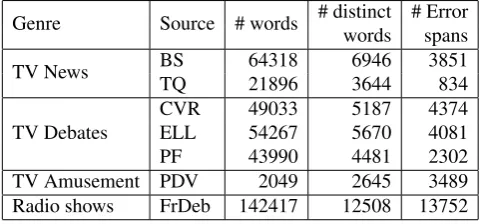
The study is based on a textual corpus in French consist-ing of manual and automatic transcriptions. The data were gathered in the framework of the ETAPE project (Gravier et al., 2012) and correspond to different audio sources manually and automatically transcribed by an ASR system (Bougares et al., 2013). A general description of the corpus is given in Table 1.
Genre Source # words # distinct # Error words spans
TV News BS 64318 6946 3851
TQ 21896 3644 834
TV Debates
CVR 49033 5187 4374 ELL 54267 5670 4081
PF 43990 4481 2302
TV Amusement PDV 2049 2645 3489 Radio shows FrDeb 142417 12508 13752
Table 1: General description of the corpus depending on the source: BS (“BFM Story”), TQ (“Top Question”), CVR (“C¸ a Vous Regarde”), ELL (“Entre les Lignes”), PF (“Pile ou Face”), PDV (“La Place du Village”), French Debate (FrDeb)
Each sentence from each transcription has been aligned with the manual reference. The alignment highlights the
error spans(Luzzati et al., 2014). Anerror spanis defined as all the consecutive words in the hypothesis which are different from the reference. The error span level has been adopted in the current study (e.g., in contrast to the word level).
Figure 1 illustrates an extract from the data. For a given sentence, three levels of information are provided and con-sidered in the analysis: the reference transcription (REF), the automatic transcription made by the system (HYP) and the description of the types of errors within each span (that is D=deletion, I=insertion, S=substitution).
REF: <IL> y a <IL> y a quatre <VINGT > mille <******>
HYP: <**> y a <**> y a quatre <VINGTS> mille <CHIENS> EVAL:<D > <D > <S > <I >
REF: <BONSOIR `A TOUTES ET TOUS MERCI> d’ ˆetre avec
HYP: <******* * ****** ** **** *****> d’ ˆetre avec
EVAL:<D D D D D D >
Figure 1: Extract from the aligned corpus
Global statistics on the corpus show that 21% of tokens are involved in an error span. The errors consist either in a substitution (49%), a deletion (35%) or an insertion (16%).
3.2.
Methods
3.2.1. Presentation
This study is based on the hypothesis that erroneous spo-ken regions and their surrounding contexts convey some
salient and predictive information about potentially am-biguous chunks for ASR. To gather as much as possible in-formation about such chunks we are conducting an in-depth morpho-syntactic analysis. Three levels are then consid-ered: (i) basic morpho-syntactic analysis (token, lemma, POS), (ii) contextual analysis (within the error span, on the left or on the right of the error span), and(iii) analy-sis based upon the edition distance of characters (distance frequency and POS involved).
The morpho-syntactic tagging has been made with the Tree Tagger (Schmid, 1994). This tool is known to be poorly adapted to process speech transcriptions which may involve repetitions and erroneous solutions. Nevertheless, for this preliminary study we make use of tagged data without a post-processing phase, in order to avoid potential new er-rors.
3.2.2. Issues
Morpho-syntactic analysis. The morpho-syntactic anal-ysis is aimed to provide insights about the forms, lemmas and POS occurring in an erroneous chunk. The following questions have been addressed.
• Which forms, lemmas and POS are the most frequent in error spans?
• Which forms, lemmas and POS obtain the higher error percentage out of the whole corpus?
• Does the most frequent POS in the error spans repre-sent the most frequent lemmas and forms?
• Does the form that achieve the highest error per-centage belongs to the POS and the lemma that also achieve the highest error percentage?
Contextual analysis. Alongside with the error span anal-ysis a contextual similar investigation have been also con-ducted to answer to the following points:
• Which n-gram and POS sequences are the most fre-quent on the left and right context of the error spans?
• Does the most frequent n-gram sequences correspond to the most frequent POS?
• Which kind of sequence precedes/follows an error span?
• Which kind of semantic information can we infer from an error span?
Surface analysis. At last, the edition distance is con-ducted to estimate the mean number of modifications to process from an erroneous string to a correct string, and the most frequent POS concerned with high distance editions.
4.
Results
4.1.
Error span analysis
Form Corpus Error span Ratio
y(there) 3,016 891 29.5%
il(he) 6,526 1,871 28.7%
c’(it) 7,307 1,737 23.8%
qu’(that) 3,588 844 23.5%
est(is) 11,288 2,395 21.2%
on(one/we) 5,800 1,215 20.9%
a(has) 5,550 1,162 20.9%
je(I) 4,138 866 20.9%
c¸a(this/that) 3,070 630 20.5%
et(and) 7,965 1,615 20.3%
`a(to) 6,628 1,041 15.7%
le(the, masculine) 8,264 1,210 14.6%
en(in) 4,778 637 13.3%
pas(no) 4,567 593 13.0%
de(of) 15,237 1,814 11.9%
les(the, plural) 6,142 667 10.9%
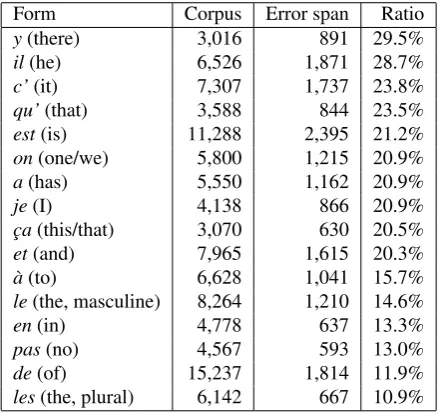
Table 2: Frequencies in the whole corpus and inside an er-ror span for some of the most frequent forms in an erer-ror span
Table 3 highlights the frequencies inside an error span in comparison with the frequencies in the whole corpus for some of the most common POS.1
POS Corpus Error span Ratio Pro:per 37,442 8,858 23.7% Ver:pres 39,996 8,027 20.1% Conj 22,581 4,418 19.6% Pro:dem 14,209 2,739 19.3% Subst 84,873 13,490 15.9% Pro:rel 9,547 1,347 14.1% Adj 23,162 3,235 14.0% Adv 27,852 3,827 13.7% Ver:infi 10,603 1,340 12.6% Det:art 35,242 3,778 10.7% Prep 37,089 3,787 10.2%
Name2 108 10 9.3%
Table 3: Frequencies in the whole corpus and inside an er-ror span for some of the most frequent POS in an erer-ror span
4.2.
Contextual analysis
4.2.1. Left context of an error span
Sequences of forms. In this sections we focus on the con-textual analysis. The context is viewed here as the forms, lemmas and POS at left and right sides of an erroneous span. It is analyzed increasingly (from one item left/right to 3 items left/right) as to evaluate the impact of the in-creasing surrounding information in erroneous chunks pre-diction. Table 4 provides the frequencies of sequences of one, two or three forms in the whole corpus and in the left context of an error span.
1
We used the following POS abbreviations: Adj (adjective), Adv (adverb), Conj (conjunction), Det:art (article), Name (proper name), Pro:dem (demonstrative pronoun), Pro:per (personal pro-noun), Pro:rel (relative propro-noun), Subst (substantive), Ver:info (verb at infinitive), Ver:pres (verb at present tense).
Sequence (1, 2, 3 forms) Corpus Context Ratio
bien ...(good/well) 1,153 152 13.2%
tr`es ...(very) 1,165 104 8.9%
de ...(of) 13,423 859 6.4%
le le ...(the the) 224 41 18.3%
tr`es bien ...(very good) 119 19 16.0%
c’ est ...(it is) 5,086 467 9.2%
tous les d´epartements ...
6 3 50.0%
(all the departements)
Roche sur Foron ... 19 7 36.8%
est `a dire ...(is to say) 207 20 9.7%
c’ est pas ...(it is not) 352 33 9.4%
Table 4: Frequencies of sequences of 1, 2 or 3 forms in the whole corpus and in the left context of an error span
Sequences of POS. Table 5 underlines the frequencies of sequences of one, two or three Part-of-Speech in the whole corpus and in the left context of an error span.
Sequence (1, 2, 3 POS) Corpus Context Ratio
Adv ... 27,852 2,957 10.6%
Pro:rel ... 9,547 678 7.1%
Adv Adv ... 2,546 297 11.7% Det:art Adj ... 3,188 250 9.1% Subst Pro:rel ... 3,660 245 6.7% Pro:rel Ver:pres Adv ... 297 33 11.1% Det:art Subst Adj ... 3,431 378 11.0% Pro:per Pro:per Ver:pres ... 3,747 294 7.8%
Table 5: Frequencies of sequences of 1, 2 or 3 POS in the whole corpus and in the left context of an error span
4.2.2. Right context of an error span
Sequences of forms. Table 6 underlines the frequencies of sequences of one, two or three forms in the whole corpus and in the right context of an error span.
Sequence (1, 2, 3 forms) Corpus Context Ratio
... bien(good/well) 1,153 200 17.3%
... par(by) 1,358 162 11.9%
... je(I) 3,272 438 13.4%
... des des(the the) 210 24 11.4%
... par le(by the) 128 12 9.4%
... parce que(because) 710 66 9.3%
... de la semaine
46 8 17.4%
(of the week)
... qui est un(who is a) 46 8 17.4%
... c’ est c’(it is it) 240 41 17.1%
... il y a(there is) 1,095 151 13.8%
Table 6: Frequencies of sequences of 1, 2 or 3 forms in the whole corpus and in the right context of an error span
Sequence (1, 2, 3 POS) Corpus Context Ratio
... Prep 37,089 2,860 7.7%
... Prep Prep 1,169 138 11.8% ... Pro:per Pro:per 6,021 564 9.4% ... Pro:dem Pro:rel 1,884 177 9.4% ... Pro:dem Pro:rel Pro:per 921 97 10.5% ... Prep Det:art Subst 7,716 597 7.7% ... Pro:rel Pro:per Ver:pres 1,960 112 5.7%
Table 7: Frequencies of sequences of 1, 2 or 3 POS in the whole corpus and in the right context of an error span
4.3.
Surface analysis
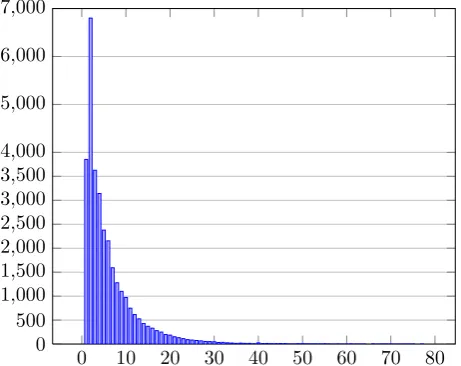
Figure 2 shows the edition distance according to Leven-shtein’s algorithm (Levenshtein, 1965), in terms of charac-ters between the correct and the erroneous forms in an error span.
0 10 20 30 40 50 60 70 80
0 500 1,000 1,500 2,000 2,500 3,000 3,500 4,000 5,000 6,000 7,000
Figure 2: Edition distance in characters between erroneous and correct forms
5.
Discussion
5.1.
Forms in error spans
In this section some trends highlighted by the morpho-syntactic analysis are mentioned.
As shown in Table 2, the most frequent forms in the er-ror spans correspond to grammatical words that is short, acoustically poor and subject to homophony items, which are good candidates to recognition errors as underlined in (Adda-Decker, 2006).
While the most frequent POS category in the corpus is substantives (20.74% of all categories3), followed by
per-sonal pronouns (9.15%) and prepositions (9.06%), three main classes are particularly represented in the erroneous chunks: (i) grammatical words (to, of, the), (ii) auxil-iary verbs(has, is), and(iii)modal verbs(should, must). The table confirms the trends highlighted by the analysis of word frequencies (see Table 2) and by previous
stud-3This percentage corresponds to the 84,873 substantives found
in the corpus out of the total number of 409,185 tokens.
ies both in ASR output analysis and comparison with hu-mans (Vasilescu et al., 2012).
However, it is worth noticing that some word classes occur more frequently in an error span than others: for instance, the category of the proper names is frequently unrecognized by the system (9.3% of proper names are within an error span).
Paronymes are also good candidates to ASR errors:
• “il” [il] (he) / “y” [i] (there)
• “et” [e] (and) / “est” [E] (is)
• “a” [a] (has) / “`a” [a] (to)
• “un” [˜E] (a, one) / “en” [˜A] (in) / “on” [˜O] (one)
5.2.
Contexts
One may notice that the salient information is provided by (at least) two items in particular at the left side of the er-ror span. The left 3-grams suggest that some contexts (e.g. repetitions, that is disfluencies, bracketing formulas such as “c’est” etc.) may be better predictors than others (see Ta-ble 4). Among the most frequent sequences at the left side of an error span, several syntagms have a bracketing role, that is they introduce information (c’ est/c’ est pas, it is/it is not, est `a dire, is to say). Speech disfluencies and in par-ticular repetitions may also occur (les les, the the). Such phenomena are spontaneous speech proper.
At last, the contexts also involved (more frequent) substan-tives and proper names (d´epartements, departments,Roche sur Foron4).
The analysis of the left and right contexts points out that grammatical words are the most frequent neighbors of an erroneous span ((Table 5 and 7). They also occur within disfluent regions suggesting that speakers’ difficulties in building the verbal message may involve less accurate pro-nunciations and then errors.
The same contextual analysis conducted in terms of POS (Table 5 and 7) underline the high frequency of short words, potential candidates to transcription errors.
Finally, one may notice the similarity between erroneous and error free regions close to the erroneous spans: the most frequent items present in erroneous span are also present as surrounding context suggesting that a “fragile” chunk in terms of morpho-syntactic characteristics may anticipate an error.
5.3.
Surface analysis
Finally, concerning the surface analysis conducted through a Levensthein distance analysis, the maximum distance is of 256 characters, which corresponds to a deletion of a whole sequence. The most common distance is a distance of 2 characters, which mainly involves inflection differ-ences between an infinitive and a past participle in French or between singular and plural of names and adjectives. This finding suggest that the most frequent errors in French do not necessarily affect the content of the message.
4
6.
Conclusion
Nowadays ASR systems reached high levels of accuracy, however speech transcription errors still occur. Several studies on the speech transcription errors have been con-ducted during the last decade, mainly focusing on the fre-quency of the lexical items concerned and on the acoustic patterns of the items likely to by unrecognized. In our pa-per we provide an original standpoint of the phenomenon by focusing on themorpho-syntactic features of the er-roneous chunks and of the surrounding left and right con-texts. The typology concerns the forms, the lemmas and the POS involved in erroneous chunks, and in the surrounding contexts. Comparison with error free contexts are also pro-vided. The study is conducted on French. Findings comfort previous observations about the presence of grammatical words among the most frequent missrecognized items. Re-sults also underline the presence of such items before and after an erroneous span as well as the presence of “fragile” contexts (e.g., disfluences) as predictors of erroneous re-gions. However, the analysis of surface forms (Levensthein analysis) points out the high frequency of errors of level 2 (2 characters difference) which correspond to inflection differences. The long run aim is to make use of such inves-tigation as to improve language models. Similar work will also be conducted on different corpora and languages as to lead to an in-depth comprehension of the speech transcrip-tion errors.
7.
Acknowledgements
This work was supported by the French National Agency for Research as part of the project VERA (adVanced ERrors Analysis for speech recognition) under grant ANR-2012-BS02-006-04.
8.
References
Adda-Decker, M. and Lamel, L. (1999). Pronuncia-tion variants across system configuraPronuncia-tion, language and speaking style.Speech Communication, 29(2–4):83–98. Adda-Decker, M. (2006). De la reconnaissance automa-tique de la parole `a l’analyse linguisautoma-tique de corpus oraux. InProc of JEP, Dinard, France.
Bougares, F., Del´eglise, P., Est`eve, Y., and Rouvier, M. (2013). LIUM ASR system for ETAPE French evalua-tion campaign: experiments on system combinaevalua-tion us-ing open-source recognizers. InSixteenth International Conference on TEXT, SPEECH and DIALOGUE (TSD 2013), Pilsen, Czech Republic.
Gravier, G., Adda, G., Paulsson, N., Carr´e, M., Giraudel, A., and Galibert, O. (2012). The ETAPE corpus for the evaluation of speech-based TV content processing in the French language. InProc of LREC, Istanbul, Turkey. Levenshtein, V. (1965). Binary codes capable of correction
deletions, insertions and reversals. Doklady Akademii Nauk SSSR, 163(4):845–848.
Lippmann, R. P. (1997). Speech recognition by machines and humans.Speech Communication, 22(1):1–15. Luzzati, D., Grouin, C., Vasilescu, I., Adda-Decker, M.,
Bilinski, E., Camelin, N., Kahn, J., Lailler, C., Lamel, L., and Rosset, S. (2014). Human annotation of asr error
regions: Is “gravity” a sharable concept for human anno-tators? InProc of LREC, Reykjavik, Iceland. ELRA. Scharenborg, O. (2007). Reaching over the gap: A review
of efforts to link human and automatic speech recogni-tion research.Speech Communication, 49(5):336–347. Schmid, H. (1994). Probabilistic part-of-speech tagging
using decision trees. InProc of International Conference on New Methods in Language.