Transform Domain Watermarking Based on
Compressive Sensing and Scrambling
Saira Thomas
1, Athira V
2PG Student [Signal Processing], Dept. of ECE, Mar Baselios College of Engineering and Technology, Trivandrum, India1
Assistant Professor, Dept. of ECE, Mar Baselios College of Engineering and Technology, Trivandrum, India2
ABSTRACT:Conventional sampling follows Nyquist Criterion which states that effective reconstruction of a signal is possibleonly if the signal is sampled at a rate greater than or equal to twice its largest frequency. Compressive Sensing is a new method by which a signal can be reconstructed with fewer samples. Watermarking is the process of hiding data in a carrier signal. Watermarking has been combined with compressive sensing in this paper. To enhance the security of the watermarked image, it is scrambled by random distribution of pixels. PSNR of the watermarked image and the recovered image is compared with respect to embedding ratio. Transform domain is done in this paper as a modification to spatial domain watermarking. Entire image is embedded in transform domain watermarking rather than just four planes which results in the better result.
KEYWORDS:Compressive Sensing(CS), Total Variation(TV), Scrambling, Transform Domain Watermarking.
I.INTRODUCTION
Transform domain watermarking, compressive sensing and scrambling are the main sections dealt in this paper. Transform domain watermarking is done whereby the data is hidden in the transform domain version of the carrier signal. Compressive Sensing is a method of compressing the image by taking few samples and then reconstructing the signal using optimizing techniques. Conventional approach of sampling is by the famous Nyquist theorem which follows the principle that effective reconstruction is only possible by sampling it at twice the maximum frequency of the signal[1]. CS(Compressive Sampling )goes against the conventional standards of reconstruction and states that with fewer samples the signal can be reconstructed, thereby compression is done by sampling the signal (in this case image) by taking fewer points as compared to the conventional sampling technique.
This paper will deal about the historical background of compressive sensing, a scrambling technique employed in the compressed image so as to increase the security attained before transmitting the image, and transform domain watermarking in which the pixel values of the message to be hidden is added to the transform domain coefficients of the carrier signal. Hereby the transmitted image is compressed as well as secure from attack. It then explains the receiver side operation of unscrambling, optimization with TV minimization technique and extraction procedure.
II.
BACKGROUND DETAILSThe idea of CS existed for a long time now and various advancements have evolved over the years. Conventional compression involves sampling and the compression as two separate processes, but the idea of compressive sampling unites both compression and sampling to a single process whereby capturing only few samples of the signal and then recovering them. It is possible by considering the following three conditions.
1. Sparsity
we take for representing the discrete signal f and x be the coefficients in this basis for representing the signal f, then it can be best expressed as
𝒇 𝒕 = 𝒏𝒊=𝟏𝒙𝒊𝝍𝒊(𝒕) (1)
As explained above, if there are s non zero coefficients and the signal is s sparse, then signal fs can be considered by
taking only s non zero coefficients. As per available literature this basis matrix can be wavelet function [1], or such frequency domain matrices as used in conventional compression techniques.
2. Incoherence
The dimensionality reduction of Compressive sensing is introduced by the measurement matrix Φ of dimension MxN which should be incoherent with the representation matrix Ψ, of dimension NxN. The measurement vector is obtained by multiplying the measurement matrix with the sparse vector; thereby the signal will be of Mx1 dimension.
𝒀 = 𝜱𝜳𝒙 (2)
Here, Φ is the measurement matrix (MxN), Ψ is the basis matrix for sparse representation (NxN) and x is the signal (Nx1), thus the resulting measurement vector is of dimension Mx1.
The coherence value between the measurement matrix and representation basis is obtained by
𝝁 𝝓, 𝝍 = 𝒎𝒂𝒙𝟏<𝑘,𝑗 ,<𝑛| < 𝝓𝒌, 𝝍𝒋> | (3)
According to the principles of CS, the coherence value should be low and the available range of the above equation is
[1,√n].
The value of m<<n and still recovery is possible. As per literature the limit for m is set by [1]
𝒎 > 𝐶. µ𝟐(𝜱, 𝜳). 𝑺. 𝒍𝒐𝒈 𝒏 (4)
where C is some positive constant, µ is the coherence value and S is the sparsity measure of the signal. Literature suggests [2] Gaussian, Bernoulli, Fourier as available incoherent measurement matrices.
3. Restricted Isometric Property
This property is used to analyze the recovery of compressive sensed signals, in this scenario, images. It shows those matrices which are almost orthonormal when operating on sparse vectors. Consider matrix A as the product of Φ and Ψ. That is A=Φ.Ψ, which would have a dimension of MxNand let s be any integer, such that 1<s<n as per the sparsity concept described above, then if there exist a coefficient δ for the sparse vector x such that
(𝟏 − 𝜹)||𝒙||𝒍𝟐𝟐 < ||𝑨𝒙||𝒍𝟐𝟐 < (𝟏 + 𝜹)||𝒙||𝒍𝟐𝟐 (5)
If the coefficient δ is small and near to unity, then the RIP condition is satisfied.
Reconstruction of Compressive Sensed Signal
For reconstruction of such compressed images we require the transpose of the measurement matrix. The best estimate of the original signal is reconstructed by multiplying the transpose of the measurement matrix to the measurement vector Y
𝑿 = 𝜱𝑻∗ 𝒀 (6)
This best estimate is then optimized by using mathematical tools. In this paper, we are dealing with TV minimization optimization techniques. A comparison is drawn after employing all the three modules and PSNR value is compared by taking the embedding ratio also into consideration. An additional sense of security is added on by scrambling the compressed image.
𝑷𝑺𝑵𝑹 = 𝟏𝟎 𝒍𝒐𝒈𝟏𝟎( 𝑴𝑨𝑿𝑰𝟐
𝑴𝑺𝑬) (7)
𝑴𝑺𝑬 = 𝟏
𝒎𝒏 [𝑰 𝒊, 𝒋 − 𝑲(𝒊, 𝒋)]
𝟐 𝒏−𝟏
𝒋=𝟎 𝒎−𝟏
𝒊=𝟎
(𝟖)
MaxI represents the maximum possible pixel value of the image. I(i,j) and K(i,j) shows the reference image and
processed image whose PSNR is calculated. For calculating PSNR of watermarked image, optimized image and watermarked images are taken as I and K, where as for obtaining the PSNR of recovered image, the real host image and the extracted message image are considered as I and K.
III.METHOD
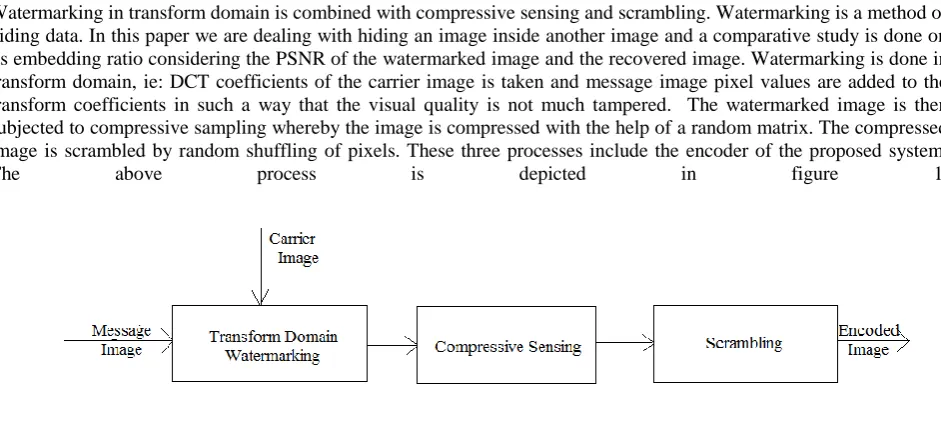
Watermarking in transform domain is combined with compressive sensing and scrambling. Watermarking is a method of hiding data. In this paper we are dealing with hiding an image inside another image and a comparative study is done on its embedding ratio considering the PSNR of the watermarked image and the recovered image. Watermarking is done in transform domain, ie: DCT coefficients of the carrier image is taken and message image pixel values are added to the transform coefficients in such a way that the visual quality is not much tampered. The watermarked image is then subjected to compressive sampling whereby the image is compressed with the help of a random matrix. The compressed image is scrambled by random shuffling of pixels. These three processes include the encoder of the proposed system. The above process is depicted in figure 1.
Fig 1. Encoder
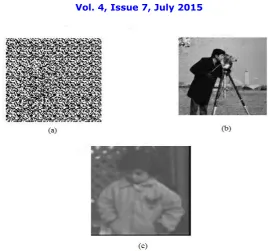
The decoding section would be employing the reverse processes which include unscrambling, decompression and extraction.Unscrambling process includes placing of pixel values in the original order. Decompression process would include optimization of the unscrambled image with TV minimization. The optimized image is subjected to extraction process where the embedded image is recovered. The decoder section is depicted in figure 2.
PSNR of the decompressed image and the recovered image is calculated and a comparative study is done on the basis of embedding ratio.
IV.RESULTS AND DISCUSSION
Cameraman image is considered as the carrier image and message image is varied in size for the comparative study. Cameraman of size 256x256 (MxN) is taken in this case and the message image size has been varied in such a way that
the sizes are (M/8xN/8),(M/4xN/4) and (M/2xN/2). In Spatial Domain Watermarking, four most significant bit planes of the message image are embedded in the least bit planes of the host image to generate the watermark. The watermarked image is subjected to compressive sensing and scrambling. The reverse process extracts the message image but since only four bit plane information is present in the extracted image, visual quality is observed to be poor. In this paper, transform domain watermarking is performed, where the entire message image information is embedded in the host image. The watermarked imageis subjected to compressive sensing and then scrambled by random shuffling
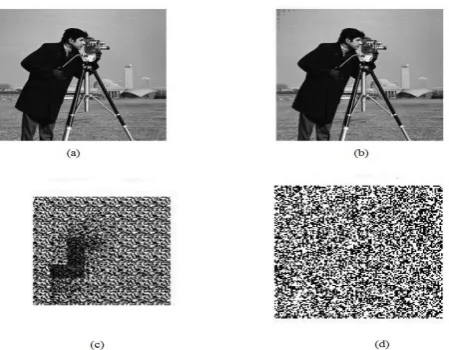
of pixels. Reverse processes are conducted on the encoded image and the PSNR of the watermarked image and recovered image (after extraction process) is calculated. The extracted image is having better visual quality.Figure 3 and figure 4 shows the results of encoder section and decoder section respectively.It can be realised from the table 1,
that a trade of remains between the PSNR of watermarked image and that of recovered image
(a)host image, (b)watermarked image, (c)encrypted image, (d)scrambled image Fig 3. Result of encoder.
(a)unscrambled image of TV minimization, (b)optimized image, (c)recovered image Fig 4. Result of decoder.
Figure 4 shows the decoder section of the proposed method. Figure 4(a) shows the unscrambled image, (b) shows the optimized image. Here optimization is done by TV minimization method and finally (c) shows the extracted pout image. PSNR values noted in table(1) shows the performance of the proposed system.
Table 1. Performance Analysis.
Sl. No
Size of the message image
PSNR of
watermarked image
PSNR of
recovered image
1 M/2 x N/2 19.5082 25.5133 2 M/4 xN/4 20.6725 22.657 3 M/8 x N/8 22.5774 19.9317
VI.CONCLUSION
As the size of the message image decreases, PSNR of the watermarked image increases and the PSNR of recovered image decreases.This concept can be further used in secure communication whereby effective embedding of message can be accomplished and further security can be brought about by scrambling the image. Here data hiding, compression and security is taken into account. Transform domain watermarking brings better result when compared to spatial domain watermarking in terms of visual quality [3]. In spatial domain watermarking, since only fourbit planes are embedded, the sizes of message image and host image are the same. In case of transform domain watermarking, embedding ratio can be varied with the above seen PSNR variations.
REFERENCES
1. Candes, E.J.; Wakin, M.B., "An Introduction To Compressive Sampling," Signal Processing Magazine, IEEE , vol.25, no.2, pp.21,30, March 2008.
3. Veena, V.K.; Jyothish Lal, G.; Vishnu Prabhu, S.; Sachin Kumar, S.; Soman, K.P., "A robust watermarking method based on Compressed Sensing and Arnold scrambling," Machine Vision and Image Processing (MVIP), 2012 International Conference on , vol., no., pp.105,108, 14-15 Dec. 2012.
4. Duarte, M.F.; Davenport, M.A.; Takhar, D.; Laska, J.N.; Ting Sun; Kelly, K.F.; Baraniuk, R.G., "Single-Pixel Imaging via Compressive Sampling," Signal Processing Magazine, IEEE , vol.25, no.2, pp.83,91, March 2008.
5. Sheikh, M.; Baraniuk, R.G., "Blind Error-Free Detection of Transform-Domainwatermarks," Image Processing, 2007. ICIP 2007. IEEE International Conference on , vol.5, no., pp.V - 453,V - 456, Sept. 16 2007-Oct. 19 2007.
6. Orovic, I.; Draganic, A.; Stankovic, S., "Compressive Sensing as a watermarking attack," Telecommunications Forum (TELFOR), 2013 21st , vol., no., pp.741,744, 26-28 Nov. 2013.
7. Orovic, I.; Stankovic, S., "Combined compressive sampling and image watermarking," ELMAR, 2013 55th International Symposium , vol., no., pp.41,44, 25-27 Sept. 2013.