APPLICATION OF FDTD-BASED MACROMODELING FOR SIGNAL INTEGRITY ANALYSIS IN PRACTICAL PCBS
M. M. Sabri and J. Rashed-Mohassel
Center of Excellence on Applied Electromagnetic Systems ECE Department
University of Tehran Tehran, Iran
N. Masoumi
Advanced VLSI Laboratory ECE Department
University of Tehran Tehran, Iran
Abstract—This paper presents the application of using the macromodels for modeling the interconnections in some fairly complex digital high speed circuits. The analysis which is based on a time domain full wave approach, deals with signal integrity. The results of this simulation are compared with measurements, and sources of error are discussed.
1. INTRODUCTION
Signal and power integrity analysis in practical high speed digital PCBs become more challenging by increasing the complexity of these circuits and clock frequency of the processors. The main idea for the consideration of interconnections effects in such PCBs is the macromodeling of the interconnection networks which means obtaining an equivalent circuit for these interconnects which have the same treatment in the considered frequency range [1]. The frequency range in which these models should work is closely related to the least rise time of the signals in the whole circuit [2].
for modeling of undesired effects in high speed circuits in the presence of lumped elements, most efforts were based on extraction of capacitive and inductive treatments for interconnections by full wave based analyses or full wave modeling of the entire problem [5, 6]. So in previous works LC models are mainly used, while the presented scheme mainly consists of dependant sources.
The first step in obtaining a macromodel by using a full wave method is to find the desired circuit or scattering parameters in frequency domain. Therefore the frequency domain full wave methods are more accurate than the time domain methods in this application. However, due to large number of ports in practical PCBs, these methods are too time consuming. The two main sources of inaccuracy in time domain methods are:
• The inability of current methods for extraction of higher order modes effects in obtaining scattering parameters.
• The impossibility of broadband matching for ports in calculation of scattering parameters.
These incapabilities arise from the fact that the calculation of transverse field distribution in such complex PCBs is practically impossible [7]. Therefore, by considering quasi-TEM mode and approximate matching at ports, we will extract the scattering parameters by using FDTD for some sample structures in this work.
The next step for macromodeling is the extraction of a set of differential equations in time domain, equivalent to the obtained frequency domain elements of the scattering matrix. First, an analytic function should be fitted to the frequency samples of each scattering parameter of the structure. The vector fitting method is used in this work [8].
Using the scattering matrix of the structure in frequency domain with its elements approximated analytically, the next step is the extraction of differential equations describing the system. Using the Jordan-Canonical approach [9], these differential equations can be obtained in the form of a state-space model. The passivity of the obtained model is one of the main challenges and different approaches are introduced but there is not still a reliable method for complicated circuits with too many ports.
The extraction of equivalent circuit for this state-space model is straight forward [1]. This equivalent circuit can be used in a SPICE-like tool by adding the lumped elements and ICs’ effects, for signal and power integrity analyses.
idea is the appropriate application of time domain full wave methods along with macromodeling.
2. SCATTERING PARAMETERS EXTRACTION BY FDTD
Full wave time domain methods suffer from two different sources of inaccuracies in the calculation of scattering parameters;
2.1. Broadband Matching
For the calculation ofS parameters in a discritized time domain mesh like FDTD, a broadband excitation and matching at each port is necessary.
For well designed microwave circuits in which impedances of the lines are approximately known, it seems convincing that using these impedances as the matched load in each port is sufficient. Therefore, at each port, modeling a voltage source with an internal impedance equal to this matched load in FDTD mesh is shown to have acceptable results [10]. Others used ABCs in FDTD mesh at the ports as a broadband matched load [11]. But for complicated circuits in which their lines’ impedances are completely unknown, these approaches are not practical.
2.2. Higher Order Modes
Current methods for calculating the voltages from fields in FDTD mesh is based on the quasi-TEM assumption. Hence, calculated S
parameters do not include the higher order modes effects. To include these modes, the transverse field distribution for each mode should be identified [7], which is an eigenvalue problem. But for practical structures this can not be achieved with acceptable accuracy, because of the complexity of the problem.
3. MACROMODELING BASED ON S PARAMETER FOR INTERCONNECTIONS
A systematic approach which extracts an equivalent differential equations set in time domain by means of frequency samples from scattering parameters in a multiport system, is called macromodeling. The first step in this approach is fitting these discrete values in the frequency range to an analytic function of frequency. The next step is the identification of an equivalent differential equations set for these analytic functions which will describe the multiport system in the time domain. The passivity of this time domain model should be examined and enforced as it might cause instability in some conditions, and finally equivalent circuit can be extracted from this differential equation set.
One can now easily use this maromodel with desired lumped elements at the ports for signal and power integrity analyses. These different steps are discussed in the following.
3.1. Vector Fitting
Using the VF method [8] for each transfer function of the system, an approximation with first order poles and desired number of poles and therefore desired accuracy is available:
Sij(s) =cij+ N
k=1 rkij s−pk
(1)
The main advantage of this method is that all of the transfer functions of the multiport system can be approximated with the same set of poles which is very useful in the identification of the equivalent differential equations.
3.2. Equivalent Differential Equations Set
the equivalent differential equations [9].
S(s) =
⎡ ⎢ ⎢ ⎢ ⎢ ⎢ ⎢ ⎢ ⎢ ⎢ ⎢ ⎢ ⎢ ⎣
c11+
q
k=1 r11k s−pk
c12+
q
k=1 rk12
s−pk · · ·
c1n+
q
k=1 rk1n s−pk
c21+
q
k=1 r21k s−pk
c22+
q
k=1 rk22
s−pk · · ·
c2n+
q
k=1 rk2n s−pk
..
. ... . .. ...
cn1+
q
k=1 rnk1 s−pk
cn2+q
k=1 rkn2 s−pk · · ·
cnn+q
k=1 rknn s−pk
⎤ ⎥ ⎥ ⎥ ⎥ ⎥ ⎥ ⎥ ⎥ ⎥ ⎥ ⎥ ⎥ ⎦ (2)
The Jordan-Canonical method leads to a state-space model for the describing differential equations of the system;
˙
x(t) =Ax(t) +Ba(t)
b(t) =Cx(t) +Da(t) (3) in whicha and b are the incident and scattered wave vectors at each port.
3.3. Passivity
Although the real parts of the poles enforced to be negative in vector fitting method, but because of non-passivity in some conditions, this stability might be violated. A simple approach for passivity check and also identification of frequency ranges of passivity violation is Hamiltonian check [12]. But as a straight criteria the eigenvalues of (I−S∗S) should be positive in the desired frequency range.
But passivity enforcement approaches which are mainly based on perturbation of approximated parameters are under investiga-tions [12, 13], and there is not yet a proper passivity enforcement method for large systems with many ports and different kinds of pas-sivity violations in frequency domain. Although the model does not have the passivity requirements for the entire frequency range in our example structures, but the lumped elements were selected such that passivity violations do not lead to any instability.
3.4. Equivalent Circuit Synthesis
each port are equal to the inputs and outputs of the main system which are the incident and scattered waves. For converting the scattering parameters to circuit parameters and using them with circuit elements, the conversion equations (4) lead to two additional circuits for each port. The whole circuit is now a macromodel for initial interconnections network which can be replaced for it.
bk =
vk−Z0kik
2√Z0k
ak =
vk+Z0kik
2√Z0k
(4)
4. APPLICATIONS
We applied this macromodeling approach which is based on the FDTD analysis [14] of interconnections network, to some fairly complex circuits which include different lumped elements and vias. The S
parameters extraction from FDTD mesh is based on assumptions described in Section 2. The results of these simulations are compared with measurements and error sources are discussed in the next section.
4.1. Case Study I
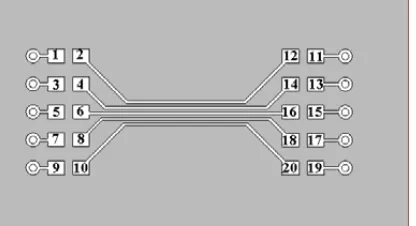
The structure in Fig. 1 consists of five parallel lines on a FR-4 substrate which are terminated to ten ports (even numbers in Fig. 1), and ten other ports (odd numbers in Fig. 1) are connected to the ground plane with ten vias. Scattering parameters of this structure with 20 ports are calculated by consideringZ0= 50 as the matched load in all ports
at the frequency range (0–1 GHz).
By equal and large frequency steps in this range there will be invalid responses from the equivalent extracted circuit in low frequencies, and this is because of poor interpolation forS parameters in low frequencies with few samples. So we used two different frequency steps in this range: 1 MHz intervals between samples up to 10 MHz and 100 MHz intervals for the rest.
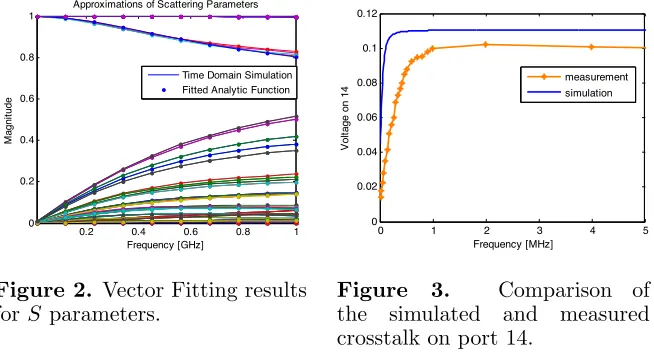
The Vector Fitting method is used to approximate these S
parameters with 14 complex poles. The acceptable results of this fitting are shown in Fig. 2 for scattering parameters.
0.2 0.4 0.6 0.8 1 0
0.2 0.4 0.6 0.8 1
Frequency [GHz]
M
agni
tu
d
e
Approximations of Scattering Parameters
Time Domain Simulation Fitted Analytic Function
Figure 2. Vector Fitting results forS parameters.
0 1 2 3 4 5
0 0.02 0.04 0.06 0.08 0.1 0.12
Frequency [MHz]
V
o
lt
ag
e o
n
1
4 measurementsimulation
Figure 3. Comparison of the simulated and measured crosstalk on port 14.
By synthesis of the equivalent subcircuit for this interconnections network, HSPICE is used to obtain responses of this model for interconnections in the presence of the desired lumped elements and excitations at the ports.
0 1 2 3 4 5 0
0.005 0.01 0.015 0.02 0.025
Frequency [MHz]
V
o
lt
a
ge on
1
2
simulation measurement
Figure 4. Comparison of the simulated and measured crosstalk on port 12.
0 0.2 0. 4 0.6 0.8 1 0
2 4 6 8 10
Frequency [GHz]
Vo
lt
a
g
e
port 2 port 4 port 6 port 12 port 14 port 16
Figure 5. Crosstalk on adjacent lines up to 1 GHz.
Table 1. Physical characteristics of the first structure. Substrate Material FR-4
Substrate Height 1.6 mm Conductor Material Copper Conductor Height 0.018 mm Width of the Lines 0.254 mm Lines Spacing 0.254 mm
beyond 1 GHz, such as a trapezoidal pulse train with a rise time more than 1 ns. The characteristics of the structure are listed in Table 1.
4.2. Case Study II
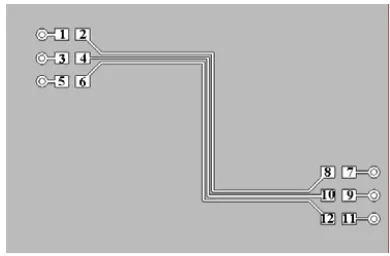
The structure in Fig. 6 is a more complicated case with 12 ports in which the scattering parameters is calculated by considering Z0 = 65
as an approximation for the matched load in the ports for the frequency range, 0–1 GHz.
Figure 6. The geometry of the second example for SI analysis.
0 0.2 0.4 0.6 0.8 1
0 0.2 0.4 0.6 0.8 1
Frequency [GHz]
Ma
g
n
it
u
d
e
Approximations of Scattering Parameters
Time Domain Simulation Fitted Analytic Function
Figure 7. Vector Fitting results for S parameters.
0 0.5 1 1.5 2 2.5 0
0.05 0.1 0.15 0.2 0.25
Frequency [MHz]
V
o
lt
ag
e on 12
measurment simulation
Figure 8. Comparison of the simulated and measured crosstalk on port 12.
0 0.2 0.4 0.6 0.8 1 0
2 4 6 8 10
Frequency [GHz]
V
o
lt
age port 4
port 6 port 10 port 12
5. CONCLUSION
The application of time domain full wave methods in the extraction of equivalent circuit for interconnection networks is studied in this work, and the resulted equivalent circuit is used to analyze the whole circuit in the presence of lumped elements. The time domain methods in such structures with too many ports, are much less time consuming versus frequency domain methods, for the extraction of scattering parameters at sufficient frequency samples. However a broadband matching for scattering parameters calculations in time domain methods is a challenging task. We used an approximation for the characteristic impedance in two sample structures, as the matched impedance for S parameters calculations and acceptable results is achieved in comparison to measurements at the frequency range of interest.
ACKNOWLEDGMENT
The authors would like to acknowledge the support of Iran’s Telecommunications Research Center (ITRC) for this work.
REFERENCES
1. Achar, R. and M. S. Nakhla, “Simulation of high-speed interconnects,”Proc. IEEE, Vol. 89, No. 5, 693–728, May 2001. 2. Paul, C. R., Introduction to Electromagnetic Compatibility, 2nd
edition, John Wiley & Sons, New Jersey, 2006.
3. Golestani-Rad, L. and J. Rashed-Mohassel, “Reconfiguration of personal computers’ internal equipment for improved protection against penetrating EM pulses,” J. of Electromagn. waves and Appl., Vol. 20, No. 5, 677–688, 2006.
4. Golestani-Rad, L. and J. Rashed-Mohassel, “Rigorous analysis of EM-wave penetration into a typical room using FDTD method: The transfer function concept,” J. of Electromagn. Waves and Appl., Vol. 20, No. 7, 913–926, 2006.
5. Kung, F. and H.-T. Chuah, “A finite-difference time-domain (FDTD) software for simulation of printed circuit board (PCB) assembly,”Progress In Electromagnetics Research, PIER 50, 299– 335, 2005.
loads,” IEEE Trans. Microwave Theory and Techniques, Vol. 42, No. 8, 1514–1523, 1994.
7. Gwarek, W. K. and M. Celuch-Marcysiak, “Wide-band S -parameter extraction from FD-TD simulations for propagating and evanescent modes in inhomogeneous guides,” IEEE Trans. Microwave Theory Tech., Vol. 51, 1920–1928, 2003.
8. Gustavsen, B. and A. Semlyen, “Rational approximation of frequency domain responses by vector fitting,”IEEE Trans. Power Del., Vol. 14, 1052–1061, 1999.
9. Chen, C. T., Linear Systems Theory and Design, Holt, Rinehart and Winston, New York, 1984.
10. Luebbers, R. J. and H. S. Langdon, “A simple feed model that reduces time steps needed for FDTD analysis of antenna and microstrip calculations,”IEEE Trans. Antennas and Propagation, Vol. 44, 1000–1005, 1996.
11. Sheen, D. M., S. M. Ali, M. D. Abouzahra, and J. A. Kong, “Application of the three-dimensional finite-difference time-domain method to the analysis of planar microstrip circuits,”
IEEE Trans. Microwave Theory Tech., Vol. 38, 849–857, 1990. 12. Grivet-Talocia, S., “Passivity enforcement via perturbation of
Hamiltonian matrices,” IEEE Trans. Circuits and Systems, Vol. 51, 1755–1769, 2004.
13. Lamecki, A. and M. Mrozowski, “Equivalent SPICE circuits with guaranteed passivity from nonpassive models,”IEEE Trans. Microwave Theory Tech., Vol. 55, 526–532, 2007.