Arm Based Cost Effective Driver Behaviour
Detection and Alerting System to Prevent
Accidents
P Sreelatha1, K. Tharun Kumar Reddy2, N Kiran Kumar3, H Chandra Sekhar4, L Rama Murthy5
PG Student [ES], Dept. of ECE, VEMU Institute of Technology, Chittoor, India1 Assistant Professor, Dept. of ECE, Kuppam Engineering College, Chittoor, India2 Assistant Professor, Dept. of ECE, VEMU Institute of Technology, Chittoor, India3 Associate Professor, Dept. of ECE, VEMU Institute of Technology, Chittoor, India4
Professor and Head, Dept. of ECE, VEMU Institute of Technology, Chittoor, India5
ABSTRACT:Road accidents are now globally recognized as a serious public health problem. The Problem is much
more serious in our country where close to 5 lakh road accidents caused nearly 1.46 lakh deaths and left more than thrice that number injured in the year 2015 only. The drivers fault (i.e. Intake of alcohol, Sleepiness etc.) is the reason for 77.1% of total Road accidents during 2015 as per report of Ministry of Road transport and Highways, India. This Paper Proposing a system for detecting the behaviour of the driver (i.e. Drunkness, Sleepiness) by using Alcoholic Sensor and IR sensor to detect the eye blinking and alert the driver to prevent the accidents. This system can also send the Location of the vehicle when accident occurs to the rescue team to save the human life from accidents causing deaths using GPS (Global Positioning System) and GSM (Global System for Mobile communications).
KEYWORDS: Road accidents, Drivers fault, GPS and GSM.
I.INTRODUCTION
Road accidents are increasing day by day in our country due to highest growth rate in motorization and human population. These road accidents will cause disabilities, injuries and fatalities. Hence, road safety has turn out to be an issue of concern in India. As Per report on Road accidents in India – 2015 by ministry of road transport & highways, India, out of total road accidents, 77.1% accidents are occurred due to driver’s fault only in India [1]. The drivers fault is the main actor for causes of road accidents is shown in below figure 1.
The factors involved in driver fault are consumption of alcohol, sleepiness and recklessness. Hence, in this paper, we are proposing a system to prevent accidents by alerting the driver. In this system, alcohol sensor, IR sensor and accelerometer is used to detect Drunkness, sleepiness and reckless driving respectively.
Here, we are using GSM and GPS to trace location of the vehicle and will send location details to concerned authorities and relatives to save the lives immediately when accident occurs.
II.DEFINING SYSTEM FUNCTIONALITY
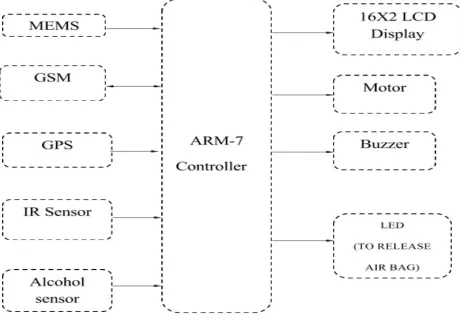
The block diagram of the proposed system is shown in the below figure. This system contains ARM-7 Microcontroller, Micro electro mechanical sensor (accelerometer), Infrared sensor, Alcohol sensor, GSM (Global System for Mobile Communications) module, GPS (Global Positioning System) and LCD (Liquid Crystal Display). The ARM Controller will get the information from sensors and will take necessary action. The block diagram of the proposed system is shown in below figure 2.
Figure 2. Block diagram of the proposed system
The MQ3 sensor is used to measure the alcohol level of the driver. It will stop the car when it detects alcohol. The Infrared sensor will send infrared rays to driver eye to find eye blink of the driver, which will alert the driver by turning on the buzzer if continuous eye blink is found indicates sleepiness.
The Piezo Resistive Accelerometers will determine reckless driving behaviour of the driver and the accelerometer will experience more strain when accident occurs then system will measure latitude and longitude of current location using GPS and same information will be sent to the registered mobile number using GSM. Whenever accident occurs it will stop the car and will release air bags to save the life. Here LED is used in place of air bags. DC motor is stopped and LED will glow if accident occurs.
III. HARDWARE REQUIREMENTS
A. ARM7 LPC2148:
Figure 3. Pin diagram of LPC2148
B. MQ3 ALCOHOL SENSOR:
The MQ3 is Semiconductor Gas Sensor, which has High Sensitivity to Alcohol. Hence, we are using MQ3 to detect alcohol taken by driver. The Tin dioxide is the sensitive material in MQ3. The MQ3 has Fast Response, stability and fast response. It is Analog Gas sensor and it requires only 5 Volts. The MQ3 is shown in below figure 4.
Figure 4. MQ3 Sensor
C. IR SENSOR:
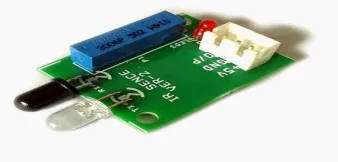
The IR Sensor is used in the system to detect Sleepiness of the driver. IR sensor will send Infrared Rays on to driver’s eyes and it will receive the reflected wave. Then Microcontroller will detect Eye is closed or open by analyzing the reflected wave and alert the driver by turn ON the buzzer. The IR sensor is shown in below figure 5.
Figure 5. IR Sensor.
D. ACCELEROMETER:
Figure 6. Accelerometer
E. GSM:
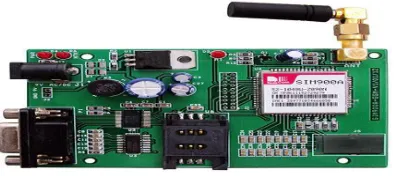
GSM (Global System for Mobile Communication) module is used to send an SMS to the Pre-registered numbers about the location of the vehicle in emergency situations. The GSM module is shown in below figure 7.
Figure 7. GSM Module
F. GPS:
GPS (Global Positioning system) System is used to track the location of the user which is send via SMS through GSM module when accident occurs. The GPS Receiver is shown in below figure 8.
Figure 8. GPS Receiver
G. LCD:
Liquid Crystal Display is used to display the information like Alcohol is detected or Eye Blink is detected etc. The LCD Display is shown in below figure 9.
H. DC MOTOR:
DC Motor is used as a dummy for indicating the engine locking facility whenever accident is occurred or alcohol is detected. The DC Motor is shown in below figure 10.
Figure10. DC Motor
I. BUZZER:
Buzzer is an Electrical device is used to generate a sound which will alert the driver. The Buzzer is shown in below figure 11.
Figure 11. Buzzer
IV. RESULTS AND DISCUSSION
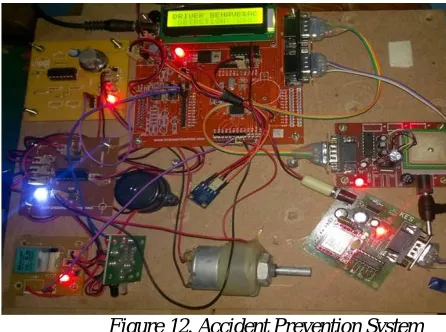
The Proposed Accident Prevention system which contains ARM7 LPC2148, Accelerometer, Alcohol Sensor, GSM and GPS is shown in below figure 12.
Figure 12. Accident Prevention System
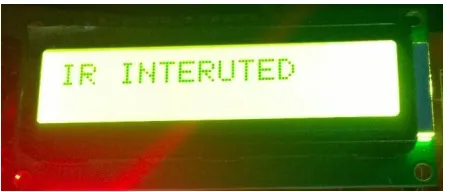
Figure 13. LCD Showing IR Interrupted Figure 14. LCD Showing Buzzer is ON
Whenever the Accident is Occurred, information will be displayed on LCD is shown in below figure 15, then immediately GPS will track the location of the vehicle and same information will be sent to registered mobile numbers is shown in below figure 16.
Figure 15. Accident Detected message on LCD
Figure 17. Alcohol Detected message on LCD Figure 16. SMS Received When accident occurs
V.CONCLUSION
Driver behavior monitoring is very important to prevent road accidents because most of the accidents are occurred due to driver’s fault only. The proposed system is will detect the eye blink using IR sensor, alcohol using MQ3 gas sensor, accident is detected using accelerometer. This system alert the driver when eye blinking is detected. It will stop the engine when driver alcohol is detected and location of the vehicle is sent to registered mobile number when accident occurs. So, this project will be helpful in detecting driver behavior in advance and will gave a warning output in form of sound and SMS.
VI. ACKNOWLEDGMENT
Assistant Professor and Mr. H. Chandra Sekhar, Associate Professor for their support, co-operation and valuable suggestions. Also, author would express her sincere thanks to all teaching and non-teaching staff of Electronics and Communication department of VEMU Institute of Technology – P. Kotha Kota, Chittoor, for their help.
REFERENCES
[1] Report on “ROAD ACCIDENTS IN INDIA – 2015” by Ministry of Road Transport & Highways Transport Research Wing, Government of
India.
[2] L. Bergasa, J. Nuevo, M. Sotelo, R. Barea, and M. Lopez, “Real-time system for monitoring driver vigilance,” IEEE Trans. Intell. Transp. Syst.,
vol. 7, no. 1, pp. 63–77, Mar. 2006.
[3] “ACCIDENT AVOIDANCE AND DETECTION ON HIGHWAYS” S.P. Bhumkar1, V.V. Deotare2, R.V.Babar3 1Sinhgad Institute Of
Technology, Lonavala, Pune, India International Journal of Engineering Trends and Technology- Volume3Issue2- 2012
[4] DriveSafe: an App for Alerting Inattentive Drivers and Scoring Driving Behaviors” Luis M. Bergasa, Daniel Almería, Javier Almazán, J. Javier
Yebes, Roberto Arroyo 2014 IEEE Intelligent Vehicles Symposium (IV) June 8-11, 2014
[5] M. A. Recarte, E. Perez, A. Conchillo, and L. M. Nunes, “Mental workload and visual impairment: Differences between pupil, blink, and subjective rating”, The Spanish Journal of Psychology, vol. 11, no. 2, 2008, pp. 374-385
[6] T. Toledo, O. Musicant, and T. Lotan, “In-vehicle data recorders for mon- itoring and feedback on drivers’ behavior,” Transp. Res. Part C, Emerging Technol., vol. 16, no. 3, pp. 320–331, Jun. 2008.
[7] “Are Drivers Aware of their Behavior Changes When Using In-Vehicle Systems” Yan Yang*, Mike McDonald, Byran Reimer and Bruce
Mehle 2012 15th International IEEE Conference on Intelligent Transportation Systems.
[8] “Intelligent Vehicle Control for Driver Behaviour using Wireless in Transportation” System 1Jayapriya.P, 2Prof. Prabhakaran.S, 3Ashok T.
1ME-EST, 2Assistant Professor Nandha Engineering College, Erode 2014 International Journal of Engineering Development and Research.
BIOGRAPHY
{1} P SREE LATHA: born in Chittoor, India. Obtained B.Tech in Electronics and Communication Engineering from Sree Rama Engineering College in 2012, currently pursuing Master degree in Embedded Systems in VEMU institute of Technology, P.Kothakota. Interested in Embedded Systems and Communication Systems.
{2} K THARUN KUMAR REDDY, Working as a Assistant Professor in Kuppam Engineering College, Kuppam, Chittoor Dist, Obtained B.Tech from KEC, Kuppam and M.Tech from VEMU Institute of Technology, Chittoor. Presently Working as an Assistant Professor In KEC, Kuppam.
{3} N KIRANKUMAR: born in Chittoor, India. Working as Assistant Professor in VEMU institute of Technology, P.Kothakota. Obtained B.Tech from SVCET, Chittoor in 2006, Master degree in Embedded systems from Narayana Engineering College, Nellore in 2011. Area of interests Embedded systems and Communications.
{4} H CHANDRASEKHAR: working as Associate Professor and Project Coordinator in VEMU institute of Technology, P. Kothakota.