ISSN (Print) : 2320 – 3765 ISSN (Online): 2278 – 8875
I
nternational
J
ournal of
A
dvanced
R
esearch in
E
lectrical,
E
lectronics and
I
nstrumentation
E
ngineering
(A High Impact Factor, Monthly, Peer Reviewed Journal)
Website: www.ijareeie.com
Vol. 7, Issue 5, May 2018
Accident Avoidance System with CAN
Prof.Ashwini Kale1, Krishnath Sankpal2, Sanket Katore3, Yogesh Pise4
Assistant Professor, Dept. of E&TC Engg, D.Y.P.C.O.E Ambi, Pune, India1 B. E Student, Dept. of E&TC Engg, D.Y.P.C.O.E Ambi, Pune, India 2, 3, 4
ABSTRACT:Our main motive of work in this thesis is to aim at Designing of CAN based Accident avoidance system using two 32 bit microcontroller which is having ARM processor with many on board interfaces like memory, LCD, I/O , CAN controller, serial port ,I2C interface, UART, 10 bit ADC, and standard JTAG interface. These two microcontroller are connected by CAN bus for transmission of data between them.In this project Driver has given alert through buzzer about the Car at shorter distance from obstacle, when it is driven in reverse direction. Also, distance between Car and Obstacle is displayed to driver. Auto braking is provided when obstacle is detected at certain distance from the car when it driven in forward direction.When there are more electrical control devices in the modem cars, such as power train management system, antilock braking system (ABS), and acceleration skid control (ASC) system,etc., the functionality and wiring of these electric control units (!XU) are getting more complicated. Therefore, it is of great concern to upgrade the traditional wire harness to a smart &car network a class of technological aids called active-safety systems is beginning to address this problem by raising drivers’ awareness of crash threats that may exist in the surrounding traffic. Virtually every car sold in developed countries today uses passive-safety features, like seat belts, air bags, and car frames that absorb impact to protect occupants during a crash. Active safety goes further by using loud sounds, visual alerts, and vibrations to direct the driver’s attention to imminent dangerthis project ACCIDENT AVOIDANCE SYSTEM WITH CAN is intended for secure and smooth journey. The car/ vehicle itself is aware of its movement. If the driver himself is not concentrating on driving or any other parameters, which may cause damage to vehicle as well a life, this intelligent car/ vehicle stops the car automatically when the danger ahead. Also, warn the driver when the obstacle backside of the Car, while reversing. As the value of a human life is countless times more than the cost of this project.
KEYWORDS: - ARM LPC1768, Controller Area Network (CAN), Buzzer, Ultrasonic Sensor, LCD, Embedded System.
I.INTRODUCTION
ISSN (Print) : 2320 – 3765 ISSN (Online): 2278 – 8875
I
nternational
J
ournal of
A
dvanced
R
esearch in
E
lectrical,
E
lectronics and
I
nstrumentation
E
ngineering
(A High Impact Factor, Monthly, Peer Reviewed Journal)
Website: www.ijareeie.com
Vol. 7, Issue 5, May 2018
about the Car at shorter distance from obstacle, when it is driven in reverse direction. Also, distance between Car and Obstacle is displayed to driver.Auto braking is provided when obstacle is detected at certain distance from the car when it driven in forward direction. When there are more electrical control devices in the modem cars, such as power train management system, antilock braking system (ABS), and acceleration skid control (ASC) system, etc., the functionality and wiring of these electric control units are getting more complicated
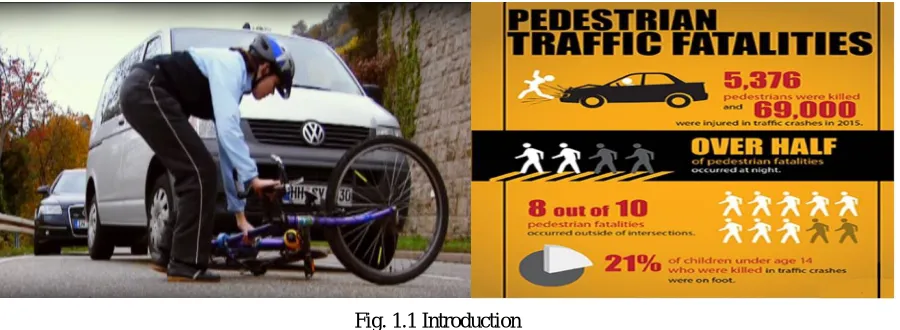
Fig. 1.1 Introduction
Therefore, it is of great concern to upgrade the traditional wire harness to a smart &car network. In 198Os, a Germany car component provider Robert Bosch Co. introduced an in-car network; the controller area network (CAN) bus, to replace the complex and expensive traditional in-car wiring. In this study, a high-level protocol CAN open is adopted to interconnect those CAN nodes with reliable communications among sensors.You’re sitting behind the wheel of your car, but instead of looking at the road, you’ve been staring at your phone, perhaps reading a new e-mail message or texting a friend. Suddenly, the driver in the car ahead of you slams on the brakes. Rather than becoming a victim of distracted driving, you feel a gentle deceleration as your car comes to a stop on its own, easily avoiding a collision. You might look up to see what the holdup is, but that’s the extent of your concern. And your car starts itself up again as soon as the road is clear. While this isn’t a realistic portrayal of your commute just yet, this future is coming and some
of the technology that will make it possible is already present in today’s cars.
The more advanced models can warn of obstacles, adjust the distance to a car ahead, and activate the brakes when a distracted driver doesn’t. And this is just the beginning. According to research firm IHS, by 2055 roughly 90 percent of the cars in the United States will be able to drive themselves in some, if not most, circumstances.Ironically, while technology will ultimately protect us from accidents on the road, sometimes it does the opposite.That’s because so many people make phone calls, text, manipulate GPS units, and fiddle with infotainment systems when they should be concentrating on their driving. And even the most diligent drivers can choose the wrong moment to glance at a navigation screen. According to the National Highway Traffic Safety Administration, driver distraction is a factor in almost 20 percent of crashes in which someone is injured.Active safety goes further by using loud sounds, visual alerts, and vibrations to direct the driver’s attention to imminent danger. Some systems can even operate the brakes to help avert disaster.
ISSN (Print) : 2320 – 3765 ISSN (Online): 2278 – 8875
I
nternational
J
ournal of
A
dvanced
R
esearch in
E
lectrical,
E
lectronics and
I
nstrumentation
E
ngineering
(A High Impact Factor, Monthly, Peer Reviewed Journal)
Website: www.ijareeie.com
Vol. 7, Issue 5, May 2018
These active-safety systems are the building blocks for the crash-avoiding cars of the future.Consider Cadillac’s Driver Assist package, which our company (General Motors) introduced in 2012. This group of safety systems detects road hazards and draws your attention to them. It adjusts your speed and the distance from the car or truck in front of you based on levels you set, and it can even bring you to a full stop when the vehicle ahead does the same. It also helps when you’re backing out of a parking spot, using visual alerts, sounds, and seat vibrations to warn of approaching cross traffic. The system sets off similar alarms if you start drifting out of a lane without the turn signal activated.A car equipped with this package can avoid many low-speed crashes, such as those in parking lots or in stop-and-go traffic, with a low-speed emergency automatic braking system that kicks in when it senses an object ahead and notices that the driver is not reacting appropriately. And at higher speeds, this same system automatically brakes to help avoid—or at least reduce the severity of an impending rear-ender.Smarts like these require some high-tech sensors. A long-range radar, positioned in the grille behind the Cadillac logo, scans for objects as far ahead as 150 meters. Short-range radars, which can sense cars a few dozen meters away, hide behind the plastic that covers the bumpers two radars in the front and three in the rear. A video camera attached to the windshield behind the rearview mirror registers lane markings and vehicles ahead. Another camera near the rear license plate surveys the scene behind the car. Eight ultrasonic sensors, four on the front bumper and four on the rear, detect objects at very close range, which is helpful when you’re trying to Parallel Park.
II.LITERATURE SURVEY
S.
N. Name of Author Title Publication Methodology
1 Ikuo Ihara
Ultrasonic Sensing: Fundamentals and Its Applications to Non-destructive Evaluation
Nagaoka University of Technology
Ultrasonic sound sensor
2
SudhakarAjmera, Abdul Subhani Shaik
Cortex-M3 based Prepaid System with Electricity Theft Control
International Journal of Engineering Research and Applications (IJERA) ISSN: 2248-9622
Microcontroller and interfacing
3
Rajan P Thomas1, Jithin K K2,
The Ultrasonic Range Detector
International Journal of Advanced Research in Electrical,
Electronics and Instrumentation Engineering
Range Detection based on Ultrasonic Principle
4
Asmita H, JathinSreenivas, Nandini S Kannan, Saritha
Accident Avoidance and Detection
Department of Information Science,
PESIT South Campus, Bangalore
PROPOSED SYSTEM
5 Rajeev Shorey Smart Vehicles IEEE New York
Emerging Trends in Vehicular
Communications 6 Marco Di Natale Controller Area Network ScuolaSuperiore S. Anna- Pisa,
Italy
ISSN (Print) : 2320 – 3765 ISSN (Online): 2278 – 8875
I
nternational
J
ournal of
A
dvanced
R
esearch in
E
lectrical,
E
lectronics and
I
nstrumentation
E
ngineering
(A High Impact Factor, Monthly, Peer Reviewed Journal)
Website: www.ijareeie.com
Vol. 7, Issue 5, May 2018
III.PROPOSED SYSTEM
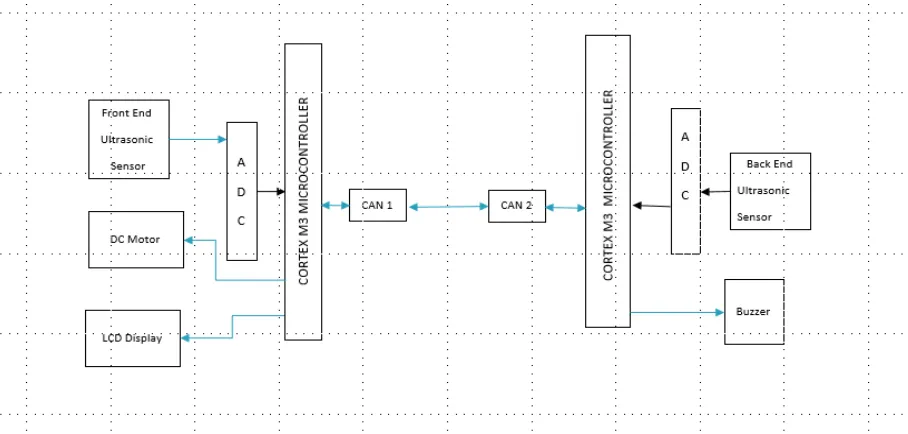
The block diagram of system which includes sensor, ADC, LCD, LPC1768, buzzer, fuel sensor and speed sensor is as shown in Fig. 3.1. The system mainly consists of front-end-sub-system and rear-end-sub-system.
A. Elements of block diagram are as follows:
a) Thefront-endsub-system
This subsystem for generating warning signals for the front-end collision avoidance is constructed bymeasuring the distance with Ultrasonic Sensor. The collision avoidance of the front-end car usually operated under a relatively high speed. Therefore, the laser radar is required to detect the front car in a relative long distance as far as 50-80 m with a high resolution as 1 cm. The warning signal is for deriver’s attention to avoid the collision by the braking action actively.
b) ARM microcontroller unit
It contains ARM microcontroller and DC motor driver circuit. The controller using is LPC1768 which is an embedded processor. An Embedded Processor is simply a micro Processor that has been “Embedded” into a device. Software programmable but interacts with different pieces of hardware. The three most important design criteria for embedded processors are performance, compactness, high code density, low power consumption, and cost. The DC motor driver circuit is a transistor which is configured as a switch and it is driven from the microcontroller PWM 0.
Fig. 3.1: Block Diagram of Proposed System
c) DC motor module
The DC motor module consists of speed sensing unit and DC motor. Speed sensing unit consists of an Opto-coupler MOC7811 and an optical encoder, which will give train of pulses with some frequency depending upon the speed of the motor. The DC motor used is less weight, low power consumption and high speed etc. The lifetime of the motor may vary from a few hundred hours to more than 10, 000 hours.
B. The rear-end sub-system
ISSN (Print) : 2320 – 3765 ISSN (Online): 2278 – 8875
I
nternational
J
ournal of
A
dvanced
R
esearch in
E
lectrical,
E
lectronics and
I
nstrumentation
E
ngineering
(A High Impact Factor, Monthly, Peer Reviewed Journal)
Website: www.ijareeie.com
Vol. 7, Issue 5, May 2018
taken. Therefore, rear-end collision avoidance warning sub-system is constructed with the Available ultrasonic sensors which have been widely implemented on commercial vehicles. The distance between the driving car and the approaching cars can be measured only with a rough distance readout every 5 on and a limited range as 20- 150 cm as in Table 1. They show that an intelligent approach to process those readout of the sensor is required to provide reliable warning signal.
Table3.1Output Code corresponding the distance of the ultrasonic
The warning subsystem is developed to be less independent of the approaching speed so that an appropriate precaution time can be provided for the approaching car to prevent the rear-end collision passively.
IV. FLOWCHART
Fig 2: Flowchart of System
Output Code corresponding the distance of the ultrasonic sensors Distance
Code
5 15 25 35 ……. 205 215 225 235 245
Physical Distance(cm)
ISSN (Print) : 2320 – 3765 ISSN (Online): 2278 – 8875
I
nternational
J
ournal of
A
dvanced
R
esearch in
E
lectrical,
E
lectronics and
I
nstrumentation
E
ngineering
(A High Impact Factor, Monthly, Peer Reviewed Journal)
Website: www.ijareeie.com
Vol. 7, Issue 5, May 2018
V. APPLICATIONS
Used as a Warning System to avoid Collision in National Highways.
Used by Police to Track the speed of the approaching vehicles.
Used to detect an object in Extreme conditions like Fog and misty areas.
Can be implemented in Robotic Applications.
VI. EXPERIMENTAL RESULTS
ISSN (Print) : 2320 – 3765 ISSN (Online): 2278 – 8875
I
nternational
J
ournal of
A
dvanced
R
esearch in
E
lectrical,
E
lectronics and
I
nstrumentation
E
ngineering
(A High Impact Factor, Monthly, Peer Reviewed Journal)
Website: www.ijareeie.com
Vol. 7, Issue 5, May 2018
Fig.6.2 Project work
VII. CONCLUSION
This project can based accident avoidance system is intended for secure and smooth journey. The car/ vehicle itself is aware of its movement. If the driver himself is not concentrating on driving or any other parameters, which may cause damage to vehicle as well a life, this intelligent car/ vehicle save the driver and co-passengers from accident and also warn driver regarding the danger at back while reversing the car. As the value of a human life is countless times more than the cost of this project.
REFERENCES
[1]. http://www.arm.com [2]. http://www.philips.com [3]. http://www.lpc2000.com [4]. http://ieeexplore.ieee.org [5]. http://ww.hitex.co.uk [6]. http://www.keil.co.uk
[7]. http://gcc.gnu.org/onlinedocs/gcc/Evaluation Boards and Modules [8]. http://www.knox.com
[9]. http://www.vishay.com [10]. http://www.edn.com
Papers:
[11]. “Ultrasonic Sensing: Fundamentals and Its Applications to Non-destructive Evaluation”byIkuo Ihara [12]. “Cortex-M3 based Prepaid System with Electricity Theft Control” by SudhakarAjmera, Abdul Subhani Shaik [13]. “The Ultrasonic Range Detector” by Rajan P Thomas1, Jithin K K2
[14]. “Accident Avoidance and Detection” by Asmita H, JathinSreenivas, Nandini S Kannan, Saritha [15]. “Smart Vehicles” by Rajeev Shorey