Available online: http://edupediapublications.org/journals/index.php/IJR/ P a g e | 293
“Automated Irrigation System”
Laxmi Chiddarwar, Durga Wankhade, Shubhangi Adsul, Prof. A. P. Gargade
Email-id:
[email protected]
Email-id:
[email protected]
Email-id:
[email protected]
Government College Of Engineering And Research, Awasari, Khurd
Department of Electronics and Telecommunication Engineering,
Awasari, Khurd Pune-412405.
Abstract
:
In this project, the development of the automated irrigation system based on Atmega328P and GSM at experimental scale within rural areas is presented. The aim of the implementation was to demonstrate that the automatic irrigation can be used to reduce water use. Different types of sensor are interfaced with controller and which gives digital output with the help of ADC. This receiver unit also has a duplex communication link based on a cellular interface (GSM). A model of controlling irrigation facilities to help millions of people. This model uses sensor technology with microcontroller to make a smart switching device. By using this technology farmer’s life will become easy.Keywords
:
Atmega328P Micro controller, Temperature sensor, Rain Drop sensor, Soil Moisture sensor, Ultrasonic sensor, Smoke detector.I. INTRODUCTION
Farming is an activity that depends heavily on the conditions that are existent in the environment surrounding the agricultural field. The work of the farmers is affected by the natural conditions such as climate, topography, etc. and also by other anthropogenic elements. This project proposes to develop a system that makes use of GSM and SMS technologies to allow for remote access to the agricultural motor, thereby making a farmer’s work much easier and less dependent of the conditions present. Now days, water shortage is becoming one
Available online: http://edupediapublications.org/journals/index.php/IJR/ P a g e | 294
II. PROPOSED SYSTEM
Here in our project, we have used Atmega328P along with GSM SIM 300 module, Temperature sensor, Rain Drop sensor, Soil Moisture sensor, Ultrasonic sensor, Smoke detector. All sensors are used for various applications. Temperature sensor measures temperature of motor, soil moisture measures moisture content in soil, rain drop measures rain fall, ultrasonic sensor measures the water level of well, smoke detector is used to detect smoke or any fire in the grain storage place.
Advantages Of Proposed System: 1) Saves water
2) Improves growth 3) Discourages weeds 4) Saves time
5) Helps control fungal diseases 6) Adaptable
7) Simplest Method
Applications Of Proposed System:
1) Water level control 2) Motor ON-OFF 3) Temperature Control 4) Drip irrigation 5) Automatic light control 6) Soil moisture measurement 7) Rainfall detection
8) Smoke detection
A)
Rain drop sensor
A rain drop sensor or rain switch is a switching device activated by rainfall. There are two main applications for rain sensors. The first is a water conservation device connected to an automatic irrigation system that causes the system to shut down in the event of rainfall
.
Rain drop sensors forirrigation systems are available in both wireless and hard-wired versions.
Fig. Rain drop sensor
B)
Ultrasonic sensor
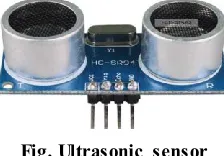
Ultrasonic sensor is basically used for two applications i.e one for object detection and second for distance measurement. Here we are using this sensor for water level measurement. It can measure distance upto 4meters.
Fig. Ultrasonic sensor
C)
Soil moisture sensor
Available online: http://edupediapublications.org/journals/index.php/IJR/ P a g e | 295
Fig. Soil moisture sensor
D)
Smoke detector
A smoke detector is a device that senses smoke, typically as an indicator of fire. Commercial security devices issue a signal to a fire alarm control panel as part of a fire alarm system, while household detectors, known as smoke alarms, generally issue a local audible or visual alarm from the detector itself.
Fig. Smoke Detector
E)
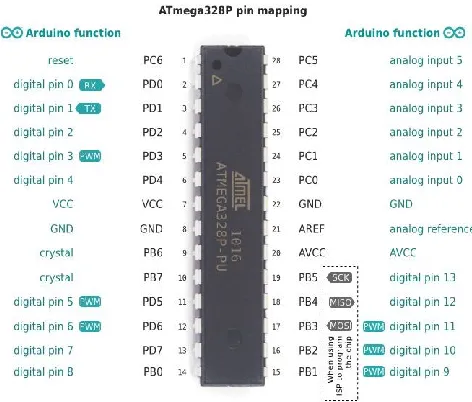
ATmega328/P Microcontroller
The ATmega328/P is a low-power CMOS 8-bit microcontroller based on the AVR enhanced RISC architecture. By executing powerful instructions in a single clock cycle. ATmega328/P achieves throughputs approaching 1 MIPS per MHz allowing the system designer to optimize power consumption versus processing speed. 131 Powerful Instructions – Most Single Clock Cycle Execution. Up to 20 MIPS Throughput at 20MHz. 32KBytes of Flash program memory. 2KBytes Internal SRAM 1KBytes EEPROM. 6-channel 10-bit ADC in PDIP Package. Programmable Serial USART. 23 Programmable I/O
Lines 28-pin PDIP, 32-lead TQFP, 28-pad QFN/MLF and 32-pad QFN/MLF Operating Voltage:1.8 - 5.5V. Temperature Range: -40 C to 85 C.32 x 8 General Purpose Working Registers. Master/Slave SPI Serial Interface. Byte-oriented 2-wire Serial Interface. Programmable Watchdog Timer with Separate On-chip Oscillator. On-On-chip Analog Comparator.
Available online: http://edupediapublications.org/journals/index.php/IJR/ P a g e | 296
Fig: block diagram of irrigation system
IV. WORKING OF THE SYSTEM
Firstly, 230V AC supply is converted to 5V DC using 12V step down transformer, Appropriate environmental conditions are necessary for optimum plant growth, improved Crop yields, and efficient use of water and other resources. Automating the data acquisition Process of the soil conditions and various climatic parameters that govern plant growth allows information to be collected at high frequency with less labor requirements. In order to prevent dry running of motor and allow automatic restart of motor when sufficient water level is regained. Whenever water falls below LL level, microcontroller switches OFF the motor and sends SMS indicating empty well (dry running) conditions. The micro-controller switches ON the motor again when ever water rises beyond HL level and sends sms indicating resumption of task.However, in order to ensure maximum reliability, one temperature sensor is mounted on body of motor, to measure ambient temperature whenever temperature difference exceeds specified safety limit, signal is sent to switch OFF pump conveying SMS to user cell
phone to indicate probable fault occurrence. We are using soil moisture sensor placed at the plants to know how much water content is present in the field. Generally frequent power cuts and insufficient rains at various stages of growth are one of major causes of losses to farmers. Many farmers use induction motor pumps to irrigate their farms from wells. In this application, GSM modem receives any incoming SMS message is directly routed to micro-controller and any outgoing text message is directly sent by micro-controller to designated cell phone number without being stored in control system cell phone memory. As a result, phone memory is not in undated with messages in spite of many messages being transferred.
V.CONCLUSION
The system provides with several benefits and can operate with less manpower. The system supplies water only when the humidity in the soil goes below the reference. Due to the direct transfer of water to the roots water conservation takes place and also helps to maintain the moisture to soil ratio at the root
SMOKE SENSOR
SOIL MOISTURE
Available online: http://edupediapublications.org/journals/index.php/IJR/ P a g e | 297
zone constant to some extent. Thus the system is efficient and compatible to changing environment.
VI. REFERENCES
M.A. Mazidi& J G mazidi, The 8051 micro controller and embedded systems, pearson education asia, (2002).
Scott MAC. Kenzie, The 8051 micro controller, second edition, preticehall Inc., USA, (1995).
John B Peatmen, Design with micro controllers, Mc- Graw Hill, USA.
Michael Predko, Hand- Book of micro controllers, Mc-Graw Hill,New-york, (1999).
Jonathan W Valvano, Embeded microprocessor systems ,Thimsonasiapvt. Ltd, Singapore, (2000).