A FRAMEWORK OF GREEN IT CAPABILITY MATURITY FOR IT PRODUCT LIFECYCLE IN UTM
TAM SAKIRIN
A dissertation submitted in partial fulfillment of the Requirements for the award of the degree of
Master of Science (Information Technology- Management)
Faculty of Computing Universiti Teknologi Malaysia
iii
This dissertation is dedicated to my beloved father Abdulqadir Adam and mother Salamah Muhammadzen for their endless support.
iv
ACKNOWLEDGEMENT
First and foremost, thanks to Allah S.W.T, the Almighty, on whom ultimately we depend for sustenance and guidance for the blessing and opportunity for me to finish my dissertation and thesis writing. I also want to take this opportunity to give my special thanks to Universiti Teknologi Malaysia (UTM), because an opportunity as a part of them about a year in doing degree of Master of Computer Science (Information Technology Management).
First and foremost, I would like to express heartfelt gratitude to my supervisor Associate Professor Dr. Azizah Abdul Rahman for her constant support during my study at UTM. She inspired me greatly to work in this project. Her willingness to motivate me contributed tremendously to my project. I have learned a lot from her and I am fortunate to have her as my mentor and supervisor.
v
ABSTRACT
vi
ABSTRAK
vii
TABLE OF CONTENTS
CHAPTER TITLE PAGE
DECLARATION ii
DEDICATION iii
ACKNOWLEDGMENT iv
ABSTRACT v
ABSTRAK vi
TABLE OF CONTENTS vii
LIST OF TABLES xi
LIST OF FIGURES xiii
1 INTRODUCTION 1
1.1 Introduction 1
1.2 Background of the Problem 4
1.3 Problem Statement 6
1.4 Research Objective 6
1.5 Scope of the study 7
1.6 Significant of study 8
1.7 Chapter Summary 8
2 LITERATURE REVIEW 9
2.1 Introduction 9
2.2 Environmental concerns in nowadays 12
viii
2.3.1 Green IT definition 13
2.3.2 Greening of IT 16
2.3.3 IT for Green 16
2.4 Green IT in university context 17 2.4.1 Green IT practices in university 17
2.5 Green IT Initiators 18
2.5.1 U.S. Environmental Protection Agency
and Energy Star 19 2.5.2 The Swedish Organization TCO
(Tjanstemannens Centralorganization)
Development and ICO Certification 20 2.5.3 Green Electronics Council (GEC) 21 2.5.4 IEEE Environmental Performance
Criteria 22
2.5.5 Summary of Green IT Initiator 23 2.6 Capability Maturity Level 24 2.7 Capability Maturity Frameworks 25 2.7.1 SICT- Capability Maturity Framework 25
2.7.1.1 Defining the scope and goal
of SICT 26 2.7.1.2 Capability Maturity level 26 2.7.1.3 SICT Capability building
blocks 28
2.7.1.4 Assessing and Managing
SICT Progress 31 2.7.2 Generic Maturity Model of COBIT 32 2.7.3 IT Capability Maturity Framework 33 2.7.3.1 Five Maturity Levels 35 2.7.4 Summary of Capability Maturity
Frameworks 40
ix
2.8.3 Reuse or Disposal 49
2.9 Conclusion 50
3 METHODOLOGY 51
3.1 Introduction 51
3.2 Operational framework 53
3.3 Research Design 53
3.3.1 Research Planning 53 3.3.2 Phase 2: Literature Review and
Framework Development 54 3.3.3 Phase 3: Framework Verification 55 3.3.3.1 Card Sorting technique 58 3.3.4 Phase 4: Green IT CM Assessment 59 3.3.4.1 Analysis Technique 61
3.4 Chapter Summary 65
4 FRAMEWORK DEVELOPMENT AND
VERIFICATION 66
4.1 Introduction 66
4.2 Green IT Capability Maturity Framework for
IT Product Lifecycle 66
4.2.1 Propose framework development 67 4.2.2 Mapping Green IT Practices with
Capability Maturity Levels 67 4.3 Framework Verification 76 4.3.1 Preparing Card and Categories 77 4.3.2 Conducting Card-Sorting 82
4.3.3 Result 84
4.3.4 Framework Discussion and Finalization 87
4.4. Conclusion 93
5 APPLICATION OF FRAMEWORK 95
5.1 Introduction 95
x
5.2.1 Application of framework preparation 96 5.2.2 Application of framework conducting 96 5.2.3 Result of framework application 96
5.2.3.1 CM result of Faculty of
Computing 97 5.2.3.2 CM result of Faculty of
Science 100 5.2.3.3 CM result of Faculty of
Education 102 5.2.3.4 CM result of Faculty of
Alam Bina 105
5.2.3.5 CM result of School of
Postgraduate Studied 108 5.2.3.6 Overall CM level result
for UTM 111 5.3 Conclusion 115
6 CONCLUSION 116
6.1 Achievements 116
6.2 Framework contribution 118
6.3 Limitations 118
6.4 Discussion 119
6.5 Recommendation 120
6.6 Closing and Future studies 121
REFERENCE 122
APPENDIX A 127
APPENDIX B 132
xi
LIST OF TABLES
TABLE NO. TITLE PAGE
2.1 Green IT Practice in University 18
2.2 Green IT Initiators 23
2.3 Capability building blocks of SICT 29 2.4 Generic Maturity Model (COBIT 4.1) 33 2.5 IT Capability Maturity Framework 35 2.6 Managing the IT budget, Key Characteristics 36 2.7 Managing the IT Capability, Key Characteristics 37 2.8 Managing the IT Business values, Key
Characteristics 38
2.9 Managing the IT like business, Key Characteristics 39 2.10 Summary of green IT CM framework 40 2.11 Green IT Procurement Practices 44
2.12 Green IT Usage Practices 47
xii
Level 71
4.2 Green IT usage with Capability Maturity Level 73 4.3 Green IT Reuse/Disposal with Capability Maturity
Level 75
4.4 Matrix table of green IT procurement 84 4.5 Matrix table of green IT usage 85 4.6 Matrix table of green IT reuse/disposal 86 4.7 Green IT procurement with Capability Maturity Level 90 4.8 Green IT usage with Capability Maturity Level 91 4.9 Green IT Reuse/Disposal with Capability Maturity
Levels 93
5.1 CM result of FC 97
5.2 CM result of FS 100
5.3 CM result of FE 102
5.4 CM result of FAB 105
xiii
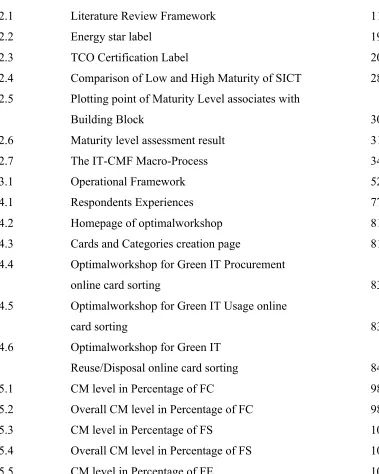
LIST OF FIGURES
FIGURE NO. TITLE PAGE
2.1 Literature Review Framework 11
2.2 Energy star label 19
2.3 TCO Certification Label 20 2.4 Comparison of Low and High Maturity of SICT 28 2.5 Plotting point of Maturity Level associates with
Building Block 30
2.6 Maturity level assessment result 31 2.7 The IT-CMF Macro-Process 34 3.1 Operational Framework 52
4.1 Respondents Experiences 77
4.2 Homepage of optimalworkshop 81 4.3 Cards and Categories creation page 81 4.4 Optimalworkshop for Green IT Procurement
online card sorting 83
4.5 Optimalworkshop for Green IT Usage online
card sorting 83
4.6 Optimalworkshop for Green IT
xiv
5.6 Overall CM level in Percentage of FE 104 5.7 CM level in Percentage of FAB 106 5.8 Overall CM in level Percentage of FAB 106 5.9 CM level in Percentage of SPS 109 5.10 Overall CM level in Percentage of SPS 110 5.11 Overall CM level for UTM 111 5.12 Overall CM level for all UTM faculties 112 5.13 CM level for UTM Faculties in Procurement
Practice 113
5.14 CM level for UTM Faculties in Usage Practice 114 5.15 CM level for UTM Faculties in Reuse/Disposal
CHAPTER 1
INTRODUCTION
1.1 Introduction
Over the past few decades, Information and Communication Technology (ICT) has completely transformed global business and social practice. With the help of technology, economies and businesses have transformed to economies and e-business. ICT provides transformation capabilities that offer any number of economic opportunities. ICT helps create greener and more sustainable environments. However, ICT industries cause global warming and contribute approximately 2% to climate change by producing CO2 emissions (Molla& Cooper, 2009). This is not an outstanding rate of emissions when compared to other industries such as the aviation industry for example. Molla and Cooper added that this rate of CO2 emissions is due to the fact that all phases of an IT product’s lifecycle has an environmental impact.
2
them better manage environmental issues and pursue new opportunities (Murugesan and Gangadharan, 2012).
Given the importance of achieving environmental sustainability and its many benefits to both the environment and business, a great deal of research has focused on green IT resulting in the proposal of numerous ‘green’ frameworks. Implementation of environmental sustainable in IT is known as green IT or green computing. Watson et al., (2010) defined Green IT as the efficient use of computing device (design product, procurement, usage, reduce/disposal). This comprises of the triple bottom line of the economy, social response, and environmental impact. Green IT uses ICT to manage organizational operations and resources towards becoming more environmentally friendly (Mingay, 2007).
There is a sustained rise in the adoption of green IT strategies and practices among organizations and businesses. These strategies promote environmentally sustainable business practices. Although there are many existing green IT capabilities and frameworks, they do not provide a comprehensive evaluation of existing practices and fail to effectively measure efforts to implement green IT (Alemayehu et al., 2010). Martine (2008) pointed out that the reason for resistance in organizational environmental implementation is because of a nonexistent integrative framework that can assist them to monitor a firm’s IT capability maturity level and performance.
3
To achieve sustainable business practice, the study of IT product lifecycle is important. IT product life cycle consists of designing, manufacturing and facilitating, packaging and transportation, usage, and reuse and disposal (Ashok and Sateesh, 2012; Eric, 2010). Some of these phases are managed by the manufacturer, while others are managed by the organization or consumer.
In this research, organizations that procure, use, reuse or dispose of IT products are considered IT consumers. In order to achieve sustainable business practice, it is important to study the practice of each phase of the IT product lifecycle that concern consumers and map them onto the capability maturity level to stabilize the maturity of an organization’s processes and its implementation.
The IT product lifecycle focuses on consumer perspectives including procurement, usage, and reuse/disposal phases. The IT product in this research focuses on office equipment, which is categorized as IEEE1680, namely computers and monitors, and image equipment (printer, scanner, copier and fax machine, digital duplicator, multi-function device, and mailing machine).
Green IT purchasing refers to the practice of purchasing products after due consideration of the environment (Lettemieke, nd, retrieved on 6/04/2013). Such considerations pertain to the environment and the impact the purchase of a product and/or service will have on human life.
4
1.2 Background of the Problem
Nowadays IT has become an inseparable part of every organizations or industries. These IT devices cause environmental impact where organizations and industries have to green it. In this regard, UTM is not exceptional and they should go through Green practices to be such leading centers in current Green wave as scientific places and also align themselves with what are happening in outside world and gain value.
Fortunately, UTM has launched the Green Campus trying to make its practices Green and be a pioneer in Green projects. In this regard, UTM has done several projects by chemical faculty and research center such as making the mosque‘s water usage efficient or measuring CO2 emission of Faculty of Chemical Engineering and suggesting a specific kind of lighting bulbs which consume less energy. It also runs some contests such as Green buildings and Green offices to get involve others’ opinions and have some other creative suggestions (Parastouossadat, 2012).
Since UTM has launched Green Campus, green IT has been considered. CICT is in charged of designing green IT policy and all UTM faculties unit is responsible to implement green IT practice. In fact, green IT is very new for CICT and recently just due to launching the Green Campus of university. Currently CICT has initiated some green practices for UTM faculties such green IT laboratory, green office and energy reduction. These green IT initiatives should be done and it is expect to be done by UTM faculties/unit.
5
For green office, UTM faculties/units have implemented green IT in their faculties by reducing paper usage, electrical power and save energy. Green IT practice in this section seems it has done more that other sections.
In laboratory section, CICT has set Green technology policy to make sure that all activities that evolving in laboratory must be under Green technology policy, and UTM faculties should implement this policy. Laboratory activities rank from purchasing IT device and IT device life cycle (Parastouossadat, 2012). In term of Green purchasing, UTM faculties consider the Green technology policy but they do not have proper implementation. It can be said that in the life cycle of IT devices, they try to follow the Green technology policy, but it seems that they have some shortcomings in managing the life cycle of IT assets especially for recycling and disposing.
In the case of energy, the energy management community of each faculty is in charge of reporting the energy usage of their faculties but not the energy usage of IT assets. So the energy usage of specific IT devices is not specified while it should be measured and cleared. As a result, the carbon emission of IT assets is not been measured and reported. Significantly, the energy consumption of IT devices should be managed and tracked seriously and each faculty should be aware of the energy consumed by their faculties which will lead to lower carbon footprint while they are using IT devices. This matter has not been done by UTM faculties yet and there is no software to track energy consumption of IT devices.
6
Therefore, there is a need to develop a comprehensive framework of green IT implementation to improve the efficiency of managing IT device over IT product lifecycle in UTM faculties.
1.3 Problem Statement
Given the problem mentioned above, this research investigates the implementation of green IT strategies in UTM towards defining a sustainable implementation capability maturity level associated with IT hardware life cycle. Such an effort is a means to provide a sustainability guideline. To this end, this research seeks to answer the following questions:
1. What are the criteria to define the capability maturity level?
2. What are the best practices in the IT product lifecycle from the consumer perspective?
3. How can a capability maturity framework on IT product life cycle be developed to assess sustainable IT implementation in UTM?
1.4 Research Objective
Research objective helps the research to set the goal to facilitate the research study. In this research, there are four objectives:
1. To identify the criteria of each capability maturity level. 2. To identify the best practice of IT product lifecycle.
3. To develop the framework of capability maturity on IT product lifecycle. 4. To assess the capability maturity level on IT product life cycle in UTM
7
1.5 Scope of the study
Universities are equipped with a great number of IT devices such as computers, printers, monitors, projectors, and scanners to name a few. These devices produce CO2 emission. According to the Higher Education Sector in UK, 500,000 metric tons of carbon dioxide were produced annually by universities in UK, much of which is produced from campuses and data centers (Retrieved from: http://www.sussex.ac.uk/its/about/greenit). Research universities are among the worst culprits in terms of CO2 emissions. This number is equal to 10% of CO2in the
USA (Retrieved from:
http://green-broadband.blogspot.com/2009/01/uk-government-to-link-funding-to.html, 2009).
This research develops a framework of green IT capability maturity for IT product lifecycle in the educational context. Faculties/unit in UTM form the scope and sample of the study in order to assess the capability maturity level on IT product life cycle base on the proposed framework.
The IT product lifecycle will focus on consumer perspectives including procurement, usage, and reuse/disposal phases. Green IT purchasing refers to the practice of purchasing products after due consideration of environmental issues (Lettemieke, nd, retrieved on 6/04/2013). Green IT product usage is the level of green IT product usage that has less impact on the environment (Ashok and Sateesh, 2012; Eric, 2010). Green IT reuse/disposal refer to the ways in which old computers and other IT devices are refurbished, reused, and recycled (Ashok and Sateesh, 2012; Eric, 2010).
8
1.6 Significances of study
This research discusses the significance of developing a framework of capability maturity on IT product lifecycle. This framework significantly assists organizations to implement and monitor their green IT implementation over the IT product lifecycle. Through such a means, organizations are able to initiate, implement, and sustain their green IT implementation.
The findings of this research are intended to assist UTM assess their green IT capability maturity level on IT product lifecycle. UTM can also obtain some guidelines to sustain green IT implementation over IT product life cycle based on their capability maturity level.
1.7 Chapter Summary
122
REFERENCES
Alemayehu, M., Hepu, D., and Brian, C. (2010). Assessing The Capability of the
IT Industry. Retrieved on 10 Nov 2010, from http://greenit.bf.rmit.edu.au
Ashok, P. K., and Sateesh, S. K. (2012). Green Devices and Hardware.
Harnessing green IT: Principle and practices. British Library ISBN (H/B)
9781119970057
Bansal, P. and Roth, K. (2000). Why companies go green: a model of ecological
responsiveness. Academy of Management Journal 43 (4), 717-748.
Boughton, C. (2009). “What is an ICT Professional Anyway”. Australasian
Journal of Information Systems, 16(1), 149-163.
Chan, R. Y., and Yam, E. (1995). “Green Movement in a Newly Industrializing
Area: A Survey on the Attitudes and Behaviors of the Hong Kong
Citizens”. Journal of Community and Applied Social Psychology, (5),
273-284.
Computer Aid International. (2010). ICT and the Environment. Retrieved on 21st
Mar 2013, from:
http://www.computeraid.org/uploads/ICTs-and-the-Environment - Special-report-1-Reuse-(Aug10).pdf.
Curry, E., and Donnellan, B. (2012). Understanding the Maturity of Sustainable
ICT.” in Green Business Process Management - Towards the Sustainable
Enterprise. Springer, 203-216.
Eagly, A., and Chaiken, S. (1993). The Psychology of Attitude, Harcourt Brace
Jovanovich, Fort Worth, TX.
Electronic Product Environmental Assessment Tool (2011). Retrieved on 21st Mar
2013, form; http://epeat.net.
EPA. (2013). Greening Your Purchase of Carpet: A Guide for Federal Purchasers.
Retrieved on 22 Mar 2013, from:
123
Eric, A. F. (2010). Green Procurement: Overview and Issues for Congress.
Congressional Research Service
Gaffney, G. (2003). What is cardsorting?. Retrieved on: 21st Nov 2013, from:
http://www.infodesign.com.au/usabilityresources/design/cardsorting.asp .
Gartner. (2008). Going Green: The CIO’s Role in Enterprise wide Environmental
Sustainability. Gartner EXP Premier.
González-Benito, J., and González-Benito. O., (2006). A review of determinant
factors of environmental proactivity. Business Strategy and the
Environment 15 (2), 87-102.
Green Boadband. (2009). UK government to link funding to universities based on
CO2 reduction. Retrieved on: 14/01/2014, from:
http://green-broadband.blogspot.com/2009/01/uk-government-to-link-funding-to.html,
Herbsleb, D., Zubrow, D., Goldenson, W. Hayes, and M. Paulk. (1997).
“Software quality and the capability maturity model.” Commune. ACM,
vol.40(6), 30–40.
ITIL Lifecycle Publication Suiite. (2008). Office of Government Commerce
(OGC)
Jacobs, J. C., and Trienekens, J. J. M., (2002). Towards a Metrics Based
Verification and Validation Maturity Model. Proceedings of the 10th
International Workshop on Software Technology and Engineering
Practice (STEP’02)
Kerinia, C., (1997). The systems engineering capability maturity model: where to
start?. IEEE
Lettemieke, M., (nd). Green Purchasing: Does It Make Sense? Retrieve on: 6th
April 3013, from:
http://ieeexplore.ieee.org/stamp/stamp.jsp?arnumber=00675043
Maiden, N. A. M., and Rugg. G. (1996). ACRE: Selecting Methods for
Requirements Acquisition, Software Engineering Journal, 11, 183-192
Martin, C., (2008). Introducing an IT Capability Maturity Framework. ICEIS,
LNBIP 12, 63–78.
Maurer, D., and Warfel, T., (2004). Card sorting: A definitive guide. Retrieved
on: 21st Nov 2013, from:
124
Mingay, S., (2007). Green IT: The new industry shock wave. Gartner RAS
Research Not G00153703
Molla, A. and Cooper, V. (2009). Green IT readiness: a framework and
preliminary proof of concepts. Australasian Journal of Information
Systems, 16(2)
Molla, A., Deng, H., and Corbitt, B. (2010). IT for Green: A Framework for
Assessing the Capability of the IT Industry. School of BITL, RMIT.
Mrugesan, S., and Gangadharan, G. R., (2012). Harnessing green IT: principle
and practice. John Wiley & Sons
Murillo-Luna, J., Garcés-Ayerbe, L., C., and Rivera-Torres. P., (2008). Why do
patterns of environmental response differ? A stakeholders’ pressure
approach. Strategic Management Journal. 29 (11), 1225-1240.
Nottingham. (nd). Information Services. Retrieved on: 14 Jan 2014, from:
http://www.nottingham.ac.uk/is/it/green-it/why-green-it.aspx,
Olson, E.G. (2008). Creating an enterprise-level ‘Green strategy’. The Journal of
Business Strategy, 29(2), 22-30
Open Green IT policy. (2013). ICT Procurement & Lifecycle. Retrieved on 6th
April 2013, from: http://www.opengreenitpolicy.org/?page_id=14
Parastouossadat, A. (2012). Green IT Initiatives For FSKSM. Master Thesis in
Faculty of Computer Science and Information Systems. Universiti
Teknologi Malaysia
Rao, P,. and Holt, D. (2005). “Do Green Supply Chains Lead to Competitiveness
and Economic Performance?” International Journal of Operations &
Production Management, 25(9), 898-916.
Rasmussen, N. (2006). “Electrical Efficiency Modeling for Data Centers”,
retrieved on 23 June 2013, from
http://www.apcmedia.com/salestools/NRAN-66CK3D_R1_EN.pdf.
Roger. D., and Glen. L. G. (2009). Proceedings of the 42nd Hawaii International
Conference on System Sciences
Rúben, P., and Miguel, M. S. (2011). Using the IT Capability Maturity
Framework to improve IT Capability and Value Creation: An Intel IT
Case Study. 15th IEEE International Enterprise Distributed Object
125
Shrivastava, P. (1995). Environmental technologies and competitive advantage.
Strategic Management Journal 16, 183-200.
Skulmoski, G. (2001). “Project maturity and competence interface,” Cost Eng.
43(6),11–18.
Sussex University. (nd). Green IT at Sussex. Retrieved on: 14 Jan 2014, from:
http://www.sussex.ac.uk/its/about/greenit
United State Environmental Protection Agency. (2013). Publications and
Resources. retrieved on 22 Mar 2013, from:
http://www.epa.gov/fec/publications.html,
Unruh, G., and Ettenson. R. (2010). Growing green. Harvard Business Review 88
(6), 94-100.
Velte, T.J., Velte, A.T., and Elsenpeter, R. (2008). Green IT: reduce your
information system’s environmental impact while adding to the bottom
line, New York: McGraw Hill.
Watson, R., Boudreau, M., and Chen, A. (2010). Information System and
environmentally sustainable development: Energy informatics and new
directions for the IS community. MIS Quarterly, 34(1), 23-38
Xin, L., and Xiao, Y., (2010). Research on sustainable green product life cycle.
International conference on Advanced Technology of Design and