Determining the Unithood of Word Sequences using a Probabilistic
Approach
Wilson Wong, Wei Liu and Mohammed Bennamoun School of Computer Science and Software Engineering
University of Western Australia Crawley WA 6009
{wilson,wei,bennamou}@csse.uwa.edu.au
Abstract
Most research related to unithood were con-ducted as part of a larger effort for the deter-mination of termhood. Consequently, nov-elties are rare in this small sub-field of term extraction. In addition, existing work were mostly empirically motivated and derived. We propose a new probabilistically-derived measure, independent of any influences of termhood, that provides dedicated measures to gather linguistic evidence from parsed text and statistical evidence from Google search engine for the measurement of unit-hood. Our comparative study using 1,825 test cases against an existing empirically-derived function revealed an improvement in terms of precision, recall and accuracy.
1 Introduction
Automatic term recognition, also referred to as term extraction or terminology mining, is the process of
extracting lexical units from text and filtering them for the purpose of identifying terms which charac-terise certain domains of interest. This process in-volves the determination of two factors: unithood and termhood. Unithood concerns with whether or not a sequence of words should be combined to form a more stable lexical unit. On the other hand, termhood measures the degree to which these sta-ble lexical units are related to domain-specific con-cepts. Unithood is only relevant to complex terms (i.e. multi-word terms) while termhood (Wong et al., 2007a) deals with both simple terms (i.e. single-word terms) and complex terms. Recent reviews by
(Wong et al., 2007b) show that existing research on unithood are mostly carried out as a prerequisite to the determination of termhood. As a result, there is only a small number of existing measures dedi-cated to determining unithood. Besides the lack of dedicated attention in this sub-field of term extrac-tion, the existing measures are usually derived from term or document frequency, and are modified as per need. As such, the significance of the different weights that compose the measures usually assume an empirical viewpoint. Obviously, such methods are at most inspired by, but not derived from formal models (Kageura and Umino, 1996).
The three objectives of this paper are (1) to sepa-rate the measurement of unithood from the determi-nation of termhood, (2) to devise a probabilistically-derived measure which requires only one thresh-old for determining the unithood of word se-quences using non-static textual resources, and (3) to demonstrate the superior performance of the new probabilistically-derived measure against existing empirical measures. In regards to the first objective, we will derive our probabilistic measure free from any influence of termhood determination. Follow-ing this, our unithood measure will be an indepen-dent tool that is applicable not only to term extrac-tion, but many other tasks in information extraction and text mining. Concerning the second objective, we will devise our new measure, known as the Odds
one threshold, namely, OUT is required to control the functioning ofOU. Regarding the third objec-tive, we will compare our new OU against an ex-isting empirically-derived measure called Unithood (U H) (Wong et al., 2007b) in terms of their preci-sion, recall and accuracy.
In Section 2, we provide a brief review on some of existing techniques for measuring unithood. In Sec-tion 3, we present our new probabilistic approach, the measures involved, and the theoretical and in-tuitive justification behind every aspect of our mea-sures. In Section 4, we summarize some findings from our evaluations. Finally, we conclude this pa-per with an outlook to future work in Section 5.
2 Related Works
Some of the most common measures of unithood include pointwise mutual information (MI) (Church and Hanks, 1990) and log-likelihood ratio (Dunning, 1994). In mutual information, the co-occurrence fre-quencies of the constituents of complex terms are utilised to measure their dependency. The mutual information for two wordsaandbis defined as:
M I(a, b) = log2 p(a, b)
p(a)p(b) (1)
wherep(a) andp(b)are the probabilities of occur-rence of a and b. Many measures that apply sta-tistical techniques assuming strict normal distribu-tion, and independence between the word occur-rences (Franz, 1997) do not fare well. For handling extremely uncommon words or small sized corpus,
log-likelihood ratio delivers the best precision (Kurz
and Xu, 2002). Log-likelihood ratio attempts to quantify how much more likely one pair of words is to occur compared to the others. Despite its poten-tial, “How to apply this statistic measure to
quan-tify structural dependency of a word sequence re-mains an interesting issue to explore.” (Kit, 2002).
(Seretan et al., 2004) tested mutual information, log-likelihood ratio and t-tests to examine the use of re-sults from web search engines for determining the collocational strength of word pairs. However, no performance results were presented.
(Wong et al., 2007b) presented a hybrid approach inspired by mutual information in Equation 1, and
C-value in Equation 3. The authors employ Google
page counts for the computation of statistical evi-dences to replace the use of frequencies obtained from static corpora. Using the page counts, the au-thors proposed a function known as Unithood (UH) for determining the mergeability of two lexical units ax anday to produce a stable sequence of wordss. The word sequences are organised as a set W = {s, ax, ay} where s = axbay is a term candidate,
bcan be any preposition, the coordinating conjunc-tion “and” or an empty string, and ax anday can either be noun phrases in the formAdj∗N+or an-others(i.e. defining a newsin terms of other s). The authors defineU Has:
U H(ax, ay) = are thresholds for determining mergeability deci-sions, andM I(ax, ay)is the mutual information be-tween ax anday, while ID(ax, s), ID(ay, s) and
IDR(ax, ay)are measures of lexical independence ofaxandayfroms. For brevity, letzbe eitheraxor lexical unitsax anday can only be merged in two cases, namely, 1) if ax and ay has extremely high mutual information (i.e. higher than a certain thresh-oldM I+), or 2) ifax anday achieve average mu-tual information (i.e. within the acceptable range of two thresholdsM I+andM I−) due to both of their extremely high independence (i.e. higher than the thresholdIDT) froms.
(Frantzi, 1997) proposed a measure known as
is based upon the claim that a substring of a term candidate is a candidate itself given that it demon-strates adequate independence from the longer ver-sion it appears in. For example, “E. coli food
poi-soning”, “E. coli” and “food poisoning” are
accept-able as valid complex term candidates. However,
“E. coli food” is not. Therefore, some measures
are required to gauge the strength of word combina-tions to decide whether two word sequences should be merged or not. Given a word sequence ato be examined for unithood, the Cvalue is defined as:
Cvalue(a) =
(
log2|a|fa if|a|=g log2|a|(fa−
P l∈Lafl
|La| ) otherwise (3) where |a| is the number of words in a, La is the set of longer term candidates that contain a, g is the longest n-gram considered, fa is the frequency of occurrence ofa, anda /∈ La. While certain re-searchers (Kit, 2002) consider Cvalue as a termhood measure, others (Nakagawa and Mori, 2002) accept it as a measure for unithood. One can observe that longer candidates tend to gain higher weights due to the inclusion oflog2|a|in Equation 3. In addition, the weights computed using Equation 3 are purely dependent on the frequency ofa.
3 A Probabilistically-derived Measure for Unithood Determination
We propose a probabilistically-derived measure for determining the unithood of word pairs (i.e. po-tential term candidates) extracted using the head-driven left-right filter (Wong, 2005; Wong et al., 2007b) and Stanford Parser (Klein and Manning, 2003). These word pairs will appear in the form of (ax, ay) ∈ A with ax anday located immediately next to each other (i.e. x+ 1 = y), or separated by a preposition or coordinating conjunction “and” (i.e.x+ 2 =y). Obviously,axhas to appear before
ay in the sentence or in other words, x < y for all pairs wherexandyare the word offsets produced by the Stanford Parser. The pairs in A will remain as potential term candidates until their unithood have been examined. Once the unithood of the pairs in Ahave been determined, they will be referred to as
term candidates. Formally, the unithood of any two
lexical unitsaxanday can be defined as
Definition 1 The unithood of two lexical units is the
“degree of strength or stability of syntagmatic com-binations and collocations” (Kageura and Umino, 1996) between them.
It is obvious that the problem of measuring the unithood of any pair of words is the determination of their “degree” of collocational strength as men-tioned in Definition 1. In practical terms, the
“de-gree” mentioned above will provide us with a way to
determine if the unitsaxandayshould be combined to forms, or left alone as separate units. The collo-cational strength ofaxandaythat exceeds a certain threshold will demonstrate to us thatsis able to form a stable unit and hence, a better term candidate than ax and ay separated. It is worth pointing that the size (i.e. number of words) ofaxanday is not lim-ited to1. For example, we can haveax=“National Institute”,b=“of ” and ay=“Allergy and Infectious Diseases”. In addition, the size ofaxanday has no effect on the determination of their unithood using our approach.
As we have discussed in Section 2, most of the conventional practices employ frequency of oc-currence from local corpora, and some statistical tests or information-theoretic measures to determine the coupling strength between elements in W = {s, ax, ay}. Two of the main problems associated with such approaches are:
• Data sparseness is a problem that is well-documented by many researchers (Keller et al., 2002). It is inherent to the use of local corpora that can lead to poor estimation of parameters or weights; and
• Assumption of independence and normality of word distribution are two of the many problems in language modelling (Franz, 1997). While the independence assumption reduces text to simply a bag of words, the assumption of nor-mal distribution of words will often lead to in-correct conclusions during statistical tests.
As a general solution, we innovatively employ re-sults from web search engines for use in a proba-bilistic framework for measuring unithood.
We consider the World Wide Web as a large general corpus and the Google search engine as a gateway for accessing the documents in the general corpus. Our choice of using Google to obtain the page count was merely motivated by its extensive coverage. In fact, it is possible to employ any search engines on the World Wide Web for this research. As for the second issue, we attempt to address the problem of determining the degree of collocational strength in terms of probabilities estimated using Google page count. We begin by defining the sample space,N as the set of all documents indexed by Google search engine. We can estimate the index size of Google,
|N| using function words as predictors. Function words such as “a”, “is” and “with”, as opposed to content words, appear with frequencies that are rel-atively stable over many different genres. Next, we perform random draws (i.e. trial) of documents from N. For each lexical unitw∈W, there will be a cor-responding set of outcomes (i.e. events) from the draw. There will be three basic sets which are of interest to us:
Definition 2 Basic events corresponding to each w∈W:
• Xis the event thataxoccurs in the document
• Y is the event thatayoccurs in the document
• Sis the event thatsoccurs in the document
It should be obvious to the readers that since the doc-uments inShave to contain all two unitsaxanday,
S is a subset ofX∩Y orS ⊆X∩Y. It is worth noting that even though S ⊆ X ∩Y, it is highly unlikely that S = X ∩Y since the two portions axanday may exist in the same document without being conjoined byb. Next, subscribing to the fre-quency interpretation of probability, we can obtain the probability of the events in Definition 2 in terms of Google page count:
P(X) = nx
|N| (4)
P(Y) = ny |N|
P(S) = ns |N|
wherenx, ny andns is the page count returned as the result of Google search using the term [+“ax”],
[+“ay”] and [+“s”], respectively. The pair of quotes that encapsulates the search terms is the
phrase operator, while the character “+” is the re-quired operator supported by the Google search
en-gine. As discussed earlier, the independence as-sumption required by certain information-theoretic measures and other Bayesian approaches may not al-ways be valid, especially when we are dealing with linguistics. As such, P(X ∩ Y) =6 P(X)P(Y) since the occurrences ofaxanday in documents are inevitably governed by some hidden variables and hence, not independent. Following this, we define the probabilities for two new sets which result from applying some set operations on the basic events in Definition 2:
P(X∩Y) = nxy
|N| (5)
P(X∩Y \S) =P(X∩Y)−P(S) where nxy is the page count returned by Google for the search using [+“ax” +“ay”]. Defining
P(X∩Y)in terms of observable page counts, rather than a combination of two independent events will allow us to avoid any unnecessary assumption of in-dependence.
Next, referring back to our main problem dis-cussed in Definition 1, we are required to estimate the strength of collocation of the two unitsax and
ay. Since there is no standard metric for such mea-surement, we propose to address the problem from a probabilistic perspective. We introduce the proba-bility thatsis a stable lexical unit given the evidence spossesses:
Definition 3 Probability of unithood:
P(U|E) = P(E|U)P(U)
P(E)
where U is the event that sis a stable lexical unit andE is the evidences belonging tos. P(U|E) is the posterior probability thatsis a stable unit given the evidenceE. P(U)is the prior probability thats is a unit without any evidence, andP(E)is the prior probability of evidences held bys. As we shall see later, these two prior probabilities will be immaterial in the final computation of unithood. Since scan either be a stable unit or not, we can state that,
whereU¯is the event thatsis not a stable lexical unit. SinceOdds = P/(1−P), we multiply both sides of Definition 3 by(1−P(U|E))−1to obtain,
P(U|E) 1−P(U|E) =
P(E|U)P(U)
P(E)(1−P(U|E)) (7) By substituting Equation 6 in Equation 7 and later, applying the multiplication rule P( ¯U|E)P(E) =
P(E|U¯)P( ¯U)to it, we will obtain: P(U|E)
P( ¯U|E) =
P(E|U)P(U)
P(E|U¯)P( ¯U) (8) We proceed to take the log of the odds in Equation 8 (i.e. logit) to get:
logP(E|U)
P(E|U¯) = log
P(U|E)
P( ¯U|E) −log
P(U)
P( ¯U) (9) While it is obvious that certain words tend to co-occur more frequently than others (i.e. idioms and collocations), such phenomena are largely arbitrary (Smadja, 1993). This makes the task of deciding on what constitutes an acceptable collocation dif-ficult. The only way to objectively identify sta-ble lexical units is through observations in samples of the language (e.g. text corpus) (McKeown and Radev, 2000). In other words, assigning the apri-ori probability of collocational strength without em-pirical evidence is both subjective and difficult. As such, we are left with the option to assume that the probability of sbeing a stable unit and not be-ing a stable unit without evidence is the same (i.e. P(U) =P( ¯U) = 0.5). As a result, the second term in Equation 9 evaluates to0:
logP(U|E)
P( ¯U|E) = log
P(E|U)
P(E|U¯) (10) We introduce a new measure for determining the odds ofsbeing a stable unit known as Odds of
Unit-hood (OU):
Definition 4 Odds of unithood
OU(s) = logP(E|U)
P(E|U¯)
Assuming that the evidences in E are independent of one another, we can evaluateOU(s)in terms of:
OU(s) = log
Q
iP(ei|U)
Q
iP(ei|U¯)
(11)
=X
i
logP(ei|U)
P(ei|U¯)
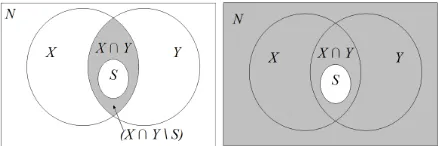
(a) The area with darker shade is the setX ∩Y \S. Computing the ratio ofP(S)
and the probability of this area will give us the first evidence.
(b) The area with darker shade is the setS′
. Comput-ing the ratio ofP(S)and the
probability of this area (i.e.
P(S′) = 1
−P(S)) will give
us the second evidence.
Figure 1: The probability of the areas with darker shade are the denominators required by the evi-dencese1ande2for the estimation ofOU(s).
whereei are individual evidences possessed bys. With the introduction of Definition 4, we can ex-amine the degree of collocational strength of ax anday in forming s, mentioned in Definition 1 in terms ofOU(s). With the base of the log in Def-inition 4 more than 1, the upper and lower bound of OU(s) would be +∞ and −∞, respectively. OU(s) = +∞ andOU(s) = −∞ corresponds to the highest and the lowest degree of stability of the two unitsax anday appearing ass, respectively. A high1 OU(s) would indicate the suitability for the two unitsax anday to be merged to form s. Ulti-mately, we have reduced the vague problem of the determination of unithood introduced in Definition 1 into a practical and computable solution in Defini-tion 4. The evidences that we propose to employ for determining unithood are based on the occurrences ofs, or the eventSif the readers recall from Defini-tion 2. We are interested in two types of occurrences ofs, namely, the occurrence ofsgiven thataxand
ay have already occurred orX∩Y, and the occur-rence ofsas it is in our sample space,N. We refer to the first evidence e1 as local occurrence, while the second one e2 as global occurrence. We will discuss the intuitive justification behind each type of occurrences. Each evidenceei captures the occur-rences ofswithin a different confinement. We will estimate these evidences in terms of the elementary probabilities already defined in Equations 4 and 5.
The first evidence e1 captures the probability of occurrences ofswithin the confinement ofaxanday
1
orX∩Y. As such,P(e1|U)can be interpreted as the probability ofsoccurring withinX∩Y as a stable unit or P(S|X ∩Y). On the other hand,P(e1|U¯) captures the probability ofsoccurring inX∩Y not as a unit. In other words,P(e1|U¯)is the probability ofsnot occurring inX∩Y, or equivalently, equal toP((X∩Y \S)|(X∩Y)). The setX∩Y \Sis shown as the area with darker shade in Figure 1(a). Let us define the odds based on the first evidence as:
OL=
P(e1|U)
P(e1|U¯) (12)
Substituting P(e1|U) = P(S|X ∩ Y) and P(e1|U¯) = P((X ∩Y \S)|(X∩Y))into Equa-tion 12 will give us:
OL=
P(S|X∩Y)
P((X∩Y \S)|(X∩Y)) = P(S∩(X∩Y))
P(X∩Y)
P(X∩Y)
P((X∩Y \S)∩(X∩Y)) = P(S∩(X∩Y))
P((X∩Y \S)∩(X∩Y))
and sinceS ⊆(X∩Y)and(X∩Y\S)⊆(X∩Y),
OL=
P(S)
P(X∩Y \S) if(P(X∩Y \S)6= 0) andOL= 1ifP(X∩Y \S) = 0.
The second evidence e2 captures the probability of occurrences ofs without confinement. If sis a stable unit, then its probability of occurrence in the sample space would simply beP(S). On the other hand, ifsoccurs not as a unit, then its probability of non-occurrence is1−P(S). The complement ofS, which is the setS′is shown as the area with darker shade in Figure 1(b). Let us define the odds based on the second evidence as:
OG =
P(e2|U)
P(e2|U¯) (13)
SubstitutingP(e2|U) = P(S)andP(e2|U¯) = 1−
P(S)into Equation 13 will give us:
OG=
P(S) 1−P(S)
Intuitively, the first evidence attempts to capture the extent to which the existence of the two lexical
unitsax anday is attributable tos. Referring back toOL, whenever the denominatorP(X∩Y \S) be-comes less than P(S), we can deduce that ax and
ay actually exist together as s more than in other forms. At one extreme whenP(X∩Y \S) = 0, we can conclude that the co-occurrence of ax and
ay is exclusively fors. As such, we can also refer to
OLas a measure of exclusivity for the use ofaxand
ay with respect tos. This first evidence is a good indication for the unithood ofssince the more the existence ofaxandayis attributed tos, the stronger the collocational strength ofsbecomes. Concerning the second evidence,OGattempts to capture the ex-tent to whichsoccurs in general usage (i.e. World Wide Web). We can considerOG as a measure of pervasiveness for the use ofs. Assbecomes more widely used in text, the numerator in OG will in-crease. This provides a good indication on the unit-hood ofssince the moresappears in usage, the like-lier it becomes thatsis a stable unit instead of an oc-currence by chance whenaxandayare located next to each other. As a result, the derivation ofOU(s) usingOLandOGwill ensure a comprehensive way of determining unithood.
Finally, expanding OU(s) in Equation 11 using Equations 12 and 13 will give us:
OU(s) = logOL+ logOG (14) = log P(S)
P(X∩Y \S)+ log
P(S) 1−P(S) As such, the decision on whetherax anday should be merged to form scan be made based solely on the Odds of Unithood (OU) defined in Equation 14. We will mergeax anday if their odds of unithood exceeds a certain threshold,OUT.
4 Evaluations and Discussions
mea-sured for their unithood. Using the 500news arti-cles, we managed to obtain1,825pairs of words to be tested for unithood.
We performed a comparative study of our new probabilistic approach against the empirically-derived unithood function described in Equation 2. Two experiments were conducted. In the first one, we assessed our probabilistically-derived measure OU(s) as described in Equation 14 where the de-cisions on whether or not to merge the1,825pairs are done automatically. These decisions are known as the actual results. At the same time, we inspected the same list manually to decide on the merging of all the pairs. These decisions are known as the ideal
results. The thresholdOUT employed for our evalu-ation is determined empirically through experiments and is set to−8.39. However, since only one thresh-old is involved in deciding mergeability, training al-gorithms and data sets may be employed to automat-ically decide on an optimal number. This option is beyond the scope of this paper. The actual and ideal results for this first experiment are organised into a contingency table (not shown here) for identify-ing the true and the false positives, and the true and the false negatives. In the second experiment, we conducted the same assessment as carried out in the first one but the decisions to merge the1,825pairs are based on theU H(ax, ay) function described in Equation 2. The thresholds required for this func-tion are based on the values suggested by (Wong et al., 2007b), namely, M I+ = 0.9, M I− = 0.02, IDT = 6,IDR+= 1.35, andIDR−= 0.93.
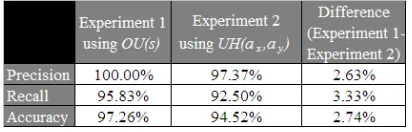
Table 1: The performance ofOU(s) (from Exper-iment 1) and U H(ax, ay) (from Experiment 2) in terms of precision, recall and accuracy. The last column shows the difference in the performance of Experiment 1 and 2.
Using the results from the contingency tables, we computed the precision, recall and accuracy for the two measures under evaluation. Table 1
sum-marises the performance ofOU(s)andU H(ax, ay) in determining the unithood of1,825pairs of lex-ical units. One will notice that our new measure OU(s) outperformed the empirically-derived func-tionU H(ax, ay)in all aspects, with an improvement of2.63%,3.33%and2.74%for precision, recall and accuracy, respectively. Our new measure achieved a 100%precision with a lower recall at 95.83%. As with any measures that employ thresholds as a cut-off point in accepting or rejecting certain decisions, we can improve the recall ofOU(s)by decreasing the thresholdOUT. In this way, there will be less false negatives (i.e. pairs which are supposed to be merged but are not) and hence, increases the recall rate. Unfortunately, recall will improve at the ex-pense of precision since the number of false pos-itives will definitely increase from the existing 0. Since our application (i.e. ontology learning) re-quires perfect precision in determining the unithood of word sequences, OU(s) is the ideal candidate. Moreover, with only one threshold (i.e. OUT) re-quired in controlling the function ofOU(s), we are able to reduce the amount of time and effort spent on optimising our results.
5 Conclusion and Future Work
In this paper, we highlighted the significance of unit-hood and that its measurement should be given equal attention by researchers in term extraction. We fo-cused on the development of a new approach that is independent of influences of termhood measure-ment. We proposed a new probabilistically-derived measure which provide a dedicated way to deter-mine the unithood of word sequences. We refer to this measure as the Odds of Unithood (OU).OU is derived using Bayes Theorem and is founded upon two evidences, namely, local occurrence and global
occurrence. Elementary probabilities estimated
recall and accuracy, respectively. Moreover, our new measure requires only one threshold, as compared to five inU Hto control the mergeability decision.
More work is required to establish the coverage and the depth of the World Wide Web with regards to the determination of unithood. While the Web has demonstrated reasonable strength in handling gen-eral news articles, we have yet to study its appropri-ateness in dealing with unithood determination for technical text (i.e. the depth of the Web). Similarly, it remains a question the extent to which the Web is able to satisfy the requirement of unithood deter-mination for a wider range of genres (i.e. the cov-erage of the Web). Studies on the effect of noises (e.g. keyword spamming) and multiple word senses on unithood determination using the Web is another future research direction.
Acknowledgement
This research was supported by the Australian En-deavour International Postgraduate Research Schol-arship, and the Research Grant 2006 by the Univer-sity of Western Australia.
References
K. Church and P. Hanks. 1990. Word association norms, mutual information, and lexicography. Computational
Linguistics, 16(1):22–29.
T. Dunning. 1994. Accurate methods for the statistics of surprise and coincidence. Computational Linguistics, 19(1):61–74.
K. Frantzi. 1997. Incorporating context information for the extraction of terms. In Proceedings of the 35th
An-nual Meeting on Association for Computational Lin-guistics, Spain.
A. Franz. 1997. Independence assumptions considered harmful. In Proceedings of the 8th Conference on
Eu-ropean Chapter of the Association for Computational Linguistics, Madrid, Spain.
K. Kageura and B. Umino. 1996. Methods of automatic term recognition: A review. Terminology, 3(2):259– 289.
F. Keller, M. Lapata, and O. Ourioupina. 2002. Using the web to overcome data sparseness. In Proceedings
of the Conference on Empirical Methods in Natural Language Processing (EMNLP), Philadelphia.
C. Kit. 2002. Corpus tools for retrieving and deriving termhood evidence. In Proceedings of the 5th East
Asia Forum of Terminology, Haikou, China.
D. Klein and C. Manning. 2003. Accurate unlexicalized parsing. In Proceedings of the 41st Meeting of the
As-sociation for Computational Linguistics.
D. Kurz and F. Xu. 2002. Text mining for the extrac-tion of domain relevant terms and term collocaextrac-tions. In Proceedings of the International Workshop on
Com-putational Approaches to Collocations, Vienna.
K. McKeown and D. Radev. 2000. Collocations. In R. Dale, H. Moisl, and H. Somers, editors, Handbook
of Natural Language Processing. Marcel Dekker.
H. Nakagawa and T. Mori. 2002. A simple but powerful automatic term extraction method. In Proceedings of
the International Conference On Computational Lin-guistics (COLING).
V. Seretan, L. Nerima, and E. Wehrli. 2004. Using the web as a corpus for the syntactic-based colloca-tion identificacolloca-tion. In Proceedings of the Internacolloca-tional
Conference on on Language Resources and Evaluation (LREC), Lisbon, Portugal.
F. Smadja. 1993. Retrieving collocations from text: Xtract. Computational Linguistics, 19(1):143–177.
W. Wong, W. Liu, and M. Bennamoun. 2007a. Deter-mining termhood for learning domain ontologies in a probabilistic framework. In Proceedings of the 6th
Australasian Conference on Data Mining (AusDM),
Gold Coast.
W. Wong, W. Liu, and M. Bennamoun. 2007b. Deter-mining the unithood of word sequences using mutual information and independence measure. In
Proceed-ings of the 10th Conference of the Pacific Associa-tion for ComputaAssocia-tional Linguistics (PACLING),
Mel-bourne, Australia.