A Generalized LCS Algorithm and Its Application to Corpus Alignment
Jin-Dong Kim
Database Center for Life Science (DBCLS), ROIS, Japan
Abstract
The paper addresses the problem of text variation which often hinders interopera-ble use or reuse of corpora and annota-tions. A systematic solution is presented based on a variation of Longest Common Sequence algorithm. An empirical exper-iment with 20 full text articles shows it works well with a real world application.
1 Introduction
Corpus with annotation is regarded indispensable for the development of natural language process-ing (NLP) technology. As so, many corpora with annotation have been developed, and many groups are working with new annotation projects.
As various annotated corpora accumulate in the field, reusability and interoperability is becoming an important issue (Cohen et al., 2005; Johnson et al., 2007; Campos et al., 2012). Among others, Wang et al. (2010) reports that there are a number of corpora that claim to have annotations for pro-tein or gene names, e.g, Genia (Kim et al., 2003), Aimed (Bunescu et al., 2004), and Yapex (Franz´en et al., 2002), and that, however, the protein anno-tations in those corpora are substantially different to each other, which calls for an interoperable in-terpretation of the annotations for integrative reuse of them. Rebholz-Schuhmann et al. (2011) inves-tigates aggregation of variable named entity anno-tations in large scale, which also show the impor-tance of interoperable use of corpus annotation.
There also have been efforts for the interop-erability of corpora and annotations from a per-spective of encoding and representation, e.g., Lin-guistic Annotation Framework (LAF) (Ide and Ro-mary, 2004) and Open Linguistics1. Without a doubt, those efforts contribute to improving the in-teroperability of corpora and annotation.
1http://linguistics.okfn.org/
A.
T G F - b e t a a c t s
· · ·
0 1 2 3 4 5 6 7 8 9 10 11 12 (0, 8), Protein
B.
T G F - & b e t a ; a c t s
· · ·
0 1 2 3 4 5 6 7 8 9 10 11 12 (0, 10), Signaling molecule
C.
T G F - β a c t s
· · ·
0 1 2 3 4 5 6 7 8 9
(0, 5), Protein, Signaling molecule
Figure 1: Text variations and annotation to them
This paper addresses another type of problem,
text variation, which often hinders interoperable
use or reuse of corpora and annotations in real world applications. As far as the author knows, it is the first attempt to develop a definite and sys-tematic solution to the problem.
The problem of text variant is explained in de-tail in Section 2, while the solutions are presented in Section 3 and 4 After discussions on its real world application in Section 5, the paper is con-cluded in Section 6.
2 Task definition
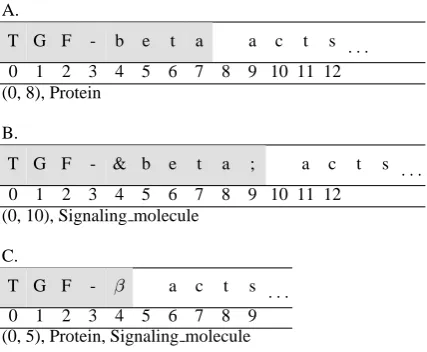
Figure 1 illustrates a simple example of the prob-lem to be addressed: A, B and C are text vari-ants from the same document; The position index of the equivalent text spans, beta”,
“TGF-β”, and “TGF-β”, are different to each other; And, the annotations made to the spans are not directly interoperable, although they are made to conceptually the same span of the same document. Note that the example is extremely simplified for the ease if understanding. In reality, the prob-lem is much more complex: a text, as the
get of annotation, is often as long as hundreds, or thousands of characters, or even much longer, and a single local variant affects the entire remaining portion of the text, in a cumulative way.
Nowadays, the widespread use of Unicode is one of the reasons of text variant, particularly when it comes to text processing, because many NLP tools, e.g., syntactic parsers, cannot han-dle Unicode characters properly. Thus, during many annotation projects, Unicode characters, e.g., Greek letters, are spelled out into ASCII al-phabets, like beta in Figure 1 A. Sometimes, extra symbols, e.g., ‘&’ and ‘;’, are inserted to delimit Unicode-origin sequences, like in B.
Suppose that two independent annotation projects took the text of C into their corpora, and their preprocessors spelled out Greek let-ters differently like in A and B. The projects may produce different annotations according to their interest and perspectives. While those an-notations may serve their goals individually, fur-ther benefit, e.g., reuse, comparison, or aggre-gation, can be gained from interoperable use of them. In the example, we want the an-notations, (0, 8, Protein)2 from A and
(0,10, Signaling_molecule)from B, to be transferable to C, or to each other. However, the variation of text poses a challenge: we need to compute the mapping between variations of text.
For standoff annotation, a text defines a one-dimensional Cartesian coordinate system, whereon any position on the text is specified. We thus cast the problem to the task of finding a map-ping function from a one-dimensional Cartesian coordinate system to another, when they are filled with comparable values (characters). In Figure 2,
δA→C is a mapping function from A to B, which enables transferring the annotation to the source text. δC→Ais the mapping for the opposite
direc-tion. Once those functions are obtained, any anno-tation produced by the project A can be transferred to the original text, and vice versa.
3 LCS for text mapping
For most cases, text mapping can be computed using Longest Common Sequences (LCS) algo-rithms (Bergroth et al., 2000). LCS is a well
2
Throughout the paper, we make the span specification in the style of BioNLP shared task (Kim et al., 2009), where the beginning of a span is specified by the number of characters preceding the span, and the end by the number of characters up to the end of the span.
Figure 2: Mapping between text variations
T G F - b e t a a c t s
Figure 3: The LCS table for “TGF-β acts” and “TGF-beta acts”. The place of text variation is in-dicated in gray
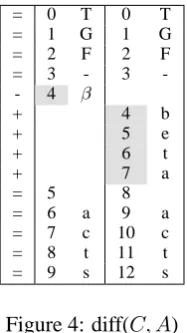
known problem, based on which the UNIX com-mand, diff, is implemented. Algorithm 1 is a dy-namic algorithm to compute the length of LCS of any two strings. Figure 3 shows the resulted LCS table for example strings. From the LCS table, the
diff between the two strings - see Figure 43- can be read out by Algorithm 2.
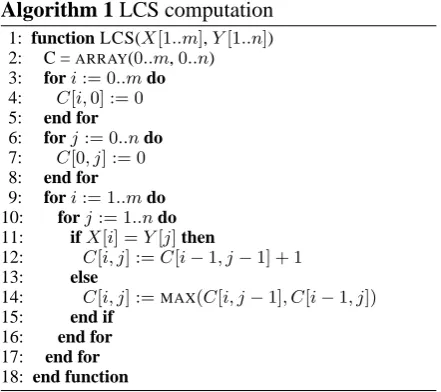
Algorithm 1 LCS computation
1: function LCS(X[1..m],Y[1..n])
Algorithm 1 has time and space complexities ofO(mn), where m and nare the length of the strings. For many real world applications,
Hunt-3In the first column, the minus (‘-’) and plus (‘+’) signs
Algorithm 2 Reading out diff from LCS table
Mcllroy algorithm (Hunt and McIlroy, 1976) is frequently used, which regularly beats the com-plexities of the dynamic algorithm with typical in-puts. Once the diff in Figure 4 is obtained, getting the mappingδC→Ais straightforward.
= 0 T 0 T
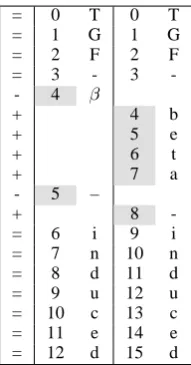
The LCS algorithm works fine when text varia-tions occur only in isolation individually as in Fig-ure 4. Sometimes, however, text variations occur successively, causing what we call the successive
variation problem. It is illustrated in the diff result
in Figure 5, where two Unicode characters, ‘β’ and ‘–’4appear successively. The source position, 5, needs to be precisely mapped to the target po-sition, 8, which however the LCS-diff algorithms cannot find: while the mapping,δ(4)→ 4, is
ob-vious, there is no clue as to which position, among 5, 6, 7 and 8, the next one,δ(5)to be mapped to.
4 Generalized LCS algorithm
To address the problem of successive variations, we need to inform the algorithm of equivalent se-quences, e.g.,β and beta. We call a collection of
4long hyphen in Unicode
= 0 T 0 T
Figure 5: The result of LCS-Diff for “TGF-β– induced” and “TGF-beta-induced”
equivalent sequences a dictionary, and modify Al-gorithm 1 as follows:
1: function GLCS(X[1..m], Y[1..n], D) ...
11-1: a, b := S(X[1..i], Y[1..j], D) 11-2: if a > 0 then
12: C[i,j] := C[i-a, j-b] + 1
As indicated in line 1, it is invoked with a dictio-nary, D, which is a list of equivalent sequences, e.g., (α, alpha), (β, beta), and so on. The 11’th line of Algorithm 1, which performs the compar-ison of the last characters, is modified to perform a general suffix comparison. The suffix compari-son function, S, first performs the last-character-comparison for trivial cases, and performs a suffix comparison in variable length when the character comparison fails. The suffix comparison relies on the dictionary,D: if the two strings have matching suffixes in the end according to the dictionary, it returns the length of the suffixes, which is received by a and b in the modified algorithm.
Following is the modification to Algorithm 2:
5-1: a, b := S(X[a..i], Y[b..j])
= 0 T 0 T
Figure 6: The result of GLCS-Diff for
“TGF-beta–induced” and “TGF-beta-induced”
of ‘–’ and ‘-’ is properly represented, solving the problem of successive variations.
As the modified algorithm generalizes the last-character-comparison to the variable-length-suffix-comparison, we call it a generalized LCS
(GLCS) algorithm. With an empty dictionary, GLCS works exactly the same as LCS. Using a
suffix tree algorithm, GLCS has the worst case
time complexity, O(mnl), where l is the length of the longest entry in the dictionary.
While the performance of GLCS relies on the dictionary, in fact, it works well even with an in-complete dictionary. For example, to get the result in Figure 6, having either (β, beta) or (–, -) in the dictionary is enough. This feature contributes to the robustness of GLCS in real world applications.
5 Application and evaluation
The proposed solution is implemented into
PubAnnotation5, a storage system for corpora and annotations. The system is developed to share corpora and annotations developed by several an-notation projects. The system maintains a col-lection of texts taken from a number of sources, e.g., PubMed6and PubMed Central7, and supplies them to the annotation projects. The annotations produced by the annotation projects are collected back toPubAnnotationfor sharing.
As the annotation projects are conducted by dif-ferent groups independently, when the resulted an-notations are submitted to the storage system, the
5
http://pubannotation.org 6
http://www.ncbi.nlm.nih.gov/pubmed 7http://www.ncbi.nlm.nih.gov/pmc/
base texts often have been varied from the original, due to, e.g., Unicode-ASCII conversion, tokeniza-tion, or accidental insertion or deletion of charac-ters. PubAnnotationhandles all the mapping and alignment by using the LCS and GLCS algo-rithms. For performance, LCS is implemented us-ing Hunt-Mcllroy algorithm, and GLCS is imple-mented as presented in this paper. While using LCS as default, GLCS is only invoked when suc-cessive variations are detected. Because succes-sive variations seldom occur, the cost for running GLCS is negligible. Yet, securing a solution for successive variations is important. When experi-mented with 10 full papers with 54,938 words and 6,007 annotation instances, the text mapping and annotation alignment took less than 10 seconds.
The accuracy of mapping and alignment is thor-oughly verified using 10 full text papers with 58,360 words and 7,315 span annotations. Two versions of dictionary for GLCS were prepared: (A) one for all the standard set of Unicode charac-ters8, and (B) another only for the Unicode charac-ters for whitespace and punctuation symbols. The system successfully aligned all the annotations even with the smaller one, (B). It indicates that when successive variations occur, in most cases, whitespace or punctuation symbols are mixed in it. At least it was the case in our application.
Another 10 full text papers with 54,369 words and 5,729 annotations were used for further veri-fication. While keeping using the dictionary (B), the system is implemented to alert when a unsolv-able case is detected. During the processing of the 10 papers, the alert was issued only once, which was caused by the Unicode sequence,∆∆. When the larger dictionary, (A), was used, the problem was not observed. So, it is true that the more com-plete the dictionary is, the higher the accuracy will be. The empirical results also suggest that, to-gether with the alerting system, the proposed so-lution works reasonably well, even with minimal size of dictionary.
6 Conclusions
The solution presented in this paper is freely avail-able as a open source Ruby library and also as a free service through the PubAnnotation stor-age system. We expect it to contribute to reduce the cost of community for interoperable use of cor-pora and annotations.
References
L. Bergroth, H. Hakonen, and T. Raita. 2000. A survey of longest common subsequence algorithms. In Proceedings of the Seventh International
Sym-posium on String Processing Information Retrieval (SPIRE’00), SPIRE ’00, pages 39–, Washington,
DC, USA. IEEE Computer Society.
Razvan Bunescu, Ruifang Ge, Rohit J. Kate, Ed-ward M. Marcotte, Raymond J. Mooney, Arun K. Ramani, and Yuk Wah Wong. 2004. Comparative experiments on learning information extractors for proteins and their interactions. Artificial Intelligence
in Medicine, 33(2):139–155.
David Campos, Srgio Matos, Ian Lewin, Jos Lus Oliveira, and Dietrich Rebholz-Schuhmann. 2012. Harmonization of gene/protein annotations: to-wards a gold standard medline. Bioinformatics,
28(9):1253–1261.
K. Bretonnel Cohen, Philip V Ogren, Lynne Fox, and Lawrence Hunter. 2005. Empirical data on cor-pus design and usage in biomedical natural language processing. In AMIA annual symposium
proceed-ings, pages 156–160.
Kristofer Franz´en, Gunnar Eriksson, Fredrik Olsson, Lars Asker, Per Lid´en, and Joakim C¨oster. 2002. Protein names and how to find them. International
Journal of Medical Informatics, 67(13):49 – 61.
James W. Hunt and M. Douglas McIlroy. 1976. An Algorithm for Differential File Comparison. Tech-nical Report 41, Bell Laboratories Computing Sci-ence, July.
Nancy Ide and Laurent Romary. 2004. International standard for a linguistic annotation framework. Nat.
Lang. Eng., 10(3-4):211–225, September.
Helen Johnson, William Baumgartner, Martin Krallinger, K Bretonnel Cohen, and Lawrence Hunter. 2007. Corpus refactoring: a feasibility study. Journal of Biomedical Discovery and Collaboration, 2(1):4.
Jin-Dong Kim, Tomoko Ohta, Yuka Tateisi, and Jun’ichi Tsujii. 2003. GENIA corpus - a seman-tically annotated corpus for bio-textmining.
Bioin-formatics, 19(suppl. 1):i180–i182.
Jin-Dong Kim, Tomoko Ohta, Sampo Pyysalo, Yoshi-nobu Kano, and Jun’ichi Tsujii. 2009. Overview of BioNLP’09 Shared Task on Event Extraction. In Proceedings of Natural Language Processing
in Biomedicine (BioNLP) NAACL 2009 Workshop,
pages 1–9.
Dietrich Rebholz-Schuhmann, Antonio Yepes, Chen Li, Senay Kafkas, Ian Lewin, Ning Kang, Pe-ter Corbett, David Milward, EkaPe-terina Buyko, Elena Beisswanger, Kerstin Hornbostel, Alexandre Kouznetsov, Rene Witte, Jonas Laurila, Christo-pher Baker, Cheng-Ju Kuo, Simone Clematide,
Fabio Rinaldi, Richard Farkas, Gyorgy Mora, Kazuo Hara, Laura I Furlong, Michael Rautschka, Mari-ana Neves, Alberto Pascual-Montano, Qi Wei, Nigel Collier, Md Chowdhury, Alberto Lavelli, Rafael Berlanga, Roser Morante, Vincent Van Asch, Wal-ter Daelemans, Jose Marina, Erik van Mulligen, Jan Kors, and Udo Hahn. 2011. Assessment of ner solutions against the first and second calbc silver standard corpus. Journal of Biomedical Semantics, 2(Suppl 5):S11.