International Journal of Research in Advent Technology, Special Issue, March 2019
E-ISSN: 2321-9637
Available online at www.ijrat.org
Design and Development of Improved Blowfish for
Encryption and Decryption of Audio File
Rashmi A Gandhi, Dr. Atul M.Gosai
Research Scholar, Professor
Department of Computer Science Gujarat Technological University, Gujrat
Saurashtra University, Rajkot
Email ID: rashmiagandhi80@gmail, [email protected]
Abstract: One of the greatest worries in the present day advanced world is Digital Data Security. Encryption of information is dependably in discourse and gets a great deal of consideration from the researcher community. Various improvements with various encryption calculations are at present working. The given paper exhibits an implementation and comparative analysis of the DES, AES, Blowfish with the Modified Blowfish. The F function is modified by doing changes in XOR and Addition Modulo task. Encryption/Decryption time, RAM used and size of the output file is assessed and analsed. The calculations are tried with Audio, Image and Text records to assess the execution. Results demonstrate that the modified algorithm with the created cases performs better and make the first Blowfish calculation more first.
Keywords: AES, Blowfish, encryption/decryption techniques
1. INTRODUCTION:
The most prominent and established technique for securing digital data is Cryptography. Before we examine in detail about the Blowfish and its implementation let us have a brief overlook about Cryptography.
Cryptography is the study of information security. The word is derived from the Greek words kryptos, signifying “hidden” and graphia meaning “writing or study”.
It is the physical process that scrambles the information by rearrangement and substitution of content, making it unreadable to anyone. In other words a given message is coded into a secure message (ciphertext) by applying some substitution techniques, to make the input message unreadable by anybody amid its transmission. The process of converting plaintext into ciphertext is called as Encryption and the turnaround process (from ciphertext to plaintext) is called Decryption [9].
A system that performs encryption and decryption is called Cryptosystem. Security of any cryptosystem relies upon the secrecy of the encryption/decryption key rather than the encryption/decryption algorithm [11].
The key purposes of cryptography are privacy, Integrity, Non-repudiation, and Authentication. Cryptographic algorithms can be classified into three independent dimensions based on transformations used, number of keys used as well as the way the way in which plaintext is processed. In view of kind of activity utilized for changing plaintext to ciphertext, cryptographic algorithms can be known as Transposition and Substitution schemes. Private Key (Single key/Symmetric) and Public key (two keys/Asymmetric)
classification is based on number of keys utilized. Again Block ciphers and Stream ciphers is another classification derived from the way in which plaintext is handled. Block cipher processes each input block one at a time, producing an output block. Stream Cipher processes input elements continuously, one at a time.
In the current paper we are analysing the symmetric Block cipher algorithms DES, AES and Blowfish.
The organization of the paper is as follows: Section II provides a comprehensive view of the Blowfish Algorithm. The ongoing improvements and utilization of Blowfish algorithm is summarised in section III. Design changes in the F function to improve the algorithm are discussed in section IV. In the next section experimental outcomes are compared and performance analysis is done. Section VI provides conclusion derived from the comparative studies.
2. BLOWFISH
Blowfish [5] is a keyed block cipher designed in 1993 by Bruce Schneier and widely used in a large number of cryptographic products. It provides good performance in software. Blowfish has 64 bit block size and a variable key length from 32 bit to 448 bits. The algorithm works in two sections: A key expansion part and a data encryption part. The key expansion part is to convert a key of at most 448 bits into several sub key arrays totalling 4168 bytes. It uses key-dependent s-boxes, which provide more protection from differential and linear cryptanalysis.
International Journal of Research in Advent Technology, Special Issue, March 2019
E-ISSN: 2321-9637
Available online at www.ijrat.org
comprises of a key dependent permutation and a key and data-dependent substitution. All operations are XORs and additions on 32-bit words. The only additional operations are four indexed array data lookups per round.
It is suitable for applications where the key does not change regularly, like communications link or an automatic file encryption. It is comparatively quicker than most encryption algorithms when implemented on 32 bit microprocessors with large data caches.
[image:2.612.72.272.270.460.2]It utilizes basic operations that are efficient on microprocessors like exclusive-or, addition, table lookup, modular- multiplication. It does not use variable length shifts or bit-wise permutations, or conditional jumps. It uses precomputable subkeys. On large-memory systems, these subkeys can be precomputed for faster operation.
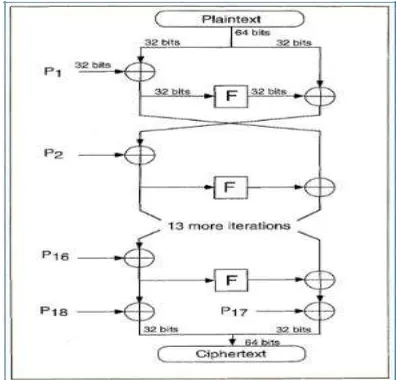
Figure 2: Structure of Blowfish Algorithm
Encryption in Blowfish Algorithm:
Blowfish has 16 rounds. The input is a 64-bit data block x. It divides x into two 32-bit halves: xL, xR. Then, for i = 1 to 16:
– xL = xL XOR Pi – xR = F(xL) XOR xR
xL and xR are exchanged. After the sixteenth round, swap xL and xR again to undo the last swap.
– xR = xR XOR P17 – xL = xL XOR P18.
Finally, recombine xL and xR to get the ciphertext. Decryption is exactly the same as encryption, except that P1, P2,..., P18 are used in the reverse order. Implementations of Blowfish that require the fastest speeds should unroll the loop and ensure that all sub keys are stored in cache.
3. RELATED WORK
Encryption Algorithms DES, 3DES, AES and Blowfish are looked at on parameters like execution time and security [2]. Performance of a block cipher varies with the block size and the key size. Bigger block size makes algorithm faster, whereas larger key size improves security. All the algorithms are tested on same platform keeping security as a secondary concern. The Blowfish turned out as the quickest performing algorithm.
Countless cryptographic techniques based on symmetric cryptographic algorithms have been analysed based on their application area, advantages, limitations, and working pattern [3]. They ensure astounding data security but there are certain areas that remained open. Out of the tested algorithms, the conclusion came for the Blowfish as the fastest and effective algorithm. It can be considered as a base algorithm for further improvements.
RSA and Diffie-Hellman algorithms are used as base algorithm to design a new algorithm [4]. The newly developed algorithm is compared with common encryption algorithm like DES, 3DES, RC2, AES and Blowfish on parameters like CPU time, memory and battery power. The new algorithm gives better throughput both for encryption and decryption as well as expends less time, which results in lower consumption of battery power. In their work we can conclude that next to the new algorithm, Blowfish is best performing among the existing conventional methods followed by AES on the above mentioned parameters.
Paper [8], compared DES, AES, 3DES, and Blowfish on different sizes of data blocks and different hardware and software platforms. The result is the Blowfish as the best performing algorithm under the security against unauthorized attack. Blowfish is the quickest and gives great security with strong key size. It tends to be utilized in many applications like Bulk encryption, Random Bit Generation, Network security and packet encryption. But it suffers from weak key problem which need to be rectified and investigated.
Researchers in [9, 10] have done extensive study for the current improvements and applications of the said algorithm in various areas. Many researchers had tried to break the security of Blowfish algorithm and concluded that it is secure for use. Till date no one claimed for the break of the algorithm.
4. SYSTEM DESIGN
International Journal of Research in Advent Technology, Special Issue, March 2019
E-ISSN: 2321-9637
Available online at www.ijrat.org
[image:3.612.320.519.129.234.2]respectively. Analysis and comparison is done between DES, AES and all the 8 cases of Modified Blowfish Algorithm. Same text, image and Audio file were input for all the three algorithms and a comparison is shown in the next section.
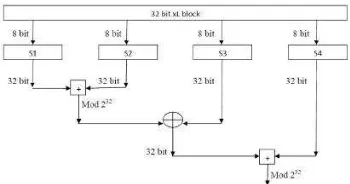
Fig 4: f Function of the Original Blowfish Algorithm
Working of the F function is as follows:
[image:3.612.73.248.132.224.2]F(XL)=(((S1+S2)mod 232) XOR S3)+S4)mod 232)). Case 1:
Fig 4.1: Modified Blowfish with case 1
Working of the F function is as follows:
F(XL)=(((S1+S2)mod 232) XOR((S3+S4)mod 232)).
[image:3.612.320.498.282.395.2]Case 2:
Fig 4.2: Modified Blowfish with case 2
Working of the F function is as follows: F(XL)=((S1 XOR S2)+(S3 XOR S4) mod 232)
Case 3:
Fig 4.3: Modified Blowfish with case 3
Working of the F function is as follows: F(XL)=((S1 XOR S3)+(S2 XOR S4) mod 232)
Case 4:
Fig 4.4: Modified Blowfish with case 4
Working of the F function is as follows:
F(XL)=(((S1+S3)mod 232)XOR ((S2+S4)mod 232)).
[image:3.612.73.254.288.391.2]Case 5:
Fig 4.5: Modified Blowfish with case 5
Working of the F function is as follows:
F(XL)=(((S1+S2)mod232)+((S3 XOR S4)mod 232)).
[image:3.612.71.257.438.568.2]Case 6:
Fig 4.6: Modified Blowfish with case 6
Working of the F function is as follows:
F(XL)=((S1 XOR S2) + (S3+S4)mod 232) mod 232).
[image:3.612.320.501.459.565.2]International Journal of Research in Advent Technology, Special Issue, March 2019
E-ISSN: 2321-9637
[image:4.612.73.268.146.260.2]Available online at www.ijrat.org
Fig 4.7: Modified Blowfish with case 7
Working of the F function is as follows:
F(XL)=(((S1+S3)mod 232)+((S2XOR S4)mod 232)).
Case 8:
Fig: 4.8: Modified Blowfish with case 8
Working of the F function is as follows:
F(XL)=((S1 XOR S3) + (S2+S4)mod 232) mod 232).
5. EXPERIMENTAL RESULTS AND COMPARATIVE ANALYSIS
An implementation Platform is developed in Java. Coding is done for DES (CBC, CFB mode), AES (CBC, CFB mode) and Blowfish with all its 8 cases.
A Prototype of the system is implemented. A Personal computer (PC) is used with 2.40 GHz intel core i3 processor, Microsoft Windows 7 Operating System (64 bit) and 3.0 GB of RAM is used. Cryptographic library functions from java ready cryptography library are called.
Initially DES, AES and Blowfish are tested for Encryption time and Decryption time. Text (.txt size 26.6 KB), Image (.jpg, size 893 KB) and Audio (.mp3, size 1.7 MB) files are tested for all the three algorithms. The comparative analysis is shown in Table 1. Output shows better performance by Blowfish.
Average of Enc/Dec Time in ms
Algorithm
Audio Image Text 1.7 MB 893 KB 26.6 KB DES:CBC 176.5 155.5 6.4 DES:CFB 172.5 149.5 7
AES:CBC 112 118 9.5
AES:CFB 100 97.5 5.65 Blowfish- 67.4 53.5 0 Org
Case 1 60.2 35 4
Case 2 58.85 34.5 1.5
Case 3 54.2 37.5 1.5
Case 4 71.9 76.9 4.6
Case 5 75.9 66.2 0
Case 6 66.4 43.8 0
Case 7 60.2 48 0
Case 8 58.6 42.8 0
Table 1: Average Enc/Dec Time for DES/AES/Blowfish
Here encryption/decryption time is calculated by considering the time taken by the CPU to do encryption and decryption. Time taken for reading data from the file and similarly time taken to write back the data in the output file is not considered.
From the above experimental results it can be easily concluded that Blowfish is performing better than DES and AES in terms average of encryption and decryption time. The Blowfish Algorithm is further tested on RAM Utilization, CPU Time, CPU load and size of the output file.
Further new 4 cases of Blowfish Algorithm have been designed. So a total of 12 cases of Blowfish are tested on an Audio file for RAM Utilization, CPU Time, CPU load and size of the output file.
The new cases of Blowfish are shown in figure 5.1, 5.2, 5.3 and 5.4.
[image:4.612.321.512.343.450.2]Case 9:
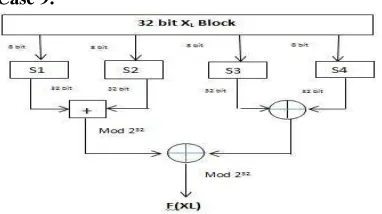
Fig 5.1: Modified Blowfish with case 9
Working of the F function is as follows:
F(XL)=(((S1+S2)mod 232) XOR ((S3 XOR S4)mod 232)).
[image:4.612.72.282.527.733.2]Case 10:
Fig 5.2: Modified Blowfish with case 10
Working of the F function is as follows:
[image:4.612.322.499.531.647.2]International Journal of Research in Advent Technology, Special Issue, March 2019
E-ISSN: 2321-9637
Available online at www.ijrat.org
Case 11:
Fig 5.3: Modified Blowfish with case 11
Working of the F function is as follows:
F(XL)=(((S1+S3)mod 232) XOR ((S2 XOR S4)mod 232)).
[image:5.612.76.283.81.231.2]Case 12
Fig: 5.4: Modified Blowfish with case 12
Working of the F function is as follows:
F(XL)=((S1 XOR S3) XOR (S2+S4)mod 232) mod 232).
[image:5.612.318.489.175.320.2]The Performance of Original Blowfish and 12 changed cases are compared on parameters like Encryption and Decryption Time, RAM utilization, CPU time and CPU Load. Size of the output file created is also taken into consideration. A comparative analysis for an Audio file of size 1.7 MB is shown in the table 2.
Table 2: Comparative analysis of Original Blowfish and all the 12 cases
i) Average of Encryption/Decryption Time:Average of
[image:5.612.65.248.297.405.2]encryption/decryption time is calculated by considering the time taken by the CPU for encrypting the original audio file and decrypting the encrypted file to get back the original file. Time taken for reading data from the file and similarly time taken to write back the data in the output file is not considered. The results are also shown in the Column chart in figure 5.1.
Fig 5.5: Column chart for comparison of encryption/decryption time
ii) CPU Time: It is the time interval between the file
[image:5.612.323.498.393.527.2]submitted for encryption and getting the original file back after decryption.
Fig 5.6: Column chart for comparison of CPU time
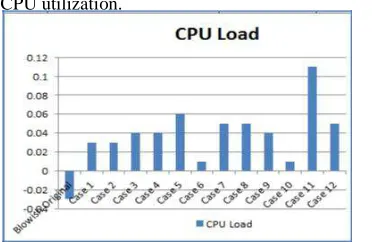
iii)CPU Load: CPU Load considers the percentage of
CPU utilization.
[image:5.612.319.506.577.698.2]International Journal of Research in Advent Technology, Special Issue, March 2019
E-ISSN: 2321-9637
Available online at www.ijrat.org
iv) RAM Utilization: Amount of RAM needed to load the
code and for the whole process of encryption and decryption is calculated as RAM utilization.
v)Output file Size: The size of the tested Audio file was
1.9 MB. When it was encrypted by Original Blowfish and all the 12 cases, the size of the intermediate file created after encryption is noted down. There was no difference in the size of the encrypted file for all the cases as shown in table 2.
6. CONCLUSION:
The purpose of the research work is to improve the security of call on a live communication network. The demonstrated work need to be implemented in a mobile environment. In a mobile device the main consideration should be CPU utilization, CPU load and RAM needed. The time taken to encrypt and decrypt is of prime concern. The comparative study shows that Modified Blowfish with Case 3 and Case 6 is showing better performance as compared to other cases. So in my further work I will continue improvements with case 3 and case 6. The improved cases will be also tested for Cryptographic attacks.
REFERENCES:
[1] William Stallings, “Cryptography and Network Security”,Third Edition, Pearson Education, 2003. [2] Aamer Nadeem, Dr M. Younus Javed, “A
Performance Comparison of Data Encryption Algorithms”, IEEE, 2005.
[3] Sourabh Chandra, Siddhartha Bhattacharyya, Smita Pair, Sk Safikul Alam, “A Study and Analysis on Symmetric Cryptography”, IEEE, 2014.
[4] Bijoy Kumar Mandal, Debnath Bhattacharyya, Samir Kumar Bandyopadhyay, “Designing and Performance Analysis of a Proposed Symmetric Cryptography Algorithm”, IEEE,2013.
[5] Rashmi A. Gandhi, Dr. Atul M. Gosai “A Study on Current Scenario of Audio Encryption ”, International Journal of Computer Applications, Volume 116, No.7, April 2015.
[6] B. Schneier, “Description of a New Variable-Length Key, 64-Bit Block Cipher (Blowfish)”, Fast Software Encryption, Cambridge Security Workshop proceedings (December 1993), Springer-Verlag, pp. 191-204, 1994.
[7] B. Schneier, "Applied Cryptography – Protocols, algorithms, and source code in C", John Wiley & Sons, Inc., New York, second edition, 1996. [8] O P Verma, Ritu Agarwal, Dhiraj Dafouti, Shobha
Tyagi, “Performance Analysis Of Data Encryption Algorithms”, IEEE, 2011.
[9] Rashmi A. Gandhi, Dr. Atul M. Gosai, “Audio Encryption with AES and Blowfish”, International Journal for Research in Applied Science and engineering Technology (IJRASET), Volume 4, Issue XI, November 2016.
[10] Vaibhav poonia and Dr. Narendra Singh Yadav, “Analysis of the modified blowfish Algorithm in different cases with various parameters” , International Conference on Advanced Computing and communication Systems, Jan 05-07,2015, IEEE 2015.