1
Review of Mobile Ad-Hoc Network Routing Protocols
for more realistic environment through NS-2
simulations
Nagendar Naik D1 Santana Limbu2 Gourab Patowary3 Department of ECE, Department of ECE, Department of ECE, NITS Mirza, Assam, India. NITS Mirza, Assam, India. NITS Mirza, Assam, India. [email protected]
Abstract – Mobile Ad-hoc Network (MANET) is a collection of dynamic and self-organizing mobile nodes
which by virtue of its dynamic nature lacks infrastructure. As a result it becomes difficult to determine a specific route for the delivery of information packets from one node to the other. Thus the routing protocols play a major role here. There is a significant difference between the properties of a common simulation model and a model controlled and maintained by a real user. In order to create high order simulation studies the models used in them should correspond as close as possible to reality. By bridging down this gap in this paper we have analyzed the performance of reactive (AODV) and proactive (DSDV) routing protocols. The objective of this paper is to study and analyze the performance of routing protocols for MANET realistic environments using an open source network simulation tool ns-2. We used performance metrics like throughput, routing overhead, packet delivery ratio and average end-to-end delay.
Index Terms- MANET; Realistic Environment; Routing overhead; Reactive Routing; Proactive Routing.
1. INTRODUCTION
A mobile ad-hoc network (MANET) uses a number of wireless mobile nodes that work in cooperation and neither involves any centralized access point nor any fixed infrastructure. MANET comprises of mobile nodes such as personal digital assistants (PDA’s) and computing devices like laptops. They communicate with each other by setting up links via wireless connections. These networks comprise of self-organizing mobile nodes which along with their links constantly remain in motion such that it gives rise to no fixed infrastructure. The recent technological advancements [1,2] and a rise in the use of mobile wireless devices has helped in the quick deployment of MANET without considering its place and time as the delay caused due to infrastructure setup has been totally coped with [3]. As a result they find high applications in emergency deployments, disasters, rescue missions and military operations.
Inter-node communication in MANET happens in a bidirectional manner if and only if the least distance between them is the minimum of their transmission range. In case of intra-node communication, i.e. when a node tries to
communicate with another node that falls outside its transmission range multiple hops involving intermediate nodes are made for the routing of information packets. MANET nodes are free to move and node movement creates dynamic network topologies – because of mobility links between nodes are created and broken. This constant movement of the nodes leads to topological changes in the MANET. Considering this special feature of MANET numerous routing protocols have been put forward so far.
The properties of real, user-initiated and maintained networks are markedly different from those of common simulation models. Careful modeling of the simulators is required for obtaining realistic results. A protocol studied under simulated environments may show very poor results when implemented and used under realistic environments because of unknowing exclusion of some important properties during the simulation studies thus rendering the protocol unsuited for use under realistic environments.
254
Destination Sequenced Distance Vector Routing(DSDV)[7]. These protocols are studied and calculated using various metrics like packet delivery ratio, throughput, end-to-end delay and routing overhead of MANET’s. The objective of this paper is to learn how by varying the traffic conditions, number of connections, node density and speed of nodes the performance of the protocols is affected.
The remainder of the paper is organized as follows. In section-2 we briefly discuss the mobile ad-hoc routing protocols which we have studied. Section- 3 presents MANET model, simulation environment, topological property and placement model. Section-4 defines the metrics and performance evaluation. Section-5 simulation results and discussions and in section-6 the performance metrics have been studied in light of the obtained simulation results. In Section-7 we finally draw the conclusions of our studies and section-8 presents future work.
2. MOBILE AD-HOC ROUTING
PROTOCOLS STUDIED
Ever since the advent of mobile ad-hoc networks, routing has posed as a major challenge. Routing protocols are categorized on the grounds that - the nodes of MANET must either be capable of keeping a track of routes to every destination possible or instead keep a track of those destinations which are of immediate concern. The routing protocols are broadly classified into the following categories:
Reactive Routing Protocols – Reactive [5] protocols
establish routes to the destination only if need be.
Proactive Routing Protocols – They keep a track of
the topology of the network via exchange of topological information so that it can readily furnish the information relating to a route when such a route has to be established [6].
2.1. Ad-hoc On Demand Distance Vector (AODV)[6]:
It is a reactive routing protocol and makes use of broadcast discovery mechanism. With the help of a destination sequence number it makes certain that any information relating to routing is constantly updated.
On the verge of communication if the routing information is not available to the node then a route request (RREQ) packet is broadcasted. The neighbouring nodes reply if the path is known to them otherwise it is re-broadcasted to their neighbours such that the packet finally reaches the destination. While forwarding the RREQ intermediate nodes record the address of the previous node. These records can later
help in establishing a reverse path via which a reply can be sent. If the reply is not received within a stipulated period of time then the records are deleted. In case the link fails to connect then a routing error is sent back to the sender node and the process is repeated.
2.2. Destination Sequenced Distance Vector (DSDV)[7]:
It is developed according to the Bellman –Ford routing algorithm. Each node of this network possesses a routing table that lists the information of the number of nodes available and as to how many hops must be taken to reach each. The routing table is constantly updated and this helps in maintaining the topology of the network.
The routing updates are available to the nodes in two different ways which are as follows: Full Dump: Here the entire routing table is transmitted infrequently, to a certain extent, to the neighbour only when no change in the position of nodes occurs.
Incremental: Only those information are transmitted which need must be changed. More stable the network more accurate will be the updates such that additional traffic is averted.
3. MANET MODEL, TOPOLOGICAL
PROPERTY AND PLACEMENT MODEL
The MANET model comprises of the following:
3.1. Node model: This model [8] briefs the properties
of nodes namely: source of energy, number of network interfaces, storage capacity, processing capability, duty cycling, whether super nodes are present and whether the node has information regarding its current location (GPS module), etc.
3.2. Node deployment and node mobility models: The
deployment or placement models [9] describe the nodes along with the area in which they are to be deployed. They provide the static networks with node positions and the mobile networks with initial node positions. In our simulations we made use of the uniform model. Node movement is described by the mobility model. In our simulation we used random way point mobility model with pass time 2 seconds and minimum velocity 0 metres per second varied upto 25 metres per second with an interval of 5 metres per second.
3.3. Radio model: The radio used by the node has its
255
layer functionality, consumption of energy duringpacket reception and transmission, etc.
3.4. Wireless signal propagation model: The
influence of environment on signal propagation and its quality is described by this model. In our simulations we made use of this model to calculate the signal-to-noise and interference (SNIR) ratio at the receiver end. If the SNIR is high as compared to a rated threshold (the one defined in the wireless radio model), the packet is received successfully at the receiver end [11].
3.5. Packet loss model: Wireless channel properties
[12] cause losses and additional packets are dropped or packet collisions occur in accordance with the uniform or Markov error models.
3.6. Traffic models: The traffic sender and receiver
nodes are defined by this model along with the traffic flow properties. In our simulation we have defined CBR packets of size 512 bytes and having duration of 100 seconds CBR traffic flow as the traffic parameter.
4. PERFORMANCE EVALUATION
The main objective of our study is analyzing the performance of the routing protocols of MANET. Our simulations were conducted using ns-2. Constant bit rate (CBR) connections made with sources and sinks selected at random are the traffic scenarios considered during the simulation. Our simulation study deals with mobile nodes spread over an area of 1000m x 1000m. During simulation the routing protocols are evaluated by varying the node speed from 0m/s (static environment) to 25m/s (90 km/h – fast vehicular speed), in increments of 5m/s. The node density is varied from 25 nodes to 125 nodes in increments of 25 nodes while the number of connections is varied from 10 to 60 and lastly the traffic rate is varied from 5 packets per second to 30 packets per second.
The following metrics were studied during the performance evaluation of routing protocols of MANET:
4.1. Packet Delivery Ratio: The fraction of packets
that were transmitted by the application and received at the receiving end.
4.2. Average End-to-end delay: Time taken by the
information packet after it is transmitted by the sender to reach the receiving end. An average of all the packets received is then calculated over the entire simulation period.
4.3. Throughput: Total data received at the receiver
end divided by the time at which the last information packet was received gives us the throughput.
4.4 Routing overhead: A total of the number of
packets that were transmitted across the network for the discovery and maintenance of the routes is defined as the routing overhead.
5. SIMULATION RESULTS AND
DISCUSSIONS
The simulation results were analyzed and the following observations were made:
5.1. Packet Delivery Ratio: Packet Delivery Ratio is
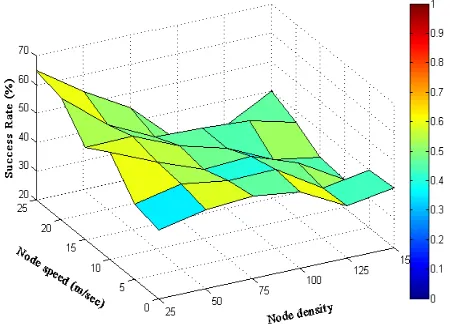
[image:3.595.321.546.381.543.2]considered as a function of node density which is varied from 25 nodes to 125 nodes and node mobility which is varied from 0m/s to 25m/s. In this simulation that we carried out we consider CBR traffic rate of 10 packets/second and the number of connections are fixed at 20. The packet delivery ratio of AODV and DSDV protocols of this simulation are shown in Figure 1 and Figure 2 respectively. On-demand routing protocol (AODV) consistently outperformed the table driven (DSDV) protocol in terms of packet delivery ratio regardless of the node speed.
Fig. 1. Impact of mobility & node density on success rate of AODV protocol
256
Fig. 2. Impact of mobility & node density on success rate of DSDV protocol
5.2. Average End-to-end Delay: Average End-to-end
[image:4.595.84.289.113.281.2]Delay as a function of node density and node speed for AODV and DSDV protocols is shown in Figure 3 and Figure 4 respectively.
Fig. 3. Impact of mobility & node density on network end-to-end delay of AODV protocol
[image:4.595.88.294.367.518.2]Table driven (DSDV) protocol outperforms the on-demand routing protocol in terms of network delay. The network delay of AODV protocol gradually increases as the node density and node speed increases. Network delay at the node speed of 25m/s is twice that of the network delay at the node speed of 5m/s and the network delay at a node density of 150 is recorded as the highest and about four times of that what is recorded at a node density of 20.
Fig. 4. Impact of mobility & node density on network end-to-end delay of DSDV protocol
Whatever is lost in the packet delivery ratio is later gained in terms of a shorter network delay. For delay sensitive applications DSDV may be considered because of its relatively low network delay and lesser fluctuation with the increase in speed.
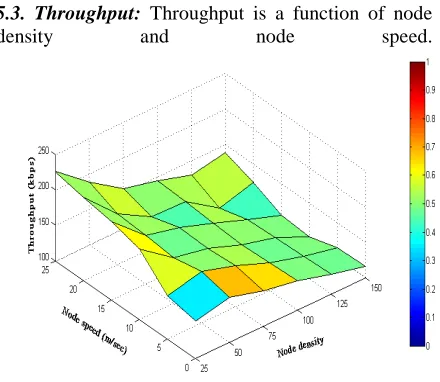
5.3. Throughput: Throughput is a function of node
density and node speed.
Fig. 5. Impact of mobility & node density on throughput of AODV protocol
[image:4.595.307.527.390.581.2]257
resulting in a higher throughput.Fig. 6. Impact of mobility & node density on throughput of DSDV protocol
From Figure 6 it is noticed that DSDV results in higher throughput at lower speeds and the throughput decreases as the speed increases. This is because the table driven protocols work on the principle of readymade paths which connect well at lower speeds but as the speed of the nodes begin to increase they are not able to keep up with it as a result of which the throughput becomes less.
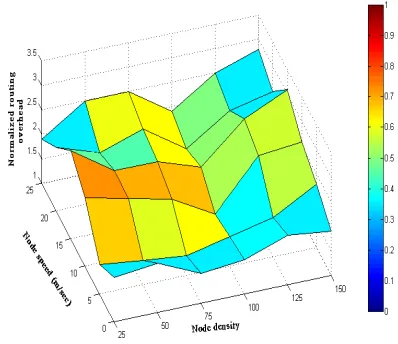
5.4. Routing Overhead: The routing overhead of
AODV and DSDV for this simulation is shown in Figure 7 and Figure 8 respectively.
Fig. 7. Impact of mobility & node density on routing overhead of AODV protocol
[image:5.595.313.512.99.271.2]The routing overhead of table-driven (DSDV) routing protocol is seven times that of reactive (AODV) routing protocols because table driven routing protocol works on the mechanism of continuous broadcasting of routing information among all its neighbours to form a route to all possible destination. On the other hand for on-demand (AODV) routing protocol routes are established on-demand basis and hence routing overhead is less.
Fig. 8. Impact of mobility & node density on routing overhead of DSDV protocol
6. PERFORMANCE ANALYSIS OF
PROTOCOLS
Now considering all the assumptions that we have made along with the metrics that have been used in this paper our simulation results bring out some chief characteristic differences among the proactive (DSDV) and reactive (AODV) protocols. The difference in their performance is a result of their different basic working mechanism. With increase in mobility the performance of DSDV fails considerably as more number of information packets start dropping out. This protocol maintains one route per destination therefore the information packets that the MAC layer cannot deliver starts dropping out because of the shortage of alternate routes. The packet delivery ratio of AODV is highest in all cases. The reason behind a high packet delivery ratio and high throughput is that the information packets are allowed on the send buffer for a maximum of 30 seconds so that the route gets discovered and once it is discovered the information packets are delivered via the route to the destination. AODV successfully delivers more number of routes as compared to DSDV as it sorts out the problem of delay. DSDV drops information packets whenever possible because of the lack of alternate routes thus resulting in lesser delay and low packet delivery ratio. Any information related to routing is maintained in a tabular form. Unlike AODV it does not adopt to the changes in route resulting from high mobility. The network is updated with routing information every 15 seconds which adds to the load. Considering the above we can conclude that the routing overhead is more in case of DSDV. In contrast to this the AODV is rather more adaptive as they create routing information when there is a need to which results in better packet delivery ratio and lesser routing load.
[image:5.595.78.291.421.620.2]258
sender node and the receiver node are not withintransmission ranges of each other than no connection will possibly be formed ever and this results in lower throughput, whereas in a mobile network by virtue of the mobility of the nodes there is a higher probability that two nodes will be in transmission region of each other resulting in increased connections and the duration for which these connections last will also be increased thus resulting in a higher throughput.
DSDV results in higher throughput at lower speeds and the throughput decreases as the speed increases. This is because the table driven protocols work on the principle of readymade paths which connect well at lower speeds but as the speed of the nodes begin to increase they are not able to keep up with it as a result of which the throughput becomes less.
7. CONCLUSION
The methodologies that we have used in our simulations have been improved to suit more realistic environment. In this paper we have made an effort to study mobile ad-hoc network proactive (DSDV) and reactive (AODV) protocols and can conclude that both have some tradeoffs. AODV has a higher delivery ratio and throughput than DSDV when the node density is less and the node mobility is high. On the other hand DSDV performs better in terms of network delay and do not fluctuate much with change in number of nodes and mobility. Overall delay is observed to be lesser in case of DSDV than in AODV. Routing overhead is very little for AODV with less traffic but increases multiplicatively with the increase in traffic. This also effects the energy consumption of the nodes. Nodes run out of energy sooner in high traffic conditions for AODV. DSDV more or less has same routing conditions for all traffic conditions.
8. FUTURE WORK
Till date the routing protocols have mainly been used for different methods of routing but the same can also be used for developing a secure routing protocol that is well aware of the Quality of Service. Maintaining both parameters at the same time may not be very feasible. Such a secure routing protocol will suffer from overhead which can in turn degrade the Quality of Service level and so to counter this, a trade-off between these two parameters must be searched for.
References
[1] Mohandas, G; Silas, S; Sam, S. (2013): Survay on routing protocols on mobile adhoc networks. Proceedings of the International Multi Conference on Compressed Sensing (iMac4s), pp. 514-517.
[2] Dina, S.G.; Janardana, S.; Jaya, J.; Sabreesaan, K.J. (2013): Implementation of network layer protocols in wireless networks for efficient routing. International Conference on
Current Trends in Engineering and Technology (ICCTET), pp. 349-352.
[3] Khan, M.A.; Zakiuddin, S. (2013): Research review of development of noval routing algorithms for mobile ad-hoc networks. 18th International Conference on Digital
Information Management (ICDIM), pp. 61-66.
[4] Karim El Defrawy, Gene Tsudik. (2011): ALARM: Anonymous Location-Aided Routing in Suspicious MANETs” IEEE Transactions on Mobile Computing, Volume: 10, Issue: 9 pp. 1345 – 1358.
[5] Istikmal. “Analysis and Evaluation performance Reactive and Proactive Routing Protocol in Mobile Adhoc Network”. Proceedings of the 6th International Conference on Telecommunication. Savoy Homan, bandung, October 27-28, 2010.
[6] C. E. Perkins. (1997): Ad-hoc On-Demand Distance Vector Routing, in Proc. MILCOM '97 panel on Ad Hoc Networks.
[7] C. Perkins and P. Bhagwat. (1994): Highly Dynamic Destination Sequenced Distance-Vector Routing (DSDV) for Mobile Computers,” Comp. Commun. Rev., pp. 234–44. [8] Yang H, Luo H, Ye F, Lu S, Zhang, L (2004) Security in Mobile Ad Hoc Networks: Challenges and Solutions. IEEE Wireless Communications, Volume 11, Issue 1:38–47. [9] Maih¨ ofer C (2004) A Survey of Geocast Routing Protocols.
IEEE Communications Surveys & Tutorials, Volume 6, Issue 2:Q2:32–42.
[10] Ramasubramanian V, Haas ZJ, Sirer, EG (2003) SHARP: A Hybrid Adaptive Routing Protocol for Mobile Ad Hoc Networks. Proceedings of ACM MobiHoc 2003:303–314. [11] Pathan A-SK, Alam MM, Monowar MM, Rabbi MF (2004)
An Efficient Routing Protocol for Mobile Ad Hoc Networks with Neighbor Awareness and Multicasting. Proceedings of IEEE E-Tech, July, 2004:97–100.