Using Shallow Semantic Parsing and Relation Extraction for Finding
Contradiction in Text
Minh Quang Nhat Pham, Minh Le Nguyen and Akira Shimazu Japan Advanced Institute of Science and Technology
1-1 Asahidai, Nomi, Ishikawa, 923-1292, JAPAN
{minhpqn,nguyenml,shimazu}@jaist.ac.jp
Abstract
Finding contradiction text is a fundamen-tal problem in natural language under-standing. Previous work on finding contra-diction in text incorporate information de-rived from predicate-argument structures as features in supervised machine learning frameworks. In contrast to previous work, we combine shallow semantic representa-tions derived from semantic role labeling with binary relations extracted from sen-tences in a rule-based framework. Eval-uation experiments conducted on stan-dard data sets indicated that our system achieves better recall and F1 score for con-tradiction detection than most of baseline methods, and the same recall as a state of the art supervised method for the task.
1 Introduction
Contradiction detection (CD) in text is a funda-mental task in natural language understanding, and necessary for many applications (De Marn-effe et al., 2008; Voorhees, 2008). For instance, contradictions need to be recognized by question answering systems or multi-document summariza-tion systems (Harabagiu et al., 2006). The task is to detect whether the contradiction relationship exists in a pair of a textT and a hypothesisH.
There are several approaches to the CD task. Contradiction detection can be formalized as a binary classification problem (Harabagiu et al., 2006; De Marneffe et al., 2008). The main effort of work which adopt this approach is to find out ef-fective features for recognizing contradiction. The other approach is using functional relations indi-cated by verb or noun phrases for detecting con-tradiction (Ritter et al., 2008).
Beyond string-based matching approaches, one can approach to the CD task by applying logical
inference techniques. Although the logical infer-ence approach may obtain good precision, it is not widely used for the task due to the fact that full predicate-logic analysis is currently not prac-tical for wide-coverage semantic processing (Bur-chardt et al., 2009). Given that fact, (Bur(Bur-chardt et al., 2009) pointed out that using shallow seman-tic representations based on predicate-argument structures and frame knowledge is an intuitive and straightforward approach to textual inference tasks.
In contrast to previous work which integrate predicate-argument structures as features in ma-chine learning-based systems (Harabagiu et al., 2006; De Marneffe et al., 2008), this paper com-bines shallow semantic representations derived from semantic role labeling with binary relations extracted from sentences for the CD task. The proposed system consists of two modules. The first module relies on the alignment of semantic role (SRL) frames extracted from the text and the hypothesis in each pair while the second one per-forms contradiction detection over binary relations extracted from the pair. If the SRL-based mod-ule fails to identify the contradiction relationship in the pair, the second module will be applied. We expect that the second module will improve the coverage of the first one. Evaluation exper-iments on standard data sets obtained from RTE challenges (Giampiccolo et al., 2007; Giampic-colo et al., 2008; Bentivogli et al., 2009) show that the proposed system achieves better recall and F1 score for contradiction detection than most of baseline methods, and the same recall as a state of the art supervised method for the task.
2 Linguistic Analysis
After parsing the text and the hypothesis of a pair by using Stanford CoreNLP1, we utilize SENNA
1
Stanford CoreNLP is available online on: http://nlp.stanford.edu/software/corenlp.shtml
package2(Collobert et al., 2011) for semantic role labeling. Then, we extract SRL frames from the output of SENNA. An SRL frame consists of a verb predicate and a list of SRL elements.
In the system, we use REVERB (Fader et al., 2011) – a tool which can automatically identify and extract binary relations from English sen-tences. The input of REVERB is a POS-tagged and NP-chunked sentence and its output is a set of extraction triples of the form (arg1, R, arg2), in whichRrepresents the relation phrase between two arguments: arg1andarg2.
REVERB cannot extract some useful relations such as “isA” relations which specify the equiva-lent relation of two objects. In addition, in some cases, relation phrases of two extraction triples cannot be compared without using inference rules that specify the entailment relationship between two triples. Therefore, we propose several sim-ple heuristic methods to extract additional binary relations from a text segment.
First, we extract “isA” relations from three formation sources: i) co-reference resolution in-formation; ii) noun phrases which the ending parts are recognized as a named entity;; and iii) “ab-brev” relations in dependency parses.
Second, entailment rules or inference rules which specify directional entailment relations be-tween two text fragments have been shown to be useful for RTE and question answering (Berant et al., 2011). In this study, we transform triples gen-erated by REVERB by looking up the corpus of
30,000entailment rules between typed predicates obtained from (Berant et al., 2011).
3 Contradiction Detection by Matching Semantic Frames
Let us denote an SRL frame by a tuple S = {V, E1, . . . , Ek}, where V is used to denote the
verb predicate; andEirepresents thei-th SRL
el-ement in the frame. Each SRL elel-ement has a type and underlying words. Types of SRL elements fol-low the annotation guideline in PropBank (Palmer et al., 2005). SRL elements can be arguments or modifiers (adjuncts). We denote two sets of SRL frames of T and H by T = {Si(t)}m
i=1 and
H = {S(jh)}n
j=1, in whichm andnare the
num-ber of SRL frames extracted fromTandH, respec-tively.
2
SENNA is available online on: http://ml.nec-labs.com/senna/
3.1 Contradiction Detection Model
The contradiction detection model consists of a contradiction functionFS(T, H)which calculates the contradiction measurement for the pair (T,H) on their SRL frames. Then, FS(T, H) is
com-pared with a threshold valuet1. IfFS(T, H)≥t1,
we determine thatTandHare contradictory. In order to define the contradiction function
FS(T, H), we rely on the assumption thatT and
H are contradictory if there exists an event indi-cated by an SRL frame in H, which is incompat-ible with an event indicated by T. Formally, the functionFS(T, H)is defined as following:
FS(T, H) = max Si(t)∈T,S(h)j ∈H
f(Si(t), Sj(h)), (1)
whereS(it)andSj(h)are two SRL frames inT and
H, respectively; and f(Si(t), Sj(h)) is a contradic-tion funccontradic-tion defined on the two SRL frames.
Next, we define the function f(S1(t), S2(h)) of two SRL framesS(1t)∈T andS(2t)∈H. For con-creteness, we denoteS1(t) ={V1, E1(1), . . . , E
(1) k }
andS2(h)={V2, E(2)1 , . . . , Eℓ(2)}.
The function f(S1(t), S2(h)) relies on the align-ment of SRL elealign-ments across two frames. Since the number of SRL elements in an SRL frame is not very large, we propose a greedy alignment al-gorithm that considers all possible pairs of an SRL element inS1(t) and an SRL element inS2(h). The core part of the greedy algorithm is the similarity measure between two SRL elements. We apply the local lexical level matching method (Dagan et al., 2007) to calculate the similarity of two SRL ele-ments. In addition, we utilize co-reference resolu-tion informaresolu-tion by substituting menresolu-tions found in an SRL element with their equivalent mentions in the corresponding co-reference chain.
After generating the alignment between ele-ments of two SRL frames, we define the contra-diction functionf(S1(t), S2(h))as follows.
From the rationale that two events are not con-tradictory if they are not related, we filter out “not contradictory” SRL frame pairs by calculat-ing their relatedness. The relatedness of two SRL frames is defined as product of the relatedness of their verb predicates and SRL elements:
R(S1(t), S2(h)) =R(V1, V2)×maxi,jR(Ei(1), E (2) j ),
where R represents the relatedness between two items; Ei(1) ∈ S1(t) and Ej(2) ∈ S(2h) are SRL
el-ements;V1 and V2 are verbs ofS1(t) andS (h) 2 ,
re-spectively.
The relatedness of two verbs is assigned to1.0
if their relation is found in WordNet (Fellbaum, 1998) or in VerbOcean database (Chklovski and Pantel, 2004). In other cases, we employ Word-Net::Similarity package (Pedersen et al., 2004) to compute the similarity of two verbs. The related-ness of two SRL elementsEi(1)andEj(2)is defined as the local lexical level matching score.
The relatedness of two SRL frames is compared with a threshold. If it is below the threshold, then S1(t)andS2(h)are not related.
If two SRL frames are related, we consider two situations: 1) two verb predicates are matching and 2) Two verb predicates are opposite. Note that if two verb predicates are neither matching nor op-posite,f(S1(t), S2(h))is also assigned to0.
In the system, that two verbs are matching are determined by utilizing synonyms in WordNet and WordNet-base semantic similarity. If two verb are matching, the functionf(S1(t), S(2h))is defined based on the alignment generated in the alignment process. We use the incompatibility of aligned ar-guments and modifiers such as temporal, location, or negation modifiers to calculatef(S1(t), S2(h)).
In the second case, two verbs are opposite if they are found as antonym verbs in WordNet or opposite verbs in VerbOcean. In this case, the contradiction function f(S(1t), S2(h)) is defined as the similarity of their SRL elements. We define the element-based similarity of two frames as the product of similarity scores of the aligned ele-ments having the same type.
4 Contradiction Detection by Relation Matching
The main idea of this module is as follows. In the first step, we extract triples from T andH by usingREVERB tool and our heuristics. Next, we compare each triple inHwith every triple inT, and determine whether the contradiction relationship exists in some pairs of triples.
Formally, we denote a extraction triple by
(x, r, y)wherex andy respectively represent the first and second argument, andrrepresents the re-lation phrase of the triple.
We denoteT ={(x(it), ri(t), yi(t))}m
i=1 andH =
{(x(jh), rj(h), yj(h))}n
j=1. Here,mandnare
respec-tively the numbers of triples inT andH. The con-tradiction detection task is reduced to searching for incompatible triple pairs across T and H. We define the contradiction function on triples of T andHas follows.
FT(T, H) = max Ti∈T;Hj∈H
g(Ti, Hj), (3)
whereTiis thei-th triple ofT;Hjis thej-th triple
ofH; andg(Ti, Hj) is the contradiction function
of the two triplesTiandHj.
The function g(Ti, Hj) is based on the
mis-match of two triples Ti and Hj. We consider
three cases as follows. If their relation phrases and first arguments are matching, the mismatch of second arguments will be calculated. If two rela-tion phrases are matching and roles of arguments in the two triples are exchanged, g(Ti, Hj) is
as-signed to 1.0. However, this rule is not applied for “isA” (equivalent) relations. In contrast, if two relation phrases are opposite, the similarity mea-sures of first arguments and second arguments are taken into account.
In the procedure for calculating g(Ti, Hj), we
need to determine whether two relation phrases r(it) and r(jh) are matching or not. If the surface and base forms of two relation phrases are differ-ent, we use WordNet to detect whether main verbs ofri(t)andrj(h)are synonyms. In order to check if
two relation phrases r(it) and rj(h) are opposite or not, we utilize antonym relations in WordNet and opposite relations in VerbOcean.
In the module, that two arguments are match-ing is checked by usmatch-ing their similarity. The sim-ilarity score of two arguments is computed by the same method as that for computing the similarity of two SRL elements. When we detect the contra-diction of two arguments, we use the contracontra-diction rule as follows. Two arguments are contradictory if they include two entities having the same type but different values. Especially, we take into ac-count four categories: NUMBER, DATE, TIME, and LOCATION. In other cases, we use the simi-larity of two arguments as the evidence for contra-diction detection.
5 Evaluation Experiments
5.1 Data Sets
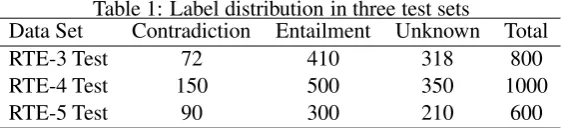
RTE-Table 1: Label distribution in three test sets
Data Set Contradiction Entailment Unknown Total
RTE-3 Test 72 410 318 800
RTE-4 Test 150 500 350 1000
RTE-5 Test 90 300 210 600
3, RTE-4, and RTE-5 competitions (Giampiccolo et al., 2007; Giampiccolo et al., 2008; Bentivogli et al., 2009). The development sets provided at each competition are used to tuned threshold val-ues in two CD modules of the system. The three-way subtask requires participant systems to decide whether the entailment, contradiction, or unknown relationship exists in a pair. Since in this study, we focus on contradiction relationship in a text pair, entailment and unknown labels in data sets are converted into non-contradiction labels. Ta-ble 1 provides statistics on the test sets of three-way subtask in RTE-3, RTE-4, and RTE-5.
The data sets used in experiments are unbal-anced, so the average accuracy over all labels is not an appropriate evaluation measures. There-fore, we use Precision, Recall, and F1 scores of the contradiction label as evaluation measures.
5.2 Baseline Methods
The first baseline method is the method presented in (De Marneffe et al., 2008), which employed su-pervised machine learning techniques for the CD task. To the best of our knowledge, (De Marneffe et al., 2008) is the only contradiction detection-focused work that evaluates on data sets of RTE challenges.
The second baseline is the BLUE system of Boeing’s team (Clark and Harrison, 2009) at RTE-4 and RTE-5 competitions. The BLUE system adopted the logical inference approach to RTE, which performs inference on logic-based repre-sentations of the text and the hypothesis in a pair. We use best scores among submitted runs of the BLUE system at each competition.
In experiments, we also compare the results achieved by our system with average results of submitted systems for three-way subtask at RTE-3, RTE-4 and RTE-5 challenges. The numbers submitted systems in RTE-3, RTE-4 and RTE-5 for the three-way subtask are 12, 34, and 24 sub-missions, respectively.
In order to assess the effectiveness of the two-stage system scheme, we separately run each CD module on the three data sets and compare the
re-sults with those of the combined system.
5.3 Experimental Results
Table 2 provides experimental results achieved on test sets of RTE-3, RTE-4, and RTE-5 challenges by our system and baseline methods. As shown in results, the proposed system consistently ob-tained better recall values and F1 scores than those of baseline methods except the supervised ma-chine learning-based method in (De Marneffe et al., 2008). Compared with the method presented (De Marneffe et al., 2008), our system achieves the same recall but lower precision.
The results shown in Table 2 indicated that the SRL-based module consistently achieved better recall and F1 score than those of the triple-based module. A possible explanation is that the infor-mation contained in shallow semantic representa-tions is richer than that of extraction triples, so the SRL-based module covers more contradiction phenomena than the triple-based module. As ex-pected, the combined system consistently obtained better recall and F1 score than each separate mod-ule. Experimental results confirmed our observa-tion that the second backup module increases the coverage of contradiction phenomena for our sys-tem.
6 Conclusion
Table 2: Experimental results on three data sets
Method RTE-3 Pilot RTE-4 Test RTE-5 Test
P R F1 P R F1 P R F1
De Marneffe (2008) 22.95 19.44 21.04 – – – – – –
BLUE system – – – 41.67 10.0 16.13 42.86 6.67 11.54
Average result 10.72 11.69 11.18 25.26 13.47 13.63 26.40 13.70 14.79
SRL-based 13.41 15.27 14.28 22.41 17.33 19.55 22.72 16.67 19.23
Triple-based 22.58 9.72 13.59 26.3 10.0 14.49 19.48 16.67 17.96
Two-stage (our system) 14.0 19.44 16.27 23.0 22.67 22.82 21.14 28.89 24.4
References
L. Bentivogli, I. Dagan, H. T. Dang, D. Giampiccolo, and B. Magnini. 2009. The fifth pascal recognizing textual entailment challenge. InIn Proceedings of TAC Workshop.
Jonathan Berant, Ido Dagan, and Jacob Goldberger. 2011. Global learning of typed entailment rules. In
Proceedings of the 49th Annual Meeting of the Asso-ciation for Computational Linguistics: Human Lan-guage Technologies, pages 610–619, Portland, Ore-gon, USA, June. Association for Computational Lin-guistics.
Aljoscha Burchardt, Marco Pennacchiotti, Stefan Thater, and Manfred Pinkal. 2009. Assessing the impact of frame semantics on textual entail-ment. Natural Language Engineering, 15(Special Issue 04):527–550.
Timothy Chklovski and Patrick Pantel. 2004. Ver-bocean: Mining the web for fine-grained semantic verb relations. In Dekang Lin and Dekai Wu, ed-itors, Proceedings of EMNLP 2004, pages 33–40, Barcelona, Spain, July. Association for Computa-tional Linguistics.
Peter Clark and Phil Harrison. 2009. Recognizing tex-tual entailment with logical inference. In In Pro-ceedings of the First Text Analysis Conference (TAC 2008).
Ronan Collobert, Jason Weston, L´eon Bottou, Michael Karlen, Koray Kavukcuoglu, and Pavel Kuksa. 2011. Natural language processing (almost) from scratch. J. Mach. Learn. Res., 999888:2493–2537, November.
Ido Dagan, Dan Roth, and Fabio Massimo. 2007. A tutorial on textual entailment.
Marie-catherine De Marneffe, Anna N Rafferty, and Christopher D Manning. 2008. Finding contradic-tions in text. InIn Proceedings of ACL 2008.
Anthony Fader, Stephen Soderland, and Oren Etzioni. 2011. Identifying relations for open information ex-traction. InProceedings of the Conference on Em-pirical Methods in Natural Language Processing, EMNLP ’11, pages 1535–1545, Stroudsburg, PA, USA. Association for Computational Linguistics.
Christiane Fellbaum. 1998. WordNet: An Electronic Lexical Database. MIT Press.
Danilo Giampiccolo, Bernardo Magnini, Ido Dagan, and Bill Dolan. 2007. The third pascal recogniz-ing textual entailment challenge. InProceedings of the ACL-PASCAL Workshop on Textual Entailment and Paraphrasing, pages 1–9.
Danilo Giampiccolo, Hoa Trang Dang, Bernardo Magnini, Ido Dagan, Elena Cabrio, and Bill Dolan. 2008. The fourth pascal recognizing textual entail-ment challenge. In In Proceedings of TAC 2008 Workshop.
Sanda Harabagiu, Andrew Hickl, and Finley Lacatusu. 2006. Negation, contrast, and contradiction in text processing. InProceedings of the Twenty-First Na-tional Conference on Artificial Intelligence (AAAI-06).
Martha Palmer, Daniel Gildea, and Paul Kingsbury. 2005. The proposition bank: An annotated corpus of semantic roles.Comput. Linguist., 31(1):71–106, March.
Ted Pedersen, Siddharth Patwardhan, and Jason Miche-lizzi. 2004. Wordnet::similarity: measuring the re-latedness of concepts. InDemonstration Papers at HLT-NAACL 2004, HLT-NAACL–Demonstrations ’04, pages 38–41, Stroudsburg, PA, USA. Associ-ation for ComputAssoci-ational Linguistics.
Alan Ritter, Stephen Soderland, Doug Downey, and Oren Etzioni. 2008. It’s a contradiction – no, it’s not: A case study using functional relations. In Pro-ceedings of the 2008 Conference on Empirical Meth-ods in Natural Language Processing, pages 11–20, Honolulu, Hawaii, October. Association for Compu-tational Linguistics.
Ellen M. Voorhees. 2008. Contradictions and justifica-tions: Extensions to the textual entailment task. In