1
A Comparative Study on Partial replacement of
E-plastic Waste and Coconut shell as a Coarse-aggregate
in Concrete
Vijay P. Lad, Shubham K. Tambekar, Prachi A. Uchade, Krishna A. Rathod, Lalita R. Lodwal (BE Students at Pankaj Laddhad Institute Of Technology and Management Studies, Buldana) Guided By Prof.A. G. Malpani (Assistant Prof. at Pankaj Laddhad Institute Of Technology and Management
Studies, Buldana)
Department of Civil Engineering, PLITMS, Buldana, Maharashtra, India. Email: [email protected], [email protected], [email protected],
[email protected], [email protected]
Abstract
Numbers of researchers are taking their own efforts to replace all the construction materials used for the concrete productions such as cement, fine and coarse aggregate and even for eater. Because of these many special concretes are coming out to meet out the special requirements in special situations in the construction industries. Many researchers was started to use coconut shell as a coarse aggregate in replacement of conventional coarse aggregate for the concrete production. They all reported encouraged results on their respective parameters studies. Authors are aimed to group the findings of coconut shell concrete under one place. Study on different wastes as coarse aggregate in concrete for the benefit of Civil Engineering communities. The management and recycling of E plastic waste is rapidly growing as it is a valuable resource of IT industries and it is very hazardous substances and with low recycling rate. The Utilization of e plastic waste materials is a partial solution to environmental and ecological problems. As the use of E-plastic waste will reduces the aggregate cost and provides a good strength for the structures and road constructions. It will reduces the landfill cost and it is energy saving. The E-plastic waste consists of non-biodegradable components. An experimental study is made on the utilization of E-waste and coconut shell as a coarse aggregate in concrete with a percentage of 0 %, 10%, 20%, and 30% on the strength criteria of M20 Concrete. The feasibility of utilizing E-plastic waste and coconut shell aggregate as partial replacement of coarse aggregate has been presented.
Keywords: E plastic waste, Concrete, Compressive strength, Review; Coconut shell; Aggregate; Concrete; Properties; Practice.
1. INTRODUCTION
Electronic waste describes discarded electrical or electronic devices. Which are destined for reuse, resale, salvage, recycling or disposal are also considered as e-waste. Informal processing of electronic waste in developing countries may cause serious health and pollution problems, as these countries have limited regulatory oversight of e-waste processing (Subramanian et al 2000). Electronic scrap components, such as CRT„s (Cathode Ray Tube), may contain contaminants such as cadmium, lead, beryllium, or brominated flame retardants. Even in developed countries recycling and disposal of e-waste may involve significant risk to workers and communities. One of the new waste materials used in the concrete industry is the recycled E - plastic. For solving the disposal of large amount of recycled plastic material, the reuse of plastic in concrete industry is considered as the most feasible application.
2 alternative to replace conventional coarse aggregate
by CS as aggregates.
2. OBJECTIVES
The main aim of this research paper is to find out the utilization of coconut shell and e-waste material in concrete as a substitute to coarse aggregate and analyse the compressive strength, and workability. Reuse waste product of coconut shell by replacing aggregate in mixture. This study will comprise of the comparative statement of properties of coconut shell and E-plastic waste with conventional concrete. Replacement of e-waste and coconut shell as coarse aggregate. To limit the amount of toxic substances in certain electronic product and to develop the technology for e-waste management. To reduce the pollution due to recycling of e-waste in the un-organized section
3. SCOPE OF STUDY
Recent studies have shown that reuse of very finely grounded E-waste and coconut shell in concrete has economical and technical advantage for solving the disposal waste. The reuse of waste saves natural resources and dumping spaces, and helps to maintain a clean environment. The work focused on possible conservation of natural resources by substituting with waste material by suggesting a possible reuse of e-plastic waste and coconut shell.
4. MATERIALS AND THEIR PROPERTIES
4.1. Materials 4.1.1 E-plastic waste
Waste Electrical and Electronic Equipment including all components, sub-assemblies. Electronic waste, consists of discarded old computers, TVs, refrigerators, radios basically any electrical or electronic appliance that has reached its end of life.
4.1.2 Coconut shell
Coconut shell has sensible sturdiness characteristics, high toughness & abrasion resistant properties. Literature study shows 10% replacement is optimum.
4.1.3 Cement
Cement may be a binder, a substance utilized in construction that sets and hardens and may bind different materials along. The foremost vital forms of cement are used as an element within the production of mortar in masonry, and of concrete, that may be a combination of cement and a mixture to create a robust building material. There are variable grades of cement available in our market, for this study ordinary Portland cement of grade 53 is used i.e. OPC 53.
4.1.4 Fine aggregate
Fine aggregate is the inert or chemically inactive material, most of which passes through 4.75 mm IS sieve and contains not more than 5 % coarse material. Fine aggregate used in concrete have the function of a filler material which fills the voids in concrete generated by coarse aggregate. The filler material used in Natural River sand which is passing in 2.36mm sieve.
4.1.5 Coarse aggregate
It is the mixture most of that is preserved on 4.75 mm IS sieve and contains solely such a lot finer material as is permissible by specification. Crushed angular stone of size less than 20mm from a local source is used as coarse aggregate.
4.1.6 Water
Water is used for making and curing concrete should be free from injurious substances such as, acid, oil, alkali, sugar, salt, organic materials or other elements deleterious to concrete. Portable water is suitable for making concrete.
4.2 Properties of materials
As e-waste and coconut shell is in different form the pure or waste. So the waste is crushed in to desired shape it passes over 20mm and retained on 4.75mm.
4.2.1 Properties of e-waste
i. The E- waste has to be completely crushed and make it in to desired shape and size. As it suitable for the replacement of coarse aggregate.
ii. Extreme versatility and ability is to be tailored to meet specific technical needs.
iii. Lighter weight reducing fuel consumption during transportation.
iv. Resistance to chemicals, water and impact. v. Excellent thermal and electrical insulation
properties.
vi. Comparatively lesser production cost. At melting point the bonding capacity increases as the temperature increases.
4.2.2 Properties of coconut shell
i. Coconut shell has high strength and modulus properties.
ii. It has added advantage of the high lignin content. High lignin content makes the composites more weather resistant.
3 iv. Coconuts are being naturally available in
nature and since its shells are non-biodegradable; they can be used readily in concrete, which may fulfill almost all the qualities of the original form of concrete.
5. QUALITY CHECK OF MATERIAL i. Sieve analysis test
ii. Aggregate crushing value test iii. Aggregate impact test iv. Los Abrasion value test
v. Water absorption and Specific gravity test
6. METHODOLOGY
1. Collection of material: coconut shell, e- waste, cement, coarse aggregate, fine aggregate, and water are collected for preparing concrete. 2. Weighing and mixing process: Materials are
weighed in proper ratio as per design and after then mixed in proper way.
3. Molding process: concrete mix (M20) is prepared with w/c ratio of 0.5 and molded in cube sized 150*150*150 mm3
4. Removing of mould: After 24 hours, the moulds are removed.
5. Curing process: concrete cubes are cured in fresh water for 14 days and 28 days.
6. Testing process: After removing the moulds, concrete cubes are tested on compression testing machine. After various test on cube, result are calculated.
Collection of Coconut Shells and E-plastic waste creating it an Aggregate Here coconut shells that were already broken into 2 items were collected from native temples; air dried for 5 days or so at the temperature of 25 to 300C the shells into small chips manually victimization hammer and sieved through 12 mm IS sieve. The material passed through 12 mm IS sieve was wont to replace coarse aggregates with coconut shell and E-waste. The material retained on 12 mm IS sieve was discarded.
6.1 Concrete Mix Design
M-20 grade of concrete was designed by I.S 10262-1982 methodology. The natural coarse aggregate were Replaced by coconut shell and E-waste in the percentage of 10%, 20%, and 30%. The check results were analyzed and compared with theoretical values, obtained from numerous codes.
6.2 Batching and Mixing
Weigh Batching was practiced with the assistance of electronic weigh balance. Batching was done as per the combination proportions. Mixing process was
exhausted tilting mixer. It absolutely was mixed for 2-3 minutes, after addition of water.
6.3 Placing and Compaction
Cubes are clean and oiled to prevent the formation of bond between concrete and moulds. Place the fresh concrete in cubes in three layers, tamping each layer for 25 times. The entrapped air in concrete is removed by table vibrator. Something unbroken on the table gets vibrated.
6.4 Demoulding
After placing fresh concrete in moulds, it absolutely was allowed to set for 24 hours. It absolutely was marked with some permanent identification mark i.e.A1, A2, A3, etc. Concrete cubes are currently unbroken in hardening tank for fourteen and twenty eight days. Once twenty eight days, concrete cubes were removed from hardening tank to conduct tests on hardened concrete.
6.5 Casting
1st a layer of coarse aggregates were unfold on clean receptacle. Then the fibers were separated manually and unfold. Over the fibers fine aggregates were unfold and dry mixed for two minutes. Then cement was other and dry mixed once more. 50% of the water was other 1st and mixed properly. Then by adding remaining water.
7. RESULTS AND DISCUSSION
A concrete mix grade of M20 is aimed; the design mix proportion is obtained by Indian Standard method of mix design. The mix proportion obtained is 1:1.5:3 with w/c ratio 0.5. E plastic waste and coconut shell was added in amount of 0%, 10%, 20% and 30% by the weight of coarse aggregate in concrete mix.
7.1 Workability test results
4 Table 1: Result of slump of concrete for various % of
E plastic waste and coconut shell
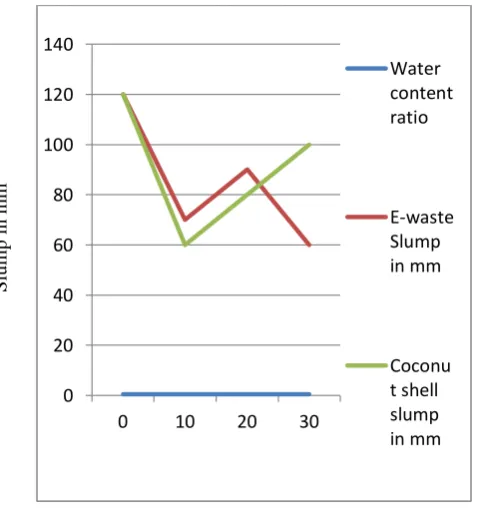
Graph 1 showing slump values
The graph show the variation of slump with 0.5 water cement ratio of different percentage of e-waste and coconut shell aggregate concrete mixes of
1:1.5:3(M20). In addition, increasing partial replacement of e-waste and coconut shell in concrete decreasing the slump value. The workability of the e-waste and coconut shell concrete is lower than that of conventional concrete because the rate of absorption of recycled aggregate is higher than nominal aggregate.
7.2 Compressive strength test results
Table 2 presents the Compressive strength of concrete mixes with E plastic aggregates, and coconut shell aggregates where 0% is S1 is Conventional Mix, S2 with E plastic of 0% of, S3 with 20% of E plastic and S4 with 30% of E plastic and same replacement percentage for coconut shell aggregates and Graph 2 shows the graphical representations of compressive strength of all mixes S1, S2, S3 And S4 for 14 and 28 days.
Compressive strength decreases due to increase in replacement of e-waste and coconut shell aggregate in concrete. The compressive strength of e-waste aggregate and coconut shell aggregate concrete is lesser than that of conventional concrete. The reason may be due to rough and smooth surface texture of these aggregates and poor bonding properties of the matrix with aggregates. But Cubes up to 10% replacement of coarse aggregate by coconut shell aggregate gave strength closer to the strength of conventional concrete cubes. The compressive strength of coconut shell aggregate concrete is greater than that of e- waste aggregate concrete. At 30% replacement, the compressive strength of coconut shell aggregate concrete and e-waste concrete is gradually decreased.
Table 2: Compressive Strength test results at varying % of E plastic waste and Coconut shell after curing of
14 and 28 Days
0 20 40 60 80 100 120 140
0 10 20 30
Water content ratio
E-waste Slump in mm
Coconu t shell slump in mm
Sr. No.
% of
waste in
mix
Slump in
mm Workability
E.W .
C.S. E.W. C.S.
1. 0 120 120 High High
2. 10 70 60 Medium Medium
3. 20 90 80 Medium Medium
4. 30 60 100 Medium High
S
lum
p
in
mm
[image:4.595.55.294.411.674.2]5 Graph 2 compressive Strength of concrete for varying
percentage E-waste and coconut shell at 14 days
Graph 3 compressive strength of concrete for varying percentage of E-waste and coconut shell at 28 days
8. CONCLUSION
The following conclusions are drawn from the experimental study.
1) E-plastic waste and coconut shell aggregate concrete may be an alternative to the conventional concrete.
2) Up to 10% replacement of coarse aggregate by these waste aggregate concrete was comparable to conventional concrete. Good compressive strength can be achieved using coconut shell. Beyond this replacement the strength acquired reduces gradually and does not cross the target strength.
3) Increase in proportion of Replacement of coconut shell and e-waste reduces compressive Strength of concrete.
4) Use of waste materials results in the formation of lightweight concrete.
5) Use of such waste materials not only cuts down the cost of construction, but also contributes in safe disposal of waste materials.
6) Permeable voids and water absorption will increase with increase in CS replacement. Plastics can be used to replace some of the aggregates in a concrete mixture. This contributes to reducing the unit weight of the concrete.
7) This is useful in applications requiring non-bearing lightweight concrete.
8) Use of these E-waste and coconut shell aggregate in the new concrete reduces the environmental pollution as well as providing an economic value for the waste material. 9) Usage of these waste aggregates can not only
preserve the finite raw materials, but also reduce energy consumption and overall construction costs
10) The reuse of these construction wastes in concrete will help in improvement of overall environment of the region. Firstly by reduction in mining and secondly reduction in air pollution resulting from production of
0 5 10 15 20 25 30
0 10 20 30
EW
CS
0 5 10 15 20 25 30 35
0 10 20 30
EW
CS
Sl. No
Mix pro.
In %
Con vent iona l Mix
Compressive strength of
E.W.
Compressive strength of
C.S.
14 Days
28 Days
14 Days
28 Days
1. 0 S1 25.7
6
32.58 25.76 32.5 8 2. 10 S2 7.72 15.89
5
18.17 23.1 2 3. 20 S3 6.61 12.84
5
13.27 20.3 25 4. 30 S4 4.94
5
7.67 8.17 17.6 65
% of waste in concrete
C
ompr
es
sive
str
ength
in
N/mm
2
C
ompr
es
sive
str
ength
in
N/mm
2
6 aggregates (dust pollution) and transportation
of aggregate from mining to consumption point (vehicular pollution).
9. FUTURE SCOPE
1) Partial replacement of e-waste and coconut shell in concrete may be an alternative to the conventional concrete.
2) The research will do on different grades of mix design.
3) Sustainable development of structures can be achieved by using waste material aggregate in concrete.
4) From past studies and results it is recommended that proper design mixes with different percentage of recycled concrete aggregates with natural aggregates should be prepared to achieve the adequate strength of the concrete and to reduce the consumption of natural aggregate.
5) By using e-waste and coconut shell as a coarse aggregate the burden of construction wastes can be reduced to a suitable extent. 6) Economical housing projects will be done.
Acknowledgements
We express our sincere thanks to our Head of Department, Prof. M. M. Joshi, and We also thanks to Prof. A. G. Malpani, for extending his valuable guidance, support for literature, critical reviews and above all the moral support they had provided to us. We express special thanks to Honorable principal Dr. P. M. Jawandhiya.
We are also indebted to all the teaching and non-teaching staff of the department of Civil Engineering for their cooperation and suggestions, which is the spirit behind this research paper.
REFERENCES
[1] Code of Indian standard specifications IS: 383-1970.
[2] Electronics Recycling‟, Institute of Scrap Recycling Industries Inc. (ISRI)
[3] Hai yong kings, “Electronic waste recycling: A review of U.S. Infrastructure and technology Options, Resources, Conservation and Recycling vol. 45 (2005) pp 368400. Code book IS 456-2000 for concrete structure.
[4] IS 10262-2009 Code Book.
[5] P.M. Subramanian, “Plastic recycling and waste Management in the US” Resources, Conservation and Recycling vol. (28) pp 253263 on net.
[6] Verma S S (2008), “Roads from Waste Plastic”, The Indian concrete journal.
[7] K. Gunasekaran, “Utilization of Coconut Shell as Coarse Aggregate in the Development of Light Concrete”, Thesis- SRM University, 2011.
[8] Basri, H.B, M.A.Mannan, and M.F.M.Zain,“Concrete using waste oil palm shells as aggregates”, Cement and Concrete Research 29, pp. 619-622, 1999.
[9] ]Ohler, J.G. (Ed.). “Modern Coconut Management, Palm Cultivation and Products”, FAO. London Intermediate Tenology Publ. Ltd, 1999.
[10] Siti Aminah BT Tukiman and Sabarudin Bin Mohd, “Investigate the combination of coconut shell and grained Palm kernel to replace aggregate in concrete: a technical Review”, National Conference on Postgraduate Research (NCON-PGR), Malaysia, 2009.