Writing Support for Controlled Natural Languages
Tobias Kuhn
Department of Informatics University of Z¨urich
Switzerland
Rolf Schwitter
Centre for Language Technology Macquarie University Sydney NSW 2109, Australia
Abstract
In this paper we present interface tech-niques that support the writing pro-cess of machine-oriented controlled natu-ral languages which are well-defined and tractable fragments of English that can be translated unambiguously into a formal tar-get language. Since these languages have grammatical and lexical restrictions, it is important to provide a text editor that as-sists the writing process by using looka-head information derived from the gram-mar. We will discuss the requirements to such a lookahead text editor and introduce the semantic wiki AceWiki as an applica-tion where this technology plays an impor-tant role. We investigate two different ap-proaches how lookahead information can be generated dynamically while a text is written and compare the runtimes and prac-ticality of these approaches in detail.
1 Introduction
Natural language interfaces have been a popular area of research in the 70’s and 80’s, in partic-ular natural language interfaces to databases re-ceived a lot of attention and some of these inter-faces found their way into commercial applica-tions (Copestake and Jones, 1990; Androutsopou-los et al., 1995). However, most of the early re-search prototypes focused on the exploration of specific NLP techniques and formalisms and were not very robust and therefore not very successful – and research drifted away from this topic in the 90’s although there is still no agreed consensus theory on how to build these text-based interfaces.
The need for text-based natural language inter-faces has recently gained again momentum since more and more non-specialists are required to ac-cess databases and maintain knowledge systems in Semantic Web applications through their web browsers and portable devices (Cimiano et al., 2008). One advantage of natural language in-terfaces is that the user is not required to learn a formal language to communicate with the sys-tem. But the use of natural language as an inter-face style is not without problems since full nat-ural language is highly ambiguous and context-dependent. In practice, natural language inter-faces can only understand a restricted subset of written (or spoken) input, and they have often only limited capabilities to make their coverage transparent to the user (Chintaphally et al., 2007). If the system is unable to understand a sentence and does not provide accurate feedback, then there is the risk that the user makes potentially incorrect assumptions about other sentences that the system actually can understand.
An obvious solution to this problem is to use a set of training sessions that teach the user what the system can and cannot understand. But this solution has at least two drawbacks: (a) untrained users cannot immediately use the system; and (b) infrequent users might not remember what they learned about the system’s capabilities (Tennant et al., 1983a).
Menu-based natural language interfaces have been suggested to overcome many problems of conventional text-based natural language inter-faces. These menu-based interfaces can be gen-erated automatically from the description of a database or from a predefined ontology (Tennant et al., 1983b). These interfaces are very ex-plicit about their coverage since they provide a set of (cascaded) menus that contain the admis-sible natural language expressions and the user has to select only from a set of choices. There-fore the failure rate is very low, in addition there are no spelling errors since no typing is required. Most menu-based and related WYSIWYM (= What You See Is What You Mean) approaches assume an existing underlying formal representa-tion (Power et al., 1998). WYSIWYM is a natural language generation approach based on concep-tual authoring where the system generates feed-back from a formal representation. Instead of ma-nipulating the formal representation, the user ed-its the feedback text via a set of well-defined edit-ing operations (Hallett et al., 2007).
Although menu-based natural language inter-faces can be applied to large domains, there ex-ist applications where menu-searching becomes cumbersome (Hielkema et al., 2008) and more importantly there exist many applications where the formal representation does not exist in ad-vance and where the construction of this formal representation is the actual task. This is the set-ting where controlled natural languages can make an important contribution. Machine-oriented con-trolled natural languages can be used as high-level interface languages for creating these formal rep-resentations, and we can try to support the writ-ing process of these controlled natural languages in an optimal way.
In the following, we will illustrate how con-trolled natural languages can be applied in a se-mantic wiki context where a formal representa-tion needs to be derived from a text that is human-readable as well as machine-processable, and then we will show how these techniques can be imple-mented in a logic programming framework.
2 Controlled Natural Languages (CNL)
Over the last decade or so, a number of machine-oriented controlled natural languages have been
designed and used for specification purposes, knowledge acquisition and knowledge represen-tation, and as interface languages to the Semantic Web – among them Attempto Controlled English (Fuchs et al., 1998; Fuchs et al., 2008), PENG Processable English (Schwitter, 2002; Schwit-ter et al., 2008), Common Logic Controlled En-glish (Sowa, 2004), and Boeing’s Computer-Processable Language (Clark et al., 2005; Clark et al., 2007). These machine-oriented controlled natural languages are engineered subsets of a nat-ural language with explicit constraints on gram-mar, lexicon, and style. These constraints usually have the form of construction and interpretation rules and help to reduce both ambiguity and com-plexity of full natural language.
The PENG system, for example, provides text-and menu-based writing support that takes the burden of learning and remembering the con-straints of the language from the user and gen-erates a paraphrase that clarifies the interpretation for each sentence that the user enters. The text editor of the PENG system dynamically enforces the grammatical restrictions of the controlled nat-ural language via lookahead information while a text is written. For each word form that the user enters, the user is given a list of choices of how to continue the current sentence. These choices are implemented as hypertext links as well as a cascade of menus that are incrementally updated. The syntactic restrictions ensure that the text fol-lows the rules of the controlled natural language so that the text is syntactically correct and can be translated unambiguously into the formal target language (Schwitter et al., 2003; Schwitter et al., 2008).
3 Semantic Wikis
Semantic wikis combine the philosophy of wikis (i.e. quick and easy editing of textual content in a collaborative way over the Web) with the con-cepts and techniques of the Semantic Web (i.e. giving information well-defined meaning in order to enable computers and people to work in coop-eration). The goal is to manage formal represen-tations within a wiki environment.
(Auer et al., 2006) belong to the most mature existing semantic wiki engines. Unfortunately,
noneof the existing semantic wikis supports ex-pressive ontology languages in a general way. For example, none of them allows the users to define general concept inclusion axioms, e.g.:
• Every country that borders no sea is a landlocked country.
Furthermore, most of the existing semantic wikis fail to hide the technical aspects, are hard to un-derstand for people who are not familiar with the technical terms, and do not provide any writing support.
4 AceWiki – a CNL-based Wiki
AceWiki (Kuhn, 2008a; Kuhn, 2008b) is a se-mantic wiki that tries to solve those problems by using the controlled natural language Attempto Controlled English (ACE) to represent the formal content.1 The use of the language ACE allows us to provide a high degree of expressivity and to represent the formal content in a natural way. Easy creation and modification of the content is enabled by a special text editor that supports the writing process.
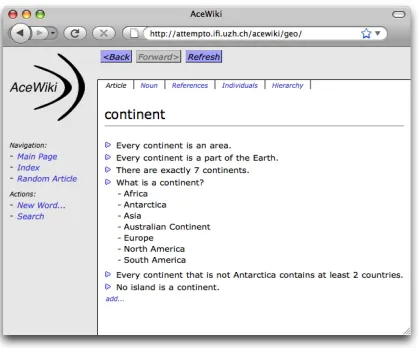
AceWiki is implemented in Java. Making use of the Echo Web Framework2, it provides a rich AJAX-based web interface. Figure 1 shows a screenshot of an exemplary AceWiki instance containing information about a geographical do-main. The ACE parser is used to translate the ACE sentences into first-order logic and, if pos-sible, into the ontology language OWL (Motik et al., 2008). In the background, the OWL reasoner Pellet3 is used to ensure that the ontology (con-sisting of the sentences that are OWL-compliant) is always consistent. The reasoner is also used to infer class memberships and hierarchies and to answer questions.
Following the wiki philosophy, the users should be able to change the content of the wiki quickly and easily. For this reason, it is impor-tant that the users are supported by an intelligent text editor that helps to construct valid sentences. AceWiki provides a predictive text editor that is
1
http://attempto.ifi.uzh.ch/acewiki/
[image:3.612.311.520.63.237.2]2http://echo.nextapp.com/site/ 3http://pellet.owldl.org/
Figure 1: A screenshot of the web interface of AceWiki showing the wiki article for the class con-tinent.
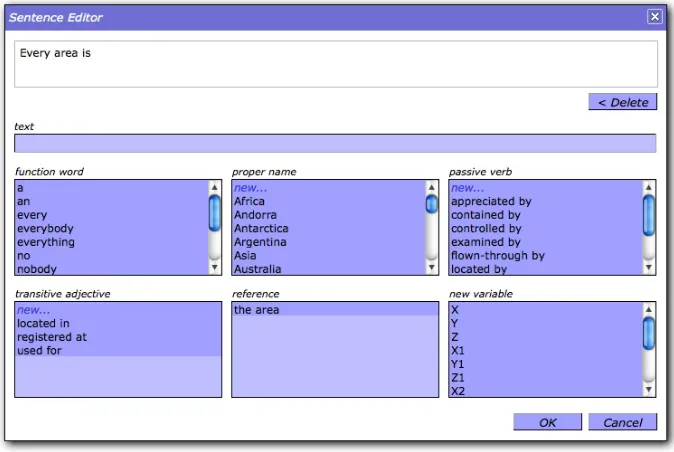
able to look ahead and to show possible words to continue the sentence. Figure 2 shows a screen-shot of this editor. A chart parser is used for the generation of the lookahead information.
This predictive editor enables the creation of sentences by clicking consecutively on the de-sired words. It ensures that only 100% syntac-tically correct sentences are created. This enables novice users to create ACE sentences without the need to read the ACE manuals first. Alterna-tively, the predictive editor allows more experi-enced users to type a sentence or a part of it into a text field. The two modes of sentence construc-tion (clicking versus typing) can be combined and the users can switch from one mode to the other at any time. Content words that are not yet known can be added on-the-fly when writing a sentence using the built-in lexical editor.
Figure 2: A screenshot of the predictive editor of AceWiki. The partial sentenceEvery area ishas already been entered and now the editor shows all possibilities to continue the sentence. The possible words are arranged by their type in different menu boxes.
5 AceWiki Grammar
AceWiki uses a subset of ACE. The grammar con-tains about 80 grammar rules and is implemented in a declarative way in Prolog. These rules are de-fined in a special grammar notation using feature structures, for example:
verbphrase(pl:PL,neg:Neg,that:T) => verb(verb:full,pl:PL,neg:Neg), nounphrase(verb:full,that:T).
This format can be transformed into Java code (which is used by the AceWiki chart parser) and can also be exported as a Prolog DCG grammar (Pereira and Shieber, 1987).
The AceWiki language consists of about 30 function words (e.g. a, every, if, then, and, not,
is,that) and five extensible types of content words (some of which have several word forms): proper names (e.g. Europe), nouns (e.g. city), transitive verbs (e.g. contains),of-constructions (e.g. part of), and transitive adjectives (e.g.located in).
The grammar covers a considerable part of En-glish: singular and plural noun phrases, active and passive voice, negation, relative phrases, conjunc-tions/disjunctions (of sentences, verb phrases, and relative phrases), existential and universal quanti-fiers, questions, and anaphoric references. Below are a few examples of declarative sentences:
• Switzerland is located in Europe and borders ex-actly 5 countries.
• Every country that borders no sea is a landlocked country and every landlocked country is a country that borders no sea.
• If X borders Y then Y borders X.
The semantic expressivity of the AceWiki lan-guage is a subset of the expressivity of first-order logic. The mapping from ACE to OWL that is ap-plied by the ACE parser covers all of OWL 2 ex-cept data properties and some very complex class descriptions (Kaljurand, 2007). Apart from those exceptions, the AceWiki language is more expres-sive than OWL. The examples shown above are OWL-compliant, but we can write sentences that go beyond the semantic expressivity of OWL, for example4:
• No country borders every country.
• If Berlin is a capital then Germany is not an un-stable country.
• If a country contains an area and does not control the area then the country is an unstable country.
4
At the moment, AceWiki supports only simple questions containing exactly one wh-word (i.e.
what, who, or which). Such questions can be mapped to OWL class descriptions5. The answers to such questions can be calculated by determin-ing the individuals of the class description. Here are three typical questions expressed in AceWiki:
• Which continents contain more than 10 coun-tries?
• Switzerland borders which country that borders Spain?
• Which rivers flow through a country that borders Spain?
In summary, the AceWiki grammar describes a relatively large subset of English which exceeds the expressivity of OWL.
6 Implementing Writing Support
As we have seen, the AceWiki grammar is writ-ten in a format that can be read as a DCG and that is used by the AceWiki chart parser in order to generate lookahead information and logical for-mulas. In this section, we will focus on a specific aspect of the writing support and illustrate how syntactic lookahead information can be harvested from the DCG in a direct way and in an indirect way through a chart parser (as AceWiki does). In order to make a direct comparison of the two ap-proaches, we use Prolog in both cases.
6.1 Harvesting the DCG
In order to harvest lookahead information directly from the DCG (for which Prolog supplies by de-fault a top-down, left-to-right, backtrack parsing algorithm), we add a dummy token after each new word that the user enters and then parse the entire input string from the beginning. This looks like a very costly approach but the advantage of this ap-proach is that it can be implemented very easily (and our empirical results show that this approach is still fast enough for practical applications). Fur-thermore, this approach prevents the parser from getting into infinite loops when processing recur-sive grammar rules. Let us assume that the user is planning to add the following sentence to the wiki:
• Switzerland is an alpine country.
5These queries are sometimes called “DL Queries”.
and that she has just appended the indefinite ar-ticle an to the stringSwitzerland is. Before this entire input string is parsed by the DCG parser, the dummy token‘$dummy$’is added to the end of the string:
[‘Switzerland’,is,an,‘$dummy$’]
This dummy token will be used – as we will see below – to trigger a Prolog rule (word form/4) that processes the lookahead information. Be-fore we describe this, we need to understand how preterminal grammar rules look like in the AceWiki grammar; here is a (simplified) exam-ple:
‘NOUN’ -->
{ lexicon(cat:‘NOUN’,wf:WF) }, word_form(‘NOUN’,WF).
The term in curly brackets is a Prolog expres-sion. The default Prolog DCG preprocessor takes this DCG rule and translates it into a pure Pro-log clause, adding two additional arguments for the input and output string. Note that the vari-able WF stands for an entire word form that can either be atomic or compound. This word form is represented as a list of tokens in the lexicon, for example (again simplified here):
lexicon(cat:‘NOUN’,
wf:[alpine,country]).
This lexicon lookup (lexicon/2) returns the entire list of tokens and sends it to the rule
word form/4 that processes these tokens
de-pending on the input string:
word_form(Cat,[T1|Ts],[‘$dummy$’],_) :-update_lah_info(lookahead(Cat,T1)), fail.
word_form(Cat,[T1|Ts],[T1|S1],S2) :-word_form(Cat,Ts,S1,S2).
user selectsalpineas the subsequent input, the dummy token is added again to the new input string but this time the second of the grammar rules (word form/4) is triggered. This rule re-moves alpinefrom the input string before the dummy token is detected by the first rule that adds the next token of the compound (country) to the lookahead information. In order to avoid du-plicates, the predicateupdate lah info/1first checks if the lookahead information already exists and only asserts this information if it is new:
update_lah_info(LAHInfo) :-(
call(LAHInfo), ! ;
assert(LAHInfo) ).
Instead of atomic and compound word forms, we can also display syntactic categories for entire groups of words using the same technique.
6.2 Harvesting the Chart
As we have seen in the last section, the DCG is used to parse each sentence from scratch to pro-cess the lookahead information for a new word. Apart from that the DCG creates many partial structures and destroys them while backtracking. In order to avoid unnecessary repetition of work, the DCG can be processed with a (top-down) chart parser. A chart parser stores well-formed constituents and partial constituents in a table (= chart) consisting of a series of numbered vertices that are linked by edges (see Kay (1980) or Gaz-dar and Mellish (1989) for an introduction). Our chart parser is an extension of (Gazdar and Mel-lish, 1989) and represents edges in a similar way as a predicate with five arguments:
edge(V1,V2,LHS,RHSFound,RHSToFind)
The first two arguments state that there exists an edge between vertex V1and vertex V2. The next three arguments represent a grammar rule and indicate to what extent the parser was able to apply this grammar rule to the constituent found between the two vertices. HereLHSstands for a category on the left-hand side of a grammar rule,
RHSFoundfor a sequence of categories that has
been found on the right-hand side of the grammar rule, andRHSToFindfor a sequence of remaining categories on the right-hand side. The edges in the
chart are eitherinactiveoractiveedges. An inac-tive edge is an edge where the listRHSToFindis empty ([]) and represents a confirmed hypothe-sis. All other edges are active and represent un-confirmed hypotheses.
The fundamental rule of chart parsing says that if an inactive edge meets an active edge of the corresponding category, then a new edge can be added to the chart that spans both the inactive and the active edges. In order to apply the fundamen-tal rule, the chart needs to contain at least one ac-tive and one inacac-tive edge. That means we have to initialise the chart first for each new sentence. This initialisation process will allow us to add a number of active edges to the chart and to extract the initial lookahead information from the chart. This information will show the user how to start a sentence. Once the user selects or types the first word, new inactive edges are triggered that are re-quired by the fundamental rule to start the chart parsing process.
Before we can process the DCG with the chart parser, we transform it into a slightly different for-mat using the infix operator==>instead of-->.
In the next step, we can initialise the chart top-down (text/1) and make sure that a number of active edges is generated. We do this with the help of a failure-driven loop (foreach/2):
chart_parser([],[_,0,_]) :-LHS = text([A,B,C,D,E,F,G,H,I]), init_chart(0,LHS).
init_chart(V0,LHS) :-foreach(rule(LHS,RHS),
init_edge(V0,V0,LHS,[],RHS)).
init_edge(V0,V0,LHS,Fnd,RHS) :-edge(V0,V0,LHS,Fnd,RHS), !.
init_edge(V0,V0,LHS,Fnd,[RHS|RHSs]) :-assert_edge(V0,V0,LHS,Fnd,[RHS|RHSs]), foreach(rule(RHS,RHS2),
init_edge(V0,V0,RHS,[],RHS2)), update_lah_info(RHS).
foreach(X,Y) :- call(X), once(Y), fail. foreach(X,Y) :- true.
This failure-driven loop calls the transformed DCG rules via the following rules:
rule(LHS,RHS) :- ( LHS ==> RHS ). rule(LHS,[]) :- ( LHS ==> [] ).
initial lookahead informationRHSthat is available as the first element in the lists of remaining cate-gories[RHS|RHSs]. This is done with the help of the predicateupdate lah info/1that works in a similar way as the one introduced for the DCG in the last section.
Once the chart is initialised and the initial lookahead information is displayed, the user can select or enter the first word that falls under these classifications. This word is processed by the predicate chart parser/2, starts at vertex 0
and generates in the case of an atomic word an inactive edge for each instance in the lexicon:
chart_parser(Word,[_,V1,V2]) :-start_chart(V1,V2,Word).
start_chart(V1,V2,Word) :-foreach(word(V1,Word,Cat),
add_edge(V1,V2,Cat,[],[])).
word(_,Word,Cat)
:-( Cat ==> [ lexicon:-(cat:Cat,wf:Word), word(Word) ] ),
call( lexicon(cat:Cat,wf:Word) ).
The chart parser adds these inactive edges to the chart using in a first step the second of the fol-lowing rules (add edge/5) and then applies the fundamental rule (fund rule/4) recursively to inactive and active edges. Note that the first of the following rules checks for duplicates and the third rule applies first the fundamental rule, then predicts new active edges, and finally updates the lookahead information in the subsequent steps:
add_edge(V1,V2,LHS,Fnd,RHS) :-edge(V1,V2,LHS,Fnd,RHS), !.
add_edge(V1,V2,LHS,Fnd,[]) :-assert_edge(V1,V2,LHS,Fnd,[]), fund_rule(V1,V2,LHS,[]).
add_edge(V1,V2,LHS,Fnd,[RHS|RHSs]) :-assert_edge(V1,V2,LHS,Fnd,[RHS|RHSs]), fund_rule(V1,V2,LHS,[RHS|RHSs]), predict_active_edges(V2,RHS), update_lah_info(RHS).
If an inactive edge is asserted by the second rule, then the fundamental rule is applied to ev-ery active edge that can make use of this inactive edge:
fund_rule(V1,V2,RHS,[])
:-foreach(edge(V0,V1,LHS,Fnd,[RHS|RHSs]), add_edge(V0,V2,LHS,[RHS|Fnd],RHSs)).
If an active edge is asserted in the third rule, then the fundamental rule is first applied to ev-ery inactive edge that can make use of this active edge:
fund_rule(V1,V2,LHS,[RHS|RHSs]) :-foreach(edge(V2,V3,RHS,Fnd,[]),
add_edge(V1,V3,LHS,[RHS|Fnd],RHSs)).
and then the predicate predict active
edges/2is applied that looks for each grammar
rule (rule/2) that has the category RHSon the left hand side (LHS) and creates new active edges for these rules starting at vertexV2:
predict_active_edges(V2,LHS) :-foreach(rule(LHS,NewRHS),
add_edge(V2,V2,LHS,[],NewRHS)).
Finally, in a last step, the actual lookahead in-formation (RHS) is updated with the help of the predicateupdate lah info/1.
Note that the ruleword/3can only be used to process atomic words. We use additional rules to deal with compound words. The basic idea is to take a compound word out of the lexicon once the user enters the first token of a compound and write all remaining tokens onto a stack. The first token of these remaining tokens is then displayed as lookahead information and the stack is pro-cessed recursively as the user enters more tokens that belong to the compound word. This approach has the advantage that a compound word is looked up only once in the lexicon and the remaining to-kens are processed directly from the stack.
7 Evaluation
We have compared the runtimes of the direct DCG approach with the indirect chart parsing ap-proach for generating lookahead information. For the chart parser, we evaluated two settings: (a) the time that it takes to add a new token incre-mentally if the chart has already been constructed, and (b) the time that it takes to parse a partial sentence from the beginning. In the case of the DCG parser, those two settings coincide since in-cremental parsing is not possible.
For this comparison, we used the AceWiki grammar together with a test suite of 100 sen-tences. The longest sentence in this test suite consists of 51 tokens, the shortest sentence of 4 tokens, and the average sentence length is 14 to-kens. Many of these sentences contain quite com-plex syntactic structures, among them embedded relative clauses, negation, coordination, and num-ber restriction, for example:
1 10 20 30 40 50 0.00
0.05 0.10 0.15 0.20 0.25 0.30 0.35 0.40 0.45 0.50
1 2 3 4 5 6 7 8 9 10 11 12 13 14 15 16 17 18 0.00
0.01 0.02 0.03 0.04 0.05 0.06 0.07 0.08
[image:8.612.87.516.63.209.2]DCG Chart Chart Sum
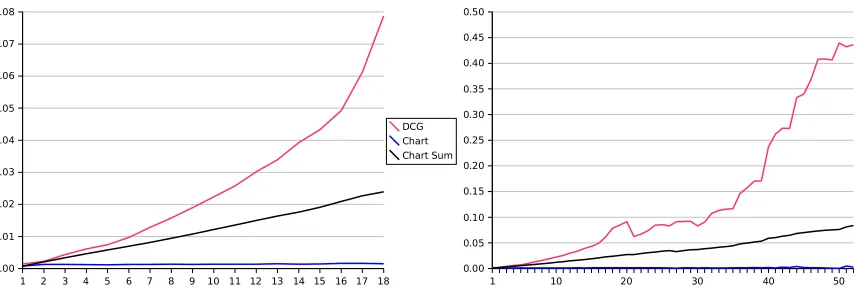
Figure 3: These two graphics show the average runtimes of the three parsing approaches in seconds (y-axis) for the different sentence positions (x-axis) up to position 18 (on the left) and 52 (on the right), respectively.
It turned out that theaverageprocessing times for generating lookahead information are: 1.3 ms for the chart parsing approach if only the last to-ken has to be processed; 13.1 ms for the chart parsing approach if all of the partial sentence is parsed; and 31.3 ms for the DCG approach. These values where retrieved on a standard 2 GHzIntel Core Duo machine using SWI Prolog6. Not sur-prisingly, the latter two values highly depend on the number of tokens in a partial sentence. Fig-ure 3 shows the average time values by sentence position (i.e. number of tokens) for the three ap-proaches. We get very nice curves up to about 18 tokens, and then the DCG curve gets shaky. This is due to the fact that only 25% of the sentences have more than 18 tokens, and thus the sample gets more and more unreliable.
The chart parsing approach requires approxi-mately constant time for each new token, and thus approximately linear time is required if the sen-tence has to be parsed from the beginning. In both settings, the chart parser performs better than the DCG parser. Surprisingly, not even the pro-cessing of the first token in a sentence is faster when we use the DCG instead of the chart parser (1.4 ms versus 0.8 ms). The theoretical worst-case time complexity of the DCG approach is cu-bic but on average a sentence of 15 tokens can be processed with the AceWiki grammar within 43.3 ms. That means that the DCG approach is still practically useful although theoretically not exhilarating.
6http://www.swi-prolog.org/
8 Conclusions
In this paper we argued for controlled natural lan-guage (CNL) interfaces using predictive text ed-itors to combine human-readability and usability with machine processability. As an example, we presented AceWiki, a semantic wiki, that uses a relatively complex grammar that is based on a subset of Attempto Controlled English (ACE) which is a machine-oriented CNL. A predictive text editor is used to enforce the restrictions of the CNL and to guide the user step-by-step via looka-head information that is generated on the fly while a sentence is written. We have explored two dif-ferent approaches to generate this lookahead in-formation: the first approach uses the DCG di-rectly and is computationally costly but very easy to implement; the second approach relies on a chart parser and is computationally cheap but re-quires a bit more work to implement. We showed how the two approaches can be implemented in Prolog, and we compared those implementations. The chart parser performs particularly well if in-cremental parsing is applied. In any case, the chart parser performs considerably better than the DCG parser. However, the parsing times of the DCG approach are still within a reasonable range to be used in practical applications.
References
I. Androutsopoulos, G. Ritchie, and P. Thanisch. 1995. Natural Language Interfaces to Databases – An Introduction. In: Journal of Language Engi-neering, 1(1), pp. 29–81.
S. Auer, S. Dietzold, and T. Riechert. 2006. OntoWiki – A Tool for Social, Semantic Collaboration. In:
Proceedings of the 5th International Semantic Web Conference, pp. 736–749, Springer.
V. R. Chintaphally, K. Neumeier, J. McFarlane, J. Cothren, and C. W. Thompson. 2007. Extend-ing a Natural Language Interface with Geospatial Queries. In:IEEE Internet Computing, pp. 82–85. P. Cimiano, P. Haase, J. Heizmann, and M. Mantel.
2008. ORAKEL: A Portable Natural Language In-terface to Knowledge Bases. In: Data & Knowl-edge Engineering (DKE)65(2), pp. 325–354. P. Clark, P. Harrison, T. Jenkins, T. Thompson, and R.
Wojcik. 2005. Acquiring and Using World Knowl-edge Using a Restricted Subset of English. In: Pro-ceedings of FLAIRS’05, pp. 506–511.
P. Clark, P. Harrison, J. Thompson, R. Wojcik, T. Jenk-ins, and D. Israel. 2007. Reading to Learn: An In-vestigation into Language Understanding. In: Pro-ceedings of AAAI 2007 Spring Symposium on Ma-chine Reading, pp. 29–35.
A. Copestake, K. Sparck Jones. 1990. Natural Lan-guage Interfaces to Databases. In:Knowledge En-gineering Review, 5(4), pp. 225–249.
N. E. Fuchs, U. Schwertel, and R. Schwitter. 1998. Attempto Controlled English – Not Just Another Logic Specification Language. In: Proceedings of LOPSTR’98, pp. 1–20.
N. E. Fuchs, K. Kaljurand, T. Kuhn. 2008. Attempto Controlled English for Knowledge Representation. In: Reasoning Web, Fourth International Summer School 2008, LNCS 5224, pp. 104–124.
G. Gazdar, C. Mellish. 1998. Natural Language Pro-cessing in Prolog. An Introduction to Computa-tional Linguistics, Addison-Wesley, 1989.
C. Hallett, R. Power, and D. Scott. 2007. Compos-ing Questions through Conceptual AuthorCompos-ing. In:
Computational Linguistics, 33(1), pp. 105–133. F. Hielkema, C. Mellish, P. Edwards. 2008.
Evaluat-ing an Ontology-Driven WYSIWYM Interface. In:
Proceedings of INLG 2008, pp. 138–146.
K. Kaljurand. 2007. Attempto Controlled English as a Semantic Web Language. PhD thesis, Faculty of Math. and Computer Science, University of Tartu. M. Kay. 1980. Algorithm Schemata and Data
Struc-tures in Syntactic Processing. In: CSL-80-12, Xe-rox Parc, Palo Alto, California, 1980.
M. Kr¨otzsch, D. Vrandecic, M. V¨olkel, H. Haller, and R. Studer. 2007. Semantic Wikipedia. In:Journal of Web Semantics, 5/2007, pp. 251–261, Elsevier.
T. Kuhn. 2008. AceWiki: A Natural and Expres-sive Semantic Wiki. In: Proceedings of Semantic Web User Interaction at CHI 2008: Exploring HCI Challenges. CEUR Workshop Proceedings. T. Kuhn. 2008. AceWiki: Collaborative Ontology
Management in Controlled Natural Language. In:
Proceedings of the 3rd Semantic Wiki Workshop. CEUR Workshop Proceedings.
B. Motik, P. F. Patel-Schneider, I. Horrocks. 2008. OWL 2 Web Ontology Language: Structural Spec-ification and Functional-Style Syntax. W3C Work-ing Draft, 11 April 2008. http://www.w3. org/TR/owl2-syntax/
F. C. N. Pereira, S. M. Shieber. 1987. Prolog and Natural-Language Analysis. CSLI, Lecture Notes, Number 10.
R. Power, D. Scott, and R. Evans. 1998. What You See Is What You Meant: direct knowledge editing with natural language feedback. In:Proceedings of ECAI 98, Brighton, UK.
S. Schaffert. 2006. IkeWiki: A Semantic Wiki for Collaborative Knowledge Management. In: Pro-ceedings of the First International Workshop on Se-mantic Technologies in Collaborative Applications (STICA06).
R. Schwitter. 2002. English as a Formal Specifica-tion Language. In: Proceedings of DEXA 2002, September 2-6, Aix-en-Provence, France, pp. 228– 232.
R. Schwitter, A. Ljungberg, and D. Hood. 2003. ECOLE – A Look-ahead Editor for a Controlled Language, In: Proceedings of EAMT-CLAW03, May 15-17, Dublin City University, Ireland, pp. 141–150.
R. Schwitter, M. Tilbrook. 2008. Meaningful Web Annotations for Humans and Machines using Con-trolled Natural Language. In: Expert Systems, 25(3), pp. 253–267.
J. F. Sowa. 2004. Common Logic Controlled En-glish. Draft, 24 February 2004. http://www. jfsowa.com/clce/specs.htm
H. R. Tennant, K. M. Ross, R. M. Saenz, C. W. Thompson, and J. R. Miller. 1983. Menu-Based Natural Language Understanding. In: Proceedings of the 21st Meeting of the Association for Compu-tational Linguistics(ACL), MIT Press, pp. 51–58. R. H. Tennant, K. M. Ross, and C. W. Thompson.
1983. Usable Natural Language Interfaces Through Menu-Based Natural Language Understanding. In:
CHI’83: Proceedings of the SIGCHI Conference on Human Factors in Computing Systems, pp. 154– 160, New York, NY.