Representing and Rendering Linguistic Paradigms
David Penton and Steven Bird
Department of Computer Science and Software Engineering The University of Melbourne, Victoria 3010, Australia
{djpenton,sb}@csse.unimelb.edu.au
Abstract
Linguistic forms are inherently multi-dimensional. They exhibit a variety of phonological, orthographic, morphosyntactic, semantic and pragmatic properties. Accordingly, linguistic analysis involves multi-dimensional exploration, a process in which the same collection of forms is laid out in many ways until clear patterns emerge. Equally, language documentation usually contains tabulations of linguistic forms to illustrate systematic patterns and variations. In all such cases, multi-dimensional data is projected onto a two-dimensional table known as a linguistic paradigm, the most widespread format for linguistic data presentation. In this paper we develop an XML data model for linguistic paradigms, and show how XSL transforms can render them. We describe a high-level interface which gives linguists flexible, high-level control of paradigm layout. The work provides a simple, general, and extensible model for the preservation and access of linguistic data.
1 Introduction
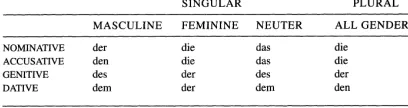
A linguistic paradigm is any kind of rational tabu-lation of linguistic forms, such as phrases, words, or phonemes, intended to illustrate contrasts and systematic variation (Bird, 1999). A characteristic property of paradigms is that interchanging entire rows or columns does not change the interpretation of the information. We view paradigms as a two-dimensional arrangement of elements and attributes, with optional row and column labels. An exam-ple of a paradigm for the German definite article is shown in Figure 1, with the labelling of number and gender at the top, and case on the left.
This paper describes a relational data model for linguistic paradigms, together with an XML based approach for representing and rendering them. An XSLT implementation provides proof of concept.1 This work presents a simple and general model for
1
The implementation is available from http: //www.csse.unimelb.edu.au/research/lt/ projects/paradigms/
Figure 1: Paradigm for German definite article (Finegan, 1999, 60)
the preservation and access of linguistic paradigms, and can generate an extensive range of useful visu-alisations.
This paper is organised as follows. In§2 we dis-cuss the existing computational models in linguistic paradigms and the lack of an existing formalism. In §3 we discuss the data model, while§4 and§5 we provide an example of how to generate and visualise a linguistic paradigm. In §6 we discuss the query engine implementation and motivate each opera-tion. In §7 we describe the transformation of the paradigm data into an XHTML presentation form. Finally, §8 discusses the significance of the work and outlines several areas for further investigation.
2 Background
Traditionally, there have been two sources for com-putational representations for linguistic paradigms, descriptive linguistic tools and technologies for lan-guages having complex morphology. There has been little formal work in either area concerning the best form for this linguistic data type. Here we examine some of the more widely-used models and their drawbacks.
Of the descriptive linguistic tools, perhaps the foremost are Shoebox2 and CHILDES.3 Shoebox is an interlinear text editor popular among field linguists for analysing linguistic transcripts. The underlying model is an attribute value set for each
2http://www.sil.org/computing/shoebox/ 3
[image:1.595.323.527.234.288.2]Tag Value Description
\id 1612 identifier (used for hyperlinks) \w mbhu orthographic form
\t LDH tone transcription \p n part of speech \pl me- plural prefix
\cl 9/6 noun class (singular/plural) \en dog English gloss
[image:2.595.78.266.70.175.2]\fr chien French gloss
Figure 2: Shoebox File Format, Adapted for Lin-guistic Paradigms (Bird, 1997)
entry, as shown in Figure 2. In the context of para-digms, each element corresponds to a cell in a table, and Shoebox can generate simple tabulated listings of forms which constitute a one-dimensional para-digm. The CHILDES CLAN tool supports tran-scription and analysis of conversation, and is widely used by psycholinguists in their study of child lan-guage acquisition. It has good search functional-ity that permits the generation of tabular reports. Despite their ability to generate simple paradigm-like reports, these systems do not provide an inter-face for generating arbitrary paradigms, nor do they permit paradigms to be saved in a format which per-mits reuse.
Outside purely linguistic description, work on computational morphology usually requires paradigms to be set up. For instance, Finnish and Romanian have such a large number of productive morphological processes it is impractical to list every form in the lexicon. Instead, regular derivational and inflectional processes are described using a formal system (such as a finite-state transducer). Groups of processes which apply to the same class of lexical items are sometimes referred to as a paradigm (e.g. (Tufis, 1989; Oflazer et al., 2001)). Unlike the descriptive viewpoint, in which a paradigm is a tabulation, here a paradigm is effectively treated as executable code which might be used to generate such tabulations. However, we are neutral on this issue since both viewpoints can be reconciled by treating a paradigm as a relation, as we do in§3.
3 Data Model
Linguistic paradigms associate linguistic forms with linguistic categories. For instance, the German def-inite article paradigm in Figure 1 categorises the form den as either masculine singular accusative or as dative plural. Systematic changes in layout, such as interchanging rows and columns, or flipping axes, have no affect on the associations between
D1 D2 D3 D0
gender number case content
masc sg nom der
masc sg acc den
masc sg gen des
masc sg dat dem
masc pl nom die
masc pl acc die
masc pl gen der
masc pl dat den
fem sg nom die
fem sg acc die
fem sg gen der
fem sg dat der
fem pl nom die
fem pl acc die
fem pl gen der
fem pl dat den
neut sg nom das
neut sg acc das
neut sg gen des
neut sg dat dem
neut pl nom die
neut pl acc die
neut pl gen der
neut pl dat den
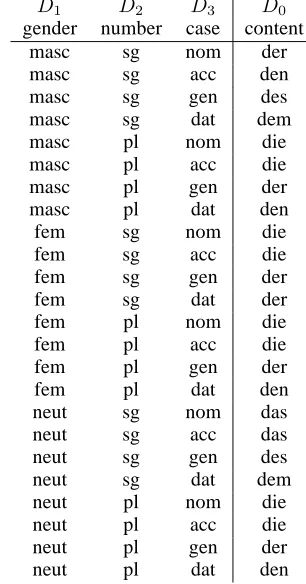
Figure 3: Function for the German Paradigm
forms and categories. Accordingly, a paradigm is a function that maps a vector of properties to content, as follows:
f :hmasc,sg,acci 7→den
Generalising, letD0. . . Dnbe a set of linguistic
properties (or domains). Then a paradigm is a func-tion:
f :D1× · · · ×Dn→D0
Let D1 = {masc,fem,neut}, D2 = {sg,pl}, and D3 = {nom,acc,gen,dat}. Also, let D0 = {der,die,das, . . .}. The functional representation of the German paradigm is shown in Figure 3.
Observe that the original paradigm display in Fig-ure 1 is a compact view of this table. It shows the domain values just once, and dispenses with the gender property for the plural forms.
Now, the above functional representation in Fig-ure 1 is just a relational table with schema German-Paradigm ( gender, number, case, content ). We can use domain relational calculus to extract the columns of the original paradigm for display, e.g.:
[image:2.595.346.499.74.366.2]∧t[gender] =‘masc’∧t[case] =s[case] ∧t[content] =s[content]}
= {hnom,deri,hacc,deni,hgen,desi,hdat,demi}
The same query is expressed in SQL as follows:
SELECT case, content FROM GermanParadigm WHERE number = "sg" AND gender = "masc".
nom, der acc, den gen, des dat, dem
Standard XML technologies provide a more con-venient way to map from this abstract representation to a range of visualisations. The relational table representation of a paradigm in XML is as follows:
<paradigm> <form>
<attribute name="gender" value="masc"/> <attribute name="number" value="sg"/> <attribute name="case" value="nom"/> <attribute name="content" value="der"/> </form>
... </paradigm>
XSL transforms provide a method to render this material into XHTML or into some other presenta-tional markup language for delivery to users. Using this approach we will accomplish a round-trip, from existing visualisations to the abstract model dis-cussed here, then back to visualisations. The next two sections describe this process in more detail.
4 Generating Paradigms
This section provides an overview of the steps required to produce a paradigm of possessive pronouns in Anejo ˜m, an Austronesian language of Vanuatu. The source data is from (Lynch, 1998). The process of generating paradigms is the same for paradigms that are more complicated, so the simplified Anejo ˜m paradigm provides a helpful introduction. First there is a simple examination of the paradigm structure which motivates the choice of model for the paradigm. Then, by investigating an example query and looking at how it is processed and presented, the intricacies and obstacles to an effective model are evident. This leads onto the discussion in §6 and §7 which provides the finer details of the implementation and presents more elaborate examples in order to reveal the strengths and weaknesses of the model.
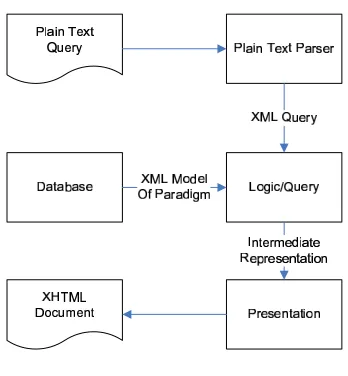
[image:3.595.340.514.74.262.2]Figure 4 shows the architecture of the system. The processing pipeline has three components: an
Figure 4: Architecture of System
Figure 5: Anejo ˜m Possessive Pronouns (Lynch 1998:106) - Scanned Version
XML model, a query engine, and a presentation engine.
Figure 5 shows a visualisation of a paradigm for Anejo ˜m. It displays suffix morphemes for posses-sive pronouns for different combinations of number and person. Each cell is characterised by its content and its attributes. For instance, the top right cell has content -n, a ‘number’ attribute whose value is ‘singular’, and a ‘person’ attribute whose value is ‘3’. Each attribute has a domain of possible values. For example, the domain of ‘number’ is ‘singular’, ‘dual’, ‘trial’ and ‘plural’. The content is likewise a domain, having values such as ‘-jau’ and ‘-mrau’. Figure 6 shows the XML model for Anejo ˜m. The attributes and their domains make up the first sec-tion, while the cells – the correspondences between content and attribute values, make up the second section.
<?xml version="1.0" encoding="UTF-8"?> <document>
<attributes>
<name name="person"> <value value="1.INC"/> <value value="1.EXC"/> <value value="2"/> <value value="3"/> </name>
<name name="number"> <value value="singular"/> ..
<value value="plural"/> </name>
<name name="content"> <value value="-"/> <value value="-jau"/> ..
<value value="-ra"/> </name>
</attributes>
<paradigm> <form>
<attribute name="person" value="1.INC"/> <attribute name="number" value="singular"/> <attribute name="content" value="-"/> </form>
<form>
<attribute name="person" value="1.INC"/> <attribute name="number" value="dual"/> <attribute name="content" value="-jau"/> </form>
.. <form>
<attribute name="person" value="3"/> <attribute name="number" value="plural"/> <attribute name="content" value="-ra"/> </form>
</paradigm> </document>
Figure 6: XML Model of Anejo ˜m Possessive Pro-nouns
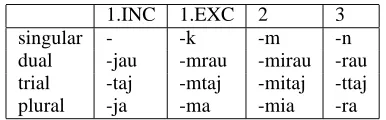
XML model of the paradigm. Here is an exam-ple. The Query 1 produces the visualisation of Fig-ure 7 from the XML model of FigFig-ure 6. Trans-lation 1 shows the full query. The table operator takes three arguments, the constraint applied to the vertical axis, the constraint applied to the horizontal axis, and the operation applied in each cell. The domain operation presents a list of all the values in a given domain. Note that the domain for the third argument of a table operation is different for each cell and determined by the values on the vertical and horizontal axes. Therefore Figure 7 shows a table with person and number as axes and content in the cells.
Query 1: table( person, number, content )
Translation 1: table( domain( person ), domain(
number ), domain( content ) )
1.INC 1.EXC 2 3
singular - -k -m -n
dual -jau -mrau -mirau -rau trial -taj -mtaj -mitaj -ttaj
[image:4.595.330.523.70.130.2]plural -ja -ma -mia -ra
Figure 7: Anejo ˜m Possessive Pronouns: Table -Reproduced Visualisation
1.INC singular -dual -jau trial -taj plural -ja 1.EXC singular -k
dual -mrau trial -mtaj plural -ma 2 singular -m
dual -mirau trial -mitaj plural -mia 3 singular -n
[image:4.595.319.541.168.365.2]dual -rau trial -ttaj plural -ra
Figure 8: Anejo ˜m Possessive Pronouns - Hierarchy induced by query
The model supports multiple visualisations of the data. For example, Query 2 produces a presenta-tion of the XML model in a tree-like structure. In Query 2 the shorthand ‘/’ symbol represents the hierarchy operation shown in Translation 2. The hierarchy operator takes two arguments, the con-straint that forms a list and the operation applied to each element of the list. This produces the visu-alisation of Figure 8. Nesting table and hierarchy operations allows presentation of paradigms that are more complicated and n-dimensional.
Query 2: person/number/content
Translation 2: hierarchy( domain( person ),
hier-archy( domain( number ), domain( content ) ) )
5 Realising Paradigms
<?xml version="1.0"?> <document>
<parse-tree>
<operator opcode="table" instruction="1"> <operand type="domain"
arg="horizontal">person</operand> <operand type="domain"
arg="vertical">number</operand> <operand type="domain"
arg="cell">content</operand> </operator>
</parse-tree> </document>
Figure 9: XML Version of Query 1
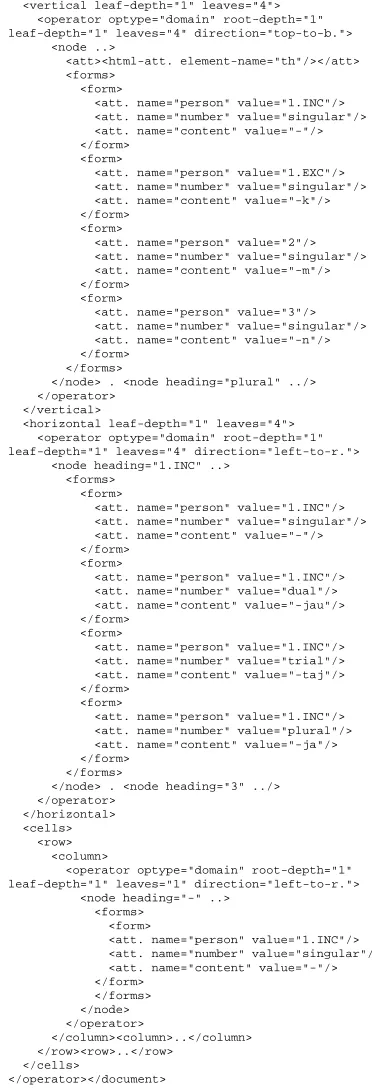
The logical transform generates an intermediate representation from the XML query and the XML source model. The XSLT processor performs a depth first traversal of the query expression. For example, in Query 1 control starts at the table oper-ation. The table operation requires calculating the domain of person and number before it can gener-ate the cells. The domain operation genergener-ates the output tree of Figure 10 with a node for each value in its domain. The processor generates nodes 1INC, 1EXC, 2 and 3 for person. It then places the forms from the source tree that match the domain value under the corresponding output node.
When processing the table operation the XSLT processor searches the output trees of the vertical and horizontal branches for child nodes. The XSLT processor generates a cell for each combination of vertical horizontal child pairs. The combined set of nodes for each cell form the domain of the third argument. In the example, the first cell of the paradigm has the following mapping:
vertical: singular{-, -k, -m. -n}
horizontal: 1.INC{-, -jau, -taj, -ja}
cell(1,1): {-}
<form>
<attribute name="person" value="1.INC"/> <attribute name="number" value="singular"/> <attribute name="content" value="-"/> </form>
The query domain(content) in cell (1,1) produces a single node with a value ‘-’. The extended XML output of the sheet is shown in Figure 10. At each node the XSLT processor tags the number of leaves and maximum depth of the tree which simplifies the presentation logic.
The presentational transform renders the intermediate representation into XHTML for display on web browsers. It traverses the
<?xml version="1.0"?>
<document><operator optype="table"> <vertical leaf-depth="1" leaves="4">
<operator optype="domain" root-depth="1" leaf-depth="1" leaves="4" direction="top-to-b.">
<node ..>
<att><html-att. element-name="th"/></att> <forms>
<form>
<att. name="person" value="1.INC"/> <att. name="number" value="singular"/> <att. name="content" value="-"/> </form>
<form>
<att. name="person" value="1.EXC"/> <att. name="number" value="singular"/> <att. name="content" value="-k"/> </form>
<form>
<att. name="person" value="2"/> <att. name="number" value="singular"/> <att. name="content" value="-m"/> </form>
<form>
<att. name="person" value="3"/> <att. name="number" value="singular"/> <att. name="content" value="-n"/> </form>
</forms>
</node> . <node heading="plural" ../> </operator>
</vertical>
<horizontal leaf-depth="1" leaves="4"> <operator optype="domain" root-depth="1" leaf-depth="1" leaves="4" direction="left-to-r.">
<node heading="1.INC" ..> <forms>
<form>
<att. name="person" value="1.INC"/> <att. name="number" value="singular"/> <att. name="content" value="-"/> </form>
<form>
<att. name="person" value="1.INC"/> <att. name="number" value="dual"/> <att. name="content" value="-jau"/> </form>
<form>
<att. name="person" value="1.INC"/> <att. name="number" value="trial"/> <att. name="content" value="-taj"/> </form>
<form>
<att. name="person" value="1.INC"/> <att. name="number" value="plural"/> <att. name="content" value="-ja"/> </form>
</forms>
</node> . <node heading="3" ../> </operator>
</horizontal> <cells>
<row> <column>
<operator optype="domain" root-depth="1" leaf-depth="1" leaves="1" direction="left-to-r.">
<node heading="-" ..> <forms>
<form>
<att. name="person" value="1.INC"/> <att. name="number" value="singular"/> <att. name="content" value="-"/> </form>
</forms> </node> </operator>
</column><column>..</column> </row><row>..</row>
</cells>
[image:5.595.311.497.109.653.2]</operator></document>
intermediate representation depth-first from the root. The XSLT document handles three classes of node; text leaves (node), text nodes with children (domains) and arrays of text nodes with children (tables). It must handle the following cases for each node; where the node is the contents of another node; and where the orientation of the node is vertical or horizontal. The next section provides further detail of how the query engine presents paradigms.
6 Operations
This section elaborates the domain, hierarchy and table operations, showing how they describe the presentation of a wide variety of linguistic para-digms. We also provide correspondences with rela-tional queries:
Query 3: person
Translation 3: domain(person)
The SQL equivalent of Translation 3 is as follows:
SELECT person FROM paradigm
person 1.INC
1.EXC
2 3
Query 4: person/number
Translation 4: hierarchy ( domain( person ),
domain ( number ) )
SELECT * FROM (
SELECT person FROM paradigm OUTER JOIN
SELECT number FROM paradigm );
person number 1.inc singular
dual trial plural 1.exc singular
dual
. .
. .
Query 5: table( person, number, content)
Translation 5: table( domain ( person ), domain (
number ), domain ( content ) )
Qv = SELECT person FROM paradigm; Qh = SELECT number FROM paradigm;
Qd = Qv OUTER JOIN Qh OUTER JOIN paradigm; Qc = SELECT content FROM Qd;
The domain and hierarchy queries have straightforward mappings to SQL as shown for Translation 3 and Translation 4. The interactions of the table operation are complex, especially when looking at the query that produces the cells. To build the table the parser generates the axes using the query for the vertical and horizontal axes with a direct mapping of the queries from the first two arguments as shown in Translation 5. In this case, it is the queries for domain(person) and domain(number) that produce the desired SQL. A projection of the vertical and horizontal values (Qv
[image:6.595.316.549.295.496.2]and Qc) form the domain (Qd) for each of the cells (Qc). Any query on the cells applies only to this new domain (Qd). The result of the query Qcis a list of values which fill the table from the top left corner.
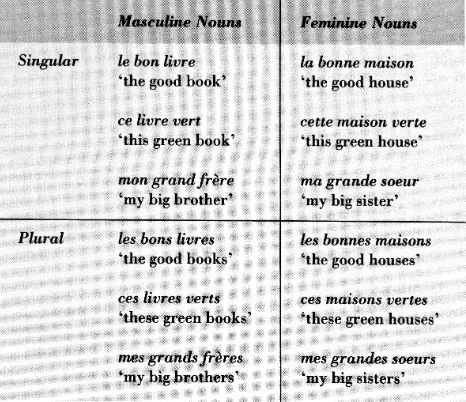
Figure 11: French concord (Crowley, 1992, 322)
This covers the simple case where the paradigm has just three-dimensions. There are however, paradigms that have many more dimensions. The French concord of Figure 11 has five dimensions and provides a good source for more complicated queries. Consider the following two queries:
Query 6: table (gender, number, language/phrase ) Translation 6: table( domain( gender ), domain(
number ), domain( language/phrase ) )
Qv = SELECT gender FROM paradigm Qh = SELECT number FROM paradigm
Qd = Qv OUTER JOIN Qh OUTER JOIN paradigm Qc =
SELECT * FROM (
SELECT language FROM Qd OUTER JOIN
Query 7: table( gender, number, language ) Translation 7: table( domain( gender ), domain(
number ), domain( language ) )
Qd = paradigm Qc =
SELECT * FROM (
SELECT language FROM Qd OUTER JOIN
SELECT phrase FROM Qd );
The difference in SQL for the cells between these two queries is the domain Qd. This represents the context for the query, its treatment is system-atic throughout the XSLT logic allowing nesting of queries. Query 8 and Query 9 show queries that produce two different structures for the French lan-guage data. Using combinations of domain, hier-archy and table operation it is possible to generate almost all presentation layouts.
Query 8: table( gender/number, case/language,
phrase )
Translation 8: table( hierarchy( domain( gender
), domain( number ) ), hierarchy( domain( case ), domain( language ) ), domain( phrase ) )
Query 9: table( gender, case, table ( number,
lan-guage, phrase ) )
Translation 9: table( domain( gender ), domain(
case ), table( domain( number ), domain( language ), domain( phrase ) )
7 Presentation
This section describes the implementation of the presentation engine. This is the most complex com-ponent in the system; it produces XHTML from the underlying XML representation. The XSL trans-form does the processing with each operation act-ing as event. The domain operation is the simplest operation. It handles three distinct cases; one case for producing a list of values; one for producing a horizontal table; and one for producing a vertical table. The processing produces the following code for each:
Row:
<tr><td>Item 1</td><td>Item 2</td></tr>
Column:
<tr><td>Item 1</td></tr> <tr><td>Item 2</td></tr>
Space separated list: Item 1 Item 2
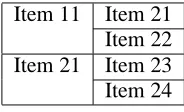
XSLT recursion solves the more difficult problem of constructing a hierarchy. The example of Table 1
[image:7.595.381.473.128.184.2]Item 11 Item 12 Item 21 Item 22 Item 23 Item 24
Table 1: Horizontal hierarchy of items.
Item 11 Item 21 Item 22 Item 21 Item 23 Item 24
Table 2: Vertical hierarchy of items.
is straightforward; each node has width equal to the number of its children (set with the colspan prop-erty). When the hierarchy is root, each level is a row with control grounded at the root. Control must be grounded at the root to avoid parts of the tree end-ing up in different rows. In Table 1 this equates to ‘Item 11’ and ‘Item 12’ forming one row and ‘Item 21’, ‘Item 22’, ‘Item 23’ and ‘Item 24’ forming the second row.
The same is true for the vertical realisation: the root node controls the generation of each row. How-ever, in this case, there is a need for a policy for when to generate XHTML nodes. The problem is the XHTML language has one nesting of row and column yet two directions of spanning cells. Thus, in Table 2, ‘Item 11’ produces a node in row one but not row two and ‘Item 21’ produces a node in row three but not row four. This causes serious difficulties for any program written in a functional language. The solution is an intricate variable pass-ing procedure where the generation of each label depends on whether it is the first node in the row. When it is first the label forms a cell with the rows-pan property equal to the number of children in the hierarchy.
The generation of tables comes in three parts; the generation of the vertical axis; the horizontal axis and the cells. The XSL transform leaves the top-left square of the paradigm blank to avoid connection ambiguity problems. The generation of the hori-zontal axis is the same as when the table did not exist, albeit appropriately shifted by the depth of the vertical axis. The table operator iterates over each row generating first the vertical heading for that row then the cells for that row. This maps to the XHTML design of the table where the declaration of the rows comes before the columns.
horizontal orientations. When supported this allows integration and presentation of arbitrary commands. In fact this XSLT framework can display any query that used operations from§6.
8 Conclusion
This paper describes an XML model for linguistic paradigms, including a query language and implementation, along with a model for generating presentations and an implementation. This work provides a flexible and extensible representation for storing multidimensional linguistic paradigms; and a simple yet powerful method for accessing and analysing stored data. This model allows the easy manipulation of paradigm structure, and easy presentation of systematic patterns and variations. We believe that the XML representation will be useful for archiving linguistic paradigms and for the interchange of paradigms between programs. We also believe the presentation system supports multidimensional exploration of complex linguistic datasets, a linguistic version of what is known in the database world as online analytical processing (OLAP).
In the future, we plan to investigate the following: ordering paradigm content; generating paradigms from interlinear text; and investigating a multi-table model. Ordering the cells of a paradigm is an issue because it complicates the axes, which then require the repetition of headings. The second line of enquiry is the generation and integration of paradigm presentation into interlinear text systems, which requires a level of machine learning combined with an understanding of how to integrate different levels of linguistic description. The other issue is how to represent some of the relationships within paradigms such as the phonetic characters for a vowel and its height (eg. ǫis a high vowel). We believe that the optimum solution for some of these problems is a multi-table model.
Acknowledgements
This paper extends earlier work by (Penton et al., 2004). This research has been supported by the National Science Foundation grant number 0317826 Querying Linguistic Databases.
References
Steven Bird. 1997. A lexical database tool for quantitative phonological research. In
Proceed-ings of the Third Meeting of the ACL Spe-cial Interest Group in Computational Phonology,
pages 33–39.
Steven Bird. 1999. Multidimensional exploration of online linguistic field data. In Pius Tamanji, Masako Hirotani, and Nancy Hall, editors,
Proceedings of the 29th Annual Meeting of the Northeast Linguistics Society, pages 33–47.
GLSA, University of Massachusetts at Amherst. Terry Crowley. 1992. An Introduction to
Histori-cal Linguistics, second edition. Auckland, NZ:
Oxford University Press.
Edward Finegan. 1999. Language: its structure
and use. Fort Worth: Harcourt Brace.
John Lynch. 1998. Pacific Languages: an
Introduc-tion. Honolulu: University of Hawai’i Press.
Kemal Oflazer, Sergei Nirenburg, and Marjorie McShane. 2001. Bootstrapping morphological analyzers by combining human elicitation and machine learning. Computational Linguistics,
27(1):59–85.
David Penton, Catherine Bow, Steven Bird, and Baden Hughes. 2004. Towards a general model for linguistic paradigms.
Dan Tufis. 1989. It would be much easier if went were goed. In Proceedings of the 4th European