A Survey on Efficient Location Tracker Using
Keyword Search
Prasad Prabhakar Joshi, Anand Bone
ME Student, Smt. Kashibai Navale Sinhgad Institute of Technology and Science Kusgaon (Budruk), Lonavala, Pune,
Maharashtra, India
Assistant Professor, Department of Computer Engineering, Smt. Kashibai Navale Sinhgad Institute of Technology and
Science Kusgaon (Budruk), Lonavala, Pune, Maharashtra, India
ABSTRACT: Spatial databases are stores the information about the spatial objects which are associated with the keywords to indicate information such as business/ features /services. Very important problem known as closest keywords search is to query objects, called keyword cover. In closest keyword search, it covers a set of query keywords and minimum distance between objects. From last few years, keyword rating increases its availability and importance in object evaluation for the decision making. This is the main reason for developing this new algorithm called Best keyword cover which is considers inter-distance as well as the rating provided by the customers through the online business review sites. Closest keyword search algorithm combines the objects from different query keywords to generate candidate keyword covers. Baseline algorithm and keyword nearest neighbor expansion algorithms are used to find the best keyword cover. The performance of the closest keyword algorithm drops dramatically, when the number of query keyword increases. To solve this problem of the existing algorithm, this work proposes generic version called keyword nearest neighbor expansion which reduces the resulted candidate keyword covers and adding user preference form historical search will give a better user experience.
KEYWORDS: Point of interests, Spatial database, keywords, keyword cover, keyword rating
I. INTRODUCTION
dramatically as a result of massive candidate keyword covers generated. To overcome this critical drawback, we developed much scalable keyword nearest neighbor expansion (keyword-NNE) algorithm which applies a different strategy. Keyword- NNE selects one query keyword as principal query keyword. The objects associated with the principal query keyword are principal objects.
II. RELATED WORK
Locating mapped resources in web 2.0: Mapping mashaps are emerging application in web 2.0 which contains object like photos videos etc. for example Google or yahoo mashups. Which contain set of coordinates indicate their geographical locations. It also provide information about tag matching technique which is used to locate an object Efficient algorithm to search for minimal closed cover in sequential machines: The state reduction in FSM is very complex problem. It provide efficient algorithm for state minimization in FSM. It also reduces search space and finds minimal close cover. Technique eliminates redundant states in a very short execution time.
Keyword search in special database towards searching by document: It used mCK query in a special database each tuple contain some descriptive information which is represented by using keywords mCK query finds specially closest tuples which matches with user specified keywords. It introduces a bR tree based or R tree.
Efficient continuously moving top k special keyword query processing: Now a day’s web data contains the geo information of users and content. The processing of continuously moving top k special keyword (MkSK) queries for special keyword data. It contains concept of safe zones which is nothing but validity of result until user remains in same zone but this method only focus on special locations not on textual data.
Fig. I. Existing system location choice with BKC vs mCK
III. PROPOSED ALGORITHM
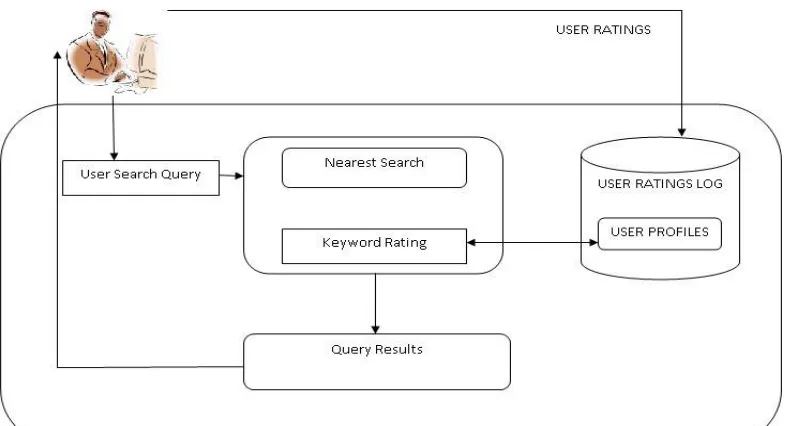
Developing much scalable keyword nearest neighbor expansion (keyword-NNE) algorithm which applies a different strategy. Also if adding user experience by users previous history will be a great parameter for better user experience. Keyword-NNE selects one query keyword as principal query keyword. The objects associated with the principal query keyword are principal objects. For each principal object, the local best solution (known as local best keyword cover lbkc) is computed. Among them, the lbkc with the highest evaluation is the solution of BKC query. Given a principal object, its lbkc can be identified by simply retrieving a few nearby and highly rated objects in each non-principal query keyword (two-four objects in average as illustrated in experiments). Compared to the baseline algorithm, the number of candidate keyword covers generated in keyword-NNE algorithm is significantly reduced. The in-depth analysis reveals that the number of candidate keyword covers further processed in keyword-NNE algorithm is optimal, and each keyword candidate cover processing generates much less new candidate keyword covers than that in the baseline algorithm. The proposed keyword-NNE algorithm applies a different processing strategy, i.e., searching local best solution for each object in a certain query keyword. As a consequence, the number of candidate keyword covers generated is significantly reduced also when we add user experience then the result we get will be user specific and always user centric for better performance. The analysis reveals that the number of candidate keyword covers which need to be further processed in keyword-NNE algorithm is optimal and processing each keyword candidate cover typically generates much less new candidate keyword covers in keyword-NNE algorithm than in the baseline algorithm.
IV. PSEUDO CODE
V. CONCLUSION AND FUTURE WORK
This system provides more sensible decision making than the mCK query. Baseline algorithm which is inspired by the mCK query. The main problem of baseline algorithm is that it reduces the performance when number of query keywords increases. Keyword-NNE algorithm applies a different strategy that searches the best solution in query keyword for each object. It reduces the generated candidate keyword covers. Baseline keyword covers are passed to keyword-NNE algorithm for further processing which is optimal and generates less new candidate keyword covers than the baseline algorithm
REFERENCES
[1] Ke Deng, Xin Li, Jiaheng Lu, and Xiaofang Zhou , Best Keyword Cover Search,IEEE Transactions on Knowledge and Data Engineering ,Volume:27 ,Year: 2015
[2] Ruicheng Zhong, Ju Fan, Guoliang Li, Kian-Lee Tan and Lizhu Zhou, Location-Aware Instant Search CIKM 12, October 29November 2, 2012, Maui, HI, USA
[3] Xin Caoy, Gao Cong, Christian S. Jensenz, Retrieving Top-k Prestige Based Relevant Spatial Web Objects, Proceedings of the VLDB Endowment, Vol. 3, No.1 , 2010.
[4] Ian De Felipe, Vagelis Hristidis, Naphtali Rishe, Keyword Search on Spatial Databases, in Proc. IEEE 24th Int. Conf. Data Eng., 2008, pp.656665
[5] Z. Li, K. C. Lee, B. Zheng, W.-C. Lee, D. Lee, and X.Wang,IRTree: An efficient index for geographic document search, IEEE Trans. Knowl. Data Eng., vol. 99, no. 4, pp. 585599, Apr. 2010.
[6] G. Cong, C. Jensen, and D. Wu,Efficient retrieval of the top-k most relevant spatial web objects, Proc. VLDB Endowment, vol. 2, no. 1, pp. 337348, Aug. 2009.
[7] D.Amutha Priya, Dr. T.Manigandan, Fast Accurate Mining on Spatial Database Using Keywords, International Journal for Research in Applied Science and Engineering Technology(IJRASET), Volume 3, Special Issue-1, May 2015.
[8] X .cao, G Cong, C Jensen COLLECTIVE SPATIAL KEYWORD QUERYING IN Proc.ACM SIGMOD Int. Conf manage. Data , 2011 ,pp.
373-Input: A set of query keywords T and a spatial database D Output: Best Keyword Cover
1.Assume that bck.score is 0
2.k - select the query keyword from set T 3.H - child nodes of the root in KRR tree; 4.foreach Nk belongs to H do
5. Compute local best keyword cover of new keyword nk
6. Add nk to H.head with max lbkc 7.while H is not zero do
8. while H:head is a node in KRR tree do 9. N is child of H.Head
10. for each Nk in N do 11. compute lbck score 12. Add new nk to H 13. Remove old head
14. new ok will be new H.Head 15. compute lbkc score of ok
16. check if bkc score is less than lbkc score of ok then 17. new lbck score will be bkc score for next iteration 18. for each NK in H
[10] Ruchir Puri, Student Member, IEEE, and Jun Gu, Senior Member, IEEE An Efficient Algorithm to Search for Minimal Closed Covers in Sequential Machines . IEEE TRANSACTIONS ON COMPUTER-AIDED DESIGN OF INTEGRATED CIRCUITS AND SYSTEMS. VOL. 12. NO. 6. JUNE 1993.