IMPROVING PROJECT DELIVERY PROCESS USING LEAN CONSTRUCTION APPROACH
SAMAILA ADAMU
IMPROVING PROJECT DELIVERY PROCESS USING LEAN CONSTRUCTION APPROACH
SAMAILA ADAMU
A thesis submitted in fulfilment of the requirements for the award of the degree of
Doctor of Philosophy (Quantity Surveying)
Faculty of Built Environment Universiti Teknologi Malaysia
DEDICATION
ACKNOWLEDGEMENT
Many thanks and gratitude goes to Allah the almighty who gave me the will, courage and means for this endeavour. After the salutations to prophet Muhammad (SAW), my heartfelt gratitude goes to my indefatigable supervisor, the source of my inspiration, Associate Professor Dr. Razali Bin Adul Hamid, whose guidance, tolerance and understanding in all situations ensured my smooth sailing, my gratitude once again, for his untiring effort in shaping the research journey. May Allah (SWA) make it among your sadaqatul Jariya. I also appreciate the companionship of my colleagues, whose assistance from beginning till end of the journey has helped in keeping me on track.
My gratitude and prayers also goes to my parents whose training, discipline and prayers made me who I am today, Rabbirhmhuma kama rabbayani sagira. Similarly, my gratitude goes to the Emir of Damaturu HRH Alhaji Shehu Hashimi II Ibn Umar Al-Amin Elkanemi for moral and financial support throughout this journey, may Allah SWT protect and guide him. My gratitude also goes to my brothers and friends who kept an eagle eye on my family and ensured their comfort and satisfaction in my absence. I will also not forget the Yobe state government for releasing me to pursue this course.
ABSTRACT
ABSTRAK
TABLE OF CONTENTS
CHAPTER TITLE PAGE
DECLARATION ii
DEDICATION iii
ACKNOWLEDGEMENT iv
ABSTRACT v
ABSTRAK vi
TABLE OF CONTENTS vii
LIST OF TABLES xvii
LIST OF FIGURES xx
LIST OF ABBREVIATIONS xxiii
LIST OF APPENDICES xxv
1 INTRODUCTION 1
1.0 Introduction 1
1.1 Background of the Research 1
1.1.1 Lean Construction 3
1.2 The Problem Statement 4
1.3 Research Gap 6
1.4 Research Question 6
1.5 Objective of the Research 7
1.6 Significance of the Research 7
1.7 Focus and Scope of the Research 8
1.8 Research Methodology 9
1.9 Limitation of the Research 10
2 NIGERIAN CONSTRUCTION INDUSTRY AND WASTE 14
2.0 Introduction 14
2.1 Geographical and Socio-Economic Characteristics
of Nigeria 14
2.2 Transformational Agenda 15
2.3 Over View Nigerian Construction Industry 17 2.4 The Contribution of Nigerian Construction
Industry to the Economy 19
2.5 Stakeholders of the Nigerian Construction Industry 21 2.6 The Actors in Nigerian Construction Industry 21
2.6.1 The Client 22
2.6.2 The Consultants 22
2.6.3 The Contractor 22
2.7 Project Delivery Methods 23
2.7.1 Traditional Procurement Method 23 2.7.2 Non-Conventional Procurement Method 24 2.7.3 Relational Contracting and Lean Project
Delivery 25
2.8 Construction Industry and Project Delivery Process 26 2.9 Waste and Non-Value Adding Activities 27 2.10 Sources of Waste and Non-Value Adding Activities 28 2.11 Summary of Material and Time Waste in Project
Delivery Process 32
2.12 Quantitative Construction Waste Estimation 35
2.12.1 Percentage Method 37
2.12.2 Generic Project Parameters/Variable 37
2.12.3 Macroeconomic Variables 38
2.13 Magnitude of Construction Waste Project
Delivery Process 38
2.14 Using Lean Construction Strategy to Address Waste
and Non-Value Adding Activities in Project Delivery 45
3 LEAN CONSTRUCTION TECHNIQUE 48
3.0 Introduction 48
3.1 Lean Construction 49 3.2 The Lean Thinking 50
3.3 Lean Thinking Adoption by Non-Automotive Sectors 51 3.4 History of Lean Production 54
3.5 Application of Lean Production Concept to Construction 56 3.6 Transformation, Flow, Value (TFV) Concepts 56
3.6.1 Transformation Concept 56
3.6.2 Flow Concept 57
3.6.3 Value Concept 57
3.7 Lean Project Delivery System 58
3.8 Lean Design and Construction Techniques/Tools 61 3.8.1 Last Planner System 61
3.8.1.1 Master Schedule (MS) 65 3.8.1.2 Phase Schedule (PS) 66
3.8.1.3 Lookahead Planning (60) 66 3.8.1.4 Weekly Work Plan (WWP) 67
3.8.1.5 Percentage Plan Completion (PPC) 67
3.8.2 Increase Visualization 68
3.8.3 Daily Huddle Meetings 70 3.8.4 First Run Studies 70 3.8.5 Fail Safe for Safety and Quality 71 3.8.6 The 5S Process (Visual Work Place) 71
3.8.6.1 Sort or Sorting 72
3.8.6.2 Straighten or Simplifying or Set in Order 72 3.8.6.3 Shine or Sweeping 72 3.8.6.4 Standardize or Standardizing 73
3.8.6.5 Sustain or Self Discipline 73 3.9 Benefits of Applying Lean Construction Approach 74
3.10 Factors for Successful Implementation of Lean Construction 79
3.10.1 Management 79
3.10.3 Education 80
3.10.4 Government 81
3.10.5 Technical 82
3.10.6 Human Attitude 82
3.11 Deficiencies of Traditional Project Delivery Process 83 3.12 Integrating Lean Construction Practice with Waste 86
3.12.1 Last Planner System (LPS) 87
3.12.2 Increased Visualisation 90
3.12.3 Daily Huddle Meetings 90
3.12.4 First Run Studies 91
3.12.5 5S Process 91
3.12.6 Fail Safe for Quality and Safety 92 3.13 Review of Developed Lean Framework 94
3.13.1 Framework for Promoting Safety Using
Lean construction 95
3.13.2 Conceptual Framework for Implementing
Lean Approach for Sustainable Construction 95
3.13.3 Lean Framework 96
3.13.4 Lean Enterprise Architecture 96
3.13.5 Lean Assessment Tool 97
3.13.6 The Framework for Management of Lean
Product Lifecycle 98
3.13.6.1 Understanding Customer’s Needs 98
3.13.6.2 Value Stream Mapping 98
3.13.6.3 Improving End-to-end Technical
process 99
3.13.6.4 Improving End-to-end People Process 99 3.13.6.5 Developing the Single Project Standard 99 3.13.6.6 Developing the Complete Process
Standard 100
3.13.7 Framework Describing Levels of Lean Capability 100 3.13.8 Impact Assessment Framework 101 3.14 Conceptual Framework Development 101
3.14.2 Processes 102
3.14.3 Output 103
3.14.4 Challenges/Barriers 104
3.14.5 Strategies for addressing the Challenges 104
3.15 Summary of Literature Review 106
4 RESEARCH METHODOLOGY 109
4.1 Introduction 109
4.2 Research Model 109
4.2.1 Quantitative Model 100
4.2.2 Qualitative Model 111
4.2.3 Mixed Mode Research Model 113
4.3 Selection of Research Model 113
4.3.1 The Research Problem 114
4.3.2 Audience 114
4.3.3 Researcher Experience 114
4.4 Action Research Model 116
4.5 Summary of Research model 119
4.6 Research Design 120
4.7 Data Collection Procedure 123
4.7.1 Procedure of Quantitative Data Collection 123
4.7.2 Procedure of Qualitative Data Collection 124
4.8 Sampling Methods 125
4.8.1 Probability Sample 125
4.8.1.1 Cluster Sampling 125
4.8.1.2 Systematic Samples 126
4.8.1.3 Simple Random Sampling 126
4.8.1.4 Stratified Random Sampling 126
4.8.2 Non-Probability Sampling 126
4.8.2.1 Quota Sampling 127
4.8.2.2 Snowball Sampling 127
4.8.2.3 Convenience Sampling 127
4.8.2.4 Purposive Sampling 127
4.9.1 Design of Questionnaire 129
4.9.2 Clarity 132
4.10 Quantitative Data Analysis 132
4.10.1 Descriptive Statistical Data Analysis 132
4.10.2 Inferential Statistics: Significance Level Testing 133
4.11 Case Study 134
4.12 Rationale Behind Selecting the Case Study 135
4.13 Unit of Analysis 135
4.14 The Qualitative Study 136
4.14.1 Sampling Technique Adopted 136
4.14.2 Data Collection Procedure Adopted 136
4.14.2.1 Project Manager and Supervisors 138
4.14.2.2 General Foremen and Key Specialist Foremen 138
4.14.2.3 Project Manager, Supervisors, contractors, and subcontractors 139
4.15 Qualitative Data Analysis 139
4.15.1 Familiarity with the Data 140
4.15.2 Transcribing the Data 140
4.15.3 Identification of Patterns 141
4.15.4. Generating the Initial Codes 141
4.15.5 Collating the Extracts 141
4.15.6 Reorganisation and Renaming of Themes 141
4.15.7 Discussion and Interpretation of Findings 142
4.15.8 Reliability and Validity Test. 142
4.15.8.1 Methodological Triangulation 144
4.15.8.2 Data Triangulation 144
4.15.8.3 Investigator Triangulation 145
4.15.8.4 Theory Triangulation 145
4.15.8.5 Environmental Triangulation 145
4.16 Documents Analysis 146
4.17 Observations 147
4.18 Development of Framework 147
4.20 Summary 149
5 DATA ANALYSIS AND DISCUSSIONS 1 WASTE AND NON-VALUE ADDING ACTIVITIES 151
5.1 Introduction 151
5.2 Frequency and Level of Waste Occurrences 152
5.2.1 Administration of Questionnaire and Response Rate 152
5.2.2 Analysis for Missing Value 155
5.2.3 Reliability Test 155
5.3 Data Analysis and Discussions 156
5.3.1 Frequency of Material Waste 156
5.3.1.1 Design Material Waste 159
5.3.1.2 Procurement Material Waste 160
5.3.1.3 Material Handling Waste 160
5.3.1.4 Operation Material Waste 161
5.3.1.5 Residual Material Waste 162
5.3.1.6 Other Material Waste 162
5.3.1.7 Summary of Material Waste Occurrences in Project Delivery 163
5.4 Frequency of Time Waste 165
5.4.1 Design Time Waste 168
5.4.2 Procurement Time Waste 169
5.4.3 Operation Time Waste 169
5.4.4 Other Time Waste 170
5.4.5 Summary of Time Waste Occurrences in Project Delivery 171
5.5 Discussions of Findings 173
5.5.1 Material Waste 174
5.5.2 Time Waste 176
5.6 Quantification of Material and Time Waste 178
5.6.1 Results and Findings 181
6 DATA ANALYSIS AND DISCUSSION 2
LEAN CONSTRUCTION ASSESSMENT 184
6.1 Introduction 184
6.2 Lean Case Study 184
6.3 Case Study A and B 188
6.3.1 Project Description 188
6.3.2 Data Collections 189
6.3.3 Field Study Implementation Assessment 189
6.3.3.1 Last Planner System 190
6.3.3.2 Increase Visualization 191
6.3.3.3 Fail safe for quality and safety 191
6.3.3.4 5S Process 192
6.3.3.5 Huddle Meetings 192
6.3.3.6 First Run Studies 192
6.3.4 Observations Results 193
6.3.4.1 Last Planner System 193
6.3.4.2 Daily Huddle Meetings 200
6.3.4.3 Increase Visualization 201
6.3.4.4 5S Process 202
6.3.4.5 Fail Safe for Quality and Safety 202
6.3.4.6 First Run Studies 203
6.3.5 Summary of Lean Tools Field Assessment 204
6.4 Interview Results Analysis for Case Study A and B 206
6.4.1 Introduction 207
6.4.2 Project Managers/Supervisors (A) and (B) Interview 208
6.4.3 Foremen for Contractors/Subcontractors interview Responses for Case Studies A and B 212
6.4.4 Strengths and Weaknesses 213
6.5 Questionnaire Responses and Analysis 214
6.6 Documents Analysis 216
6.6.1 Site Diaries Analysis 222
6.6.2 Summary of Case Studies A and B 228
6.7.1 Project Description 229
6.7.2 Data Collection 230
6.7.3 Observations Results 230
6.7.3.1 Last Planner 231
6.7.3.2 Huddle Meetings 232
6.7.3.3 Fail Safe for Quality and Safety 233
6.7.4 Interview Responses Analysis Case Study C and D 234
6.7.4.1 Project Manager/Supervisors C and D 234
6.7.4.2 Subcontractor’s Interviewees Results 237
6.8 Questionnaire Responses and Analysis 239
6.9 Documents Analysis 240
6.10 Case Studies E and F 250
6.10.1 Project Description 251
6.10.2 Data Collections 251
6.10.3 Field Study Implementation Assessment 252
6.10.3.1 Last Planner System 252
6.10.3.2 Increase Visualization 254
6.10.3.3 Daily Huddle Meetings 254
6.10.3.4 First Run Studies 254
6.10.3.5 Fail Safe for Quality and Safety 256
6.10.4 Project Manager/Supervisors E and F Interview Results 256
6.10.5 Subcontractor’s Interviewees 260
6.10.6 Questionnaire Responds Result and Analysis 261
6.10.7 Documents Analysis 263
6.11 General Summary of Case Studies 267
6.11.1 Interview and Observation 267
6.11.2 Questionnaire 269
6.11.3 Document Analysis 271
6.12 Data Triangulation 272
6.13 The Lean Implementation Framework 274
6.15 Validation of Research Framework 276
6.15.1 External Validation 277
6.15.2 Information on Respondents and Responses 278
6.16 Summary 283
7 CONCLUSIONS AND RECOMMENDATIONS 284
7.0 Introduction 284
7.1 Research Findings 284
7.2 Contribution to Knowledge and Practice 287
7.3 General Conclusion 288
7.4 Recommendation and Future Research 289
7.5 Recommendation to Practice 290
LIST OF TABLES
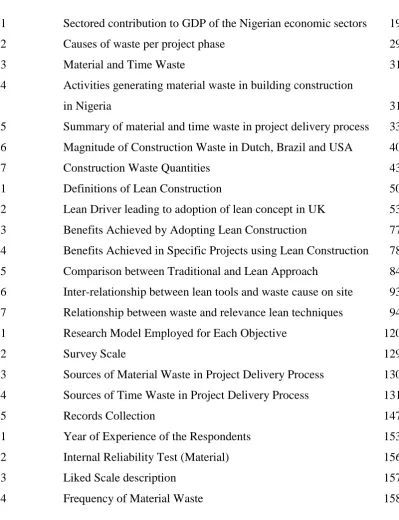
TABLE NO. TITLE PAGE
2.1 Sectored contribution to GDP of the Nigerian economic sectors 19
2.2 Causes of waste per project phase 29
2.3 Material and Time Waste 31
2.4 Activities generating material waste in building construction
in Nigeria 31
2.5 Summary of material and time waste in project delivery process 33 2.6 Magnitude of Construction Waste in Dutch, Brazil and USA 40
2.7 Construction Waste Quantities 43
3.1 Definitions of Lean Construction 50
3.2 Lean Driver leading to adoption of lean concept in UK 53
3.3 Benefits Achieved by Adopting Lean Construction 77
3.4 Benefits Achieved in Specific Projects using Lean Construction 78
3.5 Comparison between Traditional and Lean Approach 84
3.6 Inter-relationship between lean tools and waste cause on site 93 3.7 Relationship between waste and relevance lean techniques 94
4.1 Research Model Employed for Each Objective 120
4.2 Survey Scale 129
4.3 Sources of Material Waste in Project Delivery Process 130
4.4 Sources of Time Waste in Project Delivery Process 131
4.5 Records Collection 147
5.1 Year of Experience of the Respondents 153
5.2 Internal Reliability Test (Material) 156
5.3 Liked Scale description 157
5.5 Summary of material waste occurrence effects 164
5.6 Internal Reliability Test (Time) 165
5.7 Time waste 166
5.8 Summary of time waste occurrence effects 172
5.9 Descriptive Statistics Material Waste 178
5.10a One Sample t-test Material Waste 179
5.10b Description 95% Confidence Interval t-test Material Waste 179
5.11 Descriptive Statistics Time Waste 180
5.12a One Sample t-test Time 180
5.12b Description 95% Confidence Interval t-test Time Waste 181
6.1 Case study projects description 187
6.2 Phases scheduling for case studies A and B 195
6.3 Root cause for failure 200
6.4 Interview responds of PM’s of case study A and B 209
6.5 Summary of responds from project team case (project managers, supervisors and engineer) case studies A and B 215
6.6 Summary of responds from contractors and subcontractors foremen case studies A and B 216
6.7 Material waste assessment from site diary data case study A 219
6.8 Time waste assessment from site diary data case study A 220
6.9 Summary of material and time waste for case A lean and non-lean projects 221
6.10 Material waste assessment from site diary data case study B 225
6.11 Time waste assessment from site diary data case study B 226
6.12 Summary of material and time waste for case B lean and non-lean projects 227
6.13 Interview result of case study C and D with PM 235
6.14 Summary responds of project managers, supervisors and engineer case C and D 239
6.15 Contractors and subcontractors, foremen survey case studies C and D 240
6.16 Material waste assessment from site diary data case study C 241
6.18 Summary of material and time waste for case study C lean
and non-lean projects 243 6.19 Material waste assessment from site diary data case study D 246 6.20 Time waste assessment from site diary data case study D 247 6.21 Summary of material and time waste for case D lean
and non-lean projects 248 6.22 Productivity improvement for lean project 250 6.23 Interview result of case study E and F with PM 258 6.24 Questionnaire response from project team in case
studies E and F 262
6.25 Contractors and subcontractors’ foremen survey
case studies E and F 263 6.26 Material and time waste assessment from site diary
data case study E 264
6.27 Material and time waste assessment from site diary
data case study F 266
6.28 Summary of questionnaire response from PM, Sup. &
Engr.’s survey 270
LIST OF FIGURES
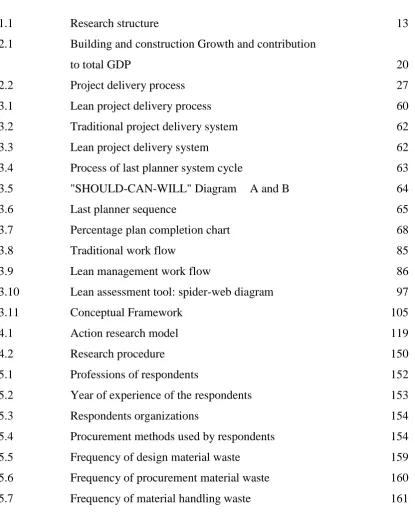
FIGURE NO. TITLE PAGE
1.1 Research structure 13
2.1 Building and construction Growth and contribution
to total GDP 20
2.2 Project delivery process 27 3.1 Lean project delivery process 60
3.2 Traditional project delivery system 62
3.3 Lean project delivery system 62
3.4 Process of last planner system cycle 63
3.5 "SHOULD-CAN-WILL" Diagram A and B 64 3.6 Last planner sequence 65
3.7 Percentage plan completion chart 68 3.8 Traditional work flow 85
3.9 Lean management work flow 86
3.10 Lean assessment tool: spider-web diagram 97
3.11 Conceptual Framework 105
4.1 Action research model 119
4.2 Research procedure 150
5.1 Professions of respondents 152
5.2 Year of experience of the respondents 153
5.3 Respondents organizations 154
5.4 Procurement methods used by respondents 154
5.5 Frequency of design material waste 159
5.6 Frequency of procurement material waste 160
5.8 Frequency of operation material waste 161
5.9 Frequency of residual material waste 162
5.10 Frequency of other material waste 163
5.11 Summary of material waste occurrence 164
5.12 Frequency of design time waste 168
5.13 Frequency of procurement time waste 169
5.14 Frequency of operation time waste 170
5.15 Frequency of other time waste 171
5.16 Summary of time waste occurrence 173
6.1 Showing the researcher conducting lean coaching 194
6.2 Phase planning meeting 195
6.3 WWP meeting sessions 197
6.4 Percentage plan completions (PPC) case study A 198
6.5 Sequence of last planner implementation 198
6.6 Percentage plan completions (PPC) case study B 199
6.7 Soil pipes laid down by plumber in case study B 199
6.8 Daily huddle meetings session on site case study B 201
6.9 Rework occurrence in non-lean project case study A 203
6.10 JIT supply of filling material in lean projects 204
6.11 Showing materials placed near operation in lean projects 204
6.12 Case study A lean and non-lean project 205
6.13 Case study B lean and non-lean project 206
6.14 Chart showing material waste for lean and non-lean projects in case study A 222
6.15 Chart Showing Time Waste for Lean and Non-Lean Projects Case Study A 223
6.16 Chart showing material waste for lean and non-lean projects in case study B 228
6.17 Chart showing time waste for lean and non-lean projects in case study B 228
6.18 Case study C starting lean implementation 231
6.19 Case study D lean implementation 231
6.20 Case studies C and D completed 233
6.22 PPC chart for case study D 237 6.23 Chart showing material waste for lean and non-lean
projects in case study C 244 6.24 Chart showing time waste for lean and non-lean
projects in case study C 245 6.25 Chart showing material waste for lean and non-lean
projects in case study D 249 6.26 Chart showing time waste for lean and non-lean
projects in case study D 249
6.27 PPC chart case study E 253
6.28 PPC chart case study F 253
6.29 Work in progress matching crew to work case study E. 255 6.30 Work in progress matching crew to work case study F 256 6.31 Chart showing material and time waste for lean
projects in case study E 265 6.32 Chart showing material and time waste for lean
projects in case study F 267 6.33 Data triangulation 273
6.34 Lean construction implementation framework 275 6.35 Respondents Background 279
6.36 Respondent’s Occupation 279
LIST OF ABBREVIATIONS
GDP - Gross Domestic Product NIOB - Nigerian Institute of Building USA - United States of America
UK - United Kingdom
NBS - National Bureau of Statistics
SPSS - Statistical Package for Social Science NIP - National Implementation Plan
3Cs - Commitment, Consistency and Continuity 3Ps - Policies, Projects and Programs
CIDB - Construction Industry Development Board AGM - Annual General Meeting
CI - Construction Industry
BLDG - Building
CAGR - Compound Aggregate Growth Rate PPP - Public Private Partnership
DBFT - Design, Build, Financed and Transfer BOO - Build, Operate and Own
BOT - Build, Operate and Transfer
DBFO - Design Build, Finance and Operate
BOOST - Build, Own, Operate, Subsidize and Transfer BOOT - Build Operate, Own and Transfer
BLT - Build Lease and Transfer ROT - Renovate Operate and Transfer IFOA - Integrated Form of Agreement BOQ - Bill of Quantities
JIT - Just-In-Time
TQM - Total Quality Management TPS - Toyota Production System TFV - Transformation, Flow, Value LPDS - Lean Project Delivery System
MS - Master Schedule
PS - Phase Schedule
RPS - Reverse Phase Schedule
LP - Lookahead Planning
SWLA - Six Week Lookahead
FWLA - Four Week Lookahead
WWP - Weekly Work Plan
PPC - Percentage Plan Completed
FISCA - Factors Influencing Scottish Construction Accidents PDCA - Plan, Do, Check & Act
5S - Seiri, Seiton, Seiso, Seiketsu Shitsuke LIP - Lean Implementation Programme
CE - Construction Excellence
BRE - British Research Establishment CPM - Critical Path Method
IGLC - International Group for Lean Construction LPS - Last Planner System
WBS - Work Breakdown Structures TQC - Total Quality Control
LEA - Lean Enterprise Architecture QFD - Quality Function Deployment
KIVP - Knowledge Innovation Visible Planning EME - Extended Manufacturing Enterprise
FA - Factor Analysis
NGO - Non-Governmental Organisation
N - Number
WOLI - Waste Occurrences Level Indicator WSM - Material Waste
LIST OF APPENDICES
APPENDIX TITLE PAGE
A Letter of ethics approval case study A 333 B Letter of ethics approval case study B 334 C Frequency and level of waste survey instrument 335 D Project managers and supervisor’s interviews 339 E General foremen and key specialist foremen interview 342 F Project manager, engineers and supervisors survey 344 G Foremen of contractor and sub-contractor survey 347 H Framework validation questionnaire 349
I Material inspection note form 353
J Inspection and status form 354
K Non-conformity note form 355
L Project production check list form 356
M Site diary 357
N Training manual 358
O SWLA form 359
P WWP and PPC Form 360
Q Last planner: lookahead constraints analysis form 361
CHAPTER 1
INTRODUCTION
1.0 Introduction
The motivation behind the study was based on the call by the federal government of Nigeria for the transformation of the key sectors of the economy through its transformational agenda 2011 to 2015 programs. The Nigerian construction industry is one of the key sectors of the Nigerian economy; it contributes about 3.74% of gross domestic product (GDP) in 2011 (Statistics, 2012). A challenge was thrown to professionals in the construction industry by Hon. Minister of Housing to come up with a holistic solution of addressing the current problems in the construction industry for sustainable development (42nd National Conference/AGM NIOB, 2012). This study will look at the possibility of applying lean construction tools in construction sites in Nigeria, and assess its suitability in managing and controlling activities in the project delivery process for the minimization or possibly elimination of waste and non-value adding activities, for improving the construction process and the creation of value to the owner, by improving productivity.
1.1 Background of the Research
so on (Abdulhameed et al., 2012; Oyewobi et al., 2011). The industry is also facing continues decrease in profit margin which lead to claims for variations (Adamu and Howell, 2012; Adamu et al., 2012). All these ensuing from poor project planning (Olusegun and Machael, 2011; Oke and Ogunsemi, 2011; Adamu and Abdulhamid, 2012), uncompleted design during the project delivery (Aina and Wahab, 2011; Windapo and Matins 2010), waste generation due to bureaucracy, delay from material suppliers, variations and poor site management (Dlakwa and Culpin, 1990; Oke and Ogunsemi, 2011; Adeagbo, 2014), and unethical behaviours in some government works in form of fraudulence practice and kickback (Mansfield et al., 1994; Olomolaye et al., 1987). All these problems are peculiar to the Nigerian construction industry which attribute to its low productivity, high cost and time overrun, poor quality of the products produced.
1.1.1 Lean Construction
Lean Construction was developed based on production management method of project delivery, is a new technique of project delivery that can be adopted to any type of construction, mainly suitable for quick, uncertain and complex project (Howell, 1999). Lean Construction is just as the current practice has objective of better meeting customers need while using of minimum or smaller amount of everything, but different from the current practice because production management philosophy is the basis of lean construction. It is a “physics” of construction. “Physics” is the word borrowed from production philosophy, which means “factory of physics” an exceptional wording on production management (Hopp and Spearman, 1996). Lean management in production has made a great revolution to the manufacturing industry, from design stage, supply chain and assembling. When adapted from manufacturing to construction, it changes the method of the work right through the project delivery process. The lean management approach differs from traditional management approach, as lean pull concept of scheduling opposes to traditional push concept. Lean construction emerges from the objectives of lean production systems, i.e. minimization of waste and maximization of end value to users using specific approaches by applying them in the new concept of project delivery (Howell, 1999). Because of these changes:
The delivery process of a facility and the definition of the facility were designed collectively to better meet the user’s expectation and support client purposes. Negative iterations are reduced in the process while positive iterations are allowed and supported.
Work is planned all through the process to reduce waste and increase value at the project delivery level.
Effort for improvement of performance and its’ management are targeted towards improving general project performance. As it is better than to increase the speed of an activity or reduction of cost.
1.2 The Problem Statement
The current yield of the Nigerian construction industry suffers continues decrease, as its contribution to GDP continues to fluctuate up and down every year as per report of the National Bureau of Statistics (2012). The average GDP contribution of Building and Construction sector for ten year after the independence records shows that, from 1971-1980 was 8.3%, 1981-1990 was 2.3%, 1991-2000 was 1.8%, 2001-2010 was 1.8% and for 2011 was 1.79%. While in the last quarter of 2012 it records 1.14%. As per records of NBS (2015), the average GDP contribution of the construction sector for 2012 maintained 1.79% and dropped to 1.62% in 2013. In 2014, the contribution made in 2013 dropped down by 0.46%. Currently, the record from NBS shows that the construction sector recoded GDP contribution of 11.24% in 2015 and dropped to 7.47% in 2016 (NBS, 2016) with all the efforts of investment in the sector by public and private sectors. The industry is also characterized with continued decrease of profit margin, increase in defects and rework, cost and time overrun, abandoned and uncompleted project due poor project definition, control and management of the project delivery process, unnecessary waste generation and non-value adding activity (Olusegun and Machael, 2011; Oke and Ogunsemi, 2011). Even so, it was demonstrated that lack of proper application of innovative approaches is among the many contributing factors associated with the recorded failure in the GDP contribution and a poor image of the industry (Adamu and Howell, 2012; Adamu et al., 2012; Adeagbo, 2014). Accordingly, waste generation and non-value adding activities were also found to be attributing factors in the poor project delivery (Oke and Ogunsemi, 1991; Dlakwa and Culpin, 1990; Adeagbo, 2014; Ahiakwo et al, 2012; Ahiakwo et al, 2014). All this research identified these problems without offering solution of solving them. The success of any project is largely dependent upon proper tools of planning, control, management, and elimination of waste and non-value activities in the industry, (Sacks and Goldin, 2007; Memon et al, 2013) as enunciated by the extant.
approach that can go beyond the normal traditional research of descriptive or explanatory research should be adopted to address the persistent practical construction management problems, and contribute to construction management knowledge. An action research, constructive research and design science research are suggested to be the best suitable research model for this situation (Aken, 2005; Jarvinen, 2007; Azhar, et al.,2010; Koskela, 2008; Alsehaimi et al, 2009; Voordijk, 2009; Jang et al, 2010).
Challenging the traditional construction approach, lean construction approach is a production-based management philosophy that stresses the removal of waste and non-value adding activities in the project delivery process. Starting from the project design stage to delivery processes of a construction project using lean ideologies advocated by Ohno (Fewings, 2013). It is a continuous process for the elimination of material and time wastages, with determination of meeting or exceeding client’s requirements, at the same time focusing on the value stream and pursuing continuous perfection in the project delivery process (Koskela et al 2002; Salem and Zimmer 2004).
It was enunciated by extant that adopting lean construction approach in project delivery on sites could address the problem of waste and non-value adding activities occurrences (Houvila and Koskela, 1998; Howell and Ballard, 1999; Saurin et al., 2002; Thomas et al., 2005; Salem et al. 2007; Schafer et al, 2008; Mossman 2009). The lean construction concept has been adopted by some developed nations in their construction industry at the project sites, and remarkable benefits were achieved at the projects levels (Nahmens and Ikuma, 2009; Koranda et al., 2012). Lean construction tools have been used in many countries to improve co-ordination, planning, control, productivity, communication, collaboration, teamwork, learning and project performance success in projects (Alarcon, 1997; Tommelein and Ballard, 1997; Fiallo and Revelo, 2002; Ballard et al, 2009; Gonzalez et al, 2010; Mossman, 2012). Nevertheless, there is no any empirical evidence that relays the implementation of lean construction concepts in the Nigerian construction sites.
1.3 Research Gap
After enlightening the economic role, the construction industry played in Nigerian, and its ugly status in terms of waste generation and on-value adding activities occurrences in the project delivery process. Consequently, with recognition of the effect of waste and non-value adding activities, which leads to cost and time overrun, and decrease in productivity and profit margin, there is no comprehensive data on frequency and level of waste and non-value adding activities occurrence in the project delivery process. Similarly, there is scarce information on how to address these menaces in the construction site. Subsequently, there is little attempt to use lean construction to improve the project delivery process in terms of waste and non-value adding activities occurrences in the construction site. Based on this gap, this research come with this aims. To develop a framework for the implementation of the lean construction in Nigerian construction site to improve the project delivery process. To achieve the research, aim the following research questions were raised.
1.4 Research Question
1 What is the frequency and level waste generation and non-value adding activity occurrence in the current project delivery of Nigerian construction
sites? This question is aimed at exploring the literature to generate a survey
questionnaire using expert opinion to establish the frequency and level of waste and non-value adding activities occurrence in the current project delivery process in the Nigerian construction industry.
2 Can the adoption of lean construction approach in Nigerian construction sites eliminate waste and non-value adding activities in the project delivery
process? This question is aimed at broadening our knowledge to understand
the benefits of applying lean construction approach in Nigeria construction sites, through assessing the implementation of lean tools in the case study sites.
3 How can lean construction approach be implemented in Nigerian
to propose a detail framework for the implementation of lean construction in the construction sites to address the problems of colossal waste and non-value adding activities occurrences in project delivery process of Nigeria.
To answer the research questions and pursuance to achieving the main aim of the research, the following objectives were developed.
1.5 Objective of the Research
1. To determines the frequency and level of waste and non-value adding activities occurrences in the current projects delivery process in Nigerian construction sites.
2. To assess the implementation of lean construction techniques in Nigeria construction sites, and established its contribution towards the elimination of waste and non-value adding activities.
3. To develop and propose a framework for the implementation of lean construction in Nigerian construction site.
1.6 Significance of the Research
The poor image of Nigerian construction industry in terms of waste and non-value adding activities occurrence is well documented in literature. Similarly, the application of lean construction to address the problem of waste and non-value adding activities has been established by many researches. Therefore, this research will contribute to the body of knowledge by revealing.
A clear picture for the benefits of lean construction implementation in the Nigerian construction site to address the problems of waste and non-value adding activities.
Remarkably, the study has come up with lean construction implementation framework to guide the government and organizations to implement lean construction on sites to eliminate waste and non-value adding activities. This will be presented as a gizmo of project delivery process improvement.
To guide the research and pursuant to these objectives, the study was design to be conducted within certain parameters.
1.7 Focus and Scope of the Research
1.8 Research Methodology
This study adopted an action research model, using mixed mode for data collection. Action Research Model is a method use to facilitate change by participating or being involve in the system’s operation in a diagnostic, active learning, problem finding and problem solving process (Jarvinen, 2007). Action research is either research initiated to solve an immediate problem or a reflective process of progressive problem solving led by individuals working with others in teams or as part of a "community of practice" to improve the way they address issues and solve problems (John and Sons, 2010). There ten features why using action research, these will be discussed in detail in Methodology chapter.
The study relies on a literature review to develop the survey questionnaire for the realisation of the first objective. The survey was undertaken within the professional in the construction industry, which includes architect’s engineers, project managers, builders, quantity surveyors and others. The quantitative data collected will be analysed using descriptive and inferential statistics using the Statistical Package For Social Science (SPSS) software to explore the frequency and level of material and time waste occurrences in current project delivery process. Cronbach Alpha will be used to test the internal reliability of the questionnaire.
thematically using classical content analysis for the interview, descriptive and inferential statistic for the questionnaire. The lean projects are compared with non-lean implemented projects to identify the benefit of the lean construction implementation. The data collected and analysed will be synthesised to develop a lean implementation framework. The framework will show how lean construction approach will improve the project delivery process in construction site in terms of waste and non-value adding activities. Detail methodology will be described in chapter 4 including the sampling method adopted.
1.9 Limitations of the Research
This research was conducted in Nigerian construction sites, using the site and the practitioners in the construction industry as unit of analysis. Lean construction is not yet implemented in construction site in Nigeria, therefore, there are limited practitioners with knowledge on lean construction implementations. The data collection procedure was limited to the case study sites only, and people involved in training conducted and the lean projects execution.
Due to this limitation, the research was conducted in the projects that were managed using lean construction approach only, and validations were made with expert that have experience in lean construction practice.
1.10 Structure of Thesis
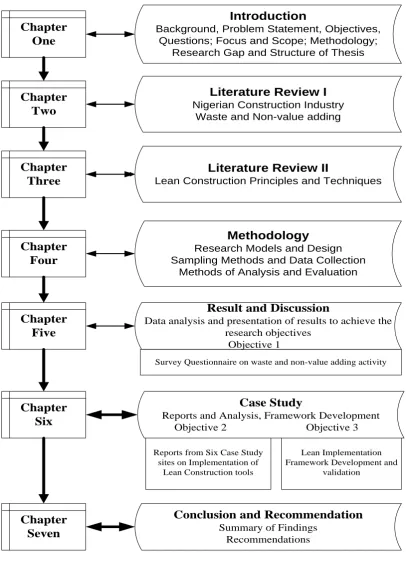
The first chapter gives an introduction of the research, by highlighting the background of the research, and how the studies was conducted from literature review to development of the research problem and research gap. Furthermore, the research goal was defined by stating the aim of the study. Subsequently, the research questions and objectives were stated and clearly outlined. The significance of the research was outlined, and the scope and focus of the study was identified And the methodology adopted for the research was outlined, followed by the research limitations. And finally, the structure of the thesis was presented in Figure 1.1.
The second chapter reviews literature on Nigerians transformational agenda and the theory on the Nigerian construction industry in term of investment and output and the problems of traditional project delivery. Comprehensive literature review on waste and non-value adding activity that exist and efforts in addressing the problems were discussed in this chapter.
The third chapter entails an in-depth review of literature and on theoretical background of lean construction, and outline the benefits achieved by the adoption of lean construction approach by developed nations and emerging economy. Different lean frameworks developed from previous studies were reviewed and conceptual framework was developed in this chapter.
The fourth chapter will outline the research methodology used for the study. It presents in detail the philosophical paradigm, theories, strategies and methods adopted during the research. It gives details of how the research was conducted in responds to the research problem and question. That is describing different research models and research designs and reason for selecting action research using mixed mode model. It will demonstrate how quantitative and qualitative data are collected and analysed to address the objective of the research.
The sixth chapter presents the lean construction implementation reports, how data was collected and analysed. Then, presents the findings for both quantitative and qualitative data. Subsequently, synthesised the results and generates an analytical outcome to present the framework. The framework and its relevance are also presented. The validation of the framework process and its result are also presented in this chapter.
Chapter One
Introduction
Background, Problem Statement, Objectives, Questions; Focus and Scope; Methodology;
Research Gap and Structure of Thesis
Chapter Three
Literature Review I
Nigerian Construction Industry Waste and Non-value adding
Chapter Four
Methodology
Research Models and Design Sampling Methods and Data Collection
Methods of Analysis and Evaluation
Chapter Five
Survey Questionnaire on waste and non-value adding activity
Reports from Six Case Study sites on Implementation of
Lean Construction tools
Lean Implementation Framework Development and
validation
Result and Discussion
Data analysis and presentation of results to achieve the research objectives
Objective 1
Chapter Six
Case Study
Reports and Analysis, Framework Development
Objective 2 Objective 3
Literature Review II
Lean Construction Principles and Techniques
Chapter Two
Chapter Seven
Conclusion and Recommendation Summary of Findings
Recommendations
REFERENCES
Abdulhameed, A. S., Bungwon, H. D., and Sheyin, A. Y. (2012). Construction Methodology in the Delivery of Building Projects in Nigeria. Proceedings of 42nd National Conference and Annual General Meeting of Nigerian Institute of Building 78-88. 11th-15th July; Enugu Nigeria
Abdelhamid, T., and Salem, S. (2005). Lean construction: a new paradigm for managing construction projects. In The International Workshop on Innovations in Materials and Design of Civil Infrastructure, Cairo Egypt. http://www.researchgate.net/publication /242085758_ Lean Construction New Paradigm For Managing Construction Projects, accessed 02/09/2013
Abdulai, T. R. (2007) The Operation of Urban Traditional Landholding Institutions in Sub-Saharan Africa: A Ghana Study. PhD Thesis, School of Engineering and the Built Environment, University of Wolverhampton.
Abdullah, F. and Rajgopal, J. (2003) Lean Manufacturing in the Process industry. Proceedings of the Industrial Engineers Annual Research Conference, 1-6 September, Norcross, GA.
Abdullahi, S., Abdul Razak, A., Abu-Bakar, A., and Sarrazin, I. (2009). Towards Producing Best Practice in Malaysian Construction Industry; The Barriers in Implementing the Lean Construction Approach. Procedings of International Conference of Construction Industry, 30th July-1st August, 2009, Padang Indonesia.
Case Study. International Journal of Production Economics, 107, pp. 223– 236.
Achanga, P. (2007). Development of an impact assessment framework for lean manufacturing within SMEs. A PhD thesis submitted to Cranfield University for the requirement of Doctor of Philosophy
Adamu, I., and Howell, G. A. (2012). Applying Last Planner in Nigerian Construction Industry. Proceedings of 20th Annual Conference of International Group for Lean Construction. . 18th-20th July San Diego, CA, USA.
Adamu, S., and Abdulhamid, R. A., (2012). Lean Construction Techniques Implementation in Nigeria Construction Industry. Canadian Journal on Environment, Construction and Civil Engineering (3) 4 Pp.186-192
Adamu, S., Howell, G. A. , and Abdulhamid, R. (2012). Adopting Lean Construction Technique in Nigerian Construction Industry. International Journal of Scientific and Engineering Research, 3(12).
Adeagbo, A. (2014) Overview of The Building And Construction Sector In The Nigerian Economy Jorind 12 (2) December, 2014. ISSN 1596-8308. www.transcampus.org/journals; www.ajol.info/journals/jorind Economic Policy Research Department Nigerian Institute of Social and Economic Research, Ibadan
Adesanya, O. (2008). Project Procurement Path. The Journal of the Federation of Construction Industry, 23(3), 6-21.
Adewuyi, T. O. and Odesola I. A. (2015) Factors Affecting Material Waste on Construction Sites in Nigeria Journal of Engineering and Technology Vol 6. No. 1 January-June
Adewuyi, T.O. And Otali, M. (2013) Evaluation of Causes of Construction Material Waste -- Case of Rivers State, Nigeria Ethiopian Journal of Environmental Studies and Management Vol. 6 Supplement 2013
Ahiakwo, O., Oloke, D. and Suresh, S (2014) Improving Project Planning and Control in Construction by implementing Last Planner Systems in Nigeria. International Council for Research and Innovations in Building and Construction (CIB W107 2014) 28th – 30th Jan
Aibinu, A.A., and Jagboro, G.O. (2002). The Effects of Construction Delay on Project Delivery in Nigerian Construction Industry. International Journal of Project Management, 20(8), 593-599.
Aina, O. O., and Wahab, A. B. (2011). An Assessement of Build Ability Problems in Nigeria. Construction Industry Global Journal of Research Engineering, 2(11).
Aiyetan, O. and Smallwood, J. (2013) Materials Management and Waste Minimisation on Construction Sites In Lagos State, Nigeria. Proceedings of the 4th International Conference on Engineering, Project, and Production Management (EPPM), pp. 1161-1172,
Aken, J. E. V. (2005). Management Research as a Design Science: Articulating the Research Products of Mode 2 Knowledge Production in Management. British Journal of Management, 16(1), 19-36. doi: 10.1111/j.1467-8551.2005.00437.x
Akinkurolere, O. O. and Franklin, S. O. (2005) Investigation into waste management on construction sites in South Western Nigeria; American Journal of Applied Sciences,
Akintoye, A. (1995) Just-in-Time Application and Implementation for Building; Material Management Construction Management and Economics, 1995 -Taylor & Francis London. 1995. pp. 35-46
Al-Hajj, A., & Hamani, K. (2011). Material Waste in the UAE Construction Industry: Main Causes andMinimization Practices. Architectural Engineering and Design Management, 7(4), 221-235. DOI: 10.1080/17452007.2011.594576 Alarcon, L. F. (1994). “Tools for the Identification and Reduction of Waste in
Alarcon, L. F. (1995). Training Field Personnel to Identify Waste and Improvement Oppotunities in Construction Projects.” In Alarcon Luis (Ed.), Lean Construction, A.A. Balkema, Netherlands, 1997.
Alarcon, L. (ed.). (1997). Lean Construction. A.A. Balkema: Rotterdam.
Alarcon, L. (2001) Lean construction in Chile: a national strategy and local results, in: 3rd Annual Lean Construction Congress, <www.leanconstruction.org>.
Alarcon, L. F., Diethelm, S. and Rojo, O. (2002) Collaborative Implementation of Lean Planning Systems in ChiLean Construction Companies, Proceedings of the 10th Annual Conference of the International Group for Lean Construction. Gramado, Brazil, 6 - 8 August 2002.
Alarcon, L. F., Diethelm, S., Rojo, O., and Calderon, R. (2006). Assessing the Impact of Implementing Lean Construction Proceedings of the 13 Annual Conference of the International Group for Lean Construction, Sidney Australia July.
Alarcon, L., Diethelm, S., Rojo O. and Calderon R. (2008) Assessing the impacts of implementing Lean Construction, Revista Ingenierfa de Construcciön 23(1), available at www. ing. puc. cl/ric.
Alinaitwe, H. M. (2009) Prioritising Lean Construction Barriers in Uganda’s Construction Industry. Journal of Construction in Developing Countries, 14(1), pp. 15-29.
Alschaimi, A., and Koskela, L. (2008). What can be learned from studies on delays in construction Proceedings of 16th Annual Conference of International Group for Lean Construction July 16–18,University of Salford, U.K
Alsehaimi, A., Tzortzopoulos, P. and Koskela, L. (2009) Last planner system: Experiences from pilot implementation in the Middle East Proceedings of the 17th Annual Conference of the International Group for Lean Construction. pp.53-65. January 2014, Lekki Lagos, Nigeria
Al-Sudairi, A A, Diekman, J, K, Songer, A D" and Brown, H, M, (1999), "Simulation of construction processes: traditional practices versus lean construction," Proceedings of IGLC-7, Berkeley, CA, July 26-28, 1999,39-50,
Alwi, S. Hampson, K. and Mohamed, S. (2002) Waste in the Indonesian construction projects. In Proceedings The 1st International Conference of CIB W107 - Creating a sustainable Construction Industry in Developing Countries pp. 305-315, 11–13 November 2002, Spier, South Africa.
Andersen, B., Bolviken, T., Hege, S. D., and Sol, S. (2008). Approching Construction as a Logistical, Economical and Social Process. Proceedings of 16th Annual Conference of International Group for Lean Construction. July 16- 18. Manchester, England.
Anderson, C. (2010). Presenting and evaluating qualitative research. American Journal of Pharmaceutical Education, 74(8).
Ankrah, N.A. (2007) An investigation into the impact of culture on construction project performance, PhD Thesis, School of Engineering and the Built Environment, University of Wolverhampton.
Aronson, J. (1994) A Pragmatic View of Thematic Analysis. The Qualitative Report, 2(1).
Arditi, D., Akan, G. T., and Gurdamar, S. (1985) Reasons for Delays in Public Projects in Turkey. Construction Management Economics, Vol. 3
Assaf, S., and Al-Hejji, S., (2006). Causes of delay in largte constructin projects. International Journal of Project Management, 24 349–357.
Assaf, S. A. ASCE, M, AI-Khalil, M. and AI-Hazml, M. (1995) Causes of Delay in Large Building Construction Projects; Journal of Management in Engineering/ March/April 1995/45 11(2): 45-50
Attride-Stirling, J. (2001). Thematic networks: an analytic tool for qualitative research. Qualitative Research, 1(3), 385-405.
Ayangade, J.A., Wahab, A.B., and Alake, O. (2009). An Investigation of the Performance of Due Process Mechanism in the Execution of Construction Project in Nigeria. Civil Enginering Dimention, 11(1), 1-7.
Azhar, s., Ahmed, I., and Sein, M.K. (2010). Action Research as a Proactive method for construction management. Journal of Construction ,Engineering and Management, 136(1).
Aziz R. F. and Hafez, S. M. (2013) Applying lean thinking in construction and performance improvement; Alexandria Engineering Journal 52, 679–695 Babatunde, S.O. (2012). Quantitative Assessment of Construction Material Wastage
in the Nigerian Construction Industry Journal of Emerging Trends in Economics and Management Sciencies (JETEMS), 3(3), 238-241.
Babatunde, S.O., Opawole, A. I. and Ujaddughe, I.C. . (2010). An Appraisal of Project Procurement Methods in the Nigerian Construction Industry. Civil Engineering Dimension, 12(1), 1-7.
Babbie, E., F. Halley, and J. Zaino. (2007). Adventures in Social Research:Data Analysis Using SPSS 14.0 And 15.0 For Windows. 6th Edition Pine Forge Press, Thousand Oaks, California, USA.
Babbie, E., F. Halley, and J. Zaino. (2003). Adventures in Social Research: Data Analysis Using SPSS 11.0/11.5 For Windows. Pine Forge Press, Thousand Oaks, California, USA.
Babbie, E. (1990) Survey research methods. 2 ed. Belmont, CA: Wadsworth.
Bailey, C. A. (2007) A Guide to Qualitative Field Research. 2nd ed. London: Pine Forge
Ballard, G. (1999) ‘‘Improving work flow reliability.’’ Procedings of 7th Conference of International Group for Lean Construction, 26-28 July, University ot California, Berkeley, CA, USA,, 275–286
Ballard. H. G., (2000) The Last Planner System of Production Control, PhD Thesis, University of Birmingham, UK.
Ballard, G. and Howell, G. (1998). “Shielding production: Essential step in production control.” Journal of Construction and Engineering Management, 124, 1, 11– 17.
Ballard, G. and Howell, G. (1999) Bringing light to the dark side of lean construction: a response to Stuart Green. In Proceedings of IGLC 6th Annual Conference,
Sao Paulo, Brazil, August 13-15 available at
http://cic.vtt./lean/conferences.htm
Ballard, G. and Howell, G. A. (2003). Lean Project Management. Building Research and Information, 2(31), 119-133.
Ballard, G., Kim, Y.W., Jang, J.W., and Liu, M. (2007). Road Map for Lean Implementation at the Project Level, Research Report 234-11, Construction Industry Institute, The University of Texas at Austin, Texas, USA, 426. Ballard, G., Hammond, J. and Nickerson, R. (2009) Production control principles
Proceedings of International Group for Lean Construction (IGLC-17) International conference.
Ballard, Glenn, and Howell, G. A. (2004). Competing Construction Management Paradigm. Lean Construction Journal, 1(1), 38-45.
Ballard, Glenn and Koskela, Lauri (1998). “On the Agenda for Design Management Research.” Proceedings of the 6th Annual Conference of the International
Group for Lean Construction, Guaruja Beach, Brazil, August, 1998.
Banawi, A. A and Bilec, M (2014) “Applying Lean, Green, and Six-Sigma Framework to Improve Exterior Construction Process in Saudi Arabia”, KICEM Journal of Construction Engineering and Project Management, vol. 4, no. 2, pp. 12-22,.
Banik, G. (1999). Construction productivity improvement. ASC Proceedings 35th Annual Conference of Associated Schools of Construction. San Luis Obispo, CA., 165-178.
Barrie, D. S. and Paulson, B. C. (1992). Professional Construction Management, Toronto: McGraw-Hill International Edition.
Bashir A. M., Suresh S., Oloke, D. A., Proverbs, D. G. and Gameson R. (2013) “Application of Lean Construction Tools in the UK Contracting Companies- Findings from Qualitative Studies”. Proceeding for Architectural Technology Institute Conference, Pennsylvania University, April 2013.
Bashir A. M., Suresh S., Oloke, D. A., Proverbs, D. G. and Gameson R. (2010). Barriers Towards the Sustainable Implementation of Lean Construction in the United Kindom Construction Organisations. ARCOM DOCTORAL WORKSHOP SUSTAINABILITY STRATEGIES IN CONSTRUCTION.
Bayou, M.E., de Korvin, A., 2008. Measuring the Leanness of Manufacturing Systems –A Case Study of Ford Motor Company and General Motors. Journal of Engineering Management 25 (4), 287–304.
Berg, B. L. (1998). Qualitative Research Methods For The Social Sciences, 2nd Edition Boston: Pearson.
Berg, B. L. (2009). Qualitative Research Methods For The Social Sciences, 4th Edition Boston: Pearson.
Bertelsen, S. (2004). Lean Construction: Where are we and how we proceed. Lean Construction Journal, 1(1), 46-49.
Bertelsen, S. (2002). Bridging the gap-towards a Comprehensive Understanding of Lean Construction. Proceedings of 10th Annual Conference of International Group for Lean Construction. Gramado, Brazil.
Bhatla, A., Pradhan, B. and Choi, J. O (2016) Identifying Wastes in Construction Process and Implementing the Last Planner System in India KICEM Journal of Construction Engineering and Project Management Online ISSN 2233-9582 http://dx.doi.org /10.6106/JCEPM.2016.6.1.011
Bird, C. M. (2005) How I stopped dreading and learned to love transcription. Qualitative Inquiry, 11(2), 226-248.
Blum, D. K., and Amy, P. E. (2005). Strategies to win: Six Steps of Creating Problem Statement in Doctoral Research. Journal of College Teaching and Learning, 2(11), 47–52.
Bogdan, R. and Knopp, B.S. (2002).Qualitative Research for Education (4th ed.), Boston: Allyn and Bacon.
Bossink, B. A. G. and Brouwers, H. J. H. (1996) Quantification and Source Evaluation. Journal of Construction, Engineering and Management. March, 55-60
Bowling, M. (2000) Convergence problems of general-sum multiagent reinforcement learning Proc. 17th International Conference on Machine Learning, Stanford, CA, Morgan Kaufmann, San Francisco, CA (2000), pp. 89–94
Boyatzis, R. E. (1998). Transforming Qualitative Information: Thematic Analysis and Code Development. Thousand Oaks: SAGE Publications.
Braun, V. and Clarke, V. (2006) Using Thematic Analysis in Psychology. Qualitative Research in Psychology, 3 (2). pp. 77-101.
Braun, V. and Wilkinson, S. (2003) ‘Liability or Asset? Women Talk about the Vagina’, Psychology of Women Section Review 5(2): 28–42.
British Research Establish (2013). SMARTWaste. Available at http://www.smartwaste.co.uk/(accessed 25/03/2013).
Bruvoll, A. and Ibenholt, K. (1997). “Future waste generation: Forecasts on the basis of a macroeconomic model.” Resources, Conservation and Recycling, 19(2), 137-149
Bryman, A. (2008) Social Research Methods. 3rd ed. Oxford: Oxford University Press. Bryman, A. (2004) Social research methods. 2nd ed. Oxford: Oxford University Press. Bryman, A., and Cramer, D. (2005). Quantitative data analysis with SPSS 12 and 13.
New York: Routledge.
Bryson, B., and Yetmen, . (2010). The Owner’s Dilemma. Atlanta, Gorgia: . Greenway Communication, LLC. Retrieved from www.greenway.us.
Burr, G. (1998). Contextualizing critical care family needs through triangulation: An Australian study. Intensive & Critical Care Nursing, 14(4), 161–169.
Burtonshaw-gunn, S. A. (2009). Risk and Financial Management in Construction, England: Gower Publishing Limited.
Cambell, D. T., and Stanley, J. C. (1963). Experimental and Quasi-ExperimentalDesign for Research. Chicago, II: Rand McNally College Publshing Company.
Castka, P., Bamber, C. and Sharp, J. (2004). Benchmarking Intangible Assets: Enhancing Teamwork Performance using Self Assessment. Benchmarking, 11(6): 571–583.
Chin, Chan-Sun, and Russell, J. S. (2008). Improving Performance of Process Flow. Proceedings of 16th Annual Conference of International Group for Lean Construction. Manchester, England.
Chandra M. M. (2010) Development of Rating Scale in Lean Construction; A thesis submitted to the Division of Graduate Studies and Research; University of Cincinnati In partial fulfilment of the requirements for the degree of MASTER OF SCIENCE;
Chen, P. H. (2008). “Integration of cost and schedule using extensive matrix method and spreadsheets.” Automation in Construction, 18(1), 32-41.
Chen, Q., Bamber, C., and Sharp, J. (2004). Lean Application on Residential Construction Site. Proceedings of ASCE Speciality Conference of Leadership and Management in Construction.
Christian, J. and Hachey, D. (1995) Effects of Delay Times on Production Rates In Construction, Journal of Construction Engineering And Management 121 (1): 20-26
Chua, D. K. H. and Godinot, M. (2006). “Use of a WBS matrix to improve interface management in projects.” Journal of Construction Engineering and Management, 132(1), 67-79.
Ciampa, D. 1991 Total Quality: a user's guide for implementation; The Wageningen UR Library Catalogue
City of San José (2012). Construction and Demolition Recycling. City of San José, California, United States. Available at <http://www.sjrecycles.org/ construction -demolition/cddd.asp >
Clarke, A and Dawson, R.. (1999) Evaluation Research: an Introduction to Principles, Methods and Practice. London: SAGE.
Clausing, D. (1996). Total Quality Development. A step-by-step guide to world-class concurrent engineering Cambridge Massachusetts: American Society of Mechanical Engineers Press
Cochran, K. M. and Townsend, T. G. (2010). “Estimating construction and demolition debris generation using a materials flow analysis approach.” Waste Management, 30(11), 2247-2254.
Collins, J. and Hussey, R. (2003). Business Research: A practical guide for undergraduate and postgraduate students. 2nd edition. Palgrave Macmillan Common, G., Johansen, D., and Greenwood, D. (2000). A Survey of the take up of
lean construction in the UK construction industry proceedings of 8th Annual Conference of International Group for Lean Construction. Brighton.
Conte, A. S. I. (2002). Lean Construction; From Theory to Practice. Proceedings of the 10 Annual Conference of the International Group for Lean Construction, .
Construction Industry Institute (2012). The Application of Lean manufacturing Principles to Construction. https://www.construction-institute.org/ scriptcontent/ more/rr191_11_more.cfm accessed 08/01/12.
Craven DJ, Okraglik HM, Eilenberg JM (1994). Construction waste and a new design methodology, in Kilbert CJ, (ed).Sustainable Construction, Centre for Construction and Environment, Gainsville,FL., pp.89-98.
Creswell, J. W. (2009) Research Design; Quantitative, Qualitative and Mixed Methods Approaches. 3rd ed. London: SAGE Publications.
Creswell, J. W. (2003) Research Design; Quantitative, Qualitative and Mixed Methods Approaches. 2nd ed. London: SAGE Publications.
Creswell, J. W. (2006) Qualitative Inquiry and Research Design: Choosing among Five Approaches. 2nd ed. London: SAGE Publications
Cresswell, J. W. (2012). Educational Research; Planning, Conducting and Evaluating Quantitative and Qualitative Research (4th ed.). Boston MA PEARSON Educattion, Inc.
Creswell, J. W., and Clark, V. L. Plano. (2011). Designing and conducting Mixed Method Research (2nd ed.). Thousand Oaks, CA: Sage.
Creswell, J. W. & Miller, D. L. (2000). Determining validity in qualitative inquiry. Theory into Practice, 39(3), 124-131.
Crute, V., Ward Y., Brown S., and Graves A. (2003) Implementing Lean in Aerospace—Challenging the Assumptions and Understanding the Challenges. Technovation, 23, pp.917-928.
Cua, K.O., McKone, K.E., and Schroeder, R.G. (2001). Relationships Between Implementation of TQM, JIT and TPM and Manufacturing Performance. Journal of Operations Management, 19(6): 675–694.
Cuttcliffe, J. R., and McKenna, H. P. (1999). Establishing the Credibility of Qualitative Research Findings: The Plot Thickens. Journal of Advanced Nursing, 30(2), 111–131.
D Vaus, D. (2002). Survey in Social Reseach. Austeralia: Allen and Unwin.
Daniel, W. H. (2006). Construction Management (Vol. 1). USA: John Wiley and sons Inc.
Dantata, S. A. (2008). General Overview of Nigerian Construction Industry. M Sc thesis
Denscombe, M. (2007) The Good Research Guide for Small Scale Social Research Projects. 3rd ed. Glasgow: Bell and Bain Ltd.
Denscombe, M. (2010) The Good Research Guide for Small Scale Social Research Projects. 4th ed. London: Open University Press.
Denzin, N. K. (2001). Interpretive Interactionism. SAGE Publications.
Denzin, N. and Lincoln,Y. (2005) Introduction: The discipline and practice of qualitative research, Handbook of Qualitative Research (2nd ed.), Thousand Oaks, CA: Sage
Denzin, N. K., and Lincoln, S. Y. (2008). Strategies of Qualitative inquiry (2nd ed.). SAGE Publications Ltd.
Denzin, N. K., and Lincoln, Y. (2000). Qualitative research. Thousand Oaks ua, Thesis in Massachusetts Institute of Technology.
Deshpande, S. Filson, E. Salem, O. and. Mille, R. (2012) Lean techniques in the management of the design of an industrial project, Journal of Management in Engineering 28 (2), 221–223.
Dickson E, Singh S, Cheung D. S. and Wyatt C. C. (2007) Application of Lean Manufacturing Techniques in the Emergency Department. Journal of Emergency Medicine, 37(2), pp. 177-182.
Dimancescu, D. (1992), Seamless Enterprise: Making Cross Functional Management Work, Harper Business, New York, NY: John Wiley & Sons
Dlakwa, M. and Culpin, M. (1990). Reasons for overrun in public sector construction in Nigeria. International Journal of Project Management, 8(4), 237-241. Donaghy, R. (2009) One Death is Too Many: Inquiry into the Underlying Causes of
Construction Fatal Accidents. [online]. [cited on 15 February 2011] http://www.dwp.gov.uk/docs/one-death-is-too-many.pdf