Two-Round Adaptively Secure MPC from
Indistinguishability Obfuscation
Sanjam Garg1 and Antigoni Polychroniadou2,?
1
University of California, Berkeley [email protected] 2
Aarhus University, Denmark [email protected]
Abstract. Adaptively secure Multi-Party Computation (MPC) first studied by Canetti, Feige, Goldreich, and Naor in 1996, is a fundamental notion in cryptography. Adaptive security is partic-ularly hard to achieve in settings where arbitrary number of parties can be corrupted and honest parties are not trusted to properly erase their internal state. We did not know how to realize con-stant round protocols for this task even if we were to restrict ourselves to semi-honest adversaries and to the simpler two-party setting. Specifically the round complexity of known protocols grows with the depth of the circuit the parties are trying to compute.
In this work, using indistinguishability obfuscation, we construct the first UC two-round Multi-Party computation protocol secure against any active, adaptive adversary corrupting an arbitrary number of parties.
1 Introduction
The notion of secure computation is central in cryptography. Introduced in the seminal work of [Yao82,GMW87] secure multiparty computation (MPC) allows several mutually distrustful parties P1, . . . , Pn to compute a joint functionf on their private inputs (x1, . . . , xn), in a way
that ensures that honest parties obtain the correct outputs and no group of colluding malicious parties learns anything beyond their own inputs and the prescribed output. For this problem, we are interested in the natural setting where the attacker can on-the-fly decide on which parties to corrupt. This model of adaptive corruption was first studied by Canetti et al. [CFGN96]. In this paper we consider adaptive adversaries that are allowed to corrupt arbitrary number of honest parties. Additionally we only consider non-erasure protocols, specifically the protocols whose security does not depend on having honest parties erase any of their internal state. We refer the reader to [CFGN96, Section 1] for discussion on the importance of considering adaptive adversaries.
One fundamental complexity measure of an MPC protocol is its round complexity. For the static setting, Yao’s original two-party secure computation protocol [Yao82] was already round-optimal. Analogous results for the multi-party setting were obtain recently [AJL+12,GGHR14]. However achieving similar results in the adaptive setting has remained open. In the case where all but one of the parties can be corrupted, [KO04,HP14] and [IPS08,GS12] including the concurrent work of [DPR14], propose constant round two-party and multi-party protocols, respectively. On the other hand, round complexity of all know adaptively secure protocols secure against an arbitrary number of corruptions grows (see, e.g. [CLOS02,GS12,DMRV13]) linearly in the depth of the circuit that the parties are trying to compute. We stress that for this problem, this limitation holds for essentially every special case of interest — namely, even if we were to restrict to semi-honest/passive adversaries or to the special case of two-party protocols. In this work we ask the following fundamental question:
?Research supported by the Danish National Research Foundation and the National Science Foundation of
Is it possible to construct a constant round protocol secure against adaptive corruption of arbitrary number of parties?
1.1 Our Result
We answer the above question in the affirmative and show how to obtain a two-round adaptively secure MPC protocol. Specifically:
Theorem 1 (informal). Assuming sub-exponentially secure indistinguishability obfuscation and other standard assumptions, we show that arbitrary functions can be UC-securely [Can01] computed in the presence of adaptive, active corruption of arbitrary number of parties with just two rounds of broadcast messages.
We stress that in the above claim we are in the setting where security holds against an adver-sary corrupting any arbitrary number of parties. Furthermore, honest parties in our case are not required to erase anything. Also note that our results are for the strongest notion of security, the UC security. This means that our protocol remains secure even when multiple instances of our protocol are executed simultaneously. Since it is impossible to achieve UC security for dishonest majority without assuming trusted setup assumptions [CF01,CKL03,Lin03], we base our construction in the common reference string model.
In our results we consider an asynchronous multi-party network3 where the communication is open (i.e. all the communication between the parties is seen by the adversary) and deliv-ery of messages is not guaranteed. For simplicity, we assume that the delivered messages are authenticated. This can be achieved using standard methods.
1.2 Independent Work
In two very recent concurrent and independent works, [DKR14,CGP14] construct constant round protocols with security against a semi-honest, adaptive adversary corrupting any number of parties. Both works can obtain a constant round malicious version of their protocols by applying the [CLOS02] compiler.
In our paper we construct a two-round multi-party protocol with security against a malicious, adaptive adversary corrupting any number of parties. In contract, the protocols of [DKR14] and [CGP14] require more rounds. Furthermore, the construction of [CGP14] solves the problem only for the special case of two parties. Note that the reduction in our result and the result of [CGP14] involves a sub-exponential loss of security.
Last but not least, our protocol and the protocol of [CGP14] are also leakage tolerant. The semi-honest version of [CGP14] is also incoercible with respect to one of the parties.
1.3 Technical Difficulties and New Ideas
The key technical tool that we use in our construction is obfuscation so let us start by recalling it briefly.
Obfuscation. Obfuscation was first rigorously defined and studied by Barak et al. [BGI+12].
Most famously, they defined the notion of virtual black box (VBB) obfuscation, and proved that this notion is impossible to realize in general — i.e., there exist functions, though a bit unnatural, that are VBB unobfuscatable.
Barak et al. also defined a weaker notion of indistinguishability obfuscation (iO), which avoids their impossibility results. Indistinguishability obfuscation requires that for any two circuits C0, C1 of similar size that compute the same function, it is hard to distinguish an
obfuscation ofC0 from an obfuscation ofC1. In a recent result, Garg et al. [GGH+13b] proposed
a construction ofiO for all circuits, basing security on assumptions related to multilinear maps [GGH13a].
Starting point — Garg et al. [GGHR14] construction. In a recent work, Garg et al. [GGHR14] constructed a two-round multiparty computation protocol secure against static adversaries. Though our goal is to realize a protocol secure in the adaptive setting it would be illustrative to see how Garg et al.’s construction works.
With the goal of explaining intuition [GGHR14] better we will describe the ideas assuming we have access to VBB obfuscation, rather than just indistinguishability obfuscation. We start by noting that two rounds of interaction are essential for realizing multiparty secure computation. This is because a 1-round protocol is inherently susceptible to the “residual function” attack in which a corrupted party could repeatedly evaluate the “residual function” with the inputs of the honest parties fixed on many different inputs of its own (e.g., see [HLP11]). This attack can be circumvented by having two rounds of interaction — where in the first round the parties commit to their inputs and the output is generated only in the second round. The first round commitments help guarantee that the “residual function” attack can not be performed in this setting.
The key idea of the Garg et al. construction is to have every party commit to its input along with its randomness in the first round. The second round of the Garg et al. protocol is actually a simple compiler: it takes any (possibly highly interactive) underlying MPC protocol, and has each party obfuscate their “next-message” function in that protocol, providing one obfuscation for each round. This enables each party to independently evaluate the obfuscations one by one, generating messages of the underlying MPC protocol and finally obtain the output. Partyi’s next-message circuit for roundj in the underlying MPC protocol depends on its input
xi and randomnessri(which are hard-coded in the obfuscation). This circuit takes as input the
transcript through round j−1, and it produces as output the next broadcast message.
However, there is another complication. Unlike the initial interactive protocol being com-piled, the obfuscations are susceptible to a “reset” attack – i.e., they can be evaluated on multiple inputs. To prevent such an attack, we need to limit the obfuscations to be used for evaluation only on a unique set of values – namely, values consistent with the inputs and randomness that the parties committed to in the first round, and the current transcript of the underlying MPC protocol. Note that this would implicitly fix the transcript to a unique value. To ensure this consistency, Garg et al. [GGHR14] use non-interactive zero-knowledge (NIZK) proofs. Since the NIZKs apply not only to the committed values of the first round, but also to the transcript as it develops in the second round, the obfuscations themselves must also generate these NIZKs “on the fly”. In other words, the obfuscations are now augmented to perform not only the next-message function, but also to prove that their output is consistent with their input, ran-domness and transcript so far. Also, obfuscations in round j of the underlying MPC protocol verify NIZKs associated to obfuscations in previous rounds before providing any output.
Garg et al. show that this construction can be adapted so that security can be based on indistinguishability obfuscation alone but we will not delve into that. Instead we will argue that this approach is fundamentally problematic for achieving the task at hand.
have a hard time explaining these obfuscations as being honestly generated. Towards solving this problem we first would like to limit the use of obfuscation in our construction; specifically not requiring honest parties to generate any obfuscations.
Still assuming we have access to VBB obfuscation, we need a fresh direction to solve the above problem. Here is our first stab at the problem: assume the parties had access to a trusted third party. In this case each party could encrypt its input and deliver it to the trusted party. The trusted party could then decrypts these values to obtain the inputs of all the parties, compute the function on the inputs and then deliver the output back to the parties. Our idea is to have an obfuscated program given out as part of the CRS implement this trusted party. Just like the Garg et al. construction, in order to make this construction secure against “residual function” attack we will need to consider a setting with two rounds. In the first round, we will have all parties commit to their inputs and then in the second round we will have them provide encryptions of the openings previously committed.
Making this construction adaptively secure seems more amenable — specifically, by using adaptive commitments for the first round and a deniable encryption scheme for the second. We actually need the first round commitments to be simulation extractable. This allows our simulator to extract the values committed to by the adversary on behalf of corrupted parties, even as it equivocates on its own commitments. Once the simulator has access to the inputs of the corrupted outputs it can force the output by including it in its own second round encryption.
Basing it on Indistinguishability Obfuscation. The protocol described so far relies on VBB and we would like to instantiate our construction based on iO. The CRS of the scheme includes an obfuscation that takes as input encryptions of inputs of all the parties and computes the desired functionality on their decryptions. A reader might have observed that this bears resemblance with functional encryption or even multi-input functional encryption [GGG+14]. One might wonder if the use of “two key trick” can help us realize this construction using just indistin-guishability obfuscation — in a way similar to the functional encryption construction of Garg et al. [GGH+13b]. In particular the idea would be that each party encrypts its input along with the opening twice under two different keys and attach along with them a NIZK proof proving that they indeed encrypt the same value.
Unfortunately, this solution is fundamentally problematic as we are in the adaptive setting. Even if we were to use an adaptively secure NIZK the problem is that NIZKs given on deniable encryptions are useless. This is because the encryption scheme is deniable. The deniability of the encryption scheme allows the adversary to encrypt two different plaintexts under the two public keys but still succeed in explaining them as encrypting the same message. This also allows the attacker to successfully prove that the two ciphertexts indeed encrypt the same message.
In summary, what we really need is a system with two ciphertexts and a proof proving that the two ciphertexts encrypt the same message with the property that only valid proofs exists. Additionally we need the property that both the ciphertexts and the proof can be denied upon in the proof of security. These requirements indeed seem to be in conflict with each other. For example, simultaneously achieving perfect soundness for NIZK and the ability to explain the simulated proofs as though they were honestly generated seems like a bottleneck.
(UDE) transformation. Briefly, UDE takes any encryption scheme and converts it to deniable so that ciphertexts are still indistinguishable from the usual ciphertexts of the underlying core encryption. Hence, our resulting encryption is deniable in a very strong sense — specifically, it allows the encryptor to deny not just on the two ciphertexts but also on the NIZK directly. However, interestingly proofs for invalid statements do not exist.
Finally various other technical challenges arise in the security proof. For example, in the proof of security the simulator needs to hardcode the output that the adversary gets as part of its ciphertext in a way that remains indistinguishable from an honest execution. In order to force the output, the core encryption scheme which is plugged into the UDE transformation is combined with the language which implicitly includes a trapdoor mode. In its trapdoor mode, the simulator can in particular plant the output of the function inside the encryptions it generates on behalf of honest parties. Then the obfuscation checks for such a trapdoor and acts accordingly. We refer the reader to the full construction and proof for details on how we resolve this and other issues.
1.4 Application to Leakage Tolerant Protocols
As another application of our techniques, we observe that our adaptively secure protocol is also leakage tolerant in a way that previous protocols failed to be. The study of leakage tolerant protocols was initiated by Bitansky et al. [BCH12] and Garg et al. [GJS11]. Very roughly, leakage tolerant protocols preserve security even when the adversary can obtain arbitrary leakage on the entire internal state of honest parties, however only up to the leaked information.
One limitation of known leakage tolerant secure computation protocols [BGJ+13] (see also [DHP11]) from the literature is that the leakage in the ideal world queries needs to depend on the inputs of all honest parties rather than just on the input of the party being leaked upon. Our adaptively secure protocol also turns out to be leakage resilient further avoiding this limitation. Another advantage of our protocol is that it is much simpler than the Boyle et al. [BGJ+13] construction.
In a recent result, Garg et al. [GGKS14] show an alternative way of avoiding this limitation, without using indistinguishability obfuscation. However their result is restricted to a setting where at least one of the parties is never leaked on. We do not make such an assumption.
2 Preliminaries
In this section we recall preliminary notions needed in this work. We will start by recalling notions of indistinguishability obfuscation and non-interactive zero-knowledge. Next we recall the notion of publicly deniable encryption scheme that we adapt from [SW14].
2.1 Notation
Throuhgout the paper λ ∈ N will denote the security parameter. We say that a function f : N → R is negligible if ∀c ∃ nc such that if n > nc then f(n) < n−c. We will use negl(·) to
denote an unspecified negligible function. We often use [n] to denote the set {1, ..., n}. The concatenation ofa withbis denoted by a||b. Moreover, we use d← Dto denote the process of samplingdfrom the distribution Dor, ifD is a set, a uniform choice from it. IfD1 and D2 are
2.2 Indistinguishability Obfuscators
We will start by recalling the notion of indistinguishability obfuscation (iO) recently realized in [GGH+13b] using candidate multilinear maps [GGH13a].
Definition 1 (Indistinguishability Obfuscator (iO)).A uniform PPT machineiOis called anindistinguishability obfuscatorfor a circuit class{Cλ}if the following conditions are satisfied:
– For all security parameters λ∈N, for all C∈ Cλ, for all inputs x, we have that
Pr[C0(x) =C(x) :C0←iO(λ, C)] = 1
– For any (not necessarily uniform) PPT distinguisher D, there exists a negligible function
α such that the following holds: For all security parameters λ∈ N, for all pairs of circuits
C0, C1 ∈ Cλ, we have that if C0(x) =C1(x) for all inputsx, then
Pr
D(iO(λ, C0)) = 1
−PrD(iO(λ, C1)) = 1
≤negl(λ)
2.3 Non-Interactive Zero-Knowledge Proofs
LetR be an NP-relation. For pairs (x, w)∈ Rwe callx the statement and w the witness. Let
L be the language consisting of statements in R. A Non-Interactive Zero Knowledge (NIZK) Proof system [BFM88,FLS90] consists of three PPT algorithms (K, P, V), a common reference string generation algorithmK, a proverP and a verifierV.
– K(1λ) expects as input the unary representation of the security parameter λand outputs a
common reference string σ of length Ω(λ).
– P(σ, x, w) takes as input a common reference stringσ, a statementxtogether with a witness
w such thatR(x, w) and produces a proof π.
– V(σ, x, π) takes as input a common reference stringσ, a statementx, a proofπ and outputs 1 if the proof is accepting and 0 otherwise.
We call (K, P, V) a non-interactive proof system forRif it satisfies the following properties. Perfect completeness. A proof system is complete if an honest prover with a valid witness can convince an honest verifier. Formally,∀x∈ L,∀w witness ofx
Prhσ←K(1λ);π←P(σ, x, w) :V(σ, x, π) = 1i= 1.
Statistical soundness.A proof system is sound if it is infeasible to convince an honest verifier when the statement is false. Formally, we have
Prhσ ←K(1λ);∃(x, π) :x6∈ L ∧V(σ, x, π) = 1i<negl(λ).
Computational zero-knowledge.We say a non-interactive proof (K, P, V) is computational zero-knowledge if there exists a PPT simulator S = (S1, S2), where S1 returns a simulated
common reference string σ together with a simulation trapdoor τ that enables S2 to simulate
proofs without having access to the witness. For all non-uniform PPT adversariesA= (A1,A2)
the following quantity is upper bounded by a negligible function:
Pr h
σ←K(1λ); (x, state)← A1(σ);π ←P(σ, x, w) :A2(x, σ, π, state) = 1
i
−
Prh(σ, τ)←S1(1λ); (x, state)← A1(σ);π ←S2(σ, τ, x) :A2(x, σ, π, state) = 1
i
2.4 Double Key Encryption and its Deniable Variant
Our protocol will use a special publicly deniable encryption scheme that we construct by first describing a core public-key encryption scheme that we then transform to its deniable variant using the Universal Deniable Encryption (UDE) transformation of [SW14].
Let (Setup,Enc,Dec) be a perfectly correct IND-CPA secure public-key encryption scheme and let (K, P , V) be a NIZK proof system with statistical soundness and computational zero-knowledge. The core encryption scheme we consider is very similar to the Naor-Yung CCA [NY90] secure encryption scheme. Recall that in the Naor-Yung construction a ciphertext con-sists of encryptions of a message under two different public keys and a NIZK proof certifying that the two ciphertexts indeed encrypt the same message. In our encryption scheme a cipher-text will also consist of two ciphercipher-texts under the two public keys but the NIZK proof will be used to certify a more sophisticated requirement. More formally:
Definition 2 (Double Key Encryption Scheme). Let (Setup,Enc,Dec) be a IND-CPA se-cure encryption scheme with perfect correctness. Let (K, P , V) be a NIZK proof system for an
N P-LanguageL. A Double Key encryption scheme, parametrised by a languageL, consists of three algorithms DKL= (SetupDK,EncDK,DecDK).
– SetupDK(1λ,1`) is a polynomial time procedure that takes as input the unary representation
of the security parameter λ, the description of length of messages encrypted 1`. It computes (pk0, sk0),(pk1, sk1)←Setup(1λ)and the common reference stringσ ←K(1λ) for the NIZK
proof. It outputs the public key P K = (pk0, pk1, σ) and the secret keySK = (sk0, sk1).
– EncDK(P K, m0, m1,aux, w;r): This polynomial time procedure takes as input public key
P K = (pk0, pk1, σ), messagesm0, m1∈ {0,1}`, auxiliary informationauxand somewwhich
will be used as part of the witness for the language L. It generates c=Enc(pk0, m0;s0) and
c0 = Enc(pk1, m1;s1) and outputs (c, c0, π), where π ← P(σ,(c, c0,aux),(m0, m1, s0, s1, w))
for the language L.
– DecDK(P K, SK,(c, c0, π),aux)): is a polynomial time procedure that takes as input P K =
(pk0, pk1, σ), SK = (sk0, sk1), ciphertext (c, c0, π) and auxiliary information aux. Outputs ⊥, in case that V(σ,(c, c0,aux), π) = 0 else output (Dec(sk0, c),Dec(sk1, c0)).
Double Key Deniable Encryption Scheme. Next we want to transform the above core pub-lic key encryption into its deniable variant using the UDE transformation of Sahai and Wa-ters [SW14, Section 4.2]. In particular, once we plug the above DKL double key encryption scheme in the UDE transformation, we obtain a double keydeniableencryption schemeDDKL= (SetupDDK,EncDDK,DecDDK,DenEncDDK,ExplainDDK) parametrized by the language Lwith
as-sociate relation RL where the procedures EncDDK and DecDDK are same as EncDK and DecDK.
HereSetupDDKis obtained by augmenting the procedureSetupDKto additionally output a public
denying keyDKgenerated usingUniversalSetup(P K) as defined in [SW14, Section 4.2] which is going to be included inP K. Further the scheme is augmented with the following two procedures whereP K = (σ, pk0, pk1,
DK).
– DenEncDDK(P K, m0, m1,aux, w;r) is a polynomial time procedure that takes as input P K
which includes the public denying key DK,m0, m1∈ {0,1}`, auxiliary informationauxand
witness wand uses random coins r. It then outputs (c, c0, π).
– ExplainDDK(P K,(c, c0, π),(m0, m1,aux, w);u): This polynomial time procedure takes as input
public key P K which includes the public denying key DK, messages m0, m1 ∈ {0,1}`,
auxiliary information auxand witness w. It also takes as input a value (c, c0, π) and outputs a string e, that is the same size as the randomness r taken byDenEncDDK above.
Indistinguishability of source of ciphertext. We say that the scheme has indistinguishability of source of ciphertext if for any λ and any PPT adversaryA = (A1,A2) the following quantity can be upper bounded by a negligible function:
Pr
(P K, SK)←SetupDDK(1λ,1`),
(m0, m1,aux, w)← A1(P K),
ct=EncDDK(P K, m0, m1,aux, w;r) A2(P K, ct) = 1
−Pr
(P K, SK)←SetupDDK(1λ,1`),
(m0, m1,aux, w)← A1(P K),
ct=DenEncDDK(P K, m0, m1,aux, w;r) A2(P K, ct) = 1
Indistinguishability of explanation. We say that the scheme has indistinguishability of expla-nation if for any λ and any PPT adversary A= (A1,A2) the following quantity can be upper bounded by a negligible function:
Pr
(P K, SK)←SetupDDK(1λ,1`),
(m0, m1,aux, w)← A1(P K),
ct=DenEncDDK(P K, m0, m1,aux, w;r)
A2(P K, ct, r) = 1
−Pr
(P K, SK)←SetupDDK(1λ,1`),
(m0, m1,aux, w)← A1(P K),
ct=DenEncDDK(P K, m0, m1,aux, w;r) e=ExplainDDK(P K, ct,(m0, m1,aux, w);u)
A2(P K, ct,e) = 1
We remark that the [SW14] deniable encryption scheme immediately implies a deniable en-cryption scheme for multi-bit messages of any polynomial lengthkbits by creating a ciphertext for a k-bit message as a sequence ofk single bit encryptions. Our construction cannot support the above bit-by-bit encryption since every single encryption takes longer messages. However the Sahai-Waters construction is selectivly secure and the security can be amplified to the adaptive setting (as defined above) at the cost of a sub-exponential loss in the security. In other words we can realize the above definition assuming sub-exponential hardness on the assumptions made by Sahai-Waters.
2.5 Equivocal and Extractable Commitments
An Equivocal and Extractable Commitment schemeCOMconsists of a tuple of PPT algorithms (Setupbind
Com,Setup equiv
Com,Com,Extr,Equiv). We will describe our definitions for the setting of bit
commitment and note that they extend to the setting of strings in a natural way.
– SetupbindCom(1λ) expects as input the unary representation of the security parameter λ and outputs a public parameterCK together with a trapdoor µ(used for extraction).
– SetupequivCom(1λ) expects as input the unary representation of the security parameter λ and outputs a public parameter CK together with trapdoors µ and ν (used for extraction and equivocation).
– Com(CK, b;r) takes as inputCK, a bitb∈ {0,1} and randomnessr∈ {0,1}λ and outputs
a commitment β.
Let us define the following language (the extraction procedureExtr is defined below):
LCom={(β, b)| ∃t : β =Com(CK, b;t)∨b=Extr(CK, t, β)}.
Indistinguishability of Public Parameters. We require that:
Pr
h
(CK, µ)←SetupbindCom(1λ) :A(CK, µ) = 1i−
Prh(CK, µ, ν)←SetupequivCom(1λ) :A(CK, µ) = 1i
<negl(λ).
Computational Hiding. Hiding means that no computationally bounded adversary can dis-tinguish as to which bit is locked in the commitment. Let A be any non-uniform adversary running in timepoly(λ). We say that the commitment scheme is computationally hiding if:
Pr
b=b0
b← {0,1}; (CK, µ)←SetupbindCom(1λ);
β =Com(CK, b;r);b0 ← A(β)
= 1
2 +negl(λ).
The same applies to the setup algorithm SetupequivCom.
Perfectly Binding.Intuitively speaking, binding requires that no (even unbounded) adver-sary can open the commitment in two different ways. Here, we define the strongest variant known as perfectly binding. Formally we require that for all (CK, µ) ← SetupbindCom(1λ) there exists no values (r0, r1) such that Com(CK,0;r0) =Com(CK,1;r1). For perfectly binding we
require that either (c,0)∈ LComor (c,1)∈ LCom, but not both.
Polynomial equivocality. The setup algorithm SetupequivCom generates public parameters
to-gether with trapdoors µ and ν such that Equiv using ν is able to produce polynomially many fake commitments, using the same CK, which can then be explained to either 0 and 1. More formally, Equiv can be viewed as a pair of PPT algorithms (Equiv1,Equiv2) such that the following holds. Let (CK, µ, ν) ← SetupequivCom(1λ) then (β, state) ← Equiv1(CK, ν) and rb ← Equiv2(CK, ν, β, state, b) such that Com(CK, b;rb) = β. Furthermore we require that for b ∈ {0,1} the distribution of{(CK, β, rb)} generated in this way is computationally
indistinguish-able from the distribution {(CK, β, rb)}where β=Com(CK, b;rb).
Simulation extractability. We require that the commitment remains binding for any ad-versaryA, even afterAobtains polynomially many equivocal commitments generated byEquiv
along with their openings. More formally, the following quantity is negligible:
Pr
b6=b0
(CK, µ, ν)←SetupequivCom(1λ); (β, b, r)← AEquiv∗(CK,ν)(CK); Com((CK, b, r) =β∧Extr(CK, µ, β) =b0
whereEquiv∗ is either invoked asEquiv1without revealing thestate, or asEquiv2which only expects as input fake commitments generated by previous invocations ofEquiv1.
In this paper, we use the non-interactive equivocal and extractable commitment scheme of [CLOS02] (CLOS commitment) which assumes the existence of enhanced trapdoor permu-tations. At the heart of their commitment scheme is the Feige-Shamir trapdoor commitment scheme [FS89], which they transform to obtain a UC Commitment scheme secure against adap-tive adversaries.
3 Our Protocol
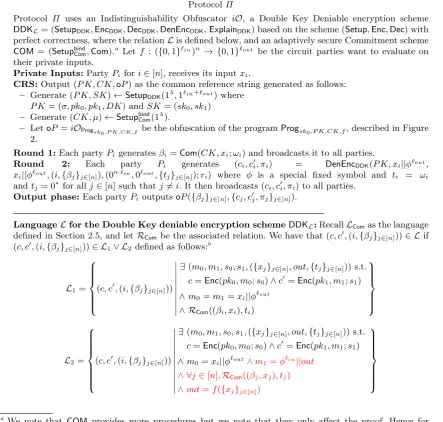
ProtocolΠ
Protocol Π uses an Indistinguishability Obfuscator iO, a Double Key Deniable encryption scheme
DDKL= (SetupDDK,EncDDK,DecDDK,DenEncDDK,ExplainDDK) based on the scheme (Setup,Enc,Dec) with perfect correctness, where the relationLis defined below, and an adaptively secure Commitment scheme
COM = (SetupbindCom,Com). a
Letf : ({0,1}`in)n → {0,1}`out be the circuit parties want to evaluate on
their private inputs.
Private Inputs:PartyPi fori∈[n], receives its inputxi.
CRS:Output (P K, CK,oP) as the common reference string generated as follows:
– Generate (P K, SK)←SetupDDK(1λ,1`in+`out) where
P K= (σ, pk0, pk1, DK) andSK= (sk0, sk1)
– Generate (CK, µ)←Setupbind Com(1λ).
– LetoP =iOProgsk
0,P K,CK,f be the obfuscation of the programProgsk0,P K,CK,f, described in Figure
2.
Round 1:Each partyPi generatesβi=Com(CK, xi;ωi) and broadcasts it to all parties.
Round 2: Each party Pi generates (ci, c0i, πi) = DenEncDDK(P K, xi||φ`out,
xi||φ`out,(i,{βj}j∈[n]),(0n·`in,0`out,{tj}j∈[n]);ri) where φ is a special fixed symbol and ti = ωi
andtj= 0∗ for allj∈[n] such thatj6=i. It then broadcasts (ci, c0i, πi) to all parties. Output phase:Each partyPioutputsoP({βj}j∈[n],{cj, c0j, πj}j∈[n]).
LanguageLfor the Double Key deniable encryption schemeDDKL:RecallLComas the language
defined in Section 2.5, and letRCom be the associated relation. We have that (c, c0,(i,{βj}j∈[n]))∈ Lif (c, c0,(i,{βj}j∈[n]))∈ L1∨ L2defined as follows:b
L1=
(c, c0,(i,{βj}j∈[n]))
∃(m0, m1, s0, s1,({xj}j∈[n], out,{tj}j∈[n])) s.t.
c=Enc(pk0, m0;s0)∧c0=Enc(pk1, m1;s1)
∧m0=m1 =xi||φ`out
∧ RCom((βi, xi), ti)
L2 =
(c, c0,(i,{βj}j∈[n]))
∃(m0, m1, s0, s1,({xj}j∈[n], out,{tj}j∈[n])) s.t.
c=Enc(pk0, m0;s0)∧c
0
=Enc(pk1, m1;s1)
∧m0=xi||φ`out∧m1=φ`in||out ∧ ∀j∈[n],RCom((βj, xj), tj)
∧out=f({xj}j∈[n])
a
We note that COM provides more procedures but we note that they only affect the proof. Hence for simplicity of exposition we skip mentioning them here.
b
Changes inL2 fromL1 are highlighted in red.
Fig. 1.TheΠ Protocol.
ProgramProgSKb,P K,CK,f Input:({βj}j∈[n],{cj, c0j, πj}j∈[n]).
Description:
1. If there existsj∈[n] such thatDecDDK(P K, SKb,(cj, cj0, πj),{βj}j∈[n]) =⊥then output⊥.
2. Parsecjasdj,0||ej,0wheredj,0is the encryption of the first`inbits andej,0is the encryption of the rest of the bits. Similarly parsec0j asdj,1||ej,1.
If ∃j ∈ [n] such that Dec(skb, ej,b) 6=φ`out, then let ibe the first suchj. If this is the case then
outputDec(skb, ei,b).
3. Otherwise for eachj∈[n], letxj=Dec(skb, dj,b) and outputf({xj}j∈[n]).
Fig. 2.The ProgramProgSKb,P K,CK,f.
Theorem 2. Letf be any deterministic poly-time function withninputs and single output. As-sume the existence of an Indistinguishability ObfuscatoriO, a Double Key Deniable encryption schemeDDKL= (SetupDDK,EncDDK,DecDDK,DenEncDDK,ExplainDDK)and an adaptively secure
pre-sented in Figure 1 UC-securely realizes the ideal functionalityFf in theFCRS-hybrid model with computational security against any adaptive, active adversary corrupting an arbitrary number of parties in two rounds of broadcast.
Corollary 1. Assume the existence of a sub-exponentially secure indistinguishability obfusca-tion and doubly enhanced trapdoor permutaobfusca-tion then any ideal funcobfusca-tionality Ff can be
UC-securely realized in theFCRS- model against any adaptive, active adversary corrupting an arbi-trary number of parties. Furthermore this protocol involves only two rounds of broadcast.
We start by noting that the protocol is correct. Observe that if all the parties behave honestly then the protocol ends us executing the circuit f on the inputs of all parties, leading to the correct output. Security is proved via a simulator provided in Section 4 and indistinguishability is argued in Section 5.
3.1 Extensions
Now we give some natural extensions of our protocol and remove assumptions that were made to simplify exposition.
General Functionality. Our basic MPC protocol as described in Figure 1, only considers de-terministic functionalities where all the parties receive the same output. We would like to gen-eralize it to handle randomized functionalities and individual outputs (just as in [AJW11]). First, the standard transformation from a randomized functionality to a deterministic one (See [Gol04, Section 7.3]) works for this case as well. In this transformation, instead of comput-ing some randomized function g(x1, . . . xn;r), the parties compute the deterministic function
f((r1, x1), . . . ,(rn, xn)) def
= g(x1, . . . , xn;⊕ni=1ri). We note that this computation does not add
any additional rounds. We note that since we are in the setting of adaptive security we can only realize adaptively well-formed [CLOS02] functionalities, which reveals its randomness if all the parties are corrupted.
Next, we move to individual outputs. Again, we use a standard transformation (See [LP09], for example). Given a functiong(x1, . . . , xn)→(y1, . . . , yn), the parties can evaluate the
follow-ing function which has a sfollow-ingle output:
f((k1, x1), . . . ,(kn;xn)) = (g1(x1, . . . , xn)⊕k1||. . .||gn(x1, . . . , xn)⊕kn)
where gi indicates the ith output of g, and ki is randomly chosen by the ith party. Then, the
parties can evaluate f, which is a single output functionality, instead of g. Subsequently every partyPi uses its secret inputki to recover its own output. The only difference is thatf has one
additional exclusive-or gate for every circuit-output wire. Again, this transformation does not add any additional rounds of interaction.
4 Description of our Simulator
LetAbe an active, adaptive adversary that interacts with parties running the protocolΠ from Figure 1 in the FCRS-hybrid model. We construct a simulator S (the ideal world adversary)
with access to the ideal functionality Ff, which simulates a real execution of Π with A such that no environmentZ can distinguish the ideal world experiment with S and Ff from a real execution of Π withA.
Recall that S interacts with the ideal functionality Ff and with the environment Z. The
ideal adversaryS starts by invoking a copy ofAand running a simulated interaction ofAwith the environmentZ and the parties running the protocol. Our simulator S proceeds as follows:
Simulated CRS: The common reference string is chosen by S in the following manner (recall thatS chooses the CRS for the simulatedA as we are in the FCRS-hybrid model):
1. S runs the setup algorithmSetupDDK(1λ,1`in+`out) of the Double Key deniable encryption
scheme, but replaces its internal call to the algorithmK withS= (S1, S2) of the NIZK proof
system. More specifically, S generates (pk0, sk0),(pk1, sk1) ← Setup(1λ), (σ, τ) ← S1(1λ),
along with the public denying key DK. It sets the public key P K= (pk0, pk1, σ, DK).
2. S runs the algorithmSetupequivCom(1λ) of the adaptively secure commitment schemeCOM and obtains (CK, µ, ν).
3. S computesoP =iOProg
sk1,P K,CK,f where the latter is the obfuscation of the program Prog, as described in Figure 2, parameterized with the key sk1.
S sets the common reference string equal to (P K, CK,oP) and locally stores (SK, τ, µ, ν). Looking ahead, the trapdoor µ will be used to extract the inputs of the corrupted parties and ν to equivocate on the commitment S provides on behalf of honest parties. The trapdoor
τ for the simulated σ will be used to generate simulated proofs.
Simulating the communication with Z: Every input value thatS receives from Z is written on
A’s input tape. Similarly, every output value written by A on its own output tape is directly copied to the output tape ofS.
Simulating actual protocol messages inΠ: Note that there might be multiple sessions executing concurrently. Letsidbe the session identifier for one specific session. We will specify the simula-tion strategy corresponding to this specific session. The simulator strategy for all other sessions will be the same. Let P ={P1, . . . , Pn} be the set of parties participating in the execution of
Π corresponding to the session identified by the session identifiersid. Also letPA ⊆ P be the set of parties corrupted by the adversary A at any time. Recall that we are in the setting of adaptive corruption so more parties could be added to this set as the protocol proceeds. At any point S only generates messages on behalf of parties P\PA. In the following, if at the end of some round all parties are corrupted thenS does not need to go to do anything else.
Round 1 Messages S → A: In the first roundS must generate messages on behalf of the honest parties, i.e. parties in the setP\PA. For each party Pi ∈ P\PA our simulator proceeds as:
1. Generate a fake commitment (βi, statei)←Equiv1(CK, ν).
Round 1 Messages A → S: Also in the first round the adversary A generates the messages on behalf of corrupted parties inPA. For each party P
i ∈ PA our simulator proceeds as follows:
1. Extracting inputs of corrupted parties: Let βi be the commitment that A sends on behalf
of Pi. Our simulatorS runs the extraction algorithmExtr(CK, µ, βi) in order to obtain xi.
Note that it is possible thatAsends a commitmentβion behalf ofPisuch that it is not
well-formed, or in other words extraction using the functionExtrfails. In this caseS setsxi =⊥
and proceeds to the next step. (Looking ahead, we note that in this case the adversary will not be able to generate a valid second round message.)
2. Next S sends (input,sid,P, Pi, xi) to Ff on behalf of the corrupted party Pi.
Simulating corruption of parties in Round 1: When A corrupts a real world party Pi, then S
first corrupts the corresponding ideal world partyPi and obtains its input xi. NextS prepares
the internal state on behalf of Pi such that it will be consistent with the commitment value βi
that it had provided toA earlier. Specifically S computes Equiv2(CK, ν, βi, statei, xi) in order
to obtain randomness ωi such that βi =Com(CK, βi;ωi). S provides ωi as the randomness of
party Pi toA. Note thatS can do this at any point during 1st round.
Completion of Round 1: After S has submitted the inputs of all the corrupted parties to Ff
then it responds by sending back the message (output,sid,P, out) where out = f({xj}j∈[n]).
Note that in caseS had failed to extract an input for some playerPi then it would have sent⊥
toFf and would have received⊥ as the output from the ideal functionality.
Round 2 Messages S → A: In the second round S generates messages on behalf of the honest parties, i.e. parties in the setP\PA as follows:
1. For each partyPi ∈ P\PA,S generatesci =Enc(pk0, φ`in||out), c0i=Enc(pk1, φ`in||out) and
generates πi as a simulated proof for the statement (ci, c0i,(i,{βj}j∈[n])). More specifically it
generates πi←S2(σ, τ,(ci, c0i,(i, {βj}j∈[n]))).
S sends (ci, c0i, πi) to Aon behalf of Pi.
Round 2 Messages A → S: In the second round the adversary A generates the messages on behalf of corrupted parties inPA. For each party Pi ∈ PA our simulator proceeds as:
1. Let (ci, c0i, πi) be the message that A sends on behalf of party Pi. S checks to see if
V(σ,(ci, c0i,(i,{βj}j∈[n])), πi) = 1 for each Pi ∈ PA.
If all the proofs verify thenSsends the message (generateOutput,sid,P) to the ideal functionality
Ff.
Simulating corruption of parties during/at the end of Round 2: WhenAcorrupts a party Pi in
the real word, thenScorrupts the corresponding partyPiin the ideal world and obtains its input
xi. NextSprepares the internal state on behalf ofPisuch that it will be consistent with messages
it had sent on behalf of Pi. As explained before, S generates randomness ωi that explains the
commitmentβi to the value xi running the algorithmωi =Equiv2(CK, ν, βi, statei, xi). NextS
needs to explain the second round message (ci, c0i, πi). S has to explain the message (ci, c0i, πi)
by computing the randomness asψi =ExplainDDK(P K,(ci, c0i, πi),
(xi||φ`out, xi||φ`out,(i,{βj}j∈[n]),(0n·`in,0`out,{tj}j∈[n]);u) where ti =ωi and tj = 0∗ for all j ∈
[n] such that j 6=i. S provides ωi||ψi as the randomness of party Pi toA. Note that S can do
5 Proof of Security
In this section, via a sequence of hybrids, we will prove that no environmentZ can distinguish the ideal world experiment with S and Ff (as defined above) from a real execution ofΠ with
A. We will start with the real world execution in which the adversaryAinteracts directly with the honest parties holding their inputs and step-by-step make changes till we finally reach the simulator as described in Section 4. At each step we will argue that the environment cannot distinguish the change except with negligible probability.
Hybrid 0.This hybrid corresponds to the Z interacting with the real world adversaryA and honest parties that hold their private inputs.
We can restate the above experiment with the simulator as follows. We replace the real world adversary Awith the ideal world adversary S. The ideal adversaryS starts by invoking a copy of A and running a simulated interaction ofA with the environmentZ and the honest parties. S forwards the messages that A generates for it environment directly to Z and vice versa (as explained in the description of the simulatorS). In this hybrid the simulator S holds the private inputs of the honest parties and generates messages on their behalf using the honest party strategies as specified byΠ.
Hybrid 1. In this hybrid, we change how the internal randomness of the corrupted party is explained to A on being adaptively corrupted. Specifically we change the randomness that is used to explain the ciphertext S generates on behalf of parties in round 2 of protocolΠ. Recall that in the second round S on behalf of an honest party Pi generates the second
message as (ci, c0i, πi) =DenEncDDK(P K, xi||φ`out, xi||φ`out,(i,
{βj}j∈[n]),(0n·`in,0`out,{tj}j∈[n]);ri) whereti is the randomness used in generating
commit-mentβi andtj = 0∗ for allj ∈[n] such that j6=i. So ifAcorruptsPi then the randomness
ri would be reveal to A. In Hybrid 1, instead we provide ψi =ExplainDDK(P K,(ci, c0i, πi),
(xi||φ`out, xi||φ`out,(i,{βj}j∈[n]),(0n·`in,0`out,{tj}j∈[n]);u) wheretj values are as before.
Lemma 1. Hybrid0 ≈cHybrid1.
Proof. The indistinguishability of Hybrid1from Hybrid0follows from the indistinguishability of explanation property of the Double Key deniable encryption scheme.
Hybrid 2. In this hybrid we change the way S generates the message (ci, c0i, π) on behalf of
the honest parties.
Recall that in the second round in Hybrid 1, S on behalf of an honest party Pi generates
the second message as (ci, c0i, πi) =DenEncDDK(P K, xi||φ`out, xi||
φ`out,(i,{β
j}j∈[n]),(0n·`in,0`out,{tj}j∈[n]);ri) whereti is the randomness used in generating
commitmentβi andtj = 0∗for allj∈[n] such thatj 6=i. We will change this by generating
the ciphertexts directly using procedures Enc and the proverP.
Specifically,ci =Enc(pk0, xi||φ`out;si0) andc0i =Enc(pk1, xi||φ`out;si1) and outputs (ci, c0i, πi),
whereπi ←P(σ,(ci, c0i,{i,{β}j∈[n]}),(xi||φ`out, xi||φ`out, si0, si1,(0n·`in,0`out,{tj}j∈[n]))) where
ti is the randomness used in generating commitmentβi andtj = 0∗ for allj ∈[n] such that
j 6=i.
Lemma 2. Hybrid1 ≈cHybrid2.
Hybrid 3. In this hybrid, we change how σ, which is a part of P K, and the proofs πi for
every Pi ∈ P\PA are generated.
More specifically, S runs the setup algorithm SetupDDK(1λ,1`in+`out) of the Double Key
deniable encryption scheme, but replaces its internal call to the algorithm K with S = (S1, S2) of the NIZK proof system. More specifically, S generates (pk0, sk0),(pk1, sk1) ← Setup(1λ), (σ, τ) ← S1(1λ), along with the public denying key DK. It sets the public key
P K = (σ, pk0, pk1, DK).
We also generate fake proofsπiusing trapdoorτ. Specifically we generateπi←S2(σ, τ,(ci, c0i,
(i,{βj}j∈[n]))).
Lemma 3. Hybrid2 ≈cHybrid3.
Proof. The indistinguishability of Hybrid3 from Hybrid2 follows immediately from the com-putational zero-knowledge property of the NIZK proof system.
Hybrid 4.We don’t change anything in the output of the hybrid itself. We just use knowledge of µ to extract the inputs A commits to in the 1st round messages that it sends on behalf of the corrupted parties.
More specifically, S for everyPi∈ PA obtainsxi =Extr(CK, µ, βi). If extraction fails then
it sets xi =⊥.
Hybrid 5. In this hybrid, we change how the simulator S generates c0i in the second round message (ci, c0i, πi) on behalf of honest parties Pi ∈ P\PA. In particular,S instead of
com-puting the ciphertextc0i=Enc(pk1, xi||φ`out;si1), generatesc0i =Enc(pk1, φ`in||out;si1), where
out is the output computed as f({xj}j∈[n]) using the inputsxi of the honest parties, that
the simulator has access to, and extracted inputs of the malicious parties. Lemma 4. Hybrid4 ≈cHybrid5.
Proof. We base the indistinguishability between hybrids Hybrid4 and Hybrid5 on the se-mantic security of the encryption scheme (Setup,Enc,Dec).
Hybrid 6. In this hybrid we essentially reverse the change that was made in going from Hybrid 2 to Hybrid 3. In particular we change the σ so that it is sampled from the honest distribution and generate the proof honestly. Note that since now we have changed the ciphertext c0i the proof will have to be generated with respect to languageL2.
More specifically, S uses K to generate σ instead of S1. Also for everyPi ∈ P\PA,S
gen-erates πi ← P(σ,(ci, c0i, (i,{βj}j∈[n])),(xi||φ`out, φ`in||out, si0, si1,({xi}i∈[n], out,{tj}j∈[n])))
where tj is the witness thatβj ∈ LCom .
Lemma 5. Hybrid5 ≈cHybrid6.
Proof. The indistinguishability of Hybrid5 from Hybrid6 follows immediately from the com-putational zero-knowledge property of the NIZK proof system.
Hybrid 7. In this hybrid we change how oP, the obfuscated program in the CRS is gen-erated. More specifically, oP is generated as an obfuscation of Progsk1,P K,CK,f instead of
Progsk0,P K,CK,f.
In the following we show that the program Prog is equivalent under sk0 and sk1 with
overwhelming probability. This allows us to conclude that the Hybrid 6 and Hybrid 7 are indistinguishable based on indistinguishability obfuscation.
Proof. Recall that the underlying languageLof the Double Key deniable encryption scheme consists of two languages, namely L1 and L2. Note that since the NIZK has statistical soundness with overwhelming probability over the choices of σ we have that all ciphertexts with an accepting proof must be from one of the two languages. We refer to the two types of ciphertexts corresponding to the language L1 and L2, as Type-1 and Type-2 ciphertext, respectively.
Recall that the programProgtakes{βj}j∈[n]and{cj, c0j, πj}i∈[n]as input. Recall from Figure
2 that in Step 1, Prog checks to see that all the proofs πi are accepting and otherwise it
outputs⊥. This means that for the program to do anything interesting all the proofs must be valid. Next we will show that in such cases the output of the program is identical regardless of whether sk0 orsk1 is used.
All ciphertexts are of Type-1: In this case, cj and c0j for j ∈ [n] encrypted under pk0 and
pk1 respectively, encrypt the same value. Hence, regardless of whethersk0 is used orsk1 is
used the program outputs the exact same value f({xj}j∈[n]).
There is at least one Type-2 ciphertext: Note that, in case sk0 is used then we have that
Step 2 of Prog is never invoked. On the other hand in case sk1 is used then we have that
Step 2 of Prog is necessarily invoked.
In other words ifsk0 is used then thexj values are decrypted and output is calculated. On
the other hand if sk1 is used then a hard-codedout value is generated. We will argue that
in both cases the output generated by Prog is identical. We argue this by showing that the only acceptable value for the hard-coded value out is f({xj}j∈[n]), wherexj are the inputs
parties commit to in the first round. Recall that the commitment scheme is perfectly binding, meaning that for every commitment βi there is exactly one xi such that (βi, xi) ∈ LCOM.
This proves our claim. ut
Hybrid 8. In this hybrid we do the same change that was made in going from Hybrid 2 to Hybrid 3. In this hybrid, we change how σ, which is a part of P K, and the proofs πi for
every Pi ∈ P\PA are generated.
More specifically, S runs the setup algorithm SetupDDK(1λ,1`in+`out) of the Double Key
deniable encryption scheme, but replaces its internal call to the algorithm K with S = (S1, S2) of the NIZK proof system. More specifically, S generates (pk0, sk0),(pk1, sk1) ← Setup(1λ), (σ, τ) ← S1(1λ), along with the public denying key DK. It sets the public key
P K = (σ, pk0, pk1, DK).
We also generate fake proofsπiusing trapdoorτ. Specifically, it generatesπi←S2(σ, τ,(ci, c0i,
(i,{βj}j∈[n]))).
Lemma 7. Hybrid7 ≈cHybrid8.
Proof. The indistinguishability of Hybrid7 from Hybrid8 follows immediately from the com-putational zero-knowledge of the NIZK proof system.
Hybrid 9. In this hybrid, we change how the simulator S generates cj in the second round
message (cj, c0j, πj) on behalf of honest parties Pj ∈ P\PA. More specifically, S instead
of computing cj = Enc(pk0, xi||φ`out), it computes cj = Enc(pk0, φ`in||out) where out =
f({xj}j∈[n]).
Lemma 8. Hybrid8 ≈cHybrid9.
Hybrid 10. In this hybrid we change the way the public parameters of the commitment schemeCOMare generated. In particular,S runs the setup algorithmSetupequivCom(1λ) (instead
of SetupbindCom(1λ)) of the adaptively secure commitment schemeCOMand obtains (CK, µ, ν) where the trapdoor µis still being used for extraction of adversary’s inputs.
Lemma 9. Hybrid9 ≈cHybrid10.
Proof. Indistinguishability between hybrids Hybrid9 and Hybrid10follows from the indistin-guishability of the public parameters of the commitment scheme COM.
Hybrid 11. In this hybrid we change the way S generates the commitments on behalf of the honest parties. In particular we will remove the inputs and make these commitments equivocal. More specifically, for every partyPi∈ P\PAthe first round message is computed
by S running (βi, statei) ← Equiv1(CK, ν). If the party later gets corrupted then S will
produce randomness ωi to equivocate the commitmentβi to the prescribed inputxi. To this
end, S will run ωi=Equiv2(CK, ν, βi, statei, xi).
Lemma 10. Hybrid10≈cHybrid11.
Proof. We base the indistinguishability between hybrids Hybrid10and Hybrid11on the poly-nomial equivocality of the adaptively secure commitment scheme COM.
Note that Hybrid11 is identical to the simulation strategy described in Section 4. This concludes the proof.
6 Extending to Leakage Tolerant Secure Computation
The adaptively secure protocol presented in this paper also turns out to be leakage tolerant. The model of leakage can be found in the full version [GP14].
Lemma 11. Assume the existence of indistinguishability obfuscation and doubly enhanced trap-door permutation then any ideal functionalityFf can be UC-securely realized in theFCRS- model
against any adaptive, active adversary corrupting an arbitrary number of parties and allowed with arbitrary leakage. Furthermore this protocol involves only two rounds of broadcast.
This lemma follows immediately from our construction and proof except for some syntactic differences. We explain this next. We will only describe how our simulator for adaptive security (from Section 4) can be converted into a simulator for the setting of leakage tolerance. The proof of indistinguishability for the adaptive simulator was already provided in Section 5.
Recall that that the simulator for arguing adaptive security, on corruption of an honest party, uses the honest party’s input alone in order to explain the messages it had previously sent on behalf of the honest party. In the setting of leakage, we note that this method of explanation can directly be expressed by a circuit that on input the input of the honest party outputs the internal secret state of that party. Furthermore note that the way in which the simulator explains its first round messages of honest parties remains the same even after it has sent the second round messages.
Using this explanation procedure as a translation method, allows us to immediately conclude that any leakage query of the real-world adversary can be reduced directly to a leakage query in the ideal-world.
Acknowledgments
References
[AJL+12] Gilad Asharov, Abhishek Jain, Adriana L´opez-Alt, Eran Tromer, Vinod Vaikuntanathan, and Daniel Wichs. Multiparty computation with low communication, computation and interaction via threshold FHE. pages 483–501, 2012.
[AJW11] Gilad Asharov, Abhishek Jain, and Daniel Wichs. Multiparty computation with low communication, computation and interaction via threshold FHE. Cryptology ePrint Archive, Report 2011/613, 2011. http://eprint.iacr.org/2011/613.
[BCH12] Nir Bitansky, Ran Canetti, and Shai Halevi. Leakage-tolerant interactive protocols. pages 266–284, 2012.
[BCL+05] Boaz Barak, Ran Canetti, Yehuda Lindell, Rafael Pass, and Tal Rabin. Secure computation without authentication. pages 361–377, 2005.
[BFM88] Manuel Blum, Paul Feldman, and Silvio Micali. Proving security against chosen cyphertext attacks. pages 256–268, 1988.
[BGI+12] Boaz Barak, Oded Goldreich, Russell Impagliazzo, Steven Rudich, Amit Sahai, Salil P. Vadhan, and Ke Yang. On the (im)possibility of obfuscating programs. J. ACM, 59(2):6, 2012.
[BGJ+13] Elette Boyle, Sanjam Garg, Abhishek Jain, Yael Tauman Kalai, and Amit Sahai. Secure computation against adaptive auxiliary information. pages 316–334, 2013.
[Can01] Ran Canetti. Universally composable security: A new paradigm for cryptographic protocols. pages 136–145, 2001.
[CF01] Ran Canetti and Marc Fischlin. Universally composable commitments. pages 19–40, 2001.
[CFGN96] Ran Canetti, Uriel Feige, Oded Goldreich, and Moni Naor. Adaptively secure multi-party computa-tion. pages 639–648, 1996.
[CGP14] Ran Canetti, Shafi Goldwasser, and Oxana Poburinnaya. Adaptively secure two-party computation from indistinguishability obfuscation. IACR Cryptology ePrint Archive, 2014:845, 2014.
[CKL03] Ran Canetti, Eyal Kushilevitz, and Yehuda Lindell. On the limitations of universally composable two-party computation without set-up assumptions. pages 68–86, 2003.
[CLOS02] Ran Canetti, Yehuda Lindell, Rafail Ostrovsky, and Amit Sahai. Universally composable two-party and multi-party secure computation. pages 494–503, 2002.
[CLP10] Ran Canetti, Huijia Lin, and Rafael Pass. Adaptive hardness and composable security in the plain model from standard assumptions. pages 541–550, 2010.
[DHP11] Ivan Damg˚ard, Carmit Hazay, and Arpita Patra. Leakage resilient secure two-party computation.
IACR Cryptology ePrint Archive, 2011:256, 2011.
[DKR14] Dana Dachman-Soled, Jonathan Katz, and Vanishree Rao. Adaptively secure, universally compos-able, multi-party computation in constant rounds.IACR Cryptology ePrint Archive, 2014:858, 2014. [DMRV13] Dana Dachman-Soled, Tal Malkin, Mariana Raykova, and Muthuramakrishnan Venkitasubrama-niam. Adaptive and concurrent secure computation from new adaptive, non-malleable commitments. pages 316–336, 2013.
[DPR14] Ivan Damg˚ard, Antigoni Polychroniadou, and Vanishree Rao. Adaptively secure UC constant round multi-party computation protocols. IACR Cryptology ePrint Archive, 2014:830, 2014.
[FLS90] Uriel Feige, Dror Lapidot, and Adi Shamir. Multiple non-interactive zero knowledge proofs based on a single random string (extended abstract). pages 308–317, 1990.
[FS89] Uriel Feige and Adi Shamir. Zero knowledge proofs of knowledge in two rounds. pages 526–544, 1989.
[GGG+14] Shafi Goldwasser, S. Dov Gordon, Vipul Goyal, Abhishek Jain, Jonathan Katz, Feng-Hao Liu, Amit Sahai, Elaine Shi, and Hong-Sheng Zhou. Multi-input functional encryption. pages 578–602, 2014. [GGH13a] Sanjam Garg, Craig Gentry, and Shai Halevi. Candidate multilinear maps from ideal lattices. pages
1–17, 2013.
[GGH+13b] Sanjam Garg, Craig Gentry, Shai Halevi, Mariana Raykova, Amit Sahai, and Brent Waters. Candi-date indistinguishability obfuscation and functional encryption for all circuits. pages 40–49, 2013. [GGHR14] Sanjam Garg, Craig Gentry, Shai Halevi, and Mariana Raykova. Two-round secure MPC from
indistinguishability obfuscation. pages 74–94, 2014.
[GGKS14] Sanjam Garg, Divya Gupta, Dakshita Khurana, and Amit Sahai. All-but-one leakage resilient mul-tiparty computation and incoercible mulmul-tiparty computation. Personal Communication, 2014. [GJS11] Sanjam Garg, Abhishek Jain, and Amit Sahai. Leakage-resilient zero knowledge. pages 297–315,
2011.
[GMR89] Shafi Goldwasser, Silvio Micali, and Charles Rackoff. The knowledge complexity of interactive proof systems. 18(1):186–208, 1989.
[Gol01] Oded Goldreich.Foundations of Cryptography: Basic Tools, volume 1. Cambridge University Press, Cambridge, UK, 2001.
[Gol04] Oded Goldreich. Foundations of Cryptography: Basic Applications, volume 2. Cambridge University Press, Cambridge, UK, 2004.
[GP14] Sanjam Garg and Antigoni Polychroniadou. Two-round adaptively secure MPC from indistinguisha-bility obfuscation. IACR Cryptology ePrint Archive, 2014:844, 2014.
[GS12] Sanjam Garg and Amit Sahai. Adaptively secure multi-party computation with dishonest majority. pages 105–123, 2012.
[HLP11] Shai Halevi, Yehuda Lindell, and Benny Pinkas. Secure computation on the web: Computing without simultaneous interaction. pages 132–150, 2011.
[HP14] Carmit Hazay and Arpita Patra. One-sided adaptively secure two-party computation. pages 368–393, 2014.
[IPS08] Yuval Ishai, Manoj Prabhakaran, and Amit Sahai. Founding cryptography on oblivious transfer -efficiently. pages 572–591, 2008.
[KO04] Jonathan Katz and Rafail Ostrovsky. Round-optimal secure two-party computation. pages 335–354, 2004.
[Lin03] Yehuda Lindell. Bounded-concurrent secure two-party computation without setup assumptions. pages 683–692, 2003.
[LP09] Yehuda Lindell and Benny Pinkas. A proof of security of Yao’s protocol for two-party computation. 22(2):161–188, April 2009.
[NY90] Moni Naor and Moti Yung. Public-key cryptosystems provably secure against chosen ciphertext attacks. pages 427–437, 1990.
[SW14] Amit Sahai and Brent Waters. How to use indistinguishability obfuscation: deniable encryption, and more. pages 475–484, 2014.
[Yao82] Andrew Chi-Chih Yao. Protocols for secure computations (extended abstract). pages 160–164, 1982.
A UC Security
In this section we briefly review UC security. For full details see [Can01]. A large part of this introduction has been taken verbatim from [CLP10].
The basic model of execution. Following [GMR89,Gol01], a protocol is represented as an interactive Turing machine (ITM), which represents the program to be run within each par-ticipant. Specifically, an ITM has three tapes that can be written to by other ITMs: the input
and subroutineoutput tapes model the inputs from and the outputs to other programs running within the same “entity” (say, the same physical computer), and the incoming communication
tapes and outgoing communication tapes model messages received from and to be sent to the network. It also has an identity tape that cannot be written to by the ITM itself. The identity tape contains the program of the ITM (in some standard encoding) plus additional identifying information specified below. Adversarial entities are also modeled as ITMs.
We distinguish between ITMs (which represent static objects, or programs) and instances of ITMs, or ITIs, that represent interacting processes in a running system. Specifically, an ITI is an ITM along with an identifer that distinguishes it from other ITIs in the same system. The identifier consists of two parts: A session-identifier (SID) which identifies which protocol instance the ITM belongs to, and a party identifier(PID) that distinguishes among the parties in a protocol instance. Typically the PID is also used to associate ITIs with “parties”, or clusters, that represent some administrative domains or physical computers.
The model of computation consists of a number of ITIs that can write on each other’s tapes in certain ways (specified in the model). The pair (SID,PID) is a unique identifier of the ITI in the system.
protocol execution process is bounded by a polynomial, we definenas the total number of bits written to the input tape ofM,minus the overall number of bits written by M to input tapes of other ITMs.; see [Can01].)
Security of protocols. Protocols that securely carry out a given task (or, protocol problem) are defined in three steps, as follows. First, the process of executing a protocol in an adver-sarial environment is formalized. Next, an “ideal process” for carrying out the task at hand is formalized. In the ideal process the parties do not communicate with each other. Instead they have access to an “ideal functionality,” which is essentially an incorruptible “trusted party” that is programmed to capture the desired functionality of the task at hand. A protocol is said to securely realize an ideal functionality if the process of running the protocol amounts to “emu-lating” the ideal process for that ideal functionality. Below we overview the model of protocol execution (called thereal-life model), the ideal process, and the notion of protocol emulation.
The model for protocol execution. The model of computation consists of the parties running an instance of a protocolΠ, anadversaryAthat controls the communication among the parties, and anenvironment Zthat controls the inputs to the parties and sees their outputs. We assume that all parties have a security parameter n ∈ N. (We remark that this is done merely for convenience and is not essential for the model to make sense). The execution consists of a sequence of activations, where in each activation a single participant (either Z, A, or some other ITM) is activated, and may write on a tape of at most one other participant, subject to the rules below. Once the activation of a participant is complete (i.e., once it enters a special waiting state), the participant whose tape was written on is activated next. (If no such party exists then the environment is activated next.)
The environment is given an external input z and is the first to be activated. In its first activation, the environment invokes the adversary A, providing it with some arbitrary input. In the context of UC security, the environment can from now on invoke (namely, provide input to) only ITMs that consist of a single instance of protocol Π. That is, all the ITMs invoked by the environment must have the same SID and the code ofΠ.
Once the adversary is activated, it may read its own tapes and the outgoing communication tapes of all parties. It may eitherdelivera message to some party by writing this message on the party’s incoming communication tape or report information to Z by writing this information on the subroutine output tape of Z. For simplicity of exposition, in the rest of this paper we assume authenticated communication; that is, the adversary may deliver only messages that were actually sent. (This is however not essential as shown in [BCL+05].)
Once a protocol party (i.e., an ITI running Π) is activated, either due to an input given by the environment or due to a message delivered by the adversary, it follows its code and possibly writes a local output on the subroutine output tape of the environment, or an outgoing message on the adversary’s incoming communication tape. Finally our adversary can decide to corrupt any honest party. In this case the input and the random coins used by this party are revealed to the adversary.
The protocol execution ends when the environment halts. The output of the protocol exe-cution is the output of the environment. Without loss of generality we assume that this output consists of only a single bit.
LetEXECπ,A,Z(n, z, r) denote the output of the environmentZ when interacting with par-ties running protocolΠon security parametern, inputzand random inputr=rZ, rA, r1, r2, . . .
Ideal functionalities and ideal protocols. Security of protocols is defined via comparing the protocol execution to an ideal protocol for carrying out the task at hand. A key ingredient in the ideal protocol is the ideal functionality that captures the desired functionality, or the specification, of that task. The ideal functionality is modeled as another ITM (representing a “trusted party”) that interacts with the parties and the adversary. More specifically, in the ideal protocol for functionality F all parties simply hand their inputs to an ITI running F. (We will simply call this ITI F. The SID of F is the same as the SID of the ITIs running the ideal protocol. (the PID of F is null.)) In addition, F can interact with the adversary according to its code. WheneverF outputs a value to a party, the party immediately copies this value to its own output tape. We call the parties in the ideal protocoldummy parties. LetΠ(F) denote the ideal protocol for functionalityF.
Securely realizing an ideal functionality. We say that a protocol Π emulates protocol φ if for any adversary A there exists an adversary S such that no environment Z, on any input, can tell with non-negligible probability whether it is interacting with A and parties runningΠ, or it is interacting with S and parties running φ. This means that, from the point of view of the environment, running protocolΠ is ‘just as good’ as interacting withφ. We say thatΠ securely realizes an ideal functionalityF if it emulates the ideal protocolΠ(F). More precise definitions follow. A distribution ensemble is calledbinary if it consists of distributions over{0,1}. Definition 3. Let Π and φbe protocols. We say thatΠ UC-emulates φif for any adversary A
there exists an adversaryS such that for any environment Z that obeys the rules of interaction for UC security we have EXECφ,S,Z ≈EXECπ,A,Z.
Definition 4. LetF be an ideal functionality and letΠbe a protocol. We say thatΠ UC-realizes
F if Π UC-emulates the ideal processΠ(F).
The Common Reference String Model. In the common reference string (CRS) model [CF01,CLOS02], all parties in the system obtain from a trusted party a reference string, which is sampled according to a pre-specified distribution D. The reference string is referred to as theCRS. In the UC framework, this is modeled by an ideal functionality FD
CRS that samples a
stringρ from a pre-specified distributionDand setsρ as the CRS.FD
CRS is described in Figure
3.
FunctionalityFD CRS
1. Upon activation with session id sid proceed as follows. Sample ρ = D(r), where r
denotes uniform random coins, and send (crs, sid, ρ) to the adversary. 2. On receiving (crs, sid) from some party send (crs, sid, ρ) to that party.
Fig. 3.The Common Reference String Functionality.
General Functionality. We consider the general-UC functionality F, which securely evalu-ates any polynomial-time (possibly randomize) function f : ({0,1}`in)n → ({0,1}`out)n. The functionality Ff is parameterized with a function f and is described in Figure 4.
Our protocol in Figure 3 (also Theorem 2) is for UC-securely realizing general functionality
Ff when the function f is restricted to be any deterministic poly-time function with ninputs
FunctionalityFf
Ff parameterized by an (possibly randomized) n-ary function f, running with parties
P = {P1, . . . Pn} (of which some may be corrupted) and an adversary S, proceeds as
follows:
1. Each partyPi (andS on behalf ofPiifPiis corrupted) sends (input,sid,P, Pi, xi) to
the functionality.
2. Upon receiving the inputs from all parties, evaluate (y1, . . . yn)←f(x1, . . . , xn). For
everyPi that is corrupted send adversaryS the message (output,sid,P, Pi, yi).
3. On receiving (generateOutput,sid,P, Pi) from S the ideal functionality outputs
(output,sid,P, Pi, yi) to Pi. (And ignores the message if inputs from all parties in
Phave not been received.)
4. If all the parties in Pare corrupted then the ideal functionality reveals the internals coins used in the computation off.
Fig. 4.General Functionality.
FunctionalityFf
Ff parameterized by ann-ary deterministic single output functionf, running with parties
P = {P1, . . . Pn} (of which some may be corrupted) and an adversary S, proceeds as
follows:
1. Each partyPi (andS on behalf ofPiifPiis corrupted) sends (input,sid,P, Pi, xi) to
the functionality.
2. Upon receiving the inputs from all parties, evaluatey←f(x1, . . . , xn). Send adversary
S the message (output,sid,P, y).
3. On receiving (generateOutput,sid,P, Pi) from S the ideal functionality outputs
(output,sid,P, y) toPi. (And ignores the message if inputs from all parties inPhave
not been received.)
Fig. 5.General Functionality for Deterministic Single Output Functionalities.
A.1 Extending to the setting of leakage
Towards extending our definition to leakage-tolerant MPC, we modify the real/ideal worlds above in the following manner.
In the real world, in addition to corrupting arbitrary parties, the adversary can now obtain leakage information on the secret internal states of the honest parties (including their inputs) at any point during the protocol execution. A leakage query may be adaptively chosen based on all information received up to that point (including responses to previous leakage queries), and computed on the joint secret states of one or more honest parties.
During the protocol honest parties have the ability to toss fresh coins at any point in the protocol; these coins are added to the state of that party at the time they are generated.
The outputs of the leakage queries along with the parties being leaked on in each query are included as part of output of the experiment. We stress that we do not allow any leakage-free phase at any point prior to or during the protocol execution.
Similarly in the ideal world, the ideal world adversary is allowed to make leakage queries on the joint inputs of one or more honest parties. The queries are answered directly by the ideal functionality. The outputs of the leakage queries along with the parties being leaked on in each query are included as part of the experiment.