Key recovery attacks on Grain family using BSW sampling
and certain weaknesses of the filtering function
Y. Wei ∗ E. Pasalic † F. Zhang ‡ W. Wu §
Abstract
A novel internal state recovery attack on the whole Grain family of ciphers is proposed in this work. It basically uses the ideas of BSW sampling along with em-ploying a weak placement of the tap positions of the driving LFSRs. Thecurrently best knowncomplexity trade-offs are obtained, and due to the structure of Grain fam-ily these attacks are also key recovery attacks. It is shown that the internal state of Grain-v1 can be recovered with the time complexity of about 266 operations using a memory of about 258.91 bits, assuming availability of 245 keystream sequences each of length 249 bits generated for different initial values. Moreover, for Grain-128 or Grain-128a, the attack requires about 2105operations using a memory of about 282.59 bits, assuming availability of 275keystream sequences each of length 276bits generated for different initial values. These results further show that the whole Grain family, due to the choice of tap positions mainly, does not provide enough security margins against internal state recovery attacks. A simple modification of the selection of the tap positions, as a countermeasure against the attacks described here, is given.
Keywords : Stream cipher, Grain cipher, State recovery attack, BSW sampling.
1
Introduction
The Grain family of stream ciphers was initially developed through the Grain-v0 version, which was submitted in the initial phase of the eSTREAM project in 2005 [18]. This design is well suited for hardware restricted environments, and in 2008 Grain-v1 (a tweaked version of Grain-v0) entered the last evaluation phase being one of the three remaining candidates in the final hardware portfolio of the eSTREAM project [26]. Grain-v1 employs an 80-bit secret key and a 64-bit initial value, whereas the number of internal state bits is 160 [19]. To satisfy higher security requirements, a version of v1, known as Grain-128, was proposed by the designers in 2006 [20]. This version uses a 128-bit secret key and a 96-bit initial value. Later, to meet both functionalities of message authentication
∗Guilin University of Electronic Technology, Guilin, P.R. China, e-mail: walker
†University of Primorska, FAMNIT and IAM, Koper, Slovenia, e-mail: [email protected] ‡School of Computer Science and Technology, China University of Mining and Technology, Xuzhou,
Jiangsu 221116, P.R. China, e-mail:[email protected].
§Institute of Software, Chinese Academy of Sciences, Beijing 100190, P.R. China, e-mail:
and encryption, the designers presented a modified version Grain-128a at SKEW2011 [2], whose key length and the length of the initialization vector is the same as for Grain-128. The number of internal state bits for both Grain-128 and Grain-128a is 256.
The Grain family of stream ciphers has a compact and high-level structure, especially suitable for hardware constrained applications. The design rationale of the Grain family is based on the use of two shift registers, that is, one linear feedback shift register (LFSR) and one nonlinear feedback shift register (NFSR). These registers provide the inputs to a nonlinear filtering functionh whose output is then added to one particular (secret) state bit of the NSFR to provide the output keystream bit [19, 20, 2]. Due to the simplicity of its design, the Grain family of stream ciphers has been a favourite target for the application of diverse cryptanalytic methods. In general, the main cryptanalytic methods applied to the Grain family of encryption algorithms may be divided into several major groups, namely into distinguishing attacks [27, 25], algebraic attacks [1], various types of chosen IV and (dynamic) cube attacks [12, 13, 24], related key chosen IV attacks [11, 10, 14], near collision and differential fault attacks [28, 9], and internal state recovery attacks [5, 22, 23]. Our technique described here belongs to state (key) recovery attacks that are closely related to the problem of inverting a one way functiony =f(x). Notice that the idea of Time-Memory trade-off attack (TMTO) was firstly proposed by Hellman in [17], which combines the exhaustive key attack and the table lookup attack to solve the problem of inverting one way functions. More precisely, the trade-off curve of TMTO in [17] is described as T M2 = N2 and P = N, where T is the online time complexity, M is the memory cost, P is the offline time complexity, and N is the number of possible keys. Later, some new time-memory-data trade-off (TMDTO) attacks on stream cipher are respectively presented by Babbage [4] and Goli´c [16]. The tradeoff curve of Babbage-Golic attack (i.e., BG-TMDTO attack) can be described asT M =N, P =M andT =D, whereDdenotes the data complexity andN is the number of possible internal states. At Asiacrypt 2000, using multiple data points, Biryukov and Shamir proposed an extension of TMDTO attacks [6]. The trade-off curve of Biryukov-Shamir attack (BS-TMDTO) in [6] can be described asT M2D2=N2 and P =N/D, where 1≤D2≤T.
At FSE 2000, a new sampling technique was proposed by Biryukov, Shamir, and Wagner (denoted by BSW sampling) [7], which can improve upon the BS-TMDTO attack by providing a more flexible choice of parameters. The main idea of BSW sampling is to find an efficient way to generate and enumerate “special” cipher states, from which the first output segment of keystream bits of the cipher is a fixed string (such as a run of consecutive zeros). If this can be done for a run ofu bits, the sampling resistance of the cipher is defined to be R = 2−u. Being of no particular importance for small values of
u, this approach may lead to improved trade-off attacks if u is sufficiently large. In [5], some special states of Grain-v1 were identified giving the sampling resistanceR = 2−21. This resistance allowed the authors to mount an attack on Grain-v1 with online time complexity ofO(270) and memory complexity ofO(269) after a precomputation ofO(2104) steps and usingO(256) bits of a known keystream sequence.
Sample (d, d′) Time (off-line) Memory Time (online) Success rate Resource
(1,256) 2104 269 270 1 [5]
(246,250) 270 246 272 1 [22]
(1,267.8) 273.1 262.8 271.4 unresolved [28]
(245.25,245.25) 269.5 269.5 269.5 1 [15]
(245,249) 266 258.91 266 1 new
Table 1: Summary on the main attack on Grain-v1 - a single-key framework
secret key and different IV values. The trade-off curve of this attack can be described as
M T =rRN, M D=N, P =M and D=d·d′, wherer is an integer (1≤r≤R−1),d de-notes the number of keystream sequences the attacker can capture (generated by the same key but different IVs), andd′ stands for the length of each sequence. It was shown that this generalization of BG-TMDTO attack on Grain-v1 and Grain-128 stream ciphers is rather efficient since the online time, offline time and memory complexity of the attack are all lower than an exhaustive key search. Even though the data complexityD=d·d′ >2K [15] (see also Table 1 and Table 2), the attack scenario is more realistic compared to the case when the same amount of output dataDis generated by a fixed secret key and a single IV. Prior to this work, two major improvements regarding the cryptanalysis of Grain-v1 and Grain-128 were proposed recently in [22, 23], where by employing the normality of filtering function h the best known trade-off parameters could be obtained (cf. Table 1 and Table 2). Notice that this approach also requiresD >2K, thoughd, d′≪2K.
Nevertheless, it appears that the Grain family leaves a lot of space for improvements to prevent the existence of these special internal states of relatively moderate size. In particular, due to the choice of tap positions of the Grain variants and the sparseness of the filtering function, we have been able to reduce the sampling resistance to R = 2−28 for Grain-v1 and to R = 2−46 for 128(a). For v1 (and similarly for Grain-128), this is done by manipulating the output keystream bit expressionzt=
∑
j∈Abt+j⊕
h(st+3, st+25, st+46, st+64, bt+63), where A = {1,2,4,10,31,43,56}, with respect to the 7 masking NFSR bitsbt+j. Due to the designers selection of the tap positions the masking
NFSR bits do not influence the function h during a certain time interval. This further implies that these bits can be computed by guessing the remaining state bits involved in the computation, and in addition the sparseness ofh also allows us to retrieve a few more bits by fixing suitable state bits. Compared to the currently best known attack presented in [22][15], our approach gives better complexity estimates.
Table 1 and Table 2 summarise relevant previous work and our main attack results on the Grain variants. Apparently, our attack has smaller time complexity compared to other approaches, and in general it performs better when all the complexity measures are taken into account.
Sample (d, d′) Time (off-line) Memory Time (online) Success rate Resource
(1,259) 2113 259 2113 0.001 [12]
(1,263) 290 263 290 0.05 [13]
(250,295) 2111 2111 2116 1 [23]
(269.5,269.5) 2117 2117 2117 1 [15]
(275,276) 2105 282.59 2105 1 new
Table 2: Summary on the main attacks on Grain-128(a)- a single-key framework
the paper with a brief discussion concerning the possibility of thwarting similar kind of attacks as the one presented here.
2
Preliminaries
2.1 A brief description of the Grain family of stream ciphers
For the self-completeness of the discussion that follows, we give a brief description con-cerning the structure of the Grain family of stream ciphers. Due to a varying length of the secret key and the initialization vector (as well as the length of the registers) used in different versions, a full specification of the filtering functions used is given in Section 3.1 and Section 3.2.
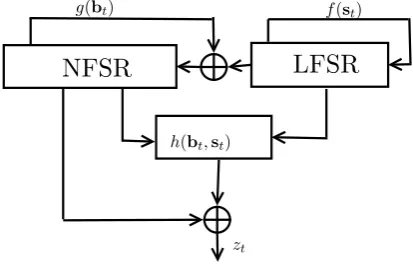
It is convenient to denote bynthe length of the shift registers, alternatively the length of the secret key. The structure of the Grain cipher is depicted in Figure 1. The LFSR is updated through a linear feedback polynomialf of degree nand is given by,
st+n=f(st), (1)
wherest = (st, st+1, . . . , st+n−1) is the secret state of the LFSR at time t. Similarly, the NFSR is updated through a nonlinear feedback polynomial gof degree n,
bt+n=st⊕g(bt), (2)
where bt = (bt, bt+1, . . . , bt+n−1) is a secret state of the NFSR at time t. The keystream sequence is generated by combining the secret state bits of both registers in a nonlinear manner,
zt=h(st,bt)⊕
∑
a∈A
bt+a, (3)
whereA⊂ {0,1, . . . , n−1}, and A is fixed for each Grain variant.
The key scheduling algorithm (KSA) is run for the first 2n clocks in a non-output mode, which is formally accomplished by feeding back the output bits zt to the registers.
Thus, the update functions during the KSA are:
st+n=f(st)⊕zt; bt+n=st⊕g(bt)⊕zt. (4)
After the completion of the KSA, zt is no longer used as a part of the update function
(which is now given by (1) and (2)), it is rather considered as the output keystream bit.
NFSR
LFSR
h(bt,st)
g(bt) f(st)
zt
Figure 1: Block description of Grain cipher
2.2 BSW Sampling and a generalization of the BG-TMDTO attack
The concept of BSW-sampling was firstly introduced by Biryukov, Shamir, and Wagner in [7], which can be used to obtain wider choices of trade-off parameters for the BS-TMDTO attack. In general, the BSW sampling trade-off works if the following assumption is satisfied for a given cipher.
Assumption 1 For a given stream cipher with n= log2N bits of internal state, given a value ofn−lparticular (special) state bits of the cipher and the firstlbits of the keystream sequence generated from the (partially unknown) internal state, then the remaining l bits of the internal state can be recovered directly (and efficiently).
Assume that the sampling resistance of a given stream cipher isR= 2−l. The adversary can then use a family of one-way functionsf′ :{0,1}n−l → {0,1}n−l as follows [7]:
Step 1 Fix a specific function by choosing an l-bit string S as the first l bits of the keystream sequence, e.g. take 0l.1
Step 2Given S and an (n−l)-bit input value x as a part of the secret state, recover the remaining l bits of the secret state using Assumption 1.
Step 3Clock the cipher ntimes, thus generating an n-bit output string S|y. Step 4Output y.
1
Actually, these functions map (n−l)-bit of states to (n−l)-bit keystream segments, re-stricted to a subset of so-called special states. Finally, givenDbits of the actual keystream, the expected number of special states encountered is DR. Therefore, the adversary can only consider the cost of invertingf′ :{0,1}n−l→ {0,1}n−l rather than inverting the full state of the cipher.
At Africacrypt 2014 [15], Dinget al. combined the BG-TMDTO attack with the BSW sampling technique to mount a new TMDTO attack, which is called here a generalization of the BG-TMDTO attack. The main idea of this generalization is the use of multiple data points, thus the keystream segments available for cryptanalysis are generated by the same key and different IVs. More precisely, for a given stream cipher, assume the adversary can collect a set of dkeystream sequences generated by the same secret key but different IVs, and the length of each sequence isd′ bits. Hence, the set of samples available for the attack consists of approximatelyD=d×d′ keystream segment samples each of length 2n
bits.
Below, for self-completeness, we briefly describe the generalization of BG-TMDTO attack, its offline and online phase.
The Offline phase[15]
Randomly collect r strings S1,· · ·, Sr, where each string consists ofl bits and 1≤r≤
R−1. For each fixed string Si, perform the following steps.
Step 1Randomly collect θ strings I1,· · · , Iθ , each Ij being of length n−l bits. Step 2 By treating Ij as n−l particular state bits and Si as the first l bits of the
keystream, compute the remaining l bits of the secret state, and clock the stream cipher n times to generate an n-bit keystream segment. Moreover, put this pair (n-bit internal state, n-bit keystream segment) in the table Ti corresponding to Si.
The Online phase[15]
For each 2n-bit keystream segment sample, check the first l bits of the sample and one of r strings S1,· · · , Sr. If the match is not found, then go to check the next 2n-bit
keystream segment sample. If the match is obtained, then perform the following steps. Step 1 For each match (say Si), check if the first n-bit keystream segment exists in
the second column of the corresponding table (i.e., Ti). If it does not exist, consider the
next 2n-bit keystream segment sample. If there is an agreement of these n bits, record the corresponding n-bit internal state in the first column of the table, clock the cipher 2n times to generate2nkeystream bits, and then compare the output with the sample. If these are identical, go to the output (a). Otherwise, consider the next2n-bit keystream segment sample.
Step 2If none of the keystream segment samples give a match, go to the output (b). Output: (a) recorded n-bit internal state; or (b) a flag that returns the algorithm is failed.
The trade-off curve of this generalization of BG-TMDTO attack can be described as
M T =rRN, M D= N, P =M and D= d·d′, where r is a integer (1 ≤r ≤ R−1), T is the online time complexity, M is the memory cost, P is the offline time complexity, and
size of initial value vector. In this case, the keystream segment samples D=d×d′ even can be larger than 2N. For instance, in [15], it is shown the internal state of Grain-v1 can be recovered with the time complexity of about 269.5 operations using a memory of about 269.5 bits, assuming availability of 245.25 keystream sequences each of length 245.25 bits generated for different initial values, whereD=d×d′= 245.25×245.25= 290.5>280.
3
Internal state recovery attacks on Grain family
In this section, we describe an application of BSW sampling on Grain family used for mounting state recovery attacks on the variants of the Grain cipher. It was originally noticed [5] that Grain-v1 allows the attacker to recursively recover the secret key once the whole secret state at some instancet has been revealed. The importance of this fact lies in the fact that even though we are formally referring to internal state recovery attacks it should be understood that we at the same time refer to key recovery attack as well. A similar observation also applies to Grain-128 and Grain-128a, see [8] and [10].
3.1 Attacking Grain-v1
The internal secret state of Grain-v1 has 160 bits, and it consists of an 80-bit LFSR, (denoted as (s0,· · · , s79)) and an 80-bit NFSR, (denoted as (b0,· · ·, b79)). The update functions of the LFSR and NFSR are, respectively, described as follows:
st+80 = st+62⊕st+51⊕st+38⊕st+23⊕st+13⊕st,
bt+80 = st⊕bt+62⊕bt+60⊕bt+52⊕bt+45⊕bt+37⊕bt+33⊕bt+28⊕bt+21⊕bt+14
⊕bt+9⊕bt⊕bt+63bt+60⊕bt+37bt+33⊕bt+15bt+9⊕bt+60bt+52bt+45
⊕bt+33bt+28bt+21⊕bt+63bt+45bt+28bt+9⊕bt+60bt+52bt+37bt+33
⊕bt+63bt+60bt+21bt+15⊕bt+63bt+60bt+52bt+45bt+37
⊕bt+33bt+28bt+21bt+15bt+9⊕bt+52bt+45bt+37bt+33bt+28bt+21. (5)
The output function is defined as
zt=h(st+3, st+25, st+46, st+64, bt+63)⊕
∑
j∈A
bt+j, (6)
whereA={1,2,4,10,31,43,56}.The output bitztis filtered by a nonlinear functionh(x)
given by,
h(x) =x1⊕x4⊕x0x3⊕x2x3⊕x3x4⊕x0x1x2⊕x0x2x3⊕x0x2x4⊕x1x2x4⊕x2x3x4, (7)
where the variables x0, x1, x2, x3, x4 of h(x) correspond to the tap positions st+3, st+25,
st+46, st+64,bt+63, respectively.
Notice that the NFSR bit bt+63 will be updated through the nonlinear feedback (5), and this bit affects the computation of zt. To obtain more equations that indicate the
relationship between the state bits andzt, our strategy is to eliminate the dependence on
bt+63 in zt. From (6), it is clear that the dependency of zt on bt+63 is equivalent to the dependency ofh(x) on the variable x4. More precisely, by setting certain constraints on the secret bits of the LFSR we deduce two linear operation modes (OM)2 of the cipher:
1. (OM 1) Letx2= 0, x3= 1 (i.e.,st+46= 0, st+64= 1), thenh(x) =x0⊕x1,
2. (OM 2) Let x0 = 1, x1 = 0, x2 = 1 (i.e., st+3 = 1, st+25 = 0, st+46 = 1), then
h(x) =x3.
Then using (6), the value ofbt+10can be computed directly from the values ofzt and the
11 other state variables occurring in the output equation. Combining this observation in the framework of OM 1, we can computebt+10, fort= 0, . . . ,15, as follows:
b10 = z0⊕b1⊕b2⊕b4⊕b31⊕b43⊕b56⊕s3⊕s25, wheres46= 0, s64= 1, (8) ..
.
b25 = z15⊕b16⊕b17⊕b19⊕b46⊕b58⊕b71⊕s18⊕s40, wheres61= 0, s79= 1.
Consequently, 32 constraint secret bits are assigned for which h(x) =x0⊕x1, that is, we need to set s46 = s47 =· · · = s61 = 0 and s64 =s65 = · · · = s79 = 1 using OM 1. The remaining assignment of the special state bits depends on the tap positions of the driving LFSR.
The distance distribution of the LFSR’s tap positions st+3, st+25, st+46, st+64, st+79 yields the following differences{25−3 = 22,46−25 = 21,64−46 = 18,79−64 = 15}. Notice that the latest updated bit of the LFSR st+79 is also taken into account since
st+79 will be shifted to the position of st+64 after exactly (79−64) + 1 = 15 + 1 = 16 clocks (steps). After these 16 clocks, we derive further constraints using OM 2. We notice that the tap position difference 64−46 = 18 implies that during the next 2 clocks the bits s62 and s63 will arrive at position s46 and therefore these bits must be set to one in order to satisfy OM 2. Furthermore, since in this mode we also have the condition that
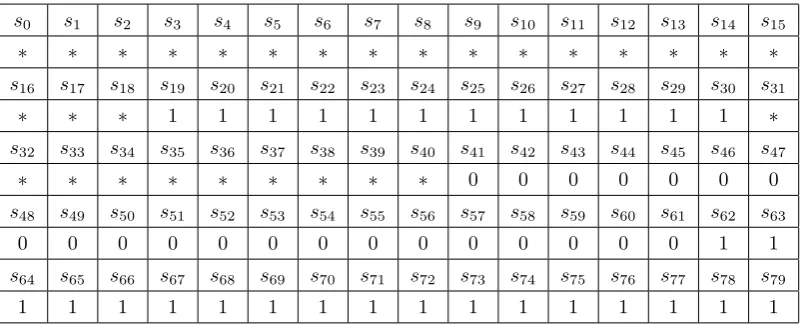
st+3= 1, st+25= 0, which fort= 16,17, implies assigning 4 more bits to the above values. So far, 32 + 6 =38 state bits have been specified. Similarly, taking into account the tap position differences 25−3 = 22,46−25 = 21, we have been able to specify 13 more state bits that satisfy the requirements for the two operation modes. Thus, in total 51 bits have been specified. A full specification of these special state bits of the LFSR is summarised in Table 3. Here, “∗“ means an unspecified bit and there are 29 unspecified bits in total. The next step is, based on the already assigned state bits (51 in total), to recover 25 secret bits of the NFSR and the 3 secret bits of the LFSR (namely s0, s1 and s2) by additionally assigning 81 bits of the secret state. The process of recovering secret state bits of the NFSR, by further specifying suitable state bits, is pretty straightforward. For instance, to computeb10using (8) it is enough to assign seven bitsb1, b2, b4, b31, b43, b56, s3
2
s0 s1 s2 s3 s4 s5 s6 s7 s8 s9 s10 s11 s12 s13 s14 s15
∗ ∗ ∗ ∗ ∗ ∗ ∗ ∗ ∗ ∗ ∗ ∗ ∗ ∗ ∗ ∗
s16 s17 s18 s19 s20 s21 s22 s23 s24 s25 s26 s27 s28 s29 s30 s31
∗ ∗ ∗ 1 1 1 1 1 1 1 1 1 1 1 1 ∗
s32 s33 s34 s35 s36 s37 s38 s39 s40 s41 s42 s43 s44 s45 s46 s47
∗ ∗ ∗ ∗ ∗ ∗ ∗ ∗ ∗ 0 0 0 0 0 0 0
s48 s49 s50 s51 s52 s53 s54 s55 s56 s57 s58 s59 s60 s61 s62 s63
0 0 0 0 0 0 0 0 0 0 0 0 0 0 1 1
s64 s65 s66 s67 s68 s69 s70 s71 s72 s73 s74 s75 s76 s77 s78 s79
1 1 1 1 1 1 1 1 1 1 1 1 1 1 1 1
Table 3: Special state bits of the LFSR
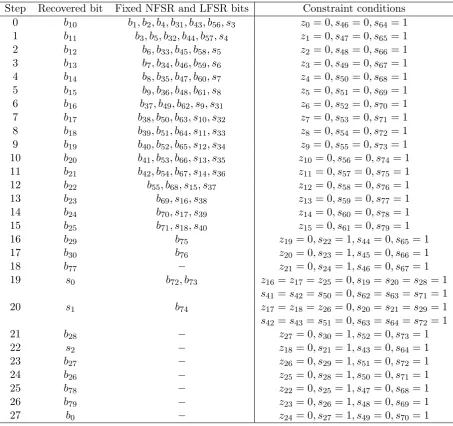
for a given outputz0. The whole process of computing 28 secret state bits by additionally specifying 81 bits of the secret state is depicted in Table 4. For convenience of the reader, we analyse in detail a more involved procedure of recovering the secret bit b29 to b0 in Appendix A, which corresponds to the step 16 to the step 27 in Table 4.
The above discussion, along with Table 3 and Table 4, implies the following result.
Lemma 1 Given the value of 132 particular (special) state bits of Grain-v1 and the first 28 keystream output bits generated from the internal state, then the remaining 28 bits of the internal state can be recovered directly.
3.1.1 The complexity estimates
The attack has two phases, i.e., the preprocessing phase (off-line) and the internal state recovery phase (on-line). A trade-off parameter l used in both phases gives a flexibility of adjusting different complexities of the attack, that is, to choose a suitable point on the TMDTO (time-memory-data-trade-off) curve. Thepreprocessing phasecontains the steps depicted below, under the assumption that the cipher generates a keystream sequence with the 28-zero prefix. Notice that during this phase, apart from having specified 51 special state bits and recovering 28 bits of the secret state by using Lemma 1, in addition
lbits of the secret state are guessed.
Input: The trade-off parameter l, 2≤l≤15.
Step 1: Set s19 = 1,· · · , s30 = 1; s41 = 0,· · · , s61 = 0;s62 = 1,· · · , s79 = 1 (51 constraint bits in total, see Table 3), ands3 = 0,· · · , sl+2= 0.
Step 2: Based on the above constraints, for each of 2160−51−28−l = 281−l possible patterns of the internal state of Grain-v1 perform the steps below:
(1) For each given pattern, deduce the bitsb0, b10,· · · , b30, b77,· · ·, b79, s0, s1, s3 (28 bits in total) by using Table 3 and Table 4, cf. Lemma 1.
Step Recovered bit Fixed NFSR and LFSR bits Constraint conditions 0 b10 b1, b2, b4, b31, b43, b56, s3 z0= 0, s46= 0, s64= 1 1 b11 b3, b5, b32, b44, b57, s4 z1= 0, s47= 0, s65= 1 2 b12 b6, b33, b45, b58, s5 z2= 0, s48= 0, s66= 1 3 b13 b7, b34, b46, b59, s6 z3= 0, s49= 0, s67= 1 4 b14 b8, b35, b47, b60, s7 z4= 0, s50= 0, s68= 1 5 b15 b9, b36, b48, b61, s8 z5= 0, s51= 0, s69= 1 6 b16 b37, b49, b62, s9, s31 z6= 0, s52= 0, s70= 1 7 b17 b38, b50, b63, s10, s32 z7= 0, s53= 0, s71= 1 8 b18 b39, b51, b64, s11, s33 z8= 0, s54= 0, s72= 1 9 b19 b40, b52, b65, s12, s34 z9= 0, s55= 0, s73= 1 10 b20 b41, b53, b66, s13, s35 z10= 0, s56= 0, s74= 1 11 b21 b42, b54, b67, s14, s36 z11= 0, s57= 0, s75= 1
12 b22 b55, b68, s15, s37 z12= 0, s58= 0, s76= 1
13 b23 b69, s16, s38 z13= 0, s59= 0, s77= 1
14 b24 b70, s17, s39 z14= 0, s60= 0, s78= 1
15 b25 b71, s18, s40 z15= 0, s61= 0, s79= 1
16 b29 b75 z19= 0, s22= 1, s44= 0, s65= 1
17 b30 b76 z20= 0, s23= 1, s45= 0, s66= 1
18 b77 − z21= 0, s24= 1, s46= 0, s67= 1
19 s0 b72, b73 z16=z17=z25= 0, s19=s20=s28= 1
s41=s42=s50= 0, s62=s63=s71= 1
20 s1 b74 z17=z18=z26= 0, s20=s21=s29= 1
s42=s43=s51= 0, s63=s64=s72= 1
21 b28 − z27= 0, s30= 1, s52= 0, s73= 1
22 s2 − z18= 0, s21= 1, s43= 0, s64= 1
23 b27 − z26= 0, s29= 1, s51= 0, s72= 1
24 b26 − z25= 0, s28= 1, s50= 0, s71= 1
25 b78 − z22= 0, s25= 1, s47= 0, s68= 1
26 b79 − z23= 0, s26= 1, s48= 0, s69= 1
27 b0 − z24= 0, s27= 1, s49= 0, s70= 1
Table 4: The deduced state bits of Grain-v1
value. Note that the 16-bit padding value is a 16-bit string of ones used in the key initialization of Grain-v1 cipher [19]. Then accordingly, generate a 160-bit keystream segment, and memorize the three values (the initial state, the observed state, the 160-bit keystream segment).
For Grain-v1, we assume the availability of 2r keystream sequences each of length 2s bits generated using different initial values, where 2r ≪ 264 and 2s ≪ 280. Within this sample of 2r+s bits in total it is expected that 2r+s−28 many segments has the prefix consisting of 28 zeros, but similarly to [22] we only collect the segments with a desired prefix thus ignoring segments with other prefixes. This means that the observed data is actually 2r+s bits but only a portion of 2r+s−28 bits is used.
The online phase of the attack consists of the steps described below.
Inputs: The trade-off parameter l, 2 ≤ l ≤ 15, and the table T from the off-line phase.
Step a: Construct a sample space consisting of [2r+320s−28] different 320-bit keystream segments generated by Grain-v1, with a 28-zero prefix.
Step b: For each 320-bit segment of the [2r+320s−28] samples, perform the steps below:
(1) If the first 160 bits of the segment match with some entry in the third column of T, sayS∗, retrieve this internal state S∗.
(2) Using this internal stateS∗, generate a 320-bit keystream segment. If the generated 320-bit keystream segment and the considered sample segment are identical, then the internal state S∗ is the correct one. Otherwise, repeat the procedure with the next sample.
The complexity analysis of the attack is as follows. Similarly to the complexity evaluation in [22], taking into account the sample keystream segments having 28-zeroes as a prefix, we have that the data requirement is about 2r+s= 251+28+l = 279+lbits. This means that the special state bits of the LFSR (51 bits in total) in Table 3 will occur with probability 1. This amount of data also implies that a unique secret state (and consequently the secret key) is recovered since the probability of recovering a wrong secret state is about 279+l−320 = 2−241+l≈0. The time complexity of the preprocessing phase isO(281−l) oper-ations, which corresponds to Step 2 above. The memory complexity of the preprocessing phase is about 265−l×160×3≈273.91−l bits.
The time complexity of the internal state recovery (on-line phase) is about 251+l op-erations. One should remark that these operations are simple table look-ups if a state recovery attack is performed, whereas in the case of a key recovery attack the operations are more complex due to the backward computation of the secret key bits. The mem-ory complexity of the internal state recovery (on-line phase) is about 273.91−l bits, which corresponds to the size of the tableT.
Remark 1 The core idea of our attack is to first eliminate the dependence onbt+63 (i.e.,
the variablex4 ) inzt. Actually, we can use another strategy to eliminate this dependence.
For instance, by lettingx2 = 0, we would haveh(x) =x1⊕x4⊕x0x3⊕x3x4. It is clear that
x3·h(x) = (x0⊕x1)x3. Then, by additionally requiring thatzt= 0 and
∑
j∈Abt+j = 0, we
have(st+3⊕st+25)·st+64= 0 so that the dependence onbt+63 inzt(orh(x)) is eliminated.
Therefore, a similar attack on Grain-v1 can be mounted using the above observations.
3.2 Attacking Grain-128
The internal state of Grain-128 has 256 bits, which consists of a 128-bit LFSR (denoted as (s0,· · ·, s127)) and a 128-bit NFSR (denoted as (b0,· · · , b127)). The update functions of both the LFSR and NFSR are respectively defined as follows.
st+128 = st⊕st+7⊕st+38⊕st+70⊕st+81⊕st+96 (9)
bt+128 = st⊕bt⊕bt+26⊕bt+56⊕bt+91⊕bt+96⊕bt+3bt+67⊕bt+11bt+13
⊕bt+17bt+18⊕bt+27bt+59⊕bt+40bt+48⊕bt+61bt+65⊕bt+68bt+84
The output function is defined as
zt=
∑
j∈A
bt+j⊕h(bt+12, st+8, st+13, st+20, bt+95, st+42, st+60, st+79, st+95)⊕st+93,
whereA={2,15,36,45,64,73,89}. Similarly to Grain-v1, the output bitztis also filtered
by a nonlinear functionh(x0,· · ·, x8), where
h(x0,· · · , x8) =x0x1⊕x2x3⊕x4x5⊕x6x7⊕x0x4x8.
The variables (x0, x1, x2, x3, x4, x5, x6, x7, x8), respectively, correspond to the tap positions
bt+12, st+8, st+13, st+20, bt+95, st+42, st+60, st+79, st+95 ( or st+94).
Grain-128 is initialized with a 96-bit IV that are input to the LFSR (the remaining bits of the LFSR are filled with ones), whereas the secret 128-bit key is loaded into the NFSR. Then the cipher is clocked 256 times without producing any keystream, but feeding the output bits back into both the LFSR and the NFSR.
The main difference between Grain-128 and Grain-128a is a modification of the NFSR update function given by,
st+128 = st⊕st+7⊕st+38⊕st+70⊕st+81⊕st+96, (10)
bt+128 = st⊕bt⊕bt+26⊕bt+56⊕bt+91⊕bt+96⊕bt+3bt+67⊕bt+11bt+13
⊕bt+17bt+18⊕bt+27bt+59⊕bt+40bt+48⊕bt+61bt+65⊕bt+68bt+84
⊕bt+22bt+24bt+25⊕bt+70bt+78bt+82⊕bt+88bt+92bt+93bt+95.
Its pre-output function is defined as,
yt=
∑
j∈A
whereA={2,15,36,45,64,73,89}. The pre-output functionyt(·) shares the same filtering
nonlinear function h(x0,· · · , x8) as Grain-128, where
h(x0,· · · , x8) =x0x1⊕x2x3⊕x4x5⊕x6x7⊕x0x4x8.
In difference to Grain-128, the variablesx0, x1, x2, x3, x4, x5, x6, x7, x8 of the filtering non-linear function in Grain-128a correspond to the tap positions bt+12, st+8, st+13, st+20,
bt+95, st+42, st+60, st+79, st+94, respectively (the bitst+95 is replaced by st+94).
Grain-128a has two different modes of operation, i.e., the first mode is with authen-tication (IV0 = 1), whereas the second mode is without authentication (IV0 = 0). For
IV0 = 1, the keystream output function is defined as zt =y64+2t,(t ≥0), i.e., every
sec-ond pre-output bit is used as the keystream bit. Notice that the first 64 pre-output bits and the other half of Grain-128a are used for generating the MAC, see [3]. Moreover, for
IV0= 0, the keystream output function is defined aszt=yt,fort≥0,i.e., the pre-output
bits of Grain-128a are directly used as the keystream bits.
3.2.1 Attack details for Grain-128 or Grain-128a without authentication
Note that both Grain-128 and Grain-128a share the same filtering function h. The vari-ablesx0, x1, x2, x3, x4, x5, x6, x7, x8 respectively correspond to the tap positions
bt+12, st+8, st+13, st+20, bt+95, st+42, st+60, st+79, st+94( or st+95).
Since the approach taken here goes along the same lines as previously described for Grain-v1, we give just a rough guidelines of these steps. More precisely, if we letx0= 0, x5= 0 (i.e., bt+12 = 0, st+42= 0), then we have h(x) = x2x3⊕x6x7, which does not depend on
x4. In this case we assign bt+12 = 0,st+42 = 0, for t= 0, . . . ,41 and t= 46, . . . ,49, thus specifying 92 bits of the secret state in total. Similarly, from the structure of Grain-128 and Grain-128a without authentication, we observe that the internal state variables satisfy the following equation,
bt+89=zt⊕bt+2⊕bt+15⊕bt+36⊕bt+45⊕bt+64⊕bt+73⊕st+93⊕st+13st+20⊕st+60st+79,
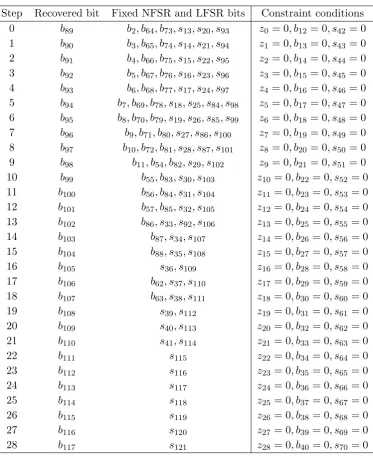
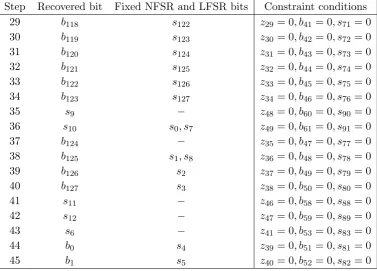
where bt+12 = 0, st+42 = 0 and t ∈ {0,· · · ,41,46, . . . ,49}. Moreover, using the above relationship and by additionally specifying 118 secret state bits, we are able to deduce 46 bits of the internal state of Grain-128 or Grain-128a without authentication directly. The whole procedure is summarized in Table 5 and Table 6, see Appendix B.
Lemma 2 Given the value of 210 particular state bits of Grain-128 (or Grain-128a with-out authentication model) and the corresponding 46 keystream with-output bits generated from the internal state, then the remaining 46 bits of the internal state can be recovered directly.
3.2.2 The complexity analysis
internal state recovery phase (on-line). In this case, we assume that the cipher gen-erates a keystream segment with 46-zero in a 50-bit prefix, where zt = 0, for t =
0, . . . ,41,46, . . . ,49.
The preprocessing phase contains the following steps.
Input : The trade-off parameter l, 0≤l≤13.
Step 1: Set bt+12 = 0, st+42 = 0, for t ∈ {0, . . . ,41,46, . . . ,49}, and s13 = 0, . . . , sl+12= 0.
Step 2: Based on the above constraints, for each of 2256−46×2−46−l = 2118−l possible patterns of internal state of Grain-128 perform the steps below:
(1) For each given pattern, compute the bitsb0, b1, b89, . . . , b127, s6, s9, . . . , s12, by using Table 5 and Table 6, cf. Lemma 2.
(2) Recover the initial state (i.e.,128-bit secret key, 96-bit initial value, and 32-bit padding value). Note that the 32-32-bit padding value is a 32-32-bit one string (or consists of a single 0 and 31 ones - Grain-128a). Then accordingly, generate a 256-bit keystream segment by Grain-128 (or Grain-128a), and memorize the triplet (the initial state, the observed state, 256-bit keystream segment).
Step 3: Output the three column tableT containing 2118−l−32= 286−l rows.
Similarly to the on-line attack procedure for Grain-v1, the internal state recovery consists of the following steps.
Input: The trade-off parameterl, 0≤l≤13, and the tableTcreated in the preprocessing phase.
Step a: Collect a sample space generated by Grain-128(a) consisting of [2r+512s−46] different 512-bit keystream segment with 46-zero in the 50-bit prefix by Grain-128 (or Grain-Grain-128a), wherezt= 0,fort= (0,· · · ,41,46,· · ·,49).
Step b: For each 512-bit segment of [2r+512s−46] samples, perform the steps below:
(1) If the first 256 bits of the segment matches with the third column in T, retrieve the corresponding internal stateS∗ from the table.
(2) Using the internal state S∗, generate a new 512-bit keystream segment. Moreover, check the new 512-bit keystream segment with the considered sam-ple segment. If the two 512-bit keystream segments are identical, then the internal stateS∗ is the correct one. Otherwise, repeat the procedure with the next sample segment.
• Time complexity : It corresponds to Step 2 and requires 2118−l operations for con-structing the tableT.
• Memory complexity: To store the tableT 286−l×256×3≈295.59−l bits of memory
are required.
The on-line phase of the attack is characterized by the following complexity estimates:
• Time complexity : The internal state (key) recovery requires 292+l operations.
• Memory complexity: The size of the input tableTwhich is 295.59−l bits.
Moreover, an ”optimal” choice of the trade-off parameter l = 13 gives the following complexity estimates. The complexity of the sample collection is about 2151 bits, e.g. availability of 275 keystream sequences each of length 276 bits generated for different initial values. The time complexity of the preprocessing phase is about 2105 operations, whereas the memory complexity is about 282.59 bits. The time complexity of the internal state (key) recovery (online phase) is about 2105 operations using table Tof 282.59 bits as the input, see Table 2. As before, the success rate of this attack is one.
4
Summary
In this work a simple but powerful attack on Grain family of ciphers was presented. To resist the new attack, the design must be more robust against the possibility of recovering modest number of internal state bits under certain constraint conditions. For Grain-v1, whose output function is zt =
∑
j∈Abt+j ⊕h(st+3, st+25, st+46, st+64, bt+63), where
A={1,2,4,10,31,43,56},the problem seems to be the placement of the NFSR bitst+56 which has a long delay before its update. In order to thwart BSW like attacks, we suggest a replacement of the tap position 56 in A = {1,2,4,10,31,43,56}. For instance, if a tap position i, for 70 < i < 79, is used instead, then the adversary may only deduce about 79−iequations (internal state bits) by using the constraint conditions as discussed in this article. Similarly, for Grain-128 and Grain-128a, the tap position 89 in A =
{2,15,36,45,64,73,89} may be replaced by some other tap position, for instance the output may be taken at positioni, where 120< i <127.
References
[1] Afzal, M., and Masood, A.: Algebraic Cryptanalysis of a NLFSR Based Stream Ci-pher. In: Information and Communication Technologies: From Theory to Applica-tions (ICTTA 2008), Umayyad Palace, Damascus, Syria, pp. 1-6, 2008.
[3] Agren, M., Hell, M., Johansson, T., and Meier, W.: A New Version of Grain-128 with Optional Authentication. International Journal of Wireless and Mobile Computing, vol. 5, no. 1, pp. 48–59, 2011.
[4] Babbage, S.: Improved exhaustive search attacks on stream ciphers. In: Euro-pean Convention on Security and Detection 1995. IEE Conference Publication, pp. 161C166. IEEE Press, New York, 1995.
[5] Bjorstad, T.: Cryptanalysis of Grain using Time/Memory/Data Tradeoffs. Available at: http://www.ii.uib.no/ tor/pdf/grain.pdf
[6] Biryukov, A., and Shamir, A.: Cryptanalytic Time/Memory/Data Tradeoffs for Stream Ciphers. In Proceedings of ASIACRYPT 2000. LNCS vol. 1976, Springer-Verlag, pp. 1-13, 2000.
[7] Biryukov, A., Shamir, A., and Wagner, D.: Real Time Cryptanalysis of A5/1 on a PC. In: Proceedings of FSE 2000, LNCS vol. 1978, pp. 1-18, Springer, Heidelberg, 2001.
[8] Banik, S., Maitra, S., and Sarkar, S.: Some Results on Related Key-IV Pairs of Grain. In: Security, Privacy, and Applied Cryptography Engineering (SPACE 2012). LNCS, vol. 7644, pp. 94-110. Springer, Heidelberg, 2012.
[9] Banik, S., Maitra, S., and Sarkar, S.: A Differential Fault Attack on the Grain Family of Stream Ciphers. In: Proc. 14th Int. Workshop on Cryptographic Hardware and Embedded System CHES 2012. LNCS, vol. 7428, pp. 122-139. Springer, Heidelberg, 2012.
[10] Banik, S., Maitra, S., Sarkar, S., and Sonmez, T.: Chosen IV Related Key Attack on Grain-128a. In: ACISP 2013. LNCS, vol. 7959, pp. 13-26. Springer, Heidelberg, 2013.
[11] Canniere, C., Kucuk, O., and Preneel, B.: Analysis of Grains Initialization Algo-rithm. In: AFRICACRYPT 2008. LNCS, vol. 5023, pp. 276-289, Springer, Heidelberg, 2008.
[12] Dinur, I. and Shamir, A.: Breaking Grain-128 with Dynamic Cube Attacks. In: Fast Software Encryption - FSE’2011. LNCS, vol. 6733, pp. 167-187. Springer, Heidelberg, 2011.
[13] Dinur, I., Guneysu, T., Paar, C., Shamir, A. and Zimmermann, R.: An Experimen-tally Verified Attack on Full Grain-128 Using Dedicated Reconfigurable Hardware. In:
Progress in Cryptology - ASIACRYPT’2011. LNCS, vol. 7073, pp. 327-373. Springer, Heidelberg, 2011.
[14] Ding, L., Guan, J.: Related Key Chosen IV Attack on Grain-128a Stream Cipher.
[15] Ding, L., Jin, C., Guan, J., and Qi, C.: New Treatment of the BSW Sampling and Its Applications to Stream Ciphers In: AFRICACRYPT 2014, LNCS 8469, pp. 136-146, Springer International Publishing Switzerland, 2014.
[16] Goli´c, J.D.: Cryptanalysis of alleged A5 stream cipher. In: EUROCRYPT 1997. LNCS, vol. 1233, pp. 239C255. Springer, Heidelberg, 1997.
[17] Hellman, M.: A cryptanalytic time-memory trade-off.IEEE Transactions on Infor-mation Theory, vol. 26, no.4, 401C406, 1980.
[18] Hell, M., Johansson, T., and Meier, W.: Grain - A Stream Cipher for Con-strained Environments. ECRYPT Stream Cipher Project Report, 2005. Available: http://www.ecrypt.eu.org/stream
[19] Hell, M., Johansson, T., and Meier, W.,: Grain: A Stream Cipher for Constrained Environments. International Journal of Wireless and Mobile Computing, vol. 2, no. 1, 2007. pp. 86-93, 2007.
[20] Hell, M., Johansson, T., Maximov,A., and Meier, W.: A Stream Cipher Proposal: Grain-128. In: IEEE International Symposium on Information Theory ISIT 2006, Seattle, Washington, USA, pp.1615-1618, 2006.
[21] Lee, Y., Jeong, K., Sung, J., and Hong, S.: Related-Key Chosen IV Attacks on Grain- v1 and Grain-128. In: ACISP 2008, LNCS, vol. 5107, pp. 321-335, Springer, Heidelberg, 2008.
[22] Mihaljevic, M., Gangopadhyay, S., Paul, G., and Imai, H.: Internal State Recovery of Grain-v1 Employing Normality Order of the Filter Function. IET Information Security, vol.6, no.2, pp.55-64, 2012.
[23] Mihaljevic, M., Gangopadhyay, S., Paul, G., and Imai, H.: Generic Cryptographic Weakness of K-normal Boolean Functions in Certain Stream Ciphers and Cryptanal-ysis of Grain-128.Periodica Mathematica Hungarica, vol. 65, no. 2, pp. 205-227, 2012.
[24] Rahimi, M., Barmshory, M., Mansouri, M., and Aref, M.: Dynamic Cube Attack on Grain-v1. Cryptology ePrint Archive: Report 2013/268. Available: http://eprint.iacr.org/2013/268
[25] Stankovski, P.: Greedy Distinguishers and Nonrandomness Detectors. In: Progress in Cryptology-INDOCRYPT 2010. LNCS, vol. 6498, pp. 210-226. Springer, Heidelberg, 2010.
[26] The ECRYPT Stream Cipher Project. eSTREAM Portfolio Revision, 2008. Available: http://www.ecrypt.eu.org/stream
[27] Zhang, H., and Wang, X.: Cryptanalysis of Stream Cipher Grain Family, Cryptology ePrint Archive, Report 2009/109. Available: http://eprint.iacr.org/.
Appendix A (The step 16 to the Step 27 in Table 4)
The step 16 in Table 4 aims at recovering the secret bitb29 of the NFSR. We compute
bt+10 in OM 2 for t=19,
b29=z19⊕b20⊕b21⊕b23⊕b50⊕b62⊕b75⊕s83, where s22= 1, s44= 0, s65= 1. Using the update function of LFSR, we have
s83=s65⊕s54⊕s41⊕s26⊕s16⊕s3.
Hence we only need to guess one new bit b75 to computeb29.
The step 17 in Table 4 aims at recovering the secret bitb30 of the NFSR. We compute
bt+10 in OM 2 for t= 20,
b30=z20⊕b21⊕b22⊕b24⊕b51⊕b63⊕b76⊕s84, where s23= 1, s45= 0, s66= 1. Using the update function of LFSR, we have
s84=s66⊕s55⊕s42⊕s27⊕s17⊕s4.
Hence we only need to guess one new bit b76 to computeb30.
The step 18 in Table 4 aims at recovering the secret bitb77 of the NFSR. We compute
bt+56 in OM 2 for t= 21,
b77=z21⊕b22⊕b23⊕b25⊕b52⊕b64⊕b31⊕s85, where s24= 1, s46= 0, s67= 1. Using the update function of LFSR, we have
s85=s67⊕s56⊕s43⊕s28⊕s18⊕s5.
Hence we need to guess no more new bit to compute b77.
The step 19 in Table 4 aims at recovering the secret bits0 of the LFSR. Notice that,
b35=z25⊕b26⊕b27⊕b29⊕b56⊕b68⊕b81⊕s89, where s21= 1, s43= 0, s64= 1.
b26=z16⊕b17⊕b18⊕b20⊕b47⊕b59⊕b72⊕s80, where s19= 1, s41= 0, s62= 1.
b27=z17⊕b18⊕b19⊕b21⊕b48⊕b60⊕b73⊕s81, where s20= 1, s42= 0, s63= 1. On the other hand, we have
s80=s62⊕s51⊕s38⊕s23⊕s13⊕s0.
s81=s63⊕s52⊕s39⊕s24⊕s14⊕s1.
s89=s71⊕s60⊕s47⊕s32⊕s22⊕s9.
b81=s1⊕b63⊕b61⊕b53⊕b46⊕b38⊕b34⊕b29⊕b22⊕b15⊕b10⊕b1⊕b64b61⊕b38b34⊕
b16b10⊕b61b53b46⊕b34b29b22⊕b64b46b29b10⊕b61b53b38b34⊕b64b61b22b16⊕b64b61b53b46b38⊕
b34b29b22b16b10⊕b53b46b38b34b29b22. Moreover, we have
b35=z25⊕z16⊕b17⊕b18⊕b20⊕b47⊕b59⊕b72⊕s62⊕s51⊕s38⊕s23⊕s13⊕s0⊕z17⊕b18⊕
b19⊕b21⊕b48⊕b60⊕b73⊕s63⊕s52⊕s39⊕s24⊕s14⊕s1⊕b29⊕b56⊕b68⊕s1⊕b64⊕b61⊕b53⊕b46⊕
b38⊕b34⊕b29⊕b22⊕b16⊕b10⊕b1⊕b64b61⊕b38b34⊕b16b10⊕b61b53b46⊕b34b29b22⊕b64b46b29b10⊕
b61b53b38b34⊕b64b61b22b16⊕b64b61b53b46b38⊕b34b29b22b16b10⊕b53b46b38b34b29b22⊕s89 Therefore, we have
s0=b35⊕z25⊕z16⊕b17⊕b18⊕b20⊕b47⊕b59⊕b72⊕s62⊕s51⊕s38⊕s23⊕s13⊕z17⊕b18⊕
b19⊕b21⊕b48⊕b60⊕b73⊕s63⊕s52⊕s39⊕s24⊕s14⊕b29⊕b56⊕b68⊕b64⊕b61⊕b53⊕b46⊕b38⊕
b34⊕b29⊕b22⊕b16⊕b10⊕b1⊕b64b61⊕b38b34⊕b16b10⊕b61b53b46⊕b34b29b22⊕b64b46b29b10⊕
It is clear that we need to guess two new bits (b72, b73) for obtaining the bits0.
The step 20 in Table 4 aims at recovering the secret bits1 of the LFSR. Similarly, we can deduce that we only need to guess one new bitsb74 for obtaining the bit s1 by using exactly the same way as step 19.
The step 21 in Table 4 aims at recovering the secret bitb28 of the NFSR. We compute
bt+1 in OM 2 fort= 27,
b28=z27⊕b29⊕b31⊕b37⊕b58⊕b70⊕b83⊕s91, where s30= 1, s52= 0, s73= 1. Using the update function of LFSR and NFSR, we have
s91=s73⊕s62⊕s49⊕s34⊕s24⊕s11.
b83=s3⊕b65⊕b63⊕b55⊕b48⊕b40⊕b36⊕b31⊕b24⊕b17⊕b12⊕b3⊕b66b63⊕b40b36⊕
b18b12⊕b63b55b48⊕b36b31b24⊕b66b48b31b12⊕b63b55b40b36⊕b66b63b24b18⊕b66b63b55b48b40⊕
b36b31b24b18b12⊕b55b48b40b36b31b24.
Hence we need to guess no more new bit to compute b28.
The step 22 in Table 4 aims at recovering the secret bit s2 of the LFSR. We compute
st+64 in OM 2 for t= 18,
s82=z18⊕b19⊕b20⊕b22⊕b28⊕b49⊕b61⊕b74, where s21= 1, s43= 0, s64= 1. Using the update function of LFSR, we have
s82=s64⊕s53⊕s40⊕s25⊕s15⊕s2.
Hence we need to guess no more new bit to compute s2.
The step 23 in Table 4 aims at recovering the secret bitb27 of the NFSR. We compute
bt+1 in OM 2 fort= 26,
b27=z26⊕b28⊕b30⊕b36⊕b57⊕b69⊕b82⊕s90, where s29= 1, s51= 0, s72= 1. Using the update function of LFSR and NFSR, we have
s90=s72⊕s61⊕s48⊕s33⊕s23⊕s10.
b82=s2⊕b64⊕b62⊕b54⊕b47⊕b39⊕b35⊕b30⊕b23⊕b16⊕b11⊕b2⊕b65b62⊕b39b35⊕
b17b11⊕b62b54b47⊕b35b30b23⊕b65b47b30b11⊕b62b54b39b35⊕b65b62b23b17⊕b65b62b54b47b39⊕
b35b30b23b17b11⊕b54b47b39b35b30b23.
Hence we need to guess no more new bit to compute b27.
The step 24 in Table 4 aims at recovering the secret bitb26 of the NFSR. We compute
bt+1 in OM 2 fort= 25,
b26=z25⊕b27⊕b29⊕b35⊕b56⊕b68⊕b81⊕s89, where s28= 1, s50= 0, s71= 1. Using the update function of LFSR and NFSR, we have
s89=s71⊕s60⊕s47⊕s32⊕s22⊕s9.
b81=s1⊕b63⊕b61⊕b53⊕b46⊕b38⊕b34⊕b29⊕b22⊕b15⊕b10⊕b1⊕b64b61⊕b38b34⊕
b16b10⊕b61b53b46⊕b34b29b22⊕b64b46b29b10⊕b61b53b38b34⊕b64b61b22b16⊕b64b61b53b46b38⊕
b34b29b22b16b10⊕b53b46b38b34b29b22.
The step 25 in Table 4 aims at recovering the secret bitb78 of the NFSR. We compute
bt+56 in OM 2 for t= 22,
b78=z22⊕b23⊕b24⊕b26⊕b53⊕b65⊕b32⊕s86, where s25= 1, s47= 0, s68= 1. Using the update function of LFSR, we have
s86=s68⊕s57⊕s44⊕s29⊕s19⊕s6.
Hence we need to guess no more new bit to compute b78.
The step 26 in Table 4 aims at recovering the secret bitb79 of the NFSR. We compute
bt+56 in OM 2 for t= 23,
b79=z23⊕b24⊕b25⊕b27⊕b54⊕b66⊕b33⊕s87, where s26= 1, s48= 0, s69= 1. Using the update function of LFSR, we have
s87=s69⊕s58⊕s45⊕s30⊕s20⊕s7.
Hence we need to guess no more new bit to compute b78.
The step 27 in Table 4 aims at recovering the secret bit b0 of the NFSR. We compute
bt+56 in OM 2 for t= 24,
b80=z24⊕b25⊕b26⊕b28⊕b55⊕b67⊕b34⊕s88, where s27= 1, s49= 0, s70= 1. Using the update function of LFSR and NFSR, we have
s88=s70⊕s59⊕s46⊕s31⊕s21⊕s8.
b80=s0⊕b62⊕b60⊕b52⊕b45⊕b37⊕b33⊕b28⊕b21⊕b14⊕b9⊕b0⊕b63b60⊕b37b33⊕
b15b9⊕b60b52b45⊕b33b28b21⊕b63b45b28b9⊕b60b52b37b33⊕b63b60b21b15⊕b63b60b52b45b37⊕
b33b28b21b15b9⊕b52b45b37b33b28b21.
Hence we need to guess no more new bit to compute b0.
Appendix B (Recovered bits in Table 5 and Table 6)
For the output function of Grain-128, if we letx0=0,x5=0 (i.e.,bt+12= 0,st+42= 0), then we havezt=bt+2⊕bt+15⊕bt+36⊕bt+45⊕bt+64⊕bt+73⊕bt+89⊕st+93⊕st+13st+20⊕
st+60st+79.
The step i (i = 0,· · ·,34) in Table 5 (or Table 6) aims at recovering the secret bit
bi+89 of the NFSR. We computebt+89 fort=i,
bi+89=zi⊕bi+2⊕bi+15⊕bi+36⊕bi+45⊕bi+64⊕bi+73⊕si+93⊕si+13si+20⊕si+60si+79,where
bi+12= 0, si+42= 0.
Clearly, we only need to guess bitsbi+2, bi+15, bi+36, bi+45, bi+64, bi+73, si+93, si+13, si+20,
si+60, si+79 to computebi+89, which is showed in Table 5 (or Table 6).
The step 35 in Table 6 aims at recovering the secret bit s9 of the LFSR. We compute
bt+89 fort= 48,
b137=z48⊕b50⊕b63⊕b84⊕b93⊕b112⊕b121⊕s141⊕s61s68⊕s108s127,whereb60= 0, s90= 0. Using the update function of LFSR and NFSR, we have
s141=s13⊕s20⊕s51⊕s83⊕s94⊕s109.
b137 = s9⊕b9⊕b35⊕b65⊕b100⊕b105⊕b12b76⊕b20b22⊕b26b27⊕b36b68⊕b49b57⊕
Hence we need to guess no more new bit to compute s9.
The step 36 in Table 6 aims at recovering the secret bits10 of the LFSR. We compute
bt+89 fort= 49,
b138 =z49⊕b51⊕b64⊕b85⊕b94⊕b113⊕b122⊕s142⊕s62s69⊕s109s128, where b61= 0, s91= 0.
Using the update function of LFSR and NFSR, we have
s128=s0⊕s7⊕s38⊕s70⊕s81⊕s96.
s142=s14⊕s21⊕s52⊕s84⊕s95⊕s110.
b138 =s10⊕b10⊕b36⊕b66⊕b101⊕b106⊕b13b77⊕b21b23⊕b27b28⊕b37b69⊕b50b58⊕
b71b75⊕b78b94⊕b32b34b35⊕b80b88b92⊕b98b102b103b105.
Hence we need to guess two new bitss0, s7 to computes10.
The step 37 in Table 6 aims at recovering the secret bitb124of the NFSR. We compute
bt+89 fort= 35,
b124=z35⊕b37⊕b50⊕b71⊕b80⊕b99⊕b108⊕s128⊕s48s55⊕s95s114,whereb47= 0, s77= 0. Using the update function of LFSR, we have
s128=s0⊕s7⊕s38⊕s70⊕s81⊕s96.
Hence we need to guess no more new bit to compute b124.
The step 38 in Table 6 aims at recovering the secret bitb125of the NFSR. We compute
bt+89 fort= 36,
b125=z36⊕b38⊕b51⊕b72⊕b81⊕b100⊕b109⊕s129⊕s49s56⊕s96s115,whereb48= 0, s78= 0. Using the update function of LFSR, we have
s129=s1⊕s8⊕s39⊕s71⊕s82⊕s97.
Hence we need to guess two new bitss1, s8 to computeb125.
The step 39 in Table 6 aims at recovering the secret bitb126of the NFSR. We compute
bt+89 fort= 37,
b126=z37⊕b39⊕b52⊕b73⊕b82⊕b101⊕b110⊕s130⊕s50s57⊕s97s116,whereb49= 0, s79= 0. Using the update function of LFSR, we have
s130=s2⊕s9⊕s40⊕s72⊕s83⊕s98.
Hence we need to guess one new bitss2 to computeb126.
The step 40 in Table 6 aims at recovering the secret bitb127of the NFSR. We compute
bt+89 fort= 38,
b127=z38⊕b40⊕b53⊕b74⊕b83⊕b102⊕b111⊕s131⊕s51s58⊕s98s117,whereb50= 0, s80= 0. Using the update function of LFSR, we have
s131=s3⊕s10⊕s41⊕s73⊕s84⊕s99.
Hence we need to guess one new bitss3 to computeb127.
The step 41 in Table 6 aims at recovering the secret bits11 of the LFSR. We compute
bt+89 fort= 46,
Using the update function of LFSR and NFSR, we have
s139=s11⊕s18⊕s49⊕s81⊕s92⊕s107.
b135=s7⊕b7⊕b33⊕b63⊕b98⊕b103⊕b10b74⊕b18b20⊕b24b25⊕b34b66⊕b47b55⊕b68b72⊕
b75b91⊕b29b31b32⊕b77b85b89⊕b95b99b100b102.
Hence we need to guess no more new bit to compute s11.
The step 42 in Table 6 aims at recovering the secret bits12 of the LFSR. We compute
bt+89 fort= 47,
b136=z47⊕b49⊕b62⊕b83⊕b92⊕b111⊕b120⊕s140⊕s60s67⊕s107s126,whereb59= 0, s89= 0. Using the update function of LFSR and NFSR, we have
s140=s12⊕s19⊕s50⊕s82⊕s93⊕s108.
b136=s8⊕b8⊕b34⊕b64⊕b99⊕b104⊕b11b75⊕b19b21⊕b25b26⊕b35b67⊕b48b56⊕b69b73⊕
b76b92⊕b30b32b33⊕b78b86b90⊕b96b100b101b103.
Hence we need to guess no more new bit to compute s12.
The step 43 in Table 6 aims at recovering the secret bit s6 of the LFSR. We compute
bt+89 fort= 41,
b130=z41⊕b43⊕b56⊕b77⊕b86⊕b105⊕b114⊕s134⊕s54s61⊕s101s120,whereb53= 0, s83= 0. Using the update function of LFSR and NFSR, we have
s134=s6⊕s13⊕s44⊕s76⊕s87⊕s102.
b130=s2⊕b2⊕b28⊕b58⊕b93⊕b98⊕b5b69⊕b13b15⊕b19b20⊕b29b61⊕b42b50⊕b63b67⊕
b70b86⊕b24b26b27⊕b72b80b84⊕b90b94b95b97.
Hence we need to guess no more new bit to compute s6.
The step 44 in Table 6 aims at recovering the secret bit b0 of the NFSR. We compute
bt+89 fort= 39,
b128=z39⊕b41⊕b54⊕b75⊕b84⊕b103⊕b112⊕s132⊕s52s59⊕s99s118,whereb51= 0, s81= 0. Using the update function of LFSR and NFSR, we have
s132=s4⊕s11⊕s42⊕s74⊕s85⊕s100.
b128=s0⊕b0⊕b26⊕b56⊕b91⊕b96⊕b3b67⊕b11b13⊕b17b18⊕b27b59⊕b40b48⊕b61b65⊕
b68b84⊕b22b24b25⊕b70b78b82⊕b88b92b93b95.
Hence we need to guess one new bitss4 to computeb0.
The step 45 in Table 6 aims at recovering the secret bit b1 of the NFSR. We compute
bt+89 fort= 40,
b129=z40⊕b42⊕b55⊕b76⊕b85⊕b104⊕b113⊕s133⊕s53s60⊕s100s119,whereb52= 0, s82= 0. Using the update function of LFSR and NFSR, we have
s133=s5⊕s12⊕s43⊕s75⊕s86⊕s101.
b129=s1⊕b1⊕b27⊕b57⊕b92⊕b97⊕b4b68⊕b12b14⊕b18b19⊕b28b60⊕b41b49⊕b62b66⊕
b69b85⊕b23b25b26⊕b71b79b83⊕b89b93b94b96.