
Azimuthal Anisotropy of
K
0S
and
Production at Midrapidity from
Au
Au
Collisions
at
p
s
NN130 GeV
C. Adler,11Z. Ahammed,23C. Allgower,12J. Amonett,14B. D. Anderson,14 M. Anderson,5G. S. Averichev,9 J. Balewski,12O. Barannikova,9,23L. S. Barnby,14J. Baudot,13S. Bekele,20V.V. Belaga,9R. Bellwied,31J. Berger,11
H. Bichsel,30A. Billmeier,31L. C. Bland,2C. O. Blyth,3B. E. Bonner,24A. Boucham,26A. Brandin,18A. Bravar,2 R.V. Cadman,1H. Caines,20M. Caldero´n de la Barca Sa´nchez,2A. Cardenas,23J. Carroll,15J. Castillo,26M. Castro,31
D. Cebra,5P. Chaloupka,20S. Chattopadhyay,31Y. Chen,6S. P. Chernenko,9M. Cherney,8A. Chikanian,33B. Choi,28 W. Christie,2J. P. Coffin,13T. M. Cormier,31J. G. Cramer,30H. J. Crawford,4W. S. Deng,2A. A. Derevschikov,22 L. Didenko,2T. Dietel,11J. E. Draper,5V. B. Dunin,9J. C. Dunlop,33V. Eckardt,16L. G. Efimov,9V. Emelianov,18 J. Engelage,4G. Eppley,24B. Erazmus,26P. Fachini,2V. Faine,2K. Filimonov,15E. Finch,33Y. Fisyak,2D. Flierl,11
K. J. Foley,2J. Fu,15,32C. A. Gagliardi,27N. Gagunashvili,9J. Gans,33L. Gaudichet,26M. Germain,13F. Geurts,24 V. Ghazikhanian,6O. Grachov,31V. Grigoriev,18M. Guedon,13E. Gushin,18T. J. Hallman,2D. Hardtke,15J.W. Harris,33 T.W. Henry,27S. Heppelmann,21T. Herston,23B. Hippolyte,13A. Hirsch,23E. Hjort,15G.W. Hoffmann,28M. Horsley,33
H. Z. Huang,6T. J. Humanic,20G. Igo,6A. Ishihara,28Yu. I. Ivanshin,10P. Jacobs,15W.W. Jacobs,12M. Janik,29 I. Johnson,15P. G. Jones,3E. G. Judd,4M. Kaneta,15M. Kaplan,7D. Keane,14J. Kiryluk,6A. Kisiel,29J. Klay,15 S. R. Klein,15A. Klyachko,12A. S. Konstantinov,22M. Kopytine,14 L. Kotchenda,18A. D. Kovalenko,9M. Kramer,19 P. Kravtsov,18K. Krueger,1C. Kuhn,13A. I. Kulikov,9G. J. Kunde,33C. L. Kunz,7R. Kh. Kutuev,10A. A. Kuznetsov,9 L. Lakehal-Ayat,26M. A. C. Lamont,3J. M. Landgraf,2S. Lange,11C. P. Lansdell,28B. Lasiuk,33F. Laue,2A. Lebedev,2
R. Lednicky´,9V. M. Leontiev,22M. J. LeVine,2Q. Li,31S. J. Lindenbaum,19M. A. Lisa,20F. Liu,32L. Liu,32Z. Liu,32 Q. J. Liu,30T. Ljubicic,2W. J. Llope,24G. LoCurto,16H. Long,6R. S. Longacre,2M. Lopez-Noriega,20W. A. Love,2
T. Ludlam,2D. Lynn,2J. Ma,6R. Majka,33S. Margetis,14C. Markert,33L. Martin,26J. Marx,15H. S. Matis,15 Yu. A. Matulenko,22T. S. McShane,8F. Meissner,15Yu. Melnick,22A. Meschanin,22M. Messer,2M. L. Miller,33 Z. Milosevich,7N. G. Minaev,22J. Mitchell,24V. A. Moiseenko,10C. F. Moore,28V. Morozov,15M. M. de Moura,31 M. G. Munhoz,25J. M. Nelson,3P. Nevski,2V. A. Nikitin,10L.V. Nogach,22B. Norman,14S. B. Nurushev,22G. Odyniec,15
A. Ogawa,21V. Okorokov,18M. Oldenburg,16D. Olson,15G. Paic,20S. U. Pandey,31Y. Panebratsev,9S. Y. Panitkin,2 A. I. Pavlinov,31T. Pawlak,29V. Perevoztchikov,2W. Peryt,29V. A Petrov,10M. Planinic,12J. Pluta,29N. Porile,23 J. Porter,2A. M. Poskanzer,15E. Potrebenikova,9D. Prindle,30C. Pruneau,31J. Putschke,16G. Rai,15G. Rakness,12
O. Ravel,26R. L. Ray,28S.V. Razin,9,12D. Reichhold,8J. G. Reid,30F. Retiere,15A. Ridiger,18H. G. Ritter,15 J. B. Roberts,24O.V. Rogachevski,9J. L. Romero,5A. Rose,31C. Roy,26V. Rykov,31I. Sakrejda,15S. Salur,33 J. Sandweiss,33A. C. Saulys,2I. Savin,10J. Schambach,28R. P. Scharenberg,23N. Schmitz,16L. S. Schroeder,15
A. Schu¨ttauf,16K. Schweda,15J. Seger,8D. Seliverstov,18P. Seyboth,16E. Shahaliev,9K. E. Shestermanov,22 S. S. Shimanskii,9V. S. Shvetcov,10G. Skoro,9N. Smirnov,33R. Snellings,15P. Sorensen,6J. Sowinski,12H. M. Spinka,1
B. Srivastava,23E. J. Stephenson,12R. Stock,11A. Stolpovsky,31M. Strikhanov,18B. Stringfellow,23C. Struck,11 A. A. P. Suaide,31E. Sugarbaker,20C. Suire,2M. Sˇumbera,20B. Surrow,2T. J. M. Symons,15A. Szanto de Toledo,25
P. Szarwas,29A. Tai,6J. Takahashi,25A. H. Tang,14 J. H. Thomas,15M. Thompson,3V. Tikhomirov,18M. Tokarev,9 M. B. Tonjes,17T. A. Trainor,30S. Trentalange,6R. E. Tribble,27V. Trofimov,18O. Tsai,6T. Ullrich,2D. G. Underwood,1
G. Van Buren,2A. M. VanderMolen,17I. M. Vasilevski,10A. N. Vasiliev,22S. E. Vigdor,12S. A. Voloshin,31F. Wang,23 H. Ward,28J.W. Watson,14R. Wells,20G. D. Westfall,17C. Whitten, Jr.,6H. Wieman,15R. Willson,20S.W. Wissink,12 R. Witt,32J. Wood,6N. Xu,15Z. Xu,2A. E. Yakutin,22E. Yamamoto,15J. Yang,6P. Yepes,24V. I. Yurevich,9Y.V. Zanevski,9
I. Zborovsky´,9H. Zhang,33W. M. Zhang,14R. Zoulkarneev,10and A. N. Zubarev9
(STAR Collaboration)
1Argonne National Laboratory, Argonne, Illinois 60439 2Brookhaven National Laboratory, Upton, New York 11973 3University of Birmingham, Birmingham, United Kingdom
4University of California, Berkeley, California 94720 5University of California, Davis, California 95616 6University of California, Los Angeles, California 90095 7Carnegie Mellon University, Pittsburgh, Pennsylvania 15213
9Laboratory for High Energy (JINR), Dubna, Russia 10Particle Physics Laboratory (JINR), Dubna, Russia
11University of Frankfurt, Frankfurt, Germany 12Indiana University, Bloomington, Indiana 47408 13Institut de Recherches Subatomiques, Strasbourg, France
14Kent State University, Kent, Ohio 44242
15Lawrence Berkeley National Laboratory, Berkeley, California 94720 16Max-Planck-Institut fuer Physik, Munich, Germany 17Michigan State University, East Lansing, Michigan 48824
18Moscow Engineering Physics Institute, Moscow Russia 19City College of New York, New York City, New York 10031
20The Ohio State University, Columbus, Ohio 43210
21Pennsylvania State University, University Park, Pennsylvania 16802 22Institute of High Energy Physics, Protvino, Russia
23Purdue University, West Lafayette, Indiana 47907 24Rice University, Houston, Texas 77251 25Universidade de Sao Paulo, Sao Paulo, Brazil
26SUBATECH, Nantes, France 27Texas A & M, College Station, Texas 77843
28University of Texas, Austin, Texas 78712 29Warsaw University of Technology, Warsaw, Poland 30University of Washington, Seattle, Washington 98195
31Wayne State University, Detroit, Michigan 48201 32Institute of Particle Physics, Wuhan, Hubei 430079 China
33Yale University, New Haven, Connecticut 06520
(Received 13 May 2002; published 9 September 2002)
We report STAR results on the azimuthal anisotropy parameterv2for strange particlesK0S,, and
at midrapidity inAuAucollisions at sNN
p
130 GeVat the Relativistic Heavy Ion Collider. The value ofv2as a function of transverse momentum,pt, of the produced particle and collision centrality
is presented for both particles up topt3:0 GeV=c. A strongpt dependence inv2 is observed up to
2:0 GeV=c. The v2 measurement is compared with hydrodynamic model calculations. The physics implications of thept integratedv2 magnitude as a function of particle mass are also discussed.
DOI: 10.1103/PhysRevLett.89.132301 PACS numbers: 25.75.Ld, 25.75.Dw
Measurements of azimuthal anisotropies in the trans-verse momentum distribution of particles can probe early stages of ultrarelativistic heavy ion collisions [1– 3]. In high-energy nuclear collisions, the initial geometric an-isotropy is established from the overlap between the col-liding nuclei. The time necessary to build up this spatial anisotropy is believed to be short because the colliding nuclei are highly Lorentz contracted in the center-of-mass system. During a5–50 fm=cperiod, rescattering transfers the initial spatial anisotropy into a momentum anisotropy. This momentum anisotropy manifests itself most strongly in the azimuthal distribution of transverse momenta. The extent to which the initial spatial ropy is transformed to the measured momentum anisot-ropy depends on the initial conditions and the dynamical evolution of the system. In particular, anisotropy meas-urements for nucleus-nucleus collisions at the Relativistic Heavy Ion Collider (RHIC) energies may provide infor-mation about a partonic stage that may exist early in the collision evolution [1,4 –8].
The transverse momentum distribution of particles can be described in the form
d2N
dp2td
dN
2dp2t
12X n
vncosn
; (1)
whereptis the transverse momentum of the particle,is its azimuthal angle with respect to the reaction plane [9,10], and the harmonic coefficients,vn, are anisotropy parameters. The second coefficient v2 is called elliptic flow. Recent experimental results from RHIC [11–14] include measurements of v2 as a function of collision
centrality and pt for charged particles with pt< 2:0 GeV=c, and for identified charged pions, kaons, and protons for pt up to 0:8 GeV=c. The degree of the anisotropy transfer from position to momentum distribu-tion depends on the density of the system during its evolution and the scattering cross sections of the particles involved (parton and/or hadron). As a result, recent theo-retical work attempted to deduce the initial gluon density from partonic energy loss [6] and the equation of state from hydrodynamic model calculations [5,7].
identified strange particles [12,20 – 25] most have been at much lower collision energies. At the CERN Super Proton Synchrotron (SPS), quantitative differences between multistrange baryons and nonstrange hadrons were ob-served in transverse radial flow in PbPbcollisions at
sNN p
17 GeV [26,27]. A physical scenario in which multistrange baryons do not participate in a common expansion and thus decouple early from the collision system due to their small hadronic cross sections was proposed to explain this observation [28]. This explana-tion suggests that it may be possible to obtain insight into very early stages of the collisions by studying the elliptic flow of strange particles.
In this Letter, we report the first measurement of the azimuthal anisotropy parameter v2 for the strange
par-ticlesK0
S,, and fromAuAucollisions at sNN p
130 GeV. Our measurement of v2 for different central-ities as a function ofpt using the Solenoidal Tracker at RHIC (STAR) extends to aptof about3:0 GeV=c, much higher than previously measured for identified charged pions, kaons, and protons [12].
The STAR detector [29] consists of several subsystems, including a Time Projection Chamber (TPC) [30], in a large solenoidal magnet. For collisions in its center, the TPC measures charged tracks in the pseudorapidity range jj<1:5with 2 azimuthal coverage. During the year 2000 data taking the STAR magnet operated with a 0.25 Tesla field, allowing tracking of particles withpt> 0:075 GeV=c. A scintillator barrel surrounding the TPC measures the charged particle multiplicity withinjj<1 for use as a central trigger. Two zero-degree calorimeters [31], located at 18:25 m from the nominal interaction region and subtending an angle <0:002 radians, are used in coincidence as a minimum-bias trigger. This analysis uses 201 103 minimum bias and 180 103
central events.
We reconstruct bothK0
S!
and !p
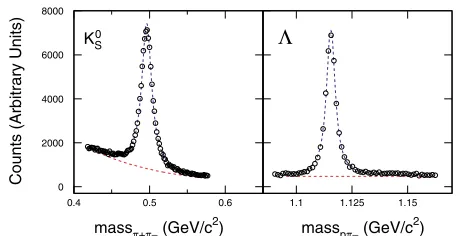
pfrom their charged daughter tracks detected in the TPC. Tracks are assigned asp,p,, orbased on their charge sign and their mean energy loss,hdE=dxi, in the TPC gas. The mass and the kinematic properties of theK0S,, orcandidates are extracted from the decay vertex geometry and daughter particle kinematics. Figure 1 shows the invariant mass distributions for
candidates showing aK0
S mass peak and forp
candidates showing a mass peak. The dashed lines are fits to the background and the peak. We determined that the background is dominated by combinatorial counts by rotating all positive tracks 180 in the transverse plane and reconstructing theK0
Sanddecay vertices. This procedure destroys all real vertices within our acceptance so that we can describe the combinatorial contribution to the invariant mass distributions. The observed masses, 4968 MeV=c2 for and 11164 MeV=c2 for
p, are consistent with accepted values [32] and the widths are determined by the momentum resolution of
the detector. The particles used for the v2 analysis are from the kinematic region of jyj 1:0 and 0:2pt 3:2 GeV=cfor K0
S or 0:3pt3:2 GeV=cfor , where y is the particle’s rapidity. No significant differ-ences in elliptic flow are observed between and, so because of the limited statistics, and are summed together.
We choose the requirements for the K0S and daughter candidates to maximize statistics and to elimi-nate autocorrelations in the event plane calculation. For
K0S, we require the daughter candidate tracks to have a distance-of-closest-approach (dca) to the collision vertex
>1:0 cm. For thereconstruction, we choose pion candidates with a dca >1:5 cm and proton candidates with a dca >0:8 cm. We use the peak in the invariant mass distribution to measure the yield of K0
S or
particles for different values ofandpt. Using thebin center for the value of, we evaluatev2as a function of
ptby calculatinghcos2iin differentptintervals. This technique enables us to measure elliptic flow for identi-fied particles beyond theptregion where particle identi-fication via hdE=dxi fails [12].
The real reaction plane is not known, but the event plane, an experimental estimator of the true reaction plane, can be calculated from the azimuthal distribution of tracks [11]. To calculate the event plane, we select charged particle tracks with at least 15 measured space points,0:1< pt2:0 GeV=candjj<1:0. We also re-quire the ratio of the number of space points to the expected maximum number of space points for each track to be greater than 0.52, suppressing split tracks from being counted twice. Events are required to have a pri-mary vertex within 75 cm longitudinally of the TPC center. These cuts are similar to those used in Ref. [11], and our analysis is not biased by them.
To avoid possible autocorrelations, tracks used for the
K0S or reconstruction are excluded from the set of tracks used to calculate the event plane. In this analysis, wherev2 is not calculated on a particle by particle basis,
0 2000 4000 6000 8000
0.4 0.5 0.6
KS0
massπ+π− (GeV/c2)
Counts (Arbitrary Units)
1.1 1.125 1.15 Λ
masspπ− (GeV/c2)
FIG. 1 (color online). Invariant mass distributions for
showing aK0
S mass peak (left panel) and forp
showing a
all tracks that might be used for the reconstruction ofK0
S or are excluded from the event plane calculation. Only tracks with a dca <1:0 cm are used in the event plane calculation while the K0
S vertices do not include these tracks. In the analysis, since pandp can-didates are allowed to have a dca<1:0 cm, all tracks that were assigned asporpcandidates, based on their charge sign and hdE=dxi, are excluded from the event plane calculation.
When the azimuthal anisotropy is evaluated viav2
hcos2i, the observedv2 must be corrected to account
for the imperfect event plane resolution [33]. We estimate the resolution using the method of random subevents [10] and use the relative multiplicity, as in Ref. [11], to measure the event centrality. The maximum resolution for theK0S
and analysis is found to be 0:6810:004 and 0:5820:007, respectively, and is reached in the central-ity corresponding to 25%–35% of the measured cross section. The poorer resolution for the analysis is caused by the exclusion of a greater number of tracks from the event plane calculation as discussed in the previous paragraph.
Elliptic flow as a function of transverse momentum for central and midcentral collisions calculated from201 103minimum bias and180 103central events is shown
in Fig. 2. The two particles show a similarptdependence in the two centrality intervals. The pt dependence is stronger in more peripheral collisions than in the central collisions. A similar dependence was observed for charged particles in AuAu collisions at the same RHIC energy [12].
For this analysis, three main sources contribute to systematic errors in the measured anisotropy parameters: particle identification, background subtraction, and cor-relations unrelated to the reaction plane (nonflow) such as resonance decays, jets, or Coulomb and Bose-Einstein correlations [34,35]. The contribution from the first two sources is estimated by examining the variation in v2
after changing several track and event cuts. We estimate that these effects contribute an error of less than0:005 tov2. The contribution tov2from nonflow effects,
how-ever, could be significant, especially in peripheral colli-sions. A previous study used the correlation of event plane angles from subevents to estimate the magnitude of these contributions [36]. Nonflow effects are assumed to con-tribute to the first and second harmonic correlations by similar amounts, so the magnitude of the first harmonic correlation sets a limit on the nonflow contributions tov2.
That study showed that the nonflow systematic errors for charged particles are typically 0 and 0:005 but are significantly larger in the more peripheral events where the error increases to0and0:035for the 58%–85% most central events. These estimates are confirmed by measurements of v2 using the 4th-order cumulant
method, a method that is insensitive to nonflow effects but which leads to larger statistical errors [37]. We assume the systematic errors on v2 for the neutral strange par-ticles K0
S and are similar to those found in the analysis of charged particles [12].
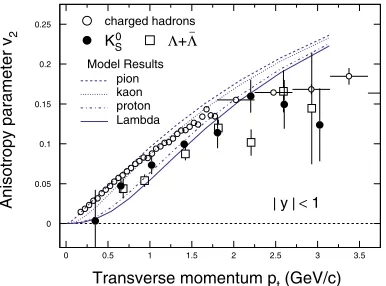
To make a comparison with available hydrodynamic model calculations [5], we plot v2pt for bothK0S and from201 103minimum-bias collisions in Fig. 3.
Also shown in the figure is v2pt for charged hadrons [38]. Within statistical uncertainty, theK0
S results are in agreement with thev2of charged kaons (not shown) [12].
We observe thatv2 for both strange particles increases as
a function of pt up to about 1:5 GeV=c, similar to the hydrodynamic model prediction. In the higherpt region, however (pt2 GeV=c), the values ofv2 seem to
satu-rate. It has been suggested that the shape and height ofv2
above2–3 GeV=cin a perturbative QCD model is related to energy loss in an early, high-parton-density stage of the collision [6].
The pt integrated anisotropy parameters for charged hadrons, K0
S, and from minimum-bias collisions are shown in Fig. 4. The integrated values of v2 are
calculated by parametrizing the yield with the inverse
0 0.05 0.1 0.15 0.2 0.25
0 1 2 3
Transverse momentum pt (GeV/c)
Anisotropy parameter v
2
(a) Ks0
0 1 2 3
(b) Λ+ Λ−
0 - 11% 11 - 45%
FIG. 2. Elliptic flowv2as a function ofpt for (a)K0Sand (b) . Circles and filled squares are for central (0%–11%) and midcentral (11% – 45%) collisions, respectively. Error bars shown are statistical errors only.
0 0.05 0.1 0.15 0.2 0.25
0 0.5 1 1.5 2 2.5 3 3.5 KS
0 Λ+Λ−
charged hadrons
Model Results pion kaon proton Lambda
Transverse momentum pt (GeV/c)
Anisotropy parameter v
2
| y | < 1
FIG. 3 (color online). Elliptic flowv2as a function ofpt for the strange particles K0
S (filled circle) and (open
slope parameter of exponential fits to the KS0 or transverse mass distributions [38,39]. The integratedv2is insensitive to the upper and lower bounds of the integra-tion. Although thev2ptof is below thev2ptof
K0
S for mostpt, as shown in Fig. 3, theptintegrated v2
values increase with the particle mass. This increase is partly due to the relatively higher meanptof the compared to theK0
S. In hydrodynamic models, although the spatial geometry of the pressure gradient and the resultant collective velocity are the same for all particles, massive particles tend to gain larger transverse momenta and so develop a larger elliptic flow. The hydrodynamic model calculations [5], shown as a gray band and central line, are, within errors, in agreement with this result. The width of the gray band in Fig. 4 indicates the uncertain-ties of the model calculation, mostly due to the choice of the freeze-out conditions. The increase ofv2with particle mass indicates that significant collective motion, perhaps established early in the collision, is an effective means to transfer geometrical anisotropy to momentum anisotropy. The nature of the particles during this process, however, whether parton or hadron, and the degree of thermal-ization for strange particles during the collective expan-sion remains an open issue.
In summary, we have reported the first measurement of the anisotropy parameter, v2, for KS0 and , from AuAucollisions at sNN
p
130 GeV. Thev2values as
a function ofpt from midcentral collisions are higher at each pt than v2 from central collisions. Hydrodynamic
model calculations seem to adequately describe elliptic flow of the strange particles up to aptof2 GeV=c. Forpt
above2 GeV=c, however, the observedv2 seems to satu-rate whereas hydrodynamic models predict a continued increase with pt. The pt integrated v2 as a function of particle mass is consistent with a hydrodynamic picture
where collective motion, established by a pressure gra-dient, transfers geometrical anisotropy to momentum anisotropy. Although the hadronic scattering cross sec-tions of strange and nonstrange particles may be differ-ent, we have yet to see deviations in the measuredv2from hydrodynamic calculations at lowptfor strange or non-strange particles. In a possible partonic phase prior to the hadronic epoch, the hadronic scattering cross sections for the final hadrons are not relevant. As such, if the elliptic flow of identified particles proves to be independent of their relative hadronic cross sections, it may be evidence thatv2 is established during a partonic phase.
We thank P. Huovinen for providing the results of the hydrodynamic model calculations. We thank the RHIC Operations Group and the RHIC Computing Facility at Brookhaven National Laboratory, and the National Energy Research Scientific Computing Center at Lawrence Berkeley National Laboratory for their support. This work was supported by the Division of Nuclear Physics and the Division of High Energy Physics of the Office of Science of the U.S. Department of Energy, the United States National Science Foundation, the Bundesministerium fuer Bildung und Forschung of Germany, the Institut National de la Physique Nucleaire et de la Physique des Particules of France, the United Kingdom Engineering and Physical Sciences Research Council, Fundacao de Amparo a Pesquisa do Estado de Sao Paulo, Brazil, the Russian Ministry of Science and Technology, and the Ministry of Education of China and the National Natural Science Foundation of China.
[1] H. Sorge, Phys. Rev. Lett.82, 2048 (1999). [2] H. Sorge, Phys. Lett. B402, 251 (1997). [3] J.-Y. Ollitrault, Phys. Rev. D46, 229 (1992).
[4] B. Zhang, M. Gyulassy, and C. M. Ko, Phys. Lett. B455, 45 (1999).
[5] P. Huovinen, P. F. Kolb, U. Heinz, P.V. Ruuskanen, and S. A. Voloshin, Phys. Lett. B503, 58 (2001).
[6] M. Gyulassy, I. Vitev, and X. N. Wang, Phys. Rev. Lett.86, 2537 (2001).
[7] D. Teaney, J. Lauret, and E.V. Shuryak, Phys. Rev. Lett.
86, 4783 (2001).
[8] Z.W. Lin and C. M. Ko, Phys. Rev. C65, 034904 (2002). [9] S. A. Voloshin and Y. Zhang, Z. Phys. C70, 665 (1996). [10] A. M. Poskanzer and S. A. Voloshin, Phys. Rev. C58, 1671
(1998).
[11] STAR Collaboration, K.H. Ackermannet al., Phys. Rev. Lett.86, 402 (2001).
[12] STAR Collaboration, C. Adleret al., Phys. Rev. Lett.,87, 182301 (2001).
[13] PHENIX Collaboration, R. A. Laceyet al., Nucl. Phys.
A698, 559 (2002).
[14] PHOBOS Collaboration, I. Parket al., Nucl. Phys.A698, 564 (2002).
[15] W. Reisdorf and H. G. Ritter, Annu. Rev. Nucl. Part. Sci.
47, 663 (1997). 0
0.02 0.04 0.06 0.08 0.1
0 0.2 0.4 0.6 0.8 1 1.2 1.4
Particle Mass (GeV/c2)
Anisotropy parameter v
2
Au + Au at √−−sNN = 130 GeV
STAR Data
(| y |< 1, pt< 2 GeV/c) Hydrodynamic calculation h−
Ks0 Λ+Λ
−
[16] N. Herrmann, J. Wessels, and T. Wienold, Annu. Rev. Nucl. Part. Sci.49, 581 (1999).
[17] E877 Collaboration, J. Barretteet al., Phys. Rev. Lett.73, 2532 (1994).
[18] EOS Collaboration, S. Wang et al., Phys. Rev. Lett. 76, 3911 (1996).
[19] NA49 Collaboration, H. Appelsha¨useret al., Phys. Rev. Lett.80, 4136 (1998).
[20] FOPI Collaboration, J. Ritmanet al., Z. Phys. A352, 355 (1995); FOPI Collaboration, P. Crochetet al., Phys. Lett. B486, 6 (2000).
[21] KaoS Collaboration, Y. Shinet al., Phys. Rev. Lett.81, 1576 (1998).
[22] EOS Collaboration, M. Justiceet al., Phys. Lett. B440, 12 (1998).
[23] E895 Collaboration, P. Chunget al., Phys. Rev. Lett.85, 940 (2000); E895 Collaboration, P. Chunget al., Phys. Rev. Lett.86, 2533 (2001).
[24] E877 Collaboration, J. Barretteet al., Phys. Rev. C 63, 014902 (2001).
[25] WA98 Collaboration, M.M. Aggarwalet al., Phys. Lett. B469, 30 (1999).
[26] NA44 Collaboration, I.G. Beardenet al., Phys. Rev. Lett.
78, 2080 (1997).
[27] WA97 Collaboration, E. Andersen et al., Phys. Lett. B
433, 209 (1998).
[28] H. van Hecke, H. Sorge, and N. Xu, Phys. Rev. Lett.81, 5764 (1998).
[29] STAR Collaboration, K.H. Ackermannet al., Nucl. Phys.
A661, 681c (1999).
[30] H. Wiemanet al.IEEE Trans. Nucl. Sci.44, 671 (1997); W. Betts et al., IEEE Trans. Nucl. Sci.44, 592 (1997); S. Kleinet al., IEEE Trans. Nucl. Sci. 43, 1768 (1996). [31] C. Adler et al., Nucl. Instrum. Methods Phys. Res.,
Sect. A461, 337 (2001)
[32] Particle Data Group, D.E. Groomet al., Eur. Phys. J. C
15, 1 (2000).
[33] R. Snellings, A. Poskanzer, and S. A. Voloshin, STAR Report No. SN0388, 1999; nucl-ex/9904003.
[34] N. Borghini, P. M. Dinh, and J. Y. Ollitrault, Phys. Lett. B
477, 51 (2000).
[35] N. Borghini, P. M. Dinh, and J. Y. Ollitrault, Phys. Rev. C
62, 034902 (2000).
[36] STAR Collaboration, R. Snellings et al., Nucl. Phys.
A698, 193 (2002).
[37] STAR Collaboration, A. H. Tanget al., hep-ex/0108029. [38] STAR Collaboration, M. Lamont et al., J. Phys. G 28,
1721 (2002).
![FIG. 4 (color online).Integrated elliptic flow v2 as a functionof particle mass. The gray band and central line indicates thehydrodynamic model results [5]](https://thumb-us.123doks.com/thumbv2/123dok_us/7898335.1311045/5.612.77.272.47.229/integrated-elliptic-functionof-particle-central-indicates-thehydrodynamic-results.webp)
