Available online: https://edupediapublications.org/journals/index.php/IJR/ P a g e | 2262
Synthesis and Identification of Some New Schiff Bases
Complexes and Study of Their Biological Activity
Mohammed Fadhil Eesee Msc, Inorganic Chemistry
Abstract:
Schiff bases are adaptable ligands which
are synthesized from the condensation of
essential amines with carbonyl
gatherings. These mixes are essential in
medicinal and pharmaceutical fields in
light of their wide range of biological
activities. The greater part of them show
biological activities such as antibacterial,
antifungal as well as antitumor action.
Move metal edifices got from the Schiff
base ligands with biological action have
been broadly contemplated. This audit
abridges the combination and biological
activities of Schiff bases and its
buildings. Two buildings of Co(II) and
Cu(II) with Schiff base got from
o-phenylenediamine and
2-hydcoxyacetophonone have been
synthesized by condensation in acidic
medium. The synthesized edifices were
examined utilizing distinctive physical
techniques such as natural investigation
(C, H and N), infrared, electronic and
atomic attractive resonance
spectroscopes. The geometrical
structures of the synthesized edifices
have been distinguished. The
antibacterial movement of the Schiff
base and their edifices have been
additionally examined, showing that the
buildings were of more antibacterial
action than the free Schiff bases.
INTRODUCTION:
Compounds containing an azomethine
assemble (- CH=N-), known as Schiff
bases are shaped by the condensation of
Available online: https://edupediapublications.org/journals/index.php/IJR/ P a g e | 2263 compound. Schiff bases of aliphatic
aldehydes are generally flimsy and are
promptly polymerizable while those of
aromatic aldehydes, having a powerful
conjugation framework, are more steady.
Schiff bases have number of utilizations
viz., preparative utilize, distinguishing
proof, location and determination of
aldehydes or ketones, decontamination
of carbonyl or amino compounds, or
insurance of these gatherings amid
complex or sensitive reactions. They
likewise frame basic units in specific
colors. Schiff bases are for the most part
bi-or tri-dentate ligands fit for framing
exceptionally stable complexes with
move metals. Some are utilized as fluid
precious stones. In natural combination,
Schiff base reactions are valuable in
making carbon-nitrogen bonds. Schiff
bases give off an impression of being a
vital middle of the road in various
enzymatic reactions including
connection of a protein with an amino or
a carbonyl gathering of the substrate One
of the most imperative sorts of synergist
system is the biochemical procedure
which includes the condensation of an
essential amine in a catalyst more often
than not that of a lysine residue, with a
carbonyl gathering of the substrate to
Available online: https://edupediapublications.org/journals/index.php/IJR/ P a g e | 2264 Stereochemical examination
completed with the guide of sub-atomic
model showed that Schiff base framed
amongst methylglyoxal and the amino
gathering of the lysine side chains of
proteins can twisted back in such a way
towards the N particle of peptide
gatherings that a charge exchange can
happen between these gatherings and
oxygen iotas of the Schiff bases. In this
regard pyridoxal Schiff bases got from
pyridoxal and amino acids have been
arranged and examined from the
biological perspective. Move metal
complexes of such ligands are
imperative catalyst models. The fast
improvement of these ligands brought
about an upgrade look into movement in
the field of coordination science
prompting to exceptionally fascinating
conclusions. This survey focuses on the
amalgamation and biological movement
of Schiff bases and its complexes. Ugras
et al1 have announced the blend,
complexation, antifungal and
antibacterial action investigations of
another full scale cyclic Schiff base.
Elzahany et al 3 have synthesized
some move metal complexes with Schiff
bases got from 2-formylindole,
salicylaldehyde and N-amino
Rhodanine. The Schiff base ligands were
described by natural examination, IR,
Mass, 1H NMR and electronic spectra.
The free ligands and their metal
Available online: https://edupediapublications.org/journals/index.php/IJR/ P a g e | 2265 antimicrobial activities against Bacillus
cerens, Escherichia coli, Pseudomonas
aeruginosa, Staphylococcus aureus and
Candida albicans. The outcomes
demonstrated that the ligands don't have
any movement, where as their
complexes showed greater action against
similar living beings under
indistinguishable trial conditions.
Readiness, physical portrayal and
antibacterial action of Ni (II) Sciffbase
complex.
Acetophenone compound is a bidentate
ligand and it has a decent capacity to
shape a few complexes with move and
non move metal particles. Cu(II), Ni(II),
Zn(II),Co(II), Mn(II) and Cd complexes
of ethylenediamine condensation with
4-(benzeazo)salicylaldehyde (1:2) [H2L
were synthesized and portrayed by
essential examination, molar
conductivity measurements, infrared and
electronic spectra, the ligand and their
Ni(II) and Zn(II) complexes were further
recognized utilizing 1H-NMR spectra.
The outcomes that metal is attached to
the ligand through the phenolic oxygen
and the imino nitrogen. The three
optically dynamic Schiff-base ligands
have been set up by condensation of
2-hydroxyacetophenone with (1R, 2R)-
diaminocyclohexane, (1S,2S)- (- )-
1,2-diphenylethylenediamine or R-(+)-
2,2́-diamino-1,1́-binaphthalene, separately.
The items have been portrayed by their
IR, 1H-and 13C-NMR spectra. Iron(III)
and Osmium(III) chalets of Schiff bases
got from salicylaldehyde and anthranilic
corrosive have been arranged and
examined utilizing diverse techniques.
Material and Methods
Synthesis of m-nitro aniline n-bezaldine
Schiff base:
Synthesis was begun with 22.3 ml
Available online: https://edupediapublications.org/journals/index.php/IJR/ P a g e | 2266 15 ml ethanol. After this 22.7 gm of
m-nitro aniline (0.02M) was added to this
alcoholic arrangement. The entire blend
was mixed with expansion of 2 to 3
drops NaOHsolution. Blend was
permitted to reflux for 4 hours. After
reflux chilly water was included and
strong yellow item was acquired. Item
was channel and dried for further utilize.
Synthesis of metal complexes of Schiff
Base: Cu and Co was utilized as metals
for determination of metal complexes. In
the process 2.6 gram schiff base was
broken up in 15 ml ethanol. To this
arrangement 0.02 mole of metal chloride
arrangement were included. This blend
was permitted to mix and refluxed for 3
hours. The item was cooled washed with
cool water. Acquired hastens were then
dried for further application.
FTIR Analysis: Fourier transforms
infrared spectrophotometer (FT-IR)
examination of each schiff base and its
metal complexes were done to affirm the
development of metal complexes.
Antimicrobial Activity: Antimicrobial
action was finished by agar glass
technique. One gram positive and one
gram negative microorganism was
chosen for the review. For the assay,
arrangements with craved centralization
of schiff base with metal complexes
were brooded with plates containing
microorganisms and zone of hindrance
was seen after 24 hrs.
Results and Discussion
FTIR Analysis: Disappearance of
carbonate and amine amass tops from IR
range demonstrated development of
metal complexes. Here when spectra of
schiff base and its metal complexes were
analyzed comparative sort of perception
was made. In the schiff base solid
pinnacles of carbonate almost 1723nm
and amine close to 3315nm were
Available online: https://edupediapublications.org/journals/index.php/IJR/ P a g e | 2267 missing in the IR spectra of metal
complexes. Notwithstanding that another
pinnacle was seen almost 1630nm which
means that azomethene (CH=N). This
mirrors amino corrosive and aldehydes
which are the substrate for combination
have been changed over into ligands. i.e.
m-nitro aniline n-benzaldene.
Comparative sorts of perception were
made by numerous different specialists
who have synthesized schiff bases
utilizing assortments of beginning
material4,13. In all the review a typical
impact was watched where pinnacles of
carbonate and amine were tons of metal
to the schiff base.
Simultaneously new peaks were
observed in the IR spectra depending on
the Schiff base and metal.
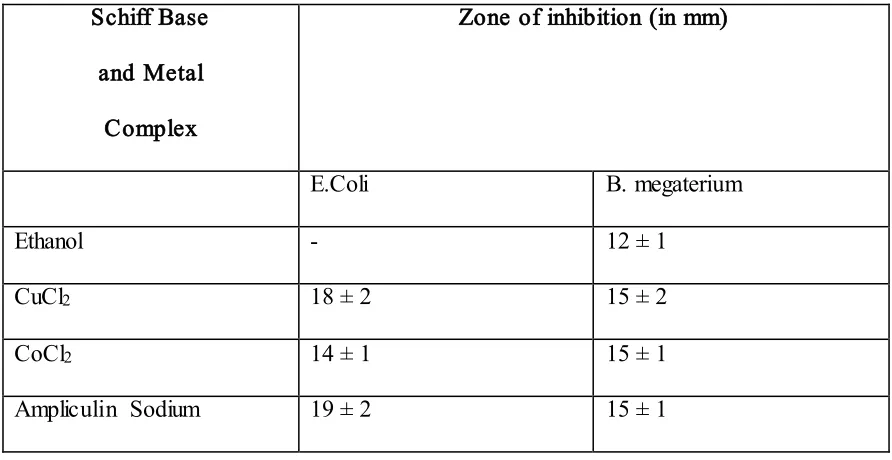
Antimicrobial Activity: Aftereffects of
antimicrobial action mirror that metal
complex made up of Cu has more
antimicrobial action than Co complex.
This is on the grounds that copper can
straightforwardly influence microbes in
two stages: first it will burst the cell
layer by direct cooperation and second it
makes gaps in the external film, through
which the cell loses essential
supplements and water, bringing about a
general debilitating of the phone and
moderate demise of cell. Cobalt is not
Available online: https://edupediapublications.org/journals/index.php/IJR/ P a g e | 2268 Table 1: Antimicrobial activity of metal complexes of schiff base
Schiff Base
and Metal
Complex
Zone of inhibition (in mm)
E.Coli B. megaterium
Ethanol - 12 ± 1
CuCl2 18 ± 2 15 ± 2
CoCl2 14 ± 1 15 ± 1
Ampliculin Sodium 19 ± 2 15 ± 1
Table 2: Elemental analysis and some physical properties of Schiff base and its
complexes
The synthesized Schiff base and its
complexes were subjected to CHN basic
examinations utilizing 2400 basic
analyzer at Micro-Analytical Center,
Cairo University, Giza, Egypt. Infrared
spectra were gotten by KBr circle
method by utilizing IFS-25DPUS/IR
Spectrometer (Bruker) in the scope of
4000-400 cm-1. Electronic ingestion
spectra were measured in nujol think
about utilizing a Perkin-Elmer-Lambda
β-spectrophotometer. The 1HNMR
spectra were recorded utilizing a Varian
Available online: https://edupediapublications.org/journals/index.php/IJR/ P a g e | 2269 d6-DMSO dissolvable and TMs as
reference. Mass range was done utilizing
Q1000 EX GC-MS Schimadzu
spectrometer at 70 ev and AM vitality
utilizing an immediate inclusion test at
temperature 90-100 0C.
Mass spectral fragmentation of the
Schiff base:
The mass range of Schiff base a base
pinnacle m/e+ at 344 which is because
of the first sub-atomic weight of the
readied compound (Schiff base). This
implies the condensation of the reactant
substances gave unadulterated
compound.
Figure 3: Mass spectra of the Schiff base
Antibacterial activity:
The three types of microscopic
organisms were streaked on supplement
agar (Oxford, England) plates, so that
the streaking secured the surface of the
plane, The 2-hydroxyacetophenon (test
1), o-phenylenediamine test 2), Schiff
base compound (specimen 3) and Co(II)
and Cu(II) complexes (4,5) were
connected on the streaked supplement a
gar plate as powder, taking a region not
more than 6mm (size of an anti-infection
paper circle) and leaving enough
separations between them. The plates
were then modified and brooded at 37
0C for 24 h. The restraint zones were
then increased in millimeters and
recorded. The two strains of microbes
(Bacillus cereus Staphylococcus aureus
Mueller-Available online: https://edupediapublications.org/journals/index.php/IJR/ P a g e | 2270 Hinton agar plates. The acetophenone,
o-phenylenediamine, Schiff base
compounds were connected on the plate
by circle paper 6mm, the plates were
then modified and hatched at 37 0C for
24 h. In an endeavor assess, the
resistance and inhibitor distances across
of Klebsiella sp. microscopic organisms
for 2 unique particles in 3 synthetic
compounds, the inhibitor distances
across were recorded between 10 – 30
mm. inhibitor distance across for sta.
spp. was between 5 – 34 mm. Test (4)
was given best outcomes with breadths (
30 mm), because of the passageway of
Co(II) particle. For E. coli resistance test
1 was given best outcomes because of
the nearness of hydroxyl gathering
(2OH) in the compound. For test 5 with
biological impact not as much as test 2
because of the nearness of (Cu2+)
particle.
Available online: https://edupediapublications.org/journals/index.php/IJR/ P a g e | 2271 Figure-4: FTIR spectra of CoCl2 complex with schiff base
Conclusion
Based on general review it was reasoned
that metal complexes of schiff bases are
more productive antimicrobial specialist
than its local shape. However the
antimicrobial probability is of metal
complex is very needy in the metal
particle utilized for development of
metal complex.
REFERENCE:
1. Bader, N. R. applications of schiff ’
s bases chelates in quantitative
analysis_: a review RASAYAN J.
Chem. 3, 660–670 (2010).
2. Satyanarayana, V. S. V, Sreevani,
P., Sivakumar, A. and Vijayakumar,
V. Synthesis and antimicrobial
activity of new Schiff bases
containing coumarin moiety and
their spectral characterization.
Arkivoc 2008, 221–233 (2008).
3. Patel, V., Trivedi, P., Gohel, H. and
Khetani, D. Synthesis and
Characterization of Schiff Base of p
-chloro aniline and their Metal
Complexes and their evaluation for
Available online: https://edupediapublications.org/journals/index.php/IJR/ P a g e | 2272 Adv.Pharmacy, Biol. Chem. 3, 999–
1003 (2014).
4. Ashraf, M. A., Mahmood, K.,
Wajid, A., Maah, M. J. and Yusoff,
I. Synthesis, Characterization and
Biological Activity of Schiff Bases.
Int. Conf. Chem. adn Chem. Process
10, 1–7 (2011).
5. Vaqas, M. et al. Salicylaldehyde
Salicyloylhydrazone-A short
Review. Sci. Int. 25, 85–89 (2013).
6. Hidron, A. I., Kourbatova, E. V and
Halvosa, J. S. The Science behind
Antimicrobial Copper. CID 159–
166 (2005)
7. C.H. Depuy and F.I. Rinehart,
"Introduction to Organic Chemistry"
John Wiley Sons, Inc, 2nd ed.
London (1975).
8. G.A. Taylor, "Organic Chemistry
for Students Biology and Medicine",
Longman, 2nd ed. UK (1973).
9. Z.K.N. Horseeva and L.A.
Alekseev," Physiological Active
Hydrazane Pleases", Chem. Pharm.
J.(Rus.), 5, 30 (1992).
10. S.H. Baiu, M.M. El-ajaily and N.
M. Mahmoud, Asian Journal of
Chemistry, 21(1), 5-10 (2009).
11. M.M. EL- ajaily, A .A Maihub,
S. S. Hudere and S. M. Ben – Saber
, Asian Journal of Chemistry , 18(4)
, 2427-2430 (2006).
12. S. Sukdolak, N. Vukovi,
S.Soluji, M. Miloev, N. Manojlovi
and L. J. Krsti, J. Serb. Chem. Soc.,