DOI: 10.1534/genetics.105.054619
Multiple-Interval Mapping for Ordinal Traits
Jian Li,*
,†,1Shengchu Wang* and Zhao-Bang Zeng*
,†,‡,2*Bioinformatics Research Center,‡Department of Statistics,†Department of Genetics, North Carolina State University, Raleigh, North Carolina 27695
Manuscript received December 12, 2005 Accepted for publication March 22, 2006
ABSTRACT
Many statistical methods have been developed to map multiple quantitative trait loci (QTL) in ex-perimental cross populations. Among these methods, multiple-interval mapping (MIM) can map QTL with epistasis simultaneously. However, the previous implementation of MIM is for continuously distrib-uted traits. In this study we extend MIM to ordinal traits on the basis of a threshold model. The method inherits the properties and advantages of MIM and can fit a model of multiple QTL effects and epistasis on the underlying liability score. We study a number of statistical issues associated with the method, such as the efficiency and stability of maximization and model selection. We also use computer simulation to study the performance of the method and compare it to other alternative approaches. The method has been implemented in QTL Cartographer to facilitate its general usage for QTL mapping data analysis on binary and ordinal traits.
M
APPING quantitative trait loci (QTL) is importantfor studying the genetic basis of quantitative trait variation. A number of statistical methods have been developed over the years for QTL mapping data
anal-ysis in designed experiments, such as those of Lander
and Botstein (1989), Haley and Knott (1992),
Jansen (1993), Zeng (1993, 1994), Sillanpa¨ a¨ and
Arjas(1998), and Kaoet al.(1999). However, many of
these statistical methods focus on continuous data. Ordinal traits are also common in many QTL mapping studies. These traits take values in one of several or-dered categories. In quantitative genetics, we usually use a threshold model to model the genetic basis of
binary and ordinal traits (Wright1934a,b; Falconer
1965; Falconerand Mackay1996). In this model, we
assume that the categorical observation of a binary or ordinal trait is a reflection of an underlying continu-ously distributed liability subject to a series of thresh-olds that categorize phenotypes. Effects of QTL on observed phenotypes are modeled through the liability. A number of studies have used this threshold model for QTL mapping analysis on binary and ordinal traits. Hackett and Weller (1995) and Xu and Atchley (1996) first studied a QTL mapping method for binary/ ordinal traits based on composite interval mapping
(CIM) (Zeng1994). Visscheret al. (1996) compared
the performance and statistical power of using a linear regression and a generalized linear model directly on a
binary trait for QTL mapping analysis and observed that the two methods give quite similar results in detecting
QTL and estimating QTL position. Yiand Xu(1999a,b)
studied a few statistical issues for mapping QTL on
binary traits in outbred populations. Broman (2003)
proposed a method to deal with data with a spike in the
trait distribution. In particular, Yiand Xu(2000, 2002)
and Yiet al.(2004) reported a series of studies using a
Bayesian approach for mapping QTL on binary and ordinal traits and studied several strategies for model selection in a Bayesian framework.
A major difference between an ordinal trait and a continuous trait is the number of trait values that a quantitative character may take: a few, say 2–10, for an ordinal trait (2 for a binary trait) and theoretically in-finite for a continuous trait. As a result of this difference, it is more complicated to map QTL on an ordinal trait, since there is less information carried by the data. Therefore, it is important to use appropriate statistical methods that take the trait distribution into account for mapping QTL, particularly for mapping multiple
QTL. For mapping multiple QTL, Kao et al. (1999)
and Zeng et al. (1999) developed a method that fits
a multiple-QTL model including epistasis on a trait and simultaneously searches the number, positions, and interaction of QTL. This method, called multiple-interval mapping (MIM), is based on maximum likeli-hood and combined with a model selection procedure and criterion. Compared with interval mapping (IM) (Lander and Botstein1989) and CIM (Zeng1994), MIM has a number of advantages, such as the improved
statistical power in detecting multiple QTL (Zenget al.
2000), facilitation for analyzing QTL epistasis, and co-herent estimation of overall QTL parameters.
1Present address: Department of Molecular Biology and Genetics, Cornell University, Ithaca, NY 14853.
2Corresponding author:Bioinformatics Research Center, Department of Statistics, North Carolina State University, Raleigh, NC 27695-7566. E-mail: [email protected]
In this study, we extend MIM for mapping QTL on ordinal traits and study many associated statistical issues. The method is based on a threshold model, implemented in the framework of MIM and targeted to experimental
populations, such as backcross and F2. After introducing
the models, we focus our discussion on many statistical issues, such as maximizing the likelihood function and model selection process. We also use simulations to investigate a few questions associated with analyzing multiple QTL on ordinal traits.
METHODS
Threshold model and liability: An imperative step in mapping QTL is to use appropriate models to con-nect trait values with QTL genotypes. For continuous
data, MIM uses models that are described inGenetic and
statistical modelsbelow. But for ordinal data, these mod-els are not appropriate to be applied directly. However,
with the help of a threshold model (Wright1934a,b;
Falconer1965; Falconerand Mackay1996), we can extend the models and methodology of MIM to ordinal data. The threshold model assumes that there is an underlying unobserved trait value, called liability, for the observed ordinal trait. The liability may be contin-uous. When it reaches a certain threshold, a categorical phenotype is observed. Thus, we can relate ordinal trait values to QTL genotypes by relating the ordinal data to their continuous liability first by the threshold model and then relating the liability to QTL genotypes by the regular genetic and statistical models.
Suppose in an experiment, n ordinal-scaled trait
values are observed and are coded as 0, 1,. . .,n 1.
In addition, suppose N individuals are sampled for
study. For theith individual, letzibe its ordinal-scaled
trait value and yi its underlying liability, where i ¼
1,. . .,N. By definition, zi takes a value from {0, 1,. . .,
n1} andyiis from an unknown continuous
distribu-tion (the liability). These two values are related by the threshold model in the following way,
gs,yi# gs11Ûzi¼s;
where ‘‘Û’’ represents ‘‘is equivalent to,’’ s is a value
from {0, 1,. . .,n1}, andgs’s (s¼0, 1,. . .,n1) are a set of fixed (unknown) values in an ascending order and are calledthresholdswithg0¼ ‘andgn¼‘. Briefly, the above relationship indicates that when the liability of an individual falls betweengsandgs11, its phenotypic value
iss; and on the other hand, if its phenotypic value iss, its liability must fall betweengsandgs11.
Genetic and statistical models:As mentioned earlier, mapping QTL requires a connection between pheno-typic values and QTL genotypes. By using the threshold model, the observed phenotypic values are connected to the underlying (continuous) liability. The next step is to connect the liability with QTL genotypes. This can be
done by using the usual genetic and statistical models that have been used in many previous studies. The statistical model is used to characterize the relationship between the liability of an ordinal trait and its compo-nents, which include a genotypic part determined by QTL genotype and a random variation part caused by environment. The genetic model is used to compute the genotypic value for an individual on the basis of its QTL
genotype. Consider a trait determined by m diallelic
QTL. On the basis of the partition of variance (Fisher
1918), the genetic model for a genotypic value G
in-cludes additive and dominant effects and interactions
among loci. Specifically, the genotypic value for theith
individual can be expressed as Equation 1 for a
back-cross design and as Equation 2 for an F2design
(ignor-ing trigenic or higher-order interactions),
gi ¼mG1
Xm
j¼1
ajxij1
X
m1
j¼1
Xm
k.j
ðaaÞjkðxijxikÞ ð1Þ
gi ¼mG1
Xm
j¼1
ajxij1
Xm
j¼1
djuij1
X
j,k
ðaaÞjkðxijxikÞ
1X
j6¼k
ðadÞjkðxijuikÞ1
X
j,k
ðddÞjkðuijuikÞ; ð2Þ
wheremGis the overall mean of genotypic values,ajis the
main effect of QTLjin a backcross design or additive
effect in an F2design, anddjis the dominant effect of
QTL j. In addition, (aa)jk, (ad)jk, and (dd)jk are,
re-spectively,additive 3additive,additive 3dominant, and
dominant3dominantinteraction effects between QTLj andk. xijanduijare the corresponding variables for the
additive and dominant effects. WithQjandqj
represent-ing alleles in the two inbred parental lines, xij takes
values of1
2forQjQjand 1
2forqjqjin a backcross design;
and in an F2design,
xij ¼
1 for genotypeQjQj
0 for genotypeQjqj
1 for genotypeqjqj
8 < :
and
uij ¼ 1
2 for genotypeQjQj
1
2 for genotypeQjqj
1
2 for genotypeqjqj:
8 < :
With this specification of genetic model, the statistical model can be defined by
yi ¼gi1ei; ð3Þ
where ei is usually assumed to be independently
nor-mally distributed with mean zero and variances2.
parameter values that yield the highest probability for the observed data given the models. The maximum-likelihood (ML) method is designed for this purpose. To use the ML method, two steps are needed: deriving a likelihood function and then maximizing it using a reliable and efficient algorithm. The likelihood func-tion is defined as the joint probability of the sample given the model. Maximum-likelihood analysis has been
used in interval mapping (Landerand Botstein1989),
composite-interval mapping (Zeng1993), and
multiple-interval mapping (Kaoet al. 1999). We describe the likeli-hood function for ordinal data in this section and show how to maximize it in the next section, using a backcross design as an example.
The likelihood function for ordinal data is defined as LðZjM;Q;G;DÞ, where Z represents the
pheno-types (in an ordinal scale),Mthe marker genotypes,D
the QTL position parameters (for example, measured as genetic distance from one end of a chromosome), Gthe threshold model parametersgs(s¼1,. . .,n1),
and Q the QTL effects (both the main and epistatic
effects, such asa’s,d’s andw’s) on the underlying lia-bility. In addition, let I(S¼s) be a half-open interval bracketed bygsandgs11as (gs,gs11] (s¼0,. . .,n1)
and Qih be the hth (h ¼ 1,. . ., 2m) possible QTL
genotype for the ith individual. With the assumption
of independent sampling, the likelihood function can be written as
LðZjM;Q;G;DÞ
¼Y
N
i¼1
PðzijMi;Q;G;DÞ
¼Y
N
i¼1
ð‘
‘
Pðzijyi;GÞ
3 X
Qih
PðyijQih;QÞPðQihjMi;DÞ
dyi;
ð4Þ
whereQrepresents product,Miis the marker genotype
of theith individual, andP(*|*)’s [such asPðzi jyi;GÞ] are conditional probabilities that are explained below along with their relationship with the likelihood function.
PðQih jMi;DÞis the probability for individuali
hav-ing QTL genotypeQihgiven its marker genotypeMiand
QTL positionsD. Formulas for computing this
proba-bility have been given in Kaoand Zeng(1997) and for
cases with missing marker genotypes, in Jiangand Zeng
(1997).
Pðyi jQih;QÞis the probability for individualihaving
yi for the underlying liability given its QTL genotypes
and QTL effectsQ.
Pðzi jyi;GÞ is the probability of observing zi given underlying liabilityyiand thresholdsG. It is one whenyi
is between gz
i and gzi11 and zero otherwise. In other
words,Pðzi jyi;GÞ ¼1 ifyi2IðS¼ziÞ ¼ ðgzi;gzi11, and Pðzi jyi;GÞ ¼0 ifyi;I(S¼zi).
DefineFQihðyiÞto be the cumulative distribution
func-tion (cdf) for Pðyi jQih;QÞ. Note that Б
‘ Pðzijyi;GÞ PðyijQih;QÞdyi¼FQihðgzi11Þ FQihðgziÞ. On the basis
of Fubini’s theorem and the properties of the cdf, we have
LðZjM;Q;G;DÞ
¼Y
N
i¼1
X
Qih
PðQihjMi;DÞ
ðgzi11
gzi
PðyijQih;QÞdyi
¼Y
N
i¼1
X
Qih
fPðQihjMi;DÞ½FQihðgzi11Þ FQihðgziÞg:
Parameter estimation:Once a likelihood function is given, estimates of parameters can be made by finding a set of parameter values that maximize the likelihood function. Estimates obtained in this way are called maximum-likelihood estimates (MLEs). In our study,
MLEs are obtained by maximizing aQfunction, which is
is the expected log-likelihood function of the complete
data (Dempsteret al. 1977), using a combined
Newton-Raphson (NR)–EM algorithm (seeappendixes aandb).
When QTL positions are selected (see more in the Model selection below), parameters such as QTL effects can be estimated using an approach combining NR and
EM algorithms (see appendix bfor the iterative
pro-cess). This approach is investigated by X.-J. Qinand Z-B.
Zeng(unpublished data). It is useful when the matrixH
(the second derivative matrix) is not positive definite or close to nonpositive definite, under which the NR
algorithm may break down (i.e., fail to converge). The
approach is similar to the regular NR method except that a check point is added to examine whether the Cholesky decomposition succeeds. This consequently determines whether the course of the iterative process is kept on the NR algorithm or is redirected to the EM algorithm.
Model selection:To search and select QTL, we adapt
the MIM procedure of Kaoet al.(1999) and Zenget al.
(1999). This is a stepwise model adaptation procedure combined with an initial model selection by markers (Zenget al. 1999). The idea is to use a computationally more efficient procedure, such as stepwise marker se-lection, first to select an initial model and then to use several model modification procedures under the MIM model to optimize the model selection.
We use a stepwise logistic regression to select
signif-icant markers as an initial model (SAS Institute1999).
We recommend using a backward stepwise selection
procedure with the significance levela ¼0.01 ora¼
After the initial model selection, the following pro-cedure can be used to update the model:
1. Optimize QTL position estimation. The position of each QTL is updated by scanning the genomic re-gion flanked by the two adjacent QTL to choose the best position as a new estimate, while fixing the other QTL at their current positions. This is performed for each QTL sequentially.
2. Search for a new QTL. The best position for a new putative QTL is first searched in the genome. The Bayesian information criterion (BIC) of the new model with one more QTL is compared with that of the previous model to decide whether to add this QTL in the model. If the QTL is added, the number of QTL is increased by one; otherwise the model is unchanged.
3. Test the current QTL effects. Each QTL effect is tested by comparing BICs of the models with or without the QTL effect conditional on other QTL. If some QTL are not significant, the number of QTL is reduced; otherwise the model is unchanged.
This procedure can be used iteratively until the model is unchanged. Usually the epistatic effects of QTL are searched and tested afterward among the QTL identified.
SIMULATIONS AND RESULTS
We use computer simulations to investigate the per-formance of our approach. In each simulation (except indicated otherwise), 100 data sets are generated by
Windows QTL Cartographer (Wanget al. 2005). Each
data set includes 200 individuals and has one to eight chromosome(s). On each chromosome, 10 evenly distributed markers are simulated with 10 cM between adjacent markers. Various numbers of QTL are simu-lated, which are specified in Tables 1 and 8. For simplicity, all QTL have the same main effects. Back-cross design is used for illustration. Each individual has
a simulated liability score that is transformed, on the basis of the preset incidence rates, to a phenotype in binary/ordinal scale. For the purpose of comparison, all data sets are analyzed in three ways. We use the MIM module in QTL Cartographer to analyze the liability score (denoted by QTLC) for comparison. The binary/ ordinal phenotype is analyzed either by our new method (denoted by bMIM) and by the MIM module in QTL Cartographer (denoted by QTLB), which ignores the fact that the phenotypic value is binary/ordinal. Differ-ent notations are used to represDiffer-ent differDiffer-ent parameter setups to avoid potential confusion, such as 1C1Q for one-chromosome one QTL. Statistics are collected for different analysis methods on the percentage of data sets that obtain the correct number of QTL, the mean number of QTL detected, and the mean of QTL position estimates.
We use these simulations to discuss several questions, such as empirical critical values, effects of various factors on mapping results, suitability of using QTL Cartogra-pher/MIM on binary traits directly, loss of information in mapping when data are scored in binary/ordinal scale as compared to a continuous distribution, epista-sis, limitations of the new method, and estimation of heritabilityh2for ordinal traits.
Empirical critical values: Although the criteria and critical values used for model selection are very impor-tant issues in QTL mapping, they are not the main study subject in the current investigation. Therefore, no com-prehensive investigation of model selection criteria is performed. Instead, we run a few sets of simulations to illustrate how critical values likely behave in mapping
binary data for three situations: one QTLvs.two QTL,
four QTLvs.five QTL, and eight QTLvs.nine QTL.
Critical values are estimated in two ways: direct data
simulation (SM) and residual bootstrapping (RB) (Zeng
et al. 1999). Both use a likelihood-ratio test statistic to test for the significance to add a QTL. For each case, 1000 test statistics are obtained under the null hypothesis.
TABLE 1
List of situations
No. of chr No. of QTL QTL positions Parameter Abbr.
1 1 Chr 1 — — — — — — — h2 0.1 0.3 0.5 1C1Q
cM 25 — — — — — — — Effect 0.67 1.31 2.00
2 2 Chr 1 2 — — — — — — h2 0.1 0.3 0.5 2C2Q
cM 25 35 — — — — — — Effect 0.37 0.72 1.09
4 4 Chr 1 2 3 4 — — — — h2 0.3 0.5 0.8 4C4Q
cM 25 35 35 45 — — — — Effect 0.50 0.77 1.53
8 8 Chr 1 2 3 4 5 5 7 8 h2 0.3 0.5 0.8 8C8Q
cM 25 35 35 45 25 75 35 45 Effect 0.35 0.54 1.08
For each combination with specific numbers of chromosomes and QTL, values under ‘‘QTL positions’’ are, respectively, chro-mosome numbers (Chr) and the corresponding chrochro-mosome positions (cM) where simulated QTL are located; and values under ‘‘Parameters’’ are values ofh2(top row) and QTL effects for the correspondingh2(bottom row). Note that the chromosome
The 100(1a)th percentile of these statistics is chosen as the critical value at a significance level ofa.
For SM, 1000 independent data sets are simulated on the basis of the given QTL positions and effects (equivalent to 1000 different experiments). For a
spe-cific test condition, say four QTLvs.five QTL, a
four-QTL model is first established, by finding the set of four chromosome positions that yield the greatest likelihood among all combinations of four positions. A fifth position maximizing the likelihood given the four-QTL model is found. The test statistic is chosen as the likelihood ratio between the four-QTL model and the model with the fifth position.
For RB, all 1000 data sets are derived from one single
data set, as outlined below. Again using four QTLvs.five
QTL as an example, a data set is first simulated on the basis of the given QTL parameters. A four-QTL model is
established as previously described. Denote D4 as the
estimated QTL positions and b as the estimated QTL
effects. The ith individual then has a genotypic value
of Xijb with a probability of PðQijjMi;D4Þ and has
a phenotypic value 0 with a probability of w0¼
P
Qij½FðgXijbÞPðQijjMi;D4Þ. A new data set is
gen-erated by assigning the trait value of theith individual to
be 0 with a probability of w0while keeping its marker
genotype. The test statistic for the new data set is obtained using the same procedure as for SM.
Results from these two procedures are shown in Table
2. For few numbers of QTL and low values ofh2such as
one QTL or two QTL with h2 ¼0.1 or h2 ¼0.3, two
procedures obtain similar results. For higher values ofh2
and greater numbers of QTL, more differences are seen in the results. For RB with the same heritability, similar
results are obtained for testing conditions 4/5 and
8/9, although they are quite different from results
for 1/2. For different heritability, greater differences
among results are seen. This trend has been seen before
in cases for continuous traits by S. Wangand Z-B. Zeng
(unpublished results). That is, heritability has some effects on critical values, and critical values change when the number of testing QTL is low and tend to be stable with increasing numbers of testing QTL. For SM, both testing conditions and heritability may greatly affect results. No clear trend is detected for SM. In addition,
we explored an approach proposed by Lin and Zou
(2004), which uses a score-type statistic and results in less variation among the empirical critical values (data not shown). Nevertheless, the inconsistency among critical values makes it difficult to use them in data analyses. Therefore, before a comprehensive investiga-tion of this issue is complete, BIC will be used as a temporary solution in model selection, since this cri-terion has been used before and reasonable results
are obtained (Zeng et al. 1999; Broman and Speed
2002).
Effects of various factors: In real experiments, the range of parameter values varies dramatically. To un-derstand what effects parameter value differences may have on mapping results is helpful in choosing appro-priate mapping methods and in evaluating QTL map-ping results. Two parameters that are likely to change from one experiment to another are investigated. They are the proportion of each category and heritability. Proportions of different categories may affect mapping results. For example, when categories are divided un-evenly, few individuals may exist within a specific category that carries inadequate information for map-ping QTL. With other conditions being the same, a greater heritability, which measures the proportion of total variation explained by genetic factors, usually means relatively larger QTL effects. Therefore, it should be easier in finding QTL when heritability increases.
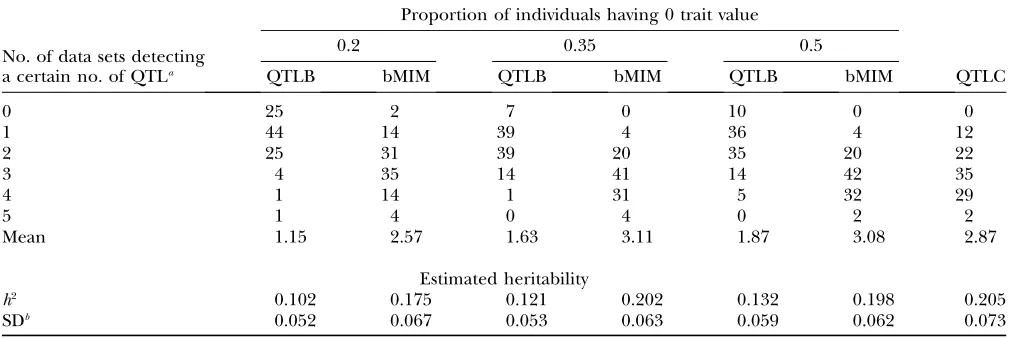
Effects of proportions of categories are studied for binary cases with 20, 30, and 50% of individuals having phenotypic values of 0 (others having 1). Simulation is
done under 4C4Q with h2¼0.3. Numbers of data sets
detecting various numbers of QTL, mean numbers of
detected QTL, and estimatedh2(with its standard
devi-ation) are shown in Table 3. Mapping results are also obtained for the same data sets using QTLB. For mod-erately unevenly divided data (such as a data set with 20% of individuals having a trait value of zero), the majority of data sets detect 2 or 3 QTL (totally 66%). For data sets divided more evenly, more data sets detect 2, 3, or 4 QTL
(.90%). The mean number of detected QTL has
in-creased from 2.57 for data with 20% zeros to3 for cases
with more evenly divided categories. The differences may be partially because with varying proportions of categories, the chances for individuals with various genotypes being in the same category are also changed.
TABLE 2
Critical values for the likelihood-ratio test statistic at significance levels of 0.01 and 0.05
0.01 0.05
h2 Method 1/2a 4/5 8/9 1/2 4/5 8/9
0.1 SM 5.71 — — 3.96 — —
RB 5.10 — — 3.89 — —
0.3 SM 5.76 7.32 6.87 3.86 5.23 5.13 RB 5.45 9.26 9.41 3.92 5.63 6.56 0.5 SM 11.00 8.69 6.52 8.07 6.53 4.23 RB 6.72 9.60 8.27 4.50 6.20 6.88 0.8 SM — 13.85 15.26 — 8.41 10.19 RB — 8.90 9.01 — 6.52 6.64
As in the text, direct data simulation and residual bootstrap-ping are abbreviated as SM and RB, respectively. For SM, 1000 different data sets are simulated, and for RB, 1000 data sets are generated by residual bootstrapping from one simulated data set.
aTests are labeled as
Effects of heritability can be seen in several tables,
such as Tables 4–7. As expected, whenh2is higher, all
methods obtain better mapping results given other situ-ations being the same.
Suitability of using QTL Cartographer/MIM on or-dinal data directly: When the number of categories for an ordinal trait is relatively large, the data can be analyzed by approaches implemented for continuous traits, such as in Visscheret al.(1996), binary traits are analyzed directly by using a linear regression method
proposed by Haley and Knott(1992). However, the
use of Haley–Knott approximation can yield a
sub-stantially inflated residual variance (Xu1995) and
po-tentially decrease the power of detecting QTL. Here we use the maximum-likelihood-based method (MIM mod-ule in QTL Cartographer) to analyze binary/ordinal traits directly, with the hope of remedying part of the inflation.
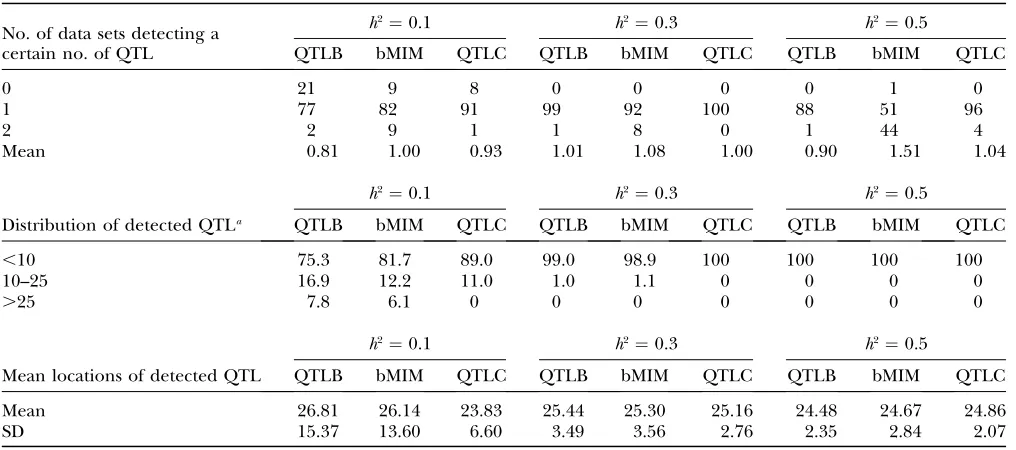
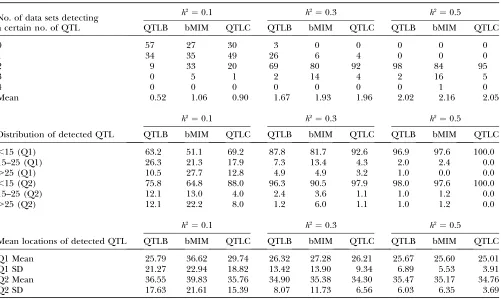
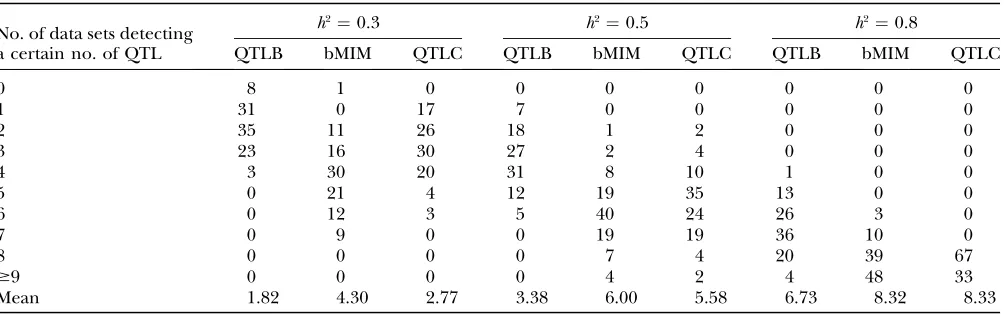
Simulations are performed for different combina-tions of QTL and chromosomes (1C1Q , 2C2Q , 4C4Q , and 8C8Q) with various values of heritability (0.1, 0.3, 0.5, and 0.8). The results are shown in Tables 4–7, with likelihood-ratio profiles from different approaches for 8C8Q shown in Figure 1. By comparing results between QTLB and QTLC and between QTLB and bMIM, we investigated whether/when QTLB can be used. Relative to QTLC, the efficiency of detecting QTL by QTLB
increases with higherh2and a lower number of QTL:
from 60% for 4C4Q (8C8Q) with h2 ¼ 0.3, under which the mean number of detected QTL is 1.87 (1.82) for QTLB and 2.87 (2.77) for QTLC, to almost 100% for
1C1Q withh2¼0.3. Compared to bMIM, QTLB yields
similar results whenh2is high and the number of QTL is
low, but has a lower efficiency for lowh2or lowh2with a
high number of QTL. For example, for 2C2Q withh2¼
0.1, 30% of data sets detect two QTL when bMIM is
applied and only10% when QTLB is used. Generally
speaking, QTLB yield reasonable mapping results when
h2is high (say.0.4) and the number of QTL is low (say
,4).
Loss of information: Binary/ordinal data carry less information than continuous data due to at least two factors. One is that phenotypic values cannot be ranked in detail for ordinal data with only several categories. This lowers the resolution of QTL mapping and reduces the ability of finding QTL with small effects. The other is related to the shape of the distribution of phenotypic values. For ordinal data, trait values concentrate on several separate points instead of covering a region for a continuous trait. This may limit the ability to evaluate mapping results in terms of power and error rate. Since some traits may yield binary/ordinal data only for tech-nical and practical reasons, investigating the efficiency of mapping QTL using binary/ordinal data relative to using continuous data can help us to better understand the limitation of analyzing QTL in experiments pro-ducing binary/ordinal data.
Comparing results from bMIM and QTLC in Tables 4–7, we find that the efficiency of bMIM increases with
higherh2. For example, for 2C2Q withh2¼0.1, 51 and
65% of position estimates by bMIM fall within 15 cM of the two corresponding simulated QTL, respectively,
relative to 69 and 88% by QTLC; whenh2increases to
0.5, the results are 98% and 98% for bMIM and 100% and 100% for QTLC. However, the estimates for QTL
numbers are relatively closer: forh2¼0.1, 0.3, and 0.5,
the numbers are 1.06, 1.93, and 2.16 for bMIM, com-pared to 0.90, 1.96, and 2.05 for QTL, respectively. A
TABLE 3
Estimation results for data with different category proportions
No. of data sets detecting a certain no. of QTLa
Proportion of individuals having 0 trait value
0.2 0.35 0.5
QTLB bMIM QTLB bMIM QTLB bMIM QTLC
0 25 2 7 0 10 0 0
1 44 14 39 4 36 4 12
2 25 31 39 20 35 20 22
3 4 35 14 41 14 42 35
4 1 14 1 31 5 32 29
5 1 4 0 4 0 2 2
Mean 1.15 2.57 1.63 3.11 1.87 3.08 2.87
Estimated heritability
h2 0.102 0.175 0.121 0.202 0.132 0.198 0.205
SDb 0.052 0.067 0.053 0.063 0.059 0.062 0.073
Results in this and all following tables are based on 100 simulated data sets, unless indicated otherwise. 4C4Q withh2¼0.3 is
simulated for this table.
aValues are the numbers of data sets (of 100) detecting certain numbers of QTL (given in the leftmost column). Mean is
com-puted asPðNdQNdDÞ=100, whereNdQis the number of detected QTL andNdDis the number of data sets detectingNdQQTL.
similar trend is also seen in multiple QTL and multiple chromosomes cases.
Epistasis: To study epistasis, we adapt an approach using a stepwise model selection scheme in MIM, as
described in Kaoet al.(1999) and Zenget al.(1999). In
this scheme, two types of epistasis can be searched. The first type is the interaction between QTL with main effects. The second one is between QTL with main effects and QTL without main effects. For either type of interaction, epistatic effects are tested for statistical sig-nificance and are added to or dropped from the model on the basis of the testing results. Two case studies are used to illustrate and test our implementation. Details of parameter values are listed in Table 8. Briefly, for all cases three QTL are simulated on two chromosomes at the following positions: 25 cM (QTL 1) and 75 cM (QTL 2) on chromosome 1 and 35 cM (QTL 3) on chromo-some 2. The interaction is between QTL pair 1–3 for all cases. For case 1, all QTL have main effects withVi/Va¼
0.1 (case I-1) or 0.3 (case I-2), whereViandVaare the
epistatic and additive variances, respectively. For case 2 (case II), QTL 1 and 2 have main effects, QTL 3 does not (hence QTL 3 enters into the model only through interaction), andVi/Va¼0.3.
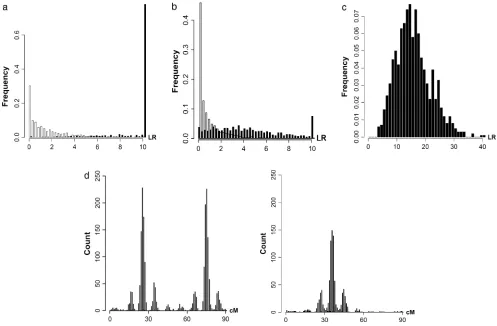
Results are shown in Figure 2, based on 1000 simu-lated data sets with 300 individuals for each set of pa-rameter values. Test statistics of the interaction among different QTL pairs are shown in Figure 2, a (for case I-1) and b (for case I-2). QTL pair with real interaction (QTL
pair 1–3) is detected with a higher probability than other QTL pairs (QTL pairs 1–2 and 2–3). Indeed for 98% of case I-1 and for 88% of case I-2, QTL pair 1–3 has the largest statistic. In Figure 2c, the distribution of the case II test statistic, which is for interaction between detected QTL and regions without detected QTL, is shown. The
distribution has a mean of15 and a variance of37.
About 97% of the test statistics are significant when chi-square distribution is used as an approximation under the null hypothesis. In addition, 97% of these signifi-cant statistics have their corresponding QTL being in accordance with simulated data. Therefore, 94% of tests recover the simulated interaction and consequently, the average number of QTL detected changes from 2.08
when no epistasis is considered to3.02 when epistasis
is considered. The counts of detected QTL based on their estimated locations are shown in Figure 2d.
Limit:It is also interesting to study parameters such as the minimal effect of QTL or maximal number of QTL that can be detected. This is useful in determining the applicability of a method and the validity of its results. Computer simulations are again used for the investiga-tion. A preliminary result for a range ofh2-values and the number of QTL are shown in Table 9. It can be seen that
the mean number of detected QTL increases when h2
increases. For example, for bMIM, the number in-creases from 0.17 to 0.61 for 1C1Q and from 0.18 to
0.37 for 2C2Q, respectively, when h2 changes from
0.01 to 0.05. This is partially expected because QTL
TABLE 4
Estimation results under one-chromosome one-QTL (1C1Q) simulation
No. of data sets detecting a certain no. of QTL
h2¼0.1 h2¼0.3 h2¼0.5
QTLB bMIM QTLC QTLB bMIM QTLC QTLB bMIM QTLC
0 21 9 8 0 0 0 0 1 0
1 77 82 91 99 92 100 88 51 96
2 2 9 1 1 8 0 1 44 4
Mean 0.81 1.00 0.93 1.01 1.08 1.00 0.90 1.51 1.04
Distribution of detected QTLa
h2¼0.1 h2¼0.3 h2¼0.5
QTLB bMIM QTLC QTLB bMIM QTLC QTLB bMIM QTLC
,10 75.3 81.7 89.0 99.0 98.9 100 100 100 100
10–25 16.9 12.2 11.0 1.0 1.1 0 0 0 0
.25 7.8 6.1 0 0 0 0 0 0 0
Mean locations of detected QTL
h2¼0.1 h2¼0.3 h2¼0.5
QTLB bMIM QTLC QTLB bMIM QTLC QTLB bMIM QTLC
Mean 26.81 26.14 23.83 25.44 25.30 25.16 24.48 24.67 24.86
SD 15.37 13.60 6.60 3.49 3.56 2.76 2.35 2.84 2.07
The simulated QTL is located at 25 cM.
a
effects are smaller whenh2is smaller and the number of QTL stays the same. However, no trend for the mean number of the detected QTL is seen when the same
value ofh2and different numbers of simulated QTL are
considered: the results fluctuate from 0.61 to 0.37 to
0.63 for 1C1Q, 2C2Q, and 4C4Q withh2¼0.05, when
bMIM is used. Another useful measurement is the percentage of detected QTL to simulated QTL (or the
ratio between the mean number of detected QTL and
the number of simulated QTL). For 1C1Q with h2 ¼
0.03, 30% of QTL could be detected by all three
approaches; for four QTL withh2¼0.1, percentages are
,30. Note that the numbers are higher for bMIM
for 4C4Q and 8C8Q. This may be due to lower critical values used in bMIM than they should be. Generally
speaking, we expect that when QTL effects are,0.10,
TABLE 5
Estimation results under two-chromosome two-QTL (2C2Q) simulation
No. of data sets detecting a certain no. of QTL
h2¼0.1 h2¼0.3 h2¼0.5
QTLB bMIM QTLC QTLB bMIM QTLC QTLB bMIM QTLC
0 57 27 30 3 0 0 0 0 0
1 34 35 49 26 6 4 0 0 0
2 9 33 20 69 80 92 98 84 95
3 0 5 1 2 14 4 2 16 5
4 0 0 0 0 0 0 0 1 0
Mean 0.52 1.06 0.90 1.67 1.93 1.96 2.02 2.16 2.05
Distribution of detected QTL
h2¼0.1 h2¼0.3 h2¼0.5
QTLB bMIM QTLC QTLB bMIM QTLC QTLB bMIM QTLC
,15 (Q1) 63.2 51.1 69.2 87.8 81.7 92.6 96.9 97.6 100.0
15–25 (Q1) 26.3 21.3 17.9 7.3 13.4 4.3 2.0 2.4 0.0
.25 (Q1) 10.5 27.7 12.8 4.9 4.9 3.2 1.0 0.0 0.0
,15 (Q2) 75.8 64.8 88.0 96.3 90.5 97.9 98.0 97.6 100.0
15–25 (Q2) 12.1 13.0 4.0 2.4 3.6 1.1 1.0 1.2 0.0
.25 (Q2) 12.1 22.2 8.0 1.2 6.0 1.1 1.0 1.2 0.0
Mean locations of detected QTL
h2¼0.1 h2¼0.3 h2¼0.5
QTLB bMIM QTLC QTLB bMIM QTLC QTLB bMIM QTLC
Q1 Mean 25.79 36.62 29.74 26.32 27.28 26.21 25.67 25.60 25.01
Q1 SD 21.27 22.94 18.82 13.42 13.90 9.34 6.89 5.53 3.91
Q2 Mean 36.55 39.83 35.76 34.90 35.38 34.30 35.47 35.17 34.76
Q2 SD 17.63 21.61 15.39 8.07 11.73 6.56 6.03 6.35 3.69
The two simulated QTL are located at 25 cM on chromosome 1 (Q1) and 35 cM on chromosome 2 (Q2), respectively.
TABLE 6
Estimation results under four-chromosome four-QTL (4C4Q) simulation
No. of data sets detecting a certain no. of QTL
h2¼0.3 h2¼0.5 h2¼0.8
QTLB bMIM QTLC QTLB bMIM QTLC QTLB bMIM QTLC
0 10 0 0 0 0 0 0 0 0
1 36 4 12 2 0 0 0 0 0
2 35 20 22 13 1 0 0 0 0
3 14 42 35 37 14 5 0 0 0
4 5 32 29 46 61 87 93 58 78
5 0 2 2 2 20 8 6 28 21
6 0 0 0 0 4 0 1 14 1
Mean 1.87 3.08 2.87 3.33 4.12 4.03 4.08 4.56 4.23
the percentage of detected QTL will be around or
,5%, which is close to the rate of random errors and
therefore may be close to QTL detection limits for these methods.
Approximation ofh2:R2of the fitted models can be
used to approximateh2, such as in QTLC and QTLB.
For ordinal data using bMIM, the estimate ofh2can be
approximated by an alternative form ofR2designed for
logistic regression, suggested by Nagelkerke(1991),
RL;2adj¼RL2=RL;2max;
which is an adjusted form ofRL2 proposed by Maddala
(1983), Coxand Snell(1989), and Magee(1990),
RL2¼1 ðL0=L1Þ2=N;
where L0 is the likelihood under the null model (no
QTL),L1is the maximum likelihood under the
alter-native model (a certain number of QTL exist), andNis
the sample size.RL2,maxis the maximal possible value for
RL2 and is equal to 1 L02/N. Note that RL2,adj ranges
between 0 and 1.
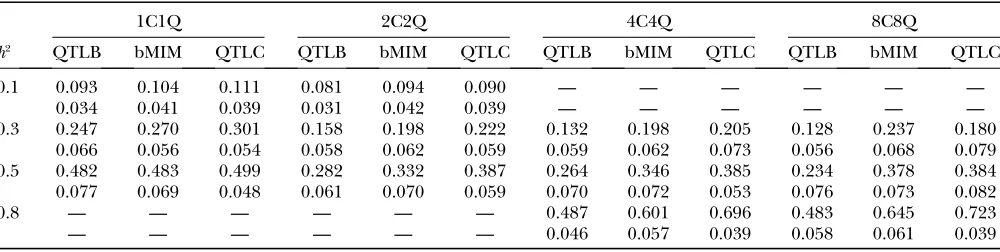
Using the simulated data sets of Tables 4–7, results of
approximating h2 are summarized in Table 10. These
results suggest that better approximation of h2 is
ob-tained when underlying heritability (denoted by hR2)
increases for a specific combination of numbers of QTL
and chromosomes and that for the same hR2 value, a
smaller number of QTL generally result in a better approximation ofh2. For example, forh
R
2¼0.3, estimates
ofh2are 0.247, 0.270, and 0.301 by QTLB, bMIM, and
QTLC, respectively, for 1C1Q, and 0.132, 0.198, and 0.205, respectively, for 4C4Q. These results are somehow expected: with a lower underlying heritability and/or greater number of QTL, QTL effects are smaller, and this will make it more difficult to detect these QTL. The model then will explain a smaller amount of total
variation. In addition, QTLC has the best estimates and bMIM yields better results than QTLB does, especially for large number of QTL/chromosome situations.
IMPLEMENTATION IN QTL CARTOGRAPHER
We have implemented the procedures of categorical trait MIM (CT–MIM) in version 2.5 of Windows QTL
Cartographer (Wanget al. 2005). Categorical traits are
coded in integer value and can be input into the program in the same way as continuous traits. One can use the categorical trait analysis to perform interval mapping (CT–IM) and multiple-interval mapping (CT– MIM) analysis. One can also use the regular IM, CIM, and MIM, implemented for continuous traits, to analyze the data for comparison.
For model selection in CT–MIM, we implemented several interactive procedures. They include a proce-dure that selects an initial model on the basis of forward or backward stepwise logistic regression on markers, a procedure to search for more QTL one at a time, a procedure to search for epistasis of QTL, a procedure to test effects of selected QTL, a procedure to optimize positions of QTL, and a procedure to output the complete information of the selected model. These procedures can be used interactively in practical data analysis to explore the data and compare different models. For more information see the software manual (http://statgen.ncsu.edu/qtlcart/WQTLCart.htm).
DISCUSSION
Kao et al. (1999) developed MIM for QTL analysis that fits a multiple-QTL model and simultaneously searches for the positions and interaction patterns of multiple QTL. This multiple-QTL-oriented approach has a number of advantages, such as improved statistical
TABLE 7
Estimation results under eight-chromosome eight-QTL (8C8Q) simulation
No. of data sets detecting a certain no. of QTL
h2¼0.3 h2¼0.5 h2¼0.8
QTLB bMIM QTLC QTLB bMIM QTLC QTLB bMIM QTLC
0 8 1 0 0 0 0 0 0 0
1 31 0 17 7 0 0 0 0 0
2 35 11 26 18 1 2 0 0 0
3 23 16 30 27 2 4 0 0 0
4 3 30 20 31 8 10 1 0 0
5 0 21 4 12 19 35 13 0 0
6 0 12 3 5 40 24 26 3 0
7 0 9 0 0 19 19 36 10 0
8 0 0 0 0 7 4 20 39 67
$9 0 0 0 0 4 2 4 48 33
Mean 1.82 4.30 2.77 3.38 6.00 5.58 6.73 8.32 8.33
power in QTL detection, facilitation for analyzing QTL epistasis, and coherent estimation of overall QTL param-eters. The implementation of the MIM method in QTL
Cartographer (Basten et al. 2005) and Windows QTL
Cartographer (Wanget al. 2005), both freely available at
http://statgen.ncsu.edu/qtlcart/, has greatly facilitated applications of the method for general QTL mapping
data analysis. However, the MIM method of Kao et al.
(1999) and its implementation in QTL Cartographer and Windows QTL Cartographer is for continuous traits.
Although extensive research has been made that takes multiple QTL into account in mapping analysis on
binary and ordinal traits (e.g., Yi and Xu 2000; Yi
et al. 2004), no computer program is available for QTL mapping data analysis on ordinal traits under the MIM framework.
In this study, we extend MIM to ordinal traits on the basis of a threshold model. This extension utilizes the properties and advantages of MIM for QTL mapping analysis on ordinal traits. The method fits a model of
multiple-QTL effects and epistasis on the underlying liability and searches for the number and positions of QTL and epistasis simultaneously. It has similar advan-tages to MIM on the statistical power of QTL detection
and estimation of overall QTL parameters. The imple-mentation of this method in Windows QTL Cartogra-pher will greatly facilitate the general usage of the methodology for QTL mapping data analysis on binary and ordinal traits.
Using simulations, we investigated several statistical issues, such as the effect of trait distribution on QTL mapping results, comparison of QTL mapping on an ordinal trait and on a continuous trait, and the statistical power of the method for QTL detection. As expected, the larger the number of trait categories, the higher the statistical power for QTL detection. There is not much difference in mapping results to regard an ordinal trait with five or more categories as a continuous trait in QTL analysis (data not shown). Also it is interesting to ob-serve that if we regard a binary trait as a continuous trait using the current MIM in QTL Cartographer, the map-ping result is actually quite comparable to that using the threshold MIM model if the heritability is reasonably high. Of course, the threshold MIM model is always more powerful and appropriate for QTL mapping analysis on binary and ordinal traits.
TABLE 8
List of epistatic situations
QTL no.
Chr no.
Position (cM)
Main
effect Epistasis
Epistatic effect
I-1 1 1 25 0.845 1 and 3 2.31
2 1 75 0.845
3 2 35 0.845
I-2 1 1 25 0.987 1 and 3 1.21
2 1 75 0.987
3 2 35 0.987
II 1 1 25 1.061 1 and 3 1.92
2 1 75 1.061
3 2 35 0.000
h2¼0.5 for all cases, and 1000 data sets of 300 individuals
are simulated for each case.
Figure2.—Results for cases with epistatic effects. (a) Distribution of test statistic for case I-1: main effects for all QTL and the epistatic effect for QTL pair 1–3 withVi/Va¼0.3. (a and b) Solid bars represent the test statistic (LR) for QTL pair 1–3 and open
bars the LR for other pairs (QTL pairs 1–2 and 2–3). (b) Distribution of the test statistic for case I-2, which is the same as case I-1 exceptVi/Va¼0.1. Note that in a and b, the rightmost bars represent test statistics$10. (c) Distribution of the test statistic for case
In studying ordinal traits, the trait value of an in-dividual may be misspecified due to measurement error.
For a binary trait, Rousseeuwand Christmann(2003)
used a ‘‘hidden logistic regression model’’ with the assumption that an observed response has a small chance to be measured with error. This can occur when a binary or ordinal phenotype is difficult to classify. A model with measurement error similar to that of Rousseeuwand Christmann(2003) can also be used for our analysis. This can be done by reassigning the value ofPðzijyi;GÞ in Equation 4. Namely, instead of being either 1 or 0, it can be 1eiandei, whereeiis a small nonnegative value for error rate. This error rate can be assumed to be the same for all observations or different for different observations.
In this article, we used the maximum-likelihood ap-proach for mapping multiple QTL on binary and ordinal traits. The Bayesian approach has also been used extensively for QTL mapping analysis in designed
experiments, such as in Thomasand Cortessis(1992),
HoescheleandvanRaden(1993a,b), Satagopanand Yandell (1996), and Sillanpa¨ a¨ and Arjas (1998, 1999). For binary and ordinal traits, a series of studies
have been performed by Xu and Atchley (1996), Yi
and Xu(1999a,b, 2000), and Yiet al.(2004) to develop
statistical methods for mapping multiple QTL under a
Bayesian framework combined with Markov chain Monte Carlo sampling with a reversible-jump algorithm for model selection. These methods, based on a threshold model for binary/ordinal traits, are comparable to our maximum-likelihood method. However, despite the ex-tensive studies performed, no user-friendly software is publicly available for QTL mapping data analysis on binary/ordinal traits. The statistical methods described in this article will be implemented in QTL Cartographer and Windows QTL Cartographer and publicly distributed at http://statgen.ncsu.edu/qtlcart/ for general usage of mapping multiple QTL on binary and ordinal traits.
There are still some issues that deserve further in-vestigation. Currently, we use a procedure suggested by
Linand Zou(2004) to estimate the threshold at each
step of searching for new QTL to aid in model selection. This procedure performs a function similar to a per-mutation test, but is numerically much more efficient. However, it is still not quite clear yet what significance level one needs to use in this stepwise procedure in the context of model selection for multiple QTL with epistasis. We will further pursue this line of research.
We thank Yongqiang Tang for help in computer programming. This work was partially supported by National Institutes of Health grant GM45344 and U.S. Department of Agriculture Plant Genome grant 2003-00754.
TABLE 9
Limits of different approaches
1C1Q 2C2Q 4C4Q 8C8Q
h2: 0.01 0.03 0.05 0.01 0.03 0.05 0.05 0.10 0.20 0.05 0.10 0.20
Effect: 0.20 0.35 0.46 0.11 0.19 0.25 0.18 0.26 0.38 0.12 0.18 0.27
The mean no. of detected QTL
QTLB 0.10 0.23 0.42 0.04 0.14 0.17 0.29 0.46 0.73 0.24 0.37 0.90 bMIM 0.17 0.39 0.61 0.18 0.29 0.37 0.63 1.02 1.98 1.47 2.24 3.41 QTLC 0.11 0.34 0.64 0.06 0.16 0.33 0.37 0.78 1.64 0.43 0.78 1.62
TABLE 10
Estimate of heritability for ordinal data
1C1Q 2C2Q 4C4Q 8C8Q
h2 QTLB bMIM QTLC QTLB bMIM QTLC QTLB bMIM QTLC QTLB bMIM QTLC
0.1 0.093 0.104 0.111 0.081 0.094 0.090 — — — — — —
0.034 0.041 0.039 0.031 0.042 0.039 — — — — — —
0.3 0.247 0.270 0.301 0.158 0.198 0.222 0.132 0.198 0.205 0.128 0.237 0.180 0.066 0.056 0.054 0.058 0.062 0.059 0.059 0.062 0.073 0.056 0.068 0.079 0.5 0.482 0.483 0.499 0.282 0.332 0.387 0.264 0.346 0.385 0.234 0.378 0.384 0.077 0.069 0.048 0.061 0.070 0.059 0.070 0.072 0.053 0.076 0.073 0.082
0.8 — — — — — — 0.487 0.601 0.696 0.483 0.645 0.723
— — — — — — 0.046 0.057 0.039 0.058 0.061 0.039
For each value forh2, its estimates from different approaches are listed in the top row with standard deviation given in the
LITERATURE CITED
Basten, C., B. S. Weirand Z-B. Zeng, 2005 QTL Cartographer.
Department of Statistics, North Carolina State University, Raleigh, NC (http://statgen.ncsu.edu/qtlcart/).
Broman, K. W., 2003 Mapping quantitative trait loci in the case of a
spike in the phenotype distribution. Genetics163:1169–1175. Broman, K. W., and T. P. Speed, 2002 A model selection approach
for the identification of quantitative trait loci in experimental crosses. J. R. Stat. Soc. Ser. B64:641–656.
Cox, D., and E. Snell, 1989 The Analysis of Binary Data, Ed. 2.
Chapman & Hall, London.
Dempster, A. P., N. M. Lairdand D. B. Rubin, 1977 Maximum
like-lihood from incomplete data via the EM algorithm. J. R. Stat. Soc. Ser. B39:1–38.
Falconer, D. S., 1965 The inheritance of liability to certain diseases,
estimated from the incidence among relatives. Ann. Hum. Genet. 29:51–71.
Falconer, D. S., and T. F. C. Mackay, 1996 Introduction to Quantita-tive Genetics, Ed. 4. Addison–Wesley, Boston.
Fisher, R. A., 1918 The correlation between relatives on the
supposi-tion of Mendelian inheritance. Trans. R. Soc. Edinb.52:399–433. Hackett, C. A., and J. I. Weller, 1995 Genetic mapping of
quan-titative trait loci for traits with ordinal distributions. Biometrics 51:1252–1263.
Haley, C. S., and S. A. Knott, 1992 A simple regression method for
mapping quantitative trait loci in line crosses using flanking markers. Heredity69:315–324.
Hoeschele, I., and P.vanRaden, 1993a Bayesian analysis of
link-age between genetic markers and quantitative trait loci. I. Prior knowledge. Theor. Appl. Genet.85:953–960.
Hoeschele, I., and P.vanRaden, 1993b Bayesian analysis of
link-age between genetic markers and quantitative trait loci. II. Com-bining prior knowledge with experimental evidence. Theor. Appl. Genet.85:946–952.
Jansen, R. C., 1993 Interval mapping of multiple quantitative trait
loci. Genetics135:205–211.
Jiang, C., and Z-B. Zeng, 1997 Mapping quantitative trait loci with
dominant and missing markers in various crosses from two in-bred lines. Genetica101:47–58.
Kao, C.-H., and Z-B. Zeng, 1997 General formulas for obtaining the
MLEs and the asymptotic variance-covariance matrix in mapping quantitative trait loci when using the EM algorithm. Biometrics 53:653–665.
Kao, C.-H., Z-B. Zengand R. D. Teasdale, 1999 Multiple interval
mapping for quantitative trait loci. Genetics152:1203–1216. Lander, E. S., and B. Botstein, 1989 Mapping Mendelian factors
underlying quantitative traits using RFLP linkage maps. Genetics 121:185–199.
Lin, D., and F. Zou, 2004 Assessing genomewide statistical
signifi-cance in linkage studies. Genet. Epidemiol.27:202–214. Maddala, G. S., 1983 Limited-Dependent and Qualitative Variables in
Econometrics.Cambridge University Press, Cambridge, UK. Magee, L., 1990 R2measures based on Wald and likelihood ratio
joint significance tests. Am. Stat.44:250–253.
Nagelkerke, N., 1991 A note on the general definition of the
co-efficient of determination. Biometrika78:691–692.
Rousseeuw, P. J., and A. Christmann, 2003 Robustness against
separation and outliers in logistic regression. Comp. Stat. Data Anal.43:315–332.
SAS Institute, 1999 SAS/STAT User’s Guide, Version 8. SAS Publishing,
Cary, NC.
Satagopan, J. M., and B. S. Yandell, 1996 Estimating the number
of quantitative trait loci via Bayesian model determination. Joint Statistical Conference, Chicago (ftp://ftp.stat.wisc.edu/pub/ yandell/revjump.ps.gz).
Sillanpa¨ a¨, M. J., and E. Arjas, 1998 Bayesian mapping of multiple
quantitative trait loci from incomplete inbred line cross data. Genetics148:1373–1388.
Sillanpa¨ a¨, M. J., and E. Arjas, 1999 Bayesian mapping of multiple
quantitative trait loci from incomplete outbred offspring data. Genetics151:1605–1619.
Thomas, D. C., and V. Cortessis, 1992 A Gibbs sampling approach
to linkage analysis. Hum. Hered.42:63–76.
Visscher, P. M., C. S. Haleyand S. A. Knott, 1996 Mapping QTLs
for binary traits in backcross and F2populations. Genet. Res.68: 55–63.
Wang, S., C. J. Bastenand Z-B. Zeng, 2005 Windows QTL Cartogra-pher 2.5.Department of Statistics, North Carolina State Univer-sity, Raleigh, NC (http://statgen.ncsu.edu/qtlcart/WQTLCart. htm).
Wright, S., 1934a An analysis of variability in number of digits in an
inbred strain of guinea pigs. Genetics19:506–536.
Wright, S., 1934b The results of crosses between inbred strains of
guinea pigs, differing in number of digits. Genetics19:537–551. Xu, S., 1995 A comment on the simple regression method for
inter-val mapping. Genetics141:1657–1659.
Xu, S., and W. R. Atchley, 1996 Mapping quantitative trait loci for
complex binary diseases using line crosses. Genetics143:1417– 1424.
Yi, N., and S. Xu, 1999a Mapping quantitative trait loci for complex
binary traits in outbred populations. Heredity82:668–676. Yi, N., and S. Xu, 1999b A random model approach to mapping
quantitative trait loci for complex binary traits in outbred popu-lations. Genetics153:1029–1040.
Yi, N., and S. Xu, 2000 Bayesian mapping of quantitative trait loci
for complex binary traits. Genetics155:1391–1403.
Yi, N., and S. Xu, 2002 Mapping quantitative trait loci with epistatic
effects. Genet. Res.79:185–198.
Yi, N., S. Xu, V. Georgeand D. B. Allison, 2004 Mapping multiple
quantitative trait loci for ordinal trait. Behav. Genet.34:3–15. Zeng, Z-B., 1993 Theoretical basis for separation of multiple linked
gene effects in mapping quantitative trait loci. Proc. Natl. Acad. Sci. USA90:10972–10976.
Zeng, Z-B., 1994 Precision mapping of quantitative trait loci. Genetics
136:1457–1468.
Zeng, Z-B., C.-H. Kaoand C. J. Basten, 1999 Estimating the genetics
architecture of quantitative traits. Genet. Res.74:279–289. Zeng, Z-B., J. Liu, L. F. Stam, C.-H. Kao, J. M. Marcer et al.,
2000 Genetic architecture of a morphological shape difference between two Drosophila species. Genetics154:299–310.
Communicating editor: M. S. McPeek
APPENDIX A: THEQ-FUNCTION AND ITS DERIVATIVES
TheQ-function is defined as the expectation of log-likelihood function for the complete data (Dempsteret al. 1977). In our study, QTL genotypes are unknown and have to be inferred from marker genotypes. This can be dealt
with by theQ-function and the process is briefly described below as
QðBjBðtÞÞ ¼
EBðtÞ½logLcðfZ;Qgcomplete;BÞ j fZ;Mgobs;
whereB¼ ðGT;QT;DTÞT
is the vector of parameters to be estimated, and the superscripttindicates thetth cycle of the
iteration. Since the realBis unknown, we compute theQ-function on the basis of its value at thetth stage. This is
symbolized asQðBjBðtÞÞ. The subscript for the expectation sign
Eindicates that the expectation is computed using a
observed data {Z,M}obs. Using definitions of expectation and conditional probability and assuming independent
sampling, we have
QðBjBðtÞÞ ¼
EBðtÞ½logLcðfZ;Qgcomplete;BÞ j fZ;Mgobs
¼X
N
i¼1
X
Qih
½PB¼BðtÞðQihjzi;MiÞlogPB¼BðtÞðzi;QihÞ
¼X
N
i¼1
X
Qih
fPB¼BðtÞðQ
ihjzi;MiÞlog½PB¼BðtÞðzijQ
ihÞPðQihÞg
¼X
N
i¼1
X
Qih
½PB¼BðtÞðQ
ihjzi;MiÞlogPB¼BðtÞðzijQ
ihÞ1C; ðA1Þ
whereCis the probability of the observed data and is a constant. Therefore,Ccan be omitted where maximization of
theQ-function is concerned. By Bayes’ theorem and noting thatPB¼B(t)(zijQih,Mi)¼PB¼B(t)(zijQih), we have
LðihtÞ¼PB¼BðtÞðQihjzi;MiÞ ¼
PB¼BðtÞðzijQ
ih;MiÞPB¼BðtÞðQ ihjMiÞ
P
Qil½PB¼BðtÞðzijQil;MiÞPB¼BðtÞðQiljMiÞ
: ðA2Þ
Here,Lih(t)can be considered as a posterior probability forQih. Equation A1 can then be written as
QðBjBðtÞÞ ¼X N
i¼1
X
Qih
fLðihtÞlog½FQihðgzi11Þ FQihðgziÞg: ðA3Þ
With a logistic-distributed liability and denoting B0¼ ðGT;QTÞ
T
, Equation A3 can be written as QðBjBðtÞÞ ¼
PN
i¼1 P
Qih½
LðihtÞlogðpzi11;ihpzi;ihÞwith
pk;ih¼pðBT0xk;ihÞ ¼expðtBT0xk;ihÞ=½11expðtBT0xk;ihÞ; ðA4Þ
where subscriptihindicates thehth QTL genotype for theith individual, andB0¼ ðGT;QTÞTis a parameter vector for
the thresholds and QTL effects. In addition,xk,ih¼(lkT,xihT)T, wherelk(k¼0,. . .,n1) is ann31 vector with all
elements being 0 except the (k11)th element being 1. Define
bih ¼pzi11;ihpzi;ih
and
aih ¼@bih=@B0¼pzi11;ihð1pzi11;ihÞxzi11;ihpzi;ihð1pzi;ihÞxzi11;ih:
Noting that@pk,ih/@B0¼pk,ih(1pk,ih)xk,ih, we have
@QðBjBðtÞÞ
@B0
¼X
N
i¼1
X
Qih
LðihtÞ@logðpzi11;ihpzi;ihÞ
@B0
¼X N i¼1 X Qih
LðihtÞ pzi11;ihpzi;ih
@pzi11;ih
@B0
@pzi;ih
@B0
¼X N i¼1 X Qih
LðihtÞaih bih
:
ðA5Þ
Further differentiating the first derivative, we have the second derivative as
@2QðB0jBð0tÞÞ
@B0@BT0 ¼
XN
i¼1
X
Qih
LðihtÞ
bih2 3
@ðaih=bihÞ
@BT0 ¼
XN
i¼1
X
Qih
LðihtÞ
bih2 bih
@aih
@BT0 aih
@bih
@BT0
¼X N i¼1 X Qih
LðihtÞAihbihaiha T
ih
bih2 ; ðA6Þ
where
Aih¼
@aih
@BT0 ¼
@2b
ih
@B0@BT0
¼pzi11;ihð1pzi11;ihÞð12pzi11;ihÞxzi11;ihx
T
zi11;ihpzi;ihð1pzi;ihÞð12pzi;ihÞxzi;ihx
T
APPENDIX B: THE ITERATIVE PROCESS FOR THE NR–EM ALGORITHM
For a set of fixed QTL positions, an approach combining Newton–Raphson (NR) and EM algorithms can be used to obtain estimates of other parameters such as QTL effects. A brief description of the iterative process is given below:
1. InitializeB0
(0) .
2. UpdateLih
(t)
in Equation A2 (the E-step) andpihin Equation A4.
3. Obtain the first derivative (g(t)) and second derivative (H(t)) using Equations A5 and A6.
4. UpdateB0
(t11)
using a formula
Bð0t11Þ¼Bð0tÞb½HðtÞ1gðtÞ;
where the superscript ‘‘1’’ indicates the inverse of a matrix, and the inverse ofHcould be obtained by Cholesky
decomposition. Several EM steps may be performed in the case that the decomposition fails.
5. Find the new value of theQ-function atB0
(t11)
by Equation A3.
6. Determine whether the iteration process converges, usually by comparing the relative change of the Q to a
convergence tolerance (d). If the change of theQ-function is smaller thand, stop; if not, go back to step 2.
Note that two parameters (bandd) in the above process need to be preset.bis a scalar and characterizes the step
length in the gradient direction. It should not be too large (missing maximum) or too small (slow convergence).
During computation,bwill start at one and reduce its value gradually in each cycle if needed, but it will be reset to one
in a new iteration cycle. The value ofdcan be determined through several methods. Here, we take the simplest one: set