R E S E A R C H
Open Access
Turbo receiver for MIMO-CDMA systems
employing parity bit selected and permutation
spreading
Alireza Mirzaee
*and Claude D’Amours
Abstract
In this paper, a turbo receiver for MIMO-CDMA systems employing parity bit selected and permutation spreading is proposed. In such systems, spreading codes used by transmit antennas are dependent on the transmitted data. In the proposed system, convolutional coding is used as an outer code, while the parity bit selected scheme is used as the inner code. Detection and decoding are performed iteratively for each detected bit. When parity bit selected
spreading is used, the parity bits generated by a linear block encoder are used to select a spreading code from a set of orthogonal spreading sequences. The selected spreading code is then used to spread the signals in all transmit antennas. In contrast, in permutation spreading, a permutation of orthogonal spreading sequences is used in each transmit antenna. In the proposed receiver, soft information passes between the detector and the decoder on multiple iterations. Detection is performed using the received signal from all receive antennas in combination with the extrinsic likelihood provided by a SISO decoder. The turbo receiver is further extended to a multiple user system, where the MAI is estimated in each iteration and subtracted out from the received signal. Simulations show a significant improvement in BER when a turbo receiver is used in these systems.
1 Introduction
In multiple input multiple output (MIMO) systems, where multiple antennas are used at both ends of the wireless channels, significant power gains are achieved by taking advantage of fading diversity of the channel. Using space-time codes in MIMO systems, a trade-off between spa-tial multiplexing and diversity order can be achieved [1]. When code division multiple access (CDMA) is com-bined with MIMO systems (MIMO-CDMA), orthogonal spreading sequences can be used in each transmit antenna in order to allow the receiver to accurately estimate the channel gains which are very crucial in the performance of MIMO systems.
Application of parity bits in selecting the spreading codes in direct-sequence spread spectrum (DS-SS) sys-tems is first introduced in [2]. In spread spectrum syssys-tems employing parity bits selected spreading codes (SS-PB), instead of appending the parity bits generated from a lin-ear block encoder, they are used to select a spreading code
*Correspondence: [email protected]
School of Electrical Engineering and Computer Science, University of Ottawa, 800 King Edward Avenue, Ottawa K1N 6N5, Canada
from a set of mutually orthogonal spreading sequences [2]. The extension of this work in MIMO-CDMA systems is discussed in [3], where two main techniques to select spreading waveforms are explained. In a MIMO-CDMA system employing parity bit selected spreading code, the calculated parity bits are used to choose a spreading wave-form from a set of mutually orthogonal spreading codes to be used in all transmit antenna during that signaling interval. In contrast, in a system employing permutation spreading, each block of information bits assigns a dif-ferent permutation of spreading waveforms to transmit antennas.
The impressive performance of turbo (iterative) pro-cessing techniques that soon followed the discovery of turbo codes [4] has inspired many researchers to utilize the turbo principle in a variety of ways in the architec-ture of the receiver. The application of turbo processing in MIMO systems has been discussed in the literature, and turbo processing techniques have been shown to attain a channel capacity close to the Shannon limit [5,6].
More recent works such as [7] have investigated the iterative joint channel estimation and data detection for
MIMO-CDMA systems. In this paper, we introduce a new turbo receiver for MIMO-CDMA systems that employ parity bit selected and permutation spreading. To be able to use turbo processing in the receiver, a serially concate-nated convolutional encoder is used in the transmitter. In this system, the parity bit selected or permutation spread-ing techniques act as an inner code without allocatspread-ing any transmit energy to the additional redundancy provided by these techniques. The receiver implements a turbo pro-cessing by iteratively exchange soft information on coded bits between a soft-input soft-output (SISO) detector and a SISO decoder. In this system, detection is performed by incorporating the extrinsic information provided by the decoder in the last iteration into the received sig-nal to calculate the likelihood of each detected bits in terms of log likelihood ratios (LLR) which are used as the input for a SISO decoder. In the case of multiple user systems, a turbo multiuser receiver is presented in which multiple access interference (MAI) affecting each user is estimated based on theextrinsicinformation of all other user in the system. Simulation results presented in this paper show a significant improvement in the performance of MIMO-CDMA systems of both parity bit selected and permutation spreading when a turbo receiver is imple-mented. Similar iterative detection strategies have been studied for a single carrier as well as multicarrier SS-PB systems in [8] and [9], respectively.
The rest of the paper is organized as follows. Section 2 contains the system model of MIMO-CDMA systems that employ parity bit selected and permutation spread-ing. The turbo receiver for these systems is described in Section 3, where the SISO detection is explained, and the details are provided for the calculation of LLRs for each detected bit. Turbo multiuser receiver for MIMO-CDMA systems employing parity bit selected and permutation spreading is explained in Section 4. In Section 5, the simulation results for the proposed turbo receiver are pre-sented, and finally, we present our conclusion in Section 6.
2 System model
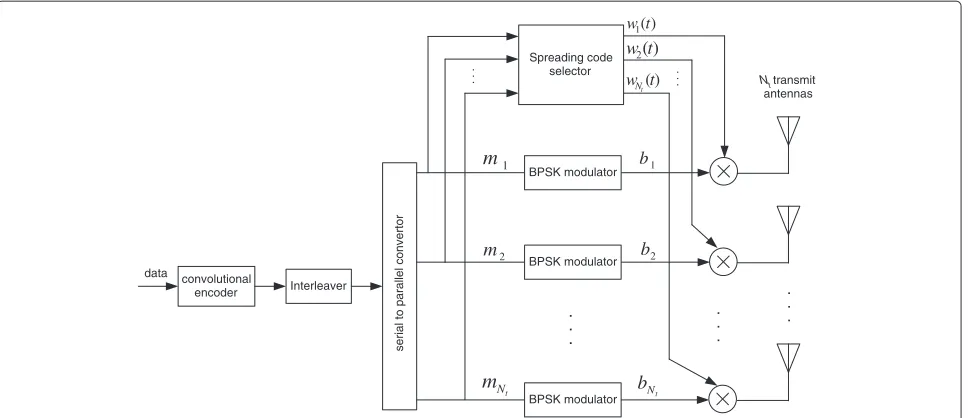
Consider a coded MIMO system withNttransmit anten-nas and Nr receive antennas. The block diagram of the transmitter is shown in Figure 1. The binary information stream {d[i]} is convolutionally encoded with code rate R, and after passing through an interleaver, the stream of interleaved coded bits{m[j]}is converted intoNt paral-lel streams. On the lth signaling interval, the vector of bits to be transmitted byNt transmit antennas is ml = (ml1,ml2,· · ·,mlN
t). Each message vector ofm
l is used to
select a set of spreading waveforms for all Nt transmit antennas, Wl = {wl
1(t),wl2(t),· · ·,wlNt(t)}, from a set of Q mutually orthogonal spreading sequences: {cq(t)},
q = 1, 2,· · ·,Q, wherewli(t) is the spreading waveform used to spread the data transmitted by the ith antenna
on time intervall. The data bits of allNttransmit anten-nas are modulated using binary phase shift keying (BPSK) to obtainbl = (bl1,bl2,· · ·,blN
t). Using the selected set of spreading waveforms,Wl, each modulated bit is spread
before being transmitted by one ofNttransmit antennas.
2.1 MIMO-CDMA systems employing parity bit selected spreading
Parity bit selected spreading for CDMA systems is first introduced in [1]. In such systems, unlike the conven-tional systems, the parity bits of a systematic block code (n,k) are used to select one of a set of 2(n−k) spreading
sequences, wheren is the length of message vector, and (n−k)is the number of parity bits. In this way, depend-ing on the coddepend-ing scheme, all possible message vectors are divided into groups that are spread by the same spreading waveform.
LetMbe a set of all M = 2Nt possible message vec-tors of length Nt. We can partition Minto Qcosets of M1,M2,· · ·,MQ, where each one has M/Q message
vectors. Depending on which coset the message vector ml comes from, a spreading waveform is assigned to all
transmit antennas. In other words, ifml∈M q, then
wl1(t)=wl2(t)= · · · =wlNt(t)=cq(t). (1)
In this paper, we consider the same system explained in [3], whereQ = 8 mutually orthogonal spreading wave-forms are used in a system withNt=4 transmit antennas. In this case, cosets are
M1={(0, 0, 0, 0),(1, 1, 1, 1)},M2={(0, 0, 0, 1),(1, 1, 1, 0)} M3={(0, 0, 1, 0),(1, 1, 0, 1)},M4={(0, 0, 1, 1),(1, 1, 0, 0)} M5={(0, 1, 0, 0),(1, 0, 1, 1)},M6={(0, 1, 0, 1),(1, 0, 1, 0)} M7={(0, 1, 1, 0),(1, 0, 0, 1)},M8={(0, 1, 1, 1),(1, 0, 0, 0)}.
(2)
For example, ifml=(0, 0, 1, 0), all four transmit antennas
usec3(t)as the spreading waveform.
To be able to determine which spreading code is used in the transmitter, each receive antenna is equipped with Qmatched filters, each matched to one of the spreading codes of set{cq(t)}. The output of theqth matched filter
of thejth receive antenna on thelth signaling interval is
zlj,q=
⎧ ⎪ ⎨ ⎪ ⎩
Eb Nr
Nt i=1
bliαijl +njl,q ifcq(t)is used
nlj,q otherwise,
(3)
convolutional
encoder Interleaver
serial to parallel convertor
data
Figure 1Transmitter of a coded MIMO-CDMA system employing parity bit selected and permutation spreading.
receive antenna which is a zero mean Gaussian random variable with varianceN0/2.
2.2 MIMO-CDMA systems employing permutation
spreading
Contrary to the MIMO-CDMA system that employs parity bit selected spreading, in MIMO-CDMA sys-tem employing permutation spreading, depending on the coset the message comes from, different permutation of spreading waveforms are assigned to transmit antennas. In this paper, we consider the system discussed in [3] with spreading permutations listed in Table 1. In this system, Q=8 orthogonal codes are available for a system with Nt=4 transmit antennas. Theqth matched filter output of thejreceive antenna is
zlj,q=
In order to optimally determine the spreading wave-forms used in the transmitter, the matched filter out-puts of all Nr receive antennas are observed: zl = (zl1,1,· · ·,zjl,q,· · ·,zlN
r,Q). Let us definey l
(b)as a noise-free
matched filter outputs of allNrreceive antennas whenbl is sent. Then, we can write
zl=yl (b)+n
l, (5)
wherenl=(nl1,1,· · ·,njl,q,· · ·,nlNr,Q).
For example, for a MIMO-CDMA system withNt =
Nr = 4 that employs parity bit selected spreading using
the cosets of Equation (2), if we considerml = (0, 0, 1, 0)
Table 1 Spreading permutations for MIMO-CDMA systems with four transit antennas
Likewise, for the system employing permutation spread-ing shown in Table 1, if the message vector is ml =
(0, 0, 0, 0)from cosetM1, thenbl=(−1,−1,−1,−1)and
yl (b)=
Eb
Nr
(−αl11, 0,−α21l , 0,−αl31, 0,−αl41, 0,−α12l , 0,
−α22l , 0,−α32l , 0,−αl42, 0,−α13l , 0,−αl23, 0,−α33l , 0,
−α43l , 0,−α14l , 0,−α24l , 0,−α34l , 0,−αl44, 0).
In what follows, for notational simplicity, we drop the signaling interval indexlwhenever possible.
In both MIMO-CDMA systems that employ parity bit selected or permutation spreading, an additional diversity is achieved by using more spreading waveforms based on the transmitting data. In other words, a sort of space code is created without repeating data on different antennas. More theoretical explanations and performance analysis of such systems are presented in [3].
3 Turbo receiver
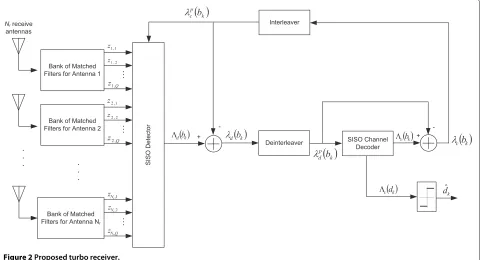
The proposed turbo receiver is shown in Figure 2. It con-sists of two stages: a SISO detector specifically designed for MIMO-CDMA systems that employ parity bit selected and permutation spreading followed by a SISO channel decoder. These two stages are connected via an inter-leaver and a deinterinter-leaver. The SISO detector observes the matched filter outputs of all Nr antennas and by
considering the extrinsic information provided by the SISO channel decoder in the previous iteration, delivers the a posterioriLLR of a transmitted ‘+1’ and a trans-mitted ‘−1’ for the coded bit in each transmit antenna,
d(bk)ln
P bk= +1|z
P bk= −1|z
,k=1, 2,· · ·,Nt. (6)
Using Bayes’ rule, we can rewrite (6) as
d(bk)=ln
P z|bk = +1
P z|bk = −1
λd(bk)
+lnP(bk = +1) P(bk = −1)
λpc(bk)
. (7)
The second term in (7), denoted byλpc(bk), represents
the a priori LLR of the coded bit bk calculated by the
SISO channel decoder in the previous iteration (as indi-cated by a superscriptpto show the previous iteration). For the first round of detection (i.e., first iteration) when there is no prior information available about the likelihood of coded bits, we assume that all the coded bits can be ‘+1’ or ‘−1’ equiprobably. In other words,λpc(bk)=0 for
k=1, 2,· · ·,Nr.
The first term in (7), denoted by λd(bk), represents
the extrinsic information provided by the SISO detec-tor about the coded bit of thekth transmit antenna,bk.
This extrinsic information is calculated by the SISO detec-tor based on the matched filter outputs, z, the spread-ing code selection strategy of the MIMO-CDMA system,
and the prior information provided by the SISO chan-nel decoder in the previous iteration about the coded bits other than the transmitted bit of thekth transmit antenna, {λpc bj
,j=k}. This extrinsic information is then passed through a deinterleaver and fed into the SISO channel decoder asa prioriinformation in the next iteration.
By making use of the prior information provided by the SISO detector,λd(bk), and also considering the trellis
structure of the convolutional code used in the transmit-ter, the SISO channel decoder calculates thea posteriori LLR of each coded bit,
c(bk)ln
where thea posterioriprobabilities are conditioned on the extrinsic information from the SISO detector in the last iteration,{λpd(bk)}Nk=t1, and the coding structure shown by
‘code structure’ in (8) that represents the trellis structure of the outer convolutional encoder [10].
It can be seen in (8) that thea posterioriLLRc(bk)
is the summation of the prior information λpd(bk) and
the extrinsic informationλc(bk), that is, the information
gleaned aboutbk from prior information of other coded bits based on the trellis structure of the channel encoder. The SISO channel decoder also computes thea posteriori LLR of the data bitsc(dk)that is used in the last iteration
to make decision about the decoded bits. The extrinsic information delivered in this stageλc(bk)is then passed
an interleaver and fed back to the SISO detector as thea prioriinformation in the next iteration (i.e.,λpc(bk)).
The SISO channel decoder discussed in this paper which provides the a posteriori information for both coded and data bits is based on the algorithm introduced in [10] which is a slight modification of the well-known BCJR algorithm [11]. In what follows, we explain how the SISO detector of a MIMO-CDMA system that employs parity bit selected and permutation spreading uses the matched filter outputs combined with the prior informa-tion from the channel decoder in the last iterainforma-tion to calculate the extrinsic information for each detected bit.
Let us define
Bk
+{b∈(+1,−1)Nt,bk = +1}, (9)
that includes all theNtcoded bit vectors whosekth bit is ‘+1’. Similarly,Bk−is defined as
Bk
−{b∈(+1,−1)Nt,bk = −1}. (10)
The extrinsic information delivered by the SISO detec-torλd(bk)can be rewritten as
whereP(bj)is the probability that the bit transmitted by
thejth antenna equals tobj forbj ∈ {+1,−1}. Equation
(11) holds true because the received signal is fully repre-sented by the outputs of the filters matched toQ orthogo-nal spreading sequences. It is also necessary and sufficient to observe the matched filter outputs of allNt transmit antennas to be able to completely extract the extrinsic information of each coded bit.
From (3) and (4), since the noise has a normal dis-tribution and assuming that the receiver has a perfect knowledge about all channel gains, (11) can be rewritten as
is the squared Euclidean distance between the vector of received and noise-free matched filter outputs whenbis sent.
Thea prioriprobabilities in (11) can be calculated based on their LLRsλpc(bk)as follows [10]:
Substituting (14) in (12), we obtain
By having (15), we can summarize the algorithm of the SISO detector in finding the extrinsic information of each coded bit as follows:
• First,B+k andBk−are formed by dividing all the vectors ofNtcoded bits,b, transmitted by all antennas into the vectors in which thek th antenna transmits ‘+1’ and ‘−1’, respectively.
• Based on whether parity bit selected or permutation spreading technique is used in the transmitter, the expected noise-free matched filter outputs ofy
(b)are
determined for each vectorb.
• The squared Euclidean distance,d(b)2, is calculated for each vectorbusing (13).
• By knowingd(b)2andλpc(bk)for each coded bits, the extrinsic LLR in the output of the SISO detector is computed by (15).
The computed extrinsic LLRs λd(bk) are then passed through a deinterleaver and fed into the SISO channel decoder as the a priori information. The SISO channel decoder provides thea posterioriLLRs for both coded and decoded (data) bits. The extrinsic LLRsλc(bk)at the
out-put of the channel decoder are formed by subtracting the thea prioriLLRsλpd(bk)from thea posterioriLLRs of the
coded bitsc(bk). In the last iteration,a posterioriLLRs
of the data bits are used to make decision on data bits, in other words, the estimated data bit,dˆ, is the sign ofλc(dk)
in the last iteration.
4 Turbo multiuser receiver for MIMO-CDMA systems employing parity bit selected and permutation spreading
All the discussion in this paper so far has been focused on a system with just a single user, where no interfer-ence from other users exist. However, one of the major aspects of any CDMA system is the way the interference form other users of the system is handled. In this section, the multiuser scenario of the MIMO-CDMA systems that employ parity bit selected and permutation spreading is discussed, and a turbo multiuser receiver is proposed for such systems.
Let us assume an uplink channel of a synchronous MIMO-CDMA system with K users, where each user has Nt transmit antennas, and the base station has Nr receive antennas. To be able to employ the parity bit selected or permutation spreading techniques, every user is assigned with a set ofQmutually orthogonal spreading sequences.
All the Nr receive antennas of the base station are equipped withQmatched filters. Let us defineZ(k)as the Q×Nr matrix of matched filter outputs of thekth user whose(i,j)th elementzi(,kj)is theith matched filter output
of thejth receive antenna. Then, we can rewrite (3) and (4) in a matrix format as
Z(k)=Y(k)H(k)+N(k), (16)
where H(k) is theNt×Nr channel gain matrix between thekth user’sNttransmit antennas andNr base station’s receive antennas, N(k) are the matrix of Gaussian noise samples, and the elements ofY(k)is defined as
y(i,kj)
b(jk) ifwj(k)(t)=ci(t)
0 otherwise, (17)
whereb(jk)is thekth user’s transmitted bit by thejth
trans-mit antenna, w(jk)(t) is the spreading sequence used by thekth user on itsjth transmit antennas, andci(t)is the
ith spreading sequence of the set ofQmutually spreading sequences assigned to thekth user. Depending on whether parity bit selected or permutation spreading technique is used, the spreading waveforms used by each transmit antenna is selected.
We can extend (16) to multiuser scenario as
Z=W R+N, (18)
where
Z=
Z(1)T,Z(2)T,· · ·,Z(K)T
; (19)
W =
W(1)T,W(2)T,· · ·,W(K)T
; (20)
W(k)=Y(k)H(k); (21)
N=
N(1)T,N(2)T,· · ·,N(K)T
; (22)
and R is theKQ×KQmatrix of cross-correlation whose (i◦j,m◦n)th element is the cross-correlation between theith spreading code of thejth user and themth spread-ing code of thenth user.
The proposed turbo multiuser receiver is based on iter-ative soft interference cancellation. Using the extrinsic information provided by the channel decoder for every bit of every user in the previous iteration, MAI caused by all users is estimated and subtracted out from the matched filter outputs.
To be able to estimate MAI in each iteration, we first calculate the estimation of matrixY(k)using the extrinsic information of the previous iteration. Thejth element of theith row inY(k)can be estimated as
˜
y(i,kj)E[y(i,kj)]=
y(i,kj)∈{−1,0,1}
whereE[.] denotes the expected value. Let us defineSias based on thea prioriprobabilities as
P(b(k))=
where the second equality follows from (14). By substitut-ing (25) into (24), we have
where the choice of Si depends on the spreading code
selection technique in use. By having the estimated matrix of Y˜(k), the estimated matrices of W˜(k) and W˜ can be
Using the estimated matrix ofW˜, MAI caused by all users can be estimated and subtracted out from the out-puts of the bank of matched filters:
˜
Z=Z− ˜W(R−I), (29)
whereZ˜ is the matched filter outputs after MAI estima-tion and subtracestima-tion, andIis theKQ×KQidentity matrix. Matrix Z˜ is considered as the matrix of matched filter outputs to be used in the following iteration.
5 Simulation results
The simulations are performed for coded MIMO-CDMA systems that employ parity bit selected and permutation spreading. In the transmitter, at first, the data bits are encoded by a 1/2 rate convolutional encoder with the
constraint length of 5 and the generators of 23 and 35 in octal notation. The coded bits are randomly inter-leaved and serial-to-parallel converted such that 4 parallel coded bits are transmitted simultaneously on 4 trans-mit antennas. Depending on the spreading code selection technique, a message vector of length 4 is used to choose spreading waveforms for transmit antennas. If parity bit selected technique is used, using (2), depending on the coset the message vector comes from, a spreading wave-form is selected to be used by all transmit antennas. In the case of MIMO-CDMA system with permutation spread-ing, the message vector follows Table 1 to select permu-tation of spreading waveforms for each transmit antenna. The channel is modeled as a slowly-varying, frequency-nonselective, Rayleigh fading channel, where the channel gains of different transmit-receive links are uncorrelated. We assume that perfect channel estimation is available at the receiver without a power penalty. We consider MIMO-CDMA systems with four transmit antennas and four or one receive antennas.
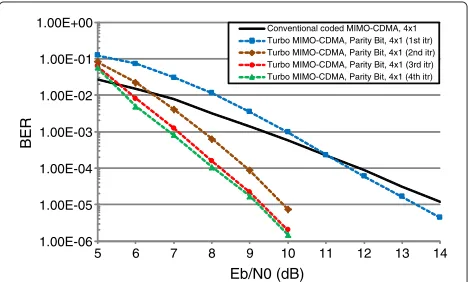
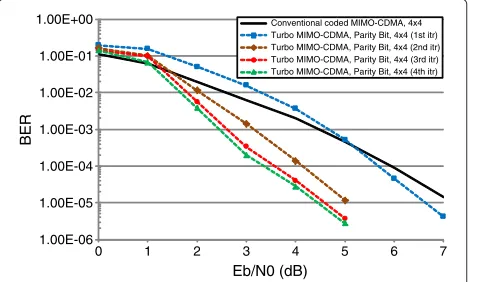
The bit error rate (BER) performance of the proposed turbo receiver versus average Eb/N0 for MIMO-CDMA systems employing parity bit selected spreading with four transmit antennas and one and four receive antennas along with the conventional coded MIMO-CDMA sys-tems are shown in Figures 3 and 4, respectively. These results show that when parity bit selected spreading is used, the first iteration of the proposed turbo receiver out-performs the conventional coded MIMO-CDMA systems atEb/N0of 11 and 5 dB for the systems with four and one receive antennas, respectively. It can be seen that a signif-icant performance improvement is achieved when more iterations are implemented at the receiver. At a BER of 10−3, the fourth iteration of the proposed turbo receiver in MIMO-CDMA systems that employ parity bit selected spreading has roughly 3-dB gain over the conventional MIMO-CDMA with both one and four receive antennas.
BER
Eb/N0 (dB)
Conventional coded MIMO-CDMA, 4x1 Turbo MIMO-CDMA, Parity Bit, 4x1 (1st itr) Turbo MIMO-CDMA, Parity Bit, 4x1 (2nd itr) Turbo MIMO-CDMA, Parity Bit, 4x1 (3rd itr) Turbo MIMO-CDMA, Parity Bit, 4x1 (4th itr)
1.00E-06
BER
Eb/N0 (dB)
Conventional coded MIMO-CDMA, 4x4 Turbo MIMO-CDMA, Parity Bit, 4x4 (1st itr) Turbo MIMO-CDMA, Parity Bit, 4x4 (2nd itr) Turbo MIMO-CDMA, Parity Bit, 4x4 (3rd itr) Turbo MIMO-CDMA, Parity Bit, 4x4 (4th itr)
1.00E-06 1.00E-05 1.00E-04 1.00E-03 1.00E-02 1.00E-01 1.00E+00
0 1 2 3 4 5 6 7
Figure 4BER for the MIMO-CDMA system employing parity bit selected spreading withNt=4 andNr=4.
Figures 5 and 6 present, respectively, the BER perfor-mance of the proposed turbo receiver in MIMO-CDMA systems with four transmit antennas and one and four receive antennas when permutation spreading is used. Comparison of the simulation results of systems with par-ity bit selected and permutation spreading shows that when permutation spreading is used, greater BER perfor-mance gain is achieved compared to parity bit selected spreading. This is due to the nature of each spreading code selection technique. In parity bit selected spread-ing, since all transmit antennas use the same spreading waveform, one decision variable (i.e., matched filter out-put) per receive antenna contains a signal component which is a sum of all the transmitted signal. This may lead to some interference between the signals transmitted by different antennas, which deteriorates the overall BER performance. In the case of permutation spreading, since in each signaling interval, different spreading waveforms are used by each antenna, there is no interference between the receive signals form each transmit antenna when the channel gains are independent.
BER
Eb/N0 (dB)
Conventional coded MIMO-CDMA, 4x1 Turbo MIMO-CDMA, Perm., 4x1 (1st itr) Turbo MIMO-CDMA, Perm., 4x1 (2nd itr) Turbo MIMO-CDMA, Perm., 4x1 (3rd itr) Turbo MIMO-CDMA, Perm., 4x1 (4th itr) 1.00E-06
1.00E-05 1.00E-04 1.00E-03 1.00E-02 1.00E-01 1.00E+00
0 1 2 3 4 5 6 7 8
Figure 5BER for the MIMO-CDMA system employing
permutation spreading withNt=4 andNr=1.
BER
Eb/N0 (dB)
Conventional coded MIMO-CDMA, 4x4 Turbo MIMO-CDMA, Perm., 4x4 (1st itr) Turbo MIMO-CDMA, Perm., 4x4 (2nd itr) Turbo MIMO-CDMA, Perm., 4x4 (3rd itr) Turbo MIMO-CDMA, Perm., 4x4 (4th itr)
1.00E-06 1.00E-05 1.00E-04 1.00E-03 1.00E-02 1.00E-01 1.00E+00
0 1 2 3 4 5 6 7
Figure 6BER for the MIMO-CDMA system employing
permutation spreading withNt=4 andNr=4.
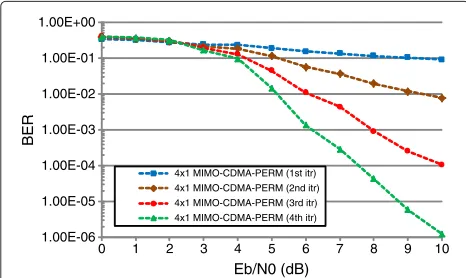
In the case of multiple user system, every user is assigned a different set of mutually orthogonal waveforms. The cross-correlation between two waveforms taken from different user sets is not zero. For simplicity, we assume that this cross-correlation between pairs of waveforms from different sets are equal. We useρ =0.3 in our sim-ulations. The simulations are performed for the MIMO-CDMA system withK = 4 users, where each user has Nt=4 transmit antennas and the base station is equipped withNr=1 or 4 receive antennas.
The BER performance of the proposed multiuser receiver for the MIMO-CDMA systems that employ par-ity bit selected spreading sequences withK =4 users and Nr = 1 and 4 receive antennas are shown in Figures 7 and 8, respectively. Figures 9 and 10 present, respectively, the BER performance of the proposed turbo multiuser receiver for MIMO-CDMA systems with Nr = 1 and 4 receive antennas that employ permutation spreading technique. The selection of spreading waveform for each transmit antenna in such systems follows Table 1.
BER
Eb/N0 (dB) 4x1 MIMO-CDMA-PB (1st itr) 4x1 MIMO-CDMA-PB (2nd itr) 4x1 MIMO-CDMA-PB (3rd itr) 4x1 MIMO-CDMA-PB (4th itr) 1.00E-06
1.00E-05 1.00E-04 1.00E-03 1.00E-02 1.00E-01 1.00E+00
5 6 7 8 9 10 11 12
BER
Eb/N0 (dB) 4x4 MIMO-CDMA-PB (1st itr) 4x4 MIMO-CDMA-PB (2nd itr) 4x4 MIMO-CDMA-PB (3rd itr) 4x4 MIMO-CDMA-PB (4th itr) 1.00E-06
1.00E-05 1.00E-04 1.00E-03 1.00E-02 1.00E-01 1.00E+00
0 1 2 3 4 5
Figure 84×4 MIMO-CDMA system employing parity bit selected spreading.Performance of the turbo multiuser receiver in a 4×4 MIMO-CDMA system that employs parity bit selected spreading.K=4,ρ=0.3.
The improved BER performance in MIMO-CDMA sys-tems that employ either of two discussed spreading code selection techniques is achieved by creating dependency between the bits carried by different antennas. In other words, the information bits transmitted by a transmit antennas encountering deep fades can still be recovered with high probability because of the relationship between the spreading codes used and the information it carries.
Although we considered frequency-nonselective fad-ing in this paper, the analysis can be extended to the frequency-selective fading case. In [12], the perfor-mance of uncoded MIMO-CDMA employing permu-tation spreading is investigated in frequency-selective fading. It is shown that by using RAKE receivers, there is no significant BER degradation despite loss of orthog-onality due to the dispersive nature of the channel. The vector used in the LLR calculations would have length Nr×Q×Np, whereNpis the number of resolvable paths. This would increase the computational complexity of the
BER
Eb/N0 (dB) 4x1 MIMO-CDMA-PERM (1st itr) 4x1 MIMO-CDMA-PERM (2nd itr) 4x1 MIMO-CDMA-PERM (3rd itr) 4x1 MIMO-CDMA-PERM (4th itr) 1.00E-06
1.00E-05 1.00E-04 1.00E-03 1.00E-02 1.00E-01 1.00E+00
0 1 2 3 4 5 6 7 8 9 10
Figure 94×1 MIMO-CDMA system employing permutation spreading.Performance of the turbo multiuser receiver in a 4×1 MIMO-CDMA system that employs permutation spreading.K=4,
ρ=0.3.
BER
Eb/N0 (dB) 4x4 MIMO-CDMA-PERM (1st itr) 4x4 MIMO-CDMA-PERM (2nd itr) 4x4 MIMO-CDMA-PERM (3rd itr) 4x4 MIMO-CDMA-PERM (4th itr) 1.00E-06
1.00E-05 1.00E-04 1.00E-03 1.00E-02 1.00E-01 1.00E+00
0 1 2 3 4 5
Figure 104×4 MIMO-CDMA system employing permutation spreading.Performance of the turbo multiuser receiver in a 4×4 MIMO-CDMA system that employs permutation spreading.K=4,
ρ=0.3.
LLR calculation with respect to the nonselective fading case.
Another way to combat frequency-selective fading is to employ multicarrier techniques, where the signal is divided into many narrowband CDMA signals so that the fading experienced by each carrier can be considered flat. For example, in [9], the authors present a Turbo MC-CDMA system employing the parity bit selected spreading technique. The work in [9] can be extended to multi-carrier MIMO-CDMA systems employing permutation spreading. Assuming that each carrier is modulated by independent data, then the BER performance of such a system would be identical to the BER performance of the system described in this paper.
6 Conclusion
In this paper, we have introduced a novel turbo receiver for MIMO-CDMA systems that employ parity bit selected and permutation spreading. An algorithm for the SISO detector in such systems is developed in which the LLRs of each bit are calculated based on the received sig-nal, thea prioriinformation from the previous iteration, and the code structure of the MIMO-CDMA system. The proposed turbo receiver consists of a SISO detector for MIMO-CDMA systems followed by a SISO channel decoder. The Iteration of LLRs between these two com-ponents provides a significant performance improvement compared to the conventional coded MIMO-CDMA sys-tems. The BER improvement that resulted from the pro-posed turbo multiuser receiver can be traded off against additional users in MIMO-CDMA systems that employ parity bit selected and permutation spreading.
Competing interests
The authors declare that they have no competing interests.
References
1. L Zheng, DNC Tse, Diversity and Multiplexing: a fundamental trade-off in multiple antenna channels. IEEE Trans. Inform. Theory.49, 1073–1096 (2003)
2. C D’Amours, Parity bit selected spreading sequences: a block coding approach to spread spectrum. IEEE Commun. Lett.9, 16–18 (2005) 3. C D’Amours, JY Chouinard. Parity bit selected and permutation spreading
for CDMA/MIMO systems in frequency-nonselective rayleigh fading channels, inIEEE 65th vehicular technology conference (VTC2007-Spring) (Dublin, 22–25 Apr 2007)
4. C Berrou, A Glavieux, P Thitimajshima. Near Shannon limit error-correction coding and decoding: turbo codes, inProceedings of the 1993 international
conference on communications (ICC’93)(Geneva, 23–26 May 1993)
5. M Sellathurai, S Haykin, Turbo-BLAST for wireless communications: theory and experiments. IEEE Trans. Signal Process.50, 2538–2546 (2002) 6. S Haykin, M Sellathurai, Y de Jong, T Willink, Turbo-MIMO for wireless
communications. IEEE Commun. Mag.42(10), 48–53 (2004) 7. A Assra, W Hamouda, I Dayoub, M Berbineau. Iterative joint channel
estimation and data detection for MIMO-CDMA systems over correlated fading channels, in11th international conference on ITS
telecommunications (ITST)(St. Petersburg, 23–25 Aug 2011)
8. A Mirzaee, C D’Amours, Iterative detection and decoding in spread spectrum systems with parity bit selected spreading sequences. IEEE Commun. Lett.16(9), 426–428 (2012)
9. A Mirzaee, C D’Amours, Turbo receiver for multicarrier spread spectrum systems employing parity bit selected spreading sequences. Wireless Pers. Commun.70(2), 889–902 (2012)
10. X Wang, HV Poor, Iterative (turbo) soft interference cancellation and decoding for coded CDMA. IEEE Trans. Commun.47(7), 1061–1064 (1999) 11. L Bahl, J Cocke, F Jelinek, J Raviv, Optimal decoding of linear codes for
minimizing symbol error rate. IEEE Trans. Inf. Theory.20(2), 284–287 (1974) 12. C D’Amours, A Dahmane, Permutation spreading for asynchronous
MIMO-CDMA systems using Hadamard codes and gold scrambling sequences. IEEE Wireless Communications networking conference (WCNC), Budapest, 5–8 Apr 2009
doi:10.1186/1687-1499-2013-266
Cite this article as:Mirzaee and D’Amours:Turbo receiver for MIMO-CDMA systems employing parity bit selected and permutation spreading.EURASIP Journal on Wireless Communications and Networking20132013:266.
Submit your manuscript to a
journal and benefi t from:
7Convenient online submission
7 Rigorous peer review
7Immediate publication on acceptance
7 Open access: articles freely available online
7High visibility within the fi eld
7 Retaining the copyright to your article