R E S E A R C H
Open Access
Exponential stability of impulsive
stochastic genetic regulatory networks with
time-varying delays and reaction-diffusion
Boqiang Cao
1, Qimin Zhang
1*and Ming Ye
2*Correspondence: [email protected] 1School of Mathematics and Statistics, Ningxia University, Yinchuan, 750021, P.R. China Full list of author information is available at the end of the article
Abstract
We present a mean-square exponential stability analysis for impulsive stochastic genetic regulatory networks (GRNs) with time-varying delays and reaction-diffusion driven by fractional Brownian motion (fBm). By constructing a Lyapunov functional and using linear matrix inequality for stochastic analysis we derive sufficient
conditions to guarantee the exponential stability of the stochastic model of impulsive GRNs in the mean-square sense. Meanwhile, the corresponding results are obtained for the GRNs with constant time delays and standard Brownian motion. An example is presented to illustrate our results of the mean-square exponential stability analysis.
Keywords: genetic regulatory networks; exponential stability; impulsive; reaction-diffusion; factional Brownian motion
1 Introduction
A genetic regulatory network (GRN) is a dynamic system to depict the interactions be-tween genes (mRNA) and proteins. Since GRNs play a key role in the area of cell and molecular biology, they have received increasing attention in the community of mathe-matical biology in recent years (see references [–]). An important topic related to math-ematical analysis of GRNs is to investigate the stability of GRNs. Wuet al.[] and Wang [] conducted robust stability analysis of GRNs by using stochastic analysis approach. Wang
et al.[] investigated the mean-square exponential stability of stochastic GRNs with time-varying delays by constructing a Lyapunov-Krasovskii functional. Although this stability analysis leads to conclusions on whether solutions of GRNs converge to an equilibrium point when a GRN system becomes stable, this analysis does not give the convergence rate of the system. For many GRN systems, slow convergence rates are undesirable, and high convergence rates (e.g., exponential rates) are needed. Therefore, it is necessary to study the exponential stability for a GRN system.
The aim of this study is to investigate the mean-square exponential stability of the solu-tion of a GRN model with diffusion process, impulses, degradasolu-tion reacsolu-tions, time-varying delays, and fBm of extrinsic noise. Stability analysis for such a comprehensive GRN model is rare in the literature. For example, Wuet al.[], Wang [], Wanget al.[], and Wang
et al.[] studied the stability and convergence of GRNs with stochastic perturbation and time delays but without diffusion and reaction. Although Maet al.[, ] investigated
the asymptotic stability of GRNs with diffusion, reaction, and delays, the systems of their study [, ] are deterministic. In [], finite-time robust stochastic stability was consid-ered under stochastic perturbation, reaction, diffusion, and delays. In addition, like in [, –], the stochastic perturbation in [] was described using a standard Brownian motion instead of a fractional Brownian motion.
Our study uses fBm to describe extrinsic noise introduced into the GRNs for mean-square exponential stability analysis, which is a novelty of this paper. We denote an fBm as
BH(t), whereHis the Hurst parameter. The fBm has a long-memory in comparison with standard Brownian motion (H=) []. In [], it was shown that a fractional Brownian motion can be used to describe a subdiffusive dynamics process. Experimental data of chromatin mobilizations show that an fBm is more appropriate to model gene movements than a standard Brownian motion []. Therefore, introducing the long-term correlations described by an fBm in GRNs is an important contribution to the literature.
Another contribution of this study is to introduce impulses into stochastic GRNs to describe sudden changes in the amount of mRNA and proteins. According to [–], an impulse is referred to the phenomenon that a system state is changed abruptly at a given time. The changes may be caused by abrupt change of physical environments, such as intake of drug or nutriment and exertion of the external force. For example, it was pointed out in [] that metaphase progression can be controlled by external mechanical impulses through different mechano-chemical cellular reactions. We have not found references of stability analysis of stochastic GRNs with impulses. Therefore, out study differs from the existing studies (e.g., Zhouet al.[], Wanget al.[], Maet al.[], Hanet al.[]) on the following two aspects: (a) a diffusion-reaction process driven by a fractional Brownian motion is considered, and (b) the impulses are involved.
The rest of this paper is organized as follows: In Section , we introduce the impulsive stochastic GRNs and define the exponential stability. Sufficient conditions of exponential stability in the mean-square sense for trivial solutions of GRNs are established in Section . Section illustrates our analysis by a numerical example.
2 GRNs and preliminaries
In Section ., we first define a deterministic GRN with time-varying delays and then in-troduce an impulse and stochastic perturbation into the deterministic model to define the model that is investigated in this study. The preliminaries needed for the exponential stability analysis are given in Section ..
2.1 Deterministic and stochastic GRNs
A deterministic GRN is defined as follows []:
⎧ ⎨ ⎩
∂m˜i(t,x)
∂t =
l k=
∂ ∂xk(Dik
∂m˜i(t,x)
∂xk ) –aim˜i(t,x) + n
j=wijgj(p˜j(t–σ(t),x)) +qi, ∂p˜i(t,x)
∂t =
l
k=∂x∂k(D
∗ ik
∂p˜i(t,x)
∂xk ) –cip˜i(t,x) +bim˜i(t–τ(t),x), i= , , . . . ,n,
()
the degradation rates of the mRNA and protein, respectively;wijis defined as follows:
wij=
⎧ ⎪ ⎨ ⎪ ⎩
δij, jis an activator of genei, –δij, jis a repressor of genei, , there is no link from genejtoi,
whereδijis the dimensionless transcriptional rate of transcriptional factorjto genei;gjis the activation function of thegj(s) = s
h
+sh, wherehis the Hill coefficient;qi=
j∈Ijδij, where Ijdenote the set of all repressors of genej; andσ(t) andτ(t) are the time-varying delays satisfying
≤τ(t)≤ ¯τ, τ˙(t)≤μ< ,
≤σ(t)≤ ¯σ, σ˙(t)≤μ< ,
()
whereτ¯,σ¯,μ, andμare nonnegative real numbers, andμ¯ =μ∨μis assumed.
Considering the time delays, we can give the initial conditions associated with () as follows:
˜
mi(t,x) =ϕi(t,x), x∈Q,s∈[–d, ],i= , , . . . ,n,
˜
pi(t,x) =ϕi∗(t,x), x∈Q,s∈[–d, ],i= , , . . . ,n,
whered=σ¯∨ ¯τ, andϕi(t,x),ϕi∗(t,x)∈C([–d, ]×Q,R). Moreover, the following Dirichlet boundary conditions are considered:
˜
mi(t,x) = , x∈∂Q,t∈[–d, ],
˜
pi(t,x) = , x∈∂Q,t∈[–d, ].
Letm∗= (m∗,m∗, . . . ,m∗n) andp∗= (p∗,p∗, . . . ,p∗n) denote the unique solution of () and the equilibrium point (m∗,p∗) of system () to the origin. Using the transformations
mi=m˜i–m∗i andpi=p˜i–p∗i (i= , , . . . ,n), we can transform () into the matrix form as follows:
⎧ ⎨ ⎩
∂m(t,x)
∂t =
l k=
∂ ∂xk(Dk
∂m(t,x)
∂xk ) –Am(t,x) +Wf(p(t–σ(t),x)),
∂p(t,x)
∂t =
l k=
∂ ∂xk(D
∗ k
∂p(t,x)
∂xk ) –Cp(t,x) +Bm(t–τ(t),x),
()
where
A=diag(a,a, . . . ,an), B=diag(b,b, . . . ,bn), C=diag(c,c, . . . ,cn),
Dk=diag(Dk,Dk, . . . ,Dnk), m(t,x) =
m(t,x),m(t,x), . . . ,mn(t,x)
T ,
D∗k=diagD∗k,D∗k, . . . ,D∗nk, p(t,x) =p(t,x),p(t,x), . . . ,pn(t,x)
T ,
fpt–σ(t),x=fpt–σ(t),x,fpt–σ(t),x, . . . ,fn
pt–σ(t),xT,
fi
pt–σ(t),x=gi
pi
t–σ(t),x+p∗i–gi
Now we introduce impulses and stochastic perturbation into account, and equations () become
⎧ ⎪ ⎪ ⎪ ⎪ ⎪ ⎪ ⎪ ⎨ ⎪ ⎪ ⎪ ⎪ ⎪ ⎪ ⎪ ⎩
dm(t,x) =lk= ∂ ∂xk(Dk
∂m(t,x)
∂xk )dt–Am(t,x)dt+Wf(p(t–σ(t),x))dt
+S(t,m(t,x),p(t,x))dBH(t), t=tk,t≥,
dp(t,x) =lk=∂x∂
k(D
∗ k
∂p(t,x)
∂xk )dt–Cp(t,x)dt+Bm(t–τ(t),x)dt, t=tk,t≥,
Δm(tk,x) =m(tk+,x) –m(tk,x) =Ukm(tk,x), k∈N,
Δp(tk,x) =p(t+k,x) –m(tk,x) =Vkp(tk,x), k∈N,
()
wherem(t+
k,x) =limt→tk+m(t,x),p(t+k,x) =limt→tk+p(t,x),tk represent the moments when impulses occur,tk<tk+,limt→∞tk=∞, andBH(t) denotes ann-dimensional fBm with Hurst parameterH∈(,].
2.2 Preliminaries
In this section, we introduce some necessary definitions, assumptions, and lemmas needed for the subsequent discussion. Let (Ω,F,P) be a complete probability space with filtration{Ft}t≥satisfying the usual conditions (i.e., it is increasing and right continuous,
andFcontains allP-null sets). For convenience, letATdenotes the transpose of a matrix A,λmax(A) andλmin(A) denote the largest and smallest eigenvalues of a square matrixA,
respectively.
The vector norm · is defined as
y(t,x) =
Q
yT(t,x)y(t,x)dx /
, ∀y(t,x)∈C[, +∞]×Q,Rn,
z(t,x) d=
Q
sup –d≤t≤
zT(t,x)z(t,x)dx /
, ∀z(t,x)∈C[–d, ]×Q,Rn,
and for a real square matrixA= (aij)n×n, its normAp(p= , ,∞) is defined as
A=max
j n
i=
|aij|, A=
λmax
ATA, A∞=max i
n
j= |aij|,
and we writeAp=A(p= , ,∞) without causing any confusion.
Definition According to [], the trivial solution of system () with initial valuesϕ(t,x),
ϕ∗(t,x)∈C([–d, ]×Q,Rn) is said to be exponentially stable in the mean-square sense if there exist constantsα,α,M,M> such that
E m(t,x) ≤Mϕe–αt, E p(t,x) ≤M ϕ∗ e–αt, t≥,
where
ϕ= sup
s∈[–τ¯,],x∈Q
m(s,x) , ϕ∗ = sup
s∈[–σ¯,],x∈Q
p(s,x) .
Lemma Let R> and R> be a pair of diagonal matrices.Then
positive definite matrix.Then we have
xTAy≤xTAx+yTAy,
i|ani|)are positive definite diagonal matrices, and|a| is the absolute value of a real
number a.
The proof is completed.
To investigate the mean-square exponential stability of trivial solution for system (), we introduce the following conditions:
(A) The functionf(p(t,x))satisfies the Lipschitz condition: there exists a positive
con-stantKsuch that
(A) The noise intensityS(t,m(t,x),p(t,x))in equation () satisfies the condition
traceSTt,m(t,x),p(t,x)St,m(t,x),p(t,x)
≤mT(t,x)Am(t,x) +pT(t,x)Ap(t,x),
whereAandAare known matrices.
(A) There exist positive definite matricesP,P,Q,Q such that the following linear
matrix inequalities are satisfied:
–π
PDL– PA+ Q+
–μ¯Q+Ht
H–Q> ,
–π
PD
∗
L– PC+ Q+ K
–μ¯Q+Ht
H–Q> ,
()
whereQ,Q,Q,Qof the same forms asA,Ain Lemma are positive definite
diagonal matrices, and
DL=diag
l
k= Dk
L
k ,
l
k= Dk
L
k , . . . ,
l
k= Dnk
L
k
,
D∗L=diag l
k= D∗k
L
k ,
l
k= D∗k
L
k , . . . ,
l
k= D∗nk
L
k
.
(A) ρ≡supk∈N(tk–tk–) <∞,
<λρ< –ln
λ(β+β) + d
–μ¯(λK+λ)
, ()
whereβ≡supk∈NI+Uk,β≡supk∈NI+Vk,λ=max{λmax(P),λmax(P)},
λ=λmax(Q),λ=λmax(Q).
(A∗) ρ≡supk∈N(tk–tk–) <∞, <λρ< –ln[λ(β+β) +d(λK+λ)].
(A) There exists a positive constantηsuch that
ln(/λ) tk–tk–≤
η≤α, k= , , . . . , ()
whereλ=min{λmin(P),λmin(P)}, andαwill be defined in ().
3 Exponential stability
In this section, we establish conditions of the exponential stability for system () by con-structing a suitable Lyapunov function.
Theorem If assumptions(A)-(A)hold,then the trivial solution of system()is globally exponentially stable in the mean-square sense.
Proof Define a Lyapunov function as follows:
where
Using Itô’s formula, we have
dV=
According to the Dirichlet boundary conditions, Green’s formula, and Lemma , we have
–
where n denotes the outer normal vector of∂Q, and
Substituting () and () into () and using Lemma , we obtain
and
where Lemma is applied. Combining (), (), and () and taking the expectation of both sides, we derive that
and
EVt,m(t,x),p(t,x)≤λ
E m(t,x) +E p(t,x)
+ λK –μ¯
tk
tk–σ(tk)
E p(s,x) ds
+ λ –μ¯
tk
tk–τ(tk)
E m(s,x) ds, k= , , , . . . , ()
whereλ,λ,λ, andλwere defined in assumption (A) and (A), respectively. Thus, we
obtain
E m(t,x) +E p(t,x) ≤
λ
EVt,m(t,x),p(t,x). ()
Substituting () into (), we have
EdVt,m(t,x),p(t,x)≤ λ
λ
EVt,m(t,x),p(t,x)dt
≡λEVt,m(t,x),p(t,x)dt, ()
whereλ=λ
λ. Integrating the both sides of inequality () fromtk–tot(t∈(tk–,tk],k=
, , . . .), we obtain
EVt,m(t,x),p(t,x)≤V,m(,x),p(,x)·eλt, t∈[,t], ()
and
EVt,m(t,x),p(t,x)
≤Vtk+–,mtk+–,x,pt+k–,x·eλ(t–tk–), t∈(t
k–,tk],k= , , . . . . ()
We define the functionras follows:
r(z) = (z+λ)ρ+ln
λ(β+β) + d
–μ¯(λK+λ)e zd
, z∈[, +∞).
Then, we have
r(z) =ρ+ d
(λK+λ )ezd
λ( –μ¯)(β+β) +d(λK+λ)ezd
> , z∈[,∞),
andr(z)→+∞(z→+∞). Moreover, from () we haver() < . Thus, there exists a unique positive numberαsuch thatr(α) = , that is,
(α+λ)ρ= –ln
λ(β+β) + d
–μ¯(λK+λ)e αd
Fort∈[,t], we have by () that
EVt,m(t,x),p(t,x)≤λ
E m(,x) +E p(,x)
+ λK –μ¯
–σ()
E p(s,x) ds
+ λ –μ¯
–τ()
E m(s,x) ds
≤
λ+ d
–μ¯(λK+λ)
ψeλt.
Therefore,
E m(t,x) ≤
λEV
t,m(t,x),p(t,x)≤
λ
λ+ d
–μ¯(λK+λ)
ψeλt
=
λ
λ+ d
–μ¯(λK+λ)
e(λ+α)ρψe–αρ
≤M
λ
ψe–αt, t∈[,t], ()
whereM= (λ+–dμ¯[λK+λ])e(λ+α)ρ> , andα is defined in (). Similarly, we can
conclude that
E p(t,x) ≤Mψe–αt, t∈[,t]. ()
Equations () and () then yield
sup
t–τ(t)≤s≤t,x∈Q
E m(t,x) ≤M
λ
ψe–α(t–τ(t))≤M
λ
ψe–αteατ¯ ,
sup
t–σ(t)≤s≤t,x∈Q
E p(t,x) ≤M
λ
ψe–α(t–σ(t))≤M
λ
ψe–αteασ¯ .
()
From the last two equations of system () we conclude that
E mt+k,x =E (I+Uk)m(tk,x)
≤ (I+Uk) ·E m(tk,x) ≤βE m(tk,x) ,
E ptk+,x =E (I+Vk)p(tk,x) ()
≤ (I+Vk)
·E p(tk,x)
≤βE p(tk,x)
,
k= , , . . . .
Thus, according to ()-(), we have
EVt+,mt+,x,pt+,x
≤λ
+ λK
Now, we will show that
EVtk+,mt+k,x,ptk+,x≤e–(λ+α)ρM
In addition, from () and () it follows directly that
+ –μ¯
ti+
ti+–τ(ti+)
E m(s,t) ds
≤λ
βE m(ti+,x)
+βE p(ti+,x)
+ λK –μ¯
ti+
ti+–σ(ti+)
E p(s,t) ds
+ λ –μ¯
ti+
ti+–τ(ti+)
E m(s,t) ds
≤
λ(β+β) +
λKσ¯
–μ¯ e ασ¯
+ λτ¯ –μ¯e
ατ¯
M
λi+
ψe–αti+
≤
λ(β+β) + d
–μ¯(λKλ)e αd
M
λi+ψ
e–αti+
=e–(λ+α)ρM
λi+
ψe–αti+,
which shows that () holds fork=i+. Therefore, () is true for everyk= , , . . . . Hence, fort∈(tk,tk+], we can conclude by () that
E m(t,x) ≤
λE
Vt,m(t,x),p(t,x)≤
λE
Vtk+,mt+k,x,ptk+,xeλ(t–tk)
≤e–(λ+α)ρ M λk+ψ
e–αtkeλρ=e–αρ M
λk+ψ
e–αtk
≤e–α(t–tk)M
λk+ψ
e–αtk= M
λk+ψ
e–αt
≤M
λ
eηtkψe–αt≤M
λ
ψe–(α–η)t, k= , , . . . . ()
Similarly, we have
E p(t,x) ≤ M
λk+ψ
e–αt≤M λ
ψe–(α–η)t, k= , , . . . , ()
which, together with (), (), and (), show that the trivial solution of system () is
globally exponentially stable in the mean square sense.
Remark If the time delays are constant functions with respect tot, that is,τ(t) =τ,
σ(t) =σ, then Theorem reduces to the following result.
Corollary If assumptions(A)-(A), (A∗),and(A)hold,then the trivial solution of system()withτ(t) =τ,σ(t) =σis globally exponentially stable in the mean-square sense.
Corollary If assumptions(A), (A), (A),and(A)hold and Eq. ()in(A)is replaced
then the trivial solution of system()is globally exponentially stable in the mean-square sense.
4 Numerical simulations
In this section, we illustrate our results in a numerical example. Without loss of generality, we consider a two-dimensional system (n= ,l= ) and choose the parameters of system () as follows:
By using MATLAB to solve the inequalities given in conditions (A)-(A), we get the fol-lowing feasible solution:
We know that the conditions of Theorem are satisfied. By Theorem we can conclude that the trivial solution of system () is exponential stability in the mean-square sense.
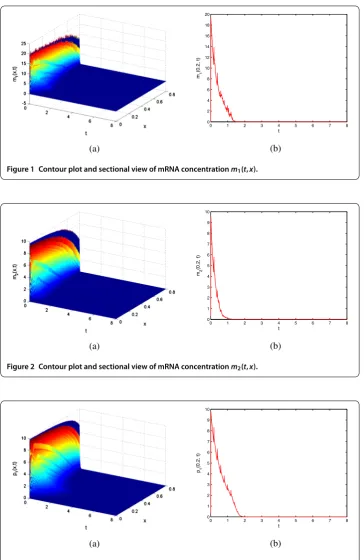
Figure 1 Contour plot and sectional view of mRNA concentrationm1(t,x).
Figure 2 Contour plot and sectional view of mRNA concentrationm2(t,x).
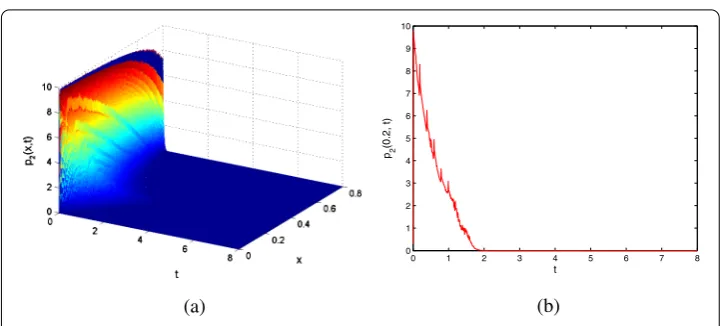
Figure 4 Contour plot of and sectional view protein concentrationp2(t,x).
atx= .. The four figures show that the concentrations of both mRNA and protein are exponentially stable, indicating effectiveness of the results derived in Theorem .
5 Conclusions
In this paper, we analyze the mean-square exponential stability for the comprehensive GRNs with (a) diffusion-reaction, (b) time-varying delay, (c) impulsive control, and (d) fBm for extrinsic noise. The stability analysis is a more challenging than the previous analysis reported in the literature that considered only one or two of the four model components. Our derived conditions of the mean-square exponential stability have a simple form and can be used for evaluating the exponential stability of GRNs in a numerically straightfor-ward manner.
Competing interests
The authors declare that they have no competing interests.
Authors’ contributions
All authors have equal contributions to the writing of this paper. All authors have read and approved the final version of the manuscript.
Author details
1School of Mathematics and Statistics, Ningxia University, Yinchuan, 750021, P.R. China.2Department of Scientific Computing, Florida State University, Tallahassee, FL 32306-4120, USA.
Acknowledgements
The research was supported in part by the National Natural Science Foundation of China (Nos. 11461053 and 11661064) and the Innovation Project of Ningxia University (GIP201624). The third author was supported in part by the DOE Early Career Award DE-SC0008272 and NSF-EAR grant 1552329.
Received: 28 September 2016 Accepted: 21 November 2016
References
1. Wu, H, Liao, H, Guo, S, Feng, W, Wang, Z: Stochastic stability for uncertain genetic regulatory networks with interval time-varying delays. Neurocomputing72, 3263-3276 (2009)
2. Vembarasan, V, Nagamani, G, Balasubramaniam, P, Park, JH: State estimation for delayed genetic regulatory networks based on passivity theory. Math. Biosci.244, 165-175 (2013)
3. Wang, W: Robust stability analysis of stochastic delayed genetic regulatory networks with polytopic uncertainties and linear fractional parametric uncertainties. Commun. Nonlinear Sci. Numer. Simul.19, 1569-1581 (2014) 4. Wang, L, Luo, Z-P, Yang, H-L, Cao, J: Stability of genetic regulatory networks based on switched systems and mixed
time-delays. Math. Biosci.278, 94-99 (2016)
5. Wang, W, Nguang, SK, Zhong, S, Liu, F: Exponential convergence analysis of uncertain genetic regulatory networks with time-varying delays. ISA Trans.53, 1544-1553 (2014)
7. Zhou, J, Xu, S, Shen, H: Finite-time robust stochastic stability of uncertain stochastic delayed reaction-diffusion genetic regulatory networks. Neurocomputing74, 2790-2796 (2011)
8. Chen, W, Wang, W: Positive periodic solutions for a model of gene regulatory system with time-varying coefficients and delays. Adv. Differ. Equ.2016, 63 (2016)
9. Ma, Q, Shi, G, Xu, S, Zou, Y: Stability analysis for delayed genetic regulatory networks with reaction-diffusion terms. Neural Comput. Appl.20, 507-516 (2011)
10. Han, Y, Zhang, X, Wang, Y: Asymptotic stability criteria for genetic regulatory networks with time-varying delays and reaction-diffusion terms. Circuits Syst. Signal Process.34, 3161-3190 (2015)
11. Biagini, F, Hu, Y, Øksendal, B, Zhang, T: Stochastic Calculus for Fractional Brownian Motion and Applications. Springer, London (2008)
12. Magdziarz, M, Weron, A, Burnecki, K, Klafter, J: Fractional Brownian motion versus the continuous-time random walk: a simple test for subdiffusive dynamics. Phys. Rev. Lett.103, 180602 (2009)
13. Kang, J, Xu, B, Yao, Y, Lin, W, Hennessy, C, Fraser, P, Feng, J: A dynamical model reveals gene co-localizations in nucleus. PLoS Comput. Biol.7, e1002094 (2011)
14. Song, Q, Yan, H, Zhao, Z, Liu, Y: Global exponential stability of impulsive complex-valued neural networks with both asynchronous time-varying and continuously distributed delays. Neural Netw.81, 1-10 (2016)
15. Gao, L, Wang, D, Wang, G: Further results on exponential stability for impulsive switched nonlinear time-delay systems with delayed impulse effects. Appl. Math. Comput.268, 186-200 (2015)
16. Wu, S-L, Li, K-L, Zhang, J-S: Exponential stability of discrete-time neural networks with delay and impulses. Appl. Math. Comput.218, 6972-6986 (2012)
17. Itabashi, T, Ishiwata, S: Chromosome segregation controlled by external mechanical impulse in a mammalian cell. Biophys. J.102(3), 346a (2012)