© 2015, IRJET | ISO 9001:2008 Certified Journal
| Page 2384
OPTIMIZATION OF FERMENTATION CONDITIONS FOR THE STRAIN
PONTOEA SP.
FOR THE PRODUCTION OF CALCIUM SUCCINATE
Raja .S
1, Dhanasekar R
21
Assistant Professor, Department of Chemical Engineering, Annamalai University
2Professors Department of Chemical Engineering, Annamalai University
---***---Abstract - In this study, a novel succinic acid producingbacterium, Pontoea sp., By considering the economic aspects succinate fermentation process, The fermentation conditions namely, initial pH and temperature are optimized by conducting batch experiments for maximize growth and production. The following optimum conditions are found for the strain Pontoea sp. initial pH 6.5; temperature 380C. The media components are screened
using statistical design of experiments by Plackett-Burman design. Four out of thirteen components are selected for further optimization, which is carried out using the Box-Behnken design of experiments. A regression model has been developed consisting of all influencial variables (media components) and their interactions. An improved succinate yield of 36 g/L was obtained with the optimized media composition for the strain Pontoea sp..
Key Words: Pontoea sp., Optimizaiton,
Plackett-Burman, Box-Behnken, Fermentation 1. INTRODUCTION
Succinic acid is a dicarboxylic acid and otherwise known as butanedioic acid. It is a common metabolite formed by plants, animals and microorganisms. It is an intermediate compound in the tricarboxylic acid cycle (TCA). It is also one of the fermentation products of energy metabolism. It has been synthesized from petrochemical based maleic acid, but its fermentation production is drawing much attention in response to the current need to develop Sustainable process using renewable resources(1). This is
an important point, as succinic acid can be produced from renewable, environmentally sound carbohydrates rather than relying on limited petrochemical hydrocarbons. It is synthesized by carbon-di-oxide fixation based carboxylation of C3 metabolism. This unique carbon-di-oxide fixation makes fermentative succinic acid production even more attractive. As the importance of succinic acid for use as a biodegradable polymer has increased, the biological production by fermentation has been focused on the alternative to the petrochemical based process. Newly developed facultative anaerobic bacteria Actinobacillus succinogens(2) and Mannheimia
succinicproducens(3) are considered as the effective
succinic acid producers because they can endure high glucose osmotic pressure and produce significant amounts of succinic acid with a high productivity.
The rumen is the first division of the stomach of a ruminant animal. More than 200 kinds of bacteria inhabit the bovine rumen. A number of functionally important rumen bacteria produce succinic acid during fermentation of carbohydrate, although succinic acid is seldom detected in measurable amounts in ruminal because it is rapidly converted to propionic acid. (Lee PC et.al: 2002) studied the production of succinic acid using bovine serum. In these studies, isolation of succinic acid producing strains was found and the process parameters for the maximum production of succinic acid using different substrates were found.
2.Materials and Methods
Bovine rumen is taken from the blood serum of cow. Seed culture were prepared by growing cells at 39°C in a sealed anaerobic flask containing (MH) medium with CO2 head
space. The isolation of a novel succinic acid producing bacterium, from bovine rumen was carried out. Anaerobic cultivation technique was used for the growth of organisms and preparation of media. The isolation medium contains (g/L): dextrose – 200; polypeptone -5; yeast extract – 5; NaCl- 2; Bactogar-12; sodium bicarbonate – 0.4; cysteine HCl – 0.25. Culture media were gassed with oxygen-free CO2 and autoclaved for 15
minutes at 121°C.
Cells were grown anaerobically in sealed anaerobic bottles containing 100 ml of MH medium plus 10 g/L of glucose under CO2 atmosphere. MH medium contains (g/L):
polypeptone - 10, 5g yeast extract, 3 g K2HPO4, 2 g
(NH4)2SO4, 0.2g CaCl22H2O. 0.2 g MgCl26H2O and 10 g
MgCO3 Na2S.9H2O was added to a final concentration of 2
mg/L to ensure anaerobic conditions. For flask cultures, exponentially growing cells, washed anaerobically with MH medium, were used to inoculate sealed anaerobic medium bottles containing 100 ml of MH medium plus 10 g/L of glucose or other carbon sources. MH medium with lower amounts of polypeptone (0, 2 and 5 g/L) and yeast extract (0, 1 and 2 g/L) was also examined to see the effect of complex nitrogen sources on cell growth. Utilization of various carbon sources was examined by monitoring their concentrations during cultivation. Batch cultures were carried out at 39°C in a jar fermentor containing 1 1 MH medium plus 20 g/L glucose Na2S.9H2O was again added
© 2015, IRJET | ISO 9001:2008 Certified Journal
| Page 2385
addition of Antifoam 289. During aerobic cultivation, air was sparged and dissolved oxygen concentration was maintained at over 40% of air saturation by increase of agitation speed up to 1,000 rpm. CO2 and N2 gases were
sparged during anaerobic cultivation and gas sparging rates and agitation speed were controlled at 0.25 vvm and 200 rpm, respectively. CO2 and N2 gases were scrubbed
free of oxygen by passing them through a gas purifier. The sensivity of M.Succiniciproducens MBEL55E to various antibiotics was examined by counting colony-forming units (cfu) on agar plates containing various concentrations of these antibiotics.
The concentrations of fermentation products and carbon compounds were determined by HPLC equipped with an ion exchange column using 0.012 N H2SO4 as mobile phase.
Cell growth was monitored by measuring the absorbance at 660 nm (OD660) using a spectrophotometer. Dry cell weight (DCW) was calculated from a curve relating the OD660 of 1.0 was equivalent to 400+20 mg DCW 1-1 was calculated from a curve relating the OD660 to DCW. An OD660 of 0.1 was equivalent to 400+20 mg DCW1-1. The yields of fermentation products were defined as grams of product formed form 1 g of glucose and were expressed as a percentage.
The estimation of growth is carried out by spectrophotometric method. The optical density of all cultures is measured using Elico-SLV 164, Double beam UV-VIS spectrophotometer at 660 nm with blanks of the appropriate growth medium. Suspension with an OD above 1.0 is diluted with appropriate growth medium. Curves relating OD to dry weight are constructed by harvesting cultures at room temperature, washing with the appropriate growth medium. Curves relating OD to dry weight are constructed by harvesting cultures at room temperature, washing with distilled water and resuspending the cells in distilled water to about 10 mg of dry weight per ml. Portions (5ml) are dried at 100°C and weighted. The dry weight of the cells is determined. The strain produces an extra cellular slime and in turn produces turbid solutions. In such cases, the optical density is read against a culture supernatant blank, diluting the blank in the same ration as the culture.
The precipated calcium succinate was filtered at 39°C by vacuum filtration. Broths from IL and 2L fermentations were filtered using Whatman No.1 filter paper (Whatman Inc., Clifton Heights, N.J.) in a 17 cm dia. Ceramic Buchner funnel. The filtrate was collected in a 2L Pyrex vacuum flask. The filter cake was washed with the minimum volume required to remove all the filtrate. For larger fermentations a 20- ounce cotton twill filter cloth in a 12-inch diameter Buchner funnel was used for the filtration. The filtrate was then heated to 80°C, seeded with calcium succinate and mixed for 25 minutes allowing equilibrium to be established. The hot slurry was then filtered. The
calcium succinate filter cake was washed with enough 80°C water to remove all filtrate.
3. Result and Discussion 1. Effect of Initial pH
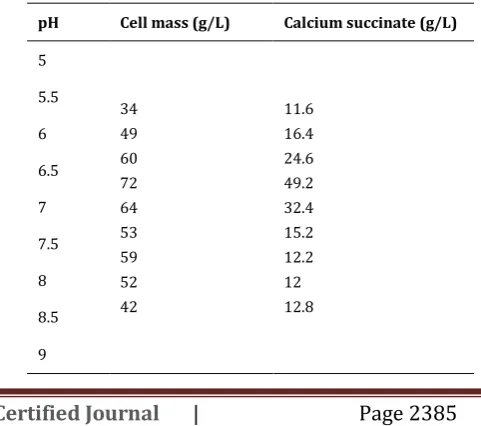
It is essential to maintain the culture conditions at optimal level for any fermentation. pH of the medium plays a important role in fermentations which affects both the growth of the cell and product formation. Thus, the effect of initial pH on cellular growth and succinate formation was studied by conducting the experiments at different initial pH values (5, 5.5, 6, 6.5, 7, 7.5, 8, 8.5 and 9) for 48 hours. The strain Pantoea sp. has exhibits for the set of initial pH values (shown in Fig.4.6). Pantoea sp. has produced the maximum succinate concentration of 49.2 g/L. The growth of Pantoea sp. was significant when inoculated in the medium with initial pH of 6.0, 6.5 and 7.0. The effect was observed for the Pantoea sp. as, when the initial pH of the medium was lowered to 5.0, the final cell mass and succinate concentrations were lowered to the very minimum. Below pH7.0 the metabolic activity of
Pantoea sp. was affected.
pH of the medium has influence the enzyme activity which involved in succinic acid production pathway. The acidic pH values below 5.5 and alkaline pH above 7.0 might negatively affect their enzyme activities. It has been reported that the low pH facilitates the formation of acidic metabolites which destabilizes the cell’s ability to maintain pH of the medium and thus results in lowering the intracellular ATP level, which inhibits the substrate uptake and also plays role in influencing the enzyme activities. The other isolates from bovine rumen,
Mannheimia succiniciproducens LPK7 [Oh et al., 2009] and
Mannheimia succiniproducens MBEL55E [Lee et al., 2002]
were reported to be have the same optimal initial pH of 6.5.
Table 1 : Effect of pH
pH Cell mass (g/L) Calcium succinate (g/L)
© 2015, IRJET | ISO 9001:2008 Certified Journal
| Page 2386
Fig.1 Effect of initial pH
2. Effect of Initial Temperature
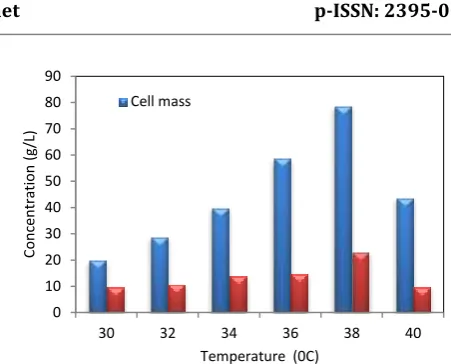
Temperature plays an important role in biological processes which influence the kinetics of cell growth and enzymatic activities in cellular metabolism. In the present study, the effects of different temperature on cell growth and succinate production were tested for both isolated strains at various temperatures (300C, 320C, 340C, 360C,
380C and 400C). Pantoea sp. also shown to be active at
mesophilic temperature range, 380C was found to be an
optimum temperature. The maximum concentrations of cell mass (79 g/L) and succinate (23.2 g/L) were obtained at 380C. At ambient temperature of 30 to 32 0C and at
400C the cell mass concentration and succinate
concentration was reduced to very minimum.
Since the strains isolated from bovine rumen of cow, the optimal conditions obtained from this experiment were matched with the cow’s rumen temperature of 38 to 420C[3]. This temperature range is in consistence with the
range as reported previously [3,4]. The most probable
reason could be that these strains being a rumen microbe which grows well at 38 to 39 0C (the ambient temperature
of the rumen) [5]. Similar temperature range has been
reported by Nhuan P. Nghiem et al.[6], 1997, who observed that the production of succinic acid was maximum at 39 0C for A.succiniciproducens.
Table 2 : Effect of Temperature
Temperature
Fig.1 Effect of initial Temperature
3.Media Optimization
Components of media and its composition are vital for any fermentation system for its success. First, screening of media components was carried out by Plackett-Burman design of experiments. Then, the components having high influence on succinate formation were taken for optimization for finding out its point optimum levels by Box-Behnken method of experiment.
3.1. Screening of Media Components using Plackett-Burman Design
Screening of significant nutrients for the production of calcium succinate was done by employing a special class of two-level fractional factorial design of experiments that are widely used in screening of media components in fermentation systems. The methodology has been proposed by Placket and Burman. These experiments have Resolution-III when conducted in completely randomized designs and are often referred to as Plackett-Burmandesigns. The rows of the table denote the design factors and the elements in each column are coded factor levels: minus sign denotes one level of a factor and plus sign denotes the other level of the factor.
© 2015, IRJET | ISO 9001:2008 Certified Journal
| Page 2387
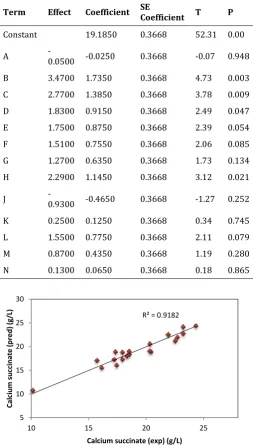
Plackett Burman design of experiments. Two level design (-1 indicates the lower level and +1 indicates the higher level) consisting of twenty runs are generated for thirteen variables with one replicate. The design is subjected to factorial analysis. From the results of analysis, the effects of variables and their significance on succinate production were found. The variables with P values < 0.04 are considered to be significant (Table 3). Further, considering their effects, Cystine HCl and Cystine HCl; Ferrous sulfate shows negative effect with Pantoea sp.
Table 3.Estimated effects and coefficients of Plackett – Burman design
Term Effect Coefficient SE Coefficient T P
Constant 19.1850 0.3668 52.31 0.00
A -0.0500 -0.0250 0.3668 -0.07 0.948
B 3.4700 1.7350 0.3668 4.73 0.003
C 2.7700 1.3850 0.3668 3.78 0.009
D 1.8300 0.9150 0.3668 2.49 0.047
E 1.7500 0.8750 0.3668 2.39 0.054
F 1.5100 0.7550 0.3668 2.06 0.085
G 1.2700 0.6350 0.3668 1.73 0.134
H 2.2900 1.1450 0.3668 3.12 0.021
J -0.9300 -0.4650 0.3668 -1.27 0.252
K 0.2500 0.1250 0.3668 0.34 0.745
L 1.5500 0.7750 0.3668 2.11 0.079
M 0.8700 0.4350 0.3668 1.19 0.280
N 0.1300 0.0650 0.3668 0.18 0.865
Fig.3. Parity plot between the experimental and predicted calcium succinate values of Pantoea sp. by
Plackett-Burman design
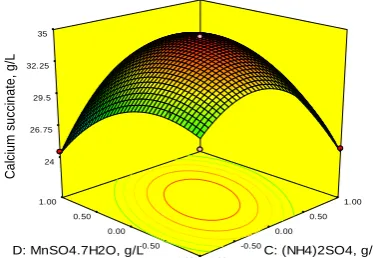
A Pareto’s chart, which demonstrates showing the dominance of individual variables on succinate production are shown in Fig 3 for Pantoea sp. The variables which lie beyond the reference line in the Pareto’s chart are intercepted to be significant. From the Pareto’s chart and also from the p-values resulting from the analysis of the experimental values of the design, the variables found to be dominant on the production of calcium succinate in their order are: yeast extract, peptone, (NH4)2SO4 and
MnSO4.7H2O.
3.2. Optimization of Screened Media Components using Box Behnken Design
The Box-Behnken design has been adopted in order to optimize the selected media components namely, yeast extract, peptone, (NH4)2SO4 and MnSO4.7H2O to their point
optimum levels. A three level design (-1, 0, +1) with three central points is used in the study. The following central values of Pantoea sp. Strain was: yeast extract – 2.9 g/L, peptone – 2.4 g/L, (NH4)2SO4 – 2.63 g/L and MnSO4.7H2O –
0.27 g/L. The design aims at obtaining a second order polynomial equation which explains the linear, interactive and square effects of the variables on the calcium succinate production.
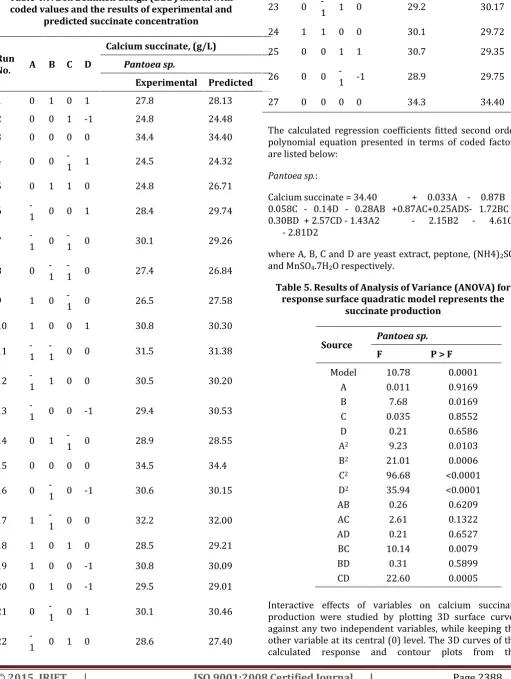
The design matrix consisting of 27 experimental runs is constructed in order to arrive a second order polynomial equation to predict the calcium succinate fermentation system. The design matrix and their corresponding experimental and predicted results are given in Table 4.
The results are analysed using the analysis of variance (ANOVA) and the estimated coefficients are presented in Table 5. The model F-value of 10.78 implies that the model are significant. Values of "Prob > F" less than 0.05 indicate the model terms are significant. In the present work, the model terms B, BC, CD, A2, B2, C2, D2 are significant for succinate production by Pantoea sp.. The coefficient of determination (R2) for succinate production is 0.9263 for
Pantoea sp, which is very close to 1 which explains more
than 92% variability of the response. The predicted R2
value of 0.7610 for Pantoea sp. is in reasonable agreement with the adjusted R2 value of 0.8404 for Pantoea sp. An
adequate precision value greater than 4 is desirable. The adequate precision value of more than 11 indicates an adequate signal and suggests that the model can be used to navigate the design space.
R² = 0.9182
5 10 15 20 25 30
10 15 20 25
C
al
ci
um
succi
nat
e
(pr
e
d)
(g
/L)
© 2015, IRJET | ISO 9001:2008 Certified Journal
| Page 2388
Table 4.9. Box Behnken design (BBD) matrix with coded values and the results of experimental and
predicted succinate concentration
Run
No. A B C D
Calcium succinate, (g/L)
Pantoea sp.
Experimental Predicted
1 0 1 0 1 27.8 28.13
2 0 0 1 -1 24.8 24.48
3 0 0 0 0 34.4 34.40
4 0 0 -1 1 24.5 24.32
5 0 1 1 0 24.8 26.71
6 -1 0 0 1 28.4 29.74
7 -1 0 -1 0 30.1 29.26
8 0 -1 -1 0 27.4 26.84
9 1 0 -1 0 26.5 27.58
10 1 0 0 1 30.8 30.30
11 -1 -1 0 0 31.5 31.38
12 -1 1 0 0 30.5 30.20
13 -1 0 0 -1 29.4 30.53
14 0 1 -1 0 28.9 28.55
15 0 0 0 0 34.5 34.4
16 0 -1 0 -1 30.6 30.15
17 1 -1 0 0 32.2 32.00
18 1 0 1 0 28.5 29.21
19 1 0 0 -1 30.8 30.09
20 0 1 0 -1 29.5 29.01
21 0 -1 0 1 30.1 30.46
22 -1 0 1 0 28.6 27.40
23 0 -1 1 0 29.2 30.17
24 1 1 0 0 30.1 29.72
25 0 0 1 1 30.7 29.35
26 0 0 -1 -1 28.9 29.75
27 0 0 0 0 34.3 34.40
The calculated regression coefficients fitted second order polynomial equation presented in terms of coded factors are listed below:
Pantoea sp.:
Calcium succinate = 34.40 + 0.033A - 0.87B - 0.058C - 0.14D - 0.28AB +0.87AC+0.25ADS- 1.72BC - 0.30BD + 2.57CD - 1.43A2 - 2.15B2 - 4.61C2
- 2.81D2
where A, B, C and D are yeast extract, peptone, (NH4)2SO4
and MnSO4.7H2O respectively.
Table 5. Results of Analysis of Variance (ANOVA) for response surface quadratic model represents the
succinate production
Source Pantoea sp. F P > F Model
A B C D A2
B2
C2
D2
AB AC AD BC BD CD
10.78 0.011 7.68 0.035
0.21 9.23 21.01 96.68 35.94 0.26 2.61 0.21 10.14
0.31 22.60
0.0001 0.9169 0.0169 0.8552 0.6586 0.0103 0.0006 <0.0001 <0.0001 0.6209 0.1322 0.6527 0.0079 0.5899 0.0005
© 2015, IRJET | ISO 9001:2008 Certified Journal
| Page 2389
interactions between the variables were shown in Figs. 4 – 8 for the bacteria Pantoea Sp. The point optimum levels of components for maximum production of succinate was same for both strains, which are as follows: yeast extract – 2.9 g/L, peptone – 2.4 g/L, (NH4)2SO4 – 2.63 g/L and
MnSO4.7H2O – 0.27 g/L.
Validation of the model was tested by carrying out batch experiments under optimal media composition. Three repeated experiments are performed and the results are compared. The succinate production obtained from experiments is very close to the actual response predicted by the regression model, which proved the validity of the model. At these optimized value the maximum succinate production was found to be 36 g/L for Pantoea sp..
Fig 4. 3D plot showing the effect of yeast extract and peptone
Fig 5. 3D plot showing the effect of yeast extract and (NH4)2SO4
Fig.6. 3D plot showing the effect of yeast extract and MnSO4.7H2O
© 2015, IRJET | ISO 9001:2008 Certified Journal
| Page 2390
3. CONCLUSION
Production of succinic acid using new strain was investigated and the factors affecting the production were optimized. The factors affecting succinate production were optimized for the strain Pantoea sp.. The initial pH of the culture medium significantly affects the total succinate production. Temperature is another important factor and it also affects the growth of the isolated bacterium. The optimum conditions for succinate fermentation were found to be initial pH 6.5 and temperature 380C Pantoea sp.. The highest calcium succinate yield obtained was 36 g/L for Pantoea sp.. Sequential media optimization technique was followed to maximize the production of succinate. Plackett-Burman design of experiments was used to screen the media components consisting of carbon, nitrogen and the essential nutrients. The four medium constituents namely, yeast extract, peptone, (NH4)2SO4 and MnSO4.7H2O were found to be effective in
the production of succinic acid. These four influential media components were considered for further optimization using Box-Behnken Design to enhance the succinate yield. Interactive effects of these media components were also analysed. Optimal values of media components are found to be yeast extract, 2.9 g/L; peptone, 2.4 g/L; (NH4)2SO4 2.63 g/L; and MnSO4.7H2O
0.27 g/L. An improved yield of 36 g/L was obtained with the optimized media components for the strain Pantoea sp..
REFERENCES
1. Willke Th, Vorlop K-D, Industrial bioconversion of renewable resources as an alternative to conventional chemistry. App microbial Biotechnol 2004; 66: 131-42.
2. Guettler MV, Rumelr D, Jain MK ; actinobacillus succinogenes sp. Nov. a novel succinic acid producing strain from the bovine rumen; 1999; Int J Syst Bacteriol 49; 207 –216.
3. .Lee PC, Lee SY, Hong SH, Change HN. Isolation and characterization of new succinic acid producing bacterium, Mannheimia succiniciproducens MBEL 55E, from bovine rumen. Appl. Microbial Biotechnol 2002; 58: 663-668.
4. Oh In Jae, Kim Dong Hyun, Oh Eun Kyoung Lee Sang Yup, Lee Jinwon. 2009: Optimization and Scale-Up of Succinic Acid Production by
Mannheimia succiniciproducens LPK7, J Microbiol.
Biotechnol. 19(2), 167-171.
5. Song H, and Lee SY. 2006: Production of succinic acid by bacterial fermentation. Enzyme Microb.
Technol., 39, 352-361.
6. Nghiem NP, Davison BH, Suttle BE, and Richardson GR. 1997: Production of succinic acid
by Anaerobiosprillium succiniciproducens .