doi:10.1155/2009/514240
Research Article
A Delayed Chemostat Model with
Impulsive Diffusion and Input on Nutrients
Jianjun Jiao and Shaohong Cai
Guizhou Key Laboratory of Economic System Simulation, School of Mathematics and Statistics, Guizhou College of Finance and Economics, Guiyang 550004, China
Correspondence should be addressed to Jianjun Jiao,[email protected]
Received 21 August 2009; Revised 2 November 2009; Accepted 30 November 2009
Recommended by Binggen Zhang
A chemostat model with delayed response in growth and impulsive diffusion and input on nutrients is considered. Using the discrete dynamical system determined by the stroboscopic map, we obtain a microorganism-extinction periodic solution. Further, it is globally attractive. The permanent condition of the investigated system is also obtained by the theory on impulsive delay differential equation. Finally, numerical analysis is inserted to illustrate dynamical behaviors of the chemostat system. Our results reveal that the impulsive input amount of nutrients plays an important role on the outcome of the chemostat. Our results provide strategy basis for biochemical reaction management.
Copyrightq2009 J. Jiao and S. Cai. This is an open access article distributed under the Creative Commons Attribution License, which permits unrestricted use, distribution, and reproduction in any medium, provided the original work is properly cited.
1. Introduction
The theory of impulsive differential equation appears as a natural description of several real
processes subject to certain perturbations whose duration is negligible in comparison with the duration of the process. Recently, equations of this kind are found in almost every domain
of applied science. Many examples are given in1. Some impulsive differential equations
have been recently introduced in population dynamics2–7, pulse vaccination 8–11, and
chemostat dynamics12–15.
The chemostat is a basic piece of laboratory apparatus. The advantages are that certain of the biological parameters assumed to influence the outcomes can be controlled by the experimenters. The chemostat plays an important role in bioprocessing, such as ecology, microbiology, chemical engineering, and so forth. Smith and Waltman had made discussion
about the chemostat model in16. The models contain discrete time delays which account
for time which laps between uptaked of nutrient and the assimilation of nutrient into viable
discrete time delay. Freedman, So, and Waltman19were the first to incorporate time delay in
chemostat models. Ellermeyer20, Hsu et al.21,22, analyzed a discrete time delay model
with two competitive microorganisms for a single nutrient in a chemostat. Hale, Somolinos
23,Hsu et al.24, Wolkowicz, Zhao25investigated competition in chemostat. Ellermeyer
et al.26 did a theoretical and empirical investigation of delayed growth response in the
continuous culture of bacteria. Delays occur naturally in biological system by two obvious sources of delays: delays due to the cell cycle; and delays due to the possibility the organism
stores the nutrient. Delays appear in a chemostat model in Bush and Cook27. They have
investigated a model of growth of one organism in the chemostat with a delay in the intrinsic growth rate of the microorganism but with no delay in the substrate equation.
In chemostat’s simplest form, the system approximates conditions for plankton growth in lakes, where the limiting nutrients such as silica and phosphate are supplied from streams draining the watershed. In the lakes, the plankton population movements
are subject to many factors, such as currents and turbulent lateral diffusioncf. Levin and
Segel 28, Mimura 29, Okubo 30, Freedman and Ruan 31. Ruan 32 proposed a
diffusive plankton-nutrient interaction model with delayed nutrient recycling and delayed
growth response and studied Turing instability and the existence of travelling wave solutions. However, they did not investigate a chemostat model with delayed response in growth
and impulsive diffusion on nutrients. Many researchers indicated that it was important to
consider models with periodic perturbations, since these models may be quite naturally exposed in many real world phenomena, for instance, food supply, mating habits, cross flooding in rainstorm season. In fact, the perturbations such as cross flooding in rainstorm which are not suitable to be considered with continuity. These perturbations bring sudden changes to the system. Systems with sudden perturbations are involving an impulsive
differential equations which have been studied intensively and systematically in1,2. There
are few papers8,12,33,34research the chemostat model with impulsive perturbations on
nutrients. In this paper, a chemostat model with delayed response in growth and impulsive
diffusion on nutrients is investigated, we will obtain a microorganism-extinction periodic
solution. Further, it is globally attractive. The permanent condition of the investigated system is also obtained.
The organizations of the paper are as following. InSection 2, we introduce a chemostat
model with delayed response in growth and impulsive diffusion on nutrients. InSection 3, we
present some preliminary results about the investigated model. Our main results are stated
and proven inSection 4. Finally, the numerical analysis is inserted to illustrate the results,
and conclude with a brief discussion inSection 5.
2. The Model
We investigate the following chemostat model with delayed response in growth and impul-sive diffusion on nutrients:
ds1t
dt D1
s0 1−s1t
,
ds2t
dt D2
s02−s2t
−Ps2txt,
dxt
dt −D2xt e−
D2τ1Ps
2t−τ1xt−τ1,
Δs1t ds2t−s1t μ1,
Δs2t ds1t−s2t,
Δxt 0,
tnτ, n1,2. . . ,
ϕ1ζ, ϕ2ζ, ϕ3ζ
∈CC
−τ1,0, R3
, ϕi0>0, i1,2,3,
2.1
where we suppose that the system is composed of two lakes connected by impulsive diffusion. sit denotes the concentration of the nutrient in ith lake at time ti 1,2. s0i
denotes the input nutrient concentration inith lakei1,2.Didenotes the input rate from
the lakes containing the substrate and the wash-out rate of substrate and microorganism by products from Lakeii 1,2. 0 < d < 1 is diffusive rate between Lake 1 and Lake 2. It is
assumed here that the net exchange from patchjto Lakeiis proportional to the difference
sj−siof concentration of the nutrient.xtdenotes the concentration of the the microorganism
in the second lake at timet.τ1stands for the time delay in conversion of nutrient to biomass
for the microorganism. As discussed in20,32,e−D2τ1xt−τ1represents the biomass of those
microorganisms that consume nutrientτ1units of time prior to timetand that survive in the
chemostat theτ1units of time necessary to complete the nutrient conversion process.Ps2t
indicates the consumption rate of nutrient by the microorganism. It is assumed thatP0
0, P0 > 0 and P0 ≤ 0. In particular, these hypotheses are satisfied by the
Michaelis-Menten function Ps2t s2t/ks2t,herek > 0 is the half-saturation constant or
Michaelis-Menten constant. The impulsive diffusion occurs everyτperiodτ >0, the system
evolves from its initial state without being further affected by diffusion until the next pulse
appears.Δx xnτ−xnτ,and xnτrepresents the concentration of the plankton in
theith lake immediately after thenth diffusion pulse at timet nτ, whilexnτrepresents
the concentration of the microorganism in theith lake before thenth diffusion pulse at time
t nτ,n ∈Z.μ1 ≥ 0 is the amount of the substrate concentration pulse att nτ,n∈ Z
in first lake. The purpose of this paper is to prove that the system2.1has a
microorganism-extinction periodic solution, further, it is globally attractive, and also prove system2.1is
permanent.
3. The Lemmas
The solution of2.1, denoted byXt s1t, s2t, xtT, is a piecewise continuous function
X:R → R3. Xt is continuous on nτ,n 1τ, n ∈ Z and Xnτ limt→nτXt
exists. Obviously the global existence and uniqueness of solutions of 2.1 is guaranteed
by the smoothness properties of f, which denotes the mapping defined by right-side of
system2.1 1. Before having the main results. we need some lemmas which will be used in
the next.
According to the biological meanings, it is assumed thats1t≥0, s2t≥0 andxt≥
0. Now, we will show that all solutions of2.1are uniformly ultimately bounded.
Lemma 3.1. There exists a constantM >0such thats1t≤M, s2t≤M, xt≤e−DτM,for each
Proof. DefineVt s1t s2t eD2τxtτ1, andDmin{D1, D2}. Whent /nτ, we have
SoVtis uniformly ultimately bounded. Hence, by the definition ofVt, there exists
a constantM > 0 such thats1t ≤ M, s2t ≤ M, xt ≤ e−DτMfor alltlarge enough. The
Integrating and solving the first two equations of system3.3 between pulses, we
have
sit s0i −
s0
Considering the last two equations of system3.3, we have the stroboscopic map of
Equation3.5are difference equations. They describe the the concentration of the nutrients
in the two lakes at a pulse in terms of values at the previous pulse. The dynamical behaviors
of system3.5with equation3.4determine the dynamical behaviors of system3.3. So we
will devote to investigate system3.5.
From system3.5, we can easily have a unique fixed point of system3.5as follows
s∗1
0.65 0.7 0.75 0.8 0.85 0.9 0.95 1
0 500 1000 1500 2000 2500 3000
t
s1
t
a
0.7 0.8 0.9 1 1.1 1.2 1.3 1.4
0 500 1000 1500 2000 2500 3000
t
s2
t
b
0.7 0.8 0.9 1 1.1 1.2 1.3 1.4
0.65 0.7 0.75 0.8 0.85 0.9 0.95 1
s1t
s2
t
c
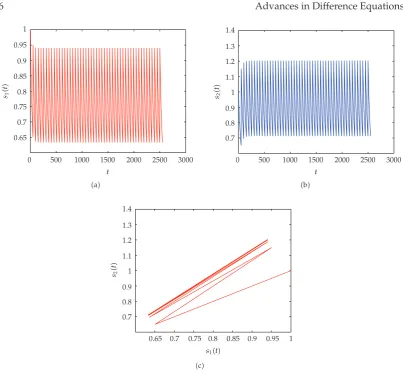
Figure 1:Dynamical behavior of system3.3withs10 1,s20 1,s010.5,s020.5,D0.6,d0.1, τ2,μ10.3.atime-series ofs1t,btime-series ofs2t,cThe phase portrait of3.3.
Doing similarly to3, Lemma 4.1 and Theorem 4.1, and using iterative method, one
can easily obtainLemma 3.2as follows:
Lemma 3.2. For every pointx1, x2>0,0of system3.7, then one has
Fnx−→s∗1, s∗2, asn−→ ∞. 3.8
Remark 3.3. Lemma 3.2 implies that the fixed point s∗1, s∗2 of F is globally stable. So all trajectories of3.3approach the positive periodic solutions1t,s2twith periodτ, where
sit s0i −si0−s∗ie−Dit−nτ,nτ < t≤n1τ,i1,2.The dynamical behaviors of system
Lemma 3.4see18. Consider the following delay equation:
yt a1yt−τ−a2yt, 3.9
wherea1, a2, τ >0;yt>0for−τ≤t≤0. Ifa1< a2,limt→ ∞yt 0.
4. Dynamical Behaviors of
2.1
From the above discussion, we know that there exists a microorganism-extinction boundary periodic solution s1t,s2t,0 of system 2.1. In this section, we will prove that the
microorganism-extinction boundary periodic solution s1t,s2t,0 of system 2.1 is
globally attractive.
Theorem 4.1. If
−d1−e−D1τs0
1
1−d1−e−D2τ−1−2d1−e−D1τe−D2τs0
2
1−1−de−D2τ−1−de−D1τ−1−2de−D2D1τ
de−D1τμ1
1−1−de−D2τ−1−de−D1τ−1−2de−D2D1τ
< P−1D2eD2τ1
,
4.1
holds, then the microorganism-extinction periodic solutions1t,s2t,0of system2.1is globally
attractive.
Proof. Since
−d1−e−D1τs0
1
1−d1−e−D2τ−1−2d1−e−D1τe−D2τs0
2
1−1−de−D2τ−1−de−D1τ−1−2de−D2D1τ
de−D1τμ1
1−1−de−D2τ−1−de−D1τ−1−2de−D2D1τ
,
< P−1D 2eD2τ1
,
4.2
then we can chooseε0sufficiently small such that
e−D2τ1P
−d1−e−D1τs0
1
1−d1−e−D2τ−1−2d1−e−D1τe−D2τs0
2
1−1−de−D2τ−1−de−D1τ−1−2de−D2D1τ
de−D1τμ1
1−1−de−D2τ−1−de−D1τ−1−2de−D2D1τ
ε0
< D2.
It follows from that the first equation of system2.1thatds2t/dt ≤ D2s02−s2t. So we
consider the following comparison impulsive differential system:
dx1t
In view ofRemark 3.3, we obtain the periodic solution of system4.4
xit s0i −
s0i −x∗ie−Dit−nτ, nτ < t≤n1τ i1,2 4.5
which is globally asymptotically stable. Here
respectively. Fornτ < t ≤ n1τ,z1t s01 −s01−z1∗e−D1t−nτ andz2t D2s02/D2
Definition 4.2. System 2.1 is said to be permanent, if there are constants m, M > 0
independent of initial valueand a finite timeT0such that for all solutionss1t, s2t, xt
with all initial values s1t > 0, s2t > 0, x0 > 0, m ≤ s1t < M,m ≤ s2t < M,
m ≤ xt ≤ e−D2τM, holds for all t ≥ T
0. Here T0 may depend on the initial values
the following equation
Proof. The third equation of system2.1can be rewritten as
then we can easily know that there exists sufficiently smallε >0 such that
Consider the following comparison impulsive system for allt > t0:
dv1t
solution of4.22which is globally asymptotically stable, where,
v2∗ −
d1−e−D1τs0
1
1−d1−e−D2x∗P0τ
−1−2d1−e−D1τe−D2x∗P0τ R 1−1−de−D2x∗P0τ−1−de−D1τ−1−2de−D2x∗P0D1τ
de−D1τμ1
1−1−de−D2x∗P0τ−1−de−D1τ−1−2de−D2x∗P0D1τ.
4.24
By the comparison theorem for impulsive differential equation1, we know that there exists
t1> t0τ1such that the inequalitys2t≥v2∗t−εholds fort≥t1, thuss2t≥v∗2−εfor all t≥t1. For convenience, we make notation asσΔv2∗−ε. So we have
e−D2τ1Pσ> D
2, 4.25
then we have
Vt> xte−D2τ1Pσ−D
2 , 4.26
for allt > t1. Setxmmint∈t1,t1τ1xt,we will show thatxt≥xmfor allt≥t1. Suppose the contrary, then there is aT0>0 such thatxt≥xmfort1≤t≤t1τ1T0, xt1τ1T0 xm
andxt1τ1T0<0. Hence, the first equation of system1.1imply that
xt1τ1T0 e−D2τ1Pst1τ1T0xt1τ1T0−D2xt1τ1T0,
≥e−D2τ1Pσ−D
2 xm>0.
4.27
This is a contradiction. Thus, xt ≥ xm for all t > t
1. As a consequence, Then Vt >
xme−D2τ1Pσ−D
2 > 0 for all t > t1. This implies that ast → ∞, Vt → ∞. It is a
contradiction toVt≤M1τ1e−2D2τ1PM. Hence, the claim is complete.
By the claim, we are left to consider two case. First,xt ≥ x∗ for alltlarge enough.
Second,xtoscillates aboutx∗fortlarge enough. Define
qmin
x∗
2 , q1
, 4.28
whereq1 x∗e−D2τ1. We hope to show thatxt≥ qfor alltlarge enough. The conclusion is
evident in first case. For the second case, lett∗ >0 andξ >0 satisfyxt∗ xt∗ξ x∗and
xt< x∗for allt∗< t < t∗ξwheret∗is sufficiently large such thatxt> σfort∗< t < t∗ξ,
xtis uniformly continuous. The positive solutions of2.1are ultimately bounded andxt
is not affected by impulses. Hence, there is aT0 < t < τ1 andT is dependent of the choice
oft∗such thatxt∗ > x∗/2 fort∗ < t < t∗T. Ifξ < T, there is nothing to prove. Let us consider the caseT < ξ < τ1. Sincext>−D2xtandxt∗ x∗, it is clear thatxt≥q1for t∈t∗, t∗τ1. Then, proceeding exactly as the proof for the above claim. We see thatxt≥q1
0.5
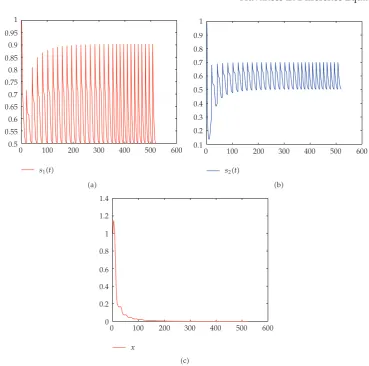
Figure 2:Dynamical behavior of system2.1on microorganism-extinction periodic solution withs10 1,s20 1,x0 1,s100.5,s020.5,D10.6,D20.4,k2,τ1,β2.5,τ11,d0.9, μ10.4.a time-series ofs1t,btime-series ofs2t,ctime-series ofxt.
we only needt∗to be large. We concludext≥qfor all larget. In the second case. In view
of above discussion, the choice ofqis independent of the positive solution, and we proved
that any positive solution of2.1satisfiesxt≥qfor all sufficiently larget. This completes
0.5
We can easily complete the proof ofTheorem 4.4by referring toLemma 3.1, Theorems
4.1and4.3.
5. Discussion
In this paper, we investigate a delayed chemostat model with impulsive diffusion and input
on nutrients. From Theorems 4.1 and 4.4, we analyze that the microorganism-extinction
periodic solution of system 2.1 is globally attractive, and System 2.1 is also proved to
be permanent. If it is assumed that the consumption rate of nutrient by the plankton is
Ps2t βs2t/ks2t,ands10 1,s20 1,x0 1,s01 0.5,s02 0.5,D1 0.6,
D2 0.4, k 2, τ 1, β 2.5, τ1 1, d 0.9, μ1 0.4. Then the
microorganism-extinction periodic solution is globally attractiveseeFigure 2. If it is also assumed that the
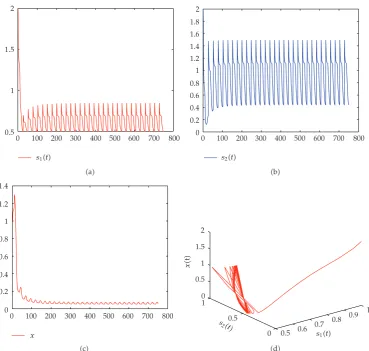
consumption rate of nutrient by the plankton isPs2t βs2t/ks2t,ands10 1,
d 0.9,μ1 2.then system2.1is permanenceseeFigure 3. From Theorems4.1and4.4,
and the numerical analysis, we can easily guess that there must exist a thresholdμ∗1. Ifμ1< μ∗1,
the microorganism-extinction periodic solutions1t, s2t,0of2.1is globally attractive. If
μ1> μ∗1, system2.1is permanent. The sameness can be discussed on parameterd, then, the
impulsive diffusion amount also plays an important role for the permanence of system2.1.
Our results provide strategy basis for biochemical reaction management.
Acknowledgments
This work was supported by National Natural Science Foundation of China10961008, the
Nomarch Foundation of Guizhou Province2008035, the Science Technology Foundation of
Guizhou2008J2250, the Science Technology Foundation of Guizhou Education Department
2008038, and the National Key Technology R&D Program of China2006BAC01A09.
References
1 D. Ba˘ınov and P. Simeonov,Impulsive Differential Equations: Periodic Solutions and Applications, vol. 66 ofPitman Monographs and Surveys in Pure and Applied Mathematics, Longman Scientific & Technical, Harlow, UK, 1993.
2 J. Jiao and L. Chen, “Global attractivity of a stage-structure variable coefficients predator-prey system with time delay and impulsive perturbations on predators,”International Journal of Biomathematics, vol. 1, no. 2, pp. 197–208, 2008.
3 L. Wang, Z. Liu, J. Hui, and L. Chen, “Impulsive diffusion in single species model,”Chaos, Solitons and Fractals, vol. 33, no. 4, pp. 1213–1219, 2007.
4 V. Lakshmikantham, D. D. Ba˘ınov, and P. S. Simeonov,Theory of Impulsive Differential Equations, vol. 6 ofSeries in Modern Applied Mathematics, World Scientific, Teaneck, NJ, USA, 1989.
5 M. Benchohra, J. Henderson, and S. Ntouyas,Impulsive Differential Equations and Inclusions, vol. 2 of
Contemporary Mathematics and Its Applications, Hindawi Publishing Corporation, New York, NY, USA, 2006.
6 A. M. Samo˘ılenko and N. A. Perestyuk,Impulsive Differential Equations, vol. 14 ofWorld Scientific Series on Nonlinear Science. Series A: Monographs and Treatises, World Scientific, River Edge, NJ, USA, 1995.
7 S. T. Zavalishchin and A. N. Sesekin, Dynamic Impulse Systems. Theory and Application, vol. 394 of
Mathematics and Its Applications, Kluwer Academic Publishers, Dordrecht, The Netherlands, 1997.
8 J. Jiao, L. Chen, and S. Cai, “An SEIRS epidemic model with two delays and pulse vaccination,”
Journal of Systems Science & Complexity, vol. 21, no. 2, pp. 217–225, 2008.
9 G. Zeng, F. Wang, and J. J. Nieto, “Complexity of a delayed predator-prey model with impulsive harvest and Holling type II functional response,”Advances in Complex Systems, vol. 11, no. 1, pp. 77– 97, 2008.
10 H. Zhang, L. Chen, and J. J. Nieto, “A delayed epidemic model with stage-structure and pulses for pest management strategy,”Nonlinear Analysis: Real World Applications, vol. 9, no. 4, pp. 1714–1726, 2008.
11 W. Wang, J. Shen, and J. J. Nieto, “Permanence and periodic solution of predator-prey system with Holling type functional response and impulses,”Discrete Dynamics in Nature and Society, vol. 2007, Article ID 81756, 15 pages, 2007.
12 J. Jiao and L. Chen, “Dynamical analysis of a chemostat model with delayed response in growth and pulse input in polluted environment,”Journal of Mathematical Chemistry, vol. 46, no. 2, pp. 502–513, 2009.
13 X. Meng, Z. Li, and J. J. Nieto, “Dynamic analysis of Michaelis-Menten chemostat-type competition models with time delay and pulse in a polluted environment,”Journal of Mathematical Chemistry, vol. 47, no. 1, pp. 123–144, 2009.
15 O. Tagashira, “Permanent coexistence in chemostat models with delayed feedback control,”Nonlinear Analysis: Real World Applications, vol. 10, no. 3, pp. 1443–1452, 2009.
16 H. L. Smith and P. Waltman,The Theory of the Chemostat. Dynamics of Microbial Competition, vol. 13 of
Cambridge Studies in Mathematical Biology, Cambridge University Press, Cambridge, UK, 1995, .
17 H. L. Smith and P. Waltman, “Perturbation of a globally stable steady state,”Proceedings of the American Mathematical Society, vol. 127, no. 2, pp. 447–453, 1999.
18 Y. Kuang,Delay Differential Equations with Applications in Population Dynamics, vol. 191 ofMathematics in Science and Engineering, Academic Press, Boston, Mass, USA, 1993.
19 H. I. Freedman, J. W.-H. So, and P. Waltman, “Chemostat competition with time delays,” inBiomedical Systems Modelling and Simulation (Paris, 1988), vol. 5 ofIMACS Annals of Computing and Applied Mathematics, pp. 171–173, Baltzer, Basel, Switzerland, 1989.
20 S. F. Ellermeyer, “Competition in the chemostat: global asymptotic behavior of a model with delayed response in growth,”SIAM Journal on Applied Mathematics, vol. 54, no. 2, pp. 456–465, 1994.
21 L. E. Caltagirone and R. L. Doutt, “The history of the vedalia beetle importation to California and its impact on the development of biological control,”Annual Review of Entomology, vol. 34, pp. 1–16, 1989.
22 S.-B. Hsu, P. Waltman, and S. F. Ellermeyer, “A remark on the global asymptotic stability of a dynamical system modeling two species competition,”Hiroshima Mathematical Journal, vol. 24, no. 2, pp. 435–445, 1994.
23 J. K. Hale and A. S. Somolinos, “Competition for fluctuating nutrient,”Journal of Mathematical Biology, vol. 18, no. 3, pp. 255–280, 1983.
24 S. B. Hsu, S. Hubbell, and P. Waltman, “A mathematical theory for single-nutrient competition in continuous cultures of micro-organisms,”SIAM Journal on Applied Mathematics, vol. 32, no. 2, pp. 366– 383, 1977.
25 G. S. K. Wolkowicz and X.-Q. Zhao, “N-species competition in a periodic chemostat,”Differential and Integral Equations, vol. 11, no. 3, pp. 465–491, 1998.
26 S. Ellermeyer, J. Hendrix, and N. Ghoochan, “A theoretical and empirical investigation of delayed growth response in the continuous culture of bacteria,”Journal of Theoretical Biology, vol. 222, no. 4, pp. 485–494, 2003.
27 A. W. Bush and A. E. Cook, “The effect of time delay and growth rate inhibition in the bacterial treatment of wastewater,”Journal of Theoretical Biology, vol. 63, no. 2, pp. 385–395, 1975.
28 S. A. Levin and L. A. Segel, “Hypothesis for origin of planktonic patchiness,”Nature, vol. 259, no. 5545, p. 659, 1976.
29 M. Mimura, “Asymptotic behaviors of a parabolic system related to a planktonic prey and predator model,”SIAM Journal on Applied Mathematics, vol. 37, no. 3, pp. 499–512, 1979.
30 A. Okubo,Diffusion and Ecological Problems: Mathematical Models, vol. 10 ofBiomathematics, Springer, Berlin, Germany, 1980.
31 H. I. Freedman and S. Ruan, “On reaction-diffusion systems of zooplankton-phytoplankton-nutrient models,”Differential Equations and Dynamical Systems, vol. 2, no. 1, pp. 49–64, 1994.
32 S. Ruan, “Turing instability and travelling waves in diffusive plankton models with delayed nutrient recycling,”IMA Journal of Applied Mathematics, vol. 61, no. 1, pp. 15–32, 1998.
33 E. Funasaki and M. Kot, “Invasion and chaos in a periodically pulsed mass-action chemostat,”
Theoretical Population Biology, vol. 44, no. 2, pp. 203–224, 1993.