Kaoru Kurosawa Ed., Springer-Verlag, 2013.
Efficient UC-Secure Authenticated Key-Exchange for Algebraic Languages
Fabrice Ben Hamouda1, Olivier Blazy2, C´eline Chevalier3, David Pointcheval1, and Damien Vergnaud1
1
ENS, Paris, France†
2 Ruhr-Universit¨at Bochum, Germany 3
Universit´e Panth´eon-Assas, Paris, France
Abstract Authenticated Key Exchange(AKE) protocols enable two parties to establish a shared, cryptographically strong key over an insecure network using various authentication means, such as cryptographic keys, short (i.e., low-entropy) secret keys orcredentials. In this paper, we provide a general framework, that encompasses several previous AKE primitives such as(Verifier-based) Password-Authenticated Key ExchangeorSecret Handshakes, we callLAKE
forLanguage-Authenticated Key Exchange.
We first model this general primitive in the Universal Composability (UC) setting. Thereafter, we show that the Gennaro-Lindell approach can efficiently address this goal. But we need smooth projective hash functions on new languages, whose efficient implementations are of independent interest. We indeed provide such hash functions for languages defined by combinations of linear pairing product equations.
Combined with an efficient commitment scheme, that is derived from the highly-efficient UC-secure Lindell’s commit-ment, we obtain a very practical realization of Secret Handshakes, but alsoCredential-Authenticated Key Exchange protocols. All the protocols are UC-secure, in the standard model with a common reference string, under the classical Decisional Linear assumption.
1 Introduction
The main goal of anAuthenticated Key Exchange (AKE) protocol is to enable two parties to establish a shared cryptographically strong key over an insecure network under the complete control of an adversary. AKE is one of the most widely used and fundamental cryptographic primitives. In order for AKE to be possible, the parties must have authentication means,e.g.(public or secret) cryptographic keys, short (i.e., low-entropy) secret keys orcredentials that satisfy a (public or secret) policy.
Motivation. PAKE, forPassword-Authenticated Key Exchange, was formalized by Bellovin and Merritt [BM92] and followed by many proposals based on different cryptographic assumptions (see [ACP09,CCGS10] and refer-ences therein). It allows users to generate a strong cryptographic key based on a shared “human-memorable” (i.e.
low-entropy) password without requiring a public-key infrastructure. In this setting, an adversary controlling all communication in the network should not be able to mount an off-line dictionary attack.
The concept of Secret Handshakes has been introduced in 2003 by Balfanz, Durfee, Shankar, Smetters, Staddon and Wong [BDS+03] (see also [JL09, AKB07]). It allows two members of the same group to identify each other secretly, in the sense that each party reveals his affiliation to the other only if they are members of the same group. At the end of the protocol, the parties can set up an ephemeral session key for securing further communication between them and an outsider is unable to determine if the handshake succeeded. In case of failure, the players do not learn any information about the other party’s affiliation.
More recently,Credential-Authenticated Key Exchange (CAKE) was presented by Camenisch, Casati, Groß and Shoup [CCGS10]. In this primitive, a common key is established if and only if a specific relation is satisfied between credentials hold by the two players. This primitive includes variants of PAKE and Secret Handshakes, and namely Verifier-based PAKE, where the client owns a passwordpw and the server knows a one-way trans-formationv of the password only. It prevents massive password recovering in case of server corruption. The two players eventually agree on a common high entropy secret if and only ifpw and v match together, and off-line dictionary attacks are prevented for third-party players.
Our Results. We propose a new primitive that encompasses most of the previous notions of authenticated key exchange. It is closely related to CAKE and we call it LAKE, for Language-Authenticated Key-Exchange, since parties establish a common key if and only if they hold credentials that belong to specific (and possibly independent) languages. The definition of the primitive is more practice-oriented than the definition of CAKE from [CCGS10] but the two notions are very similar. In particular, the new primitive enables privacy-preserving
†
ENS, CNRS & INRIA – UMR 8548
c
authentication and key exchange protocols by allowing two members of the same group to secretly and privately authenticate to each other without revealing this group beforehand.
In order to define the security of this primitive, we use the UC framework and an appropriate definition for languages that permits to dissociate the public part of the policy, the private common information the users want to check and the (possibly independent) secret values each user owns that assess the membership to the languages. We provide an ideal functionality for LAKE and give efficient realizations of the new primitive (for a large family of languages) secure under classical mild assumptions, in the standard model (with a common reference string – CRS), with static corruptions.
We significantly improve the efficiency of several CAKE protocols [CCGS10] for specific languages and we enlarge the set of languages for which we can construct practical schemes. Notably, we obtain a very practical realization of Secret Handshakes and a Verifier-based Password-Authenticated Key Exchange.
Our Techniques. A general framework to design PAKE in the CRS model was proposed by Gennaro and Lindell [GL03] in 2003. This approach was applied to the UC framework by Canetti, Halevi, Katz, Lindell, and MacKenzie [CHK+05], and improved by Abdalla, Chevalier and Pointcheval [ACP09]. It makes use of the
smooth projective hash functions (SPHF), introduced by Cramer and Shoup [CS02]. Such a hashing family is a family of hash functions that can be evaluated in two ways: using the (secret) hashing key, one can compute the function on every point in its domain, whereas using the (public) projection key one can only compute the function on a special subset of its domain. Our first contribution is the description of smooth projective hash functions for new interesting languages: Abdalla, Chevalier and Pointcheval [ACP09] explained how to make disjunctions and conjunctions of languages, we study here languages defined by linear pairing product equations on committed values.
In 2011, Lindell [Lin11] proposed a highly-efficient commitment scheme, with a non-interactive opening algorithm, in the UC framework. We will not use it in black-box, but instead we will patch it to make the initial Gennaro and Lindell’s approach to work, without zero-knowledge proofs [CHK+05], using the equivocability of the commitment.
Language Definition. In [ACP09], Abdalla et al. already formalized languages to be considered for SPHF. But, in the following, we will use a more simple formalism, which is nevertheless more general: we consider any efficiently computable binary relation R : {0,1}∗ × P × S → {0,1}, where the additional parameters
pub∈ {0,1}∗ and priv∈ P define a languageLR(pub,priv)⊆ S of the words W such thatR(pub,priv, W) = 1:
– pub are public parameters;
– priv are private parameters the two players have in mind, and they should think to the same values: they will be committed to, but never revealed;
– W is the word the sender claims to know in the language: it will be committed to, but never revealed.
Our LAKE primitive, specific to two relations Ra and Rb, will allow two users, Alice and Bob, owning a word
Wa ∈ LRa(pub,priva) and Wb ∈ LRb(pub,privb) respectively, to agree on a session key under some specific
conditions: they first both agree on the public parameterpub, Bob will think about priv0afor his expected value ofpriva, Alice will do the same with priv0b forprivb; eventually, ifpriv0a =priva andpriv0b =privb, and if they both know words in the languages, then the key agreement will succeed. In case of failure, no information should leak about the reason of failure, except the inputs did not satisfy the relations RaorRb, or the languages were not consistent.
We stress that each LAKE protocol will be specific to a pair of relations (Ra,Rb) describing the way Alice
and Bob will authenticate to each other. This pair of relations (Ra,Rb) specifies the setsPa,Pb andSa,Sb (to which the private parameters and the words should respectively belong). Therefore, the formats of priva,privb
and Wa and Wb are known in advance, but not their values. When Ra and Rb are clearly defined from the
context (e.g., PAKE), we omit them in the notations. For example, these relations can formalize:
– Password authentication: The language is defined by R(pub,priv, W) = 1⇔ W =priv, and thus pub =∅. The classical setting of PAKE requires the players A and B to use the same password W, and thus we should have priva=priv0b =privb=priv0a=Wa=Wb;
– Signature authentication:R(pub,priv, W) = 1⇔Verif(pub1,pub2, W) = 1, wherepub= (pub1 =vk,pub2=
– Credential authentication: we can consider any mix for vk and M in pub or priv, and even in W, for which the relation R verifies the validity of the signature. When M and vk are in priv or W, we achieve
affiliation-hiding property.
In the two last cases, the parameterpubcan thus consist of a message on which the user is expected to know a signature valid undervk: either the user knows the signing key and can generate the signature on the fly to run the protocol, or the user has been given signatures on some messages (credentials). As a consequence, we just assume that, after having publicly agreed on a commonpub, the two players have valid words in the appropriate languages. The way they have obtained these words does not matter.
Following our generic construction, private elements will be committed using encryption schemes, derived from Cramer-Shoup’s scheme, and will thus have to be first encoded asn-tuples of elements in a groupG. In the case of PAKE, authentication will check that a player knows an appropriate password. The relation is a simple equality test, and accepts for one word only. A random commitment (and thus of a random group element) will succeed with negligible probability. For signature-based authentication, the verification key can be kept secret, but the signature should be unforgeable and thus a random wordW should quite unlikely satisfy the relation. We will often make this assumption on useful relationsR: for anypub,{(priv, W)∈ P × S,R(pub,priv, W) = 1}
is sparse (negligible) inP × S, and a fortiori in the set Gn in which elements are first embedded.
2 Definitions
In this section, we first briefly recall the notations and the security notions of the basic primitives we will use in the rest of the paper, and namely public key encryption and signature. More formal definitions, together with the classical computational assumptions (CDH, DDH, and DLin) are provided in the Appendix A.1: A public-key encryption scheme is defined by four algorithms:param←Setup(1k), (ek,dk)←KeyGen(param),c←
Encrypt(ek, m;r), and m←Decrypt(dk, c). We will need the classical notion of IND-CCA security. A signature scheme is defined by four algorithms: param ← Setup(1k), (vk,sk) ← KeyGen(param), σ ← Sign(sk, m;s), and
Verif(vk, m, σ). We will need the classical notion of EUF-CMA security. In both cases, the global parameters
param will be ignored, included in the CRS. We will furthermore make use of collision-resistant hash function families.
2.1 Universal Composability
Our main goal will be to provide protocols with security in the universal composability framework. The interested reader is referred to [Can01, CHK+05] for details. More precisely, we will work in the UC framework with joint state proposed by Canetti and Rabin [CR03] (with the CRS as the joint state). Since players are not individually authenticated, but just afterward if the credentials are mutually consistent with the two players’ languages, the adversary will be allowed to interact on behalf of any player from the beginning of the protocol, either with the credentials provided by the environment (static corruption) or without (impersonation attempt). As with the Split Functionality [BCL+05], according to whom sends the first flow for a player, either the player itself or the adversary, we know whether this is an honest player or a dishonest player (corrupted or impersonation attempt, but anyway controlled by the adversary). Then, our goal will be to prove that the best an adversary can do is to try to play against one of the other players, as an honest player would do, with a credential it guessed or obtained in any possible way. This is exactly the so-called one-line dictionary attack when one considers PAKE protocols. In the adaptive corruption setting, the adversary could get complete access to the private credentials and the internal memory of an honest player, and then get control of it, at any time. But we will restrict to the static corruption setting in this paper. It is enough to deal with most of the concrete requirements: related credentials, arbitrary compositions, and forward-secrecy. To achieve our goal, for a UC-secure LAKE, we will use some other primitives which are secure in the classical setting only.
2.2 Commitment
r ← R$ , under the label `, and the opening information d; while Decommit(`, c, m, d) opens the commitment c
with the messagem and the opening informationdthat proves the correct opening under the label `.
Such a commitment scheme should be both hiding, which says that the commit phase does not leak any information about m, and binding, which says that the decommit phase should not be able to open to two different messages. Additional features will be required in the following, such as non-malleability, extractability, and equivocability. We also included a label`, which can be empty or an additional public information that has to be the same in both the commit and the decommit phases. A labeled commitment that is both non-malleable and extractable can be instantiated by an IND-CCA labeled encryption scheme (see the Appendix A.1). We will use the Linear Cramer-Shoup encryption scheme [Sha07, CKP07]. We will then patch it, using a technique inspired from [Lin11], to make it additionally equivocable (see Section 3). It will have an interactive commit phase, in two rounds: Commit(`, m;r) and a challenge ε from the receiver, which will define an implicit full commitment to be open latter.
2.3 Smooth Projective Hash Functions
Smooth projective hash function (SPHF) systems have been defined by Cramer and Shoup [CS02] in order to build a chosen-ciphertext secure encryption scheme. They have thereafter been extended [GL03,ACP09,BPV12] and applied to several other primitives. Such a system is defined on a language L, with five algorithms:
– Setup(1k) generates the system parameters, according to a security parameterk;
– HashKG(L) generates a hashing keyhk for the language L;
– ProjKG(hk, L, W) derives the projection keyhp, possibly depending on a word W;
– Hash(hk, L, W) outputs the hash value from the hashing key;
– ProjHash(hp, L, W, w) outputs the hash value from the projection key and the witnessw thatW ∈L.
The correctness of the scheme assures that ifW is inLwithw as a witness, then the two ways to compute the hash values give the same result:Hash(hk, L, W) =ProjHash(hp, L, W, w). In our setting, these hash values will belong to a groupG. The security is defined through two different notions: thesmoothness property guarantees that if W 6∈L, the hash value is statistically indistinguishable from a random element, even knowing hp; the
pseudo-randomness property guarantees that even for a word W ∈L, but without the knowledge of a witness
w, the hash value iscomputationally indistinguishable from a random element, even knowing hp.
3 Double Linear Cramer-Shoup Encryption (DLCS)
As explained earlier, any IND-CCA labeled encryption scheme can be used as a non-malleable and extractable labeled commitment scheme: one could use the Cramer-Shoup encryption scheme (see the Appendix A.4), but we will focus on theDLin-based primitives, and thus the Linear Cramer-Shoup scheme (see the Appendix A.3), we callLCS. Committed/encrypted elements will either directly be group elements, or bit-strings on which we apply a reversible mapping G from {0,1}n to
G. In order to add the equivocability, one can use a technique inspired from [Lin11]. See the Appendix B for more details, but we briefly present the commitment scheme we will use in the rest of this paper in conjunction with SPHF.
Linear Cramer-Shoup Commitment Scheme. The parameters, in the CRS, are a groupGof prime order
p, with three independent generators (g1, g2, g3) $
←G3, a collision-resistant hash functionH
K, and possibly an
additional reversible mapping G from {0,1}n to
G to commit bit-strings. From 9 scalars (x1, x2, x3,y1, y2, y3,
z1, z2, z3) $
← Z9p, one also sets, for i = 1,2, ci = gixig3x3, di = gyiigy33, and hi = gizig3z3. The public parameters consist of the encryption key ek= (G, g1, g2, g3,c1, c2,d1, d2,h1, h2, HK), while the trapdoor for extraction is dk= (x1, x2, x3,y1, y2, y3,z1, z2, z3). One can define the encryption process:
LCS(`,ek, M;r, s)def= (u= (g1r, gs2, g3r+s), e=M ·hr1hs2, v= (c1dξ1)r(c2dξ2)s)
where ξ=HK(`,u, e). When ξ is specified from outside, one additionally denotes it LCS∗(`,ek, M, ξ;r, s). The
commitment to a message M ∈G, orM =G(m) form ∈ {0,1}n, encryptsM underek:LCSCom(`, M;r, s)def =
Commit(`, M;r, s, a, b, t) : for (r, s, a, b, t)←$ Z5p (C,C0
)←DLCSCom(`, M,1G;r, s, a, b)
χ=HK(C0),C00=g1tζχ
C,C00 −−−−−−→
ε
←−−−−−− ε←$ Z∗p
ε6= 0 mod? p
z= (zr=r+εamodp, zs=s+εbmodp)
Decommit(`,C,C0
, ε) : C0
, t
−−−−−−→ χ=HK(C0),C00=? g1ζt χ
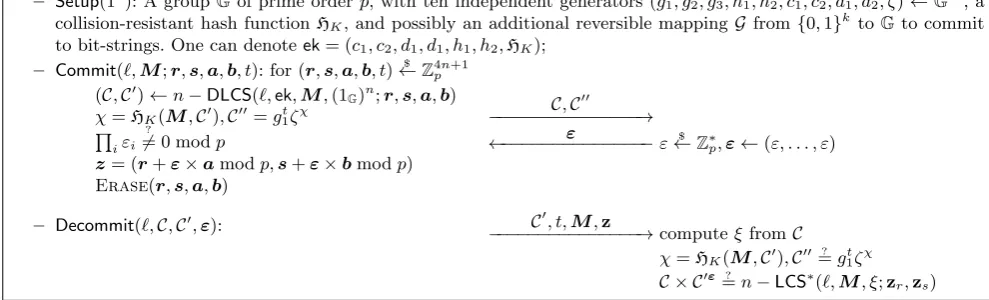
Withz= (zr, zs), implicit check ofC × C0ε=? LCS∗(`,ek, M, ξ;zr, zs) Figure 1.DLCSCom0 Commitment Scheme for SPHF
Double Linear Cramer-Shoup Commitment Schemes. To make it equivocable, we double the commit-ment process, in two steps. The CRS additionally contains a scalarℵ $
←Zp, one also sets,ζ =gℵ1. The trapdoor for equivocability isℵ. The Double Linear Cramer-Shoup encryption scheme, denotedDLCSand detailed in the Appendix B is
DLCS(`,ek, M, N;r, s, a, b)def= (C ←LCS(`,ek, M;r, s),C0←LCS∗(`,ek, N, ξ;a, b))
whereξ=HK(`,u, e) is computed during the generation ofCand transfered for the generation ofC0. As above, we denoteDLCSComdenotes the use ofDLCSwith the encryption keyek. The usual commit/decommit processes are described on Figure 6 in the Appendix B. On Figure 1, one can find theDLCSCom0 scheme where one can implicitly check the opening with an SPHF. These two constructions essentially differ withχ=HK(C0) (for the SPHF implicit check) instead of χ = HK(M,C0) (for the explicit check). We stress that with this alteration,
the DLCSCom0 scheme is not a real commitment scheme (not formally extractable/binding): in DLCSCom0, the sender can indeed encrypt M in C and N 6= 1G in C0, and then, the global ciphertext C × C0ε contains
M0=M Nε6=M, whereas one would have extracted M fromC. ButM0 is unknown beforeεis sent, and thus, if one checks the membership ofM0 to a sparse language, it will unlikely be true.
Multi-Message Schemes. One can extend these encryption and commitment schemes to vectors of n mes-sages (see the Appendix B). We will denote them n-DLCSCom0 or n-DLCSCom for the commitment schemes. They consist in encrypting each message with independent random coins in Ci = (ui, ei, vi) but the same
ξ =HK(`,(ui),(ei)), together with independent companion ciphertexts Ci0 of 1G, still with the sameξ for the
doubled version. In the latter case, nindependent challenges εi ←$ Z∗p are then sent to lead to the full
commit-ment (Ci× Ci0εi) with random coinszri =ri+εiai andzsi =si+εibi. Again, if one of the companion ciphertext
C0
i does not encrypt 1G, the full commitment encrypts a vector with at least one unpredictable componentM
0
i.
Several non-unity components in the companion ciphertexts would lead to independent components in the full commitment. For languages sparse enough, this definitely turns out not to be in the language.
4 SPHF for Implicit Proofs of Membership
In [ACP09], Abdalla et al. presented a way to compute a conjunction or a disjunction of languages by some simple operations on their projection keys. Therefore all languages presented afterward can easily be combined together. However as the original set of manageable languages was not really developed, we are going to present several steps to extend it, and namely in order to cover some languages useful in various AKE instantiations.
We will show that almost all the vast family of languages covered by the Groth-Sahai methodology [GS08] can be addressed by our approach too. More precisely, we can handle all the linear pairing product equations, when witnesses are committed using our above (multi-message) DLCSCom0 commitment scheme, or even the non-equivocableLCSComversion. This will be strong enough for our applications. For using them in black-box to build our LAKE protocol, one should note that the projection key is computed from the ciphertextCwhen using the simple LCSCom commitment, but also when using the DLCSCom0 version. The full commitmentC × C0ε is
not required, butξ only, which is known as soon asCis given (or the vector (Ci)i for the multi-message version).
Of course, the hash value will then depend on the full commitment (either C for the LCSCom commitment, or
C · C0ε for the DLCSCom0 commitment).
handshakes; valid credentials, in CAKE protocols. All those tests are quite similar: one has to show that the ciphertexts are valid and that the plaintexts satisfy the expected relations in a group. We first illustrate that with commitments of Waters signatures of a public message under a committed verification key. We then explain the general method. The formal proofs are provided in the Appendix C.
4.1 Commitments of Signatures
Let us consider the Waters signature [Wat05] in a symmetric bilinear group, as reviewed in the Appendix A.3, and then we just need to recall that, in a pairing-friendly setting (p,G,GT, e), with public parameters (F, g, h),
and a verification keyvk, a signature σ= (σ1, σ2) is valid with respect to the messageM under the keyvkif it satisfiese(σ1, g) =e(h,vk)·e(F(M), σ2).
A similar approach has already been followed in [BPV12], however not with a Linear Cramer-Shoup com-mitment scheme, nor with such general languages. We indeed first consider the language of the signatures (σ1, σ2) ∈ G2 of a message M ∈ {0,1}k under the verification key vk ∈ G, where M is public but vk is pri-vate: L(pub,priv), where priv =vk and pub =M. One will thus commit the pair (vk, σ1) ∈ G2 with the label
`= (M, σ2) using a 2-DLCSCom0 commitment and then prove the commitment actually contains (vk, σ1) such that e(σ1, g) = e(h,vk)·e(F(M), σ2). We insist on the fact that σ1 only has to be encrypted, and not σ2, in order to hide the signature, since the latter σ2 is a random group element. If one wants unlinkability between signature commitments, one simply needs to re-randomize (σ1, σ2) before encryption. Hence σ2 can be sent in clear, but bounded to the commitment in the label, together with the pub part of the language. In order to prove the above property on the committed values, we will use conjunctions of SPHF: first, to show that each commitment is well-formed (valid ciphertexts), and then that the associated plaintexts verify the linear pairing equation, where the committed values are underlined:e(σ1, g) =e(h,vk)·e(F(M), σ2) Note thatvkis not used as a committed value for this verification of the membership of σ to the language since this is the verification key expected by the verifier, specified in the private part priv, which has to be independently checked with respect to the committed verification key. This is enough for the affiliation-hiding property. We could consider the similar language whereM ∈ {0,1}k is in the word too:e(σ
1, g) =e(h,vk)·e(F(M), σ2), and then one should commitM, bit-by-bit, and then use a (k+ 2)-DLCSCom0 commitment.
4.2 Linear Pairing Product Equations
Instead of describing in details the SPHF for the above examples, let us show it for a more general framework: we considered
e(σ1, g) =e(h,vk)·e(F(M), σ2) or e(σ1, g) =e(h,vk)·e(F(M), σ2),
where the unknowns are underlined. These are particular instantiations oftsimultaneous equations
Y
i∈Ak
e(Yi,Ak,i)
·
Y
i∈Bk
Zizk,i
=Bk, fork= 1, . . . , t,
whereAk,i∈G,Bk∈GT, andzk,i∈Zp, as well asAk⊆ {1, . . . , m}andBk⊆ {m+ 1, . . . , n}are public, but the
Yi ∈GandZi ∈GT are simultaneously committed using the multi-messageDLCSCom0orLCSComcommitments scheme, in G orGT respectively. This is more general than the relations covered by [CCGS10], since one can
also commit scalars bit-by-bit. In the Appendix C.4, we detail how to build the corresponding SPHF, and prove the soundness of our approach. For the sake of clarity, we focus here to a single equation only, since multiple equations are just conjunctions. We can even consider the simpler equation Qi=m
i=1 Zizi = B, since one can lift
any ciphertext from G to a ciphertext inGT, settingZi =e(Yi,Ai), as well as, for j = 1,2,3, Gi,j =e(gj,Ai)
and forj= 1,2,Hi,j =e(hj,Ai),Ci,j =e(cj,Ai),Di,j =e(dj,Ai), to lift all the group basis elements. Then, one
transforms Ci =LCS∗(`,ek,Yi, ξ;zi) = (ui = (g zri
1 , g
zsi
2 , g
zri+zsi
3 ), ei =h zri
1 h
zsi
2 · Yi, vi = (c1dξ1)zri ·(c2dξ2)zsi) into (Ui = (Gzi,ri1, Gzi,si2, Gzi,ri3+zsi), Ei = H
zri i,1H
zsi
i,2 · Zi, Vi = (Ci,1D
ξ
i,1)zri ·(Ci,2D
ξ
i,2)zsi). Encryptions of Zi originally in GT use constant basis elements for j = 1,2,3, Gi,j =Gj =e(gj, g) and for j = 1,2,Hi,j = Hj =e(hj, g),
Ci,j =Cj =e(cj, g), Di,j =Dj =e(dj, g).
The commitments have been generated in GandGT simultaneously using them-DLCSCom0 version, with a
thereafter lifted to GT. For the hashing keys, one picks random scalars (λ,(ηi, θi, κi, µi)i=1,...,m)
$
←Z4m+1
p , and
setshki= (ηi, θi, κi, λ, µi). One then computes the projection keys ashpi= (gη1ig
κi
3 hλ1(c1dξ1)µi, g
θi
2 g
κi
3 hλ2(c2dξ2)µi)∈ G2. The hash value is
Y
i
e(uηi i,1·u
θi i,2·u
κi i,3·e
λ i ·v
µi
i ,Ai)× B−λ =
Y
i
e(hpzi,ri1hpi,zsi2,Ai),
where Ai is the constant used to compute Zi = e(Yi,Ai) and to lift ciphertexts from G toGT, or Ai =gzi if
the ciphertext was already in GT. These evaluations can be computed either from the commitments and the
hashing keys, or from the projection keys and the witnesses. We insist on the fact that, whereas the hash values are in GT, the projection keys are in G even if the ciphertexts are initially in GT. We stress again that the
projection keys require the knowledge ofξ only: known from theLCSComcommitment or the first partCof the
DLCSCom0 commitment.
5 Language-Authenticated Key Exchange
5.1 The Ideal Functionality
We generalize the Password-Authenticated Key Exchange functionality Fpake (first provided in [CHK+05]) to more complex languages: the players agree on a common secret key if and only if they own words that lie in the languages the partners have in mind. More precisely, after an agreement on pub between Pi and Pj (modeled
here by the use of the split functionality, see below), playerPi uses a wordWi belonging toLi=LRi(pub,privi)
and it expects its partnerPj to use a word Wj belonging to the languageLj0 =LRj(pub,priv
0
j), and vice-versa
forPj andPi. We assume relationsRi andRj to be specified by the kind of protocol we study (PAKE,
Verifier-based PAKE, secret handshakes, . . . ) and so the languages are defined by the additional parameterspub, privi
and privj only: they both agree on the public part pub, to be possibly parsed in a different way by each player for each language according to the relations. Note however that the respective languages do not need to be the same or to use similar relations: authentication means could be totally different for the 2 players. The key exchange should succeed if and only if the two following pairs of equations hold: (L0i = Li andWi ∈ Li) and
(L0j =Lj and Wj ∈Lj).
Description. In the initialFpake functionality [CHK+05], the adversary was given access to aTestPwd-query, which modeled the on-line dictionary attack. But it is known since [BCL+05] that it is equivalent to use the split functionality model [BCL+05], generate theNewSession-queries corresponding to the corrupted players and tell the adversary (on behalf of the corrupted player) whether the protocol should succeed or not. Both methods enable the adversary to try a credential for a player (on-line dictionary attack). The second method (that we use here) implies allowing S to ask NewSession-queries on behalf of the corrupted player, and letting it to be aware of the success or failure of the protocol in this case: the adversary learns this information only when it plays on behalf of a player (corruption or impersonation attempt). This is any way an information it would learn at the end of the protocol. We insist that third parties will not learn whether the protocol succeeded or not, as required for secret handshakes. To this aim, the NewKey-query informs in this case the adversary whether the credentials are consistent with the languages or not. In addition, the split functionality model guarantees from the beginning which player is honest and which one is controlled by the adversary. This finally allows us to get rid of the TestPwd-query. The Flake functionality is presented in Figure 2 and the corresponding split functionality sFlake in Figure 3, where the languages are formally described and compared using thepub and
priv parts.
The security goal is to show that the best attack for the adversary is a basic trial execution with a credential of its guess or choice: the proof will thus consist in emulating any real-life attack by either a trial execution by the adversary, playing as an honest player would do, but with a credential chosen by the adversary or obtained in any way; or a denial of service, where the adversary is clearly aware that its behavior will make the execution fail.
5.2 A Generic UC-Secure LAKE Construction
The functionality Flake is parametrized by a security parameter k and a public parameter pub for the languages. It interacts with an adversaryS and a set of partiesP1,. . . ,Pnvia the following queries:
– New Session: Upon receiving a query (NewSession:sid, Pi, Pj, Wi, Li=L(pub,privi), L
0
j=L(pub,priv
0
j)) fromPi, • If this is the first NewSession-query with identifier sid, record the tuple (Pi, Pj, Wi, Li, L0j,initiator). Send
(NewSession;sid, Pi, Pj,pub,initiator) toS andPj.
• If this is the second NewSession-query with identifier sid and there is a record (Pj, Pi, Wj, Lj, L0i,initiator), record the tuple (Pj, Pi, Wj, Lj, L0i,initiator, Wi, Li, L0j,receiver). Send (NewSession;sid, Pi, Pj,pub,receiver) toS andPj.
– Key Computation: Upon receiving a query (NewKey : sid) from S, if there is a record of the form (Pi, Pj, Wi,
Li, L0j,initiator, Wj, Lj, L0i,receiver) and this is the firstNewKey-query for sessionsid, then
• If (L0i=LiandWi∈Li) and (Lj0 =LjandWj∈Lj), then pick a random keyskof lengthkand store (sid,sk). If one player is corrupted, send (sid,success) to the adversary.
• Else, store (sid,⊥), and send (sid,fail) to the adversary if one player is corrupted. – Key Delivery: Upon receiving a query (SendKey:sid, Pi,sk) fromS, then
• if there is a record of the form (sid,sk0), then, if both players are uncorrupted, output (sid,sk0) toPi. Otherwise, output (sid,sk) toPi.
• if there is a record of the form (sid,⊥), then pick a random keysk0 of lengthkand output (sid,sk0) toPi. Figure 2.Ideal FunctionalityFlake
Given the functionalityFlake, the split functionalitysFlakeproceeds as follows:
– Initialization:
• Upon receiving (Init,sid,pubi) from partyPi, send (Init,sid, Pi,pubi) to the adversary.
• Upon receiving a message (Init,sid, Pi, H,pub,sidH) fromS, whereH={Pi, Pj}is a set of party identities, check thatPi has already sent (Init,sid,pubi) and that for all recorded (H
0
,pub0,sidH0), eitherH=H0,pub=pub0 andsidH=sidH0
or H and H0 are disjoint and sidH 6= sidH0. If so, record the pair (H,pub,sidH), send (Init,sid,sidH,pub) to Pi, and invoke a new functionality (Flake,sidH,pub) denoted asFlake(H,pub) and with set of honest partiesH.
– Computation:
• Upon receiving (Input,sid, m) from party Pi, find the set H such that Pi ∈ H, the public value pub recorded, and forwardmtoFlake(H,pub).
• Upon receiving (Input,sid, Pj, H, m) fromS, such thatPj∈/H, forwardmtoFlake(H,pub) as if coming fromPj.
• WhenFlake(H,pub)generates an outputmfor partyPi∈H, sendmtoPi. If the output is forPj∈/H or for the adversary, sendmto the adversary.
Figure 3.Split FunctionalitysFlake
languages and the owned words), and eventually the smooth projective hash functions will be used to make implicit validity checks of the global relation.
To this aim, we use the commitments and associated smooth projective hash functions as described in Sections 3 and 4. More precisely, all examples of SPHF in Section 4 can be used on extractable commitments divided into one or two parts (the non-equivocable LCSCom or the equivocable DLCSCom0 commitments, see Figure 1). The relations on the committed values will not be explicitly checked, since the values will never be revealed, but will be implicitly checked using SPHF. It is interesting to note that in both cases (one-part or two-part commitment), the projection key will only depend on the first part of the commitment.
As it is often the case in the UC setting, we need the initiator to use stronger primitives than the receiver. They both have to use non-malleable and extractable commitments, but the initiator will use a commitment that is additionally equivocable, the DLCSCom0 in two parts ((Ci,Ci0) and Comi = Ci· Ci0ε), while the receiver
will only need the basicLCSCom commitment in one part (Comj =Cj).
As already explained, SPHF will be used to implicitly check whether (L0i =Li and Wi ∈Li) and (L0j =Lj
and Wj ∈Lj). But since in our instantiations private parameters privand wordsW will have to be committed,
the structure of these commitments will thus be publicly known in advance: commitments of P-elements and
S-elements. Section 6 discusses on the languages captured by our definition, and illustrates with some AKE protocols. However, while theseP and S sets are embedded inGn from somen, it might be important to prove that the committed values are actually inP andS (e.g., one can have to prove it commits bits, whereas messages are first embedded as group elements in G of large order p). This will be an additional language-membership to prove on the commitments.
Execution betweenPiandPj, with session identifiersid.
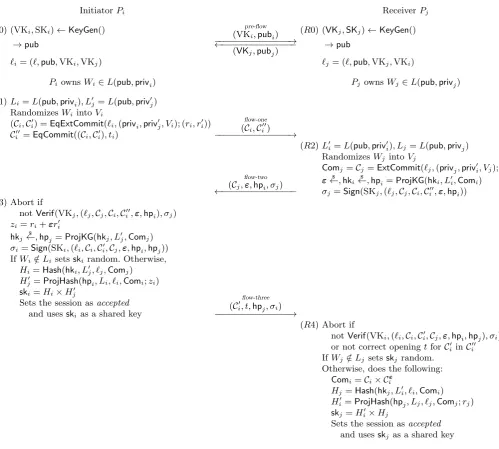
– Preliminary Round: each user generates a pair of signing/verification keys (SK,VK) and sends VKtogether with its contribution to the public part of the language.
We denote by`i= (sid,ssid, Pi, Pj,pub,VKi,VKj) and by`j= (sid,ssid, Pi, Pj,pub,VKj,VKi), wherepubis the combination of the contributions of the two players. The initiator now uses a wordWiin the languageL(pub,privi), and the receiver uses a wordWj in the languageL(pub,privj), possibly re-randomized from their long-term secrets (*). We assume commitments and associated smooth projective hash functions exist for these languages.
– First Round: userPi (with random tapeωi) generates a multi-DLCSCom0 commitment on (privi,priv
0
j, Wi) in (Ci,C
0
i), whereWi has been randomized in the language, under the label`i. It also computes a Pedersen commitment onCi0 in Ci00(with random exponentt). It then sends (Ci,C
00
i) toPj;
– Second Round: userPj (with random tape ωj) computes a multi-LCS commitment on (privj,priv
0
i, Wj) in Comj=Cj, with witnessr, whereWj has been randomized in the language, under the label`j. It then generates a challengeε on Ciand hashing/projection keys (**)hkiandhpiassociated toCi(which will be associated to the futureComi). It finally signs all the flows usingSKj inσj, and sends (Cj,ε,hpi, σj) toPi;
– Third Round: user Pi first checks the signature σj, computes Comi = Ci × Ci0
ε
and witness z (from ε and ωi), it generates hashing/projection keyshkj and hpj associated to Comj. It finally signs all the flows using SKi in σi, and sends (Ci0, t,hpj, σi) toPj;
– Hashing:Pjfirst checks the signatureσi and the correct opening ofCi00intoC
0
i, it computesComi=Ci× Ci0
ε
.
PicomputesKiandPj computesKjas follows:
Ki=Hash(hkj,{(priv0j,privi)} ×L(pub,priv
0
j), `j,Comj)·ProjHash(hpi,{(privi,priv
0
j)} ×L(pub,privi), `i,Comi;z)
Kj=ProjHash(hpj,{(privj,priv
0
i)} ×L(pub,privj), `j,Comj;r)·Hash(hki,{(priv
0
i,privj)} ×L(pub,priv
0
i), `i,Comi) (*) As explained in Section 1, recall that the languages considered depend on two possibly different relations, namely
Li =LRi(pub,privi) and Lj =LRj(pub,privj), but we omit them for the sake of clarity. We assume they are both self-randomizable.
(**) Recall that the SPHF is constructed in such a way that this projection key does not depend onC0
i and is indeed associated to the future wholeComi.
Figure 4.Language-based Authenticated Key Exchange from a Smooth Projective Hash Function on Commitments
will compute everything with dummy words, and will replace theProjHashevaluation by a random value, which will lead to a random key at the end.
Security Analysis. Since we have to assume commonpub, we make a first round (with flows in each direction) where the players send their contribution, to come up with pub. These flows will also be used to know if there is a player controlled by the adversary (as with the Split Functionality [BCL+05]). In case the languages have emptypub, these additional flows are not required, since the Split Functionality can be applied on the committed values. The signing key for the receiver is not required anymore since there is one flow only from its side. This LAKE protocol is secure against static corruptions. The proof is provided in the Appendix D, and is in the same vein as the one in [CHK+05, ACP09]. However, it is a bit more intricate:
– in PAKE, when one is simulating a player, and knows the adversary used the correct password, one simply uses this password for the simulated player. In LAKE, when one knows the language expected by the adversary for the simulated player and has to simulate a successful execution (because of success announced by the NewKey-query), one has to actually include a correct word in the commitment: smooth projective hash functions do not allow the simulator to cheat, equivocability of the commitment is the unique trapdoor, but with a valid word. The languages must allow the simulator to produce a valid wordW inL(pub,priv), for any pub and priv ∈ P provided by the adversary or the environment. This will be the case in all the interesting applications of our protocol (see Section 6): if priv defines a Waters’ verification key vk= gx,
with the master key ssuch that h=gs, the signing key is sk=hx =vks, and thus the simulator can sign any message; if such a master key does not exist, one can restrictP, and implicitly check it with the SPHF (the additional language-membership check, as said above). But since a random word is generated by the simulator, we need the real player to derive a random word from his own word, and the language to be
self-randomizable.
Comi will eventually containM0 ifCi0 does not encrypt (1G)
n. However, since the actual valueM0 depends
on the random challenge ε, and the language is assumed sparse (otherwise authentication is easy), the protocol will fail: this can be seen as a denial of service from the adversary.
Theorem 1. Our LAKE scheme from Figure 4 realizes the sFlake functionality in the Fcrs-hybrid model, in the presence of static adversaries, under the DLin assumption and the security of the One-Time Signature.
Actually, from a closer look at the full proof, one can notice that Comj = Cj needs to be extractable, but IND−CPA security is enough, which leads to a shorter ciphertext (2 group elements less if one uses a Linear ciphertext instead of LCS). Similarly, one will not have to extract Wi from Ci when simulating sessions where
Pi is corrupted. As a consequence, only the private parts of the languages have to be committed to inComi in
the first and third rounds, whereasWi can be encrypted independently with anIND−CPA encryption scheme
in the third round only (5 group elements less in the first round, and 2 group elements less in the third round if one uses a Linear ciphertext instead ofLCS).
6 Concrete Instantiations and Comparisons
In this section, we first give some concrete instantiations of several AKE protocols, using our generic protocol of LAKE, and compare the efficiencies of those instantiations.
6.1 Possible Languages
As explained above, our LAKE protocol is provably secure for self-randomizable languages only. While this notion may seem quite strong, most of the usual languages fall into it. For example, in a PAKE or a Verifier-based PAKE scheme, the languages consist of a single word and so trivially given a word, each user is able to deduce all the words in the language. One may be a little more worried about Waters Signature in our Secret Handshake, and/or Linear pairing equations. However theself-randomizability of the languages is easy to show:
– Given a Waters signature σ = (σ1, σ2) over a message m valid under a verification key vk, one is able to randomize the signature into any signature over the same messagem valid under the same verification key
vksimply by picking a randomsand computing σ0 = (σ1· F(m)s, σ2·gs).
– For linear pairing equations, with public parametersAi fori= 1, . . . , mand γi fori=m+ 1, . . . , n, andB,
given (X1, . . . ,Xm,Zm+1, . . . ,Zn) verifying Qm
i=1e(Xi,Ai)·Qni=m+1Z
γi
i =B, one can randomize the word
in the following way:
• Ifm < n, one simply picks random (X10, . . . ,Xm0 ), (Zm0 +1, . . . ,Zn0−1) and setsZn0 = (B/(Qm i=1e(X
0
i,Ai)·
Qn−1
i=m+1Zi0
γi))1/γn,
• Else, if m = n > 1, one picks random r1, . . . , rn−1 and set Xi0 = Xi· Arni, for i = 1, . . . , m−1 and
Xm0 =Xm·Qim=1−1A−i ri,
• Else m=n= 1, this means only one word satisfies the equation. So we already have this word.
As we can see most of the common languages manageable with a SPHF are alreadyself-randomizable. We now show how to use them in concrete instantiations.
6.2 Concrete Instantiations
Password-Authenticated Key Exchange. Using our generic construction, we can easily obtain a PAKE protocol, as described on Figure 5, where we optimize from the generic construction, since pub =∅, removing the agreement on pub, but still keeping the one-time signature keys (SKi,VKi) to avoid man-in-the-middle attacks since it has another later flow: Pi uses a passwordWi and expectsPj to own the same word, and thus
in the language L0j =Li = {Wi}; Pj uses a password Wj and expects Pi to own the same word, and thus in
the language L0i = Lj = {Wj}; The relation is the equality test between privi and privj, which both have no
restriction in G (hence P =G). As the word Wi, the language private parameters privi of a user and priv0j of
the expected language for the other user are the same, each user can commit in the protocol to only one value: its password.
Piuses a passwordWiandPjuses a passwordWj. We denote`= (sid,ssid, Pi, Pj).
– First Round:Pi (with random tapeωi) first generates a pair of signing/verification keys (SKi,VKi) and aDLCSCom0 commitment onWi in (Ci,Ci), under0 `i= (`,VKi). It also computes a Pedersen commitment onCi0 inCi00(with random exponentt). It then sends (VKi,Ci,Ci00) toPj;
– Second Round:Pj(with random tapeωj) computes aLCSComcommitment onWjinComj=Cj, with witnessr, under the label`. It then generates a challengeε on Ci and hashing/projection keys hki and the corresponding hpi for the equality test onComi (”Comi is a valid commitment ofWj”, this only requires the value ξicomputable thanks toCi). It then sends (Cj, ε,hpi) toPi;
– Third Round: userPican computeComi=Ci× C0i ε
and witnessz(fromεandωi), it generates hashing/projection keys
hkjandhpj for the equality test onComj. It finally signs all the flows usingSKiinσi and send (Ci0, t,hpj, σi) toPj; – Hashing:Pj first checks the signature and the validity of the Pedersen commitment (thanks tot), it computesComi=
Ci× C0
i ε
.PicomputesKiandPjcomputesKj as follows:
Ki=Hash(hkj, L0j, `,Comj)·ProjHash(hpi, Li, `i,Comi;z)
Kj =ProjHash(hpj, Lj, `,Comj;r)·Hash(hki, L0i, `i,Comi) Figure 5.Password-based Authenticated Key Exchange
but a Linear encryption forCj and thus 3 group elements. Projection keys are both 2 group elements. Globally,
Pi sends 13 groups elements plus 1 scalar, a verification key and a one-time signature, while Pj sends 5 group
elements and 1 scalar: 18 group elements and 2 scalars in total. We can of course instantiate it with the Cramer-Shoup and ElGamal variants, under theDDHassumption:Pisends 8 groups elements plus 1 scalar, a verification
key and a one-time signature, while Pj sends 3 group elements and 1 scalar (all group elements can be in the
smallest group): 11 group elements and 2 scalars in total.
Verifier-based PAKE. The above scheme can be modified into an efficient PAKE protocol that is additionally secure againstserver compromise: the so-called verifier-based PAKE, where the client owns a passwordpw, while the server knows a verifier only, such as gpw, so that in case of break-in to the server, the adversary will not immediately get all the passwords.
To this aim, as usually done, one first does a PAKE with gpw as common password, then asks the client to additionally prove it can compute the Diffie-Hellman value hpw for a basis h chosen by the server. Ideally, we could implement this trick, where the client Pj just considers the equality test between the gpw and the
value committed by the server for the language L0i = Lj, while the server Pi considers the equality test with
(gpw, hpw), wherehis sent as its contribution to the public part of the language by the serverLi =L0j. Since the
server chooseshitself, it chooses it ash=gα, for an ephemeral randomα, and can thus computehpw= (gpw)α. On its side, the client can compute this value since it knows pw. The client could thus commit to (gpw, hpw), in order to prove its knowledge of pw, whereas the server could just commit to gpw. Unfortunately, from the extractability of the server commitment, one would just get gpw, which is not enough to simulate the client.
To make it in a provable way, the server chooses an ephemeral h as above, and they both run the previous PAKE protocol with (gpw, hpw) as common password, and mutually checked: h is seen as the pub part, hence the preliminary flows are required.
Credential-Authenticated Key Exchange. In [CCGS10], the authors proposed instantiations of the CAKE primitive for conjunctions of atomic policies that are defined algebraically by relations of the formQk
j=1g
Fj j = 1
where thegj’s are elements of an abelian group andFj’s are integer polynomials in the variables committed by
the users.
The core of their constructions relies on their practical UC zero-knowledge proof. There is no precise instan-tiation of such proof, but it is very likely to be inefficient. Their proof technique indeed requires to transform the underlying Σ-protocols into corresponding Ω-protocols [GMY06] by verifiably encrypting the witness. An
Ω-protocol is aΣ-protocol with the additional property that it admits a polynomial-time straight-line extractor. Since the witnesses are scalars in their algebraic relations, their approach requires either inefficient bit-per-bit encryption of these witnesses or Paillier encryption in which case the problem of using group with different orders in the representation and in the encryption requires additional overhead.
Cramer Shoup), and some extra for the last proof of existence (cf.[CKS11]), where our PAKE requires less than 20 group elements. Anyway they say, their PAKE scheme is less efficient than [CHK+05], which needed 6 rounds and around 30 modular exponentiations per user, while our efficient PAKE requires less than 40 exponentiations, in total, in only 3 rounds. Our scheme is therefore more efficient than the scheme from [CHK+05] for the same security level (i.e.UC-security with static corruptions).
Secret-Handshakes. We can also instantiate a (linkable) Secret Handshakes protocol, using our scheme with two different languages: Pi will commit to a valid signature σi on a message mi (his identity for example),
under a private verification key vki, and expects Pj to commit to a valid signature on a message m0j under a
private verification keyvk0j; but Pj will do analogously with a signatureσj on mj undervkj, while expecting a
signature onm0i undervk0i. The public parts of the signature (the second component) are sent in clear with the commitments.
In a regular Secret Handshakes both users should use the same languages. But here, we have a more general situation (calleddynamic matching in [AKB07]): the two participants will have the same final value if and only if they both belong to the organization the other expects. If one lies, our protocol guarantees no information leakage. Furthermore, the semantic security of the session is even guaranteed with respect to the authorities, in a forward-secure way (this property is also achieved in [JL09] but in a weaker security model). Finally, our scheme supports revocation and can handle roles as in [AKB07].
Standard secret handshakes, like [AKB07], usually work with credentials delivered by a unique authority, this would remove our need for a hidden verification key, and private part of the language. Both users would only need to commit to signatures on their identity/credential, and show that they are valid. This would require a dozen of group elements with our approach. Their construction requires only 4 elements underBDH, however it relies on the asymmetric Waters IBE with only two elements, whereas the only security proof known for such IBE [Duc10] requires an extra term in G2 which would render their technique far less efficient, as several extra terms would be needed to expect a provably secure scheme. While sometimes less effective, our LAKE approach can manage Secret Handshakes, and provide additional functionalities, like more granular control on the credential as part of them can be expressly hidden by both the users. More precisely, we provide affiliation-hiding property and let third parties unaware of the success/failure of the protocol.
Unlinkable Secret-Handshakes. Moving the users’ identity from the publicpubpart to individual privatepriv
part, and combining our technique with [BPV12], it is also possible to design an unlinkable Secret Handshakes protocol [JL09] with practical efficiency. It illustrates the case where committed values have to be proven in a strict subset of G, as one has to commit to bits: the signed message M is now committed and not in clear, it thus has to be done bit-by-bit since the encoding G does not allow algebraic operations with the content to apply the Waters function on the message. It is thus possible to prove the knowledge of a Waters signature on a private message (identity) valid under a private verification key. Additional relations can be required on the latter to make authentication even stronger.
Acknowledgments
This work was supported in part by the European Commission through the FP7-ICT-2011-EU-Brazil Program under Contract 288349 SecFuNet and the ICT Program under Contract ICT-2007-216676 ECRYPT II.
References
[ACGP11] Michel Abdalla, C´eline Chevalier, Louis Granboulan, and David Pointcheval. Contributory password-authenticated group key exchange with join capability. In Aggelos Kiayias, editor,Topics in Cryptology – CT-RSA 2011, volume 6558 ofLecture Notes in Computer Science, pages 142–160. Springer, February 2011.
[ACP09] Michel Abdalla, C´eline Chevalier, and David Pointcheval. Smooth projective hashing for conditionally extractable com-mitments. In Shai Halevi, editor,Advances in Cryptology – CRYPTO 2009, volume 5677 ofLecture Notes in Computer Science, pages 671–689. Springer, August 2009.
[AKB07] Giuseppe Ateniese, Jonathan Kirsch, and Marina Blanton. Secret handshakes with dynamic and fuzzy matching. In
[BCL+05] Boaz Barak, Ran Canetti, Yehuda Lindell, Rafael Pass, and Tal Rabin. Secure computation without authentication.
In Victor Shoup, editor,Advances in Cryptology – CRYPTO 2005, volume 3621 ofLecture Notes in Computer Science, pages 361–377. Springer, August 2005.
[BDS+03] Dirk Balfanz, Glenn Durfee, Narendar Shankar, Diana K. Smetters, Jessica Staddon, and Hao-Chi Wong. Secret hand-shakes from pairing-based key agreements. InIEEE Symposium on Security and Privacy, pages 180–196. IEEE Computer Society, 2003.
[BFPV11] Olivier Blazy, Georg Fuchsbauer, David Pointcheval, and Damien Vergnaud. Signatures on randomizable ciphertexts. In Dario Catalano, Nelly Fazio, Rosario Gennaro, and Antonio Nicolosi, editors,PKC 2011: 14th International Workshop on Theory and Practice in Public Key Cryptography, volume 6571 ofLecture Notes in Computer Science, pages 403–422. Springer, March 2011.
[BM92] Steven M. Bellovin and Michael Merritt. Encrypted key exchange: Password-based protocols secure against dictionary attacks. In1992 IEEE Symposium on Security and Privacy, pages 72–84. IEEE Computer Society Press, May 1992. [BPV12] Olivier Blazy, David Pointcheval, and Damien Vergnaud. Round-optimal privacy-preserving protocols with smooth
projective hash functions. In Ronald Cramer, editor, TCC 2012, volume 7194 of Lecture Notes in Computer Science, pages 94–111, Springer, March 2012.
[Can01] Ran Canetti. Universally composable security: A new paradigm for cryptographic protocols. In42nd Annual Symposium on Foundations of Computer Science, pages 136–145. IEEE Computer Society Press, October 2001.
[CCGS10] Jan Camenisch, Nathalie Casati, Thomas Groß, and Victor Shoup. Credential authenticated identification and key exchange. In Tal Rabin, editor,Advances in Cryptology – CRYPTO 2010, volume 6223 ofLecture Notes in Computer Science, pages 255–276. Springer, August 2010.
[CHK+05] Ran Canetti, Shai Halevi, Jonathan Katz, Yehuda Lindell, and Philip D. MacKenzie. Universally composable password-based key exchange. In Ronald Cramer, editor,Advances in Cryptology – EUROCRYPT 2005, volume 3494 ofLecture Notes in Computer Science, pages 404–421. Springer, May 2005.
[CKP07] Ronald Cramer, Eike Kiltz, and Carles Padr´o. A note on secure computation of the Moore-Penrose pseudoinverse and its application to secure linear algebra. In Alfred Menezes, editor,Advances in Cryptology – CRYPTO 2007, volume 4622 ofLecture Notes in Computer Science, pages 613–630. Springer, August 2007.
[CKS11] Jan Camenisch, Stephan Krenn, and Victor Shoup. A framework for practical universally composable zero-knowledge protocols. InAdvances in Cryptology – ASIACRYPT 2011, Lecture Notes in Computer Science, pages 449–467. Springer, December 2011.
[CR03] Ran Canetti and Tal Rabin. Universal composition with joint state. In Dan Boneh, editor,Advances in Cryptology – CRYPTO 2003, volume 2729 ofLecture Notes in Computer Science, pages 265–281. Springer, August 2003.
[CS98] Ronald Cramer and Victor Shoup. A practical public key cryptosystem provably secure against adaptive chosen ciphertext attack. In Hugo Krawczyk, editor,Advances in Cryptology – CRYPTO’98, volume 1462 ofLecture Notes in Computer Science, pages 13–25. Springer, August 1998.
[CS02] Ronald Cramer and Victor Shoup. Universal hash proofs and a paradigm for adaptive chosen ciphertext secure public-key encryption. In Lars R. Knudsen, editor,Advances in Cryptology – EUROCRYPT 2002, volume 2332 ofLecture Notes in Computer Science, pages 45–64. Springer, April / May 2002.
[Duc10] L´eo Ducas. Anonymity from asymmetry: New constructions for anonymous HIBE. In Josef Pieprzyk, editor,Topics in Cryptology – CT-RSA 2010, volume 5985 ofLecture Notes in Computer Science, pages 148–164. Springer, March 2010. [GL03] Rosario Gennaro and Yehuda Lindell. A framework for password-based authenticated key exchange. In Eli Biham,
editor, Advances in Cryptology – EUROCRYPT 2003, volume 2656 of Lecture Notes in Computer Science, pages 524– 543. Springer, May 2003. http://eprint.iacr.org/2003/032.ps.gz.
[GMR88] Shafi Goldwasser, Silvio Micali, and Ronald L. Rivest. A digital signature scheme secure against adaptive chosen-message attacks. SIAM Journal on Computing, 17(2):281–308, April 1988.
[GMY06] Juan A. Garay, Philip D. MacKenzie, and Ke Yang. Strengthening zero-knowledge protocols using signatures. Journal of Cryptology, 19(2):169–209, April 2006.
[GS08] Jens Groth and Amit Sahai. Efficient non-interactive proof systems for bilinear groups. In Nigel P. Smart, editor,Advances in Cryptology – EUROCRYPT 2008, volume 4965 ofLecture Notes in Computer Science, pages 415–432. Springer, April 2008.
[JL09] Stanislaw Jarecki and Xiaomin Liu. Private mutual authentication and conditional oblivious transfer. In Shai Halevi, editor, Advances in Cryptology – CRYPTO 2009, volume 5677 of Lecture Notes in Computer Science, pages 90–107. Springer, August 2009.
[Lin11] Yehuda Lindell. Highly-efficient universally-composable commitments based on the DDH assumption. In Kenneth G. Paterson, editor, Advances in Cryptology – EUROCRYPT 2011, volume 6632 of Lecture Notes in Computer Science, pages 446–466. Springer, May 2011.
[Ped92] Torben P. Pedersen. Non-interactive and information-theoretic secure verifiable secret sharing. In Joan Feigenbaum, editor,Advances in Cryptology – CRYPTO’91, volume 576 ofLecture Notes in Computer Science, pages 129–140. Springer, August 1992.
[Sha07] Hovav Shacham. A cramer-shoup encryption scheme from the linear assumption and from progressively weaker linear variants. Cryptology ePrint Archive, Report 2007/074, 2007. http://eprint.iacr.org/2007/074.pdf.
A Preliminaries
A.1 Formal Definitions of the Primitives
We first recall the definitions of the basic tools, with the security notions with success/advantage that all depend on a security parameter (which is omitted here for simplicity of notation).
Hash Function Family. A hash function family H is a family of functions HK from {0,1}∗ to a fixed-length output, either{0,1}kor
Zp. Such a family is saidcollision-resistant if for any adversaryAon a random function
HK ← H$ , it is hard to find a collision. More precisely, we denote SucccollH (A) = Pr[HK
$
← H,(m0, m1)← A(HK) :HK(m0) =HK(m1)], SucccollH (t) = max A≤t{Succ
coll H (A)}.
Labeled encryption scheme. A labeled public-key encryption scheme is defined by four algorithms:
– Setup(1k), where kis the security parameter, generates the global parameters param of the scheme;
– KeyGen(param) generates a pair of keys, the encryption key ek and the decryption keydk;
– Encrypt(`,ek, m;r) produces a ciphertextc on the input messagem∈ M under the label`and encryption keyek, using the random coinsr;
– Decrypt(`,dk, c) outputs the plaintextm encrypted inc under the label`, or⊥.
An encryption schemeE should satisfy the following properties
– Correctness: for all key pair (ek,dk), any label `, all random coins r and all messages m,
Decrypt(`,dk,Encrypt(`,ek, m;r)) =m.
– Indistinguishability under chosen-ciphertext attacks: this security notion can be formalized by the following security game, where the adversaryAkeeps some inter-nal state between the various callsFINDandGUESS, and makes use of the oracle ODecrypt:
• ODecrypt(`, c): This oracle outputs the decryption of cunder the label `and the challenge decryption keydk. The input queries (`, c) are added to the list
CT.
ExpindE,A−cca−b(k) 1.param←Setup(1k) 2. (ek,dk)←KeyGen(param)
3. (`∗, m0, m1)← A(FIND:ek,ODecrypt(·,·)) 4.c∗ ←Encrypt(`,ek, mb)
5.b0 ← A(GUESS:c∗,ODecrypt(·,·)) 6.IF (`∗, c∗)∈ CT RETURN 0 7.ELSE RETURN b0
The advantages are
AdvEind−cca(A) = Pr[ExpEind,A−cca−1(k) = 1]−Pr[ExpindE,A−cca−0(k) = 1] AdvindE −cca(t) = max A≤t{Adv
ind−cca E (A)}.
Labeled commitment scheme. A labeled commitment scheme is defined by three algorithms:
– Setup(1k), where kis the security parameter, generates the global parameters param of the scheme;
– Commit(`, m;r) produces a commitment c and the opening information d on the input message m ∈ M
under the label`, using the random coinsr;
– Decommit(`, c, m, d) checks the validity of the opening informationdon the commitmentc for the message
m under the label`. It answers 1 for true, and 0 for false.
A commitment scheme C should satisfy the following properties
– Correctness: for any label`, and all messages m, if (c, d)←Commit(`, m;r), thenDecommit(`, c, m, d) = 1.
– Hiding: this security notion is similar to the indistinguishability under chosen-plaintext attacks for encryp-tion, which means that c does not help to distinguish between two candidates m0 and m1 as committed values.
– Binding: this security notion is more an unforgeability notion, which means that for any commitment c, it should be hard to open it in two different ways, which means to exhibit (m0, d0) and (m1, d1), such that
The commitment algorithm can be interactive between the sender and the received, but the hiding and the binding properties should still hold. Several additional properties are sometimes required:
– Extractability: an indistinguishable Setup procedure also outputs a trapdoor that allows a extractor to get the committed valuemfrom any commitmentc. More precisely, ifccan be open in a valid way, the extractor can get this value from the commitment.
– Equivocability: an indistinguishable Setup procedure also outputs a trapdoor that allows a simulator to generate commitments that can thereafter be open in any way.
– Non-Malleability: it should be hard, from a commitment c to generate a new commitment c0 6= c whose committed values are in relation.
It is well-known that any IND-CCA encryption scheme leads to a non-malleable and extractable commitment scheme [GL03].
Signature scheme. A signature scheme is defined by four algorithms:
– Setup(1k), where kis the security parameter, generates the global parameters param of the scheme;
– KeyGen(param) generates a pair of keys, the verification key vkand the signing keysk;
– Sign(sk, m;s) produces a signature σ on the input message m, under the signing key sk, and using the random coinss;
– Verif(vk, m, σ) checks whether σ is a valid signature on m, w.r.t. the public key vk; it outputs 1 if the signature is valid, and 0 otherwise.
A signature scheme S should satisfy the following properties
– Correctness: for all key pair (vk,sk), all random coinssand all messages m,Verif(vk, m,Sign(sk, m;s)) = 1.
– Existential unforgeability under (adaptive) chosen-message attacks: this security notion can be formalized by the following security game, where it makes use of the oracleOSign:
• OSign(m): This oracle outputs a valid signature on m under the signing keysk. The input queries mare added to the listSM.
ExpeufS,A−cma(k)
1.param←Setup(1k) 2. (vk,sk)←KeyGen(param) 3. (m∗, σ∗)← A(vk,OSign(·)) 4.b←Verif(vk, m∗, σ∗) 5.IF M ∈ SM RETURN 0 6.ELSE RETURN b
The success probabilities are
SucceufS −cma(A) = Pr[ExpeufS,A(k) = 1] SucceufS −cma(k, t) = max A≤t{Succ
euf−cma S (A)}.
Smooth Projective Hash Functions A smooth projective hash function system is defined on a language L, with five algorithms:
– Setup(1k) generates the system parameters, according to a security parameterk;
– HashKG(L) generates a hashing keyhk for the language L;
– ProjKG(hk, L, W) derives the projection keyhp, possibly depending on a word W;
– Hash(hk, L, W) outputs the hash value from the hashing key;
– ProjHash(hp, L, W, w) outputs the hash value from the projection key and the witnessw thatW ∈L.
The correctness of the scheme assures that if W is in L with w as a witness, then the two ways to compute the hash values give the same result: Hash(hk, L, W) = ProjHash(hp, L, W, w). In our setting, these hash val-ues will belong to a group G. The security is defined through two different notions, the smoothness and the pseudo-randomness properties, where we use the distribution ∆(L, W) = {(hk,hp),hk ← HashKG(L),hp ←
ProjKG(hk, L, W)}:
– thesmoothness property guarantees that if W 6∈L, the hash value is statistically indistinguishable from a random element, even knowing hp:
{(hp, G),(hk,hp)←∆(L, W), G←Hash(hk, L, W)} ≈s{(hp, G),(hk,hp)←∆(L, W), G
$
←G}.
We define byAdvsmooth the statistical distance between the two distributions.
– thepseudo-randomness property guarantees that even for a word W ∈L, but without the knowledge of a witnessw, the hash value iscomputationally indistinguishable from a random element, even knowinghp:
{(hp, G),(hk,hp)←∆(L, W), G←Hash(hk, L, W)} ≈c{(hp, G),(hk,hp)←∆(L, W), G←$ G}.
A.2 Computational Assumptions
The three classical assumptions we use along this paper are: the computational Diffie-Hellman (CDH), the decisional Diffie-Hellman (DDH) and the decisional Linear (DLin) assumptions. Our constructions essentially rely on theDLinassumption, that implies theCDH. It is the most general since it (presumably) holds in many groups, with or without pairing. Some more efficient instantiations will rely on the DDH assumption but in more specific groups.
Definition 2 (Computational Diffie-Hellman (CDH)). The Computational Diffie-Hellman assumption says that, in a group (p,G, g), when we are given (ga, gb) for unknown randoma, b←$ Zp, it is hard to compute
gab. We define by Succcdhp,G,g(t) the best advantage an adversary can have in finding gab within time t.
Definition 3 (Decisional Diffie-Hellman (DDH)). The Decisional Diffie-Hellman assumption says that, in a group (p,G, g), when we are given (ga, gb, gc) for unknown random a, b ←$ Zp, it is hard to decide whether
c = abmodp (a DH tuple) or c ←$ Zp (a random tuple). We define by Advddhp,G,g(t) the best advantage an
adversary can have in distinguishing a DH tuple from a random tuple within time t.
Definition 4 (Decisional Linear Problem (DLin)). The Decisional Linear Problem [BBS04] says that, in a group (p,G, g), when we are given (gx, gy, gxa, gyb, gc) for unknown random x, y, a, b←$ Zp, it is hard to decide
whetherc=a+bmodp(a linear tuple) orc←$ Zp(a random tuple). We define byAdvdlinp,G,g(t) the best advantage
an adversary can have in distinguishing a linear tuple from a random tuple within time t.
A.3 Some Primitives in Symmetric Groups – Based on DLin
Linear Cramer-Shoup (LCS) encryption scheme. The Linear Cramer-Shoup encryption scheme [Sha07] can be tuned to a labeled public-key encryption scheme:
– Setup(1k) generates a group Gof order p, with three independent generators (g1, g2, g3)←$ G3;
– KeyGen(param) generates dk = (x1, x2, x3, y1, y2, y3, z1, z2, z3) ←$ Z9p, and sets, for i = 1,2, ci = gxiigx33,
di =gyiig y3
3 , andhi =gziig z3
3 . It also chooses a hash function HK in a collision-resistant hash family H (or
simply a Universal One-Way Hash Function). The encryption key isek= (c1, c2, d1, d2, h1, h2,HK).
– Encrypt(`,ek, M;r, s), for a message M ∈Gand two random scalars r, s←$ Zp, the ciphertext isC = (u= (g1r, gs2, gr3+s), e=M·hr1hs2, v= (c1dξ1)r(c2dξ2)s), wherev is computed afterwards with ξ=HK(`,u, e). – Decrypt(`,dk,C= (u, e, v)): one first computesξ=HK(`,u, e) and checks whetherux1+ξy1
1 ·u
x2+ξy2 2 ·u
x3+ξy3 3
? =
v. If the equality holds, one computesM =e/(uz1 1 u
z2 2 u
z3
3 ) and outputs M. Otherwise, one outputs⊥.
This scheme is indistinguishable against chosen-ciphertext attacks, under the DLin assumption and if one uses a collision-resistant hash functionH.
Waters signature. The Waters signature [Wat05] is defined as follows:
– Setup(1k): In a pairing-friendly setting (p,G, g,GT, e), one chooses a random vectorf = (f0, . . . , fk)←$ Gk+1 that defines the Waters hash functionF(M) =f0
Qk i=1f
Mi
i forM ∈ {0,1}k, and an extra generatorh
$
←G. The global parametersparam consist of all these elements (p,G, g,GT, e,f, h).
– KeyGen(param) chooses a random scalar x←$ Zp, which defines the public verification key as vk=gx, and the secret signing key as sk=hx.
– Sign(sk, M;s) outputs, for some random s←$ Zp,σ= σ1 =sk· F(M)s, σ2 =gs
.
– Verif(vk, M, σ) checks whether e(σ1, g) ?
=e(h,vk)·e(F(M), σ2).
This scheme is existentially unforgeable against (adaptive) chosen-message attacks [GMR88] under the CDH