A Narrative Study of First-Time Parenthood in
the Information Age
Sarah Suter
A thesis submitted in partial fulfilment of the
requirements of the University of East London for the
Professional Doctoral Degree in Clinical Psychology
I owe my gratitude to a number of people and services who have made this narrative research project possible. My deepest gratitude goes to six wonderful women and mothers who shared their amazing stories with me. I would also like to say a big thank you to Dr Paula Magee, my research supervisor, for all her insightful comments and support.
TABLE OF CONTENTS
ACKNOWLEDGMENTS...1
TABLE OF CONTENTS...2
ABSTRACT...6
CHAPTER ONE – PARENTHOOD...7
1.1 A Conceptual Overview...7
1.2 Theories...8
1.3 Search Methods...9
1.4 Parenthood: Conceptualisation...10
1.5 Implications of the Construct on Psychological Well-Being...11
1.6 Antenatal/Postnatal Classes and Professional Support...13
1.7 Research into the Lived Experience...15
1.8 Cyberspace...19
1.9 Conclusion...22
1.10 Aim of the Study...22
1.11 Research Questions...22
CHAPTER TWO – METHODOLOGY...23
2. 1 RESEARCH METHOD AND DESIGN...23
2.1.1 Rationale for Narrative Research...23
2.1.2 Epistemological Position...23
2.2 PARTICIPANTS...24
2.2.1 Sampling...24
2.2.2 Sample Size and Demographics...24
2.2.3 Recruitment Strategy...25
2.2.4 Recruitment Criteria...25
2.3 PROCEDURE...27
2.3.1 Consent...27
2.3.2 Participation...27
2.3.3 Narrative Interviewing...28
2.4 ETHICAL CONSIDERATIONS...29
2.4.1 Ethical Approval...29
2.4.2 Research Participants’ Well-Being...29
2.4.3 Confidentiality and Data Storage...29
2.4.4 Participant Feedback...30
2.5 NARRATIVE ANALYTIC PROCEDURE...30
2.5.1 Introduction...30
2.5.2 Transcription and Interpretation...30
2.5.3 The Analytic Framework...31
2.5.4 Evaluation of Data Analysis...33
CHAPTER THREE – THE FINDINGS...34
3.1 INTRODUCTION...34
3.2 CASE STUDY ONE: “MAKE IT [PARENTHOOD] YOUR OWN” [256] – KATY’S STORY...35
3.2.1 About Katy...35
3.2.2 Katy’s Narrative...35
3.2.3 Katy’s Feedback...39
3.3 CASE STUDY TWO: “DON’T PLAY THE GAME” [352] – ANNA’S STORY 40 3.3.1 About Anna...40
3.3.2 Anna’s Story...40
3.3.3 Anna’s Feedback...45
3.4 CASE STUDY THREE: “LEARNING THROUGH TRIAL AND ERROR” [27] – LILY’S STORY...46
3.4.2 Lily’s Narrative...46
3.4.3 Lily’s Feedback...48
3.5 CASE STUDY FOUR: “YOU JUST GONNA HAVE TO FIGURE IT OUT ON YOUR OWN” [298] – EMMA’S STORY...49
3.5.1 About Emma...49
3.5.2 Emma’s Story...49
3.5.3 Emma’s Feedback...54
3.6 CASE STUDY FIVE: “FOLLOWING MY INSTINCTS” [423] – ISABEL’S STORY...55
3.6.1 About Isabel...55
3.6.2 Isabel’s Narrative...55
3.6.3 Isabel’s Feedback...59
3.7 CASE STUDY SIX: “I THINK THERE IS SOMETHING UNIQUE IN NOAH” [546] – ROSE’S STORY...60
3.7.1 About Rose...60
3.7.2 Rose’s Narrative...60
3.7.3 Rose’s Feedback...64
CHAPTER FOUR – CONCLUSIONS...65
4.1 DISCUSSION IN THE CONTEXT OF THE LITERATURE REVIEW...65
4.1.1 The Global Impression...65
4.1.2 About the Lived Experience of Motherhood...66
4.1.3 Connectedness and Support...67
4.1.4 The Influence of Cyberspace...67
4.1.5 Reframing Society’s Concept of the Good Mother...69
4.1.6 Professionals’ Role in the Lived Experience of Motherhood...70
4.2 CLINICAL IMPLICATIONS...71
4.2.1 Reaching Out – A PPIMHS Website...72
4.3 RESEARCH IMPLICATIONS AND RECOMMENDATIONS...74
4.3.1 Recruiting Mothers and Fathers...74
4.3.2 Future Research...75
4.4 QUALITY OF ANALYIS...77
4.4.1 Narrative Research and Validity...77
4.4.2 Transparency...77
4.4.3 Participant Feedback...78
4.4.4 A Systematic and Consistent Approach to Data Analysis...78
4.5 CRITICAL REVIEW...79
4.5.1 Limitations...79
4.5.2 Personal Reflections – Doing Narrative Research...79
4.5.3 Co-Construction...79
4.5.4 Research as an on-going Learning Process...82
4.5.5 Conclusion...82
REFERENCES...84
APPENDIX A – ETHICS LETTER...91
APPENDIX B – INVITATION TO PARTICIPATE...93
APPENDIX C – CONSENT FORM...96
APPENDIX D – INTERVIEW SCHEDULE...97
APPENDIX E – TRANSCRIPTION KEY...98
APPENDIX F – TRANSCRIPTION SAMPLE...99
APPENDIX G – INVITATION TO FEEDBACK...100
ABSTRACT
Background: The subjective lived experience of early first-time parenthood remains an under-researched area. The literature highlights a need for storied experiences that portray the “normal” experiences and reactions of becoming and being a parent.
Objective: The purpose of this narrative study was to capture how a parent’s interactions with their family, the wider society, media and cyberspace shape their understanding of early parenthood.
Method: A narrative framework embedded in a social constructionist epistemology was adopted. Participants’ narratives were obtained either through face-to-face interviews or via email correspondence.
Participants: Six mothers chose to share their powerful and candid stories about first-time parenthood. The research involved a considerable amount of self-selection. Consequently, all participants were female, partnered, and the mothers chose to have a baby. The participants described themselves as White British or White Eastern European. The babies’ age range was between three months and 17 months.
Findings: Each story was treated as a case study and findings are presented in summary and story form. The journey to making motherhood their own appears to be the thread that runs through each narrative. The thread seems to portray a transition from idealised motherhood to de-mythologised, meaningful, lived experience. Overall, the experience of urban first-time parenthood has been constructed in a positive light.
CHAPTER ONE – PARENTHOOD
1.1 A Conceptual Overview
Our experience and understanding of parenthood is deeply social, contextual, and uniquely personal. From a traditional viewpoint, parenthood is intrinsically linked to marriage and reproduction. The emphasis tends to be on family constellation (McClain & Cere, 2013) and biological/genetic connection (Meyer, 2006). Alternative understandings of parenthood reflect the diversity, fluidity and elasticity of the term parenthood, for example placing more emphasis on the quality of the caregiving relationship, or on the plurality of parenting arrangements (Stacey, 2013).
The inherent complexity of sociocultural, religious and legal frameworks, dominant stories and ideologies that guide our understanding of parenthood have a profound impact on the everyday parenting experience. The transition into parenthood is a life-changing event. Adjustments on a practical level are made, and changes in self, identity, roles and relationships are experienced.
dynamic, and fluid. This nature is fundamentally shaped and constructed by each parent’s unique social, cultural, familial and individual contexts. Consequently, my definition of this transitory phase has no arbitrary start and end date.
1.2 Theories
A number of frameworks including the social role transition theory (Burr, Leigh, Day, & Constantine, 1979), family life cycle frameworks (e.g. Carter & McGoldrick, 1989) and contemporary adult attachment theories (e.g. Trillingsgaard, Elklit, Shevlin, & Maimburg, 2011) have been proposed to elucidate the psychological and social processes that mediate the experience of early parenthood.
Burr’s et al. (1979) role transition framework is based on the notion that perceived role strain plays an influential role in how the transition to parenthood is experienced. Parents who have to fulfil multiple roles are predicted to experience greater strain than parents who for example, can solely dedicate themselves to the care of their infant. In addition, experiences during pregnancy, labour and birth of the child are all thought to affect parental psychological well-being during the antenatal and postnatal period. Burr’s et al. (1979) framework is fundamentally informed by principles of social learning positing that parental beliefs, values, attitudes and expectations as well as societal norms significantly impact on both parents’ perception of the parent role and ease of transitioning into the role.
Attachment approaches are central to the many studies on the psychological effects of first-time parenthood. Attachment patterns formed during childhood have long-term consequences across the life span. They play an influential role in the formation of attachment styles in adult relationships (Cere, 2013). Attachment patterns are believed to be intrinsically linked with the quality and quantity of social support available to first-time parents looking after a baby (Alexander, Feeney, Hohaus, & Noller, 2001). Parents who feel supported have been found to feel less anxious about looking after a child under the age of five years which in turn facilitated greater developmentally appropriate interaction between parent and child (Green, Furrer, & McAlister, 2007). Furthermore, studies into attachment theories and early parenthood have consistently shown that parents with anxious attachment styles tend to experience greater psychological distress during the transition process to parenthood (e.g. Wilson, Rholes, Simpson, & Tran, 2007).
How parents regulate their own emotional experiences during early parenthood is also at least partly the product of their own childhood relational matrix. Consequently, attachment frameworks have become influential in our understanding of the emotion regulation strategies applied by new parents. For example, Behringer, Reiner, and Spangler (2011) reported that the manifestation and resolution of anger is fundamentally influenced by the mother’s attachment patterns developed during childhood, whereas present secure attachment styles with their partner is associated with facilitating the voicing of sadness and anxiety experienced during the transition to motherhood.
1.3 Search Methods
parenthood, transition (to parenthood) and first-time mother(s), father(s), and parenting were used. The search terms cyberspace, Internet, virtual media, and information were also used to include studies looking into the impact of information on the individual construction of parenthood, and the lived experience itself.
A broader search strategy was employed during the design process of the presented study. The search produced a large body of both quantitative and qualitative literature discussing a broad range of topics related to my research questions, such as a randomized control trial on antenatal education (e.g. Bergström, Kieler, & Waldenström, 2011) or the transition into parenthood in the presence of specific psychiatry illnesses (e.g. Keeton, Perry-Jenkins, & Sayer, 2008).
1.4 Parenthood: Conceptualisation
Parenthood is a heuristic and intrinsically relational construct that describes a wide range of ever-evolving sociocultural, legal, medical, and educational norms, narratives and ideologies as they relate to and shape everyday parenting experiences (Cere & McClain, 2013), whereas parenting is defined as the daily practices and responsibilities of parents (Weille, 2010).
Parenthood in general, and motherhood in particular, are embedded in cultural mythology and religious stories, often romanticising motherhood as a joyful, blissful and rewarding experience (Pusse & Walter, 2013). Arendell’s (1997) conception of parenthood and parenting is derived from social constructionist ideas of social processes, meaning parenthood is learned from the community, and consequently shaped by socio-cultural understandings and beliefs about parenthood and childhood. These beliefs are located within the structural realities that fundamentally shape family realities and parenting differences, such as a family's origin, economic realities, socioeconomic class status, and ethnic or minority group membership. Parenting and parenthood is therefore conceptualised by Arendell (1997) as dynamic and mutable subject to context and time.
providing financially for their families to being involved in caring and nurturing the infant (e.g. Deutsch, 2001; Miller, 2011). While the role of the provider remains a dominant influence on the way many fathers perceive themselves (Kushner, Pitre, Williamson, Breitkreuz, & Rempel, 2014), the emerging plurality and fluidity of their identities is apparent in the literature. Fathers described themselves as providers, nurturers, carers, role models, disciplinarians, co-parent, mentor, and a friend to their children (e.g. Harrington, Van Deusen, & Ladge, 2010; Eerola & Huttunen, 2011; Miller, 2011).
The assumption of the glowing mother-to-be is deeply embedded in social and cultural forms where motherhood is equated with happiness. Women are culturally expected to both experience a sense of fulfilment and joy in nurturing and bonding with their new-born baby. The same scripts also imply that women have innate knowledge about how to care for a baby (Maher, 2005). These implicit socio-cultural scripts can be a significant source of anxiety and guilt for a new mother/father as many parents liken parenthood to being under a magnifying glass where they are constantly scrutinised by family and the wider society (Weille, 2010). Parents often find themselves labelled as “good”, “bad” or often in the case of fathers “absent/uninterested” (Marks & Palkovitz, 2004) or “useless” (Featherstone, 2003). Many decades ago, Winnicott (1960) recognised the adverse effects on parents’ psychological wellbeing caused by striving to achieve the unrealistic ideal of flawless parents. It is for this reason that Winnicott (1960) introduced the idea of “good enough mothering” to describe a socially acceptable level of parenting and to alleviate some pressures on mothers in particular (but parents in general).
Women (and men) not meeting these assumptions are at risk of having their diverse experiences of motherhood/fatherhood pathologised. The medical explanations often imply that they are victims of hormones and neurological processes. The dominant deficit model of medicine and psychiatry therefore tends to position women (and men) as passive beings to which parenthood happens, in spite of them being very much active participants who construct their own social and psychological worlds.
1.5 Implications of the Construct on Psychological Well-Being
familial pressures stemming from current and historical discourses, there remains a considerable risk that these powerful narratives impact both on parental mental health and on the lived experience of early parenthood. Mothers/fathers who experience antenatal/postnatal depression, anxiety, anger toward the baby, or delayed bonding with the baby often delay seeking help from professionals out of fear of societal disapproval/rejection.
1.6 Antenatal/Postnatal Classes and Professional Support
The influential role antenatal/postnatal classes can play in demythologising parenthood by providing balanced information about the rewards and challenges of early parenthood is evident in many research studies (e.g. Delmore-Kro, Pancer, Hunsberger, & Pratt, 2000). In the same vein, professionals such as midwives and health visitors can act as a positive and supportive resource for parents-to-be or new parents providing them with factual knowledge and choices as well as strengthening the parents’ sense of competence (e.g. Tarkka, Paunonen, & Laippala, 2000; Turner, Chew-Graham, Folkes, & Sharp, 2010).
Few studies have explored the experiences of British first-time mothers and/or fathers of antenatal classes and even fewer ones are recent (e.g. Kowlessar, Fox, & Wittkowski, 2015). In addition, a Cochrane Intervention Review by Gagnon and Sandal (2007) concluded that further evidence was needed to establish the effects of antenatal classes on the experience of birth or parenthood. Studies from abroad as well as anecdotal evidence from parenting forums and clinical practice seem to indicate a tendency for parents to feel dissatisfied with their antenatal classes for a multitude of reasons. Perhaps in recognition of this sentiment, the National Childbirth Trust, commonly known as NCT, has been developing a new approach. The proposed content for their antenatal programme called “preparing for pregnancy, birth and beyond” consists of six themes. In addition to conventional topics such as labour, birth and infant care, the programme also explores maternal health and well-being as well as emotional, social and financial support (Gore, Newburn, & Garrod, 2011). Coincidentally, the research literature suggests that such classes must go beyond the antenatal period. In a recent Australian study by Eronen, Pincombe, and Calabretto (2007), 27 mothers and one father with infants aged 21 weeks or less attended focus group interviews to explore parental well-being and support needs. Eronen’s et al. (2007) findings reveal a need for on-going reassurance and normalisation of parents’ postnatal experiences by professionals. Many participants reported feelings of loneliness, isolation and worry, and some participants described feelings of guilt and confusion because their expectations of parenthood did not match their parenting experiences. Conflicting information and advice by health professionals was also identified as a particular source of stress and confusion to new parents (Eronen et al., 2007).
highlighted by Swedish researchers Andersson et al. (2012). 28 mothers and fathers explored their experiences of group-based antenatal care. The female participants felt that the group was helpful in normalising pregnancy, whilst the fathers-to-be reported feeling less anxious. The year-long group consisting of two-hourly sessions increased the participants’ levels of confidence and offered positive experiences of support (Andersson et al., 2012). Interestingly perhaps, the researchers reported that while the parents felt better prepared for childbirth, the same did not apply for parenthood (Andersson et al., 2012). It is not known whether Adersson et al. (2012) considered to offer a group-session of postnatal care.
Notable in the narratives of fathers-to-be is a sense of exclusion from antenatal/ postnatal classes (e.g. Deave, Johnson, & Ingram, 2008) and experiences of mother-centrism (Kowlessar et al., 2015). In a British interview study by Kowlessar et al. (2015), first-time fathers (n=10) experienced their antenatal classes as tailored to preparing pregnant women for labour and birth. Fletcher, Silberberg, and Galloway (2004) found that over half of the 120 surveyed Australian fathers (59%) would have signed up to postnatal classes if they had been offered outside office hours. A lack of father-specific information (Deave et al., 2008), a condescending teaching style (Bradley, Mackenzie, & Boath, 2004) and a focus on skills deficits (Roggman, Boyce, Cook, & Cook, 2002) have been identified as barriers to fathers accessing antenatal classes.
valuable support and reassurance to new parents. Furthermore, the timing of these classes and greater attention to content covering the psychological impact and lifestyle changes of early parenthood as well as a greater sensitivity to existing parental skills and competencies appear to be crucial components to be considered during the design and delivery of antenatal classes.
1.7 Research into the Lived Experience
Women’s and men’s subjective experience of early parenthood remains a neglected research area. The focus of the existing literature tends to be on the experience of the pre-birth/perinatal transition phase often set in the context of antenatal classes, or pregnancy, labour and birth. There is also considerable research dedicated to the exploration of psychiatric/psychological distress during the transition process (e.g. Keeton, Perry-Jenkins, & Sayer, 2008; Leahy-Warren, McCarthy, & Corcoran, 2012).
There is a strong tendency in the research literature to frame the lived experience of parenthood as a time marked by stress and turmoil (Don, Biehle, & Mickelson, 2013), intermittent sleep, and uncertainty about one’s ability to care for an infant (John, Cameron, & McVeigh, 2005). Weille (2010) described the transition into parenthood as “a project in re-working the self” (p. 18). Evaluating the studies, the medical model of parenthood dominates many publications portraying the adjustment process to parenthood as a period of psychological vulnerability to antenatal and postnatal depression and anxiety (e.g. Grant, McMahon, & Austin, 2008).
“life’s greatest journey”, and Nelson et al. (2013) postulated the idea that children are associated with more joy than misery. The first-time fathers in John’s et al. (2005) study recounted the early weeks of fatherhood as a period of wonder coupled with a sense of completeness and contentment. Chin, Daiches, and Hall (2011) found that fathers on paternal leave experienced the postnatal period as a “bubble” or a “cocoon”; a safe and protected space to spend precious time with their partner and to bond with their baby.
Thus, a tendency to dichotomise the lived experiences of parenthood can be observed in studies, whereas undoubtedly the lived experience is associated with both positive and negative events. Researching parenthood and evaluating studies has its unique challenges due to the diversity and uniqueness of individuals, families and the formative influences of their communities. The bulk of existing research adopts the traditional and dominant Western construct of parenthood occurring within a (married) male and female dyad. While fewer in numbers, there is a growing body of studies that approach parenthood differently, for example narrating the experiences of becoming parents from the perspective of gay men and lesbian women (e.g. Goldberg & Sayer, 2006), and adoptive parenthood (McKay & Ross, 2010).
not meet the societal’s idea(l) of good motherhood not only felt inadequate but were very ambivalent about seeking help and support (Choi et al., 2005).
There is emerging research documenting the lived experience of men becoming first-time fathers. As with women, their transition is often framed in a deficit model. In addition, Hofferth and Goldscheider (2010) noted that the experiences of early fatherhood for men who do not live with their partners (or former partners) is different because the majority of infants born into single households continues to be raised by their mothers rather than their fathers. The findings of Deave and Johnson (2008) suggest that some of the men's experiences of the transition to fatherhood is dominated by a sense of exclusion and frustration due to the medical and social focus being on the expectant/new mother resulting in some fathers feeling useless during pregnancy, and helpless during labour (Deave & Johnson, 2008; Draper, 2002).
For many first-time fathers, Kowlessar et al. (2015) reported, the adjustment process to parenthood is experienced with a sense of helplessness while the new fathers tried to figure out their baby’s needs. Over time, the fathers noticed how they started to feel more competent and confident in their new role as fathers. Interestingly, the fathers’ narratives also suggest an implicit assumption that their wives (who were first-time mothers) somehow not only knew how to look after a baby, but were also more able to care for their infant (Kowlessar et al., 2015).
when the mother was perceived as encouraging fathers to learn and engage in infant care (Kowlessar et al., 2015). Similarly, a study by Eerola et al. (2011) exploring the accounts of first-time fathers in Finland reported that mothers were experienced both as gatekeepers to caring for the infant and as supportive co-parents by first-time fathers. Furthermore, short paternity leave also appears to have the potential of a negative impact on fathers’ confidence levels. Miller (2011) argued that upon returning to work from paternity leave, some fathers start to experience more anxiety in relation to caring for their infant because they feel less attuned and more out of touch with their baby and the baby’s constantly evolving needs and developments.
While the quality of a couple’s relationship has no doubt an influential role on the transitional process, the experience of early parenthood is fundamentally shaped by the parent’s sense of social connectedness. Family, friends and peer support from other new mothers and fathers are central to the psychological well-being of first-time parents (e.g. Darvill, Skirton, & Farrand, 2010). Feeling connected and having opportunities to meet other mothers/mothers-to-be and sharing experiences has been shown to play a key role in maternal mental health (Meadows, 2011). Peer support and peer validation of mothers’ experiences and feelings are associated with increased psychological well-being during early motherhood (Wilkins, 2006). In an English study by Deave et al. (2008) 24 first-time mothers and 20 partners were interviewed before birth and 3-4 months postpartum to explore their support needs during pregnancy and early parenthood. Many of the interviewed women identified their own mothers and friends as invaluable in providing practical and emotional support. In contrast, fathers felt they had fewer sources of support, and stated that they mainly relied on their partners, and for some, on their work colleagues (Deave et al., 2008). Similarly, a Swedish study by Fägerskiöld (2008) investigating the changes experienced by first-time fathers (n=20) found that many of the fathers talked about turning to their male work colleagues and work-related friends for support and advice as well as for sharing experiences of fatherhood.
and fathers turn to the Internet to seek support, advice, and information. Gibson and Hanson (2013) noted that there is emerging evidence for parents to use virtual social support, especially where parents’ social contacts are mostly work-related.
1.8 Cyberspace
Many adults experience parenthood in an increasingly interconnected world due to a readily available cyberspace that spans across the globe. While there is a growing trend among parents in industrialised countries to access the Internet to obtain information and to seek peer support (Daneback & Plantin, 2008), Sarkadi and Bremberg (2005) were surprised to find that Swedish fathers made less use of online parenting forums than mothers. Brady and Guerin (2010) reported a gender bias and described an Irish Parenting website as a predominantly female environment. While parents from socio-economically disadvantaged backgrounds are still less likely to have access to the Internet at home (Kind, Huang, Farr & Pomerantz, 2005), Sarkadi and Bremberg (2005) found no evidence to support their hypothesis that socio-economically privileged parents would proportionally be the largest group represented in an online parenting forum.
Putting the influence of virtual social networking sites in context, Mumsnet for example, (set up in 2000) claims to be the UK’s largest network for parents with over 70 million page views and 14 million visits per month (Mumsnet, 2015). Other equally popular online communities include Netmums (2015), and the BabyCentre (2015), a virtual network reportedly connecting 35 million mums across the world in eleven languages. It therefore feels important to consider the influence of cyberspace (including social media) on parental well-being and also its impact on the social construct of parenthood/motherhood/fatherhood.
expert-based information (Eriksson & Salzmann-Erikson, 2012). In an American focus group study exploring the use of the web among mothers (n=20), Bernhardt and Felter (2004) found that while the Internet was used by most participating women to obtain information about their pregnancy, more frequent site visits were reported by pregnant women transitioning into first-time parenthood. Many of the women reported that they were particularly interested in finding online information about foetal development, and information pertaining to their due date and stage of pregnancy. Postpartum, the Internet was often accessed to research baby-related medical symptoms. The mothers’ accounts suggest that they consulted a wide range of websites, including commercial websites (e.g. the BabyCentre), academic websites, and websites hosted by charities and medical providers (Bernhardt & Felter, 2004).
There is growing evidence to suggest that online parent communities can reduce social isolation in new mothers (e.g. Gibson & Hanson, 2013), often leading to an increase in psychological well-being and confidence in one’s parenting skills (Madge et al., 2006). Brady and Guerin (2010) reported “a strong community sense to the discussion boards” (p.19). The accounts recorded by Bernhardt and Felter’s (2004) study paint a portrait of cyberspace as a social portal to virtual communities bringing mothers-to-be together. Consequently, websites such as the BabyCentre were particularly favoured by first-time mothers because of their design as a source of information and a platform for social networking with other mothers (Bernhardt & Felter, 2004).
perpetrator is reminded of the forum’s etiquette, and when that failed to reinstate a supportive environment, the mothers relied on forum moderators to address the issue (Drentea & Moren-Cross, 2005). Another netnographic study exploring the online threads posted by fathers about caring for a baby revealed the three-fold nature of communicated support available online. Support expressed in the form of reassurance, validation, and advice, allowed fathers to become experts in their own right, and to assume the role and status of a skilled father within the forum (Eriksson & Salzmann-Erikson, 2012).
Upon becoming a mother or a father, many parents experience loss of self-identity and the emergence of a socially constructed, gendered role self-identity enmeshed with the public idea of “good” mother/father. For the mothers in Gibson and Hanson’s (2013) study, online communities, blogs, and other forms of social media (e.g. Facebook) offered crucial opportunities for self-expression and “a form of therapy” (p. 318). To be more than “just” a mother and to have an identity as a person in their own right was fundamental to the experience and preservation of one’s pre-mother self (Gibson & Hanson, 2013). Their accounts underscore the importance of exercising their non-mothering mind and self (Gibson & Hanson, 2013), and also introduce the idea of parenthood as an activity rather than an identity (Maher, 2005). In fact, the narratives of Australian women interviewed by Maher (2005) portray the nature of being a parent as fluid, temporal and contingent and very much activity-dependent (as opposed to identity-dependent). Finally, it appears that smartphones played a central role in the mothers’ emotional wellbeing, allowing them to stay connected with the wider social world and giving access to online games such as Sudoku. These activities provided the mothers with a sense of productivity, intellectual stimulation, and mental satisfaction Gibson and Hanson
(2013) argued.
the myth of the textbook parent/child (e.g. Brady & Guerin, 2010). To Mungham and Lazard (2010) cyberspace has the potential to be a dynamic and influential vehicle for diminishing the dominance of both the romanticised ideals of motherhood, and of expert advice.
1.9 Conclusion
There are many contextual factors that shape early, first-time parenthood. With readily available and easily accessible information, a decline in extended family support paired with constant sociocultural change, early discharge after childbirth, austerity measures in the NHS and changes in midwifery and health visitor practices there appears to be an even greater need to explore the lived experience of first-time parents. The small number of studies, and the even fewer number of British investigations, provide a limited understanding of current contextual variables that impact on early parenthood. First-time parents’ stories of their lived experience of becoming and being parents to an infant provides invaluable insight into the social meanings and constructs that shape parents’ perspectives of their experiences and needs in early parenthood.
1.10 Aim of the Study
The goals for this exploratory study was to develop a better understanding of the current context-dependent ideas of early parenthood in relation to a parent’s interactions with the wider society, family, media, and cyberspace. The study aims to develop a more current understanding as to the storied experience of being a first-time parent to a baby in order to inform clinical practice and raise awareness of the challenges parents face in an increasingly interconnected world.
1.11 Research Questions
1) What are the contextual influences on a parent’s understanding of early parenthood?
2) What are the sources of support and the barriers to enjoying life with a baby?
CHAPTER TWO – METHODOLOGY
2. 1 RESEARCH METHOD AND DESIGN
The study used the qualitative methodology of narrative research embedded in a social constructionist epistemology. I obtained participants’ narratives either through face-to-face interviews or via email correspondence.
2.1.1 Rationale for Narrative Research
Narrative approaches are considered powerful mediums to give meaning to experience (Esin, 2011). The pluralism of narrative research is reflected in the different approaches to data analysis, each concentrating on particular features within the participants’ stories. Depending on the lens adopted, these features can be for example identified as structure, content and performative (e.g. Mishler, 1996).
Narrative research is based on the idea that narratives (or stories) are means for individuals to talk about their world, lives and selves. Narrative approaches acknowledge that stories are the product of social interactions between individuals, and consequently, are not privately authored (Smith & Sparks, 2008).
Central to the narrative approach is an interest in empowering research participants (Elliot, 2005) by creating space for the participant to influence the introduction and flow of their own narratives (Mishler, 1986) and thereby allowing participants to talk about themes that are salient to them (Elliot, 2005). In narrative research, the interviewer is considered both audience and co-narrator (Mishler, 1986).
As the aim for this research was to explore the uniqueness of parenthood from the perspective of first-time parents while considering the context-dependent variables that shape their lived experience, narrative research was considered the most appropriate method.
2.1.2 Epistemological Position
shaped and regulated through social experience. These everyday social interactions reflect a shared way of making sense of the world (Gergen & Gergen, 1986).
Consequently, the underlying epistemological assumptions of social constructionism are defined by the idea that the researcher and the participant find themselves in a dynamic, changing and interlinked relational reality where meaning is created through the process of research. The social constructionist framework therefore maintains that reality is personal, subjective and unique, a view that is in contradiction to the traditional scientific approaches that understand reality as something that is objectively observable and tangible (Cohen & Manion, 1992). Consequently, a narrative approach enables participants to share with the researcher how they perceive, experience and interpret the subjective social world of human experience.
2.2 PARTICIPANTS
2.2.1 Sampling
I employed purposive sampling targeting first-time mothers or fathers living in an urban environment with a child between the ages of one day and 18 months. The child’s age limit of 18 months was chosen as an arbitrary cut-off point for the purpose of sampling only. This cut-off point was chosen for two reasons:
a) Eighteen months was considered to be a broad enough age range to achieve data collection within the limited time available (i.e. two months) b) It was felt that parents would still be able to reconnect with the memories of
their journey to becoming and being a parent
Therefore, this age limit is not a reference to the temporal definition of the term transition to parenthood as discussed in Chapter One, Paragraph 1.1.
2.2.2 Sample Size and Demographics
Small sample sizes are a characteristic of narrative research (Kohler Riessman, 2008). The sample size is considered acceptable because the narratives represent a large quantity of extremely rich data.
I intentionally collected limited demographic details. After much deliberation, I chose to remove demographic information from this section and instead provide the reader with a little bit of information about each participant at the beginning of the participant’s story (see Chapter Three – Findings). Such an approach introduces the reader to each story’s protagonist and her family at the beginning of each story, thereby setting the scene for the participant’s narration of the lived experience of first-time parenthood.
Participants were encouraged to choose a pseudonym for themselves and their baby.
2.2.3 Recruitment Strategy
While the aim was to recruit a maximum of seven participants, I concluded data collection at the End of February 2015 due to time constraints.
Word-of-mouth recruiting was used via the following channels:
1) Two Clinical Psychology Prof.Doc. cohorts 2) One Counselling Psychology Prof.Doc. cohort
Additionally, I contacted the following organisations to invite them to support my study by allowing me to attend their parent-toddler groups or by distributing the invitation packs on my behalf.
1) Playgroup for dads and toddlers (North London) – No reply 2) Playgroup for dads and toddlers (South London) – No reply 3) Children’s Centre (North London) – No reply
4) Children’s Centre (East London) – Replied - Participated
2.2.4 Recruitment Criteria
translating narratives is problematic, time-consuming, and costly. Translation bears a significant risk of both diminishing the richness of the stories and its nuances. Translating quotes from one language to another is also problematic because the quote no longer represents the participant’s own words (e.g. Van Nes, Abma, Jonsson, & Deeg, 2010).
Participants needed to be first-time parents. The lived experience of becoming and being a parent for the first-time is thought to be more challenging for most new parents because of limited pre-existing knowledge about parenting and lack of previous exposure to the demands of parenthood.
2.2.5 Invitation to participate
Word of mouth recruiting: I cascaded my invitation to participate via email across three cohorts on the Doctorate courses in Clinical Psychology/Counselling (see Section 2.2.3). I asked the trainees to forward my invitation to any person they knew who might be interested in participating. Attached to my email invitation was the participant information sheet (see Appendix B) and the consent form (Appendix C). Printed invitation letters containing the above documents as well as a pre-stamped return envelope were available on request.
return envelope) with my contact details.
2.3 PROCEDURE
2.3.1 Consent
Participants interested in the study were asked to return the signed consent form either using a pre-stamped envelope addressed to the School of Psychology or by emailing me the scanned form.
Where the participant had scanned the form, I asked for the original signed form on the day of interviewing. The consent form was revisited just before the interview started to reiterate key points such as voluntary participation, withdrawal from the study. I recorded all interviews with the written consent of the interviewees (see Appendix C).
2.3.2 Participation
Together with the consent form, the participants returned an “expression of interest form” (see Appendix B). The form gave me the permission to contact the participant using their preferred method of communication (telephone or email). I called/emailed the participant to discuss participation, to answer any questions, and to determine the respondent’s preferred method of participation (interview vs email).
Five participants chose to be interviewed, and one participant shared her story via email correspondence.
All participants - regardless of their form of participation - received the first three broad interview questions (see Interview Schedule Appendix D) in written format once they had expressed interest in the study. They were given the interview questions in advance in order to make an informed choice whether to participate in the study. The questions they received were:
“Can you share with me how information has shaped how you feel and think about being a mother or father?”
“What is it like to use the internet to seek advice or google for information about life with a baby?”
The participant who chose to share her story via email received the same information and instructions.
The interviewee chose the interview location (e.g. participant’s home), day and time. Two participants wished to be interviewed in their local coffee shop. I ensured that participants understood the implications of a public space on confidentiality. For home visits, a research safety protocol was observed.
Participation was voluntary and unpaid.
2.3.3 Narrative Interviewing
At the heart of narrative interviewing lies a discursive, interactive and dynamic process of storytelling. Typically, non-narrative interviewing techniques use a pre-determined interview schedule prone to creating alienation in interviewees (Mishler, 1996). In narrative interviewing, the participant co-influences the flow of the story and the topics shared with the interviewer. Thus, the researcher assumes the role of both the “…interviewer and a listener-to-a story” (Mishler, 1996, p. 102) thereby creating space for the participant to be the driving force behind the storytelling process while the researcher keeps in mind a broad interview schedule (see Appendix D). This approach to interviewing was communicated clearly to the participants. The women were therefore encouraged to contribute their own salient topics and I emphasised that it was up to the participant to choose a starting point for their story. Participants were also reminded of the three broad research questions I was interested in. They had already received these questions in writing once they had expressed interest in the study.
The participant who chose to write her story received a letter via email explaining narrative research and participation by email (see Appendix H). The letter also provided the participant again with all three research questions and informed the participant that once the story had been received, I would most likely be in touch to follow up some strands of the written story in order to develop and deepen our shared understanding.
2.4 ETHICAL CONSIDERATIONS
2.4.1 Ethical Approval
The study obtained ethical approval from the University of East London Research Ethics Committee on 5th November 2014 (see Appendix A).
2.4.2 Research Participants’ Well-Being
The risk of emotional distress was considered to be low. However, early parenthood can be a time of mixed emotions. I anticipated that while sharing their story about first-time parenthood, some participants may touch on sensitive or potentially difficult areas. Each participant received a list of organisations that can offer support and advice to parents. Subjectively, no interviewee appeared distressed during or after the interview. I encouraged participants to reflect on their experience of participating in the study.
2.4.3 Confidentiality and Data Storage
After each interview, the audio file was transferred to an encrypted memory stick (DataTraveler® Vault Privacy) and deleted from the voice recorder. The narrative
sent by email was also transferred to the same memory stick and deleted from the University email account.
Upon receiving written confirmation from the University that I have passed my viva voce, all audio files (and emailed narrative) will be deleted permanently. The transcripts will be kept as password-protected files on a University owned, password-protected computer for three years. The responsibility for their safe storage lies with the Director of the Studies.
2.4.4 Participant Feedback
Participants received a copy of my interpretation of their story and were invited to provide feedback (see Chapter Three - Findings).
2.5 NARRATIVE ANALYTIC PROCEDURE
2.5.1 Introduction
The analysis of stories is fundamentally guided by principles of lived life and told story. Lived life is understood in the sense that stories both describe experiences and the realities from which they arise, whereas told story portrays the narrator’s meaning-making process of events and reflects the interpersonal and contextual influences of the interview itself. Based on a narrative framework, interviews are understood as a data collection and a data production process as well as a collaborative exploration of the narrator’s meaning-making process (Elliot, 2005).
2.5.2 Transcription and Interpretation
Therefore, the transcription and interpretation of the stories presented in this dissertation were critically shaped by the researcher who is perceived by Elliot (2005) as an active agent both in the production and interpretation of narratives. In Chapter 4, sub-heading “Co-Construction” (p. 79) I reflected on my influence in the co-construction of the narratives. Namely:
How did my positioning as a researcher working as a trainee clinical psychologist in a Perinatal Service, and my gender influence the development of the narratives, and their interpretations?
interpretations?
Consequently I systematically transcribed all of my speech and the participant’s speech as well as other vocal sounds (e.g. laughter, audible sighs), uncompleted words or self-interrupted speech (e.g. but she didn’t like- I don’t think she), repetitions of words, long pauses, and interruptions by the baby (see Appendix E for transcription symbols).
I further acknowledge that the transcripts contain words and sentences which could not be transcribed due to being drowned out by background noise (e.g. baby shaking a rattle). With mixed success, the software Audacity® was used to remove
some of the background noise. However, despite my best intentions, it is safe to assume that some words are missing and some were transcribed incorrectly.
In summary, and as highlighted by Mishler (1996), “transcripts are only a partial representation of speech” (p. 48).
2.5.3 The Analytic Framework
The transcription, coding and interpretation of narratives is fundamentally shaped by the lens or lenses the researcher adopts. It is important to note that I viewed each interview in its entirety as the story.
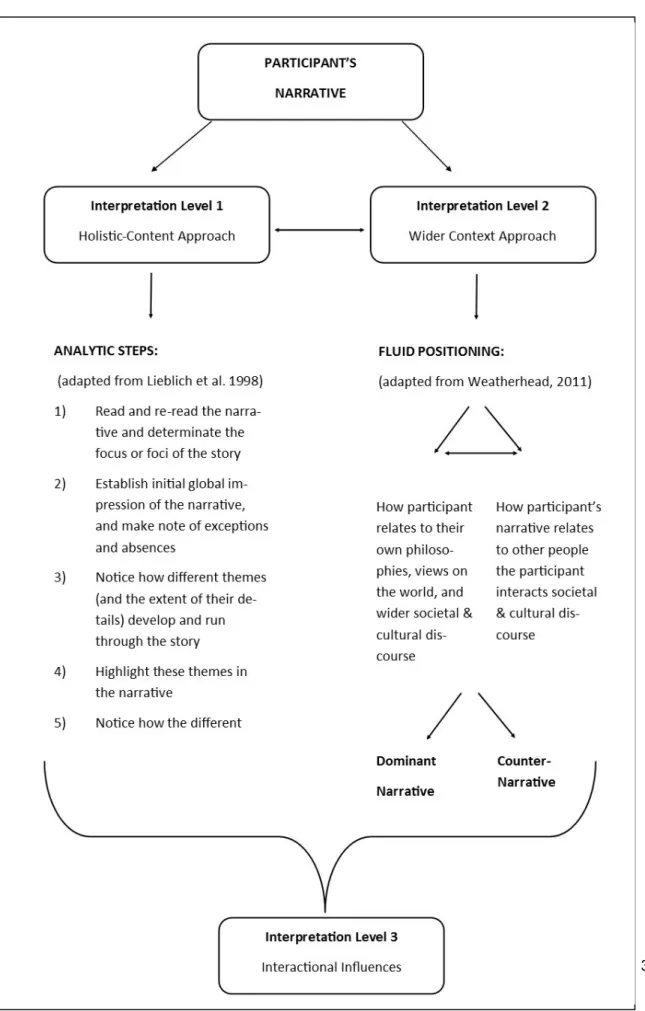
Considering the research topic and questions, I strongly felt that there should be no artificial divide between content and context. Thus, the holistic-content approach of Lieblich, Tuval-Mashiach and Zilber (1998) and the wider context approach of Weatherhead (2011) were combined to systematically guide my analysis of the co-constructed and meanings expressed during the storytelling. This approach created space and flexibility to follow the different narrative strands that run through the story. They were sensitively linked together into a global impression and coherent and meaningful themes while simultaneously they remained embedded in their relevant contextual frames.
On the following page, Diagram 1, illustrates the narrative analysis matrix I created for analysing each transcript in a structured, systematic and methodical manner.
2.5.4 Evaluation of Data Analysis
Many narrative researchers, including Kohler Riessman (2008) and Lieblich et al. (1998) argue that parameters such as validity and reliability traditionally used to evaluate the quality of analysis are reliant upon a realist epistemology and are therefore incongruent with narrative research. Both Kohler Riessman (2008) and Lieblich et al. (1998) have proposed alternative parameters such as transparency, pragmatic use, and feedback on the interpretation to evaluate the quality of data analysis. Therefore, participants received a copy of my interpretation of their story and were invited to provide feedback (see Chapter Three - Findings).
CHAPTER THREE – THE FINDINGS
3.1 INTRODUCTION
Each interview is treated as a case study as recommended by Lieblich et al. (1998). In keeping with both narrative research and case studies, the findings are presented in summary and story form. Interpretations are supported by evidence from the transcripts. Line numbers are used following each quote for easy reference of the quote’s location in the transcript.
The two main forms of analysis – holistic-content and wider context – have been combined to maintain the integrity of the entire story and its context.
I intentionally moved away from the conventional approach of the disembodied researcher traditionally used in quantitative research and therefore, used “I” instead of “the interviewer/researcher” in the narratives presented in this chapter.
3.2 CASE STUDY ONE: “MAKE IT [PARENTHOOD] YOUR OWN” [256] – KATY’S STORY
3.2.1 About Katy
Katy is in her early twenties and at the time of interviewing her baby girl Ella was 11 months old. Prior to Ella’s arrival, Katy worked in the Hospitality Sector. She identified herself as White British and raises her daughter together with her partner.
3.2.2 Katy’s Narrative
The global impression of Katy’s story about parenthood is that of a creative, individualistic process. Throughout her pregnancy and following Ella’s birth, Katy’s account details how she was trying to navigate her way through a complex information and expectation landscape. Over time Katy came to perceive parenthood as “lots of things” [255] leaving her with a feeling that ultimately “you have to make it [parenthood] your own” [256].
Katy’s story of parenthood suggests three significant themes that appear to have fundamentally shaped both her understanding of parenthood and parenting itself.
1) Cyberspace
Katy starts her account by expressing her ambivalence about the usefulness of the internet, saying “the thing that I found quite interesting that’s either helped or hindered me is the different information and the Internet” [10-11]. The use of the conjunction either reinforces the possibility of the Internet as both a form of support and a barrier. She continues by telling me that she found parent forums unhelpful, emphasising her statement by using the adverb really [14]. Hence, the first perspective about the Internet’s mixed usefulness is voiced very clearly in Katy’s introduction.
norm.
Katy positions herself as someone who has never posted anything and throughout her narrative, she conveys the sense of a silent participant suggesting the presence of a paradox: Katy seems to be searching for reassurance both from experts based on their lived experience of motherhood or expertise through profession-based training, yet she repeatedly stresses the unhelpfulness of these expert opinions. Simultaneously, assertions of autonomy and non-conformity to dominant narratives about parenthood are abound in Katy’s story. In the context of forums, she stated “I don’t… like that kind of thing” [37]. She concludes her exploration by wondering whether these forums are populated by “very… pushy” [31] people, questioning the credibility of their messages in light of the anonymity of the authors. Katy re-visits this idea further along in her account, positioning these mothers as “quite stressed and worried” [53]. Towards the end of her story, Katy positions herself as someone who through Ella’s presence has “become more kind of relaxed”
[311].
Katy used Google a lot throughout her pregnancy and also after Ella’s birth and dedicates a large part of her story to the kind of information she would almost compulsively look up. Google it appears seems to be a vehicle for Katy to obtain factual knowledge historically obtained from professionals such as midwives. Katy for example talked about googling for information about signs of labour, affirming her drive for autonomy. When she had arrived at the hospital about to give birth, they [the professionals] told her “oh, you should have come a bit earlier” [156].
Before Katy concludes her story, she describes how Skype is connecting Ella with her wider family. Skype with a webcam seems to help Ella to remember the faces of family members living further afield. The positive influence of Skype appears to be evident in Katy’s narration in the sense that she frequently Skypes her parents and says “that’s really good” [348].
had decided not to post any photos online worrying about the intentions of people who might download pictures of Ella, and also feeling hesitant about sharing her life online. Her love for Ella is clearly communicated in her story. Her narrative suggests Katy was grappling with how safe it would be to post Ella’s photos online while proudly wanting to show her off to families and friends. Her account implies that by sharing photos of Ella online, her family and friends can be part of Ella’s development and in that way, online photo sharing can create a sense of belonging and connection. Perhaps she felt the need to justify to herself (and/or to the interviewer) her decision to put photos online by arguing that “everyone wants to look at her pictures” [354-355].
2) Assumed expectations and their implicit impact on making parenthood your own
Katy’s story demonstrates that her lived experience of first-time motherhood was, and still is coloured by assumed expectations made by society on Katy. She talks about being “worried what other people thought when you are out and about” [289] and this concern resulted in Katy walking everywhere with Ella instead of catching a bus. Underlying her explanation appears a sense of lack of control over Ella’s behaviour and fear of judgement as a bad mother. Reflecting on her avoidance of buses, Katy tells me that she was “scared that she [Ella] would start crying” [292] implying perhaps a fear that should she not be able to soothe Ella, the passengers might consider her an unfit mother. She finishes her reflection by stating that “now I don’t care that much and I think that was quite an important experience for me” [292-294]. Katy chose not to elaborate on her transition from avoiding buses to not caring. In keeping with Lieblich et al.’s (1998) approach, occurrences of non-elaboration are considered meaningful and therefore, worth documenting. Katy’s statement seems to assert again her autonomy and non-conformity by highlighting the value of this experience to aid the process of making parenthood your own.
that” [230]. Katy attended a one-day antenatal class with her husband and whilst she didn’t enjoy the class, she chose not to elaborate on her experience nor on her husband’s experience. Katy is candid about the implicit pressure to conform to antenatal education saying “I felt like I should go”. Deviation from what Katy thinks is the dominant viewpoint of society is depicted as a positive act which is congruent with her ideas about parenthood. She states “it’s the… realisation that you actually don’t have to do it if you don’t want…” [238-239].
Perhaps her attempts to make parenthood her own is partially shaped by her philosophy of autonomy and partially driven by a fear of not meeting assumed expectations? This fear is implied later in her account when Katy talks about the fact that she has only ever attended a baby massage class. Katy tells me that she felt quite scared about meeting other parents because of “what was kind of expected” [272-273]. It is not clear whether she referred to expectations by other parents or by the staff running mother and baby classes.
Her elaboration suggests that she attended the baby massage class because it was skills-based as opposed to a play session. The class’ focus created a pressure-free environment for Katy which is evident in her declaration “I mean you could just sit there and not talk to anyone if you wanted to” [282-283]. Her autonomy from mother and baby groups is further manifested by going to art galleries “and things like that” [268] with Ella.
Linking Katy’s earlier comment about NCT classes being good for some mothers for making friends, Katy’s lived experience of parenthood is clearly embedded in nurturing relationships with friends and family. This condition perhaps has created space for Katy to confidently follow her own ideas and views about parenthood.
3) Support and Expectations by Professionals
shouting at you” [148-149]. The origins of this assumption about midwives is not explored further but perhaps reflects anecdotal stories she has heard. While at the hospital, Katy found it “disconcerting that every single time a midwife came in, it was a different one” [178-179]. The lack of continuity in care had a profound impact on Katy. She felt patronised and worried because every time a midwife came in and Ella was crying, the midwives told her to feed Ella. In her story, her choice of words appears to reflect her growing frustration, worry over being perceived as a bad mother, and a need to justify herself. She said she responded to one midwife’s demand to feed Ella with “I am not being mean, I have just fed her” [184]. Katy dedicates a good part of her story to narrate the negative implications of the dominant narrative surrounding breastfeeding. In her account, Katy expresses concerns about the negative impact of society’s preoccupation with breastfeeding on how mothers might feel about themselves and talks about an acquaintance who had to stop breastfeeding for medical reasons. She said her acquaintance upset was because of society’s focus on breastfeeding. Katy feels that professionals want mothers to breastfeed, saying “it feels like it’s so pushed on you” [200]. Katy was not impressed with either the length of the breastfeeding class (3 hours) or its content. The teaching favoured breastfeeding to the extent of excluding a more holistic approach. There was for example no information on how difficult breastfeeding can be for some mothers because “they don’t want to put you off and I think that’s really bad” [208-209]. Katy concludes this part of her story by stating “luckily I could breastfeed” [224] conveying a sense of relief and perhaps achievement.
Towards the end of the interview, Katy briefly returns to this theme of support saying that she didn’t get much professional support post-discharge, wondering whether more visits from health visitors would have been beneficial. This reflection was not further explored due to the baby interrupting the interview.
3.2.3 Katy’s Feedback
3.3 CASE STUDY TWO: “DON’T PLAY THE GAME” [352] – ANNA’S STORY
3.3.1 About Anna
Anna is in her thirties and at the time of interviewing, her baby boy Leo was eight months old. Prior to Leo’s arrival, Anna worked in journalism. She identified herself as White British and raises her son together with her partner.
3.3.2 Anna’s Story
The global impression of Anna’s story captures parenthood as an intriguing and challenging adventure that involves finding ways to tame her knowledge- and reassurance-seeking mind. While resisting the lure of cyberspace proved to be tricky at times, Anna’s analytical mind seems to act as a buffer against society’s ideology of “this hallowed good mother” [347]. “I found myself reacting against this”
[350] Anna declares, and peppers her narrative with anecdotes of resistance against implicit and explicit views and expectations of others, and wider society in general. Her story evokes a strong sense of Anna’s ownership of her own motherhood and affirms Anna’s resistance in participating in the dominant game of parenthood.
Anna’s story of parenthood suggests four major themes that appear to have fundamentally shaped both her understanding of parenthood and parenting itself.
1) Conception & The Coldness of Professionalism
baby, her relief at seeing her baby’s heartbeat after an anxious 2-week wait is palpable when she says “that was just amazing” [65]. The use of the adjective
just further accentuates how welcome this piece of good news was.
Anna describes how her own excitement during her 12-week scan was somewhat dulled by the professionals’ pragmatic testing approach describing the professionals as “being quite cold” [101]. She experienced these medical tests as pressure on her to perform well saying “you sort of feel like you’ve got to pass all these tests and you sort of worry about passing them” [111-112]. Underlying her narrative is maybe an implicit sensitivity to assumed fertility expectations from the wider society and also from friends and acquaintances. Anna reflects on the unspoken pressures she experienced while trying to get pregnant saying “if I just said to people ‘we are trying but just don’t ask any questions’ I wouldn’t have felt so pressurised” [79-81]. Once her pregnancy was confirmed, Anna started to notice changes in her behaviour. She describes herself as “pretty gung-ho usually in life” [134] and then tells me how she became “cautious about everything” [135], affirming the preciousness of baby Leo.
2) Cyberspace
Anna’s account is interspersed with references to the Internet. While her husband was reading baby-related books, Anna said she felt trusting her instincts “will be fine” [140], yet she is candid about almost compulsively googling for information to the point where “it became a bit addictive <laughter> definitely” [181-182]. While waiting for her 2-week scan to learn whether her baby was viable, she turned to the Internet in search for reassurance only to discover that even the more balanced messages offered no relief to her. She wonders why she wasn’t able to curb her urges to google, saying “you’d just sort of googling till you find your worst nightmare” [158-159].
useful information” [166] and “brilliant answers” [200]. Although Anna likes information grounded in science, she feels that “child development is not an exact science” [176] which means that often she can’t find the answers she had hoped for.
For Anna, the online parent forums are helpful and she describes them as offering “a sisterhood” [222] of supportive women who share the strategies that have worked for them in a predominantly sensitive manner. She acknowledges with a laugh that of course there is always one mother who
“really thinks they have the answer and will push it quite strongly” [224-225]. Interestingly, her focus is on other mothers who are part of this virtual community which implies an absence of participating fathers in the forums she visits. While Anna positions herself as someone who has never posted any questions or answers, she clearly interacts with the threads and messages other mothers create, saying that she is “trying to sift through” [218] their contributions but ultimately is wanting “to work it [parenthood] out myself”
[286].
3) The Lived Experience is a Different Story
For Anna, her own experience of early motherhood did not resemble the idealised mothering she had seen being portrayed in the media. Everywhere you go, she recounts, every baby product you buy shows pictures of happy and smiley babies alluding to a universal phenomenon of the contented baby. For Anna, her lived experience could not have been more different. She tells me that Leo “was just not a happy baby” [387] and that because of this dominant depiction, she found herself sometimes worrying that people would attribute his unhappiness to her doing something wrong, that somehow she was at fault.
The lived experience of motherhood also appears to have left its marks on Anna’s feminist ideology. Her prepartum view on childcare was that raising an infant should be equally shared between the father and the mother. “I didn’t quite realise how time-consuming feeding was” [523-524], Anna tells me. Her narrative suggests that her 50/50 childcare philosophy wasn’t translatable into practice because of how much time was taken up by feeding. In telling her struggle to have a semblance of 50/50 childcare, she seems to voice her frustration by saying “I feel I always have to say ‘can you do this, can you do that’” [532] and concludes that she reluctantly found herself in a position where she was now responsible for the bulk of infant care. Her new position as a full-time mother is perhaps accentuated by the fact that the baby monitor is placed next to her at night and while she appreciates that her husband needs his sleep, she asks with a laugh “why am I doing this?” [538].
4) Bad Mother(s) vs Good Mother(s) & Health Visitors
Different parts of her narrative about parenthood are dedicated to the dominant views of motherhood. Her account paints a picture where society’s ideology of a good mother appears to be reinforced both by professionals and members of the public. Anna talks about “the pressure to be a good mum”
experience in her stride. She tells the interviewer that she replied to the woman saying “thank you for your advice but…” [402]. On the other hand, the experience left her friend shaken, saying “she was so upset, poor thing…”
[414]. Anna’s story provides evidence for how highly judged the role of a mother is by society.
When Leo was only about seven weeks old, Anna’s mothering skills came under the spotlight by a health visitor. She dedicates a considerable amount of space to narrate what had happened when she went to have Leo weighed and was bluntly told off for briefly turning her back on him. She exclaims “there was absolutely no way he could have rolled off, he was only 7 weeks old anyway”
[246-247]. Anna is candid about how she had felt, saying I “felt like I was being told I was a bad mother” [253-254]. In her narrative, Anna’s inner strength and confidence surfaces again because she decided to challenge the health visitor for rebuking her, emphasising that there was no chance her 7-week old infant could have fallen off the table. Anna tells me that her health visitor resorted to telling her “he could choke” [258]. She challenged her reply by highlighting that even with her back turned to him, she surely would be able to hear him choke. The health visitor then advised Anna “just keep your eye on him” “even when you are loading the dishwasher” [261-262]. Anna perhaps sensing her exasperation brought back by these memories asks me with a laugh “how do you actually get physically anything done” [263-264] if you can’t ever turn your back to your infant. She concludes that this experience “was “just a nightmare”
[267], saying that the health visitor “wasn’t using common sense” [267-268].
taboo subject not to be named; a perspective that was once widespread in society.
3.3.3 Anna’s Feedback