Project Title
The effectiveness and cost effectiveness of acupressure for the control and management of chemotherapy-related acute and delayed nausea: a randomised controlled trial
List of authors:
Molassiotis A1, Russell W1, Hughes J2, Breckons M3, Lloyd Williams M2, Richardson J3, Hulme C4, Brearley S5, Campbell M1, Garrow A6, Ryder D7.
Affiliations:
1School of Nursing, Midwifery & Social Work, University of Manchester
2Academic Palliative and Supportive Care Studies Group, Division of Primary Care, University of Liverpool
3Faculty of Health, University of Plymouth
4Academic Unit of Health Economics, Leeds Institute of Health Sciences, University of Leeds 5Faculty of Health & Medicine, Lancaster University
6School of Health Sciences, University of Salford 7Clinical Trials Unit, Christie NHS Foundation Trust Contact details
Alexander Molassiotis, RN, PhD Professor of Cancer & Supportive Care University of Manchester
School of Nursing University Place
MANCHESTER M13 9PL, UK
email: [email protected]
tel: +44 (0)161-3067830; fax: +44 (0)161-3067894
Competing interests
Table of contents
Page
1. Literature review 8
1.1. Existing research 8
1.2. Our own work 9
2. Research objectives 10
3. Research methods 11
3.1. Design of the study 11
3.2. Pilot study using this design 11
3.3. Interventions, both experimental and control 12
3.4. Inclusion/exclusion criteria 13
3.5. Proposed sample size 14
3.5.1. Recalculation of sample size requirements during the trial 15
3.6. Statistical analysis 15
3.7. Randomisation method 16
3.8. Outcome measures 16
3.8.1. Primary outcome 16
3.8.2. Secondary outcomes 16
3.9. Wristband compliance and audit 17
3.10. Measurement of costs 18
3.11. Nested Qualitative Study 20
3.11.1. Objectives 20
3.11.2. Sample 20
3.11.3. Methodology 20
3.12. Research Governance 21
3.13. Service user involvement 22
4. MAIN FINDINGS 22
4.1. Patient Recruitment 22
4.2. Descriptive statistics by trial arm 26
4.3. Primary outcome analysis 32
4.4. Assessment of missing data for the primary outcome 33
4.5. Regression analyses for the nausea primary outcome data 34
4.5.1. Unadjusted fit 35
4.5.2. Adjusted fit (age, gender and emetogenic risk) 36
4.5.3. Adjusted fit (age, gender, emetogenic risk, cycle frequency, anxiety and
nausea expectation) 37
4.7. Longitudinal regression analyses of mean Rhodes nausea experience scores 41
4.7.1. Unadjusted fit 41
4.7.2. Trial arm effects by gender from adjusted regression analyses 42
4.8. Longitudinal analyses of secondary outcomes 43
4.8.1. MASCC Antiemesis Tool acute and delayed nausea 43 4.8.2. MASCC Antiemesis Tool acute and delayed vomiting 44 4.8.3. Longitudinal analyses for nausea and vomiting using post hoc
dichotomies 45
4.9 Analysis of Hospital Anxiety & Depression Scale and FACT-G scales 47
4.10. Scale reliability 48
4.11. Wristband audit 48
4.12. Side effects from wearing the wristbands 49
5. HEALTH ECONOMICS DATA 50
5.1. Context of the data 50
5.1.1. Aim and perspective 50
5.1.2. Time frame 50
5.1.3. Resource use and costs 51
5.2. Assumptions made on anti-emetic use 53
5.3. Outcome measurement and valuation 54
5.4. Missing data 54
5.5. Economic evaluation 55
5.6. Results 56
5.6.1. Resource use and costs 56
5.6.1. Utility data 57
5.6.3. Economic Evaluation Results regarding QALYs 59
6. QUALITATIVE DATA 65
6.1. Objectives 65
6.2. Findings 65
6.2.1. Sample 65
6.2.2. Themes 66
7. DISCUSSION 78
7.1. Key quantitative findings 78
7.2. Health care utilization data 81
7.3. Qualitative data 82
7.4. Conclusions 83
8. References 85
Executive summary
Background:
While chemotherapy-related vomiting is relatively well-controlled with current antiemetics, nausea remains a significant problem for patients and a difficult symptom for clinicians to manage. The role of complementary therapies, and particularly acupressure at the P6 (Neiguan) point, as adjunctive treatments to pharmacological antiemetics has been investigated in a number of studies in the past. Both positive and negative results have been reported in the literature, providing evidence of highly suggestive but not conclusive results. Many past studies, however, are hampered by methodological problems, including small sample sizes, minimal control of risk factors for chemotherapy-related nausea and vomiting and no control of the antiemetic drugs used. Hence, there is a need to clarify whether acupressure is effective and cost-effective in the management of chemotherapy-related nausea and vomiting using a robust methodological design with well-powered sample size.
Objectives: Primary objective:
1. To assess the clinical effectiveness of self-acupressure using wristbands in addition to standard care in the management of chemotherapy-induced (acute and delayed) nausea compared to patients receiving standard care with sham acupressure wristbands and standard care alone.
Secondary objectives:
2. To assess the cost effectiveness and extent of use of usual care in patients using acupressure wristbands in addition to standard care for the management of chemotherapy-induced nausea compared to patients receiving standard care with sham acupressure wristbands and standard care alone.
3. To assess the level of quality of life in patients using acupressure wristbands in addition to standard care in the management of chemotherapy-induced nausea and vomiting compared to patients receiving standard care with sham acupressure wristbands and standard care alone. 4. To assess the clinical effectiveness of self-acupressure using wristbands in addition to
standard care in the management of chemotherapy-induced (acute and delayed) vomiting compared to patients receiving standard care with sham acupressure wristbands and standard care alone.
6. To ascertain whether any improvement in chemotherapy-induced nausea and vomiting from using acupressure wristbands is different in males and females.
7. To ascertain whether there is an age effect from the use of acupressure wristbands in relation to chemotherapy-induced nausea and vomiting.
Methods:
A randomised three-group sham-controlled trial was designed to test the effects of acupressure in the management of chemotherapy-related nausea and vomiting. Patients with heterogeneous cancer diagnoses receiving low, moderate and highly emetogenic chemotherapy were randomised to receive, in addition to standardised antiemetics, either acupressure wristbands, sham acupressure wristbands or antiemetics alone. The randomisation method used consisted of minimisation with a random element (stochastic minimisation), balancing for gender, age (16-24; >24-50; >50) and three levels of emetogenic chemotherapy (low, moderate and high according to international ASCO and MASCC classifications). Patients were instructed to wear the wristbands throughout the day for the first 7 days during each cycle of chemotherapy. Primary outcome assessment was carried out daily for 7 days per chemotherapy cycle over four cycles using the Rhodes Index for Nausea & Vomiting. Other
assessments, completed at day 6 of each of the four cycles, included the MASCC Antiemesis Tool, EQ-D 5 Utility scale and the FACT-G quality of life scale. At baseline participants completed measures of anxiety and depression, of nausea/vomiting expectation and expectations from using the acupressure wristbands. An economic evaluation was also carried out based on drug and health service utilisation from the perspective of the health and social care provider and presenting
incremental cost-effectiveness ratios with quality-adjusted life years as the outcome. Finally, a nested qualitative interview study was incorporated to shed more light into the quantitative findings.
Results:
cost-effectiveness evaluation revealed no significant differences (t-tests) between the costs in each arm.Total costs (all drugs and NHS costs) were £70.66 for the acupressure group, £111.13 for the standard care group and £161.92 for the sham acupressure group. However caution is needed in interpreting these results due to very small changes in utility and the influence of a few high cost outliers. Twenty-six subjects from all three groups took part in in-depth qualitative interviews. Four themes emerged from the data, including ‘Deciding to participate’, ‘Perceptions and experiences of complementary therapies’, ‘Experience of taking part in the trial’, and ‘Experience of using the wristbands’. The qualitative data overall suggested that the participants perceived the wristbands (both real and sham ones) as effective and helpful to manage their nausea experience during chemotherapy. Minor and transient side effects from the use of the wristbands were observed.
Conclusions
No clear recommendations can be made about the use of acupressure wristbands in the management of chemotherapy-related nausea and vomiting, as results did not reach statistical significance. However, these differences observed may be of clinical importance for the patients and potentially lead to lower health care utilisation. The use of wristbands was also safe and perceived to be effective by the patients. Before rejecting this intervention we need to consider the therapeutic effect of
placebos in situations such as in the management of nausea when otherwise low-cost and safe
intervention may enhance the effect of antiemetic drugs. The study provided evidence of encouraging signals in relation to improved nausea experience and and a suggestion of potential health resource use benefits to warrantee further consideration both in practice and in further clinical trials.
(WORD COUNT: 1,141)
Trial Registration
This trial is registered with the ISRCT register, number ISRCTN87604299.
Funding
The effectiveness and cost effectiveness of acupressure for the control and management of chemotherapy-related acute and delayed nausea: arandomised controlled trial
1. Literature review 1.1. Existing research
Significant developments in antiemetic therapy over the past two decades have improved the control of chemotherapy-related vomiting. By contrast, chemotherapy-related nausea, both acute and delayed, is still a significant problem in clinical practice, with 42–52% of patients experiencing nausea on any one day in routine practice1. Surprisingly, despite improvements in the management of vomiting, post-chemotherapy nausea seems to have increased2. Furthermore, clinicians often underestimate the experience of nausea, especially with regards to delayed nausea3,4.
Chemotherapy-induced nausea and vomiting (CINV) can have a profound effect on the cancer treatment experience5 and is associated with negative effects on daily life and overall quality of life, including effects on food intake, weight loss, effects on social interactions, dehydration, difficulty with sleeping and anxiety5,6. In a qualitative study of patients’ experiences, unmanaged nausea was constant in some patients and made them exhausted for long periods after chemotherapy, making recovery between cycles longer5. The impact of nausea is greater than that of vomiting7 and nausea has proven to be more difficult to control. The direct and indirect costs of the experience of nausea and vomiting, especially of delayed symptoms, are considerable8. Antiemetic trials have traditionally focused primarily on vomiting and emetic episodes, upon which the effectiveness of many antiemetic drugs is judged. Little attention has been directed to the concept of chemotherapy-induced nausea despite the fact that it is increasingly recognised that nausea and vomiting are related but separate entities9,10. The need for these two symptoms to be treated as two separate entities is strongly advocated10.
The reasons behind this incomplete management of chemotherapy-induced nausea and vomiting are multifaceted. They include health professionals’ limited understanding of the complex concept of chemotherapy-induced nausea and vomiting and its different phases; limited assessment in clinical practice of chemotherapy-induced nausea and vomiting and its risk factors; using more emetogenic chemotherapy protocols than in the past; not understanding clearly all the pathways involved in the development of chemotherapy-induced nausea and vomiting; and more focus given to the vomiting experience than nausea in clinical trials11.
results in most studies (for a full review see reference 12). Acupuncture and its non-invasive form of acupressure have been tested several times after the classic early work of Dundee13,14. In a literature search of Medline, PubMEd and CINAHLusing the key words ‘acupressure’, ‘nausea’, ‘vomiting’, ‘emesis’, ‘chemotherapy’, ‘cancer’ and combinations, between 1990 and May 2005, we have identified 10 studies specific to oncology, reported elsewhere15, with 7/10 studies showing positive results and a further two approaching statistical significance. These studies have used a variety of acupressure methods, such as the ‘ReliefBand’ (a small battery-operated TENS device designed to stimulate the P6 acu-point) 16-18; an acupressure wristband ( a small elastic band with a round plastic button applying constant mild pressure on the P6 acu-point) 19-21; direct pressure on the acu-point P622 (Shin et al, 2004) or P6 and ST36 points together23. Most studies had small sample sizes of 18-50 patients. The largest study to date (n=739) testing acupressure and acustimulation showed improvements in nausea and vomiting in men while there was a similar trend in women to reduce acute symptoms only, although the latter did not reach statistical significance24. No improvement in nausea/vomiting was shown in a small study by Roscoe et al25 in women with breast cancer using acustimulation (ReliefBand) wristbands. The latter two studies are suggestive of a possible gender effect. However, most past studies are hampered by small sample sizes, the wide variety of (non-standardised) antiemetics used, differences in the risk factors for nausea and vomiting in these samples, the range of emetogenicity of chemotherapy regimens used and sampling issues. A recent Cochrane systematic review of the literature highlights that acupressure reduces acute nausea but not delayed nausea, and has no benefit for vomiting26. However, the review was primarily focused on acupuncture rather than acupressure, all different methods of acupressure were examined together and the results regarding specifically vomiting are questionable (as many of the studies included in the review had samples with little, if any, vomiting across experimental and control groups).
1.2. Our own work
Over the past 8 years the lead applicant has developed a programme of research in the management of chemotherapy-induced nausea and vomiting that feeds into the current application. This has involved the assessment of the effectiveness of non-pharmacological interventions for the management of chemotherapy-induced nausea and vomiting including progressive muscle relaxation training and imagery techniques27 ; pilot testing of acupressure15; identification of risk factors for chemotherapy-induced nausea and vomiting development such as age, gender and anxiety28,29; the management of anticipatory nausea and vomiting30;31, the development of international clinical guidelines for managing chemotherapy-induced nausea and vomiting 32,33 and radiation-induced nausea and
only chemotherapy-specific scale available to date. In our qualitative study of the experience of chemotherapy-related nausea in seventeen patients with cancer in the UK and USA, nausea was described as distressing and complex symptom36. Preliminary evidence indicates that nausea is part of a cluster of symptoms. Self-management techniques, such as dietary strategies and distraction
techniques were rooted in participants’ understanding of nausea and their beliefs about what caused nausea. While self-management was common in almost all patients, acupressure was not one of the approaches used. In an observational prospective evaluation using patient self-reports, 102 patients with cancer receiving their first chemotherapy treatment participated37. Participants were followed up for 4 cycles of chemotherapy, providing a total of 272 assessments of nausea and vomiting. Results indicated that acute vomiting was experienced by 15.7% of the patients in cycle 1 and delayed vomiting by 14.7%, while acute nausea was present in 37.3% of the patients and delayed nausea in 47.1%, which increased over the four cycles. Moderately emetogenic chemotherapy had the highest incidence of chemotherapy-induced nausea and vomiting and acute symptoms were more controlled than delayed symptoms. The data suggested that, while vomiting is relatively well controlled, nausea is a significant problem in practice; it also highlighted the high cost of inappropriate use of
2. Research objectives Primary objective:
1. To assess the clinical effectiveness of self-acupressure using wristbands in addition to standard care in the management of chemotherapy-induced (acute and delayed) nausea compared to patients receiving standard care with sham acupressure wristbands and standard care alone.
Secondary objectives:
2. To assess the cost effectiveness and extent of use of usual care in patients using acupressure wristbands in addition to standard care for the management of chemotherapy-induced nausea compared to patients receiving standard care with sham acupressure wristbands and standard care alone.
3. To assess the level of quality of life in patients using acupressure wristbands in addition to standard care in the management of chemotherapy-induced nausea and vomiting compared to patients receiving standard care with sham acupressure wristbands and standard care alone. 4. To assess the clinical effectiveness of self-acupressure using wristbands in addition to
standard care in the management of chemotherapy-induced (acute and delayed) vomiting compared to patients receiving standard care with sham acupressure wristbands and standard care alone.
5. To ascertain for which emetogenic level of chemotherapy regimens (ie. high, moderate or low emetogenic chemotherapy) self-acupressure using wristbands in addition to standard care is more or less effective in terms of nausea compared to patients receiving standard care with sham acupressure wristbands and standard care alone.
6. To ascertain whether any improvement in chemotherapy-induced nausea and vomiting from using acupressure wristbands is different in males and females.
3. Research methods 3.1. Design of the study
The design of the study was a randomised controlled trial with 3 arms. Each arm consisted of usual care plus one of (1) self administered acupressure wristbands, (2) sham acupressure wristbands, and (3) no additional treatment. The duration of the patients’ involvement was for four cycles of
chemotherapy, as after 4 cycles patients not responding to the given chemotherapy may discontinue it, may be offered a different chemotherapy regimen, a different treatment plan or may be offered supportive care only.
Subjects were allocated to the trial groups through computer-generated randomisation carried out remotely by the trials unit of the Christie Hospital NHS Foundation Trust. The randomisation method used consisted of minimisation with a random element (stochastic minimisation), balancing for gender29,40, age (16-24; >24-50; >50)29,41 and three levels of emetogenic chemotherapy (low, moderate and high according to international ASCO and MASCC classifications)32,42.
Biases were minimised through: a) carefully developed inclusion and exclusion criteria that take into consideration the range of factors and sources of nausea and vomiting in cancer patients other than chemotherapy (ie. intestinal obstruction); b) the use of covariates for variables that are closely linked with nausea and cannot be excluded as they are present in a large proportion of the population (ie. anxiety) 29,43, to be incorporated during the data analysis as a covariate in ANCOVA models; and c) the use of stratification for other key risk factors for nausea development during chemotherapy (ie. age, gender) at the randomisation stage. Stratification, prior to randomisation, is important to ensure that known prognostic factors are equally distributed before measuring the treatment-related variables.
3.2. Pilot study using this design
acknowledged as a limitation of the pilot study. However, missing data in the returned assessments was almost non-existent, and patient logs for acupressure usage were fully completed.
The use of sham acupressure and acupressure have also been used in another pilot trial we have carried out recently for the management of cancer-related fatigue44, and it was shown that patients in the sham group who were informed they were receiving one of two combinations of (acu)-points were blinded until the end of the trial and that this group had little improvement compared to the real acupressure group, suggesting that this technique was a credible placebo and thus capable of minimising the likely effect of placebo on the study’s findings.
3.3. Interventions, both experimental and control
The design of the study involved a phase III pragmatic randomised trial.
Sample: The target population was a heterogeneous group of cancer patients meeting inclusion criteria and about to receive chemotherapy of high, moderate and low emetogenic potential. Heterogeneity is important in order to address issues of response to different types of emetogenic chemotherapy, and by gender and age, as past literature highlights these are important in assessing the effectiveness of treatments for chemotherapy-related nausea and vomiting. Minimally emetogenic chemotherapy was not included, as clinical guidelines recommend no antiemetic treatment and the nausea/vomiting level is <10%.
In the acupressure group, in addition to standard antiemetics, patients were provided with a pair of widely available acupressure wristbands . These bands are elastic wristbands with a 1cm protruding round plastic button (stud). These are available in two sizes, a standard one and a larger one. Patients wore the wristband with the stud pressing the P6 acu-point, which is located on the anterior surface of the forearm, approximately three-finger width up from the crease of the wrist between the tendons of the Palmaris longus and flexor carpi radialis. Patients were provided with a pair of acupressure wristbands and they were instructed to wear them on both arms and take them off only when showering/bathing. An instruction sheet with a picture of point P6 and how to locate the point was also provided to patients. Patients were instructed to wear the wristbands from the morning before chemotherapy administration and for the subsequent 6 days (total=7 days). No other complementary therapies use was recommended during the course of acupressure (although any such use was documented).
constitutes an appropriate sham treatment, and it had been acknowledged that there was no sham method in acupuncture and acupressure studies that could be widely accepted as the optimal method. It was increasingly believed that sham acupuncture/acupressure designs cannot detect the whole placebo effect and may generate false negative results45-48, depending on the method used. We had debated the appropriateness of other sham methods, but either they were not blinded enough for the purposes of the trial (ie. had to be slightly dissimilar to real acupressure wristbands) or could be perceived as treatments themselves (ie. acupressure at other points in the forearm or elsewhere where we had no information as to an effect on the experience of nausea). Patients in the clinics could also talk to each other and realize they have different interventions or check the P6 point on the internet. Hence, we resolved to use an acupressure technique which appeared to be exactly the same as the active treatment with the only exception being the place of stud in the wristband (interior or exterior to the band) used. This was also agreed by practitioners too, who had been consulted about their views on the most appropriate sham method. Furthermore, while it was acknowledged that many patients may have heard of the use of such wristbands, the results of our pilot study suggested that their knowledge of acupressure wristbandswould be limited15. In addition, the results of our qualitative study on self-management of chemotherapy-induced nausea and vomiting suggested that acupressure was not commonly used by patients36. An assessment of blinding at the end of the trial was not conducted as patients had not been informed of the use of both sham and real acupressure bands during the trial, but had instead been informed that two different types of wristbands were being evaluated in the trial, with the approval of the Ethics Committee. Clinicians did not know the patients’ group allocation.
The control group received standard antiemetics alone. Standard antiemetics for all three groups were based on ASCO and MASCC international antiemetic guidelines with the exception of NK1 receptor antagonists (ie. aprepitant) recommended in highly emetic chemotherapy, which was not available in the NHS. Hence, for highly emetic chemotherapy, patients received a 5-HT3 receptor antagonist (ie. Zofran 8mg) and dexamethasone 8mg intravenously before chemotherapy and the same orally for 3 days post chemotherapy; for moderately emetogenic chemotherapy a 5-HT3 receptor antagonist (Zofran 8mg) and dexamethasone 8 mg intravenously before chemotherapy and a 5-HT3 receptor antagonist or dexamethasone (preferred) for 2 days post-chemotherapy; and for low emetogenic chemotherapy dexamethasone 8mg before chemotherapy and no other treatment post
chemotherapy32,42. All patients received rescue antiemetics if nausea and/or vomiting was persistent and failed to respond to the antiemetic treatment (ie. severe nausea or >5 vomiting episodes), based on the experience of each clinician (as agreed guidelines for rescue antiemetics had not been developed to date).
Inclusion criteria:
Patients scheduled to receive their first chemotherapy cycle
Patients scheduled to receive highly, moderately and low emetogenic chemotherapy (as per ASCO and MASCC classifications)
Patients scheduled to receive a chemotherapy regime given as a single or multiple administration repeated in 2, 3 or 4-week cycles
Patients who were acupressure wristband-naïve (in terms of never having tried for themselves such a wristband, although they may have seen or heard about such wristbands)
Patients of either gender and older than 16 years old
Patients with any cancer diagnosis receiving chemotherapy without concurrent use of radiotherapy Patients receiving chemotherapy as outpatients or inpatients
Patients who were willing to participate in the study and be randomised into one of the three study groups
Exclusion criteria:
Patients scheduled to receive radiotherapy concurrently with chemotherapy and during the assessment period of four cycles for each patient
Patients unable to self care (ie. unable to use wristbands appropriately; mental incapacity preventing continuous and optimal use of wristbands) as judged by the investigators
Patients with liver disease (as nausea is common presenting symptom)
Patients with metabolic risk factors for nausea (ie. electrolyte imbalances causing nausea/vomiting) Patients with mechanical risk factors for nausea (ie. intestinal obstruction)
Patients experiencing nausea and/or vomiting due to use of opioids Patients with lymphoedematous arms
Patients with chronic alcohol use (chronic alcohol use is associated with minimal levels of nausea and/or vomiting).
3.5. Proposed sample size
the t-test divided by 0.864. This would increase the required sample size to 156 per arm before attrition, 233 after attrition, totaling 699 across the three arms.
3.5.1. Recalculation of sample size requirements during the trial
Due to slower recruitment rate than envisaged initially, it was felt that rethinking of the sample size requirements was necessary. The CTU has analysed the first 141 cases which provided complete data over all four cycles. The Standard Deviation for this cohort of patients was 2.75, slightly lower that the SD of 3 that we included in the initial power calculations. We had also calculated the power of the study to 90%, whereas the standard power in most studies is 80%. We adjusted this number down to 80% power, which is the standard power accepted. With these adjustments in mind, the sample required was at 480 participants. This change was agreed both with the DMEC and the HTA programme.
There were 361 cases with data on the primary outcome (117, 118 and 126 in the three trial arms respectively). Pairwise trial arm comparisons were planned and as the data are skewed a
nonparametric test (Mann-Whitney) will be used and this has an asymptotic relative efficiency of at worst 0.864 compared to the t-test. Thus our effective sample sizes are around 117 x 0.864 which is about 100. With such a sample size there is approximately 80% power to detect a standardized difference in means of 0.46 in a two-tail test at the 0.017 level of significance.
Recruitment took place in the largest single-site cancer centre in the UK, and cancer units or centres of district general hospitals and university hospitals, including the Christie Hospital NHS Trust and its peripheral clinics where chemotherapy is administered (Royal Oldham Hospital, Tameside General Hospital, Leighton Hospital, Stepping Hill Hospital at Stockport, Macclesfield District General Hospital, North Manchester General Hospital), the Royal Liverpool Hospital, Clatterbridge Centre for Oncology, St Helen’s Hospital and Southport General Infirmary, and three cancer units associated with the University of Plymouth (South Devon Healthcare NHS Foundation Trust, Plymouth
3.6. Statistical analysis
Descriptive statistics have been estimated for all baseline socio-demographic and clinical variables by arm, and for outcome variables (scores on nausea and vomiting subscales) by arm. The association between baseline socio-demographic or clinical variables and outcome variables has been assessed using between-group tests or correlations depending on skewness. Primary outcome variables have been compared between the arms using t-tests, one-way analysis of variance, Mann-Whitney tests and Kruskal-Wallis tests, bearing in mind any skewness in the data.. Ordinal regression models were employed to permit covariate adjusted analyses of a grouped version of the primary outcome. An extension of the proportional odds regression model was used for longitudinal analyses over cycles and this was fitted with a Generalised Estimating Equation (GEE) approach. An intention-to-treat analysis model has been followed. As the primary outcome variable was assessed over several days repeatedly, an aggregate score of all assessments in each cycle was calculated before any modeling analysis.
The effect of missing values was assessed by comparing the numbers and percentages of participants with missing values in the three arms of the study; differences in baseline variables between
participants with observed and missing outcomes in each arm; and for participants with observed outcomes, differences in baseline variables between the three arms. There were no clear associations between known predictors of nausea and cases missing the nausea primary outcome. This fact along with the highly non-normal distribution of the primary response (for which imputation methods are not so well developed) informed our decision to not apply multiple imputation analyses.
3.7. Randomisation method
The trial arm allocation method was minimisation with a random element over the margins of three factors: gender, age (16 to 24, 25 to 50, 51+) and emetogenic risk (low, moderate, high). The first 20 cases were allocated completely at random and thereafter the allocation probability vector was (0.6, 0.3, 0.1) to the arms that would result in the least to the most imbalance respectively. Researchers telephoned the randomisation office staff with the patient details and the staff used an in-house program to obtain the allocated trial arm.
3.8. Outcome measures 3.8.1. Primary outcome:
Rhodes Index of Nausea, Vomiting and Retching49.
end point. From the nausea experience score, incidence and severity can also be isolated. Scores can range from 0-12, with higher scores indicating higher levels of the symptom experience. This scale, taking 1-2 minutes to complete, was done daily from the day before chemotherapy (to capture any anticipatory nausea) up to seven days post chemotherapy i.e. 8 assessments/cycle.
3.8.2. Secondary outcomes: MASCC Antiemesis Tool (MAT)
This is a scale designed by the Multinational Association of Supportive Care in Cancer (MASCC) 39. This 8-item scale assesses in a simple way both acute and delayed nausea and vomiting incidence and extent and was designed specifically for chemotherapy-related nausea and vomiting. This short clinical scale has shown satisfactory internal reliability (a=0.77), contrasted-groups and concurrent validity, and high recall of events up to 3 weeks post chemotherapy. The MASCC Antiemesis Toolis designed to be used once-per-cycle with retrospective patient recall of events, minimising the patient burden. Factor analysis has clearly identified three factors, namely vomiting, acute nausea and delayed nausea39. The scale (see appendix 2) was completed at day 10 of each cycle (=4 assessments). FACT-G quality of life scale.
This is a well-validated quality of life scale focusing on functional assessment50. This functional scale
has not only provided quality of life indications, but also changes in other symptoms/side effects that may have resulted from any improved management of nausea (ie. appetite). High internal consistency and construct validity have been reported in past studies using the FACT scales in various cancer populations. Completion time is about 5 minutes. This scale (given in appendix 3) was completed at baseline and then at day 10 of each cycle (=5 assessments).
Hospital Anxiety & Depression Scale51.
This is a 14-item scale assessing anxiety with 7 items and depression with a further 7 items. Each item is answered on a 4-point scale (0-3). Scores on each sub-scale thus range between 0 (no symptoms) and 21 (numerous and severe symptoms). There are separate scores for anxiety and for depression51.
In this study, the Anxiety subscale was obtained at baseline (see appendix 4), the score of which was used as a covariate in the final statistical analysis of the data, as anxiety is a key risk factor for the development of nausea/vomiting29,43. This scale has been used extensively with cancer patients as a
screening tool and has been reported to have excellent psychometric properties. Completion time is approximately 2-5 minutes.
Patient Expectations of Nausea/Vomiting.
As this is a key risk factor identified in the literature29,43, a 2-item scale was developed assessing the patient expectation for nausea and vomiting, measured on a 10-point ordinal scale . We have used the same measurement approach elsewhere in the past77, although no validation of these 2 items has
asked how much they believed this method had helped them alleviate nausea and how much faith they had in complementary therapies using 10-point scales (see appendix 5).
Sociodemographic and treatment characteristics were obtained from the patients’ records and the patients themselves (appendix 6). These included gender, age, educational level, marital status, experience with nausea in the past such as during pregnancy, motion sickness or nausea when eating certain foods, use of/experience with other complementary therapies in the past, cancer diagnosis, stage of disease, and chemotherapy protocol used and dosage. Such a questionnaire had already been developed by the team and used in the past in other nausea/vomiting studies15,29. Medication use
(standard and rescue antiemetics) during study participation were obtained from the pharmacy records. Furthermore, although not formally required, researchers were asking patients for any side effects (or patients could volunteer side effect information) and these were recorded in a descriptive manner.
Assessment scales were provided to patients for self-completion at home; completed forms were returned back to researchers using a pre-paid self-addressed envelope (see Table 1). Patients were asked to complete their daily assessments of nausea at the same time in the evening to have a consistent time frame for measuring change. Patients were reminded to return their completed scales when attending for chemotherapy, and were also contacted at an early stage during the trial when the researcher would remind patients of the instructions for completing and returning the scales.
Table 1. Timing of completion of study assessment forms
Baseline assessment
Chemo days -1,0,1,2,3,4,5,6 x 4 cycles
Chemo day 10
X 4 cycles
End of study participation
Rhodes Index of Nausea and Vomiting
X
MASCC Antiemesis Tool X
FACT-G X X
Hospital Anxiety & Depression Scale
X X
Patient Expectations Questionnaire
X
Sociodemographic variables X
Disease/treatment variables X X
3.9. Wristband compliance and audit
Patients who had been randomised to the acupressure and sham acupressure groups were also asked to provide information about the length of time that they had worn their wristbands on the day of chemotherapy and the 6 subsequent days. A wristband compliance questionnaire (see appendix 7) per cycle was given to the patients to complete and return in the pre-paid envelope together with the completed scales.
In addition to compliance with wearing wristbands, it was important to determine whether patients were wearing the wristbands correctly according to the instructions they had been given. A wristband audit was conducted at two Manchester sites (Christie NHS Foundation Trust and Macclesfield District Hospital) and two Liverpool sites (Clatterbridge Centre for Oncology and the Royal Liverpool Hospital). Research nurses who were involved with patient recruitment into the trial assessed how correctly patients were wearing their wristbands when they attended for chemotherapy treatment. In total, observations were carried out for 35 pairs of wristbands. An audit proforma is shown in appendix 8.
Due to the device nature of the intervention the trial did not come under MHRA regulations as it was not a clinical trial of an Investigational Medicinal Product as defined by the EU Directive
2001/20/EC. The nature of the intervention therefore did not require a procedure for the reporting of serious adverse events. However, patients were regularly asked about their experiences with regard to wearing wristbands (for example when attending for chemotherapy and during routine telephone communication during the trial), and any comments made regarding any kind of problems associated with the wristbands (for example if a larger size was required; if the wristband caused any kind of discomfort; if the wristband became damaged) were logged by the researchers, with appropriate advice offered to the patient.
3.10. Measurement of costs
Costs were identified, measured and valued using a micro-costing approach (by which each component of resource use was identified, estimated and a unit cost derived from market prices and national estimates52). The cost analysis was performed from the perspective of the health service provider and from a societal perspective. Included in the health care provider costs were those accrued by the acute trusts and PCTs. Costs to the patients and their families, including social care, were considered as the additional costs for society. Indirect costs in terms of workdays lost were also included.
with use of services in the social sector such as home help and support from family and friends. Valuation of resource items including hospital resources (e.g. bed days and staff time) and community resources (e.g. GP visits, home help) use were carried out using national estimates52; market prices were assigned to medication; non-market items, specifically patient time and informal help provided by family and friends, were valued using market wage rates; out of pocket expenses (e.g. bus fares) used financial expenditures.
In more detail, directmedical costs were defined as those of prophylactic or rescue antiemetic medications, drug administration devices, staff time associated with preparing and administering medication and tending to patients with chemotherapy-induced nausea and vomiting, hospitalizations due to chemotherapy-induced nausea and vomiting, hospital outpatient or GP visits due to chemotherapy-induced nausea and vomiting and costs for over-the-counter medications or other complementary therapies. Direct non-medical costs were those for transportation and need for assistance, such as additional childcare. Indirect costs were based exclusively on the number of workdays lost due to chemotherapy-induced nausea and vomiting. Costs that were not included in this evaluation were costs for chemotherapy agents, preplanned visits or hospitalizations for the purpose of chemotherapy administration, diagnostic and laboratory tests, and other patient management costs not directly related to chemotherapy-induced nausea and vomiting.
Analysis of Economic Data: The total cost of each arm of the trial was calculated by combining the resource use and unit cost data. No discounting was necessary given the time period of data collection (less than 1 year); sensitivity analysis was carried out to account for uncertainty where estimates in cost data were used. Differences in costs between the three arms were tested for using independent sample t-tests. Cost data in each of the arms were analysed alongside the quality of life measures with the data combined and analysed using cost effectiveness ratios (i.e. the difference in costs between alternatives relative to the difference in effectiveness between the same alternatives). Cost per quality adjusted life year (QALY) are presented.
3.11. Nested Qualitative Study
There was an exploratory nested qualitative study within the trial which explored patients’ reasons for consenting to take part in the trial, and their experiences of participating in a randomised controlled trial for acupressure wristbands.
lifestyle, and can result in patients ‘feeling normal again’ and ‘regaining their lives.’ Despite the burgeoning qualitative research exploring the experiences of patients receiving acupuncture, to date no study has been conducted to explore the experiences of users of acupressure or acupressure wristbands. To address this gap in the evidence base, a nested qualitative study was conducted with patients taking part in the main trial.
3.11.1. Objectives
1. To outline patients’ experiences of using acupressure wristbands.
2. To outline the reasons why patients consent to take part in a clinical trial of acupressure wrist -bands.
3. To outline patients’ experiences of taking part in a randomised controlled trial of acupressure wristbands.
3.11.2. Sample
A purposive sample of patients who had taken part in the clinical trial of the effectiveness and cost-effectiveness of acupressure wristbands for chemotherapy-induced nausea and vomiting participated in one-to-one semi-structured interviews. Patients were recruited from each of the three geographical sites, represented all three study arms, had either high or low scores in the item about their expectation of effect from the wristbands and either had or did not have experience using complementary therapies in general.
3.11.3. Methodology
Interviews were conducted by three members of the research team and were directed by a topic guide. Topic guides were updated throughout the study to incorporate emerging themes. Interviews were audio-taped and transcribed verbatim. Interviews lasted for between 30 and 70 min. Transcripts were analysed thematically using Framework analysis, a manual, matrix method, which facilitates thematic and cross-case interpretation56,57. Analysis proceeded in five stages:
Familiarization. Transcripts were read and re-read by members of the research team to familiarize and immerse in the data.
Identification of the thematic framework. Key issues, concepts and themes arising from the data were identified, and grouped thematically to construct a conceptual framework.
Indexing. Two of the research team independently applied the thematic framework to the same transcript to explore any differences in application. The thematic framework was then applied sys-tematically to all the data.
Detection, categorization and classification. The original research questions were reconsidered, and the charts examined in order to define concepts, map the range and nature of phenomena, find any associations and provide explanations.
3.12. Research Governance
The sponsor of the study was The University of Manchester. The MHRA has confirmed that this trial does not fall under the clinical trial regulations 2004, as mentioned earlier on.
Trial Steering Committee: A Trial Steering Committee was formed which was chaired by a patient representative. Other members included a medically trained expert in chemotherapy nausea
independent of the study, an acupressure practitioner, a representative of the trials unit (statistician), the lead applicant and two of the co-applicants, one of which was the study’s user/co-applicant. This committee was responsible for trial safety and assurance of scientific validity, and was convened four times, once after completion of the preparatory part of the trial, twice more during the recruitment phase and once after data cleaning and before data analysis.
Data Monitoring & Ethics Committee (DMEC): An independent DMEC was set up by the Christie Cancer Trials unit as per standard procedures to review accruing trial data on a regular basis and also to ensure that sufficient patients were enrolled, reporting back to and guiding the trial’s Steering committee, and also reporting to the HTA via the steering committee. The members of this committee were not linked to the study in any way.
Trial Management: The Christie Cancer Clinical Trials Unit was responsible for data management. It is based within the R&D division of the Christie Hospital NHS Foundation Trust. The unit manages international, national and local studies and its portfolio during the conduct of our trial included 3 international studies, 14 randomised studies and 12 other studies. These included a number of studies with funding from CRUK via the CTAAC route. The unit has a strategic alliance with the MRC trials unit in London, and the development and operation of the Christie unit is supported by the MRC unit. The Trials unit has robust governance and management systems which have been subjected to a MHRA GCP inspection where the inspectors described the systems for the management of clinical trials as ‘robust’. This study was conducted in accordance with the unit’s Standard Operating
are typically reviewed through these mechanisms. Randomisation and statistical analysis have been supported by the unit’s statisticians.
3.13. Service user involvement
4. MAIN FINDINGS
4.1. Patient Recruitment
Three study centres were involved in patient recruitment, namely Manchester, Liverpool and
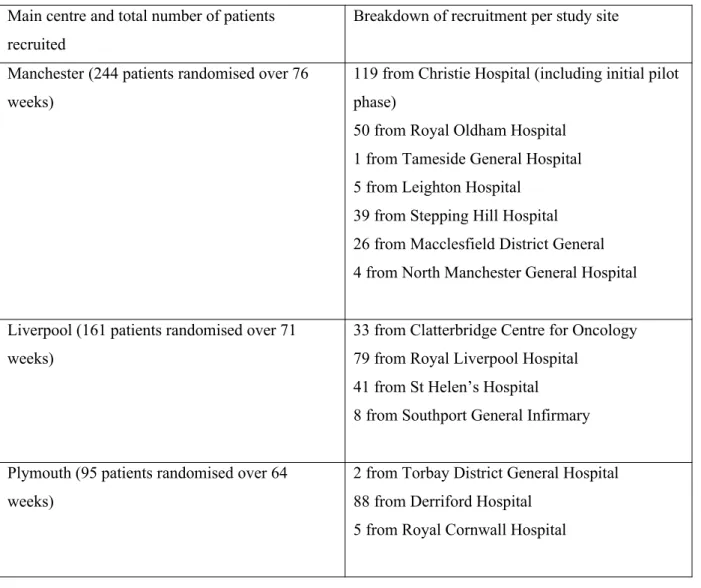
Plymouth. Recruitment began with a month long pilot phase in Manchester at The Christie hospital to test recruitment processes. The first case was randomised on 23March 2009 and the last case on 15 October 2010. A phased recruitment launch followed in the two remaining centres with patient recruitment starting in Liverpool in May 2009, and in Plymouth in June 2009. 500 cases were randomised (166 Standard care [None], 166 Sham acupressure [Sham] and 168 Acupressure [Acu] groups). In total 14 hospital sites were involved in recruitment as shown in Table 2 below:
Table 2: Trial recruitment per study site
Main centre and total number of patients recruited
Breakdown of recruitment per study site
Manchester (244 patients randomised over 76 weeks)
119 from Christie Hospital (including initial pilot phase)
50 from Royal Oldham Hospital 1 from Tameside General Hospital 5 from Leighton Hospital
39 from Stepping Hill Hospital 26 from Macclesfield District General 4 from North Manchester General Hospital
Liverpool (161 patients randomised over 71 weeks)
33 from Clatterbridge Centre for Oncology 79 from Royal Liverpool Hospital
41 from St Helen’s Hospital
8 from Southport General Infirmary
Plymouth (95 patients randomised over 64 weeks)
2 from Torbay District General Hospital 88 from Derriford Hospital
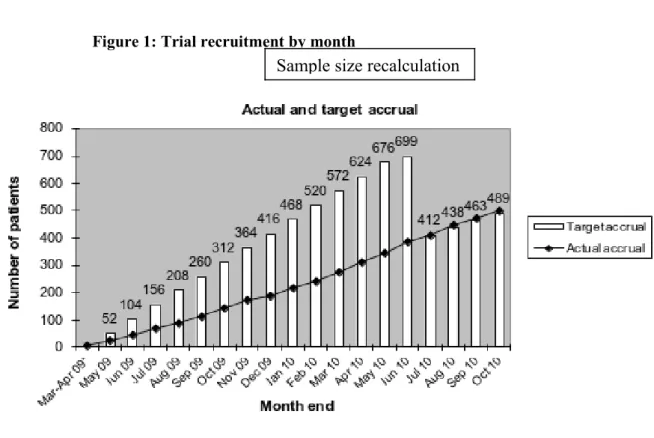
Monthly recruitment for the trial is given in figure 1 below:
Figure 1: Trial recruitment by month
Note: Monthly target accrual was recalculated after sample size adjustment in May 2010, with the agreement of the HTA team. Power was initially calculated to 90%, but as recruitment was slower than expected the sample size was recalculated to 80% power.
A participant flow diagram (figure 2; CONSORT diagram) shows the numbers of participants recruited and randomly assigned to the three trial arms and who received the intended interventions and were analysed for the primary outcome.
Figure 2: Patient recruitment into the ANCHoR Trial: Manchester, Liverpool and Plymouth Sites, March 2009-October 2010
500 patients consented to ANCHoR 168randomised to acupressure group
(11 withdrawn / died*)
166
randomised to no wrist bands group
(15 withdrawn / died**)
166 randomised to sham
acupressure group
(10 withdrawn / died***)
36 lost to follow up (no outcome data)
(6 withdrawn / died)
132
patients retained in trial lost to follow up45 (no outcome data)
(7 withdrawn / died)
121
patients retained in trial lost to follow up47 (no outcome data)
(7 withdrawn)
119
patients retained in trial
50 patients, partial data1 (5 with-drawn) 82 patients, complet e data 41 patients, partial data1 (8 with-drawn / died) 80 patients, complet e data 43 patients, partial data1 (3 with-drawn) 76 patients, complete data
* eyesight problems: 1 ** chemotherapy changed: 1 *** difficulties with chemotherapy: 1
felt very ill: 1 chemotherapy stopped: 2 chemotherapy stopped: 1
lymphoedema: 1 didn’t receive wristbands: 4 ineligible re. screening criteria: 4
sore arms after chemotherapy: 1 felt very ill: 2 sore arms after chemotherapy: 2
uncomfortable wristbands: 2 no reason given: 3 uncomfortable wristbands: 1
no reason given: 2
died: 2 Please note: Data represented in this figure include pilot phase, March-April 2009
4.2. Descriptive statistics by trial arm
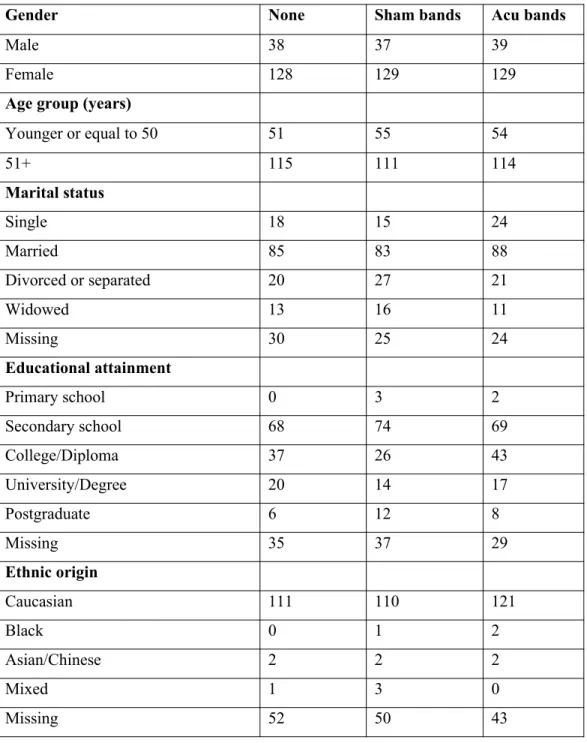
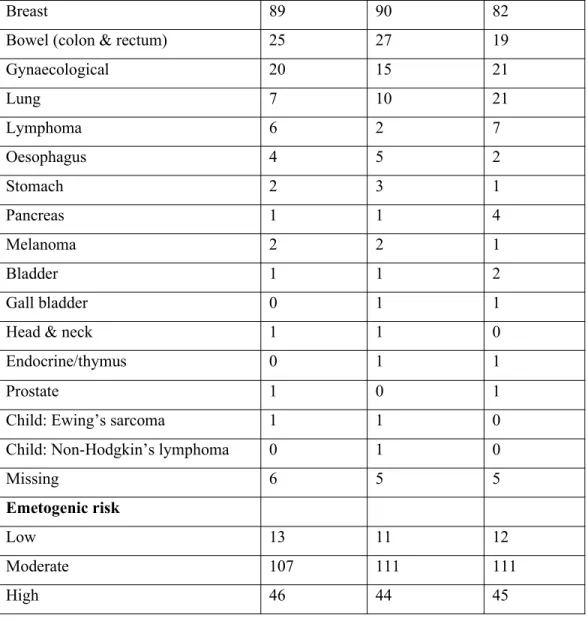
The majority of the participants were females, married and older than 50 years old. The key diagnoses of the sample included breast and colorectal cancer and the majority had received moderately emetogenic chemotherapy (including anthracycline-based chemotherapy). Other sociodemographic can clinical data can be seen in Table 3.
Table 3. Demographic and clinical data of the sample
Gender None Sham bands Acu bands
Male 38 37 39
Female 128 129 129
Age group (years)
Younger or equal to 50 51 55 54
51+ 115 111 114
Marital status
Single 18 15 24
Married 85 83 88
Divorced or separated 20 27 21
Widowed 13 16 11
Missing 30 25 24
Educational attainment
Primary school 0 3 2
Secondary school 68 74 69
College/Diploma 37 26 43
University/Degree 20 14 17
Postgraduate 6 12 8
Missing 35 37 29
Ethnic origin
Caucasian 111 110 121
Black 0 1 2
Asian/Chinese 2 2 2
Mixed 1 3 0
Missing 52 50 43
Religious affiliation
Christian 114 106 122
Muslim 1 2 3
Hindu 0 1 0
None 17 18 12
Prefers not to say 1 4 2
Other 5 8 7
Missing 28 27 22
Occupational group
Professional 40 44 36
Managerial & technical 17 16 23
Skilled non manual 14 11 16
Skilled manual 14 12 11
Unskilled 14 16 15
Not applicable 28 33 43
Missing 39 34 24
Occupational statusOffice of Population Censuses and Surveys
Employed full-time 50 36 33
Employed part-time 22 17 26
Retired 46 50 51
Unemployed 2 4 3
Casual worker 0 0 1
Not working due to ill health 10 20 17
Housewife 5 11 10
Other 2 3 4
Missing 29 25 23
Smoking history
Never 63 62 66
Previously 56 51 62
Current 20 25 18
Missing 27 28 22
Diagnosis
Breast 89 90 82
Bowel (colon & rectum) 25 27 19
Gynaecological 20 15 21
Lung 7 10 21
Lymphoma 6 2 7
Oesophagus 4 5 2
Stomach 2 3 1
Pancreas 1 1 4
Melanoma 2 2 1
Bladder 1 1 2
Gall bladder 0 1 1
Head & neck 1 1 0
Endocrine/thymus 0 1 1
Prostate 1 0 1
Child: Ewing’s sarcoma 1 1 0
Child: Non-Hodgkin’s lymphoma 0 1 0
Missing 6 5 5
Emetogenic risk
Low 13 11 12
Moderate 107 111 111
High 46 44 45
4.3. Assessment of missing data for the primary outcome
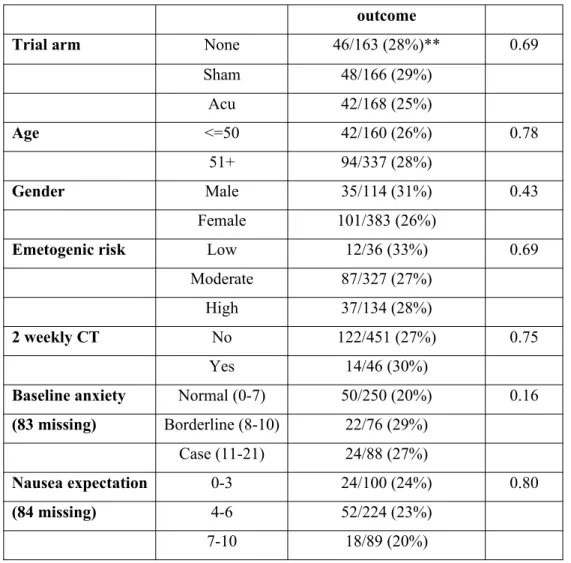
500 cases were randomised but there is only data for 361 of these for the primary outcome i.e. around 28% of cases are missing the primary outcome. The following Table 4 illustrates the proportion of cases missing the primary outcome by various factors thought to influence nausea propensity for the remaining 497 cases.
Table 4. The proportion of cases missing the primary outcome by trial arm
Factor Level Missing primary p-value*
outcome
Trial arm None 46/163 (28%)** 0.69
Sham 48/166 (29%)
Acu 42/168 (25%)
Age <=50 42/160 (26%) 0.78
51+ 94/337 (28%)
Gender Male 35/114 (31%) 0.43
Female 101/383 (26%)
Emetogenic risk Low 12/36 (33%) 0.69
Moderate 87/327 (27%)
High 37/134 (28%)
2 weekly CT No 122/451 (27%) 0.75
Yes 14/46 (30%)
Baseline anxiety Normal (0-7) 50/250 (20%) 0.16
(83 missing) Borderline (8-10) 22/76 (29%) Case (11-21) 24/88 (27%)
Nausea expectation 0-3 24/100 (24%) 0.80
(84 missing) 4-6 52/224 (23%)
7-10 18/89 (20%)
* Chi-square tests of equal proportions.
** Three were all allocated to “No acupressure” but there are no records in the trial database for these 3 cases i.e. no completed screening forms and no returned data forms. These 3 cases are the discrepant ones between n=500 and n=497.
There are no marked associations of any of these factors with the probability of missing the primary outcome.
Inevitably there is further dropout of cases with each cycle as illustrated in the following Table 5:
Table 5. Dropout data by trial arm over the four cycles of chemotherapy
Dropout status None Sham Acu Total Immediate (no outcome data) 45 47 36 128
Complete (all outcome data) 80 76 82 238 Cycle 1 then dropped out 12 14 14 40 Cycle 1-2 then dropped out 11 17 12 40 Cycle 1-3 then dropped out 14 11 12 37
Intermittent data 4 1 12 17
Total 166 166 168 500
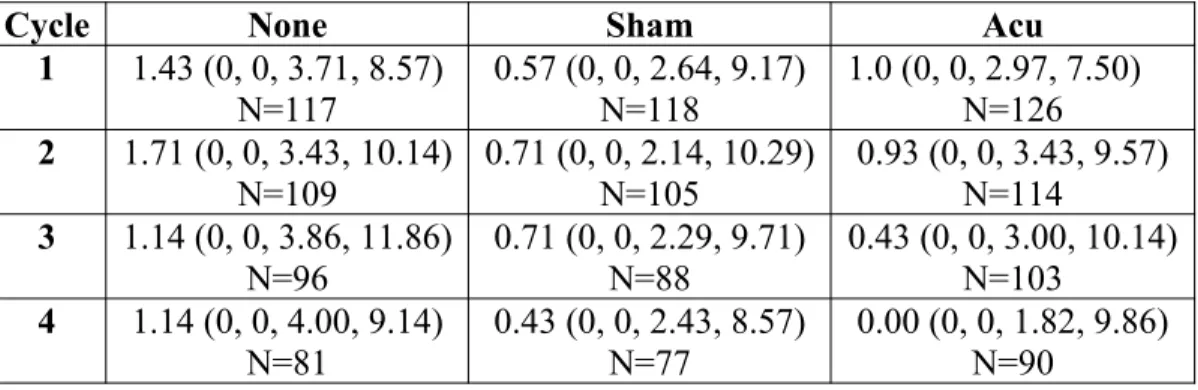
Table 6 below shows the mean nausea experience of the patients using the Index of Nausea, Vomiting and Retching scale. Scores can be from 0-12, with higher scores indicating higher levels of nausea. Both the sham and acupressure arms had less nausea experience compared to the standard care arm, although this did not reach statistical significance. To note that these mean values represent very low levels of nausea. Only at cycle 4 results become significant (P<0.05) with the acupressure group having no nausea experience reported.
Table 6. Mean Rhodes nausea experience (days 0-6). Entries are median (min, lower
quartile, upper quartile, max):
Cycle
None
Sham
Acu
1
1.43 (0, 0, 3.71, 8.57)
N=117
0.57 (0, 0, 2.64, 9.17)
N=118
1.0 (0, 0, 2.97, 7.50)
N=126
2
1.71 (0, 0, 3.43, 10.14)
N=109
0.71 (0, 0, 2.14, 10.29)
N=105
0.93 (0, 0, 3.43, 9.57)
N=114
3
1.14 (0, 0, 3.86, 11.86)
N=96
0.71 (0, 0, 2.29, 9.71)
N=88
0.43 (0, 0, 3.00, 10.14)
N=103
4
1.14 (0, 0, 4.00, 9.14)
N=81
0.43 (0, 0, 2.43, 8.57)
N=77
0.00 (0, 0, 1.82, 9.86)
N=90
Tables 7 and 8 show frequencies of the nausea and vomiting experience respectively,
categorised over five groups of experience.
Table 7.
Number of participants in each nausea experience score (based on
Rhodes
nausea experience subscale, days 0-6)
:Cycle 1
0 (0-2] (2,4] (4,6] >6 <NA>
None 34 35 21 14 13 49
Sham 36 47 19 8 8 48
Acupressure 41 38 28 11 8 42
Cycle 2
None 32 29 27 9 12 57
Sham 36 41 13 10 5 61
Acupressure 43 29 19 10 13 54
Cycle 3
None 33 22 19 14 8 70
Sham 33 31 10 9 5 78
Acupressure 43 29 11 8 12 65
Cycle 4
None 27 23 13 10 8 85
Sham 36 16 15 7 3 89
Acupressure 53 17 8 6 6 78
Table 8
. Number
of participants in each vomiting experience score (based on
Rhodes
vomiting experience subscale, days 0-6)
:Cycle 1
0 (0-1] (1,2] (2,3] >3 <NA>
None 76 24 11 4 3 48
Sham 80 27 7 3 1 48
Acupressure 85 24 9 7 1 42
Cycle 2
None 74 20 9 2 3 58
Sham 74 21 6 4 0 61
Acupressure 90 16 2 4 2 54
Cycle 3
None 75 13 3 0 5 70
Sham 68 15 4 0 1 78
Acupressure 81 15 3 1 3 65
Cycle 4
None 60 11 3 5 2 85
Sham 61 12 1 2 1 89
Acupressure 76 9 3 1 1 78
Tables9 and 10 below present descriptive data of acute and delayed nausea based on the MASCC Antiemesis Tool scale, showing similar results with the Index of Nausea, Vomiting and Retching scale. Tables 11 and 12 report the same for acute and delayed vomiting based on the MASCC Antiemesis Tool scale.
Table 9. MASCC Antiemesis Tool- acute nausea: Number of participants reporting a score from ‘0’ to ‘10’
Cycle 1
0 1-3 4-6 7-9 10 <NA>
None 63 20 14 11 9 49
Sham 65 33 9 8 5 46
Acupressure 72 29 14 8 7 38
Cycle 2
None 56 28 14 6 6 56
Sham 71 21 4 8 2 60
Acupressure 68 25 7 8 8 52
Cycle 3
None 52 24 10 7 3 70
Sham 53 21 9 4 2 77
Acupressure 65 15 10 8 4 66
Cycle 4
None 44 17 10 7 3 85
Sham 49 16 8 5 1 87
Acupressure 61 12 8 4 3 80
Table 10.
MASCC Antiemesis Tool-delayed nausea
: Number of participants reporting a score from ‘0’ to ‘10’Cycle 1
0 1-3 4-6 7-9 10 <NA>
None 49 24 21 13 11 48
Sham 61 25 14 7 9 50
Acupressure 58 30 25 8 7 40
Cycle 2
None 43 23 22 11 6 61
Sham 54 24 17 7 2 62
Acupressure 57 28 17 9 5 52
Cycle 3
None 43 22 15 8 5 73
Sham 42 26 14 4 3 77
Acupressure 56 19 13 10 4 66
Cycle 4
None 35 20 10 8 6 87
Sham 44 16 13 4 1 88
Acupressure 57 14 6 7 2 82
Table 11.
MASCC Antiemesis Tool-acute vomiting (Number of participants and
occasions of vomiting)
:Cycle 1
0 1-3 4-6 7-9 10 <NA>
None 99 10 4 2 2 49
Sham 106 12 1 1 1 45
Acupressure 110 11 5 1 3 38
Cycle 2
None 97 8 1 4 0 56
Sham 94 7 4 1 0 60
Acupressure 101 9 2 0 3 53
Cycle 3
None 91 3 1 1 1 69
Sham 81 5 1 1 0 60
Acupressure 91 8 3 0 0 66
Cycle 4
None 75 4 1 1 0 85
Sham 72 6 0 1 0 87
Acupressure 86 3 0 1 0 78
Table 12.
MASCC Antiemesis Tool-delayed vomiting (Number of participants and
days of vomiting experience)
:Cycle 1
0 1 2 3 4 <NA>
None 99 9 6 2 3 47
Sham 103 7 3 2 2 49
Acupressure 108 8 7 2 3 40
Cycle 2
None 94 7 3 0 2 60
Sham 98 3 2 1 1 61
Acupressure 104 7 3 0 2 52
Cycle 3
None 86 2 2 1 2 73
Sham 80 5 2 1 1 77
Acupressure 90 6 2 2 1 67
Cycle 4
None 71 2 2 2 3 86
Sham 71 3 2 2 0 88
Acupressure 80 4 1 1 0 82
4.4. Primary outcome analysis
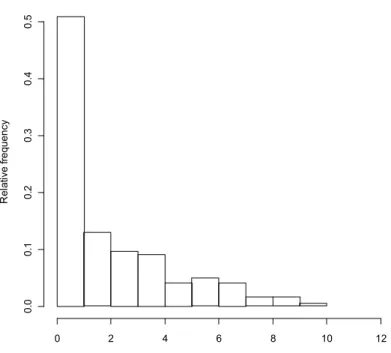
The primary outcome is the mean Rhodes (Index of Nausea, Vomiting and Retching scale) nausea experience (days 0 to 6) for cycle 1. As can be seen from figure 3 the data are highly skewed. The possible range for values is 0 to 12 but in fact 111/361 (31%) are exactly zero and around half of all values are less than 1. No transformation would be successful in normalising such a distribution.
Mean Rhodes Nausea Experience (days 0 to 6 of cycle 1)
R
e
la
tiv
e
fr
e
qu
e
n
cy
0 2 4 6 8 10 12
0
.0
0
.1
0
.2
0
.3
0
.4
0
.5
Figure 3. Primary outcome distribution (n=361)
Note: The intervals are [0,1], (1,2], (2,3], ..[11,12]. The first interval is closed at both ends and subsequent intervals are open at their lower bound and closed at their upper bound
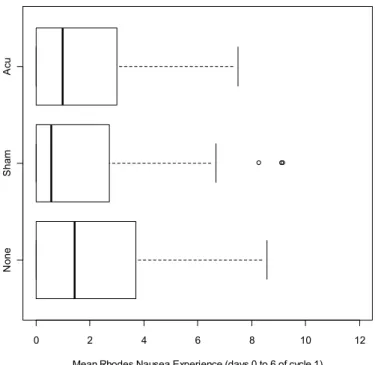
The distribution by trial arm is shown in figure 4. Due to the highly skewed distribution the non-parametric Kruskal-Wallis test has been used for the primary comparison of the trial arms. This overall test is non-significant (p=0.14).
Provision for pairwise comparisons (Mann-Whitney U tests) with a Bonferroni adjustment was made in the trial design: None v Acupressure (p=0.23), None v Sham acupressure (p=0.05), Sham v Acupressure (p=0.40). It should be noted that the reference value for statistical significance is 0.017 and so none of these pairwise comparisons are statistically significant.
N
o
n
e
S
h
am
A
cu
0 2 4 6 8 10 12
Mean Rhodes Nausea Experience (days 0 to 6 of cycle 1)
Figure 4. Box and whisker plot of the primary outcome by trial arm
4.5. Regression analyses for the nausea primary outcome data
As noted previously the data are highly skewed and no transformation will be successful in normalising the distribution. The approach adopted here is to group the values into five ordered categories and to utilize regression methods for ordinal data. The categories were chosen after inspection of figure 3. The first category “Zero” was chosen as it represented no nausea at all and there was a large fraction of cases that fell into such a category (31%). The choice of the other categories was somewhat arbitrary. Five
categories is fairly typical for ordinal regression models in the literature and it is desirable that no category has a very small frequency. Category five has a broad range but only
8% cases; subdividing it further would be counter-productive. Having chosen the lowest and highest categories the remaining three were simply selected to have equal width. The following Table 13 shows the categories and the frequencies by trial arm (n=361).
Table 13. Ordered categories of Nausea experience by trial arm (Number of participants in each group of nausea scores)
Category Nausea score None Sham Acu
1 0 34 36 41
2 (0, 2] 35 47 38
3 (2, 4] 21 19 28
4 (4, 6] 14 8 11
5 (6, 12] 13 8 8
The main tool used was the proportional odds regression model.58
k = 1, 2, 3, 4 denotes category i = 1, 2, …, n denotes case
is the response category for the i’th case
is a vector of covariate values for the i’th case (including trial arm) is an intercept term for the k’th category
is a vector of parameters to be estimated Logit(p) = log[p/(1-p)]
4.5.1. Unadjusted fit
The following snippet of output in Box 1 is for an unadjusted fit using all the available data (n=361).
Box 1. Unadjusted fit model for nausea experience
Coefficients:
Definition Value Std. Error t value ArmSham (Sham=1, otherwise=0) 0.3354 0.2356 1.424 ArmAcupressure (Acu=1, otherwise=0) 0.2418 0.2334 1.036
Intercepts:
Value Std. Error t value 1|2 -1.0138 0.1836 -5.5203 2|3 0.3777 0.1775 2.1281 3|4 1.3821 0.1943 7.1138 4|5 2.2506 0.2343 9.6047
Residual Deviance: 1055.186 AIC: 1067.186
The above data show that:
The likelihood ratio test of the proportional odds assumption is non-significant (p=0.51) meaning there is no good evidence against this assumption.
The likelihood ratio test for the trial arm effects is non-significant (p=0.34). The estimated odds ratio of a lower (i.e. better) score for Acupressure compared to
control are e0.2418 = 1.27 , 95% CI (0.80, 2.03)
The estimated odds ratio of a lower (i.e. better) score for Sham Acupressure compared to control are e0.3354 = 1.40 , 95% CI (0.87, 2.24)
Hence, patients in the acupressure arm are 27% more likely to have less nausea/vomiting than the control arm and the sham arm 40%.
4.5.2. Adjusted fit (age, gender and emetogenic risk)
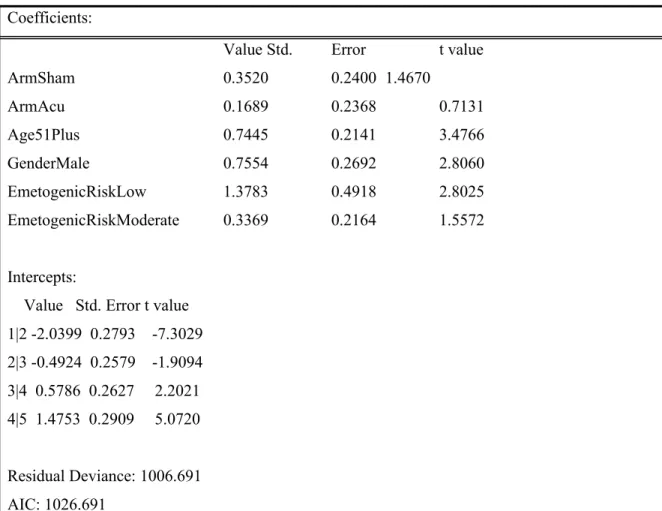
The following snippet of output presented in Box 2 is for an adjusted fit using all the available data (n=361).
Box 2. Adjusted fit model for gender, age and emetogenic level in relation to nausea experience Coefficients:
Value Std. Error t value ArmSham 0.3520 0.2400 1.4670
ArmAcu 0.1689 0.2368 0.7131 Age51Plus 0.7445 0.2141 3.4766 GenderMale 0.7554 0.2692 2.8060 EmetogenicRiskLow 1.3783 0.4918 2.8025 EmetogenicRiskModerate 0.3369 0.2164 1.5572
Intercepts:
Value Std. Error t value 1|2 -2.0399 0.2793 -7.3029 2|3 -0.4924 0.2579 -1.9094 3|4 0.5786 0.2627 2.2021 4|5 1.4753 0.2909 5.0720
Residual Deviance: 1006.691 AIC: 1026.691
Table 14 shows the results of the regression analysis assessing variables that affect the primary outcome of nausea. It indicates that, irrespective of arm allocation, subjects that were older than 50 years old and male had better nausea outcome. Also, the emetogenicity of the drug was also significant factor to the nausea outcome.
Table 14. Regression analysis: variables influencing primary outcome (4-variables model)
Term df P-value
Arm 2 0.34
Age >= 51 1 0.0005
Male 1 0.005
Emetogenic risk group
2 0.013
The above data show that:
The likelihood ratio test of the proportional odds assumption is non-significant (p=0.66) meaning there is no good evidence against this assumption.
The likelihood ratio test for the trial arm effects after adjustment for age group, gender and emetogenic risk group is non-significant (p=0.34).
The estimated odds ratio of a lower (i.e. better) score for Acupressure compared to control (for identical age group, gender and emetogenic risk group) is e0.1689 = 1.18 , 95% CI (0.74, 1.90)
The estimated odds ratio of a lower (i.e. better) score for Sham Acupressure compared to control (for identical age group, gender and emetogenic risk group) is e0.3520 = 1.42 , 95% CI (0.88, 2.30).Hence, considering the three risk factors presented in Table 14 and the adjusted data presented earlier, patients in the acupressure arm are 18% more likely to have less nausea/vomiting than the control arm and the sham arm 42%.
It is of interest to consider the impact of adding a trial arm x term interaction effect to the fitted model for each of age group, gender and emetogenic risk group in turn. A regression analysis presents the findings of this impact (Table 15).
Table 15. Regression analysis: trial arm x term interaction effect
Interaction term df P-value Arm x (Age >= 51) 2 0.70
Arm x Male 2 0.002
Arm x (Emetogenic risk group)
4 0.88
This is indicating that there is evidence to suggest that treatment effects may vary with gender. This merits further investigation (see simple illustration later on).
4.5.3. Adjusted fit (age, gender, emetogenic risk, cycle frequency, anxiety and nausea expectation)