Web Spam Taxonomy
Zolt´
an Gy¨
ongyi
Computer Science DepartmentStanford University [email protected]
Hector Garcia-Molina
Computer Science DepartmentStanford University [email protected]
Abstract
Web spamming refers to actions intended to mislead search engines into ranking some pages higher than they deserve. Recently, the amount of web spam has in-creased dramatically, leading to a degradation of search results. This paper presents a comprehensive taxon-omy of current spamming techniques, which we believe can help in developing appropriate countermeasures.
1
Introduction
As more and more people rely on the wealth of informa-tion available online, increased exposure on the World Wide Web may yield significant financial gains for in-dividuals or organizations. Most frequently, search en-gines are the entryways to the Web; that is why some people try to mislead search engines, so that their pages would rank high in search results, and thus, capture user attention.
Just as with emails, we can talk about the phenom-enon ofspammingthe Web. The primary consequence of web spamming is that the quality of search results decreases. For instance, at the time of writing this article, the second result returned by a major search engine for the query “Kaiser pharmacy” was a page on the spam web site techdictionary.com. This site contains only a few lines of useful information (mainly some term definitions, probably copied from a real dic-tionary), but consists of thousands of pages, each re-peating the same content and pointing to dozens of other pages. All the pages were probably created to boost the rankings of some others, and none of them seems to be particularly useful for anyone looking for pharmacies affiliated with Kaiser-Permanente.
The secondary consequence of spamming is that search engine indexes are inflated with useless pages, increasing the cost of each processed query.
To provide low-cost, quality services, it is critical for search engines to address web spam. Search engines currently fight spam with a variety of often manual
techniques, but as far as we know, they still lack a fully effective set of tools for combating it. We believe that the first step in combating spam isunderstanding it, that is, analyzing the techniques the spammers use to mislead search engines. A proper understanding of spamming can then guide the development of appro-priate countermeasures.
To that end, in this paper we organize web spam-ming techniques into a taxonomy that can provide a framework for combating spam. We also provide an overview of published statistics about web spam to un-derline the magnitude of the problem.
There have been brief discussions of spam in the sci-entific literature [3, 6, 12]. One can also find details for several specific techniques on the Web itself (e.g., [11]). Nevertheless, we believe that this paper offers the first comprehensive taxonomy of all important spamming techniques known to date. To build our taxonomy, we worked closely with experts at one of the major search engine companies, relying on their experience, while at the same time investigating numerous spam instances on our own.
Some readers might question the wisdom of revealing spamming secrets, concerned that this might encourage additional spamming. We assure readers that nothing in this paper is secret to the spammers; it is only most of the web users who are unfamiliar with the techniques presented here. We believe that by publicizing these spamming techniques we will raise the awareness and interest of the research community.
2
Definition
page is to the query. Importance refers to the global (query-independent) popularity of a page, as often in-ferred from the link structure (e.g., pages with many incoming links are more important), or perhaps other indicators. In practice, search engines usually combine relevance and importance, computing a combined rank-ingscore that is used to order query results presented to the user.
We use the termspamming(also,spamdexing) to re-fer to any deliberate human action that is meant to trigger an unjustifiably favorable relevance or impor-tance for some web page, considering the page’s true value. We will use the adjectivespamto mark all those web objects (page content items or links) that are the result of some form of spamming. People who perform spamming are calledspammers.
One can locate on the World Wide Web a handful of other definitions of web spamming. For instance, some of the definitions (e.g., [13]) are close to ours, stating that any modification done to a page solely because search engines exist is spamming. Specific organiza-tions or web user groups (e.g., [9]) define spamming by enumerating some of the techniques that we present in Sections 3 and 4.
An important voice in the web spam arena is that of search engine optimizers (SEOs), such as SEO Inc. (www.seoinc.com) or Bruce Clay (www.bruceclay.com). The activity of some SEOs benefits the whole web community, as they help au-thors create well-structured, high-quality pages. How-ever, most SEOs engage in practices that we call ming. For instance, there are SEOs who define spam-ming exclusively as increasing relevance for queries not related to the topic(s) of the page. These SEOs endorse and practice techniques that have an impact on impor-tance scores, to achieve what they call “ethical” web page positioning or optimization. Please note that ac-cording to our definition, all types of actions intended to boost ranking (either relevance, or importance, or both), without improving the true value of a page, are considered spamming.
There are two categories of techniques associated with web spam. The first category includes the boost-ing techniques, i.e., methods through which one seeks to achieve high relevance and/or importance for some pages. The second category includes hiding techniques, methods that by themselves do not influence the search engine’s ranking algorithms, but that are used to hide the adopted boosting techniques from the eyes of hu-man web users. The following two sections discuss each of these two categories in more detail.
! "#
!$!%# &$!#
' ! "#
'
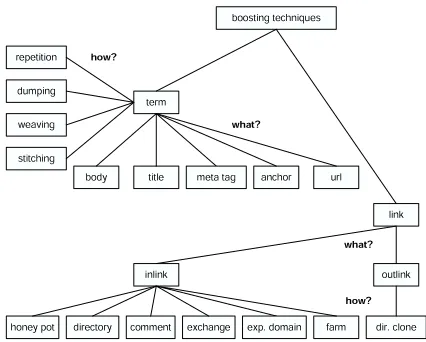
Figure 1: Boosting techniques.
3
Boosting Techniques
In this section we present spamming techniques that in-fluence the ranking algorithms used by search engines. Figure 1 depicts our taxonomy, in order to guide our discussion.
3.1
Term Spamming
In evaluating textual relevance, search engines consider where on a web page query terms occurs. Each type of location is called afield. The common text fields for a pagepare the document body, the title, the meta tags in the HTML header, and pagep’s URL. In addition, the anchor texts associated with URLs that point to
pare also considered belonging to pagep(anchor text field), since they often describe very well the content of
p. The terms inp’s text fields are used to determine the relevance ofpwith respect to a specific query (a group of query terms), often with different weights given to different fields. Term spamming refers to techniques that tailor the contents of these text fields in order to make spam pages relevant for some queries.
3.1.1 Target Algorithms
The algorithms used by search engines to rank web pages based on their text fields use various forms of the fundamental TFIDF metric used in information re-trieval [1]. Given a specific text field, for each termt
of documents in the collection that contain t. For in-stance, if “apple” appears in 4 out of the 40 documents in the collection, its IDF(“apple”) score will be 10. The TFIDF score of a page pwith respect to a query q is then computed over all common termst:
TFIDF(p, q) = X t∈pandt∈q
TF(t)·IDF(t)
With TFIDF scores in mind, spammers can have two goals: either to make a page relevant for a large number of queries (i.e., to receive a non-zero TFIDF score), or to make a page very relevant for a specific query (i.e., to receive a high TFIDF score). The first goal can be achieved by including a large number of distinct terms in a document. The second goal can be achieved by re-peating some “targeted” terms. (We can assume that spammers cannot have real control over the IDF scores of terms. Moreover, some search engines ignore IDF scores altogether. Thus, the primary way of increas-ing the TFIDF scores is by increasincreas-ing the frequency of terms within specific text fields of a page.)
3.1.2 Techniques
Term spamming techniques can be grouped based on the text field in which the spamming occurs. Therefore, we distinguish:
• Body spam. In this case, the spam terms are in-cluded in the document body. This spamming technique is among the simplest and most pop-ular ones, and it is almost as old as search engines themselves.
• Title spam. Today’s search engines usually give a higher weight to terms that appear in the title of a document. Hence, it makes sense to include the spam terms in the document title.
• Meta tag spam. The HTML meta tags that appear in the document header have always been the tar-get of spamming. Because of the heavy spamming, search engines currently give low priority to these tags, or even ignore them completely. Here is a simple example of a spammedkeywordsmeta tag:
<meta name=“keywords” content=“buy, cheap, cameras, lens, accessories, nikon, canon”>
• Anchor text spam. Just as with the document ti-tle, search engines assign higher weight to anchor text terms, as they are supposed to offer a sum-mary of the pointed document. Therefore, spam terms are sometimes included in the anchor text of the HTML hyperlinks to a page. Please note that
this spamming technique is different from the pre-vious ones, in the sense that the spam terms are added not to a target page itself, but the other pages that point to the target. As anchor text gets indexed for both pages, spamming it has im-pact on the ranking of both the source and target pages. A simple anchor text spam is:
<a href=“target.html”>free, great deals, cheap, in-expensive, cheap, free</a>
• URL spam. Some search engines also break down the URL of a page into a set of terms that are used to determine the relevance of the page. To exploit this, spammers sometimes create long URLs that include sequences of spam terms. For instance, one could encounter spam URLs like:
buy-canon-rebel-20d-lens-case.camerasx.com, buy-nikon-d100-d70-lens-case.camerasx.com, . . .
Some spammers even go to the extent of setting up a DNS server that resolves anyhost name within a domain.
Often, spamming techniques are combined. For in-stance, anchor text and URL spam is often encoun-tered together with link spam, which will be discussed in Section 3.2.2.
Another way of grouping term spamming techniques is based on the type of terms that are added to the text fields. Correspondingly, we have:
• Repetitionof one or a few specific terms. This way, spammers achieve an increased relevance for a doc-ument with respect to a small number of query terms.
• Dumpingof a large number of unrelated terms, of-ten even entire dictionaries. This way, spammers make a certain page relevant to many different queries. Dumping is effective against queries that include relatively rare, obscure terms: for such queries, it is probable that only a couple of pages are relevant, so even a spam page with a low rel-evance/importance would appear among the top results.
within the text, so that search engine algorithms that filters out plain repetition would be misled. A short example of spam weaving is:
Remember not only airfare to say the right plane tickets thing in the right place, but far cheap travel more difficult still, to leave hotel rooms unsaid the wrong thing at vacation the tempting moment.
• Phrase stitchingis also used by spammers to create content quickly. The idea is to glue together sen-tences or phrases, possibly from different sources; the spam page might then show up for queries on any of the topics of the original sentences. For instance, a spammer using this paper as source could come up with the following collage:
The objective of a search engine is to provide high-quality results by correctly identifying. Unjustifiably favorable boosting techniques, i.e., methods through which one seeks relies on the identification of some common features of spam pages.
3.2
Link Spamming
Beside term-based relevance metrics, search engines also rely on link information to determine the impor-tance of web pages. Therefore, spammers often create link structures that they hope would increase the im-portance of one or more of their pages.
3.2.1 Target Algorithms
For our discussion of the algorithms targeted by link spam, we will adopt the following model. For a spam-mer, there are three types of pages on the Web:
1. Inaccessible pages are those that a spammer can-not modify. These are the pages out of reach; the spammer cannot influence their outgoing links. (Note that a spammer can still point to inaccessi-ble pages.)
2. Accessible pages are maintained by others (pre-sumably not affiliated with the spammer), but can still be modified in a limited way by a spammer. For example, a spammer may be able to post a comment to a blog entry, and that comment may contain a link to a spam site. As infiltrating ac-cessible pages is usually not straightforward, let us say that a spammer has a limited budget ofm
accessible pages. For simplicity, we assume that at most one outgoing link can be added to each accessible page.
3. Ownpages are maintained by the spammer, who thus has full control over their contents. We call
the group of own pages aspam farm Σ. A spam-mer’s goal is to boost the importance of one or more of his or her own pages. For simplicity, say there is a single target paget. There is a certain maintenance cost (domain registration, web host-ing) associated with a spammer’s own pages, so we can assume that a spammer has a limited budget ofnsuch pages, not including the target page.
With this model in mind, we discuss the two well-known algorithms used to compute importance scores based on link information.
HITS. The original HITS algorithm was introduced in [7] to rank pages on a specific topic. It is more com-mon, however, to use the algorithm on all pages on the Web to assigns globalhubandauthorityscores to each page. According to the circular definition of HITS, im-portant hub pages are those thatpoint tomany impor-tant authority pages, while imporimpor-tant authority pages are those pointed to by many hubs. A search engine that uses the HITS algorithm to rank pages returns as query result a blending of the pages with the highest hub and authority scores.
Hub scores can be easily spammed by adding outgo-ing links to a large number of well known, reputable pages, such aswww.cnn.comor www.mit.edu. Thus, a spammer should add many outgoing links to the target pagetto increase its hub score.
Obtaining a high authority score is more compli-cated, as it implies having many incoming links from presumably important hubs. A spammer could boost the hub scores of his n pages (once again, by adding many outgoing links to them) and then make those pages point to the target. Links from important acces-sible hubs could increase the target’s authority score even further. Therefore, the rule here is “the more the better”: within the limitations of the budget, the spammer should have all own and accessible pages point to the target. Non-target own pages should also point to as many other (known important) authorities as possible.
PageRank. PageRank, as described in [10], uses incoming link information to assign global importance scores to all pages on the Web. It assumes that the number of incoming links to a page is related to that page’s popularity among average web users (people would point to pages that they find important). The intuition behind the algorithm is that a web page is important if several other important web pages point to it. Correspondingly, PageRank is based on a mu-tual reinforcement between pages: the importance of a certain pageinfluences and is being influencedby the importance of some other pages.
t
accessible own
inaccessible
.
.
.
.
.
.
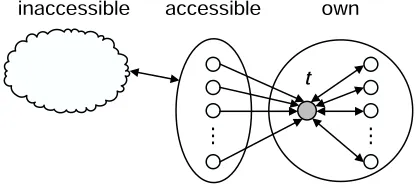
Figure 2: An optimal link structure for PageRank.
(at the extreme, a single page) depends on four factors:
PR(Γ) = PRstatic(Γ)+PRin(Γ)−PRout(Γ)−PRsink(Γ),
where PRstaticis the score component due to the static score distribution (random jump); PRinis the score re-ceived through the incoming links from external pages; PRoutis the score leaving Γ through the outgoing links to external pages; and PRsink is the score loss due to those pages within the group that have no outgoing links.
For our spam farm model, the previous formula leads to a class of optimal link structures that were proved to maximize the score of the target page [4]. One such optimal structure is presented in Figure 2; it has the arguably desirable properties that (1) it makes all own pages reachable from the accessible ones (so that they could be crawled by a search engine), and (2) it does this using a minimal number of links. We can observe how the presented structure maximizes the total Page-Rank score of the spam farm, and of paget in partic-ular:
1. All available n own pages are part of the spam farm, maximizing the static score PRstatic(Σ).
2. All m accessible pages point to the spam farm, maximizing the incoming score PRin(Σ).
3. Links pointing outside the spam farm are sup-pressed, making PRout(Σ) equal to zero.
4. All pages within the farm have some outgoing links, rendering a zero PRsink(Σ) score component.
Within the spam farm, the the score of page t is maximal because:
1. All accessible and own pages point directly to the target, maximizing its incoming score PRin(t).
2. The target points to all other own pages. Without such links, t would had lost a significant part of
its score (PRsink(t)>0), and the own pages would had been unreachable from outside the spam farm. Note that it would not be wise to add links from the target to pages outside the farm, as those would decrease the total PageRank of the spam farm.
As we can see in Figure 2, the “more is better” rule also applies to PageRank. It is true that setting up sophisticated link structures within a spam farm does not improve the ranking of the target page. However, a spammer can achieve high PageRank by accumulating many incoming links from accessible pages, and/or by creating large spam farms with all the pages pointing to the target. The corresponding spamming techniques are presented next.
3.2.2 Techniques
We group link spamming techniques based on whether they add numerous outgoing links to popular pages or they gather many incoming links to a single target page or group of pages.
Outgoing links. A spammer might manually add a number of outgoing links to well-known pages, hoping to increase the page’s hub score. At the same time, the most wide-spread method for creating a massive number of outgoing links isdirectory cloning: One can find on the World Wide Web a number of directory sites, some larger and better known (e.g., the DMOZ Open Directory, dmoz.org, or the Yahoo! directory, dir.yahoo.com), some others smaller and less famous (e.g., the Librarian’s Index to the Internet, lii.org). These directories organize web content around topics and subtopics, and list relevant sites for each. Spam-mers then often simply replicate some or all of the pages of a directory, and thus create massive outgoing-link structures quickly.
Incoming links. In order to accumulate a num-ber of incoming links to a single target page or set of pages, a spammer might adopt some of the following strategies:
• Create a honey pot, a set of pages that provide
some useful resource (e.g., copies of some Unix documentation pages), but that also have (hid-den) links to the target spam page(s). The honey pot then attracts people to point to it, boost-ing indirectly the rankboost-ing of the target page(s). Please note that the previously mentioned direc-tory clones could act as honey pots.
• Infiltrate a web directory. Several web directories
the editors of such directories do not control and verify link additions strictly, or get misled by a skilled spammer. In these instances, spammers may be able to add to directory pages links that point to their target pages. As directories tend to have both high PageRank and hub scores, this spamming technique is useful in boosting both the PageRank and authority scores of target pages.
• Post links on blogs, unmoderated message boards, guest books, or wikis. As mentioned earlier in Sec-tion 3.2.1, spammers may include URLs to their spam pages as part of the seemingly innocent comments/messages they post. Without an edi-tor or a moderaedi-tor to oversee all submitted com-ments/messages, pages of the blog, message board, or guest book end up linking to spam. Even if there is an editor or a moderator, it could be non-trivial to detect spam comments/messages as they might employ some of the hiding techniques pre-sented in the next section. Here is a simple ex-ample of a spam blog comment that features both link and anchor text spamming:
Nice story. Read about my <a href=“http:// bestcasinoonlinever.com”>Las Vegas casino</a> trip.
It is important to mention that blog comment spamming is gaining popularity, and it is not only a problem for search engines, but also has a strong direct influences on the large community of mil-lions of bloggers: for the web users with their own blogs, comment spamming represents a nuisance similar to email spamming. Recently, a num-ber of tools and initiatives were launched to curb comment spamming. For instance, some bloggers maintain lists of domain names that appear in spam URLs [8].
• Participate in link exchange. Often times, a group of spammers set up a link exchange structure, so that their sites point to each other.
• Buy expired domains. When a domain names ex-pires, the URLs on various other web sites that point to pages within the expired domain linger on for some time. Some spammers buy expired domains and populate them with spam that takes advantage of the false relevance/importance con-veyed by the pool of old links.
• Create own spam farm. These days spammers can control a large number of sites and create arbi-trary link structures that would boost the ranking of some target pages. While this approach was
boosting techniques
term
link body title anchor url repetition
dumping
weaving
honey pot directory post exchange farm meta tag
what?
how? how?
outlink inlink
dir. clone what?
stitching
hiding techniques
content hiding
text link
redirection
meta tag script cloaking
color script graphics what?
how?
how?
t
u ... ... accessible own inaccessible
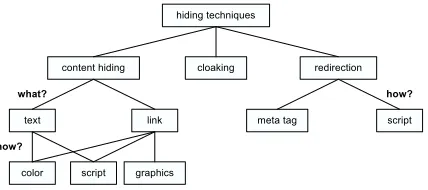
Figure 3: Spam hiding techniques.
prohibitively expensive a few years ago, today it is very common as the costs of domain registration and web hosting have declined dramatically.
4
Hiding Techniques
It is usual for spammers to conceal the telltale signs (e.g., repeated terms, long lists of links) of their activ-ities. They use a number of techniques to hide their abuse from regular web users visiting spam pages, or from the editors at search engine companies who try to identify spam instances. This section offers an overview of the most common spam hiding techniques, also sum-marized in Figure 3.
4.1
Content Hiding
Spam terms or links on a page can be made invisible when the browser renders the page. One common tech-nique is using appropriatecolor schemes: terms in the body of an HTML document are not visible if they are displayed in the same color as the background. Color schemes can be defined either in the HTML document or in an attached cascading style sheet (CSS). We show a simple HTML example next:
<body background=“white”>
<font color=“white”>hidden text</font> . . .
</body>
In a similar fashion, spam links can be hidden by avoiding anchor text. Instead, spammers often create tiny, 1×1-pixelanchor imagesthat are either transpar-ent or background-colored:
<a href=“target.html”><img src=“tinyimg.gif”></a>
4.2
Cloaking
If spammers can clearly identify web crawler clients,
they can adopt the following strategy, called
cloak-ing: given a URL, spam web servers return one specific
HTML document to a regular web browser, while they return a different document to a web crawler. This way, spammers can present the ultimately intended content to the web users (without traces of spam on the page), and, at the same time, send a spammed document to the search engine for indexing.
The identification of web crawlers can be done in two ways. On one hand, some spammers maintain a list of IP addresses used by search engines, and iden-tify web crawlers based on their matching IPs. On the other hand, a web server can identify the application
requesting a document based on theuser-agentfield in
the HTTP request message. For instance, in the follow-ing simple HTTP request message the user-agent name is that one used by the Microsoft Internet Explorer 6 browser:
GET /db pages/members.html HTTP/1.0 Host: www-db.stanford.edu
User-Agent: Mozilla/4.0 (compatible; MSIE 6.0; Win-dows NT 5.1)
The user-agent names are not strictly standardized, and it is really up to the requesting application what to include in the corresponding message field. Never-theless, search engine crawlers identify themselves by a name distinct from the ones used by traditional web browser applications. This is done in order to allow webmasters to block access to some of the contents, control network traffic parameters, or even perform some well-intended, legitimate optimizations. For in-stance, a few sites serve to search engines versions of their pages that are free from navigational links, ad-vertisements, and other visual elements related to the presentation, but not to the content. This kind of ac-tivity might even be welcome by some of the search engines, as it helps indexing the useful information.
4.3
Redirection
Another way of hiding the spam content on a page is by
automatically redirectingthe browser to another URL
as soon as the page is loaded. This way the page still gets indexed by the search engine, but the user will not
ever see it—pages with redirection act asintermediates
(or proxies, doorways) for the ultimate targets, which spammers try to serve to a user reaching their sites through search engines.
Redirection can be achieved in a number of ways.
A simple approach is to take advantage of therefresh
meta tag in the header of an HTML document. By
setting the refresh time to zero and the refresh URL to the target page, spammers can achieve redirection as soon as the page gets loaded into the browser:
<meta http-equiv=“refresh” content= “0;url=target.html”>
While the previous approach is not hard to imple-ment, search engines can easily identify such redirec-tion attempts by parsing the meta tags. More sophis-ticated spammers achieve redirection as part of some script on the page, as scripts are not executed by the crawlers:
<script language=“javascript”><! -location.replace(“target.html”) --></script>
5
Statistics
While we have a good understanding of spamming techniques, the publicly available statistical data de-scribing the amount and nature of web spam is very limited. In this section we review some of what is known.
Two papers discuss the prevalence of web spam,
pre-senting results from three experiments. Fetterlyet al.
[3] manually evaluated sample pages from two different data sets.
The first data set (DS1) represented 150 million URLs that were crawled repeatedly, once every week over a period of 11 weeks, from November 2002 to Feb-ruary 2003. The authors retained 0.1% of all crawled pages, chosen based on a hash of the URLs. A man-ual inspection of 751 pages sampled from the set of re-tained pages yielded 61 spam pages, indicating a preva-lence of 8.1% spam in the data set, with a confidence interval of 1.95% at 95% confidence.
The second data set (DS2) was the result of a sin-gle breadth-first search started at the Yahoo! home page, conducted between July and September 2002. The search covered about 429 million pages. During a later manual evaluation, from a random sample of 1,000 URLs, the authors were able to download 535 pages, of which 37 (6.9%) were spam.
A third, independent set of statistics is provided by
Gy¨ongyiet al. [5]. In this case, the authors used the
into 20 buckets. Each of the buckets contained a dif-ferent number of sites, with PageRank scores summing up to 5 percent of the total PageRank. Accordingly, the first bucket contained the 86 sites with the highest PageRank scores, bucket 2 the next 665, while the last bucket contained 5 million sites that were assigned the lowest PageRank scores. The upper part of Figure 4 shows the size of each bucket on a logarithmic scale.
First, an initial sample of 1000 sites was constructed by selecting 50 sites at random from each bucket. Then, the sample was reduced to 748 existing sites that could be categorized clearly. A manual inspection dis-covered that 135 (18%) of these sites were spam. The lower part of Figure 4 presents the fraction of spam in each bucket. It is interesting to note that almost 20% of the second PageRank bucket is spam, indicating that some sophisticated spammers can achieve high impor-tance scores. Also, note that there is a high preva-lence of spam (almost 50%) in buckets 9 and 10. This fact seems to indicate that “average” spammers can generate a significant amount of spam with mid-range logarithmic PageRank.
Table 1 summarizes the results from the three psented experiments. The differences between the re-ported prevalence figures could be due to an interplay of several factors:
• The crawls were performed at different times. It is possible that the amount of spam increased over time.
• Different crawling strategies were used.
• There could be a difference between the fraction of sites that are spam and the fraction of pages that are spam. In other words, it could be the case that the average number of pages per site is different for spam and non-spam sites.
• Classification of spam could be subjective; indi-viduals may have broader or narrower definition of what constitutes spam.
Despite the discrepancies, we can probably safely esti-mate that 10-15% of the content on the Web is spam. As the previous discussion illustrates, our statistical knowledge of web spam is sparse. It would be of inter-est to have data not only on what fraction of pages or sites is spam, but also on the relative sizes (as measured in bytes) of spam and non-spam on the Web. This would help us estimate what fraction of a search en-gine’s resources (disk space, crawling/indexing/query processing time) is wasted on spam. Another im-portant question is how spam evolves over time. Fi-nally, we do not yet know much about the relative fre-quencies of different spamming techniques, and the co-occurrence patterns between them. It is suspected that
!"
#
$
%&
'
($
)
*
'
"
+
$
(
'
&%
,-./
0
&
'
Figure 4: Bucket sizes and spam/bucket for DS3.
currently almost all spammers use link spamming, usu-ally combined with anchor text spamming, but there are no published research results supporting this hy-pothesis. It is our hope that future research in the field will provide some of the answers.
6
Conclusions
In this paper we presented a variety of commonly used web spamming techniques, and organized them into a taxonomy. We argue that such a structured discussion of the subject is important to raise the awareness of the research community. Our spam taxonomy natu-rally leads to a similar taxonomy of countermeasures. Correspondingly, we outline next the two approaches that a search engine can adopt in combating spam.
On one hand, it is possible to address each of the boosting and hiding technique presented in Sections 3 and 4 separately. Accordingly, one could:
1. Identify instances of spam, i.e., find pages that contain specific types of spam, and stop crawling and/or indexing such pages. Search engines usu-ally take advantage of a group of automatic or semi-automatic, proprietary spam detection algo-rithms and the expertise of human editors to pin-point and remove spam pages from their indexes. For instance, the techniques presented in [3] could be used to identify some of the spam farms with machine-generated structure/content.
2. Preventspamming, that is, making specific spam-ming techniques impossible to use. For instance, a search engine’s crawler could identify itself as a regular web browser application in order to avoid cloaking.
Data set Crawl date Data set size Sample size Spam DS1 11/02 – 02/03 150 million pages 751 pages 8.1% of pages DS2 07/02 – 09/02 429 million pages 535 pages 6.9% of pages DS3 08/03 31 million sites 748 sites 18% of sites
Table 1: Spam prevalence statistics.
search engines use variations of the fundamen-tal ranking methods (discussed in Sections 3.1.1 and 3.2.1) that feature some degree of spam re-silience.
On the other hand, it is also possible to address the problem of spamming as a whole, despite the differ-ences among individual spamming techniques. This approach relies on the identification of some common features of spam pages. For instance, the spam detec-tion methods presented in [5] take advantage of the
approximate isolation of reputable, non-spam pages:
reputable web pages seldom point to spam. Thus, ade-quate link analysis algorithms can be used to separate reputable pages from any form of spam, without deal-ing with each spammdeal-ing technique individually.
Acknowledgement
This paper is the result of many interesting discussions with one of our collaborators at a major search engine company, who wishes to remain anonymous. We would like to thank this person for the explanations and ex-amples that helped us shape the presented taxonomy of web spam.
References
[1] Ricardo Baeza-Yates and Berthier Ribeiro-Neto. Modern Information Retrieval. Addison-Wesley, 1999.
[2] Monica Bianchini, Marco Gori, and Franco Scarselli. Inside PageRank. ACM Transactions on Internet Technology, 5(1), 2005.
[3] Dennis Fetterly, Mark Manasse, and Marc Najork. Spam, damn spam, and statistics. InProceedings of the Seventh International Workshop on the Web and Databases (WebDB), 2004.
[4] Zolt´an Gy¨ongyi and Hector Garcia-Molina. Link spam alliances. Technical report, Stanford Uni-versity, 2005.
[5] Zolt´an Gy¨ongyi, Hector Garcia-Molina, and Jan Pedersen. Combating web spam with TrustRank.
In Proceedings of the 30th International
Confer-ence on Very Large Databases (VLDB), 2004.
[6] Monika Henzinger, Rajeev Motwani, and Craig Silverstein. Challenges in web search engines. SIGIR Forum, 36(2), 2002.
[7] Jon Kleinberg. Authoritative sources in a hyper-linked environment. Journal of the ACM, 46(5), 1999.
[8] Mark Carey Consulting Inc. Blog spam database. http://www.markcarey.com/spamdb/.
[9] Open Directory Project. Open directory edito-rial guidelines: Spamming. http://dmoz.org/ guidelines/spamming.html.
[10] Lawrence Page, Sergey Brin, Rajeev Motwani, and Terry Winograd. The PageRank citation ranking: Bringing order to the web. Technical report, Stanford University, 1998.
[11] Alan Perkins. The classification of search engine spam. http://www.ebrandmanagement.com/ whitepapers/spam-classification/.
[12] Mehran Sahami, Vibhu Mittal, Shumeet Baluja, and Henry Rowley. The happy searcher: Chal-lenges in web information retrieval. In Trends in Artificial Intelligence, 8th Pacific Rim In-ternational Conference on Artificial Intelligence (PRICAI), 2004.