An Efficient Algorithm for Easy-First Non-Directional Dependency Parsing
Yoav Goldberg∗and Michael Elhadad
Ben Gurion University of the Negev Department of Computer Science POB 653 Be’er Sheva, 84105, Israel
{yoavg|elhadad}@cs.bgu.ac.il
Abstract
We present a novel deterministic dependency pars-ing algorithm that attempts to create the easiest arcs in the dependency structure first in a non-directional manner. Traditional deterministic parsing algorithms are based on a shift-reduce framework: they traverse the sentence from left-to-right and, at each step, per-form one of a possible set of actions, until a complete tree is built. A drawback of this approach is that it is extremely local: while decisions can be based on complex structures on the left, they can look only at a few words to the right. In contrast, our algo-rithm builds a dependency tree by iteratively select-ing the best pair of neighbours to connect at each parsing step. This allows incorporation of features from already built structures both to the left and to the right of the attachment point. The parser learns both the attachment preferences and the order in which they should be performed. The result is a determin-istic, best-first, O(nlogn) parser, which is signifi-cantly more accurate than best-first transition based parsers, and nears the performance of globally opti-mized parsing models.
1 Introduction
Dependency parsing has been a topic of active re-search in natural language processing in the last sev-eral years. An important part of this research effort are the CoNLL 2006 and 2007 shared tasks (Buch-holz and Marsi, 2006; Nivre et al., 2007), which al-lowed for a comparison of many algorithms and ap-proaches for this task on many languages.
∗
Supported by the Lynn and William Frankel Center for Computer Sciences, Ben Gurion University
Current dependency parsers can be categorized into three families: local-and-greedy transition-based parsers (e.g., MALTPARSER (Nivre et al., 2006)), globally optimized graph-based parsers (e.g., MSTPARSER (McDonald et al., 2005)), and hybrid systems (e.g., (Sagae and Lavie, 2006b; Nivre and McDonald, 2008)), which combine the output of various parsers into a new and improved parse, and which are orthogonal to our approach.
Transition-based parsers scan the input from left to right, are fast (O(n)), and can make use of rich feature sets, which are based on all the previously derived structures. However, all of their decisions are very local, and the strict left-to-right order im-plies that, while the feature set can use rich struc-tural information from the left of the current attach-ment point, it is also very restricted in information to the right of the attachment point: traditionally, only the next two or three input tokens are avail-able to the parser. This limited look-ahead window leads to error propagation and worse performance on root and long distant dependencies relative to graph-based parsers (McDonald and Nivre, 2007).
Graph-based parsers, on the other hand, are glob-ally optimized. They perform an exhaustive search over all possible parse trees for a sentence, and find the highest scoring tree. In order to make the search tractable, the feature set needs to be restricted to fea-tures over single edges (first-order models) or edges pairs (higher-order models, e.g. (McDonald and Pereira, 2006; Carreras, 2007)). There are several attempts at incorporating arbitrary tree-based fea-tures but these involve either solving an ILP prob-lem (Riedel and Clarke, 2006) or using
(1) ATTACHRIGHT(2)
a brown fox jumped with joy
-157
-27
-68
403
-197
-47
-152
-243
231
3
(2) ATTACHRIGHT(1)
a fox
brown
jumped with joy
-52
314
-159
0
-176
-146
246
12
(3) ATTACHRIGHT(1)
fox
a brown
jumped with joy
-133
270
-149
-154
246
10
(4) ATTACHLEFT(2)
jumped
fox
a brown
with joy -161
-435
186
-2
(5) ATTACHLEFT(1)
jumped
fox
a brown with
joy
430
-232
(6)
jumped
fox
a brown with
[image:2.612.117.495.63.285.2]joy
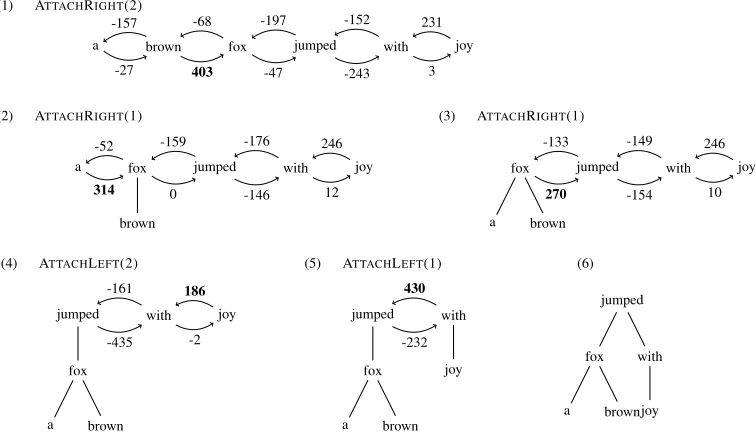
Figure 1: Parsing the sentence “a brown fox jumped with joy”. Rounded arcs represent possible actions.
tionally intensive sampling-based methods (Naka-gawa, 2007). As a result, these models, while accu-rate, are slow (O(n3)for projective, first-order mod-els, higher polynomials for higher-order modmod-els, and worse for richer tree-feature models).
We propose a new category of dependency pars-ing algorithms, inspired by (Shen et al., 2007): non-directional easy-first parsing. This is a greedy, de-terministic parsing approach, which relaxes the left-to-right processing order of transition-based pars-ing algorithms. By doing so, we allow the ex-plicit incorporation of rich structural features de-rived from both sides of the attachment point, and implicitly take into account the entire previously de-rived structure of the whole sentence. This exten-sion allows the incorporation of much richer features than those available to transition- and especially to graph-based parsers, and greatly reduces the local-ity of transition-based algorithm decisions. On the other hand, it is still a greedy, best-first algorithm leading to an efficient implementation.
We present a concrete O(nlogn) parsing algo-rithm, which significantly outperforms state-of-the-art transition-based parsers, while closing the gap to graph-based parsers.
2 Easy-first parsing
When humans comprehend a natural language sen-tence, they arguably do it in an incremental,
left-to-right manner. However, when humans consciously annotate a sentence with syntactic structure, they hardly ever work in fixed left-to-right order. Rather, they start by building several isolated constituents by making easy and local attachment decisions and only then combine these constituents into bigger constituents, jumping back-and-forth over the sen-tence and proceeding from easy to harder phenom-ena to analyze. When getting to the harder decisions a lot of structure is already in place, and this struc-ture can be used in deciding a correct attachment.
Our parser follows a similar kind of annotation process: starting from easy attachment decisions, and proceeding to harder and harder ones. When making later decisions, the parser has access to the entire structure built in earlier stages. During the training process, the parser learns its own notion of easy and hard, and learns to defer specific kinds of decisions until more structure is available.
3 Parsing algorithm
Our (projective) parsing algorithm builds the parse tree bottom up, using two kinds of actions: AT -TACHLEFT(i) and ATTACHRIGHT(i) . These actions are applied to a list of partial structures
p1, . . . , pk, calledpending, which is initialized with
ac-tion connects the heads of two neighbouring struc-tures, making one of them the parent of the other, and removing the daughter from the list of partial structures. ATTACHLEFT(i) adds a dependency edge(pi, pi+1)and removespi+1from the list. AT -TACHRIGHT(i) adds a dependency edge(pi+1, pi)
and removespi from the list. Each action shortens
[image:3.612.85.290.245.476.2]the list of partial structures by 1, and aftern−1such actions, the list contains the root of a connected pro-jective tree over the sentence.
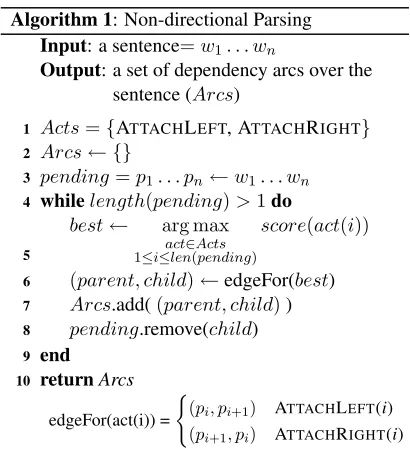
Figure 1 shows an example of parsing the sen-tence “a brown fox jumped with joy”. The pseu-docode of the algorithm is given in Algorithm 1.
Algorithm 1: Non-directional Parsing
Input: a sentence=w1. . . wn
Output: a set of dependency arcs over the sentence (Arcs)
Acts={ATTACHLEFT, ATTACHRIGHT}
1
Arcs← {}
2
pending=p1. . . pn←w1. . . wn
3
whilelength(pending)>1do 4
best← arg max
act∈Acts
1≤i≤len(pending)
score(act(i))
5
(parent, child)←edgeFor(best) 6
Arcs.add((parent, child)) 7
pending.remove(child) 8
end 9
returnArcs
10
edgeFor(act(i)) =
(
(pi, pi+1) ATTACHLEFT(i) (pi+1, pi) ATTACHRIGHT(i) At each step the algorithm chooses a spe-cific action/location pair using a function
score(ACTION(i)), which assign scores to ac-tion/location pairs based on the partially built structures headed bypi andpi+1, as well as
neigh-bouring structures. Thescore()function is learned from data. This scoring function reflects not only the correctness of an attachment, but alsothe order in which attachments should be made. For example, consider the attachments (brown,fox) and (joy,with) in Figure (1.1). While both are correct, the scoring function prefers the (adjective,noun) attachment over the (prep,noun) attachment. Moreover, the attachment (jumped,with), while correct, receives a negative score for the bare preposition “with” (Fig. (1.1) - (1.4) ), and a high score once the verb has its subject and the PP “with joy” is built (Fig.
(1.5) ). Ideally, we would like to score easy and reliable attachments higher than harder less likely attachments, thus performing attachments in order of confidence. This strategy allows us both to limit the extent of error propagation, and to make use of richer contextual information in the later, harder attachments. Unfortunately, this kind of ordering information is not directly encoded in the data. We must, therefore, learn how to order the decisions.
We first describe the learning algorithm (Section 4) and a feature representation (Section 5) which en-ables us to learn an effective scoring function.
4 Learning Algorithm
We use a linear modelscore(x) = w~ ·φ(x), where
φ(x) is a feature representation andw~ is a weight vector. We writeφact(i) to denote the feature repre-sentation extracted for actionactat location i. The model is trained using a variant of the structured per-ceptron (Collins, 2002), similar to the algorithm of (Shen et al., 2007; Shen and Joshi, 2008). As usual, we use parameter averaging to prevent the percep-tron from overfitting.
The training algorithm is initialized with a zero parameter vector w~. The algorithm makes several passes over the data. At each pass, we apply the training procedure given in Algorithm 2 to every sentence in the training set.
At training time, each sentence is parsed using the parsing algorithm and the currentw~. Whenever an invalid action is chosen by the parsing algorithm, it is not performed (line 6). Instead, we update the pa-rameter vector w~ by decreasing the weights of the features associated with the invalid action, and in-creasing the weights for the currently highest scor-ingvalidaction.1 We then proceed to parse the sen-tence with the updated values. The process repeats until a valid action is chosen.
Note that each single update does not guarantee that the next chosen action is valid, or even different than the previously selected action. Yet, this is still an aggressive update procedure: we do not leave a sentence until our parameters vector parses it
cor-1
rectly, and we do not proceed from one partial parse to the next untilw~ predicts a correct location/action pair. However, as the best ordering, and hence the best attachment point is not known to us, we do not perform a single aggressive update step. Instead, our aggressive update is performed incrementally in a series of smaller steps, each pushingw~ away from invalid attachments and toward valid ones. This way we integrate the search of confident attachments into the learning process.
Algorithm 2: Structured perceptron training for direction-less parser, over one sentence.
Input: sentence,gold arcs,currentw,feature~ representationφ
Output: weight vectorw~
Arcs← {}
1
pending←sent 2
whilelength(pending)>1do 3
allowed← {act(i)|isV alid(act(i), Gold, Arcs)} 4
choice← arg max
act∈Acts
1≤i≤len(pending) ~ w·φact(i)
5
if choice∈allowedthen 6
(parent, child)←edgeFor(choice) 7
Arcs.add((parent, child)) 8
pending.remove(child) 9
else 10
good← arg max
act(j)∈allowed
~ w·φact(j) 11
~
w←w~ +φgood−φchoice
12 end 13
returnw~ 14
FunctionisValid(action,Gold,Arcs)
(p, c)←edgeFor(action) 1
if(∃c0: (c, c0) ∈ Gold ∧ (c, c0) 6∈ Arcs)
2
∨(p, c) 6∈ Goldthen returnfalse
3
returntrue
4
The functionisV alid(act(i), gold, arcs)(line 4) is used to decide if the chosen action/location pair is valid. It returns True if two conditions apply: (a)
(pi, pj) is present in gold, (b) all edges (2, pj) in
goldare also inarcs. In words, the function verifies that the proposed edge is indeed present in the gold parse and that the suggested daughter already found all its own daughters.2
2
This is in line with the Arc-Standard parsing strategy of shift-reduce dependency parsers (Nivre, 2004). We are cur-rently experimenting also with an Arc-Eager variant of the
non-5 Feature Representation
The feature representation for an action can take into account the original sentence, as well as the entire parse history: φact(i) above is actually
φ(act(i), sentence, Arcs, pending).
We use binary valued features, and each feature is conjoined with the type of action.
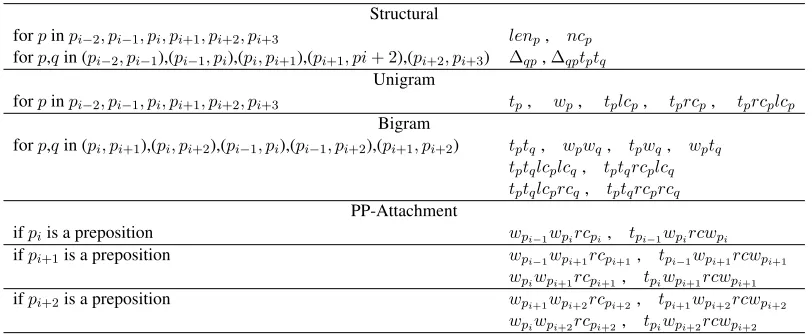
When designing the feature representation, we keep in mind that our features should not only di-rect the parser toward desired actions and away from undesired actions, but also provide the parser with means of choosing between several desired actions. We want the parser to be able to defer some desired actions until more structure is available and a more informed prediction can be made. This desire is re-flected in our choice of features: some of our fea-tures are designed to signal to the parser the pres-ence of possibly “incomplete” structures, such as an incomplete phrase, a coordinator without conjuncts, and so on.
When considering an action ACTION(i), we limit ourselves to features of partial structures around the attachment point: pi−2, pi−1, pi, pi+1, pi+2, pi+3,
that is the two structures which are to be attached by the action (pi andpi+1), and the two neighbouring
structures on each side3.
While these features encode local context, it is lo-cal in terms of syntactic structure, and not purely in terms of sentence surface form. This let us capture some, though not all, long-distance relations.
For a partial structure p, we use wp to refer to
the head word form, tp to the head word POS tag,
andlcpandrcpto the POS tags of the left-most and
right-most child ofprespectively.
All our prepositions (IN) and coordinators (CC) are lexicalized: for them,tpis in factwptp.
We define structural, unigram, bigram and pp-attachmentfeatures.
The structural features are: the length of the structures (lenp), whether the structure is a word
(contains no children:ncp), and the surface distance
between structure heads (∆pipj). Theunigramand
bigramfeatures are adapted from the feature set for left-to-right Arc-Standard dependency parsing
de-directional algorithm.
Structural
forpinpi−2, pi−1, pi, pi+1, pi+2, pi+3 lenp, ncp
forp,qin (pi−2, pi−1),(pi−1, pi),(pi, pi+1),(pi+1, pi+ 2),(pi+2, pi+3) ∆qp,∆qptptq Unigram
forpinpi−2, pi−1, pi, pi+1, pi+2, pi+3 tp, wp, tplcp, tprcp, tprcplcp
Bigram
forp,qin (pi, pi+1),(pi, pi+2),(pi−1, pi),(pi−1, pi+2),(pi+1, pi+2) tptq, wpwq, tpwq, wptq tptqlcplcq, tptqrcplcq tptqlcprcq, tptqrcprcq PP-Attachment
ifpiis a preposition wpi−1wpircpi, tpi−1wpircwpi
ifpi+1is a preposition wpi−1wpi+1rcpi+1, tpi−1wpi+1rcwpi+1
wpiwpi+1rcpi+1, tpiwpi+1rcwpi+1 ifpi+2is a preposition wpi+1wpi+2rcpi+2, tpi+1wpi+2rcwpi+2
[image:5.612.105.511.59.226.2]wpiwpi+2rcpi+2, tpiwpi+2rcwpi+2
Figure 2: Feature Templates
scribed in (Huang et al., 2009). We extended that feature set to include the structure on both sides of the proposed attachment point.
In the case of unigram features, we added features that specify the POS of a word and its left-most and right-most children. These features provide the non-directional model with means to prefer some attach-ment points over others based on the types of struc-tures already built. In English, the left- and right-most POS-tags are good indicators of constituency.
The pp-attachment features are similar to the bi-gram features, but fire only when one of the struc-tures is headed by a preposition (IN). These feastruc-tures are more lexicalized than the regular bigram fea-tures, and include also the word-form of the right-most child of the PP (rcwp). This should help the
model learn lexicalized attachment preferences such as (hit, with-bat).
Figure 2 enumerate the feature templates we use.
6 Computational Complexity and Efficient
Implementation
The parsing algorithm (Algorithm 1) begins with
n+ 1disjoint structures (the words of the sentence + ROOT symbol), and terminates with one connected structure. Each iteration of the main loop connects two structures and removes one of them, and so the loop repeats for exactlyntimes.
The argmax in line 5 selects the maximal scoring action/location pair. At iteration i, there are n−i
locations to choose from, and a naive computation of the argmax isO(n), resulting in anO(n2)algorithm. Each performed action changes the partial
struc-tures and with it the extracted feastruc-tures and the com-puted scores. However, these changes are limited to a fixed local context around the attachment point of the action. Thus, we observe that the feature ex-traction and score calculation can be performed once for each action/location pair in a given sentence, and reused throughout all the iterations. After each iter-ation we need to update the extracted features and calculated scores for onlyklocations, where kis a fixed number depending on the window size used in the feature extraction, and usuallykn.
Using this technique, we perform only (k+ 1)n
feature extractions and score calculations for each sentence, that isO(n)feature-extraction operations per sentence.
Given the scores for each location, the argmax can then be computed in O(logn) time using a heap, resulting in an O(nlogn) algorithm: n iterations, where the first iteration involves n feature extrac-tion operaextrac-tions andnheap insertions, and each sub-sequent iteration involvesk feature extractions and heap updates.
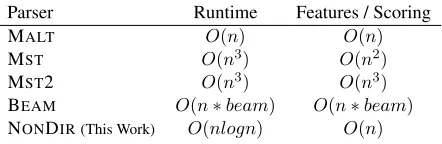
We note that the dominating factor in polynomial-time discriminative parsers, is by far the feature-extraction and score calculation. It makes sense to compare parser complexity in terms of these opera-tions only.4 Table 1 compares the complexity of our
4
Indeed, in our implementation we do not use a heap, and opt instead to find the argmax using a simpleO(n)max oper-ation. ThisO(n2)
parser to other dependency parsing frameworks.
Parser Runtime Features / Scoring
MALT O(n) O(n)
MST O(n3) O(n2)
MST2 O(n3) O(n3)
[image:6.612.77.298.87.159.2]BEAM O(n∗beam) O(n∗beam) NONDIR(This Work) O(nlogn) O(n)
Table 1: Complexity of different parsing frameworks. MST: first order MST parser, MST2: second order MST parser, MALT: shift-reduce left-to-right parsing. BEAM: beam search parser, as in (Zhang and Clark, 2008)
In terms of feature extraction and score calcula-tion operacalcula-tions, our algorithm has the same cost as traditional shift-reduce (MALT) parsers, and is an order of magnitude more efficient than graph-based (MST) parsers. Beam-search decoding for left-to-right parsers (Zhang and Clark, 2008) is also linear, but has an additional linear dependence on the beam-size. The reported results in (Zhang and Clark, 2008) use a beam size of 64, compared to our con-stant ofk= 6.
Our Python-based implementation5 (the percep-tron is implemented in aCextension module) parses about 40 tagged sentences per second on an Intel based MacBook laptop.
7 Experiments and Results
We evaluate the parser using the WSJ Treebank. The trees were converted to dependency structures with the Penn2Malt conversion program,6using the head-finding rules from (Yamada and Matsumoto, 2003).7 We use Sections 2-21 for training, Section 22 for development, and Section 23 as the final test set. The text is automatically POS tagged using a trigram HMM based POS tagger prior to training and pars-ing. Each section is tagged after training the tagger on all other sections. The tagging accuracy of the tagger is 96.5 for the training set and 96.8 for the test set. While better taggers exist, we believe that the simpler HMM tagger overfits less, and is more
5
http://www.cs.bgu.ac.il/∼yoavg/software/
6
http://w3.msi.vxu.se/∼nivre/research/Penn2Malt.html
7
While other and better conversions exist (see,e.g., (Johans-son and Nugues, 2007; Sangati and Mazza, 2009)), this con-version heuristic is still the most widely used. Using the same conversion facilitates comparison with previous works.
representative of the tagging performance on non-WSJ corpus texts.
Parsers We evaluate our parser against the
transition-based MALT parser and the graph-based MSTparser. We use version 1.2 of MALTparser8, with the settings used for parsing English in the CoNLL 2007 shared task. For the MST parser9, we use the default first-order, projective parser set-tings, which provide state-of-the-art results for En-glish. All parsers are trained and tested on the same data. Our parser is trained for 20 iterations.
Evaluation MeasuresWe evaluate the parsers using three common measures:
(unlabeled) Accuracy: percentage of tokens which got assigned their correct parent.
Root: The percentage of sentences in which the ROOT attachment is correct.
Complete: the percentage of sentences in which all tokens were assigned their correct parent.
Unlike most previous work on English dependency parsing, wedo notexclude punctuation marks from the evaluation.
Results are presented in Table 2. Our
non-directional easy-first parser significantly outper-forms the left-to-right greedy MALTparser in terms of accuracy and root prediction, and significantly outperforms both parsers in terms of exact match. The globally optimized MSTparser is better in root-prediction, and slightly better in terms of accuracy.
We evaluated the parsers also on the English dataset from the CoNLL 2007 shared task. While this dataset is also derived from the WSJ Treebank, it differs from the previous dataset in two important as-pects: it is much smaller in size, and it is created us-ing a different conversion procedure, which is more linguistically adequate. For these experiments, we use the dataset POS tags, and the same parameters as in the previous set of experiments: we train the non-directional parser for 20 iterations, with the same feature set. The CoNLL dataset contains some non-projective constructions. MALTand MSTdeal with non-projectivity. For the non-directional parser, we projectivize the training set prior to training using the procedure described in (Carreras, 2007).
Results are presented in Table 3.
8
http://maltparser.org/dist/1.2/malt-1.2.tar.gz 9
Parser Accuracy Root Complete
MALT 88.36 87.04 34.14
MST 90.05 93.95 34.64
[image:7.612.333.524.59.186.2]NONDIR(this work) 89.70 91.50 37.50
Table 2: Unlabeled dependency accuracy on PTB Section 23, automatic POS-tags, including punctuation.
Parser Accuracy Root Complete
MALT 85.82 87.85 24.76
MST 89.08 93.45 24.76
[image:7.612.89.284.61.105.2]NONDIR(this work) 88.34 91.12 29.43
Table 3: Unlabeled dependency accuracy on CoNLL 2007 English test set, including punctuation.
While all models suffer from the move to the smaller dataset and the more challenging annotation scheme, the overall story remains the same: the non-directional parser is better than MALT but not as good as MST in terms of parent-accuracy and root prediction, and is better than both MALT and MST in terms of producing complete correct parses.
That the non-directional parser has lower accu-racy but more exact matches than the MST parser can be explained by it being a deterministic parser, and hence still vulnerable to error propagation: once it erred once, it is likely to do so again, result-ing in low accuracies for some sentences. How-ever, due to the easy-first policy, it manages to parse many sentences without a single error, which lead to higher exact-match scores. The non-directional parser avoids error propagation by not making the initial error. On average, the non-directional parser manages to assign correct heads to over 60% of the tokens before making its first error.
The MST parser would have ranked 5th in the
shared task, and NONDIR would have ranked 7th. The better ranking systems in the shared task are either higher-order global models, beam-search based systems, or ensemble-based systems, all of which are more complex and less efficient than the NONDIRparser.
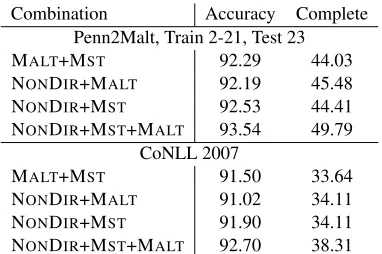
Parse Diversity The parses produced by the non-directional parser are different than the parses pro-duced by the graph-based and left-to-right parsers. To demonstrate this difference, we performed an Or-acle experiment, in which we combine the output of several parsers by choosing, for each sentence, the parse with the highest score. Results are presented
Combination Accuracy Complete Penn2Malt, Train 2-21, Test 23
MALT+MST 92.29 44.03
NONDIR+MALT 92.19 45.48 NONDIR+MST 92.53 44.41 NONDIR+MST+MALT 93.54 49.79
CoNLL 2007
MALT+MST 91.50 33.64
NONDIR+MALT 91.02 34.11 NONDIR+MST 91.90 34.11 NONDIR+MST+MALT 92.70 38.31
Table 4: Parser combination with Oracle, choosing the highest scoring parse for each sentence of the test-set.
in Table 4.
A non-oracle blending of MALT+MST+NONDIR using Sagae and Lavie’s (2006) simplest combina-tion method assigning each component the same weight, yield an accuracy of 90.8 on the CoNLL 2007 English dataset, making it the highest scoring system among the participants.
7.1 Error Analysis / Limitations
When we investigate the POS category of mistaken instances, we see that for all parsers, nodes with structures of depth 2 and more which are assigned an incorrect head are predominantly PPs (headed by ’IN’), followed by NPs (headed by ’NN’). All parsers have a hard time dealing with PP attachment, but MSTparser is better at it than NONDIR, and both are better than MALT.
[image:7.612.89.285.154.198.2]8 Related Work
Deterministic shift-reduce parsers are restricted by a strict left-to-right processing order. Such parsers can rely on rich syntactic information on the left, but not on the right, of the decision point. They are forced to commit early, and suffer from error propagation. Our non-directional parser addresses these deficien-cies by discarding the strict left-to-right processing order, and attempting to make easier decisions be-fore harder ones. Other methods of dealing with these deficiencies were proposed over the years:
Several Passes Yamada and Matsumoto’s (2003) pioneering work introduces a shift-reduce parser which makes several left-to-right passes over a sen-tence. Each pass adds structure, which can then be used in subsequent passes. Sagae and Lavie (2006b) extend this model to alternate between left-to-right and right-to-left passes. This model is similar to ours, in that it attempts to defer harder decisions to later passes over the sentence, and allows late deci-sions to make use of rich syntactic information (built in earlier passes) on both sides of the decision point. However, the model is not explicitly trained to op-timize attachment ordering, has an O(n2) runtime complexity, and produces results which are inferior to current single-pass shift-reduce parsers.
Beam Search Several researchers dealt with the early-commitment and error propagation of deter-ministic parsers by extending the greedy decisions with various flavors of beam-search (Sagae and Lavie, 2006a; Zhang and Clark, 2008; Titov and Henderson, 2007). This approach works well and produces highly competitive results. Beam search can be incorporated into our parser as well. We leave this investigation to future work.
Strict left-to-right ordering is also prevalent in se-quence tagging. Indeed, one major influence on our work is Shenet.al.’s bi-directional POS-tagging algorithm (Shen et al., 2007), which combines a perceptron learning procedure similar to our own with beam search to produce a state-of-the-art POS-tagger, which does not rely on left-to-right process-ing. Shen and Joshi (2008) extends the bidirectional tagging algorithm to LTAG parsing, with good re-sults. We build on top of that work and present a concrete and efficient greedy non-directional depen-dency parsing algorithm.
Structure Restrictions Eisner and Smith (2005) propose to improve the efficiency of a globally op-timized parser by posing hard constraints on the lengths of arcs it can produce. Such constraints pose an explicit upper bound on parser accuracy.10 Our parsing model does not pose such restrictions. Shorter edges are arguably easier to predict, and our parses builds them early in time. However, it is also capable of producing long dependencies at later stages in the parsing process. Indeed, the distribu-tion of arc lengths produced by our parser is similar to those produced by the MALTand MSTparsers.
9 Discussion
We presented anon-directionaldeterministic depen-dency parsing algorithm, which is not restricted by the left-to-right parsing order of other deterministic parsers. Instead, it works in aneasy-firstorder. This strategy allows using more context at each decision. The parser learns both what and whento connect. We show that this parsing algorithm significantly outperforms a left-to-right deterministic algorithm. While it still lags behind globally optimized pars-ing algorithms in terms of accuracy and root pre-diction, it is much better in terms of exact match, and much faster. As our parsing framework can eas-ily and efficiently utilize more structural information than globally optimized parsers, we believe that with some enhancements and better features, it can out-perform globally optimized algorithms, especially when more structural information is needed, such as for morphologically rich languages.
Moreover, we show that our parser produces different structures than those produced by both left-to-right and globally optimized parsers, mak-ing it a good candidate for inclusion in an ensem-ble system. Indeed, a simple combination scheme of graph-based, left-to-right and non-directional parsers yields state-of-the-art results on English de-pendency parsing on the CoNLL 2007 dataset. We hope that further work on this non-directional parsing framework will pave the way to better under-standing of an interesting cognitive question: which kinds of parsing decisions are hard to make, and which linguistic constructs are hard to analyze?
10
References
Sabine Buchholz and Erwin Marsi. 2006. CoNLL-X shared task on multilingual dependency parsing. In
Proc. of CoNLL.
Xavier Carreras. 2007. Experiments with a higher-order projective dependency parser. In Proc. of CoNLL Shared Task, EMNLP-CoNLL.
Michael Collins. 2002. Discriminative training methods for hidden markov models: Theory and experiments with perceptron algorithms. InProc of EMNLP. Markus Dreyer, David A. Smith, and Noah A. Smith.
2006. Vine parsing and minimum risk reranking for speed and precision. InProc. of CoNLL, pages 201– 205, Morristown, NJ, USA. Association for Computa-tional Linguistics.
Jason Eisner and Noah A. Smith. 2005. arsing with soft and hard constraints on dependency length. InProc. of IWPT.
Liang Huang, Wenbin Jiang, and Qun Liu. 2009. Bilingually-constrained (monolingual) shift-reduce parsing. InProc of EMNLP.
Richard Johansson and Pierre Nugues. 2007. Extended constituent-to-dependency conversion for english. In
Proc of NODALIDA.
Ryan McDonald and Joakim Nivre. 2007. Characteriz-ing the errors of data-driven dependency parsCharacteriz-ing mod-els. InProc. of EMNLP.
Ryan McDonald and Fernando Pereira. 2006. On-line learning of approximate dependency parsing al-gorithms. InProc of EACL.
Ryan McDonald, Koby Crammer, and Fernando Pereira. 2005. Online large-margin training of dependency parsers. InProc of ACL.
Tetsuji Nakagawa. 2007. Multilingual dependency pars-ing uspars-ing global features. InProc. of EMNLP-CoNLL. Joakim Nivre and Ryan McDonald. 2008. Integrating graph-based and transition-based dependency parsers. In Proc. of ACL, pages 950–958, Columbus, Ohio, June. Association for Computational Linguistics. Joakim Nivre, Johan Hall, and Jens Nillson. 2006.
Malt-Parser: A data-driven parser-generator for dependency parsing. InProc. of LREC.
Joakim Nivre, Johan Hall, Sandra K¨ubler, Ryan Mcdon-ald, Jens Nilsson, Sebastian Riedel, and Deniz Yuret. 2007. The CoNLL 2007 shared task on dependency parsing. InProc. of EMNLP-CoNLL.
Joakim Nivre. 2004. Incrementality in deterministic de-pendency parsing. In Incremental Parsing: Bringing Engineering and Cognition Together, ACL-Workshop. Sebastian Riedel and James Clarke. 2006. Incremental
integer linear programming for non-projective depen-dency parsing. InProc. of EMNLP 2006, July.
Kenji Sagae and Alon Lavie. 2006a. A best-first proba-bilistic shift-reduce parser. InProc of ACL.
Kenji Sagae and Alon Lavie. 2006b. Parser combination by reparsing. InProc of NAACL.
Federico Sangati and Chiara Mazza. 2009. An english dependency treebank `a la tesni`ere. InProc of TLT8. Libin Shen and Aravind K. Joshi. 2008. Ltag
depen-dency parsing with bidirectional incremental construc-tion. InProc of EMNLP.
Libin Shen, Giorgio Satta, and Aravind K. Joshi. 2007. Guided learning for bidirectional sequence classifica-tion. InProc of ACL.
Ivan Titov and James Henderson. 2007. Fast and robust multilingual dependency parsing with a generative la-tent variable model. InProc. of EMNLP-CoNLL. Yamada and Matsumoto. 2003. Statistical dependency
analysis with support vector machines. In Proc. of IWPT.