Tuning as Linear Regression
Marzieh Bazrafshan, Tagyoung Chung and Daniel Gildea
Department of Computer Science University of Rochester
Rochester, NY 14627
Abstract
We propose a tuning method for statistical ma-chine translation, based on the pairwise rank-ing approach. Hopkins and May (2011) pre-sented a method that uses a binary classifier. In this work, we use linear regression and show that our approach is as effective as us-ing a binary classifier and converges faster.
1 Introduction
Since its introduction, the minimum error rate train-ing (MERT) (Och, 2003) method has been the most popular method used for parameter tuning in ma-chine translation. Although MERT has nice proper-ties such as simplicity, effectiveness and speed, it is known to not scale well for systems with large num-bers of features. One alternative that has been used for large numbers of features is the Margin Infused Relaxed Algorithm (MIRA) (Chiang et al., 2008). MIRA works well with a large number of features, but the optimization problem is much more compli-cated than MERT. MIRA also involves some modi-fications to the decoder itself to produce hypotheses with high scores against gold translations.
Hopkins and May (2011) introduced the method of pairwise ranking optimization (PRO), which casts the problem of tuning as a ranking problem be-tween pairs of translation candidates. The problem is solved by doing a binary classification between “correctly ordered” and “incorrectly ordered” pairs. Hopkins and May (2011) use the maximum entropy classifier MegaM (Daum´e III, 2004) to do the binary classification. Their method compares well to the
results of MERT, scales better for high dimensional feature spaces, and is simpler than MIRA.
In this paper, we use the same idea for tuning, but, instead of using a classifier, we use linear regression. Linear regression is simpler than maximum entropy based methods. The most complex computation that it needs is a matrix inversion, whereas maximum en-tropy based classifiers use iterative numerical opti-mization methods.
We implemented a parameter tuning program with linear regression and compared the results to PRO’s results. The results of our experiments are comparable to PRO, and in many cases (also on av-erage) we get a better maximum BLEU score. We also observed that on average, our method reaches the maximum BLEU score in a smaller number of iterations.
The contributions of this paper include: First, we show that linear regression tuning is an effective method for tuning, and it is comparable to tuning with a binary maximum entropy classifier. Second, we show linear regression is faster in terms of the number of iterations it needs to reach the best re-sults.
2 Tuning as Ranking
The parameter tuning problem in machine transla-tion is finding the feature weights of a linear trans-lation model that maximize the scores of the candi-date translations measured against reference transla-tions. Hopkins and May (2011) introduce a tuning method based on ranking the candidate translation pairs, where the goal is to learn how to rank pairs of candidate translations using a gold scoring function.
PRO casts the tuning problem as the problem of ranking pairs of sentences. This method iteratively generates lists of “k-best” candidate translations for each sentence, and tunes the weight vector for those candidates. MERT finds the weight vector that max-imizes the score for the highest scored candidate translations. In contrast, PRO finds the weight vec-tor which classifies pairs of candidate translations into “correctly ordered” and “incorrectly ordered,” based on the gold scoring function. While MERT only considers the highest scored candidate to tune the weights, PRO uses the entirek-best list to learn the ranking between the pairs, which can help pre-vent overfitting.
Let g(e) be a scoring function that maps each translation candidateeto a number (score) using a set of reference translations. The most commonly used gold scoring function in machine translation is the BLEU score, which is calculated for the en-tire corpus, rather than for individual sentences. To use BLEU as our gold scoring function, we need to modify it to make it decomposable for single sen-tences. One way to do this is to use a variation of BLEU called BLEU+1 (Lin and Och, 2004), which is a smoothed version of the BLEU score.
We assume that our machine translation system scores translations by using a scoring function which is a linear combination of the features:
h(e) =wTx(e) (1)
wherewis the weight vector andxis the feature vec-tor. The goal of tuning as ranking is learning weights such that for every two candidate translationse1and
e2, the following inequality holds:
g(e1)> g(e2)⇔h(e1)> h(e2) (2)
Using Equation 1, we can rewrite Equation 2:
g(e1)> g(e2)⇔wT(x(e1)−x(e2))>0 (3)
This problem can be viewed as a binary classifica-tion problem for learningw, where each data point is the difference vector between the feature vectors of a pair of translation candidates, and the target of the point is the sign of the difference between their gold scores (BLEU+1). PRO uses the MegaM classifier to solve this problem. MegaM is a binary maximum
entropy classifier which returns the weight vector w as a linear classifier. Using this method, Hop-kins and May (2011) tuned the weight vectors for various translation systems. The results were close to MERT’s and MIRA’s results in terms of BLEU score, and the method was shown to scale well to high dimensional feature spaces.
3 Linear Regression Tuning
In this paper, we use the same idea as PRO for tun-ing, but instead of using a maximum entropy clas-sifier, we use a simple linear regression to estimate the vectorwin Equation 3. We use the least squares method to estimate the linear regression. For a ma-trix of data points X, and a target vector g, the weight vector can be calculated as:
w= (XTX)−1
XTg (4)
AddingL2 regularization with parameterλhas the
following closed form solution:
w= (XTX+λI)−1
XTg (5)
Following the sampling method used in PRO, the matricesXand vectorgare prepared as follows:
For each sentence,
1. Generate a list containing the k best transla-tions of the sentence, with each translation e scored by the decoder using a function of the formh(e) =wTx(e).
2. Use the uniform distribution to samplen ran-dom pairs from the set of candidate transla-tions.
3. Calculate the gold scoresgfor the candidates in each pair using BLEU+1. Keep a pair of can-didates as a potential pair if the difference be-tween theirgscores is bigger than a threshold t.
4. From the potential pairs kept in the previous step, keep thespairs that have the highest dif-ferences ingand discard the rest.
5. For each paire1ande2kept in step 4, make two data points(x(e1)−x(e2), g(e1)−g(e2))and
The rows ofXconsist of the inputs of the data points created in step 5, i.e., the difference vectorsx(e1)− x(e2). Similarly, the corresponding rows ing are the outputs of the data points, i.e., the gold score differencesg(e1)−g(e2).
One important difference between the linear re-gression method and PRO is that rather than using the signs of the gold score differences and doing a binary classification, we use the differences of the gold scores directly, which allows us to use the in-formation about the magnitude of the differences.
4 Experiments
4.1 Setup
We used a Chinese-English parallel corpus with the English side parsed for our experiments. The cor-pus consists of 250K sentence pairs, which is 6.3M words on the English side. The corpus derives from newswire texts available from LDC.1We used a 392-sentence development set with four references for parameter tuning, and a 428-sentence test set with four references for testing. They are drawn from the newswire portion of NIST evaluations (2004, 2005, 2006). The development set and the test set only had sentences with less than 30 words for decoding speed.
We extracted a general SCFG (GHKM) grammar using standard methods (Galley et al., 2004; Wang et al., 2010) from the parallel corpus with a mod-ification to preclude any unary rules (Chung et al., 2011). All rules over scope 3 are pruned (Hopkins and Langmead, 2010). A set of nine standard fea-tures was used for the experiments, which includes globally normalized count of rules, lexical weight-ing (Koehn et al., 2003), and length penalty. Our in-house decoder was used for experiments with a trigram language model. The decoder is capable of both CNF parsing and Earley-style parsing with cube-pruning (Chiang, 2007).
We implemented linear regression tuning using
1We randomly sampled our data from various
differ-ent sources (LDC2006E86, LDC2006E93, LDC2002E18, LDC2002L27, LDC2003E07, LDC2003E14, LDC2004T08, LDC2005T06, LDC2005T10, LDC2005T34, LDC2006E26, LDC2005E83, LDC2006E34, LDC2006E85, LDC2006E92, LDC2006E24, LDC2006E92, LDC2006E24) The language model is trained on the English side of entire data (1.65M sen-tences, which is 39.3M words.)
Average of max BLEU Max BLEU
dev test dev test
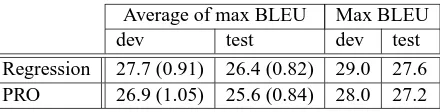
[image:3.612.320.540.53.109.2]Regression 27.7 (0.91) 26.4 (0.82) 29.0 27.6 PRO 26.9 (1.05) 25.6 (0.84) 28.0 27.2
Table 1: Average of maximum BLEU scores of the periments and the maximum BLEU score from the ex-periments. Numbers in the parentheses indicate standard of deviations of maximum BLEU scores.
the method explained in Section 3. Following Hop-kins and May (2011), we used the following param-eters for the sampling task: For each sentence, the decoder generates the 1500 best candidate transla-tions (k = 1500), and the sampler samples 5000
pairs (n = 5000). Each pair is kept as a potential data point if their BLEU+1 score difference is big-ger than 0.05 (t= 0.05). Finally, for each sentence, the sampler keeps the 50 pairs with the highest dif-ference in BLEU+1 (s= 50) and generates two data points for each pair.
4.2 Results
We ran eight experiments with random initial weight vectors and ran each experiment for 25 iterations. Similar to what PRO does, in each iteration, we lin-early interpolate the weight vector learned by the re-gression (w) with the weight vector of the previous iteration (wt−1) using a factor of 0.1:
wt= 0.1·w+ 0.9·wt−1 (6)
For the sake of comparison, we also implemented PRO with exactly the same parameters, and ran it with the same initial weight vectors.
12 14 16 18 20 22 24 26 28
0 5 10 15 20 25
BLEU
Iteration
[image:4.612.75.295.58.213.2]reg-avg pro-avg
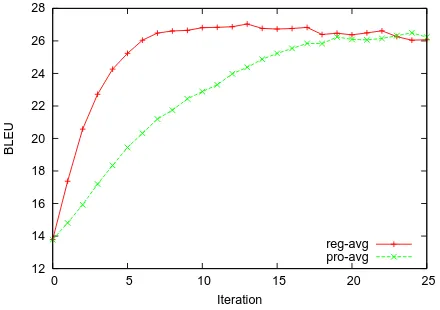
Figure 1: Average of eight runs of regression and PRO.
higher BLEU scores on both development and test data for both the average over initial weights and the maximum over initial weights.
Figure 1 shows the average of the BLEU scores on the development set of eight runs of the experi-ments. We observe that on average, the linear regres-sion experiments reach the maximum BLEU score in a smaller number of iterations. On average, linear regression reached the maximum BLEU score after 14 iterations and PRO reached the maximum BLEU score after 20 iterations. One iteration took several minutes for both of the algorithms. The largest por-tion of this time is spent on decoding the develop-ment set and reading in thek-best list. The sampling phase, which includes performing linear regression or running MegaM, takes a negligible amount of time compared to the rest of the operations.
We experimented with adding L2 regularization
to linear regression. As expected, the experiments with regularization produced lower variance among the different experiments in terms of the BLEU score, and the resulting set of the parameters had a smaller norm. However, because of the small num-ber of features used in our experiments, regulariza-tion was not necessary to control overfitting.
5 Discussion
We applied the idea of tuning as ranking and modi-fied it to use linear regression instead of binary clas-sification. The results of our experiments show that tuning as linear regression is as effective as PRO, and on average it reaches a better BLEU score in a
fewer number of iterations.
In comparison with MERT, PRO and linear re-gression are different in the sense that the latter two approaches take into account rankings of thek-best list, whereas MERT is only concerned with separat-ing the top 1-best sentence from the rest of the k -best list. PRO and linear regression are similar in the sense that both are concerned with ranking the k-best list. Their difference lies in the fact that PRO only uses the information on the relative rankings and uses binary classification to rank the points; on the contrary, linear regression directly uses the infor-mation on the magnitude of the differences. This dif-ference between PRO and linear regression explains why linear regression converges faster and also may explain the fact that linear regression achieves a somewhat higher BLEU score. In this sense, lin-ear regression is also similar to MIRA since MIRA’s loss function also uses the information on the magni-tude of score difference. However, the optimization problem for linear regression is simpler, does not re-quire any changes to the decoder, and therefore the familiar MERT framework can be kept.
Acknowledgments We thank the anonymous re-viewers for their helpful comments. This work was supported by NSF grant IIS-0910611.
References
David Chiang, Yuval Marton, and Philip Resnik. 2008. Online large-margin training of syntactic and struc-tural translation features. In Conference on Empirical
Methods in Natural Language Processing (EMNLP-08).
David Chiang. 2007. Hierarchical phrase-based transla-tion. Computational Linguistics, 33(2):201–228. Tagyoung Chung, Licheng Fang, and Daniel Gildea.
2011. Issues concerning decoding with synchronous context-free grammar. In Proceedings of the ACL
2011 Conference Short Papers, Portland, Oregon.
As-sociation for Computational Linguistics.
Hal Daum´e III. 2004. Notes on CG and LM-BFGS opti-mization of logistic regression. August.
Michel Galley, Mark Hopkins, Kevin Knight, and Daniel Marcu. 2004. What’s in a translation rule? In
Pro-ceedings of the 2004 Meeting of the North American chapter of the Association for Computational Linguis-tics (NAACL-04), pages 273–280, Boston.
Conference on Empirical Methods in Natural Lan-guage Processing, pages 646–655, Cambridge, MA,
October. Association for Computational Linguistics. Mark Hopkins and Jonathan May. 2011. Tuning as
rank-ing. In Proceedings of the 2011 Conference on
Empir-ical Methods in Natural Language Processing, pages
1352–1362, Edinburgh, Scotland, UK., July. Associa-tion for ComputaAssocia-tional Linguistics.
Philipp Koehn, Franz Josef Och, and Daniel Marcu. 2003. Statistical phrase-based translation. In
Proceed-ings of the 2003 Meeting of the North American chap-ter of the Association for Computational Linguistics (NAACL-03), Edmonton, Alberta.
Chin-Yew Lin and Franz Josef Och. 2004. Orange: a method for evaluating automatic evaluation metrics for machine translation. In Proceedings of Coling 2004, pages 501–507, Geneva, Switzerland, Aug 23–Aug 27. COLING.
Franz Josef Och. 2003. Minimum error rate training for statistical machine translation. In Proceedings of the
41th Annual Conference of the Association for Com-putational Linguistics (ACL-03).
Wei Wang, Jonathan May, Kevin Knight, and Daniel Marcu. 2010. Re-structuring, labeling, and re-aligning for syntax-based machine translation.